








Key Points:
- The USD/CAD pair, following an aggressive bullish move, has entered a compression phase with two-sided liquidity accumulation and is now positioned within a structural decision zone;
- On the 4-hour timeframe, if Sell Side Liquidity is collected and price reacts to a Rejection Block or Order Block accompanied by a CHoCH, a buy scenario is activated with the stop loss placed behind the block and the target set at Buy Side Liquidity;
- On the 1-hour timeframe, Price Compression and liquidity concentration on both sides of the market are observed; there is a possibility of price being drawn toward one of the liquidity clusters followed by a reversal move;
- The U.S. Dollar Index on the 4-hour timeframe still maintains a bullish structure; however, negative divergence in the Multi RSI has increased the risk of a short-term correction;
- Corrective targets for DXY are located within the 96.658 to 97.163 range; a reaction to these levels could provide the groundwork for a renewed bullish move in the dollar and indirectly impact USD/CAD;
- The final market direction will depend on the quality of closes within Order Blocks, the strength of momentum, and the manner in which two-sided liquidity is collected; risk management is highly important in this phase.
In recent sessions, price, after an aggressive bullish move, collected Buy Side Liquidity and simultaneously moved upward in alignment with the strengthening of the U.S. Dollar Index.
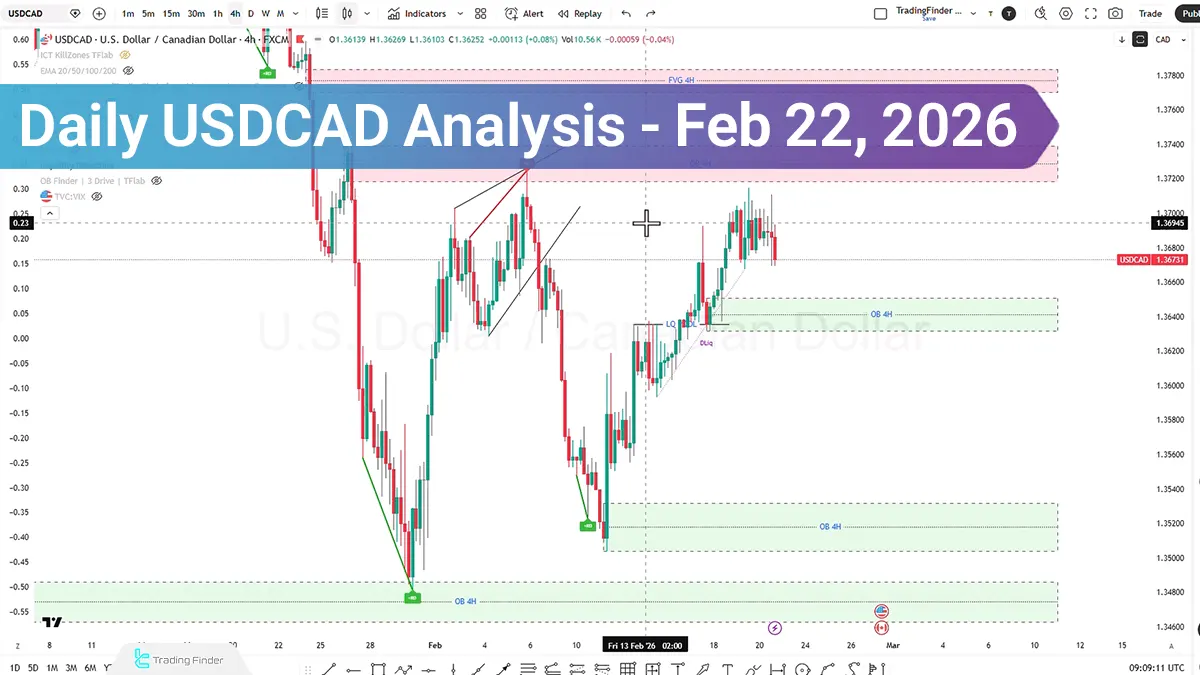
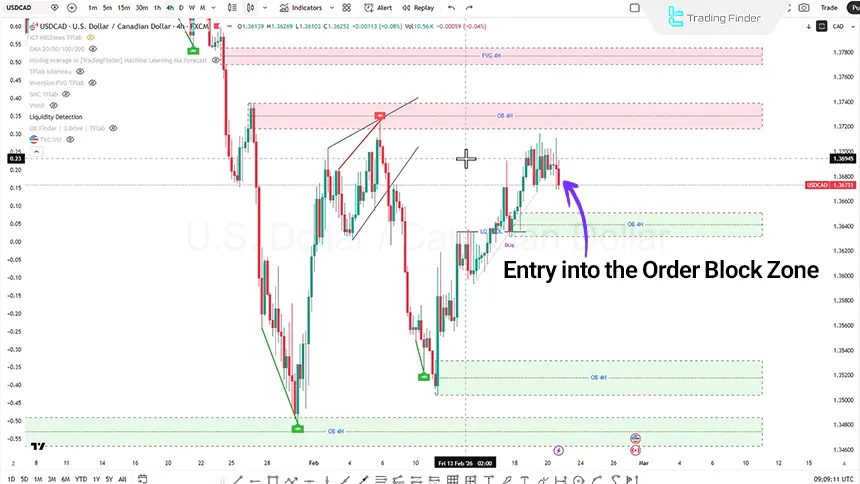
Price entering the Order Block zone and forming a consolidation area accompanied by two-sided liquidity collection indicates that the market has entered a decision-making phase. The upcoming scenarios for the current week will depend on price behavior around key liquidity zones and its reaction to market structure.
USDCAD Analysis on the 4-Hour Timeframe (H4)
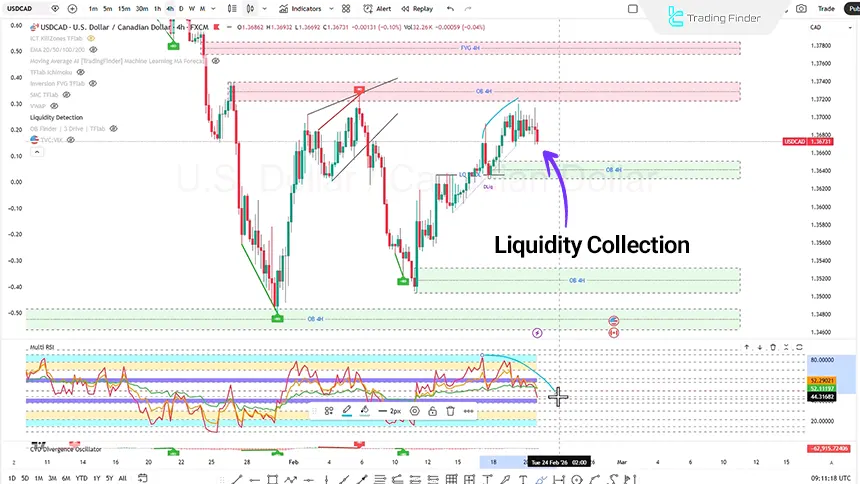
On the four-hour chart, at the beginning of the week, price may move downward and initially collect Sell Side Liquidity; entry into the Rejection Block or Order Block zone can serve as an area to evaluate a potential bullish reaction.
The activation conditions for this scenario are as follows:
- Formation of three lower support layers;
- Observation of weakness in the bearish trend;
- Break of Structure or Change of Character.
If these conditions are met, entering a Buy position can be considered; with the Stop Loss placed behind the Order Block zone and the target set at Buy Side Liquidity within the market structure.
Another scenario within the same timeframe becomes active if, after collecting Sell Side Liquidity, price re-stabilizes within the range with a valid candle Close. Such behavior may indicate buying pressure in the market and pave the way for price movement toward the upper Order Block.
This position can be evaluated within the framework of Ryan Soldier’s trading strategy.
USDCAD Analysis on the 1-Hour Timeframe (H1)
On the one-hour timeframe, Price Compression is evident with significant liquidity positioned on both sides of the market. Key characteristics of this situation:
- Concentration of Buy Side Liquidity and Sell Side Liquidity in areas close to the current price;
- The likelihood of price being drawn to one of these zones prior to the primary directional move.
If price is attracted to either of these zones and reacts after liquidity collection, a move in the opposite direction can be anticipated. These scenarios may be evaluated as potential trade entry points, provided that structure and candlestick behavior are confirmed.
U.S. Dollar Index (DXY) Analysis on the 4-Hour Timeframe (H4)
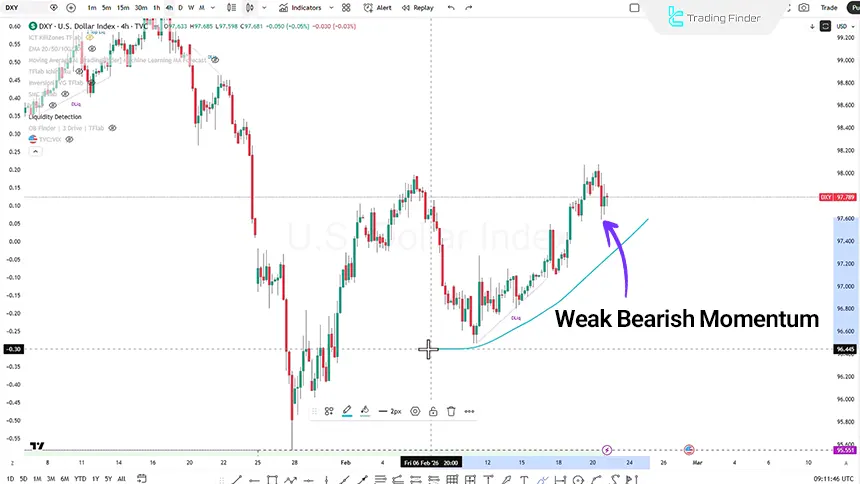
On the 4-hour timeframe, the bullish structure of the U.S. Dollar Index remains visible. However, negative divergence is observed in the Multi RSI indicator, reinforcing the probability of a price correction.
If the bearish scenario in DXY is activated, the potential targets are as follows:
- The Order Block zone down to the 96.658 level;
- In the case of weak bearish momentum, a limited move toward the 97.163 level.
Reaching these levels and reacting to them may set the stage for a renewed return to the bullish trend, which would indirectly influence the USD/CAD pair as well.
Conclusion
The overall structure of USD/CAD is positioned in a decision phase; where liquidity collection and negative divergence in the Relative Strength Index (RSI) provide signs of weakening bullish momentum.
At the same time, despite its upward trend, the U.S. Dollar Index (DXY) has shown signals of a short-term correction. The final market direction will depend on how price reacts to key Order Blocks and its behavior in collecting two-sided liquidity.