







The International Financial Services Commission (IFSC) of Belize is a financial regulatory authority for traders who prefer high leverage and avoid restrictions. Considered a tier-3 offshore authority, it has a relaxed approach toward brokerages.
Here’s a shortlist of few top brokers regulated by the IFSC.
 | XM | IFSC-Regulated | |||
 | FBS | IFSC-Regulated | |||
 | Scope Markets | IFSC-Regulated | |||
| 4 |  | PUPRIME | Not IFSC-Regulated | ||
| 5 |  | vt markets | Not IFSC-Regulated | ||
| 6 |  | FXGLORY | Not IFSC-Regulated | ||
| 7 |  | IC Markets | Not IFSC-Regulated | ||
| 8 |  | BlackBull Markets | Not IFSC-Regulated |
Trustpilot Ratings of IFSC Brokers (Not IFSC Regulated Brokers Included)
The table below is a ranking of mentioned brands according to their respective Trustpilot reviews and ratings.
Broker Name | Trustpilot Rating | Number of Reviews |
IC Markets | 4.8/5 ⭐ | 51,655 |
4.8/5 ⭐ | 3,149 | |
4.3/5 ⭐ | 2,455 | |
FBS | 4.3/5 ⭐ | 8,540 |
FXGlory | 64 | |
PU Prime | 3.8/5 ⭐ | 1,788 |
XM | 3.1/5 ⭐ | 2,986 |
Scope Markets | 54 |
Minimum Spread in Select Brokers
Here’s a ranking of nominated brokers based on the minimum spread across all account types and asset classes.
Broker Name | Min. Spread |
0 Pips | |
0 Pips | |
Axiory | 0 Pips |
IC Markets | 0 Pips |
XTB | 0.5 Pips |
XM | 0.6 Pips |
FBS | 0.7 Pips |
GeneTrade | 1 Pip |
Non-Trading Fees and Costs
This section of the article compares introduced brokerages in terms of deposit/withdrawal costs and inactivity fees.
Broker Name | Deposit Fee | Withdrawal Fee | Inactivity Fee |
Pepperstone | $0 | $0 | $0 |
FBS | $0 | $0 | $0 |
XTB | $0 | $0 | $10 Monthly |
$0 on Most Methods | 5% for < 300 Transactions | $0 | |
GeneTrade | $0 on Credit/Debit Cards | $0 on Credit/Debit Cards | $10 Monthly |
$0 | $0 (for Transfers over $200 in Bank Wire) | $10 Monthly | |
FX Pro | $0 | $0 | $15 Monthly |
AvaTrade | $0 | $0 | $50 Monthly |
Tradable Instruments in IFSC Brokers (Not IFSC-Regulated Brokers Included)
Here’s a summary of tradable assets count in the brokerages to enable a comparison between them.
Broker Name | No. of Instruments |
Scope Markets | 40,000+ |
XTB | 36,400+ |
2,250+ | |
XM | 1,400+ |
PU Prime | 800+ |
550+ | |
Axiory | 100+ |
FXGlory | 50+ |
Top 6 IFSC Brokers in Detail
The next four sections introduce select brokerages in the Belize IFSC regulation territory. They will cover account types, tradable instruments, platforms, and more.
FBS
FBS is an international forex and CFD broker serving more than 27 million registered users worldwide. Founded in 2009, the brand focuses on accessible trading conditions, combining low entry requirements with a simplified account structure suitable for both new and experienced traders.
Operating through multiple regulated entities, FBS provides global coverage under IFSC/FSC Belize, alongside CySEC and ASIC supervision.
The Belize-regulated branch supports international clients with flexible trading conditions, including maximum leverage up to 1:3000, while maintaining core protections such as fund segregation and negative balance protection.
From a trading perspective, FBS offers access to 550+ CFD instruments across forex, indices, commodities, shares, and cryptocurrencies. Pricing is spread-based, with floating spreads from 0.7 pips and zero trading commissions, making cost structures predictable for high-frequency and discretionary strategies alike.
Moreover, a FBS rebate program is offered for reduced fees and spreads.
Platform support includes MetaTrader 4, MetaTrader 5, and the proprietary FBS mobile app, which integrates over 90 technical indicators and streamlined order execution. Combined with fast execution speeds and 24/7 multilingual support, FBS positions itself as a high-leverage, globally accessible broker under IFSC Belize oversight.
Before opening an account, you may check out our FBS registration guide. Here’s a summary of specifications.
Account Types | Standard |
Regulating Authorities | FSC, CySEC |
Minimum Deposit | $5 |
Deposit Methods | Bank Transfers, Payment Systems, Credit/Debit Cards |
Withdrawal Methods | Bank Transfers, Payment Systems, Credit/Debit Cards |
Maximum Leverage | 1:3000 |
Trading Platforms & Apps | MT4, MT5, Mobile App |
FBS Pros & Cons
FBS presents a mix of low-cost trading, strong platform accessibility, and high leverage for global traders. The following pros and cons summarize the broker’s main strengths and limitations, helping traders evaluate whether its IFSC Belize setup aligns with their risk profile and trading objectives.
Pros | Cons |
Very low minimum deposit starting from $5 | Only one primary live account type available |
High leverage up to 1:3000 under IFSC Belize | No PAMM or copy trading services |
Zero commission with competitive floating spreads | Service restrictions in several countries |
User-friendly mobile app with 90+ indicators | Investor compensation not available under Belize entity |
XM
XM Group is a multi-jurisdiction Forex/CFD broker founded in 2009, reporting 15M+ clients and close to 14M trades per day. Its product list covers 55+ FX pairs and 1,200+ stock CFDs, contributing to a catalog of 1,400+ CFD instruments across several markets.
For Belize-focused comparisons, XM Global Limited operates under the Financial Services Commission (FSC) Belize with license 8557558 (updated from registration 000261/27). XM also runs regulated entities in Cyprus (CySEC 120/10), South Africa (FSCA 49976), Dubai (DFSA F003484), Mauritius (GB23202700), and Seychelles (SD190).
XM positions itself as a MetaTrader-first broker, offering MT4, MT5, and the XM mobile app, plus MQL5 Signals for strategy following inside the platform ecosystem. Core trading specs highlight a $5 minimum deposit, 0.01-lot minimum order size, and spreads stated from around 0.6 pips on lower-cost account structures.
User feedback shows mixed sentiment across review portals: Trustpilot 3.1/5 (2,900+ reviews) and ForexPeaceArmy ~3.0/5. Operationally, XM emphasizes execution certainty with an order policy that references guaranteed fills up to 50 lots, while noting typical industry factors like slippage risk and verification requirements for full account access.
If you are not sure how to pass the KYC, check out our XM verification guide. The table below demonstrates the broker’s features and specifics.
Account Types | Standard, Ultra Low, Shares |
Regulating Authorities | FSC Belize, CySEC Cyprus, FSCA South Africa, DFSA Dubai, FSC Mauritius, FSA Seychelles |
Minimum Deposit | $5 |
Deposit Methods | Credit/Debit Cards, Bank Transfers, E-Wallet Payments |
Withdrawal Methods | Credit/Debit Cards, Bank Transfers, E-Wallet Payments |
Maximum Leverage | Up To 1:1000 |
Trading Platforms & Apps | MT4, MT5, Mobile App |
XM Pros and Cons
The following pros and cons summarize the most decision-relevant strengths and limitations traders typically weigh when comparing Belize-regulated brokers. Carefully read this section before XM registration.
Pros | Cons |
1,400+ CFDs including 55+ FX pairs and 1,200+ stock CFDs | $10 monthly inactivity fee after prolonged dormancy |
Low entry point with $5 minimum deposit (Standard/Ultra Low) | Not available in several jurisdictions (e.g., US/Canada) |
Multi-entity regulation footprint (Belize, CySEC, FSCA, DFSA, etc.) | No PAMM structure; “Shares” account has a much higher entry ($10,000) |
MetaTrader ecosystem (MT4/MT5) + XM mobile app + MQL5 Signals | Mixed public ratings (e.g., Trustpilot/FPA averages below top peers) |
IC Markets
IC Markets operates as a multi-asset brokerage providing access to Forex and CFD markets across a broad range of instruments, including more than 2,100 stock CFDs.
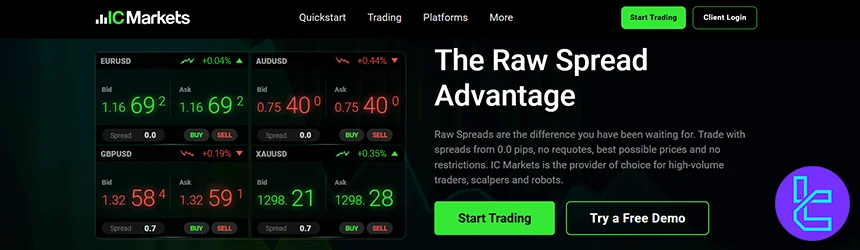
The platform supports ten base account currencies such as USD, EUR, AUD, GBP, JPY, and CHF, with a minimum initial deposit requirement of $200.
Originally established in Australia in 2007, the company has expanded its regulatory footprint through licenses issued by the Australian Securities and Investments Commission (ASIC), the Cyprus Securities and Exchange Commission (CySEC), and the Financial Services Authority (FSA) of Seychelles.
These entities oversee different operational branches, including IC Markets (EU) Ltd, International Capital Markets Pty Ltd, and Raw Trading Ltd.
Client asset protection measures include fund segregation within tier-one banking institutions, implementation of AML compliance frameworks, and periodic external audits.
Under the Investor Compensation Fund (ICF), eligible CySEC-regulated clients may receive coverage of up to €20,000 in the event of insolvency.
Trading infrastructure is available via MetaTrader 4 (MT4), MetaTrader 5 (MT5), and cTrader, supporting market execution, algorithmic strategies, and Expert Advisors (EAs).
Account structures such as Standard, Raw Spread, and Islamic (swap-free) are offered, with spreads starting from 0.0 pips on Raw accounts and commissions typically ranging between $3 and $3.5 per lot. To reduce trading costs, traders can use the IC Markets rebate program.
Depending on the regulatory jurisdiction, leverage may vary from 1:30 to 1:500. Tradable asset classes include Forex CFDs, indices, commodities, bonds, cryptocurrencies, and equities, with position sizing starting from 0.01 lots.
Account Types | Standard, Raw Spread, Islamic |
Regulating Authorities | ASIC (Australia), CySEC (Cyprus), FSA (Seychelles) |
Minimum Deposit | $200 |
Deposit Methods | Bank Cards, Wire Transfer, E-wallets (Skrill, Neteller, PayPal) |
Withdrawal Methods | Bank Cards, Wire Transfer, Electronic Payment Systems |
Maximum Leverage | Up to 1:500 (Entity-Based) |
Trading Platforms & Apps | MetaTrader 4 (MT4), MetaTrader 5 (MT5), cTrader, IC Markets Mobile |
IC Markets Pros and Cons
The table below helps you understand the benefits and drawbacks of trading with the IC Markets broker.
Pros | Cons |
Spreads from 0.0 pips on Raw Spread Accounts | $200 Minimum Deposit Requirement |
Multi-Platform Access (MT4, MT5, cTrader) | Lower Leverage in ASIC / CySEC Regions |
Segregated Client Funds Across Entities | No PAMM Account Support |
Supports Expert Advisors (EAs) & Scalping | - |
Scope Markets
Founded in 2014, Scope Markets is a global multi-asset broker operating under Rostro Group, serving traders from more than 200 countries. The broker positions itself as an STP provider, focusing on fast execution and institutional-grade trading infrastructure.
Scope Markets offers access to 40,000+ tradable instruments, spanning Forex, indices, commodities, shares, fractional stocks, and futures. Trading is supported via MetaTrader 4 and MetaTrader 5, with additional market data from CQG, IRESS, and Bloomberg, appealing to both active traders and data-driven investors.
To learn about the details of the user interface in the broker, visit our Scope Markets dashboard page.
From a regulatory perspective, Scope Markets operates internationally through multiple entities.
Its offshore arm is regulated by the Financial Services Commission of Belize (license 000274/325), while European clients are onboarded via its CySEC-regulated entity in Cyprus, providing a split structure between flexible leverage and stronger EU-level protections.
Account options include One, Islamic, Scope Elite, and Scope Invest accounts, with minimum deposits starting from $10. Notably, the Scope Invest account enables fractional stock investing from $50, while Elite accounts offer cashback rebates, positioning the broker for both low-capital traders and high-volume participants.
Specifics and Details
Account Types | One, Islamic, Scope Invest, Scope Elite |
Regulating Authorities | FSC, CySEC |
Minimum Deposit | $10 |
Deposit Methods | VISA, MasterCard, Skrill, Neteller, International Bank Transfer, Local Bank Transfer, VietQR, MoMo, ZaloPay, UnionPay, DC/EP, AliPay |
Withdrawal Methods | VISA, MasterCard, Skrill, Neteller, International Bank Transfer, Local Bank Transfer, VietQR, MoMo, ZaloPay, UnionPay, DC/EP, AliPay |
Maximum Leverage | 1:1000 |
Trading Platforms & Apps | MT4, MT5 |
Scope Markets Pros & Cons
Before going through Scope Markets registration, check it the table below which is a balanced overview of its main advantages and limitations to help assess whether it fits different trading profiles.
Pros | Cons |
Low minimum deposit starting from $10 | Tier-3 offshore regulation under IFSC Belize |
Access to 40,000+ instruments across global markets | No investor compensation scheme for Belize entity |
Fractional stock trading via Scope Invest account | High $20,000 entry requirement for Elite account |
MT4 & MT5 with institutional data feeds (CQG, IRESS) | Crypto trading not supported |
VT Markets
VT Markets is a multi-asset Forex and CFD broker headquartered in Australia, serving over 400,000 active traders and facilitating more than 30 million trades monthly. The broker provides access to 1,000+ instruments across seven global markets, including Forex, indices, shares, and commodities.
From a regulatory standpoint, VT Markets operates through entities licensed by Australian Securities and Investments Commission (ASIC 516246), Financial Sector Conduct Authority (FSCA 50865), and the Financial Services Commission (GB23202269).
However, the ASIC-regulated entity primarily serves wholesale clients, while global clients are onboarded under other jurisdictions.
The broker offers four live account types, including Standard STP, RAW ECN, Cent STP, and Cent ECN, plus demo access. With a minimum deposit starting from $50 and spreads from 0.0 pips on ECN accounts, VT Markets supports both entry-level and cost-focused traders. Go to our VT Markets registration guide for a walk-through on account opening.
Platform coverage includes MetaTrader 4, MetaTrader 5, Webtrader+ (TradingView-powered), and the proprietary VT Markets mobile app. Additional features such as copy trading, PAMM accounts, negative balance protection, and flexible funding options enhance its multi-asset trading infrastructure.
To learn about the broker’s user interface, check out VT Markets dashboard article. Here’s a table of specifications.
Account Types | Standard STP, RAW ECN, Cent STP, Cent ECN, Demo |
Regulating Authorities | FSCA, ASIC, FSC Mauritius |
Minimum Deposit | $50 |
Deposit Methods | Neteller, Skrill, Credit/Debit Cards, Wire Transfer, UnionPay, Fasapay |
Withdrawal Methods | Neteller, Skrill, Credit/Debit Cards, Wire Transfer, UnionPay, Fasapay |
Maximum Leverage | 1:500 |
Trading Platforms & Apps | MetaTrader 4, MetaTrader 5, Webtrader+, VT Markets App |
VT Markets Pros & Cons
VT Markets combines competitive spreads, diverse account structures, and multi-jurisdiction licensing. However, the absence of excess loss insurance and mixed trust ratings may influence risk-sensitive traders. Below is a structured summary of its primary advantages and limitations.
Pros | Cons |
1,000+ tradable instruments across 7 markets | ASIC entity limited to wholesale clients |
RAW spreads from 0.0 pips on ECN accounts | No excess loss insurance coverage |
Multiple account types incl. Cent & ECN | Withdrawal fees may apply |
Supports MT4, MT5 & TradingView-powered Webtrader+ | Mixed third-party review ratings |
FXGlory
Founded in 2011, FXGlory Ltd is an international forex broker headquartered in Saint Lucia, offering retail access to currencies, metals, and oil CFDs. The broker is widely recognized for its ultra-high leverage of up to 1:3000 and a $1 minimum deposit requirement.
Unlike IFSC (Belize) licensed brokers, FXGlory currently operates without formal financial regulation, meaning it does not participate in any investor compensation scheme or client-fund protection framework. This absence of oversight remains a critical consideration when evaluating counterparty risk.
Four FXGlory account types are available, including Standard, Premium, VIP, and CIP, with spreads starting from 2.0 pips (Standard) down to 0.1 pips (CIP). Trading is commission-free across all accounts, and micro-lot trading from 0.01 lot is available.
The broker provides access to MetaTrader 4 (MT4) and MetaTrader 5 (MT5) with support for EAs, hedging, VPS hosting, swap-free accounts, and 24/7 customer service. Deposits start from as little as $1 via multiple e-wallets, cards, wire transfers, and cryptocurrencies.
Specifications and Parameters
Account Types | Standard, Premium, VIP, CIP |
Regulating Authorities | None |
Minimum Deposit | $1 |
Deposit Methods | Wire Transfer, Credit/Debit Card, PayPal, NETELLER, Payza, Skrill, OKPAY, Webmoney, Sticpay, Perfect Money, CryptoCurrency, Zelle |
Withdrawal Methods | Wire Transfer, Credit/Debit Card, PayPal, NETELLER, Payza, Skrill, OKPAY, Webmoney, Sticpay, Perfect Money, CryptoCurrency, Zelle |
Maximum Leverage | 1:3000 |
Trading Platforms & Apps | Metatrader 4, Metatrader 5 |
FXGlory Pros & Cons
FXGlory focuses on high leverage, low entry barriers, and bonus incentives. However, the lack of regulatory supervision and formal investor protection mechanisms significantly increases risk exposure. Below is a structured overview of its key strengths and limitations.
Pros | Cons |
Extremely high leverage up to 1:3000 | No regulation by major or offshore authorities |
Very low minimum deposit ($1) | No investor compensation scheme |
Commission-free trading model | Limited tradable instruments (Forex, metals, oil only) |
MT4 & MT5 support with EA compatibility | High withdrawal fees on certain payment methods |
How Were IFSC Brokers Selected?
Choosing the Best IFSC-Regulated Forex brokers requires far more than comparing spreads or leverage. At TradingFinder, every broker is evaluated using a 19-metric review methodology designed to reflect real trading conditions, regulatory credibility, and long-term reliability.
Regulation is the foundation of our analysis. We verify that each broker holds a valid license from the International Financial Services Commission and assess how that license is implemented in practice.
This includes reviewing client fund segregation, internal risk controls, AML/KYC procedures, and whether the broker operates transparently under its Belize entity rather than marketing regulation in name only.
Beyond licensing, TradingFinder experts analyze core broker fundamentals such as establishment year, ownership structure, headquarters, and global office presence. These factors help identify operational stability and reduce counterparty risk.
We then examine account type diversity (Standard, ECN, Micro, PAMM, Islamic), ensuring brokers can accommodate different trading styles and risk profiles.
Trading conditions are reviewed in depth. Our methodology covers spreads, commissions, non-trading fees, deposit and withdrawal efficiency, and execution quality. We also assess tradable instrument breadth, including forex pairs, indices, commodities, stocks, ETFs, and CFDs, as this directly impacts strategy flexibility.
Technology and usability are tested hands-on. Platforms like MetaTrader 4, MetaTrader 5, cTrader, and mobile apps are evaluated for stability, execution speed, and overall user experience. Account opening, verification speed, copy trading features, and educational tools are also factored into the score.
Finally, qualitative data completes the picture. We analyze customer support responsiveness, broker communications, infographics, news updates, verified Trustpilot feedback, scam alerts, and how brokers handle disputes.
This structured, data-driven approach ensures that every IFSC (Belize)-regulated broker listed by TradingFinder meets practical, trader-focused standards; not just regulatory checkboxes.
What is the IFSC in Belize?
The International Financial Services Commission (IFSC) is the primary regulatory authority responsible for supervising non-bank financial services in Belize.
Established under the International Financial Services Commission Act, the IFSC oversees a wide range of financial activities, including forex brokerage, CFD trading, securities dealing, asset management, and international investment services.
In the forex market, the IFSC’s role is to license and monitor brokers that offer trading services to international clients outside Belize.
Licensed brokers must meet specific legal and operational requirements, such as maintaining a registered legal entity, complying with anti-money laundering (AML) and know-your-customer (KYC) rules, and submitting periodic compliance reports.
The regulator also has the authority to issue warnings, impose fines, suspend licenses, or revoke authorization in cases of serious misconduct.
Compared to Tier-1 regulators like the Financial Conduct Authority (FCA) or Australian Securities and Investments Commission (ASIC), the IFSC is generally considered an offshore regulator. It offers brokers greater operational flexibility, particularly regarding leverage and product offerings, while still providing a formal legal framework for oversight.
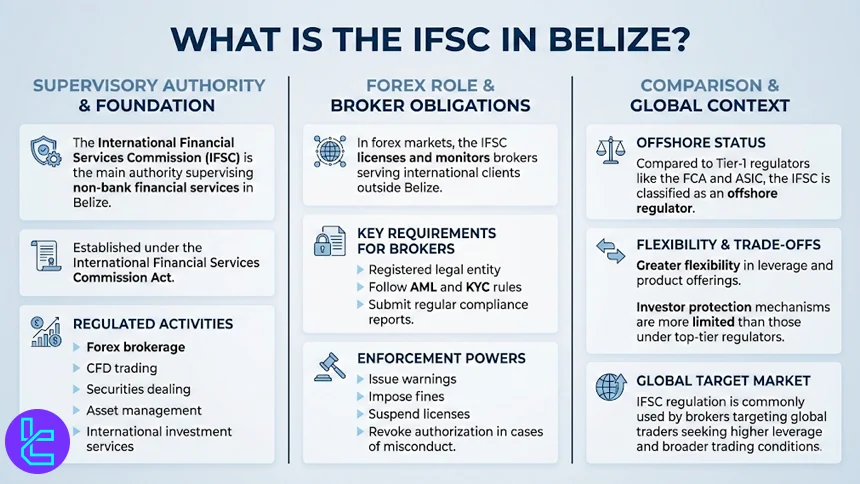
As a result, IFSC regulation is often chosen by brokers targeting global traders who seek higher leverage and broader trading conditions, with the understanding that investor protection mechanisms are more limited than those found in top-tier regulatory jurisdictions.
IFSC Regulation Advantages and Disadvantages
The International Financial Services Commission (IFSC) provides a legally recognized framework for forex brokers operating from Belize, balancing regulatory oversight with operational flexibility.
IFSC regulation is commonly associated with higher leverage access and broader product offerings, but it offers fewer investor protection mechanisms compared to Tier-1 authorities such as the Financial Conduct Authority or Australian Securities and Investments Commission.
Pros | Cons |
Legal licensing framework for forex and CFD brokers | No statutory investor compensation scheme |
Allows higher leverage compared to EU or UK regulators | Weaker enforcement compared to Tier-1 authorities |
Lower compliance and operating costs for brokers | Limited transparency requirements in some areas |
Suitable for international, non-EU retail traders | Less protection in broker insolvency scenarios |
Does IFSC Have Any Limitations for Leverage in Brokers?
The International Financial Services Commission does not impose fixed or standardized leverage caps on forex and CFD brokers it licenses in Belize.
Unlike regulators operating under EU or UK frameworks, such as the Financial Conduct Authority (FCA) or European Securities and Markets Authority (ESMA), the IFSC allows brokers to determine leverage levels based on their internal risk policies and target markets.
In practice, this regulatory flexibility enables IFSC-regulated brokers to offer high leverage, commonly ranging from 1:200 up to 1:1000 or higher, depending on the asset class and account type. This approach is designed to support international brokers serving non-EU clients who seek greater capital efficiency and more aggressive trading strategies.
However, the absence of mandatory leverage limits also means that risk controls are largely broker-defined, rather than regulator-enforced.
While IFSC-licensed brokers are still expected to implement basic risk disclosures and margin management rules, retail traders do not benefit from standardized protections such as leverage caps or uniform margin close-out levels.
As a result, IFSC regulation prioritizes market flexibility over prescriptive risk limitation. Traders choosing high-leverage brokers under IFSC oversight should carefully assess margin requirements, stop-out policies, and the broker’s overall risk management framework, as leverage-related protections are not centrally regulated in the same way as under Tier-1 authorities.
What Rules Must IFSC-Regulated Brokers Adhere to?
Forex and CFD brokers licensed by the International Financial Services Commission are required to operate within a defined legal and compliance framework set by Belize. While this framework is less prescriptive than Tier-1 regimes, it establishes baseline obligations aimed at maintaining market integrity and regulatory accountability.
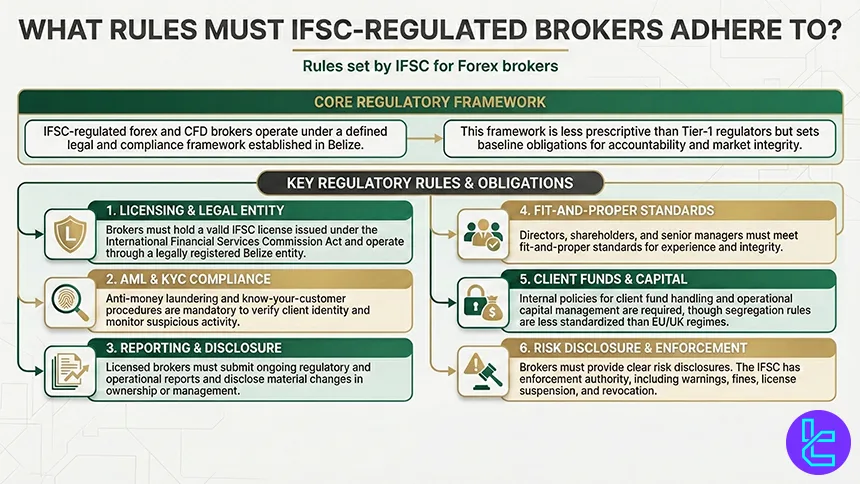
Key rules and requirements for IFSC-regulated brokers include:
- Licensing and Authorization: Brokers must hold a valid IFSC license issued under the International Financial Services Commission Act and operate through a legally registered entity in Belize;
- AML and KYC Compliance: Brokers are required to implement anti-money laundering (AML) and know-your-customer (KYC) procedures to verify client identities and monitor suspicious transactions, in line with international standards;
- Ongoing Regulatory Reporting: Licensed entities must submit periodic compliance and operational reports to the IFSC and promptly disclose material changes in ownership, management, or business activities;
- Fit and Proper Management: Directors, shareholders, and senior managers must meet suitability requirements, ensuring that individuals controlling the brokerage have appropriate experience and integrity;
- Client Fund Handling: Brokers are expected to maintain clear internal policies for handling client funds and managing operational capital, though fund-segregation rules are not as detailed or standardized as under EU or UK regulation;
- Risk Disclosure Obligations: Brokers must provide transparent risk disclosures outlining the nature of leveraged trading, potential losses, and key trading conditions;
- Regulatory Oversight and Enforcement: The IFSC retains authority to conduct reviews, issue warnings, impose administrative penalties, suspend licenses, or revoke authorization in cases of non-compliance.
These rules create a formal supervisory structure for offshore forex brokers while granting them operational flexibility. As a result, traders should place additional emphasis on broker transparency, internal controls, and reputation when dealing with IFSC-regulated entities.
How Can I Check if a Broker is Licensed by IFSC?
Verifying whether a broker is genuinely licensed by the IFSC is a critical step before opening an account with an offshore forex broker. The process is straightforward but must be done carefully to avoid cloned or misleading regulatory claims.
To check a broker’s IFSC license, follow these steps:
- Review the Broker’s Legal Disclosure: Reputable brokers clearly state their regulatory status in the website footer or legal documents, including the registered company name and IFSC license number;
- Visit the Official IFSC Website: Access the IFSC’s official website directly and navigate to the list or register of licensed service providers. Avoid using links provided by the broker itself;
- Search by Company Name or License Number: Enter the broker’s legal entity name or IFSC license number exactly as disclosed. A valid record should confirm the license status and authorization scope;
- Match the Trading Domain: Ensure the website domain you are using is explicitly associated with the licensed entity. Some brokers operate multiple brands, and only approved domains fall under IFSC supervision;
- Check License Status and Updates: Confirm that the license is active and has not been suspended or revoked. IFSC notices or warnings should be reviewed for any enforcement actions;
- Cross-Check with Independent Sources: Use reputable review platforms and regulatory databases to verify consistency between the broker’s claims and public records.
Are IFSC Brokers Allowed to Offer Crypto Trading Services?
Brokers regulated by the International Financial Services Commission are generally allowed to offer crypto-related trading services, but the scope depends on how those services are structured.
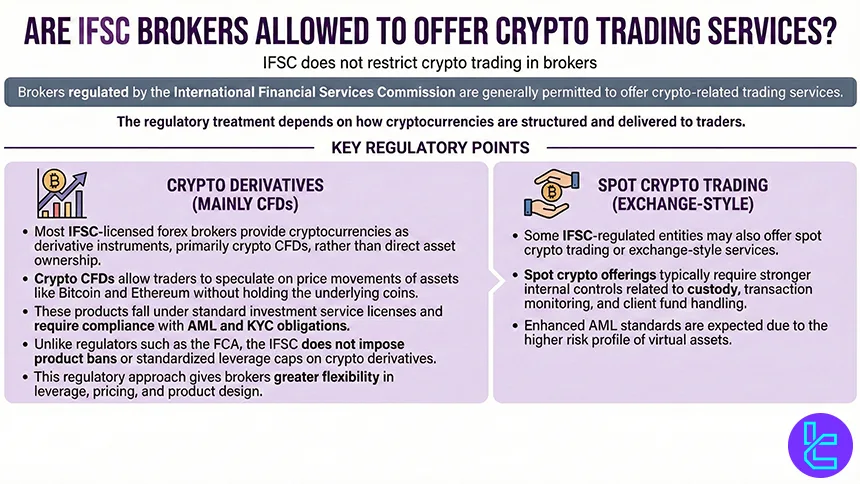
Under Belize’s regulatory framework, most IFSC-licensed forex brokers provide cryptocurrencies as derivative products, primarily crypto CFDs, rather than offering direct ownership of digital assets.
When cryptocurrencies are offered as CFDs, traders speculate on price movements of assets such as Bitcoin or Ethereum without holding the underlying coins. These products typically fall under the broker’s investment services license and are subject to standard compliance requirements, including AML and KYC procedures.
Compared to regulators like the FCA, the IFSC does not impose product bans or standardized leverage caps on crypto derivatives, allowing brokers greater flexibility in pricing and leverage.
Some IFSC-regulated entities may also offer spot crypto trading or exchange-style services, but this usually requires additional internal controls related to custody, transaction monitoring, and client fund handling. In such cases, brokers are expected to comply with enhanced AML standards due to the higher risk profile of virtual assets.
Overall, IFSC regulation allows a broader range of crypto trading models than many onshore regulators. However, because investor protections are more limited, traders should carefully review whether crypto exposure is offered via CFDs or spot markets, and assess how the broker manages custody, liquidity, and counterparty risk before trading digital assets.
Does IFSC Offer Any Investor Protection Schemes?
The International Financial Services Commission does not operate a statutory investor compensation scheme for clients of forex or CFD brokers licensed in Belize.
Unlike regulators in jurisdictions such as the European Union or the United Kingdom, where formal compensation funds are mandatory, the IFSC framework does not include a guaranteed mechanism to reimburse traders in the event of broker insolvency.
IFSC-regulated brokers are required to maintain internal compliance standards, including AML/KYC procedures and basic client fund handling policies. However, there is no IFSC-backed fund comparable to the Investor Compensation Fund (ICF) under CySEC or the Financial Services Compensation Scheme (FSCS) under the UK Financial Conduct Authority.
As a result, any client protection related to insolvency, dispute resolution, or fund recovery depends largely on the broker’s internal safeguards, financial stability, and contractual terms rather than on regulator-backed guarantees.
Some IFSC-licensed brokers voluntarily implement fund segregation or private insurance arrangements, but these are not standardized, mandatory, or regulator-guaranteed.
From a risk perspective, IFSC regulation prioritizes market access and operational flexibility over formal investor compensation. Traders choosing IFSC-regulated brokers should factor in the absence of a statutory protection scheme and place greater emphasis on broker reputation, financial transparency, and overall risk management practices when allocating capital.
Does IFSC Enforce Any Tax Obligations?
The IFSC does not directly impose or collect taxes on forex brokers or their clients. Its role is strictly regulatory and supervisory, not fiscal. Taxation matters fall under the authority of the Belize government and its tax legislation, not the IFSC itself.
From a broker perspective, IFSC-licensed international brokerage companies in Belize often benefit from tax-neutral or preferential tax treatment, particularly when they operate as International Business Companies (IBCs) serving non-resident clients.
In many cases, income generated from activities conducted outside Belize may be exempt from local corporate taxes, subject to compliance with Belizean corporate and reporting laws.
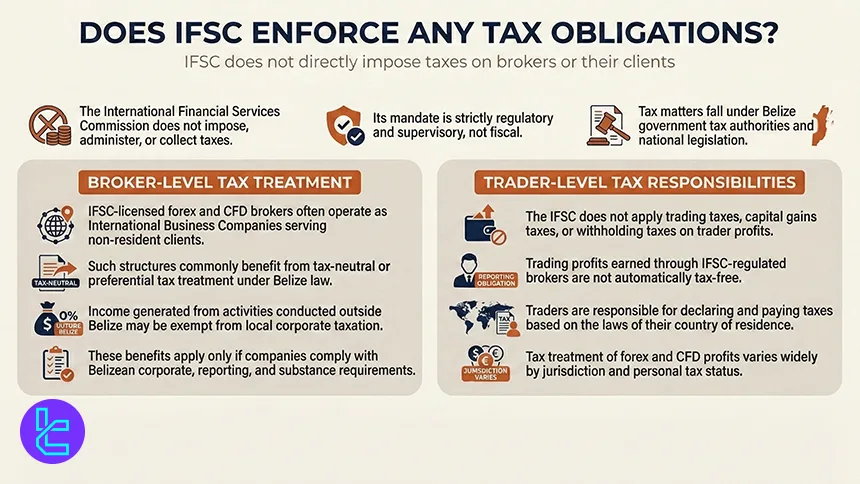
For traders, the IFSC does not levy any trading taxes, capital gains taxes, or withholding taxes on profits earned through IFSC-regulated brokers. However, this does not mean trading profits are tax-free.
Traders remain fully responsible for declaring and paying taxes according to the tax laws of their country of residence. The tax treatment of forex and CFD profits varies widely depending on jurisdiction and individual circumstances.
In summary, IFSC regulation is tax-neutral rather than tax-enforcing. While Belize offers an offshore-friendly environment for brokers, neither brokers nor traders are exempt from their respective legal tax obligations elsewhere.
IFSC in Comparison to Other Regulatory Authorities
The IFSC of Belize is often compared with regulators like ASIC, FSC Mauritius, and BVI FSC due to its offshore positioning and flexible framework. While IFSC offers brokers higher leverage and lower compliance costs, it provides fewer statutory investor protections than ASIC.
The comparison below highlights how IFSC differs from these regulators in terms of capital requirements, leverage rules, client safeguards, and regulatory oversight.
Parameter | IFSC (Belize) | ASIC (Australia) | FSC (Mauritius) | BVI FSC |
Minimum Capital Requirement | Relatively low; offshore-friendly, exact thresholds not publicly standardized | High; typically, AUD 500,000–1,000,000 depending on license scope | Moderate; varies by license type and business model | Moderate; risk-based capital tied to exposure |
Client Fund Segregation | Required in practice, but less prescriptive than Tier-1 regulators | Required and strictly enforced | Required | Required |
Compensation Scheme | No statutory investor compensation fund | No formal compensation scheme, but strong enforcement and AFCA dispute resolution | No mandatory compensation fund | No statutory compensation fund |
Leverage Limits | No fixed regulatory cap; brokers often offer 1:500–1:1000+ | Retail leverage capped at 1:30 | No fixed cap; commonly higher than EU/UK | No fixed cap; broker-defined |
Negative Balance Protection | Not mandatory by regulation | Effectively enforced for retail CFD clients | Not mandatory | Not mandatory |
Reporting & Audits | Periodic compliance reporting | Ongoing financial reporting and audits | Regular compliance reporting | Ongoing reporting and supervision |
Conclusion
The IFSC is one of the well-known offshore financial regulators in Forex market with no leverage limitations and no investor compensation schemes or restrictions of any kind. The number of reputable brokers regulated by the authority is not very large, but FBS, XM, XTB, and Scope Markets are among the top choices.
To become familiar with the way we chose the brokerages, read our Forex methodology article.