








According to the ICT style perspective, the Asian range is a low-volatility zone where the market accumulates liquidity so that in later sessions (especially London) this liquidity can be consumed or swept.
At the beginning of the day (Asian session), the market is usually deliberately kept within a low-volatility range. This serves several purposes, including preventing the start of a trend during low-volume hours, creating liquidity traps, and preparing for liquidity manipulation.
At the start of the day and during the Asian session, the market is intentionally placed within a low-volatility range.
This behavior pursues several specific objectives, including preventing the initiation of a trend during low-volume hours, creating a liquidity trap, and setting the conditions for liquidity manipulation later in the day.
What is the ICT Asian Range Strategy?
According to the ICT Asian Range Trading strategy, the price range during the Asian session provides critical insights into potential market movements in subsequent sessions.
Key characteristics of the Asian Range strategy:
- Timeframe: Typically from 7 PM to midnight New York time;
- Identification: The highest and lowest prices within this specific period.
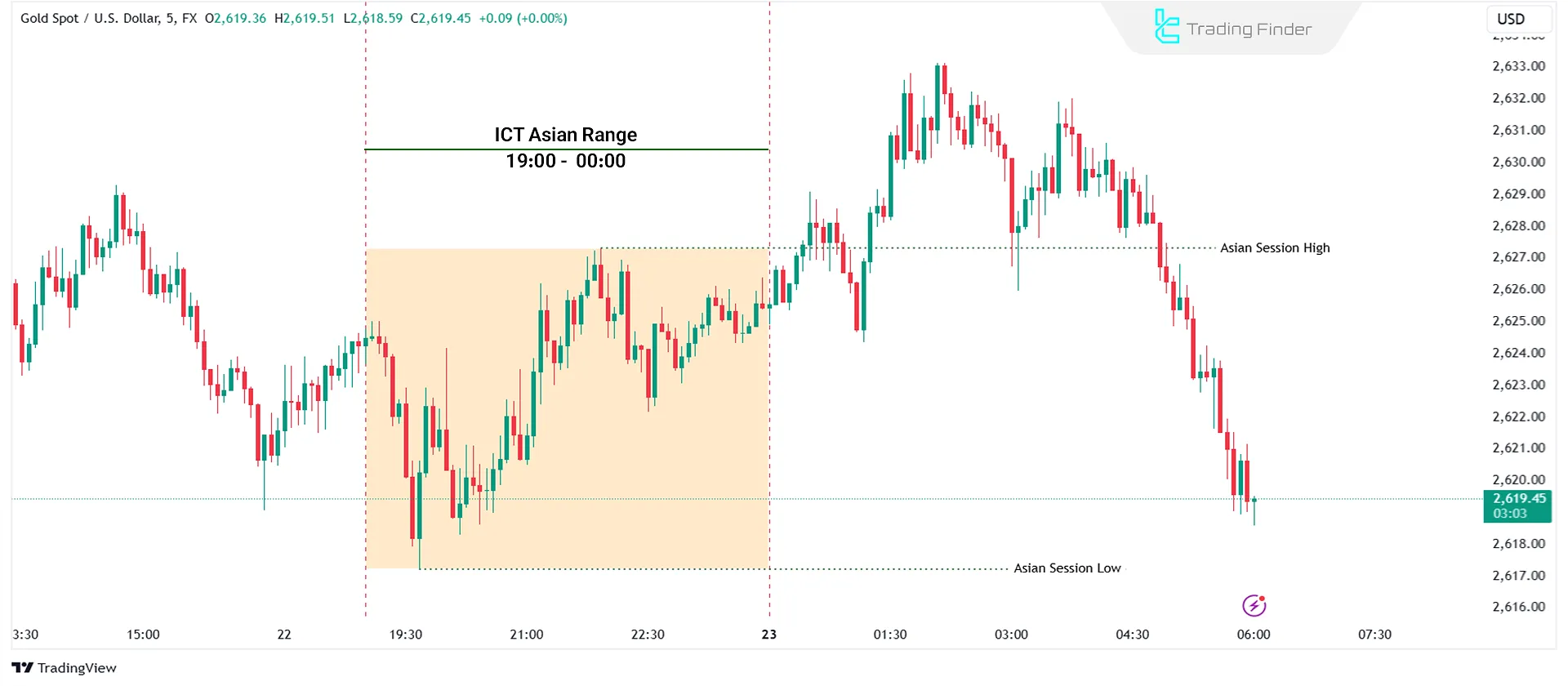
The Asian Range Trading strategy does not rely on complex indicators or advanced algorithms. Instead, it depends on the trader's ability to observe and interpret price movements within a specific timeframe.
Advantages and Disadvantages of Trading with the ICT Asian Range Strategy
The Asian range trading strategy in the ICT style, like all trading strategies, includes specific advantages and disadvantages, and a few of them are mentioned in the table below:
Advantages | Disadvantages |
Compact structure and a clearly defined range | Frequent false breakouts |
Tighter stop losses and higher safety | Limited opportunities within the session |
Basis for identifying liquidity and the London breakout | Unclear direction until the London session begins |
Why is the Asian Range Important?
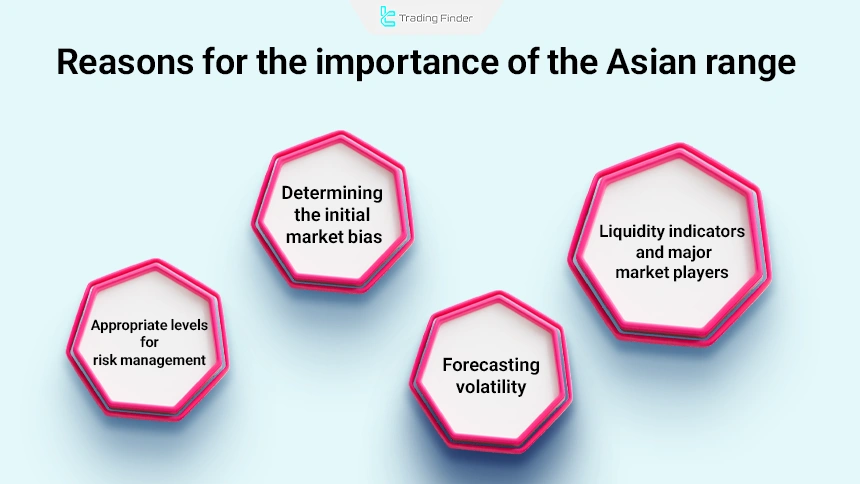
Understanding the Asian Range can enhance your success rate in trading. Asian Range Advantages:
- Early market insights: The Asian Range sets the daily market trend, allowing you to anticipate market sentiment earlier;
- Liquidity indicators: It reveals how major players are positioning themselves, offering clues about potential price movements;
- Volatility prediction: The price volatility during this session acts as a guide for predicting the level of volatility in subsequent sessions;
- Risk management: The Asian Range provides suitable levels for setting stop-loss and take-profit.
How to use the ICT Asian Range Strategy?
To effectively execute the ICT Asian Range strategy, follow these steps:
- Identify the Asian Range: Observe price movements during the Asian session and pay attention to key fluctuations;
- Mark the range: Highlight the highest and lowest prices during this period, as these levels become key reference points;
- Analyze breakouts: Monitor price movements beyond the defined range; such movements indicate potential market changes;
- Examine market context: Align your analysis with overall market trends Daily Bias to improve trading accuracy;
- Execute trades: Open positions based on breakouts or reversals from the range.
In the article on training the Asian range trading strategy in the ICT style on the blog.opofinance.com website, more explanations are provided about using this strategy, which interested readers can refer to.
Implementing the ICT Asian Range Strategy in Bullish Conditions
ICT Asian Range strategy in an uptrend sets the Asian range Asia Range as the daily price movement base.
After liquidity is accumulated below the range and a Market structure shift(MSS), which acts as an institutional entry signal, is formed, the market structure is aligned.
This alignment occurs with fair value gaps (FVG), order blocks (Order Block), or the optimal trade entry zone (OTE - Optimum Trade Entry) in order to provide a low-risk entry aligned with the continuation of the uptrend.
To implement this strategy, the following steps should be followed:
- Drawing the range: Extend the Asian high and low to future sessions to frame your trading setup;
- Looking for dips: In a bullish market, wait for the price to dip below the Asian low, liquidity sweep and trapping traders;
- Entry options:After the Asian range low forms, buy either below the New York midnight open or on a retracement that breaks above the Asian range high. If both are missed, wait for a retrace to the Asian range high at the New York open.
After sweeping the Asian Range liquidity, look for an ICT Market Structure Shift (MSS) to confirm the price reversal.
Example of the ICT Asian Range Strategy in Bullish Conditions
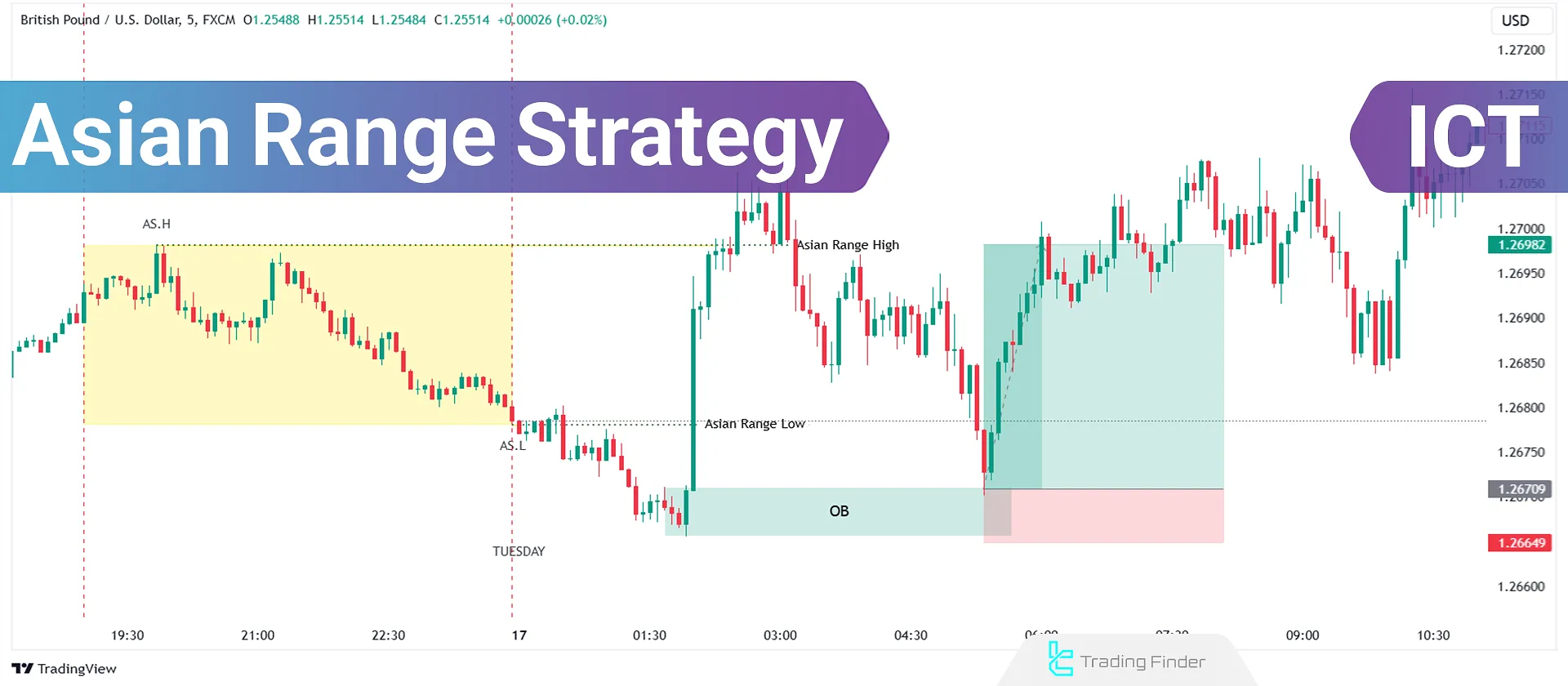
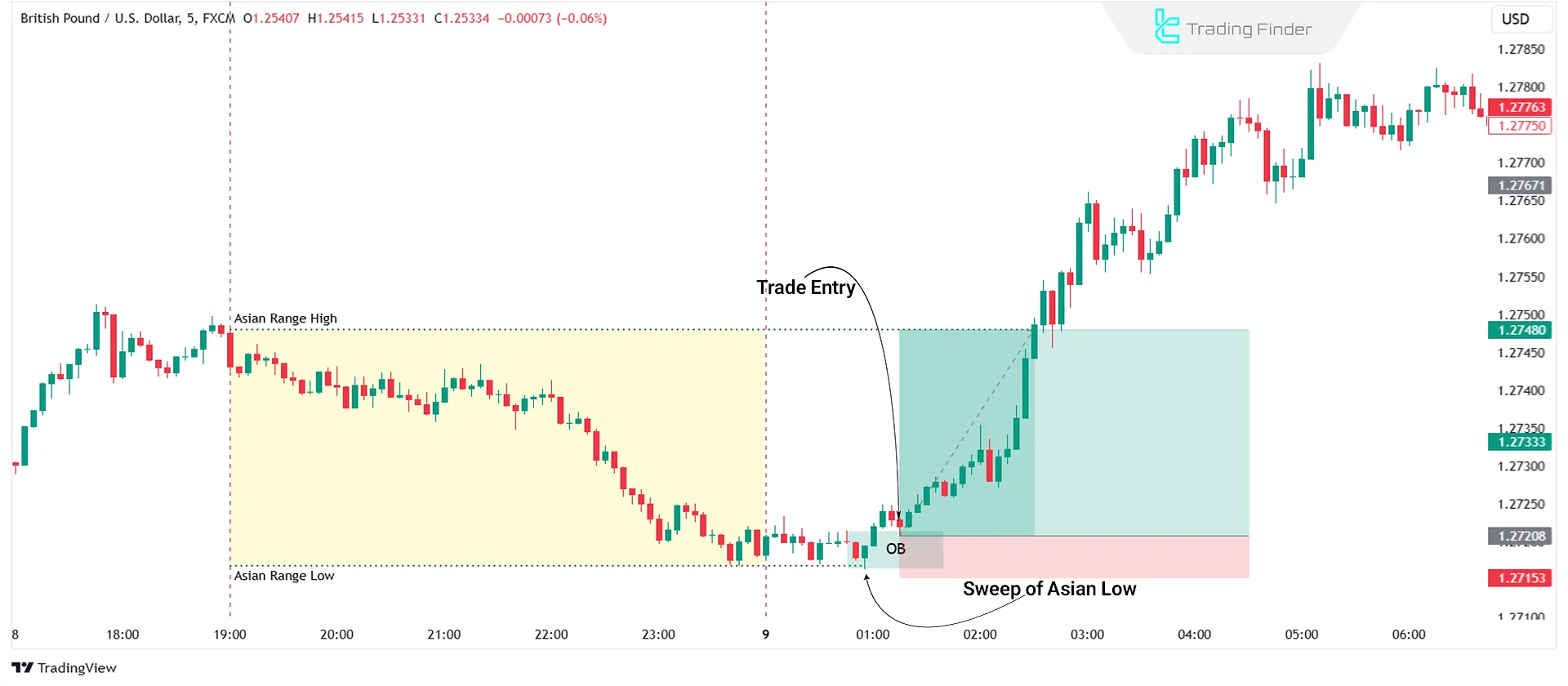
On the GBP/USD chart, we observe that a false breakout of the Asian range has formed from the low (liquidity has been collected), and after a strong upward price reversal, a buy trade can be entered on the pullback to the order block.
In this case, the price target will usually be the Asian range high.
Implementing the ICT Asian Range Strategy in Bearish Conditions
In a downtrend, the ICT Asian Range strategy, after the Asian range is carried into the later sessions, waits for the range high to be swept.
After this liquidity sweep and the formation of a valid MSS, a sell entry is taken in one of three locations.
These include selling above the midnight open, selling on the price retracement and the break of Asian range liquidity from the low, or entering after price returns to the range low at the New York open.
To implement the Asian range trading strategy in the ICT style, the following steps should be followed:
- Drawing the range: Similar to bullish conditions, extend the range to future sessions for setup alignment;
- Looking for breakouts: In a bearish market, wait for the price to rise above the Asian high, sweeping liquidity and trapping traders;
- Entry options: After the Asian range high is collected, either sell above the New York midnight open, or enter on a reversal that breaks the Asian range low. If both are missed, wait for a return to the Asian range low at the New York open.
After sweeping the Asian Range liquidity, look for an ICT Market Structure Shift (MSS) to confirm the price reversal.
What Setups Complement the Asian Range Strategy?
Integrating the ICT Asian Range strategy with the overall liquidity analysis framework significantly increases trade success probability.
This is because the model, by defining a reliable range for initial price behavior, clarifies liquidity sweep moments and market structure shifts, and enables low-risk and repeatable entries during the London and New York sessions.
Breakout Strategy
The ICT Asian Range breakout strategy focuses on entering after price exits the consolidated range of the Asian session, which includes the following points:
- Entering a trade when price breaks out of the Asian range;
- Using volume or other indicators to confirm the breakout and increase the probability of success.
Fair Value Gap Strategy
After the Asian range breakout, fair value gaps usually form during strong impulsive price movements; these gaps indicate order imbalance and potential points for retracement or continuation.
By identifying these FVGs and aligning them with the breakout direction, the trader can use them as optimal retracement entry zones or targeted exit points, thereby increasing profitability and the accuracy of ICT liquidity-based analysis.
This strategy includes the following elements:
- Identifying significant price gaps that are created during breakouts;
- Using fair value gaps (FVG) as entry or exit points to profit from price inefficiencies.
Integration with Indicators
Integrating the Asian range strategy with indicators, while preserving the core logic of the range strategy, provides a simple yet effective confirmation layer. For example, the following can be used:
- Combining Asian range analysis with RSI, MACD, or moving averages for a multi-dimensional approach;
- Using multi-timeframe analysis to gain a comprehensive understanding of market conditions and trends.
How to manage risk in the ICT Asian Range Strategy?
Risk management in the ICT Asian Range strategy, while preserving core principles, relies on three simple and practical pillars.
These include determining position size proportional to risk, placing the stop loss at the boundaries of the Asian range, and using an appropriate risk-to-reward ratio for each trade in alignment with capital management standards.
- Position sizing: Adjust position size based on risk tolerance and account size;
- Stop-loss placement: Use the boundaries of the Asian Range to determine logical stop-loss levels;
- Risk-reward ratio: Execute trades with an appropriate risk-reward ratio (e.g., 1:2) for favorable outcomes.
The educational video from the Gulf Trading channel reviews real examples of the Asian Range strategy and provides a deeper understanding of its execution mechanism.
Interested viewers can watch this video for more detailed study and improved risk management.
Key tips for improving the Asian Range Strategy
Observing the following points, which are considered among the most critical factors for improving the performance of the Asian Range strategy, is essential:
- Utilize confluence: Combine the trading strategy with other analysis methods to generate stronger signals;
- Monitor volume: Unusual volume provides additional insights and validates trade ideas;
- Risk management: Use stop-loss orders to manage position size and preserve capital;
- Maintain a trading journal: Document your results to refine the strategy over time.
Comparison of the Asian, London, and New York Ranges
Below, we examine and compare candlestick price ranges across different sessions, including Asia, London, and New York:
Features | Asian range | London range | New York range |
Volatility | Low | Medium to high | High to very high |
Liquidity volume | Low | High | Very high |
Price behavior | Compressed, consolidated | Start of major trends, valid breakouts | Sharp moves, trend continuation or strong reversals |
Dominant movement type | Range and retracement | Directional trends, breakouts | Impulsive and volatile movements |
Probability of valid breakout | Low | High | Very high |
Participation of major players | Limited | High (banks and institutions) | Very high (overlap with London) |
Use of range structure | Defining liquidity boundaries and compression | Initiation of the day’s main moves | Trend acceleration, liquidity sweeps, and news-driven moves |
Trading risk | Low (small stops) | Medium | High |
Trading opportunities | Limited | High | High and fast-occurring |
Typical daily behavior | Formation of a consolidation box | Break of the Asian box and market direction setting | Completion of major moves or trend reversal |
Session Box Indicator in MetaTrader
The Session Box Indicator in MetaTrader, as one of the specialized tools in the ICT field, plays an important role in analyzing market volatility based on trading sessions.
This indicator relies on the official timing of central banks to mark the start and end times of major sessions such as Asia, London, and New York on the chart, providing traders with the ability to accurately analyze price behavior in each trading session.
The core functionality of this tool is based on drawing colored boxes; boxes that display the high and low prices of each session based on the highest and lowest prices within that specific time window.
Such information is highly valuable for scalping and day trading styles, as many currency pairs such as EUR/USD or GBP/JPY experience a significant increase in trading volume during specific hours of the day, especially in the London and New York sessions.
Observations on the 15-minute chart show that breaking the London session low can draw liquidity in New York and signal new trends, as seen when a Sydney range break triggered a bearish move in Europe and continued into New York.
The floating time panel of this indicator displays the open or closed status of each session, which helps prevent traders from entering the market during low-volatility hours.
In addition, the settings section allows full customization of each session, including color selection, defining start and end times, enabling or disabling the fill box, and using local time or UTC. The Asia, Sydney, Tokyo, Europe, London, and New York sessions all have independent configuration options.
Overall, the Session Box indicator is one of the powerful MetaTrader tools for identifying price behavior based on the market’s time structure.
It guides traders toward more optimal decision-making in the forex market, commodities, and indices by providing a more precise understanding of ranges, breakouts, and liquidity zones.
Conclusion
The ICT Asian Range strategy is based on analyzing price behavior within the Asian session time window and considers this range as the liquidity base and the market’s initial structure throughout the day.
In this approach, by accurately identifying the high and low of the Asian range, the trader establishes the necessary foundation for analyzing valid breakouts, liquidity behavior, and the market’s potential directional bias during the London and New York sessions.
In addition to defining key entry zones, this strategy also enables evaluation of the broader market context, identification of price manipulations, and alignment of trades with the primary order flow.