








Key Points:
- After collecting buy-side liquidity at higher levels, Copper showed signs of active selling pressure as price closed within the shadow of a Pin Bar candle;
- Failure to stabilize above the all-time high and the subsequent return to the consolidation range strengthens the probability of a corrective or bearish market phase;
- On the daily timeframe, a pullback into the weekly rejection block combined with the presence of draw-on liquidity at lower levels highlights bearish market targets;
- determine whether the next move continues lower or enters a corrective consolidation;
- Until a confirmed market structure shift occurs, Copper trading scenarios remain conditional and dependent on liquidity behavior and momentum.
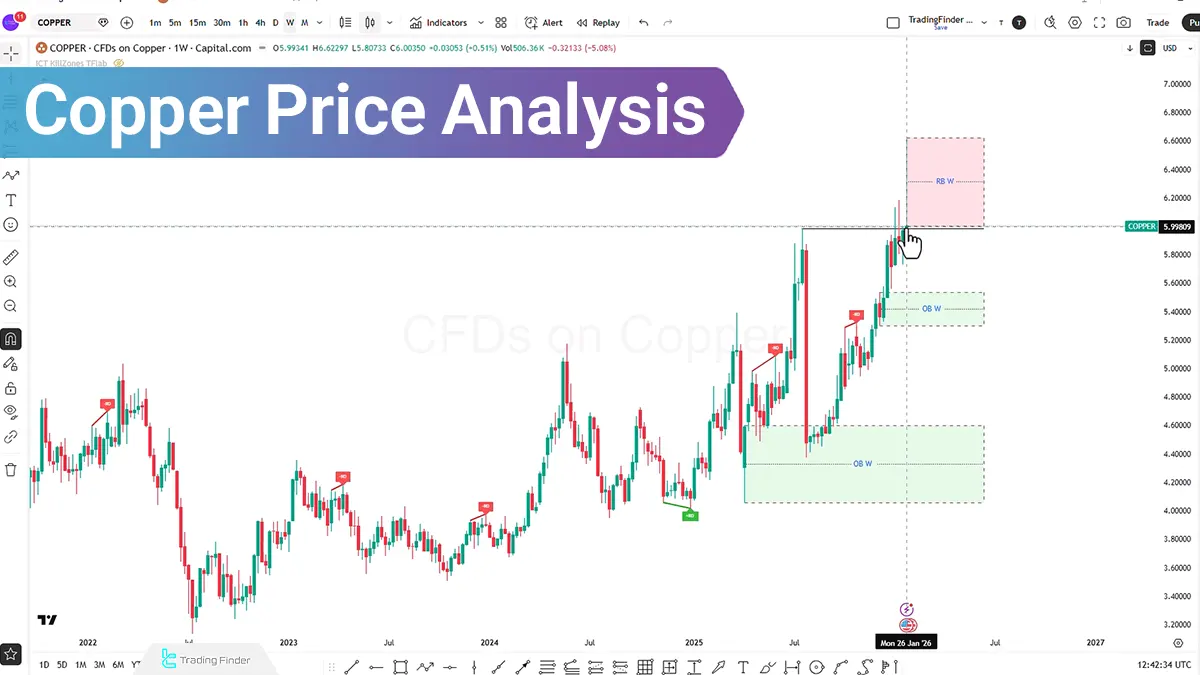
On February 1, 2026, Copper continued its bullish move by collecting buy-side liquidity at higher levels but ultimately closed within the shadow of a Pin Bar candle, signaling active selling pressure in the market.
Within this structure, Trading Strategy No. 5 has formed, where price collected buy-side liquidity across three consecutive phases. This behavior increases the probability of a bullish reversal developing within a broader bearish phase.
Copper Analysis on the Daily Timeframe (D1)
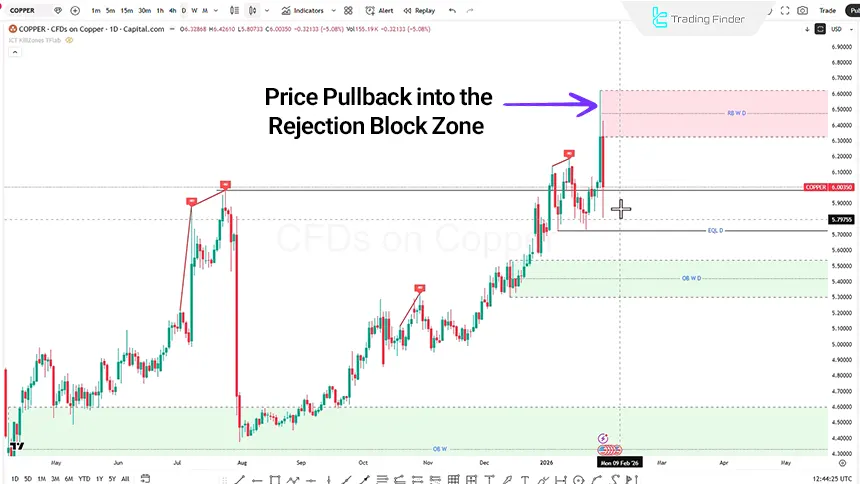
On the daily timeframe, Copper closed above the all-time high without confirmation and then returned to the consolidation range, indicating active selling pressure in the market. This structure is accompanied by the formation of Trading Strategy No. 6 based on the Single Failure Pattern.
A pullback into the weekly Rejection Block (daily-optimized) represents a suitable zone for evaluating short trade entries. In this scenario, the entry point is located at $6.3282, the stop loss at $6.6250, and the price target at the edge of the weekly order block (daily-optimized) at $5.5277.
At lower levels of the chart, a draw-on liquidity zone is identified at $5.7256, attracting price and intensifying bearish pressure. Additionally, if weakness in the bearish trend is observed within the order block zone, a conditional long-entry scenario may also become active.
Copper Price Analysis on the 4-Hour Timeframe (H4)
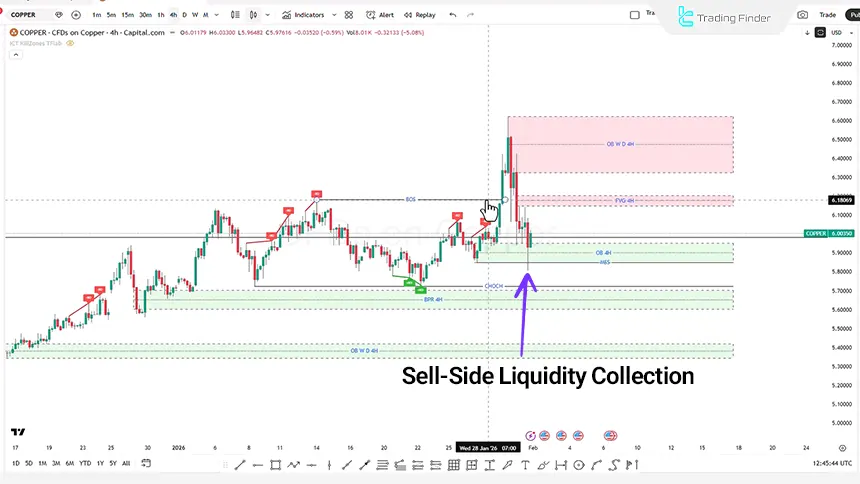
On the 4-hour timeframe, after a bullish move and a Break of Structure, price moved lower and collected sell-side liquidity at the $5.8404 level. Under these conditions, as Monday trading begins, price is expected to initially move higher and collect buy-side liquidity at the $6.1521 level.
Entry into the Fair Value Gap zone followed by a negative reaction from this area may set the stage for the next bearish move and sell-side liquidity collection at $5.7238. Furthermore, if price closes below the $5.8523 level and moves toward $5.8095, a short-term Market Structure Shift becomes visible.
Note: A candle close below $5.7214 confirms a Change of Character, signaling a broader trend shift from bullish to bearish.
Copper Analysis on the 1-Hour Timeframe (H1)
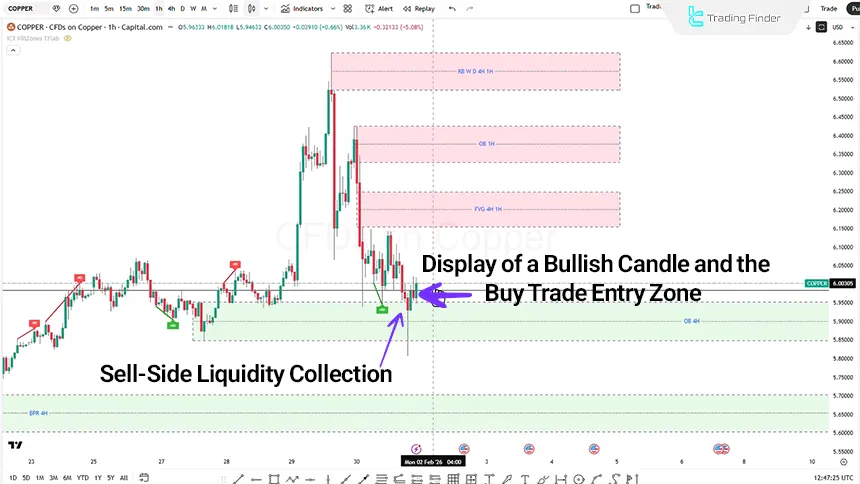
On the 1-hour timeframe, a Pin Bar candle is observed, which collected sell-side liquidity and closed above the 50 percent level of the 4-hour order block range. This structure may serve as the foundation for an independent trading scenario. Formation of three lower layers within the Pin Bar shadow, combined with downward price movement, signals the activation of Trading Strategy No. 2.
Identifying weakness in the bearish trend and the emergence of a bullish candle within this structure provides conditions to evaluate long trade entries. In this scenario, the stop loss is placed behind the Pin Bar swing at $5.8073, while the price target is set at the Fair Value Gap zone around $6.1536.
As a result, liquidity concentration on the 1-hour timeframe increases the importance of this zone, allowing it to act as a price magnet. Simultaneously, a downward price move accompanied by sell-side liquidity collection and a close within the candle shadow highlights the formation of the Ryan Soldier Strategy, which may be evaluated as an independent trade setup.
Conclusion
Copper price structure across multiple timeframes shows signs of weakening bullish momentum and the activation of selling pressure. Failure to stabilize above the all-time high, combined with price reactions to order block and rejection block zones, has shifted market focus toward corrective and bearish scenarios.
The role of draw-on liquidity at lower levels and price behavior within Fair Value Gaps will define the next phase of market movement.
Until a confirmed market structure change is established, trading scenarios remain conditional and driven by liquidity dynamics and momentum behavior.