










China UnionPay is widely used for secure, card-based deposits in Forex trading, especially across China and other Asian markets. While deposits are usually fast and reliable, withdrawals may be broker-dependent and sometimes routed through bank channels or alternative methods rather than UnionPay itself.
Below, the best Forex brokers supporting China UnionPay payments are listed:
 | pepperstone | |||
 | BlackBull Markets | |||
 | eightcap | |||
| 4 |  | Vantage Markets | ||
| 5 |  | FXCC |
China UnionPay Forex Brokers Ranked by Trustpilot Reviews
In this section, China UnionPay-supported Forex brokers are ranked by their Trustpilot scores and review volumes, highlighting how consistently each broker performs in areas such as reliability, service quality, and overall trading experience:
Broker Name | Trustpilot Rating | Number of Reviews |
4.8/5 ⭐️ | 3,070 | |
Vantage Markets | 4.4/5 ⭐️ | 11,686 |
FXCC | 4.3/5 ⭐️ | 114 |
4.2/5 ⭐️ | 3,155 | |
Eightcap | 4.0/5 ⭐️ | 3,406 |
Forex Broker Fees for China UnionPay Payments
This table compares broker-side fees applied to China UnionPay transactions, showing whether brokers absorb processing costs or pass withdrawal charges on to traders:
Broker Name | Deposit Fee | Withdrawal Fee |
$0 | $0 | |
Pepperstone | $0 | $0 |
HF Markets | $0 | $0 |
FXCC | $0 | $0 |
BlackBull Markets | $0 | $5 per Transaction |
China UnionPay Deposit/Withdrawal Time in Forex Brokers
The following table outlines how quickly China UnionPay deposits and withdrawals are processed across different Forex brokers, from instant funding to same-day or next-business-day withdrawals:
Broker Name | Deposit Time | Withdrawal Time |
Vantage Markets | Instant | Instant |
Instant | Up to 1 Business Day | |
VT Markets | Instant | Within 1 Business Day |
Eightcap | Instant | Within 1 Business Day |
BlackBull Markets | Instant on Approval | 24 Hours |
Minimum Amount for China UnionPay Deposit/Withdrawals in Brokers
This table compares the lowest required deposit and withdrawal amounts for China UnionPay across brokers, helping identify platforms suitable for both small and large account balances:
Broker Name | Min. Deposit | Min. Withdrawal |
BlackBull Markets | $0 | $0 |
Pepperstone | $1 | $0 |
$20 | $30 | |
Eightcap | $100 | $50 |
IC Markets | $200 | $1 |
Top 5 Forex Brokers Offering China UnionPay Payments
It’s time to highlight the top five Forex brokers that support China UnionPay, selected based on payment reliability, regulatory standing, trading conditions, and overall user experience.
BlackBull Markets
BlackBull Markets is a multi-award-winning forex and CFD broker, having secured 7industry awards, including MoneyHub and ForexBrokers.com recognitions. Founded in 2014 in New Zealand, the broker provides access to 26,000+ instruments across 6 asset classes, catering to active traders and professionals.

The broker operates under Black Bull Group Limited, regulated by the New Zealand FMA (Tier-1) and the Seychelles FSA (Tier-3). Client funds are held in segregated accounts, supported by tier-1 banking partners, with negative balance protection available across regulated entities.
After registration and BlackBull Markets verification, thebroker offers ECN Standard, ECN Prime, and ECN Institutional accounts, featuring spreads from 0.0 pips andleverage up to 1:500. The platform lineup includes MT4, MT5, TradingView, cTrader, alongside proprietary solutions such as BlackBull CopyTrader and BlackBull Invest.
For traders in Asia-Pacific regions, BlackBull supports a broad range of funding methods, including China UnionPay, cards, bank wire, e-wallets, and crypto. With 24/7 customer support, API trading, and copy-trading tools, the broker positions itself as a high-performance venue for global forex traders.
Broker Specifications:
Account Types | ECN Standard, ECN Prime, ECN Institutional |
Regulating Authorities | New Zealand FMA, Seychelles FSA |
Minimum Deposit | $0 |
Deposit Methods | China UnionPay, Bank Wire, Credit/Debit Cards, E-wallets, Crypto |
Withdrawal Methods | Bank Wire, Union Pay |
Maximum Leverage | 1:500 |
Trading Platforms & Apps | MT4, MT5, TradingView, cTrader |
BlackBull Markets Pros & Cons
Before completing the BlackBull Markets registration process, it’s important to review the broker’s strengths and limitations, which are summarized below to help traders assess its overall suitability:
Pros | Cons |
Access to 26,000+ instruments across multiple markets | Not available for US, UK, and some restricted regions |
ECN pricing with spreads from 0.0 pips | Platform ecosystem may feel complex for beginners |
Strong platform support (MT4, MT5, TradingView, cTrader) | Offshore entity regulated under Tier-3 authority |
No minimum deposit on ECN Standard & Prime accounts | $5 flat fee on all withdrawals |
This balanced profile makes BlackBull Markets a competitive choice among Forex brokers offering China UnionPay, particularly for traders prioritizing platform flexibility, deep liquidity, and institutional-style execution.
Pepperstone
Founded in 2010 in Melbourne, Pepperstone scaled into a global forex and CFD brokerage built around high-frequency execution. The broker reports an average of $9.2B daily trading volume from 400,000+ clients, with order sizes ranging from 0.01 to 100 lots.
Pepperstone’s regulatory footprint spans multiple jurisdictions, including ASIC, FCA, CySEC, DFSA, BaFin, CMA, and SCB. Depending on the entity, client coverage may include FSCS (up to £85,000), ICF (up to €20,000), or EdW (up to €20,000).
Account pricing is built around Standard (spread-only) and Razor (raw spreads + commission), with spreads from 0.0 pips and commissions from $0 (account-dependent). Pepperstone supports 10 base currencies (including USD, EUR, GBP, JPY, and AUD) and offers leverage up to 1:500 under eligible entities.
For traders prioritizing flexible funding, Pepperstone includes China UnionPay alongside cards, bank transfer, PayPal, Skrill, Neteller, and USDT. The broker features include MetaTrader 4, MetaTrader 5, cTrader, TradingView integration, plus proprietary web/mobile apps, and the Pepperstone rebate program.
An overview of the broker parameters:
Account Types | Standard, Razor |
Regulating Authorities | ASIC, FCA, CySEC, DFSA, BaFin, CMA, SCB |
Minimum Deposit | $1 |
Deposit Methods | China UnionPay, Bank Transfer, Credit/Debit Cards, PayPal, Skrill, Neteller, USDT |
Withdrawal Methods | Bank Transfer, UnionPay |
Maximum Leverage | Up to 1:500 (entity-dependent) |
Trading Platforms & Apps | MT4, MT5, cTrader, TradingView, Web & Mobile Apps |
Pepperstone Pros & Cons
The following pros and cons highlight Pepperstone’s practical advantages (execution, platforms, regulation) alongside constraints that may matter depending on region, account type, and available leverage caps. You must take a look into the following list before proceeding with Pepperstone registration:
Pros | Cons |
Multi-regulated structure with Tier-1 oversight across key regions | Leverage capped at 1:30 under several Tier-1 entities |
Razor account built for active trading (raw spreads from 0.0 pips + clear commission model) | No PAMM offering for managed-account style allocation |
Broad platform lineup (MT4/MT5, cTrader, TradingView, proprietary apps) | Promotional/bonus programs typically not offered |
Supports China UnionPay plus multiple e-wallets and crypto funding routes | Demo access may be limited compared with some competitors |
Eightcap
Founded in 2009 in Melbourne, Eightcap is a multi-asset forex and CFD broker focused on fast, platform-centric execution. The broker offers access to 6 markets, Forex, commodities, metals, crypto, indices, and shares, with leverage up to 1:500 (entity-dependent) and order sizing that supports active trading styles.
Eightcap operates across several regulated entities, including oversight by ASIC, FCA, CySEC, and SCB. Depending on jurisdiction, client protections may include FSCS (up to £85,000) or ICF (up to €20,000), alongside segregated accounts and negative balance protection.
The broker structures live trading around Standard, Raw, and TradingView accounts offered after completing the Eightcap registration process. Standard and TradingView accounts start from 1.0 pip (spread-only, share fees may apply), while the Raw account can reach 0-pip spreads with a commission model designed for higher-frequency traders. A $100 minimum deposit is listed for account funding.
Eightcap differentiates its offering with integrated productivity tools: Capitalise.ai for no-code automation, FlashTrader for one-click risk and order placement, and an AI-powered economic calendar that adds event context and historical impact signals. Platform coverage includes MT4, MT5, and TradingView access for chart-first workflows.
Specifications and features of the broker:
Account Types | Standard, Raw, TradingView |
Regulating Authorities | ASIC, FCA, CySEC, SCB |
Minimum Deposit | $100 |
Deposit Methods | China UnionPay, Bank Transfer, Credit/Debit Cards, E-wallets |
Withdrawal Methods | Bank Transfer, UnionPay |
Maximum Leverage | Up to 1:500 (entity-dependent) |
Trading Platforms & Apps | MT4, MT5, TradingView |
Eiightcap Pros & Cons
The pros and cons below summarize where Eightcap tends to stand out (platform flexibility and tooling) and where limitations may appear (deposit threshold, passive options, and account availability by region).
Pros | Cons |
Multi-jurisdiction regulation with ASIC/FCA/CySEC oversight | No copy trading, PAMM, or built-in investment programs |
TradingView-dedicated account option plus MT4/MT5 coverage | $100 minimum deposit may be high versus $0–$10 entry brokers |
Strong trader-assist tooling (Capitalise.ai, FlashTrader, AI calendar) | Educational resources can feel basic for advanced learners |
Eightcap rebate program with cashbacks of up to $3.6 per lot for forex trading | Availability and leverage vary materially by entity/jurisdiction |
Vantage Markets
Founded in 2009 and headquartered in Sydney, Vantage Markets expanded into a global brokerage network with 30+ offices. The broker offers multi-asset access across forex and CFDs on indices, commodities, stocks, and cryptocurrencies, supported by a reported 4.3/5 Google score for general user feedback.

Vantage’s structure includes multiple regulated entities, with Tier-1 oversight from ASIC and FCA, plus regional licensing via FSCA, VFSC, and CIMA. Several entities advertise Lloyd’s insurance coverage up to $1,000,000 (where applicable), alongside segregated accounts and negative balance protection (entity-dependent).
Account coverage spans Standard STP, Standard Cent, Raw ECN, Pro ECN, and Swap Free, with spreads from 0.0 pips on ECN pricing and leverage up to 1:1000 under eligible offshore entities. Minimum deposit starts from $20, while higher-tier accounts such as Pro ECN carry materially higher entry requirements after the completion of the Vantage Markets registration process.
Platform variety is a core differentiator: MetaTrader 4, MetaTrader 5, ProTrader, TradingView integration, and a proprietary mobile application. For passive exposure, Vantage supports third-party copy solutions via ZuluTrade, DupliTrade, and Myfxbook AutoTrade.
Broker specifications:
Account Types | Standard STP, Standard Cent, Raw ECN, Pro ECN, Swap Free |
Regulating Authorities | ASIC, FCA, FSCA, VFSC, CIMA |
Minimum Deposit | $20 |
Deposit Methods | China UnionPay, Bank Transfer, Credit/Debit Cards, E-wallets |
Withdrawal Methods | Bank Transfer, UnionPay |
Maximum Leverage | Up to 1:1000 (offshore entities) |
Trading Platforms & Apps | MT4, MT5, ProTrader, TradingView, Mobile App |
Vantage Markets Pros & Cons
The pros and cons below summarize Vantage Markets’ strongest practical advantages (platform diversity, ECN pricing options, copy integrations) alongside constraints that can affect eligibility, leverage caps, and account accessibility by region.
Pros | Cons |
Multi-entity regulation including Tier-1 oversight (ASIC/FCA) | High minimum deposit for Pro ECN account compared with other tiers |
Five-platform lineup (MT4/MT5/ProTrader/TradingView/proprietary app) | No full-feature proprietary desktop platform listed |
Multiple copy/social options (ZuluTrade, DupliTrade, Myfxbook AutoTrade) | Restricted availability in some countries (e.g., US, Canada; others vary) |
Competitive ECN pricing (spreads from 0.0 pips; commission-based) | Negative balance protection terms vary by entity (not uniform) |
FXCC
Headquartered in Cyprus and operating since 2010, FXCC is a multi-asset broker covering 5 CFD markets: Forex, crypto, indices, metals, and energies. The broker advertises leverage up to 1:500 (entity-dependent) and positions its offering around ECN-style pricing and straightforward account structure.
FXCC operates through Central Clearing Ltd, with regulatory coverage that includes CySEC (license 121/10) for EU/EEA clients and MISA (license BFX2024085) for global clients. Under the EU-facing entity, investor coverage may include ICF protection up to €20,000.
Trading access is centered on a single live account, ECN XL, paired with a demo option. FXCC promotes $0 commission trading with floating spreads from 0.0 pips, plus a swap-free (Islamic) variant. Risk parameters include a 50% stop-out level on the live account, with market execution for order handling. Also, the FXCC verification is mandatory.
Platform availability is focused: FXCC supports MetaTrader 4 only, alongside features such as free VPS (availability and conditions apply) for latency-sensitive strategies. Funding is flexible for an entry-level setup, listing $0 minimum deposit and support for cards, e-wallets, and crypto rails through region-dependent processors.
Broker parameters:
Account Types | ECN XL |
Regulating Authorities | CySEC, MISA |
Minimum Deposit | $0 |
Deposit Methods | Bank Transfer, Credit/Debit Cards, E-wallets, Crypto |
Withdrawal Methods | Bank Transfer, UnionPay |
Maximum Leverage | Up to 1:500 |
Trading Platforms & Apps | MT4 |
FXCC Pros & Cons
The pros and cons below reflect the broker’s core trade-offs that you need to know before initiating the FXCC registration process: a simplified ECN setup with low entry friction versus narrower platform and product breadth compared with larger multi-platform brokers.
Pros | Cons |
EU-facing regulation via CySEC with ICF coverage up to €20,000 | MT4-only offering (no MT5/cTrader/TradingView integration) |
Single ECN XL account with $0 commission model and spreads from 0.0 pips | No variety in live account types beyond ECN XL |
Swap-free (Islamic) option available on the live account | No stocks or ETFs, limiting diversification |
$0 minimum deposit and multi-rail funding (cards, e-wallets, crypto) | Support is 24/5 (no weekend coverage) |
How We Chose the Best Forex Brokers Offering China UnionPay
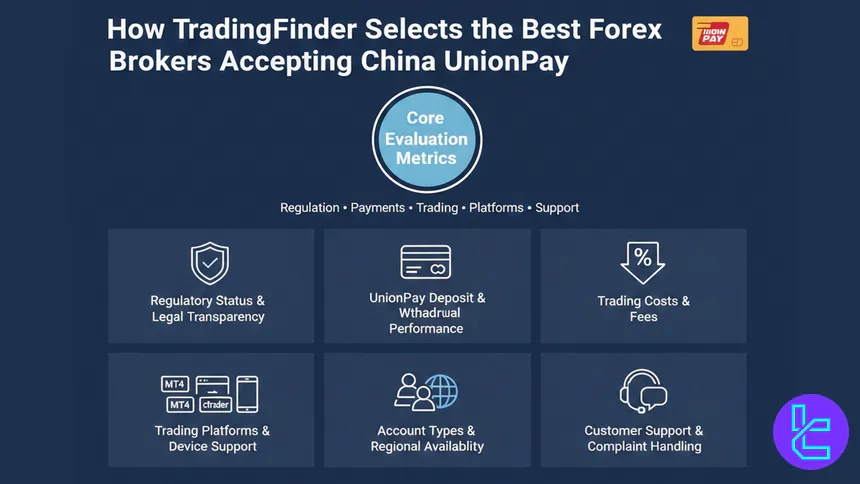
At TradingFinder, broker selection follows a structured, compliance-focused methodology designed for payment reliability. UnionPay support is assessed not only as a funding option but as a fully integrated payment infrastructure aligned with Asian banking systems and international regulatory standards.
Our framework covers 19 evaluation metrics, beginning with regulatory verification. We confirm license validity, legal entity transparency, and investor protection policies such as fund segregation and dispute resolution procedures. Only brokers meeting defined compliance thresholds proceed to payment analysis.
UnionPay functionality is examined in depth. We analyze authorization speed, supported currencies, deposit limits, withdrawal compatibility, and cost transparency. Brokers are also tested for real transaction consistency across desktop, mobile, and regional access points.
Key evaluation criteria:
- Regulatory status and legal entity transparency
- UnionPay deposit & withdrawal speed and limits
- Trading costs (spreads, commissions, non-trading fees)
- Platform support (MT4, MT5, cTrader, web & mobile)
- Account types and regional availability
- Customer support quality and complaint handling
What is China UnionPay?
UnionPay International is the largest card payment network in the world by issued cards. Founded in 2002 and headquartered in Shanghai, UnionPay operates in 180+ countries and regions, providing debit, credit, and prepaid card services across domestic and cross-border payments.
In forex trading, UnionPay functions primarily as a bank-linked card funding method. It allows traders to deposit capital directly through domestic banking infrastructure without relying on global card schemes such as Visa or Mastercard.
Its dominance in Mainland China and strong expansion across Asia make it a strategic payment solution for brokers targeting region-specific traders. Many Asia-focused brokers integrate UnionPay to streamline RMB-linked funding flows.
Core UnionPay features:
- Global acceptance across Asia, Europe, and emerging markets
- RMB and multi-currency transaction support
- Bank-backed infrastructure with domestic clearing in China
- Card-based funding without third-party e-wallets
What are the Pros and Cons of Using China UnionPay in Forex Brokers?
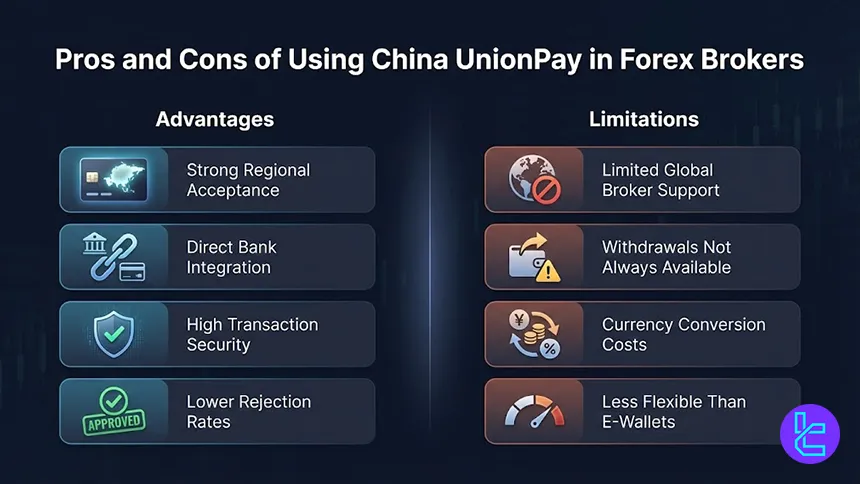
Using China UnionPay in forex trading offers regional convenience and banking integration, especially for traders in China and neighboring markets. However, its functionality differs from e-wallets and international card schemes, which can affect flexibility and processing options depending on the broker.
UnionPay is typically favored for secure deposits rather than rapid withdrawals. While many brokers support instant funding, withdrawals may be routed through bank channels or alternative methods, depending on compliance rules and broker setup.
Here is an overview of the advantages and disadvantages of China UnionPay:
Pros | Cons |
Strong acceptance in China and Asia | Limited broker support outside Asia |
Direct bank-linked card transactions | Withdrawals not always supported |
High security and domestic clearing | Currency conversion costs may apply |
Lower rejection rates for regional traders | Less flexibility than e-wallets |
Compared with e-wallets, UnionPay prioritizes regulated banking pathways over speed flexibility. This distinction influences suitability depending on whether traders prioritize deposit stability or rapid withdrawal cycles.
Does China UnionPay Charge Fees for Transactions?
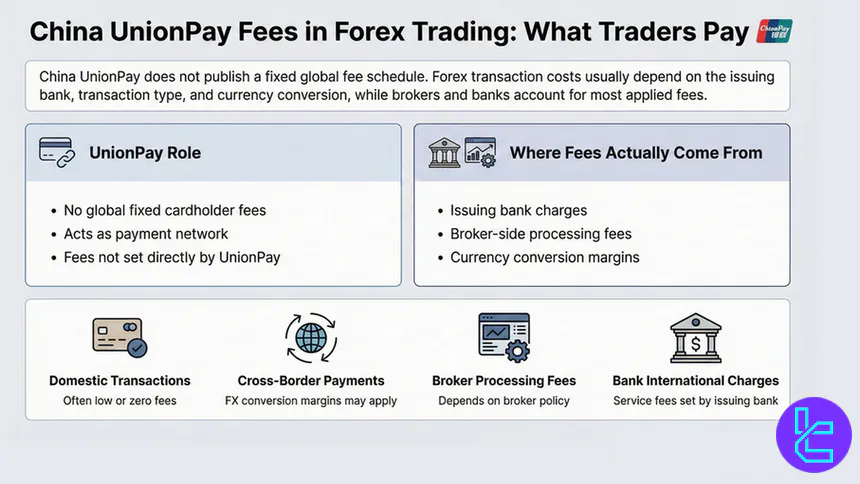
UnionPay does not publish a universal global fee schedule for individual cardholders. Instead, transaction costs depend on issuing banks, currency type, and whether the payment is domestic or cross-border.
In forex trading, brokers often absorb deposit fees to remain competitive. However, currency conversion margins or international processing charges may still apply through the card-issuing bank.
Cross-border RMB transactions typically involve exchange rate spreads determined by the bank. Traders should review both broker disclosures and bank fee policies before funding accounts internationally.
Typical fee considerations:
- Domestic transactions: often low or zero
- Cross-border payments: FX conversion margins
- Broker-side processing fees (if any)
- Bank-imposed international service charges
UnionPay Safety as A Payment Method
UnionPay operates under Chinese banking regulations and institutional oversight. Transactions use chip authentication, encryption protocols, and centralized monitoring systems to reduce fraud exposure and unauthorized access.
In forex funding, UnionPay secures the payment transmission layer. However, overall safety depends equally on broker regulation, fund segregation policies, and operational transparency.
Traders should confirm broker licensing under recognized authorities before depositing. UnionPay adds payment security, but regulatory compliance determines full capital protection.
Key safety considerations:
- Chip-based card authentication and encrypted transactions
- Real-time fraud detection and monitoring systems
- Domestic clearing under the regulated Chinese banking infrastructure
- Broker-side fund segregation and regulatory oversight verification
What Should I Do if Funds Do Not Appear After a China UnionPay Deposit/Withdraw?
Transaction delays may occur due to banking reconciliation or compliance screening. Traders should first verify transaction status within the broker’s client portal and confirm whether the payment shows as pending or completed.
If marked completed but funds are missing, contact broker support with the transaction reference number. Provide timestamps, currency details, and card confirmation evidence.
If unresolved, escalate the issue through the issuing bank. Banks can trace UnionPay payment records and confirm settlement status within the clearing network. Resolution steps:
- Check broker dashboard transaction history;
- Confirm bank statement authorization status;
- Contact broker support with reference number;
- Request bank trace investigation if needed.
How to Deposit/Withdraw in Forex Brokers Using China UnionPay
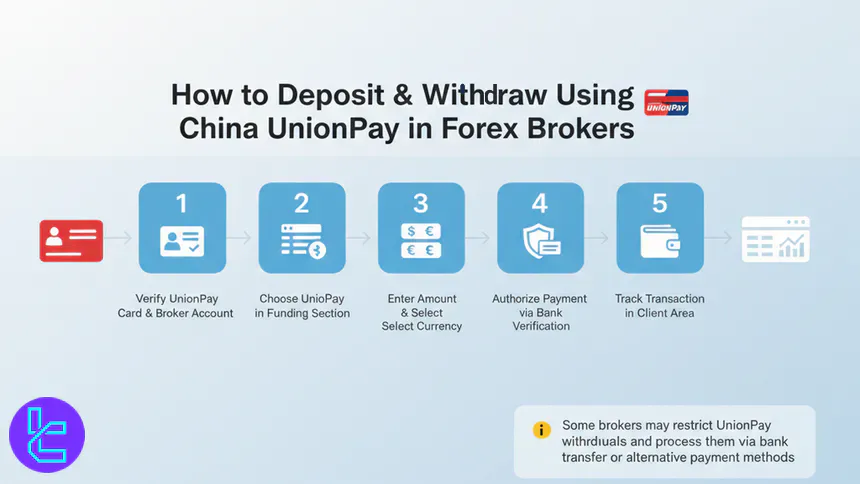
Depositing funds via China UnionPay is usually straightforward when supported by the broker. Most platforms treat UnionPay as a card payment method, similar to debit cards, with fast authorization and secure processing. Withdrawals, however, may be limited.
Most brokers process deposits quickly once authorization is confirmed. Withdrawal availability depends on broker policy, regulatory framework, and regional compliance rules.
Some brokers require withdrawals through bank transfer even if UnionPay was used for deposits. Reviewing payment policy terms beforehand prevents unexpected limitations.
Deposit & withdrawal process:
- Verify your UnionPay card and broker account;
- Select UnionPay in the broker’s funding section;
- Enter amount and confirm currency;
- Authorize payment via bank verification;
- Track transaction status in the client area.
Are There Inactivity Fees for China UnionPay Accounts?
UnionPay does not impose inactivity fees at the network level. Card validity and account status are governed by the issuing bank rather than transaction frequency. If traders encounter inactivity charges, they usually originate from the forex broker.
Many brokers apply dormancy fees after several months without trading activity. These charges are unrelated to the payment method used. Traders should review broker account terms to understand inactivity timelines and fee structures.
Forex brokers may apply inactivity or dormancy fees if a trading account remains unused for several months. These charges are independent of the payment method used for funding. Inactivity fee considerations:
- UnionPay network does not charge dormancy fees
- Issuing banks determine card validity policies
- Brokers may apply trading account inactivity fees
- Fee schedules are outlined in broker terms and conditions
Does China UnionPay Require Specific Regulatory Licenses for Eligible Forex Brokers?
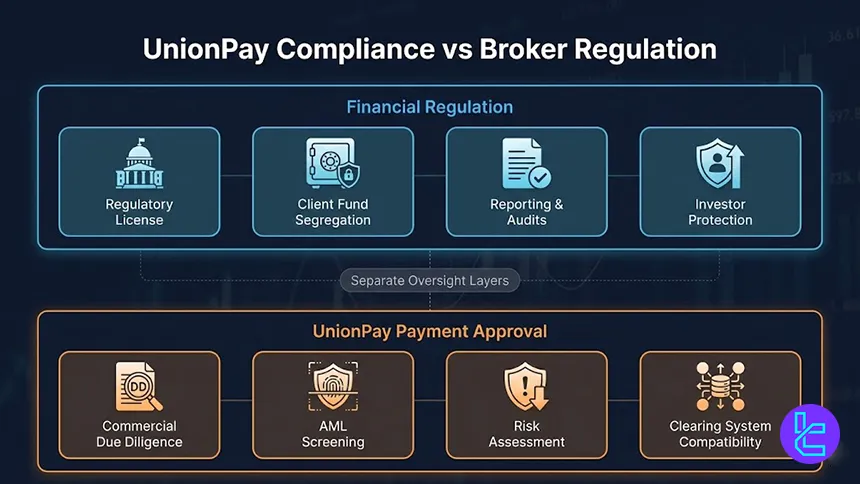
UnionPay does not publish a single mandatory regulatory license for all participating forex brokers. However, brokers must pass commercial due diligence, AML checks, and risk assessments before integration.
Acquiring banks and payment processors coordinate approval. This process ensures operational compliance but does not substitute for financial market regulation.
Most UnionPay-supported brokers operate under recognized regulatory authorities or structured offshore frameworks. Payment approval adds compliance oversight but does not replace formal broker licensing.
Compliance framework factors:
- Commercial due diligence by acquiring institutions
- AML and risk assessment screening
- Operational compatibility with UnionPay clearing systems
- Separate verification of broker's financial regulation status
How Does China UnionPay Compare to Other Payment Methods?
China UnionPay competes mainly with Visa, Mastercard, and regional bank transfers rather than e-wallets. It excels in Asian markets but offers less global flexibility than international card networks or digital wallets like Skrill and Neteller.
For traders in China, UnionPay often provides higher acceptance and fewer declines, while international traders may prefer e-wallets for faster withdrawals and multi-currency management.
In the table below, we have compared China UnionPay with similar payment options:
Parameter | China UnionPay | Bank Wire Transfer | Credit Cards | Skrill |
Broker Acceptance | Moderately accepted; mainly by Asia-focused brokers | Widely accepted by regulated Forex brokers | Widely accepted by most brokers | Widely accepted, especially in Forex |
Deposit Speed | Instant to a few minutes | 1-5 business days | Instant to a few minutes | Instant to a few minutes |
Withdrawal Speed | Broker-dependent; often bank-routed (1-5 days) | 1-5 business days | 1-5 business days | Same day to 24 hours |
Transaction Fees | Low to moderate; bank & FX conversion dependent | Often higher; bank & intermediary fees | Low to moderate; issuer/broker-dependent | Low to moderate; wallet fees may apply |
Supported Currencies | Primarily CNY; FX conversion supported | Depends on bank & broker base currencies | Depends on card & broker | 40+ fiat currencies |
Security & Compliance | Very high; bank-backed network with domestic clearing | Very high; bank-level AML/KYC | High; chargeback & fraud protection | Strong KYC; regulated e-wallet |
Typical Forex Deposit Limits | Medium to high; bank & broker-defined | High limits; ideal for large transfers | Medium limits; broker-defined caps | Low minimums; flexible limits |
Regional Availability | Strong in China & Asia; limited elsewhere | Global | Global | Global; strong in EU & Asia |
Conclusion
China UnionPay deposits are fast and reliable, but withdrawals can be more restrictive and often depend on broker policy or bank routing.
Pepperstone, BlackBull Markets, Eightcap, Vantage Markets, and FXCC stand out as some of the best China UnionPay Forex brokers, combining instant funding, transparent fees, and regulated trading environments.
If you want to see how these brokers were evaluated, review our Forex methodology, which breaks down the exact metrics used to rank UnionPay-supported brokers.