





Direct Market Access (DMA) brokers enable traders to directly access the market and the sellers, eliminating the need for a dealing desk or a network that connects buyers with sellers. These brokerages have specific benefits that attract traders.
Here are 8 of the best Forex brokers offering DMA trading to their clients.
 | HFM | |||
 | fpmarkets | |||
 | pepperstone | |||
| 4 |  | IC Markets | ||
| 5 |  | ACTIVTRADES | ||
| 6 |  | IUX | ||
| 7 |  | AVATRADE | ||
| 8 |  | NORD FX |
Trustpilot Ratings in Select Brokers
Users can submit reviews and scores on “Trustpilot”, reflecting their experience. The table in this section ranks the recommended brokers based on submitted ratings.
Broker Name | Trustpilot Rating | Number of Reviews |
10,000 | ||
IC Markets | 51,458 | |
AvaTrade | 11,907 | |
3,286 | ||
NordFX | 80 | |
Pepperstone | 3,214 | |
IUX | 886 | |
ActivTrades | 1,066 |
Minimum Spread Levels in DMA Brokers
Spreads are part of trades in Forex brokers; they vary based on market conditions, account type, and other parameters.
Broker Name | Min. Spread |
0 Pips | |
AvaTrade | 0 Pips |
FxPro | 0 Pips |
NordFX | 0 Pips |
0 Pips | |
IUX | 0 Pips |
Interactive Brokers | 0 Pips |
IG | 0.3 Pips |
Account Types and Leverage Availability Comparison
DMA brokers offer various account types, such as Standard, ECN, Cent, and more. Also, the available leverage may differ.
Broker Name | Account Types | Max. Leverage |
IC Markets | Standard, Raw Spread, Islamic | 1:500 |
Professional, Individual, Demo, Islamic | 1:400 | |
FxPro | Standard, Raw+, Elite | 1:500 |
NordFX | MT4 Zero, MT4 Pro, MT5 Zero, MT5 Pro | 1:1000 |
Pepperstone | Standard, Razor | Up to 1:500 |
Standard, Raw, Pro | 1:3000 | |
Interactive Brokers | Individual, Joint, Trust, Retirement, Institutional, Non-Professional Advisor | 1:1000 |
FOREX.com | Standard, Raw Spread, MetaTrader | 1:50 |
Number of Instruments in DMA Brokers
The table in this section lists and ranks mentioned brokerages with respective number of trading instruments. A higher number enables more diversity in investment.
Broker Name | Number of Instruments |
IC Markets | 2,250+ |
1,250+ | |
FxPro | 2,100+ |
500+ | |
Pepperstone | 1,200+ |
IG | 17,000+ |
Interactive Brokers | 4,900+ |
FOREX.com | 5,500+ |
Top 6 DMA Forex Brokers in Detail
The following sections will dig deeper into the noteworthy specifications and features of brokerages, such as non-trading fees and cashback programs.
FP Markets
Founded in 2005, FP Markets (First Prudential Markets) is an Australian-based multi-regulated Forex and CFD broker operating under top-tier authorities such as Australian Securities and Investments Commission (ASIC) and Cyprus Securities and Exchange Commission (CySEC - License No. 371/18).
The broker also maintains licenses with FSCA, FSC, and FSA entities across multiple jurisdictions.
FP Markets provides two primary retail account types - Standard and RAW - both requiring a minimum deposit of $50. RAW accounts offer spreads from 0.0 pips with a $3 commission per lot, aligning with DMA-style pricing structures and institutional-grade liquidity access.
You may participate in FP Markets rebate program for reduced trading fees and spreads.
The broker supports MT4, MT5, and cTrader, enabling manual, algorithmic, and ECN-based trading. With over 10,000 tradable instruments across Forex, indices, stocks, commodities, ETFs, metals, and cryptocurrencies, FP Markets delivers broad multi-asset exposure under a single trading environment.
Client protection measures include segregated funds, negative balance protection, and compensation coverage up to €20,000 under CySEC’s Investor Compensation Fund (ICF). Leverage varies by jurisdiction, ranging from 1:30 in EU/Australia to significantly higher ratios in offshore-regulated entities.
Table of Specifics
Account Types | Standard, RAW |
Regulating Authorities | ASIC, CySEC, FSC, FSCA, FSA |
Minimum Deposit | $50 |
Deposit Methods | Visa and Master card, Skrill, PayPal, Neteller, Bank Transfer |
Withdrawal Methods | Visa and Master card, Skrill, PayPal, Neteller, Bank Transfer |
Maximum Leverage | 1:500 |
Trading Platforms & Apps | MT4, MT5, cTrader |
FP Markets Pros and Cons
Overall, FP Markets combines competitive DMA pricing, global regulatory coverage, and diverse platform access. Below is a balanced overview of its primary advantages and limitations.
Pros | Cons |
Regulated by ASIC and CySEC (Tier-1 oversight) | Not available to US clients |
RAW spreads from 0.0 pips with $3 commission | No proprietary trading platform |
Access to 10,000+ instruments across 7 asset classes | Higher leverage only under offshore entities |
MT4, MT5, and cTrader support (ECN-compatible) | Investor compensation depends on entity |
IC Markets
IC Markets is a multi-asset DMA-focused Forex and CFD broker established in 2007, offering access to over 2,100 stock CFDs and 60+ currency pairs. With a $200 minimum deposit and 10 base currencies (USD, EUR, GBP, AUD, SGD, NZD, JPY, CHF, HKD, CAD), it supports globally diversified trading portfolios.
The broker operates under the supervision of Australian Securities and Investments Commission (ASIC), Cyprus Securities and Exchange Commission (CySEC), and the Financial Services Authority (FSA).
EU clients benefit from Investor Compensation Fund protection up to €20,000, while segregated client funds and AML compliance strengthen operational integrity.
IC Markets offers three primary account types: Standard (from 0.8 pips, no commission), Raw Spread (from 0.0 pips, $3.5 per lot MT4/MT5), and cTrader Raw ($3 per lot). Maximum leverage reaches 1:500 under offshore regulation, with institutional-style market execution suited for scalpers and algorithmic traders.
It’s worth noting that there is an IC Markets rebate program available for discounts on trading fees.
Platforms include MetaTrader 4, MetaTrader 5, and cTrader, alongside mobile apps. The broker supports Islamic (swap-free) accounts and copy trading via cTrader. Average EUR/USD spreads can reach 0.1 pips on Raw accounts, positioning IC Markets among low-cost DMA providers.
Table of Specifications
Account Types | Standard, Raw Spread, Islamic |
Regulating Authorities | FSA, CySEC, ASIC |
Minimum Deposit | $200 |
Deposit Methods | Bank Cards, Wire Transfers, Electronic payments, etc. |
Withdrawal Methods | Bank Cards, Wire Transfers, Electronic payments, etc. |
Maximum Leverage | 1:500 |
Trading Platforms & Apps | Metatrader 4, Metatrader 5, cTrader, cTrader Web, IC Markets Mobile |
IC Markets Pros and Cons
Overall, IC Markets combines multi-regulation, competitive pricing, and deep liquidity access. Below is a balanced overview of its main advantages and limitations for DMA-focused traders.
Pros | Cons |
Raw Spread accounts from 0.0 pips | $200 minimum deposit may be high for beginners |
Multi-regulated (ASIC, CySEC, FSA) | Leverage capped at 1:30 in EU/Australia |
2,100+ stock CFDs and broad asset coverage | No PAMM account offering |
Strong support for scalping and EAs | Offshore entity offers lower investor protection |
AvaTrade
AvaTrade is a multi-jurisdictional brokerage operating under nine regulatory licenses, including oversight from the Central Bank of Ireland, ASIC, CySEC, FSCA, and ADGM. Its global regulatory footprint enhances credibility for traders seeking DMA-style institutional-grade environments.
Client fund protection includes segregated accounts and negative balance protection across regulated entities. Under EU branches, compensation coverage reaches up to €20,000 via investor protection schemes. Margin call and stop-out levels are set at 25% and 10%, supporting structured risk control within leveraged trading frameworks.
AvaTrade offers Retail, Professional, Islamic, and Demo accounts with a minimum deposit of $100. Base currencies include USD, EUR, GBP, CHF, JPY, and AUD. Maximum leverage reaches 1:400 (jurisdiction-dependent), while minimum trade size starts from 0.01 lot, aligning with scalable position management strategies.
It’s worth noting that you can participate in the AvaTrade rebate program to reduce trading fees and related costs.
Platform infrastructure includes MetaTrader 4, MetaTrader 5, WebTrader, Mobile App, and AvaOptions. The broker supports over 1,250 CFD instruments across Forex, indices, commodities, stocks, bonds, and crypto. Instant execution, fixed spreads, and no deposit/withdrawal commissions define its cost structure.
Table of Specifics
Account Types | Retail, Professional, Islamic, Demo |
Regulating Authorities | ASIC, CySEC, CBI, FSA, FSCA, MiFID, ADGM, PFSA, ISA |
Minimum Deposit | $100 |
Deposit Methods | Credit/Debit Cards, E-Wallets, Bank Wire Transfer, PayPal |
Withdrawal Methods | Credit/Debit Cards, E-Wallets, Bank Wire Transfer, PayPal |
Maximum Leverage | 1:400 |
Trading Platforms & Apps | MetaTrader 4, MetaTrader 5, Mobile App, WebTrader |
AvaTrade Pros and Cons
From a DMA account perspective, AvaTrade combines regulatory depth, diversified instruments, and multi-platform access, though its spread model and limited raw ECN transparency may not suit all high-frequency traders. Below is a balanced overview of its strengths and limitations, which must be considered before AvaTrade registration.
Pros | Cons |
Regulated by 9 authorities across multiple jurisdictions | No dedicated RAW/DMA account structure |
Segregated funds & negative balance protection | Fixed spread model may be wider than ECN |
1,250+ tradable CFD instruments | Inactivity fee after 2 months |
Multiple platforms including MT4, MT5, and AvaOptions | Not available to U.S. traders |
HFM
HF Markets, operating under the HFM brand, has served global traders since 2010 and now hosts over 2.5 million live accounts. The broker provides DMA-style access across multiple asset classes, combining floating spreads from 0.0 pips with market execution on MT4 and MT5 platforms.
HFM operates through regulated entities including CySEC (183/12), FCA (801701), DFSA (F004885), FSCA (46632), and Seychelles FSA. This multi-tier structure enables leverage up to 1:2000 (offshore entities) while maintaining negative balance protection and segregated client funds.
The broker offers Cent, Zero, Pro, and Premium accounts with a minimum deposit from $0 and base currencies including USD, EUR, and USC. Forex trading is commission-free except on the Zero account, where spreads from 0.0 pips apply alongside fixed per-lot commissions.
HFM supports crypto deposits (TRC20/ERC20), copy trading, PAMM solutions, Autochartist integration, VPS services, and SMS alerts. With over 1,000 CFDs across Forex, metals, indices, stocks, ETFs, bonds, and crypto, the broker positions itself as a high-volume DMA-oriented provider for diversified portfolios.
Specifications and Parameters
Account Types | Cent, Zero, Pro, Premium |
Regulating Authorities | CySEC, DFSA, FCA, FSCA, FSA |
Minimum Deposit | From $0.00 |
Deposit Methods | Wire transfer, E-payments, Credit/Debit cards, Crypto |
Withdrawal Methods | Wire transfer, E-payments, Credit/Debit cards, Crypto |
Maximum Leverage | 1:2000 |
Trading Platforms & Apps | MT4, MT5, Mobile App |
HFM Pros and Cons
HFM combines regulatory depth, high leverage flexibility, and competitive pricing, but traders should weigh execution conditions and platform limitations against their specific DMA trading requirements. Before HFM registration, check this balanced overview of its key strengths and weaknesses.
Pros | Cons |
Multi-regulated (FCA, CySEC, DFSA, FSCA) | Geo-restrictions (U.S., France, Belgium, etc.) |
Spreads from 0.0 pips (Zero account) | Limited proprietary trading platform ecosystem |
Leverage up to 1:2000 (offshore entity) | Inactivity fees after 6 months |
Wide asset coverage (1,000+ CFDs) | Mixed customer support reviews |
NordFX
Founded in 2008, NordFX has grown into a global online trading provider serving over 1.7 million accounts across 190 countries. With more than 16 years of market presence, the broker offers DMA-style access through Zero accounts with spreads from 0.0 pips and market execution.

NordFX provides four primary account types: MT4 Pro, MT4 Zero, MT5 Pro, and MT5 Zero. Minimum deposits start from just $10, while leverage reaches up to 1:1000, making the broker accessible to both retail traders and high-risk, high-capital strategies. For a review of the broker’s user interface and personal cabinet, check out the NordFX dashboard article.
Trading is conducted exclusively on MetaTrader 4 and MetaTrader 5, supporting advanced charting, algorithmic trading via Expert Advisors (EAs), VPS hosting, and MQL5 signal integration. Zero accounts apply a 0.0035% commission per trade, targeting scalpers and active DMA-oriented traders.
NordFX operates through entities in Saint Lucia, Seychelles (FSA), and Mauritius (FSC). While segregated funds and negative balance protection are available under certain branches, the broker lacks top-tier regulatory oversight and does not provide an investor compensation scheme.
It’s worth noting that to access all features and options, you should pass the NordFX verification. The table below summarizes the broker’s specifics.
Account Types | MT4 Zero, MT4 Pro, MT5 Zero, MT5 Pro |
Regulating Authorities | Not regulated |
Minimum Deposit | $10 |
Deposit Methods | Bank wire transfer, Credit/debit cards, E-wallets, Cryptocurrencies |
Withdrawal Methods | Bank wire transfer, Credit/debit cards, E-wallets, Cryptocurrencies, Internal Transfer |
Maximum Leverage | 1:1000 |
Trading Platforms & Apps | MT4 / MT5 |
NordFX Pros and Cons
NordFX’s strengths lie in high leverage, low minimum deposits, tight spreads, and multiple payment solutions, including crypto deposits via TRC20 and ERC20. However, regulatory limitations and the absence of a compensation fund remain key considerations for risk-focused traders.
Pros | Cons |
Spreads from 0.0 pips on Zero accounts | No top-tier regulation (FCA/ASIC equivalent) |
High leverage up to 1:1000 | No investor compensation fund |
Low minimum deposit from $10 | Limited research and educational depth |
Multiple crypto deposit options (TRC20, ERC20, BEP20) | Restricted access for several major jurisdictions |
Pepperstone
Founded in2010 in Melbourne, Pepperstone has evolved into a globally recognized DMA-focused broker, processing an average of $9.2 billion in daily trading volume for over 400,000 clients. Its infrastructure is designed for direct market access, fast execution, and institutional-grade liquidity aggregation.
Pepperstone operates under multiple regulators, including Australian Securities and Investments Commission (ASIC), Financial Conduct Authority (FCA), Cyprus Securities and Exchange Commission (CySEC), Dubai Financial Services Authority (DFSA), and Federal Financial Supervisory Authority (BaFin).
Client funds are held in segregated accounts, with negative balance protection across regulated entities.
The broker supports 10 base currencies (AUD, USD, GBP, JPY, EUR, CAD, CHF, NZD, SGD, HKD) and offers leverage up to 1:500 depending on jurisdiction. Traders can place orders from 0.01 to 100 lots, with margin call/stop-out levels at 90%/20%, ensuring structured risk control.
It’s wroth noting that a Pepperstone rebate program is launched offering discounts on trading fees and related costs.
Pepperstone provides DMA-style execution via Razor and Standard accounts, with spreads from 0.0 pips and commissions starting from $0 (Standard) or $3.5 per side (Razor). Platforms include MT4, MT5, cTrader, TradingView, and a proprietary interface; supporting EAs, hedging, and scalping strategies.
Table of Specifications
Account Types | Standard, Razor |
Regulating Authorities | ASIC, SCB, FCA, DFSA, CMA, BaFin, CySEC |
Minimum Deposit | $1 |
Deposit Methods | Apple Pay, Google Pay, Visa, Mastercard, Bank transfer, PayPal, Neteller, Skrill, Union Pay, USDT, ZotaPay |
Withdrawal Methods | Apple Pay, Google Pay, Visa, Mastercard, Bank transfer, PayPal, Neteller, Skrill, Union Pay, USDT, ZotaPay |
Maximum Leverage | Up to 1:500 |
Trading Platforms & Apps | Proprietary Platform, cTrader, Trading View, MetaTrader 4&5 |
Pepperstone Pros & Cons
Pepperstone’s advantages and limitations are summarized below to provide a balanced perspective for DMA-focused traders.
Pros | Cons |
Regulated by multiple Tier-1 authorities (ASIC, FCA, BaFin, CySEC) | No PAMM account offering |
Razor account with raw spreads from 0.0 pips | Bonuses and promotions not available |
Supports MT4, MT5, cTrader, and TradingView | Certain leverage limits under Tier-1 jurisdictions |
Deep liquidity with high daily trading volume ($9.2B average) | Restricted access in countries like the US and Canada |
How Was Each Broker Selected?
Selecting the Best DMA Forex Brokers requires more than reviewing spreads or leverage. At TradingFinder, our evaluation is based on a structured 19-metric framework designed to measure transparency, execution quality, and institutional reliability. DMA (Direct Market Access) brokers are assessed specifically for order routing models, liquidity access, and pricing integrity.
The first layer of analysis focuses on Regulations and Licenses. We verify oversight by top-tier authorities such as the Financial Conduct Authority (FCA), Australian Securities and Investments Commission (ASIC), and CySEC.
We also review asset segregation policies, investor compensation schemes, and any alerts or scam reports to ensure capital protection standards are met.
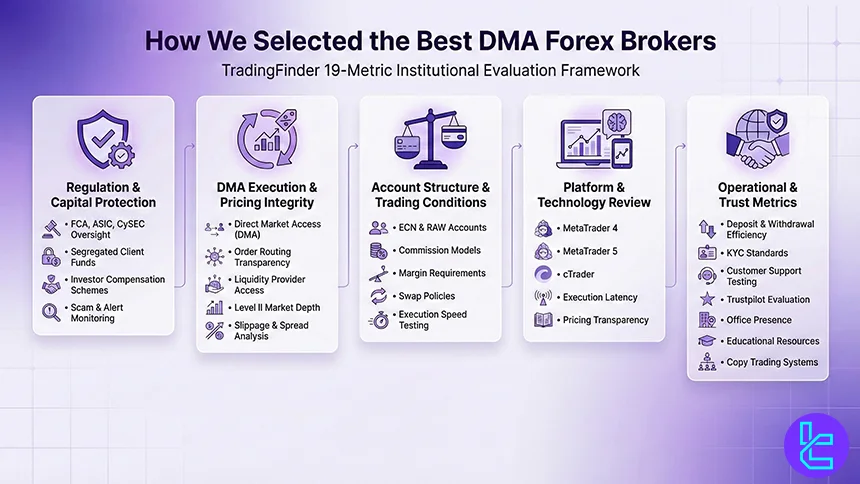
Next, we analyze account structure and trading conditions. This includes ECN and RAW account availability, commission models, spread transparency, slippage statistics, margin requirements, and swap policies.
We directly test platforms like MetaTrader 4, MetaTrader 5, and cTrader to evaluate execution speed, Level II pricing, and liquidity depth, critical components for DMA trading strategies.
Operational factors are equally important. Our team reviews deposit and withdrawal efficiency, KYC procedures, customer support responsiveness, Trustpilot score, office locations, and educational tools. We also assess copy trading features, micro-data transparency, infographics, and broker responsiveness to user complaints.
Finally, TradingFinder’s analysts, who are experienced in forex, CFDs, stocks, and crypto markets, weight each metric according to its real impact on trader performance. This methodology ensures that every broker listed in our DMA comparison meets strict standards of regulation, execution quality, and client experience.
What is a DMA Forex Broker?
A DMA Forex broker (Direct Market Access broker) is a brokerage model that allows traders to place orders directly into the interbank market or to external liquidity providers without internal dealing desk intervention.
Instead of acting as a market maker, the broker connects clients to a network of banks, prime brokers, hedge funds, and institutional liquidity pools.
In a DMA environment, pricing is derived from multiple liquidity providers, often displayed through Level II market depth. Traders can see bid and ask volumes at different price levels, which enhances transparency and improves order execution quality.
This structure is commonly associated with ECN or STP execution models but is more specifically focused on direct order routing.
Unlike market maker brokers, DMA brokers typically do not take the opposite side of a client’s trade. Instead, they earn revenue through commissions and markups on raw spreads. As a result, spreads are often variable and can reach near-zero levels during high-liquidity sessions, depending on market conditions.
DMA Forex brokers are particularly attractive to professional traders, scalpers, and algorithmic trading strategies that rely on tight spreads, low latency, and minimal requotes. Platforms such as MetaTrader 4, MetaTrader 5, and cTrader frequently support DMA-style execution when integrated with institutional liquidity providers.
Overall, DMA trading emphasizes transparency, competitive pricing, and direct connectivity to global forex markets; making it a preferred model for traders seeking institutional-grade execution standards.
What are the Advantages and Disadvantages of DMA?
Direct Market Access (DMA) provides traders with institutional-style execution by routing orders directly to liquidity providers instead of through a dealing desk.
This model enhances transparency and pricing efficiency but may introduce variable spreads and commission costs. DMA is commonly preferred by high-frequency, scalping, and algorithmic traders who prioritize execution speed and market depth visibility.
Advantages | Disadvantages |
Direct access to interbank liquidity providers | Commission-based pricing structure |
Greater pricing transparency with Level II market depth | Variable spreads during low-liquidity periods |
Reduced conflict of interest (no dealing desk intervention) | Higher minimum deposit requirements in some brokers |
Faster execution with lower requote risk | May not be ideal for beginners due to complexity |
Suitable for scalping and algorithmic trading strategies | Potential slippage during high volatility |
How Does a DMA Forex Broker Operate?
A DMA Forex broker operates by routing client orders directly to external liquidity providers rather than internalizing trades through a dealing desk. When a trader places an order on platforms such as MetaTrader 4, MetaTrader 5, or cTrader, the order is transmitted to the broker’s liquidity aggregation system.
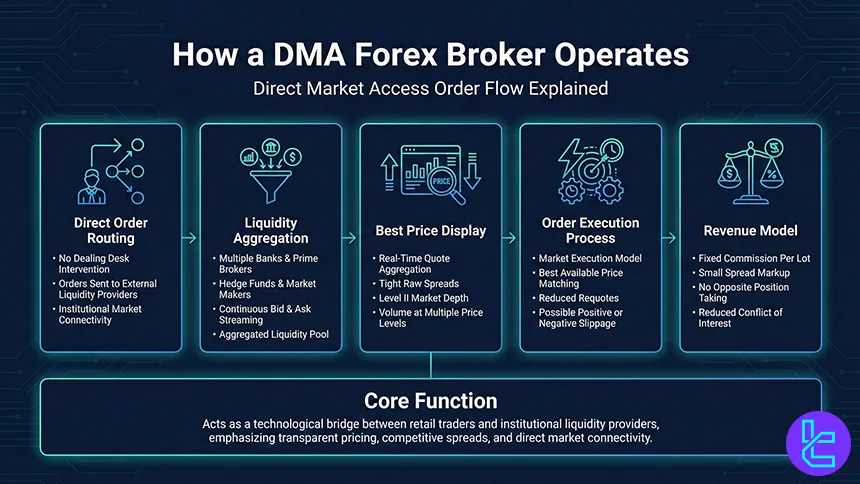
The broker connects to multiple banks, prime brokers, hedge funds, and institutional market makers. These entities continuously stream bid and ask prices into a liquidity pool.
The DMA broker’s technology aggregates these quotes and displays the best available prices to the trader, often including Level II market depth, which shows available volumes at different price levels.
Once an order is submitted, it is matched with the best available counterparty in real time. Execution is typically handled via market execution, meaning trades are filled at the best available price rather than a pre-confirmed quote. This structure reduces requotes but may result in positive or negative slippage during volatile conditions.
DMA brokers generally generate revenue through fixed commissions per lot or a small markup added to raw spreads. Since they do not take the opposite side of client positions, conflicts of interest are minimized compared to traditional market maker models.
In essence, a DMA Forex broker acts as a technological bridge between retail traders and institutional liquidity providers, emphasizing transparent pricing, competitive spreads, and direct market connectivity.
Do DMA Forex Brokers Have Wider Spreads?
DMA Forex brokers do not inherently offer wider spreads, but their spreads are typically variable rather than fixed. Because pricing comes directly from liquidity providers, such as banks and institutional market makers, spreads reflect real-time supply and demand conditions in the interbank market.
During high-liquidity sessions (for example, the London-New York overlap), major currency pairs like EUR/USD may show raw spreads close to 0.0-0.2 pips. However, in low-liquidity periods or during high-impact economic news releases, spreads can widen significantly due to reduced order book depth and increased volatility.
Unlike market maker brokers that may offer fixed spreads, DMA brokers usually apply a commission per lot on top of raw spreads. This means that while the quoted spread may appear tighter, the trader’s total trading cost (spread + commission) should be evaluated holistically.
It is also important to consider slippage and liquidity fragmentation. Since DMA brokers use market execution, trades are filled at the best available price in the liquidity pool, which may lead to slight spread fluctuations. Overall, DMA spreads are market-driven-not artificially widened-but they can expand temporarily under volatile conditions.
Do DMA Brokers Charge Different Non-Trading Fees?
DMA Forex brokers generally donot have a fundamentally different non-trading fee structure compared to other broker models such as STP or market makers. Non-trading fees refer to costs unrelated to placing trades, including deposit and withdrawal fees, inactivity fees, currency conversion charges, and administrative costs.
Most DMA brokers generate their primary revenue through commissions and raw spreads, meaning non-trading fees are not their main income source. However, certain charges may still apply depending on the broker’s policies and regulatory environment.
For example, withdrawal fees may vary based on the payment provider (bank wire, card processor, or e-wallet), while currency conversion fees may apply if the trading account base currency differs from the funding currency.
Inactivity fees are also common across the industry, including among DMA brokers, particularly if an account remains dormant for several months. These fees are typically disclosed in the broker’s terms and conditions.
It is important to note that DMA accounts may sometimes have higher minimum deposit requirements, but this is not a non-trading fee; it is a capital threshold. Overall, DMA brokers do not systematically charge higher non-trading fees; costs depend on the individual broker’s pricing structure and regulatory obligations.
Who Should Register with DMA Brokers?
DMA brokers are designed for traders who prioritize execution transparency, institutional pricing, and direct connectivity to liquidity providers. Because DMA accounts typically operate with raw spreads and commission-based pricing, they are more suitable for traders who understand spread dynamics, slippage, and order book depth.
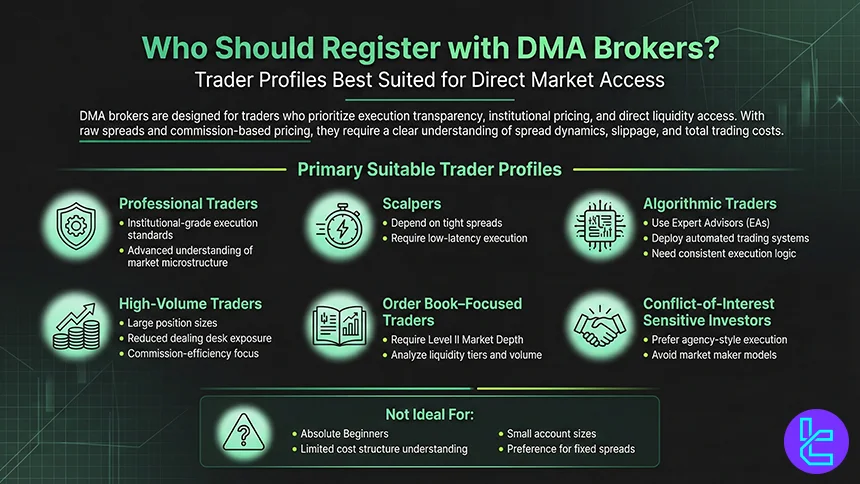
DMA is not necessarily ideal for absolute beginners. The variable spread environment and commission structure require a clear understanding of total trading costs (spread + commission) and execution mechanics. However, for experienced traders, DMA can provide measurable advantages in speed and pricing efficiency.
The following types of traders are typically best suited for DMA brokers:
- Professional traders seeking institutional-grade execution
- Scalpers who rely on tight spreads and low latency
- Algorithmic traders using Expert Advisors (EAs) or automated systems
- High-volume traders aiming to reduce dealing desk intervention
- Traders who require Level II market depth visibility
- Investors sensitive to conflict-of-interest risks in market maker models
In contrast, beginners with small account sizes or traders who prefer fixed spreads and simplified pricing may find standard or market maker accounts easier to manage.
Overall, DMA brokers are most appropriate for market participants who understand execution quality, liquidity structure, and commission-based cost models.
What Tradable Instruments Do DMA Brokers Offer?
DMA brokers typically provide access to a broad range of financial instruments, depending on their liquidity partnerships and regulatory framework. Because DMA models connect traders directly to external liquidity providers, the available instruments often mirror institutional market offerings rather than limited in-house product lists.
In the forex market, DMA brokers commonly offer major, minor, and exotic currency pairs with raw spreads sourced from banks and prime brokers. In addition to spot FX, many DMA brokers provide access to CFDs (Contracts for Difference) on global asset classes.
Common tradable instruments offered by DMA brokers include:
- Major, minor, and exotic forex pairs
- Stock CFDs (US, European, and Asian equities)
- Index CFDs (S&P 500, NASDAQ 100, DAX 40, FTSE 100, etc.)
- Commodity CFDs (Gold, Silver, Crude Oil, Natural Gas)
- Cryptocurrency CFDs (Bitcoin, Ethereum, and other major coins)
- ETFs (in some jurisdictions)
- Futures CFDs or direct exchange-traded futures (with certain brokers)
Some advanced DMA brokers also provide direct access to exchange-traded equities and futures through multi-asset platforms, particularly under strong regulatory oversight.
The exact product range depends on the broker’s licenses, liquidity providers, and trading platform infrastructure. However, DMA brokers are generally known for offering multi-asset access aligned with institutional pricing and execution standards.
Tips Before Choosing A DMA Broker
Choosing a DMA broker requires careful evaluation beyond headline spreads or leverage. Because DMA execution connects traders directly to liquidity providers, factors such as order routing quality, commission transparency, and regulatory oversight significantly influence performance outcomes.
Before opening a DMA account, traders should analyze both structural and operational aspects of the brokerage.
Key considerations include:
- Verify regulation under reputable authorities (e.g., FCA, ASIC, CySEC);
- Confirm whether the broker truly offers DMA or operates a hybrid STP/market maker model;
- Evaluate total trading costs (raw spread + commission per lot);
- Assess execution model (market execution, slippage policy, requote frequency);
- Review liquidity depth and availability of Level II market data;
- Test platform stability on MetaTrader 4, MetaTrader 5, or cTrader;
- Compare minimum deposit requirements and margin conditions;
- Check deposit and withdrawal processing times and associated fees;
- Examine inactivity fees and account maintenance policies;
- Analyze Trustpilot reviews and broker responsiveness to complaints.
It is also advisable to test a demo account to measure execution speed and spread variability during different trading sessions (e.g., London open vs. Asian session).
DMA Brokers vs. Dealing Desk Brokers vs. STP Brokers vs. ECN Brokers
Forex execution models differ mainly in how orders are routed, priced, and matched. DMA (Direct Market Access) and ECN (Electronic Communication Network) brokers connect traders directly to external liquidity pools with market-driven spreads.
In contrast, Dealing Desk (Market Maker) brokers internalize order flow, while STP (Straight Through Processing) brokers route trades externally but without full order book transparency.
Understanding these structural differences is critical for evaluating execution quality, pricing integrity, and potential conflicts of interest.
Parameter | DMA | ECN | Dealing Desk (Market Maker) | STP |
Order Routing | Direct routing to liquidity providers or exchange order book; no internal dealing desk | Orders matched within electronic network of LPs; direct interbank access | Internal execution; broker may take opposite side of trade | Routed to external liquidity providers; no internal matching |
Spread Type | Raw, variable spreads based on LP quotes | Raw/variable spreads aggregated from multiple LPs | Fixed or variable spreads set by broker | Variable spreads (aggregated, may include markup) |
Commission | Usually yes (per lot traded) | Yes (transparent per-trade commission) | Typically no direct commission; profit from spread | Often no separate commission; spread markup common |
Conflict of Interest | Minimal (broker not counterparty) | Minimal (network-based matching) | Potential (broker may act as counterparty) | Low; broker does not typically warehouse risk |
Transparency | High; pricing reflects real liquidity pool | High; market-driven pricing and depth visibility | Lower; broker-generated quotes | Moderate; external routing but limited depth visibility |
Execution Model | Market execution; possible positive/negative slippage | Market execution within ECN environment | Instant or market execution; possible requotes | Market execution via LP aggregation |
Execution Speed | Fast; direct LP connectivity | Fast; electronic matching engine | Fast internally; may requote in volatility | Fast; dependent on LP bridge quality |
Market Access | Direct access to institutional liquidity or exchange venues | Full interbank network access | Limited to broker’s internal pricing | Access through selected liquidity providers |
Conclusion
DMA brokers enable direct access to the market to ensure transparency and speed in trading various markets. However, because of the variable spreads and the big effect of market conditions in working with them, they might not be suitable for beginner traders. If you are sure of what you are doing, FP Markets, IC Markets, and AvaTrade are the best choices.
You may find the details and parameters of our framework for curating specific brokers on our Forex methodology page.