







The Estonian Financial Supervisory Authority is the main regulatory body in Estonia that has oversight over Forex brokers, investment firms, banks, etc.
This authority requires broker to provide negative balance protection, go through regular audits, and require mandatory KYC to comply with the AML and CFT international laws.
 | IC Markets | |||
 | XM Group | |||
 | VT Markets | |||
| 4 |  | FxPro | ||
| 5 |  | FXTM | ||
| 6 |  | Errante | ||
| 7 |  | FxGrow | ||
| 8 |  | Plus500 | ||
| 9 |  | Lightyear |
Trustpilot Ratings of EFSA and Non-EFSA-Regulated Forex Brokers
The table below contains the Trustpilot ratings of the Forex brokers licensed and registered by the Estonian Financial Supervision Authority.
Broker | Trustpilot Rating | Number of Reviews |
4.8/5 ⭐ | 51000+ | |
Lightyear | 4.7/5 ⭐ | 2000+ |
VT Markets | 4.3/5 ⭐ | 2000+ |
Plus500 | 4.2/5 ⭐ | 18000+ |
4.1/5 ⭐ | 2000+ | |
Errante | 4.1/5 ⭐ | 50+ |
FxPro | 3.5/5 ⭐ | 800+ |
XM Group | 3.1/5 ⭐ | 2500+ |
FXGrow | 2.9/5 ⭐ | 5 |
FXTM | 2.6/5 ⭐ | 1000+ |
Minimum Spreads of Forex Brokers Licensed By EFSA (Unregulated Brokers Included)
Here you can see and choose between the best EFSA-regulated Forex brokers that offer low minimum spreads.
Brokers | Minimum Spreads |
0.0 Pips | |
Admirals | 0.0 Pips |
HFM | 0.0 Pips |
Eightcap | 0.0 Pips |
Exness | 0.0 Pips |
0.0 Pips | |
LiteForex | 0.0 Pips |
AMarkets | 0.0 Pips |
FXGlory | 0.7 Pips |
Plus500 | 0.8 Pips |
Non-Trading Fees in Forex Brokers Regulated by EFSA (Non EFSA-Regulated Included)
Traders must consider deposit, withdrawal, and inactivity fees due to that fact that they effect the overall costs of trading with an EFSA-regulated broker.
Broker | Deposit Fee | Withdrawal Fee | Inactivity Fee |
Pepperstone | $0 | $0 | $0 |
Lightyear | $0 | $0 | $0 |
$0 | Varies | $5 | |
$0 | Generally $0 | $10 | |
Tickmill | $0 | $0 | $10 |
Admirals | $0 | $1 | €10 |
Alpari | $0 for Withdrawals over $30 | Varies | $10 |
$0 | $0 | $15 | |
TMGM | $0 | $0 | $30 |
AvaTrade | $0 | $0 | $50 |
Number of Tradable Instruments in Forex Brokers Regulated or Unregulated by EFSA
Before choosing a EFSA-regulated broker, traders must consider the number of tradable assets and instruments in the broker to diversify their portfolio.
Broker | Number of Tradable Assets |
Admirals | 8000+ |
Lightyear | 5000+ |
Plus500 | 2800+ |
1000+ | |
Moneta Markets | 1000+ |
PU Prime | 1000+ |
FBS | 550+ |
OctaFX | 300+ |
160+ | |
120+ |
Top 9 Forex Brokers (EFSA-regulated and Unregulated Brokers Included)
Here are the TradingFinder’s 8 best EFSA-regulated brokers for traders residing in the United Arab Emirates and other parts of the world.
Plus500
Plus500 is an Israel-founded CFD brokerage established in 2008 that operates globally through a network of licensed subsidiaries.
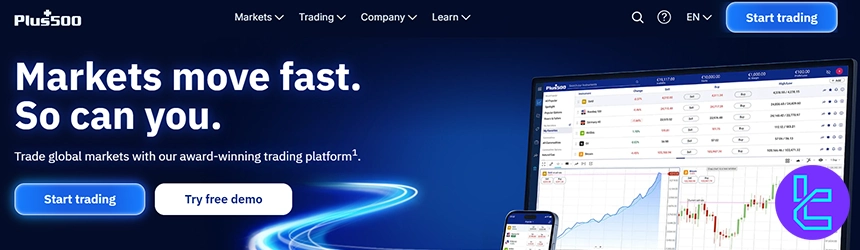
The company is headquartered in London and is publicly traded on the London Stock Exchange under the ticker PLUS, where it is included in the FTSE 250 index.
Its business model is centered on Contracts for Difference and, in selected regions, direct share dealing via separate platforms.
From a regulatory perspective, Plus500 operates under the supervision of multiple financial authorities across different jurisdictions. These include the FCA in the United Kingdom, CySEC, ASIC, DFSA, EFSA and the Monetary Authority of Singapore.
Depending on the entity and client location, investor protections such as segregated client funds, negative balance protection, and compensation schemes (for example, FSCS in the UK or ICF in Cyprus) may apply.
The broker provides Retail and Professional accounts, with a minimum deposit of $100.
Leverage limits vary by jurisdiction and client classification, ranging from 1:30 for retail traders under stricter regulatory regimes to as high as 1:300 for eligible professional clients.
Trading is conducted exclusively through broker’s proprietary WebTrader and mobile applications after completing the Plus500 registration, without support for MetaTrader platforms.
Plus500 offers access to more than 2,800 CFD instruments across Forex, indices, commodities, shares, ETFs, options, and cryptocurrencies.
Pricing is based on a spread-only model with no separate trading commissions, while overnight funding and inactivity fees may apply.
Overall, Plus500 positions itself as a technology-driven broker focused on self-directed trading, regulatory compliance, and a streamlined user experience rather than advanced platform customization or social trading features.
Account Types | Retail Account, Professional Account |
Regulating Authorities | FCA, CySEC, ASIC, DFSA, MAS , EFSA, FSCA, FMA , ISA |
Minimum Deposit | $100 |
Deposit Methods | Visa / MasterCard, Bank Wire Transfer, PayPal, Skrill, Apple Pay, Google Pay (availability depends on region) |
Withdrawal Methods | Visa / MasterCard, Bank Wire Transfer, PayPal, Skrill, Apple Pay, Google Pay |
Maximum Leverage | Up to 1:30 (Retail clients, regulation-dependent), up to 1:300 (Professional clients) |
Trading Platforms & Apps | Proprietary Plus500 WebTrader (browser-based), Plus500 Mobile App (iOS & Android) |
Plus500 Pros and Cons
The table below provides a list of pros and cons of trading with the Plus500 broker.
Pros | Cons |
Regulated by multiple tier-1 and tier-2 authorities across Europe, Asia, and Australia | No support for MetaTrader 4 or MetaTrader 5 platforms |
Access to 2,800+ CFD instruments across forex, stocks, indices, commodities, ETFs, options, and crypto | Lack of copy trading, social trading, or investment portfolio features |
Simple account structure with a low minimum deposit of $100 | Inactivity fee applies after prolonged periods without account activity |
Proprietary WebTrader and mobile apps with integrated risk-management tools | - |
Lightyear
Lightyear is a European investment platform launched in 2020, designed to provide direct access to global equity markets with a simplified, low-cost structure.
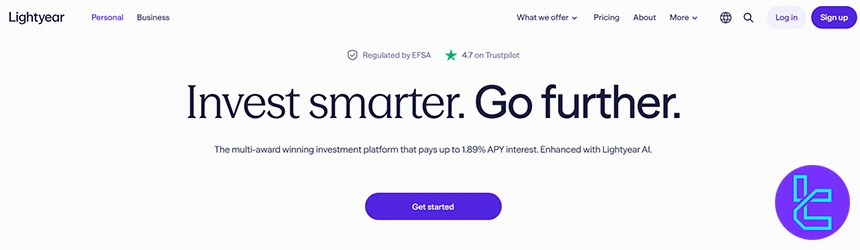
The broker serves clients across the United Kingdom and selected European countries, offering trading in more than 5,000 stocks, ETFs, and money market instruments without the use of leverage, as its maximum leverage is set at 1:1.
Lightyear operates through two regulated entities: Lightyear UK Ltd under the supervision of the Financial Conduct Authority and Lightyear Europe AS, licensed by the Estonian Financial Supervision Authority.
Client assets are held in segregated accounts, and eligible European investors benefit from coverage of up to €20,000 via the Estonian Investor Protection Sectoral Fund, reflecting a compliance-focused operational model rather than a trading-oriented one.
A distinctive element of Lightyear’s offering is its “Savings” feature, which allocates uninvested cash to money market funds managed by BlackRock.
Depending on the base currency, this service provides competitive annual yields linked to prevailing central bank rates, positioning Lightyear closer to an investment and cash-management platform than a traditional brokerage.
The broker supports Personal and Business accounts, with no minimum deposit requirement and base currencies including EUR, GBP, USD, and HUF.
Trading is conducted exclusively through Lightyear’s proprietary web and mobile applications, which focus on execution simplicity rather than advanced analytics or third-party integrations.
Fees are largely transaction-based, with low, transparent commissions on equities and no charges for deposits, withdrawals, or inactivity.
Overall, Lightyear targets investors seeking straightforward access to stocks, ETFs, and cash-yield products within a regulated European framework, rather than active traders looking for leverage, derivatives, or extensive trading tools.
Account Types | Personal Account, Business Account |
Regulating Authorities | Financial Conduct Authority (FCA – UK), Estonian Financial Supervision Authority (EFSA) |
Minimum Deposit | $0 |
Deposit Methods | Bank Transfer, Visa / MasterCard, Apple Pay, Google Pay |
Withdrawal Methods | Bank Transfer |
Maximum Leverage | 1:1 (no leverage) |
Trading Platforms & Apps | Proprietary Lightyear Web Platform, Lightyear Mobile App (iOS & Android) |
Pros and Cons of Lightyear
Traders must consider the following advantages and disadvantages before opening an account with Lightyear broker.
Pros | Cons |
Regulated by FCA (UK) and EFSA (Estonia), with client funds held in segregated accounts | No leverage or margin trading (maximum leverage limited to 1:1) |
Access to 5,000+ stocks, ETFs, and money market funds across major global markets | Lack of advanced trading tools, charting features, or third-party platform integrations |
No minimum deposit and generally low, transparent trading commissions | Limited customer support channels (email only) and restricted availability outside the UK and EU |
“Savings” feature linked to BlackRock money market funds offering competitive APY on idle cash | - |
Admirals
Admirals, formerly known as Admiral Markets, is a multi-asset brokerage established in 2001 and headquartered in Tallinn, Estonia.
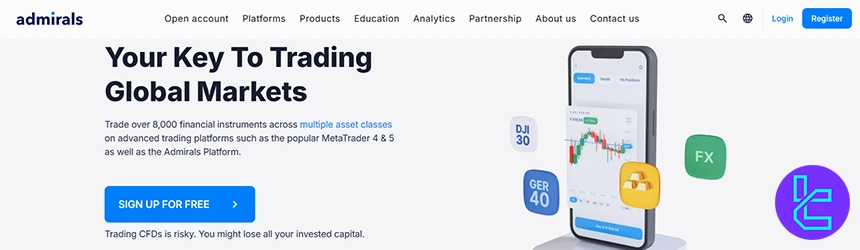
Over more than two decades of operation, the firm has expanded its presence to serve clients across 130+ countries, positioning itself as a long-standing participant in the global online trading industry.
From a regulatory standpoint, Admirals operates through several licensed entities and is supervised by multiple authorities, including the FCA, CySEC, ASIC, the Estonian Financial Supervision Authority (EFSA), and additional regional bodies.
Depending on the entity and client jurisdiction, investor protection schemes apply, generally covering client funds up to €20,000, alongside requirements such as segregated accounts and negative balance protection.
Admirals registration provides access to a broad range of markets through forex and CFD products, including currencies, equities, indices, commodities, ETFs, bonds, and cryptocurrencies.
The broker supports multiple account structures built around MetaTrader 4 and MetaTrader 5, such as Trade, Zero, and Invest accounts, each with different pricing models.
Spreads can start from 0.0 pips on commission-based accounts, while minimum deposits are relatively low, beginning at $1 for certain account types. Traders can lower costs by leveraging the Admirals rebate program.
In addition to trading, this broker offers features such as copy trading, automated strategies via Expert Advisors, educational resources, and market analysis tools after completing the Admirals verification process.
Overall, the broker emphasizes regulatory coverage, platform flexibility, and product breadth, while maintaining a pricing structure that varies according to account type and trading activity rather than promotional incentives.
Account Types | Trade.MT4, Trade.MT5, Zero.MT4, Zero.MT5, Invest.MT5 |
Regulating Authorities | Financial Conduct Authority (FCA), Cyprus Securities and Exchange Commission (CySEC), Australian Securities and Investments Commission (ASIC), Estonian Financial Supervision Authority (EFSA), JSC (Jordan), CIPC (South Africa) |
Minimum Deposit | From $1 (account-dependent) |
Deposit Methods | Bank Wire Transfer, Visa / MasterCard, Skrill, Klarna, Brite |
Withdrawal Methods | Bank Wire Transfer, Visa / MasterCard, Skrill, Brite |
Maximum Leverage | Up to 1:30 (retail clients), up to 1:500 (professional clients) |
Trading Platforms & Apps | MetaTrader 4, MetaTrader 5, WebTrader, Admirals Mobile App (iOS & Android) |
Admiral Markets Pros and Cons
Traders must consider the following benefits and limitations before opening an account with the Admirals broker.
Pros | Cons |
Regulated by multiple tier-1 authorities including FCA, ASIC, CySEC, and EFSA | Not available to residents of several major markets such as the USA, Canada, and Japan |
Access to a wide range of markets with 8,000+ tradable instruments across forex, CFDs, stocks, ETFs, bonds, and crypto | Mobile trading app offers fewer advanced features than desktop MetaTrader platforms |
Support for MetaTrader 4 and MetaTrader 5 with advanced tools, Expert Advisors, and add-ons | - |
Competitive pricing structure with low minimum deposits and multiple account types | - |
IC Markets
IC Markets operates as a multi-asset brokerage offering access to Forex CFDs, Stocks CFDs, Crypto CFDs, Index CFDs, Commodity CFDs, and Bond CFDs through recognized trading platforms such as MetaTrader 4 (MT4), MetaTrader 5 (MT5), and cTrader.
The broker supports 10 base currencies, including USD, EUR, GBP, AUD, and JPY, with a minimum deposit requirement set at $200.
Founded in Australia in 2007, IC Markets has expanded its regulatory footprint through entities authorized by the ASIC, CySEC, and FSA of Seychelles.
Clients registered under CySEC fall within the scope of the Investor Compensation Fund (ICF), which provides protection of up to €20,000.
The broker facilitates market execution with leverage reaching 1:500 under certain jurisdictions and maintains operational safeguards such as segregated client accounts, AML compliance procedures, and periodic external audits.
Negative balance protection is applied selectively, depending on the regulatory entity governing the trading account. IC Markets offers multiple account structures, including Standard, Raw Spread, and Islamic accounts.
Raw Spread configurations on MT4/MT5 apply commissions from $3.50 per lot with spreads starting at 0.0 pips, whereas Standard accounts provide commission-free trading with spreads from 0.8 pips.
In terms of infrastructure, the broker supports automated trading via Expert Advisors (EAs) and provides copy trading functionality through the cTrader ecosystem.
Deposit and withdrawal methods include bank transfers, Visa/Mastercard, Skrill, Neteller, PayPal, and UnionPay, with no inactivity or direct funding fees reported under standard conditions.
Account Types | Standard, Raw Spread (MT4/MT5), cTrader Raw Spread, Islamic (Swap-Free) |
Regulating Authorities | ASIC (Australia), CySEC (Cyprus), FSA (Seychelles) |
Minimum Deposit | $200 |
Deposit Methods | Bank Transfer, VISA, MasterCard, PayPal, Skrill, Neteller, UnionPay, POLi, Rapidpay, Klarna |
Withdrawal Methods | Bank Transfer, Credit/Debit Cards, PayPal, Skrill, Neteller, Visa Direct, Transact365, CardPay |
Maximum Leverage | Up to 1:500 (depending on regulatory jurisdiction) |
Trading Platforms & Apps | MetaTrader 4 (MT4), MetaTrader 5 (MT5), cTrader, cTrader Web, IC Markets Mobile App |
IC Markets Pros and Cons
The table below outlines the pros and cons of trading with the IC Markets broker.
Pros | Cons |
Raw Spread accounts with spreads from 0.0 pips on MT4, MT5, and cTrader | Leverage limited to 1:30 under ASIC and CySEC regulation |
Supports automated trading via Expert Advisors (EAs) | Negative balance protection not applied under the FSA (Seychelles) entity |
Regulated by ASIC and CySEC with segregated client fund policies | $200 minimum deposit may not suit low-capital traders |
Access to 2,100+ Stock CFDs across global markets | - |
XM Group
XM Group is a multi-regulated CFD broker providing access to more than 1,400 tradable instruments, including over 55 Forex currency pairs and 1,200+ Stock CFDs across asset classes such as Commodities, Indices, Cryptocurrencies, and Precious Metals.
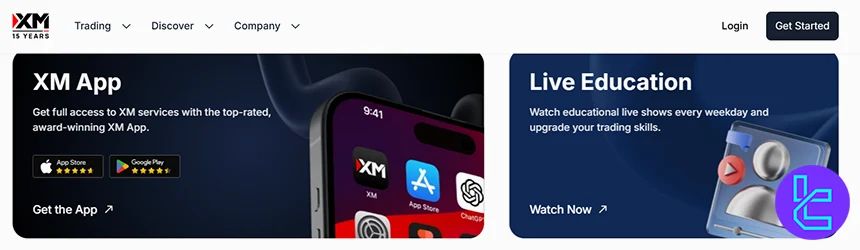
The broker operates exclusively through MetaTrader 4 (MT4) and MetaTrader 5 (MT5) platforms, with support for MQL5 Signal Service and algorithmic trading environments. The broker also offers XM Group copy trading to traders worldwide.
Established in 2009, XM maintains operational entities in Cyprus, South Africa, Dubai, and Belize, functioning under regulatory supervision of CySEC, FSCA, DFSA, and FSA of Seychelles. All entities require completing the XM Group verification process
The Middle East promotion of services is conducted by XM Financial Products Promotion L.L.C., licensed by the Securities and Commodities Authority (SCA) of the UAE.
XM offers multiple retail account types including Micro, Standard, Ultra Low, and Shares, with a minimum deposit requirement starting from $5 for most accounts.
Leverage may reach up to 1:1000 depending on the governing jurisdiction, while all retail trading accounts include negative balance protection and hedging support.
Trading costs vary across account structures, with spreads beginning from 0.6 pips on Ultra Low accounts and commission-free trading applied outside the Shares account. Traders can open their preferred account type in the XM Group dashboard.
Execution policies support both market and instant order types, with guaranteed fills available for orders up to 50 lots.
Account Types | Micro, Standard, Ultra Low, Shares |
Regulating Authorities | CySEC (Cyprus), FSCA (South Africa), DFSA (Dubai), FSC (Belize), FSC (Mauritius), FSA (Seychelles) |
Minimum Deposit | From $5 |
Deposit Methods | Credit/Debit Cards, Bank Transfer, Skrill, Neteller, Perfect Money, Google Pay, Apple Pay |
Withdrawal Methods | Credit/Debit Cards, Bank Transfer, Skrill, Neteller, Local Payment Methods |
Maximum Leverage | Up to 1:1000 (depending on regulatory jurisdiction) |
Trading Platforms & Apps | MetaTrader 4 (MT4), MetaTrader 5 (MT5), XM Mobile App |
XM Group Pros and Cons
Traders must know the following pros and cons of trading with XM before opening an account.
Pros | Cons |
Minimum deposit starting from $5 across Micro and Standard accounts | Inactivity fee of $10 applied to dormant accounts |
Access to 1,400+ CFDs including Forex, Stocks, and Crypto | Shares account requires a significantly higher minimum deposit ($10,000) |
Available on MetaTrader 4 (MT4) and MetaTrader 5 (MT5) platforms | Service availability restricted in regions such as the US and Canada |
Negative balance protection for retail clients | - |
VT Markets
VT Markets is an Australia-headquartered multi-asset brokerage offering access to more than 1,000 tradable instruments across key CFD markets, including Forex, Indices, Metals, Energies, ETFs, CFD Shares, Bonds, and Soft Commodities.
The broker processes over 30 million trades monthly for a client base exceeding 400,000 active users.
The company operates through several regulatory entities, including the Australian Securities and Investments Commission (ASIC), the Financial Sector Conduct Authority (FSCA) of South Africa, and the Financial Services Commission (FSC) of Mauritius.
Client accounts are maintained in segregated funds, while negative balance protection is available under selected jurisdictions such as FSCA and FSC-regulated branches.
VT Markets supports multiple retail trading environments, including Standard STP, RAW ECN, Cent STP, and Cent ECN accounts after completing the VT Markets registration, with a minimum deposit requirement starting from $50.
Maximum leverage may reach 1:500 depending on the governing regulatory entity, with execution carried out through market-based order processing.
Trading infrastructure is built around MetaTrader 4 (MT4), MetaTrader 5 (MT5), and Webtrader+ interfaces, alongside a proprietary VT Markets mobile application, all available for download on the VT Markets dashboard.
RAW ECN accounts provide spreads from 0.0 pips with commission-based pricing, whereas Standard STP accounts apply spread-only cost structures. In addition to manual trading, VT Markets offers Copy Trading and PAMM investment modules.
Funding options include bank wire transfers, credit/debit cards, Skrill, Neteller, UnionPay, and Fasapay, with no inactivity or deposit fees reported under standard operating conditions.
Traders must finalize the VT Markets verification process to access withdrawals.
Account Types | Standard STP, RAW ECN, Cent STP, Cent ECN, Demo |
Regulating Authorities | ASIC (Australia), FSCA (South Africa), FSC (Mauritius) |
Minimum Deposit | From $50 |
Deposit Methods | Credit/Debit Cards, Bank Transfer, Skrill, Neteller, UnionPay, Fasapay |
Withdrawal Methods | Credit/Debit Cards, Bank Transfer, Skrill, Neteller, UnionPay, Fasapay |
Maximum Leverage | Up to 1:500 (depending on regulatory jurisdiction) |
Trading Platforms & Apps | MetaTrader 4 (MT4), MetaTrader 5 (MT5), Webtrader+, VT Markets Mobile App |
VT Markets Pros and Cons
The following table contains the benefits and limitations of trading with the VT Markets broker.
Pros | Cons |
Multiple account types including Standard STP and RAW ECN | ASIC-regulated entity available only for wholesale clients |
Leverage up to 1:500 under FSCA and FSC-regulated entities | Withdrawal fees may apply depending on payment method and region |
Supports Copy Trading and PAMM investment options | - |
No inactivity or account maintenance fees | - |
Errante
Errante is a Forex and CFD brokerage established in 2018, operating under regulatory supervision from the CySEC and the Financial Services Authority (FSA) of Seychelles.
Its European entity functions within the Investor Compensation Fund (ICF) framework, offering coverage up to €20,000, while international clients may access Lloyd’s-backed insurance protection of up to €1,000,000 depending on jurisdiction.
The broker provides access to financial markets including Forex pairs, Metals, Indices, Energy, Stocks, and Cryptocurrencies through multiple trading platforms such as MetaTrader 4 (MT4), MetaTrader 5 (MT5), cTrader, and TradingView.
Errante supports market and ECN execution models, with a minimum trade size starting from 0.01 lots and leverage levels reaching up to 1:1000 under offshore regulation.
Retail account options include Standard, Premium, VIP, and Tailor-Made structures, with minimum deposits ranging from $50 to $15,000 depending on the selected environment after finalizing the Errante registration process.
Commission-free trading is applied to Standard, Premium, and VIP accounts, while Tailor Made accounts introduce a fixed $3 commission per lot with spreads from 0.0 pips.
Traders can lower costs by joining the Errante rebate program offered by TradingFinder.
Errante also integrates indirect investment services such as Copy Trading, PAMM, and MAM account management modules, which are all accessible after completing the Errante verification procedure.
Funding channels include bank transfers, Visa, MasterCard, Skrill, Neteller, SticPay, Volet, and cryptocurrency-based payments such as Bitcoin, Ethereum, Tether, and Ripple.
Islamic account variants are available across major account types, although swap-free conditions are time-limited depending on asset class and position duration.
Account Types | Standard, Premium, VIP, Tailor Made |
Regulating Authorities | CySEC (Cyprus), FSA (Seychelles) |
Minimum Deposit | From $50 |
Deposit Methods | Bank Transfer, VISA, MasterCard, Skrill, Neteller, SticPay, Volet, Bitcoin, Ethereum, Tether |
Withdrawal Methods | Bank Transfer, VISA, MasterCard, Skrill, Neteller, SticPay, Volet, Bitcoin, Ethereum, Tether |
Maximum Leverage | Up to 1:1000 (depending on regulatory jurisdiction) |
Trading Platforms & Apps | MetaTrader 4 (MT4), MetaTrader 5 (MT5), cTrader, TradingView |
Errante Pros and Cons
You can check the benefits and drawbacks of Errante broker by checking the table below.
Pros | Cons |
Supports MT4, MT5, cTrader, and TradingView platforms | No Cent account available |
Leverage up to 1:1000 under offshore regulation | Limited operational history since 2018 |
Offers Copy Trading, PAMM, and MAM account options | Swap-free conditions are time-limited on Islamic accounts |
Commission-free trading on Standard, Premium, and VIP accounts | - |
FxPro
FxPro is a multi-regulated Forex and CFD brokerage that has been operating since 2006, offering access to more than 2,100 tradable instruments across financial markets such as Forex, Shares, Indices, Metals, Energies, Futures, and Cryptocurrencies.
The broker supports both market and instant execution models, with average order processing speeds reported below 12 milliseconds.
FxPro maintains regulatory authorization from the FCA, CySEC, FSCA, and SCB.
Client protection frameworks such as the Financial Services Compensation Scheme (FSCS) in the UK and the Investor Compensation Fund (ICF) in Cyprus provide coverage up to £85,000 and €20,000 respectively, depending on jurisdiction.
Retail clients can select from Standard, Raw+, and Elite account types, with a minimum deposit requirement starting from $100.
Trading is available through MetaTrader 4 (MT4), MetaTrader 5 (MT5), cTrader, WebTrader, and proprietary mobile applications. Automated strategies using Expert Advisors (EAs) are supported across MT4 and MT5 environments.
Trading costs vary by account structure, with Raw+ accounts offering spreads from 0.0 pips and commission-based pricing, while Standard accounts apply spread-only cost models. Traders can lower these trading costs by leveraging the FxPro rebate services.
Leverage for retail traders is typically capped at 1:30 under FCA and CySEC regulation and can be changed in the FxPro dashboard section.
Funding methods include bank wire transfers, Visa, MasterCard, Skrill, Neteller, and PayPal and traders must complete the FxPro verification process to unlock withdrawals. Inactivity fees may apply to dormant accounts after a defined period of non-trading activity.
Account Types | Standard, Raw+, Elite |
Regulating Authorities | FCA (UK), CySEC (Cyprus), FSCA (South Africa), SCB (Bahamas) |
Minimum Deposit | From $100 |
Deposit Methods | Bank Transfer, VISA, MasterCard, Skrill, Neteller, PayPal, Broker-to-Broker Transfer |
Withdrawal Methods | Bank Transfer, VISA, MasterCard, Skrill, Neteller, PayPal, Broker-to-Broker Transfer |
Maximum Leverage | Up to 1:500 (depending on regulatory jurisdiction) |
Trading Platforms & Apps | MetaTrader 4 (MT4), MetaTrader 5 (MT5), cTrader, WebTrader, FxPro Mobile App |
FxPro Pros and Cons
Traders must consider the following advantages and disadvantages before opening an account with FxPro.
Pros | Cons |
Regulated by FCA and CySEC Tier-1 authorities | Inactivity fee applied after a defined dormant period |
Supports MT4, MT5, and cTrader platforms | No 24/7 customer support |
Access to 2,100+ tradable instruments across multiple CFD markets | Leverage limited to 1:30 under FCA and CySEC regulation |
CopyTrade service and Expert Advisor (EA) compatibility | - |
FXGrow
FXGrow is a Cyprus-based Forex and CFD broker founded in 2008, operating under CySEC supervision (license 214/13).
Through the MiFID framework, its oversight aligns with a wider European compliance network that includes regulators such as CNMV, BaFin, ACPR, KNF, FI, and other national authorities.
Retail leverage under the CySEC rule-set is typically capped at 1:30, while the broker also advertises leverage up to 1:300 depending on account classification and client jurisdiction.
The account lineup after FXGrow registration is structured around ECN execution, including ECN, ECN Plus, and ECN Elite tiers, alongside a Demo environment.
FXGrow positions MetaTrader 5 (MT5) as its core terminal, combining desktop, web, and mobile workflows within a single platform ecosystem.
A copy trading feature is also available in the FXGrow dashboard for strategy replication, but the broker does not list PAMM as an investment module in its specifications.
In terms of market coverage, FXGrow provides CFD access across Forex pairs, Indices, Commodities, Metals, Energies, Futures-based CFDs, and Cryptocurrency instruments.
Minimum trade size starts from 0.01 lots, with market execution as the standard order model. Reported spreads can reach extremely tight levels on higher-tier ECN structures, while FX commissions are shown as a fixed $8 for FX in the broker’s summary.
Funding is comparatively narrow versus brokers with broader payment rails.
Deposits and withdrawals are centered on bank wire transfer, Skrill, and Neteller after completing the FXGrow verification, and the minimum deposit is shown from $100 with supported base currencies including USD, EUR, and PLN.
Support is listed as 24/5 via email, phone, live chat, and callback services, and availability may vary by region.
Account Types | ECN, ECN Plus, ECN Elite, Demo |
Regulating Authorities | CySEC |
Minimum Deposit | $100 |
Deposit Methods | Bank Wire Transfer, Skrill, Neteller |
Withdrawal Methods | Bank Wire Transfer, Skrill, Neteller |
Maximum Leverage | Up to 1:300 |
Trading Platforms & Apps | MetaTrader 5 |
FXGrow Pros and Cons
Traders must ensure they know the following benefits and drawbacks before creating an account with this broker.
Pros | Cons |
Regulated by CySEC under MiFID framework | Only MetaTrader 5 platform supported |
ECN-based account types available | No PAMM or MAM investment options |
Copy Trading functionality supported | Limited base currencies (USD, EUR, PLN) |
Segregated client funds and NBP provided | No proprietary trading platform |
How Did we Choose the Best EFSA-Regulated Brokers?
TradingFinder experts have considered all the brokers that have been licensed and regulated by the EFSA to create this article.
These are the most important features and aspects that we have considered besides being regulated by the Estonian Financial Supervision Authority.
- Spreads
- Commissions
- Account types
- Deposit and withdrawal methods
- Customer support quality
- Leverage
What is EFSA?
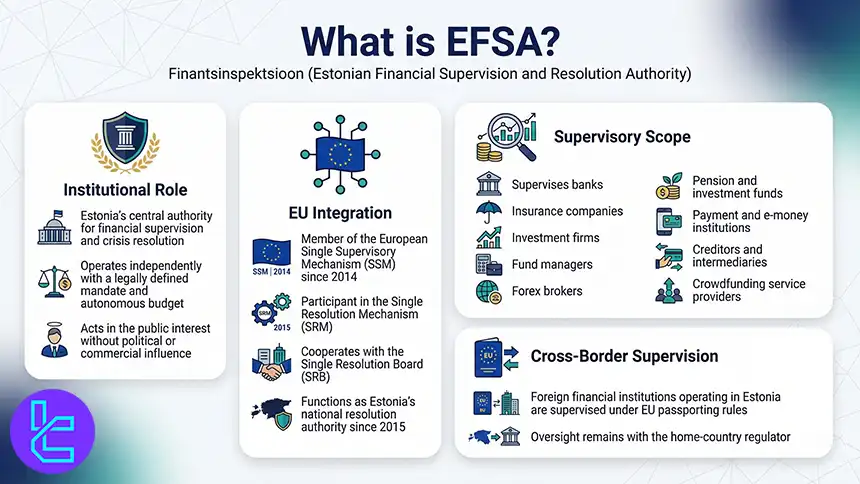
Finantsinspektsioon, formally known as the Estonian Financial Supervision and Resolution Authority, functions as Estonia’s central body for financial oversight and crisis resolution.
Operating with institutional independence, its mandate is defined by law and supported by an autonomous budget, allowing it to act without political or commercial influence while serving the public interest of the Estonian state.
The authority is responsible for supervising a broad spectrum of financial market participants.
Its remit covers banks, insurance companies, investment firms, fund managers, Forex brokers, pension and investment funds, payment and e-money institutions, creditors and credit intermediaries, and crowdfunding service providers.
This wide supervisory scope places Finantsinspektsioon at the core of Estonia’s financial stability framework.
At the European level, Finantsinspektsioon is integrated into the European Single Supervisory Mechanism (SSM), which has overseen the prudential supervision of major European banks and banking groups since November 2014.
It is also a participant in the European Single Resolution Mechanism (SRM) and cooperates closely with the Single Resolution Board, reflecting its dual supervisory and resolution role within the EU banking union.
Since the establishment of the SRB in 2015, Finantsinspektsioon has assumed formal responsibilities in crisis resolution as the national resolution authority.
Supervision of branches of foreign banks, insurers, and investment funds operating in Estonia generally falls under the authority of the institution’s home-country regulator, in line with EU passporting rules.
What Powers Does EFSA Have?
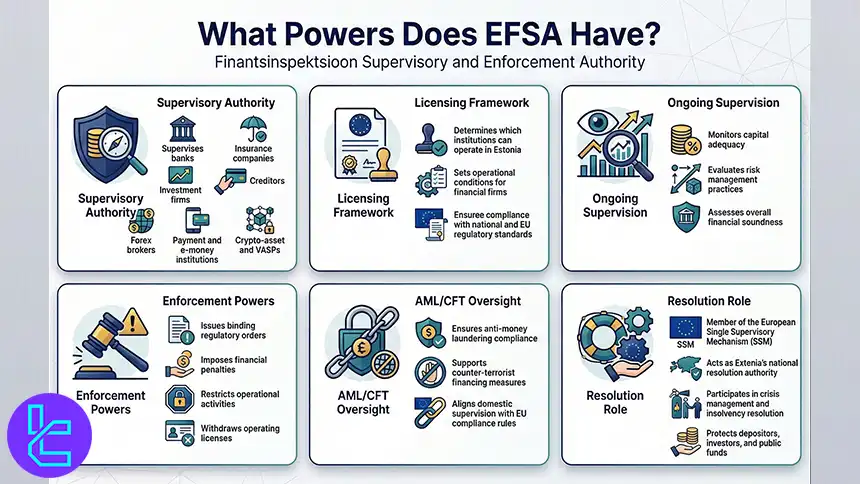
Finantsinspektsioon has extensive supervisory authority over a wide range of financial entities. Its remit includes banks, insurance companies, investment firms, creditors, Forex brokers, payment and e-money institutions, as well as crypto-asset and virtual asset service providers (VASPs).
Through its licensing framework, the authority determines which institutions are permitted to operate in Estonia and under what conditions, ensuring compliance with national and European regulatory standards.
Ongoing supervision is a core function, focusing on capital adequacy, risk management practices, and overall financial soundness.
Where regulatory breaches are identified, Finantsinspektsioon has the power to initiate enforcement measures, including issuing binding orders, imposing financial penalties, restricting activities, or withdrawing operating licenses.
Anti-money laundering and counter-terrorist financing (AML/CFT) oversight also forms a key pillar of its responsibilities, aligning domestic supervision with EU-wide compliance requirements.
At the European level, Finantsinspektsioon is integrated into the European Single Supervisory Mechanism (SSM), contributing to coordinated oversight of significant banking groups across the EU.
In parallel, it acts as Estonia’s national resolution authority, playing a defined role in crisis management and insolvency resolution to protect depositors, investors, and public funds.
Do EFSA-Regulated Brokers offer Negative Balance Protection?
Yes. Brokers supervised by the Estonian Financial Supervision Authority (EFSA) are required to provide Negative Balance Protection (NBP) to retail clients when operating under the European regulatory framework.
This obligation stems from product intervention measures introduced by the European Securities and Markets Authority (ESMA) in 2018 and applies uniformly across EU member states.
In practice, Negative Balance Protection ensures that a retail trader’s losses from CFD (Contracts for Difference) trading cannot exceed the total funds available in their trading account.
If extreme market volatility, price gaps, or sudden events (such as flash crashes) cause leveraged positions to move beyond the account balance, the broker must absorb the excess loss and reset the client’s balance to zero.
This safeguard is specifically designed for retail clients and applies only to CFD products offered under EU regulation.
It does not prevent losses within the amount initially deposited, nor does it typically extend to professional clients, who often waive NBP in exchange for access to higher leverage and fewer trading restrictions.
Are EFSA-Regulated Brokers Safe?
Brokers regulated by the Estonian Financial Supervision Authority (EFSA) operate within the European Union’s harmonized regulatory framework and are generally regarded as operating under a high level of supervisory control.
Their activities are governed by MiFID II, which establishes uniform standards for investor protection, operational transparency, and market integrity across EU member states.
One of the core safeguards applied to EFSA-regulated brokers is the mandatory segregation of client funds.
Customer deposits must be held separately from the broker’s own operational capital, reducing the risk of misuse and limiting exposure if the firm encounters financial difficulties.
In parallel, these brokers are subject to ongoing regulatory monitoring, periodic audits, and strict reporting obligations designed to detect misconduct or financial weakness at an early stage.
From a security perspective, EFSA-licensed firms are expected to implement robust technical controls, including encrypted data transmission and multi-factor authentication, to protect client information and transaction records. Regulatory compliance also extends to transparency requirements, such as clear disclosure of trading conditions, costs, and risk warnings.
In many cases, investor protection is further supported by national compensation mechanisms.
For example, eligible clients of EU-regulated firms may be covered by investor compensation schemes that reimburse funds up to a defined limit if a broker becomes insolvent, similar in principle to the UK’s Financial Services Compensation Scheme (FSCS).
How can I Check If a Broker is Regulated by EFSA?
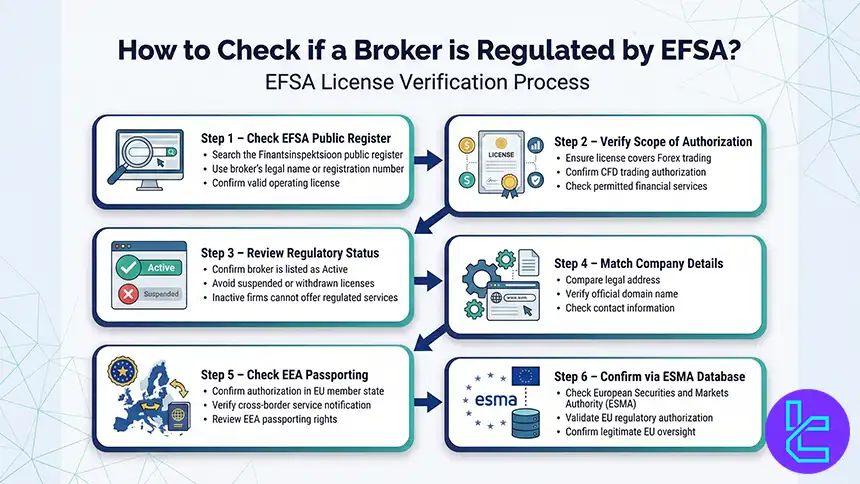
The primary reference point is the public register maintained by Finantsinspektsioon, the Estonian Financial Supervision and Resolution Authority.
By searching the register using the broker’s legal name or registration number, it is possible to determine whether the firm holds a valid license and which financial services it is permitted to provide.
Particular attention should be paid to the scope of authorization, ensuring that the license explicitly covers activities such as CFD trading or foreign exchange services rather than unrelated financial operations.
Equally important is the firm’s current regulatory status. Only entities listed as “active” in the register are legally authorized to operate. Inactive, suspended, or withdrawn licenses indicate that the broker is not permitted to offer regulated services at that time.
To reduce the risk of dealing with clone or impersonator websites, registration data (such as the company’s legal address, official domain, and contact details) should be carefully matched against the information published on the broker’s own website. Any inconsistencies may signal fraudulent activity.
If a broker is not directly licensed in Estonia but claims to serve Estonian or EU clients, verification should extend to EEA passporting rights. In such cases, the firm must be authorized in another EU member state and notified for cross-border activity.
This status can be independently confirmed through the database of the European Securities and Markets Authority (ESMA).
Following these steps provides a structured and reliable way to assess whether a broker operates under legitimate EU regulatory oversight.
Rules Set by EFSA for Forex Brokers
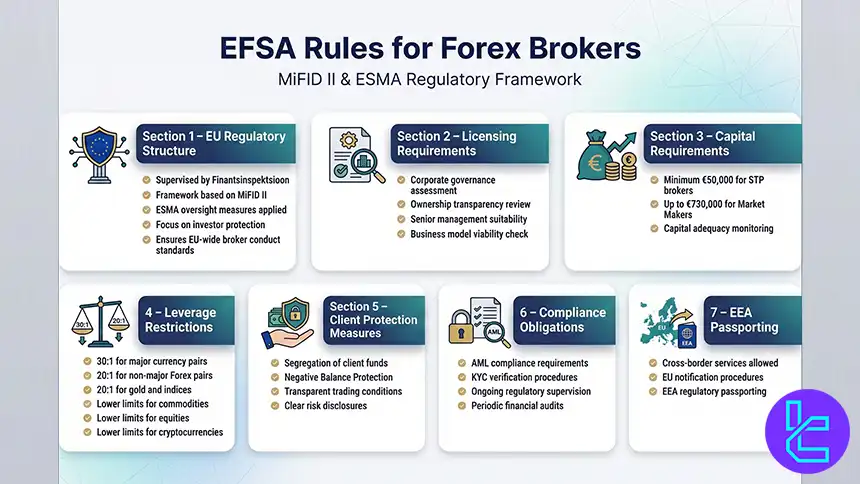
Forex brokers operating under the supervision of the Estonian Financial Supervision Authority (Finantsinspektsioon) are subject to a regulatory framework shaped by MiFID II and oversight measures introduced by ESMA.
This structure is designed to standardize broker conduct across the European Union while prioritizing market stability and investor protection.
To obtain authorization, brokers must undergo a licensing process that assesses corporate governance, ownership transparency, senior management suitability, and the viability of their business model.
Capital adequacy is a central requirement, with minimum thresholds varying by execution model (ranging from approximately €50,000 for STP-style brokers to over €730,000 for firms acting as market makers).
Risk controls extend to product intervention rules, particularly leverage restrictions.
Retail clients are subject to capped leverage levels, including 30:1 for major currency pairs, 20:1 for non-major forex pairs, gold, and indices, and progressively lower limits for commodities, equities, and cryptocurrencies.
These caps aim to limit excessive exposure rather than influence trading outcomes.
Client protection measures are equally prescriptive. Regulated brokers must segregate customer funds from operational capital, apply Negative Balance Protection to retail accounts, and disclose trading conditions in a clear and auditable manner.
In parallel, strict AML and KYC obligations apply, supported by ongoing supervision and periodic audits.
Once authorized in Estonia, brokers may provide cross-border services throughout the European Economic Area (EEA) via regulatory passporting, subject to EU notification procedures.
Tradable Instruments in the EFSA Regulated Brokers
EFSA-regulated brokers typically offer trading in both traditional securities and derivative instruments. Currency markets form a core component, covering major, minor, and selected exotic Forex (FX) pairs.
Equity exposure is available through direct share trading on international exchanges, as well as through diversified ETFs, which are structured to track indices, sectors, or asset baskets.
Derivatives also play a central role in these offerings. CFDs (Contracts for Difference) enable leveraged exposure to assets such as commodities (including gold and oil), global indices like the DAX or S&P 500, and listed equities, subject to EU-imposed leverage limits.
In addition, some EFSA-supervised firms provide access to more traditional derivative instruments, including options, futures, and swaps, depending on their specific license scope.
Crypto-asset services are increasingly represented within this regulatory perimeter. Where permitted, brokers may facilitate trading in regulated cryptocurrencies, including asset-referenced tokens and e-money tokens, in line with EU compliance standards.
Overall, EFSA regulation supports a multi-asset trading environment that balances market access with standardized oversight, allowing participation across currencies, securities, derivatives, and selected crypto-assets.
EFSA vs Other Top-tier Regulatory Entities
The table below allows you to compare Estonian Financial Supervisory Authority requirement and rules in comparison to those of other well-known authorities.
Parameter | EFSA (Estonia) | CySEC (Cyprus) | FCA (UK) | ASIC (Australia) |
Minimum Capital Requirement | From €50,000 | €750,000+ depending on firm type | £125,000-£730,000+ depending on model | Between AU$500,000 and AU$1,000,000 |
Client Fund Segregation | Required | Required | Required | Required |
Compensation Scheme | No | Investor Compensation Fund (~€20,000) | FSCS (~£85,000) | Investor Compensation Fund (AU$10,000) |
Leverage Limits | Set under MiFID (often 1:30 for retail in EU) | Set under MiFID (often 1:30 for retail in EU) | Retail max ~1:30 on majors | 1:30 |
Negative Balance Protection | Required | Often required | Required | Required |
Reporting & Audits | Ongoing financial reporting | Ongoing financial reporting | Ongoing reporting standard | Ongoing financial reporting |
Conclusion
Based on our review of the best EFSA-regulated brokers, we can certainly say that Plus500, Lightyear, and Admirals offer the best services.
However, for traders who are looking to get spreads from 0.0 pips, higher leverage (up to 1:1000), and various account types, we recommend checking IC Markets, XM Group, VT Markets, and FXGrow.
All brokers have been assessed based on the TradingFinder Forex methodology.