






CFDs enable traders to speculate on price movements across forex, stocks, indices, commodities, and cryptocurrencies without owning the underlying asset. Through margin trading and flexible leverage, Contracts for Difference (CFDs) provide capital efficiency, short-selling opportunities, and access to thousands of global instruments from a single account.
The best CFD brokers combine Tier 1 regulatory oversight, transparent spreads, fast execution speeds, and robust platforms such as MT4, MT5, and TradingView. We evaluate pricing structure, leverage policies, asset coverage, order execution quality, and fund protection standards to identify brokers delivering secure and competitive CFD trading conditions. Here are our top picks:
 | XM | |||
 | FxGLORY | |||
 | vt markets | |||
| 4 |  | pepperstone | ||
| 5 |  | BlackBull | ||
| 6 |  | NORD FX | ||
| 7 |  | LiteFinance | ||
| 8 |  | eToro | ||
| 9 |  | FUSION MARKETS | ||
| 10 |  | eightcap |
CFD Brokers Ranked by Trustpilot
Trustpilot ratings highlight real user experiences with CFD brokers, reflecting service reliability, execution quality, pricing transparency, and customer support responsiveness. Higher rated platforms typically demonstrate consistent trade performance, efficient withdrawals, and strong dispute resolution standards across global client bases.
Mid tier and lower ranked brokers often show mixed feedback related to spreads, platform stability, or support efficiency. While ratings offer valuable sentiment indicators, traders should also assessregulatory status, capital protection policies, and overall cost structure before selecting a CFD trading provider.
Broker Name | Trustpilot Rating | Number of Reviews |
Fusion Markets | 6,320 | |
3,129 | ||
NordFX | 80 | |
Pepperstone | 3,226 | |
VT Markets | 2,372 | |
30,657 | ||
FxGlory | 65 | |
Eightcap | 3,489 | |
569 | ||
XM Group | 3,072 |
Minimum Spreads in CFD Trading Brokers
Minimum spreads in CFD trading directly impact transaction costs and overall profitability, especially for scalping and high-frequency strategies. Several leading brokers offer 0.0 pip spreads on major pairs, reflecting raw pricing models with no markups, typically combined with transparent commission based structures.
Other platforms provide fixed or variable spreads starting from 0.5 to 0.6 pips, often within spread only accounts. Traders should evaluate whether ultra tight spreads are linked to ECN style execution, liquidity depth, and consistent pricing during volatile market conditions.
Broker Name | Min. Spread |
0.0 Pips | |
Pepperstone | 0.0 Pips |
VT Markets | 0.0 Pips |
Exness | 0.0 Pips |
0.0 Pips | |
LiteFinance | 0.0 Pips |
eToro | 0.0 Pips |
ActivTrades | 0.5 Pips |
Plus500 | 0.5 Pips |
0.6 Pips |
CFD Brokers’ Non-Trading Fees
Non-trading fees significantly affect overall CFD trading costs, especially for long-term or inactive accounts. Many leading brokers charge $0 deposit and withdrawal fees, with no inactivity penalties, improving capital efficiency and cash flow flexibility for retail and professional traders.
However, some platforms apply withdrawal fees of around $5, monthly inactivity charges of $10 to $18, or percentage-based funding fees. Evaluating these operational costs alongside spreads and commissions ensures a transparent and cost-effective CFD brokerage selection.
Broker Name | Deposit Fee | Withdrawal Fee | Inactivity Fee |
$0 | $0 | $0 | |
Exness | $0 | $0 | $0 |
VT Markets | $0 | $0 | $0 |
BlackBull Markets | $0 | $5 | $0 |
FxGlory | Up to 9% | Up to 9% | $0 |
TMGM | $0 | $0 | $10/Month |
$0 | $0 | $10/Month | |
ActivTrades | $0 | $0 | $10/Month |
eToro | $0 | $5 | $10/Month |
IG | Up to 1% | $0 | $18/Month |
Trading Platforms Offered by CFD Trading Brokers
Leading CFD brokers support industry standard platforms such as MetaTrader 4, MetaTrader 5, cTrader, and TradingView, alongside proprietary web-based systems. These platforms provide advanced charting, automated trading via Expert Advisors, multi-asset execution, and cross-device compatibility across desktop, web, and mobile.
Platform diversity allows access to one-click trading, algorithmic strategies, copy trading networks, and integrated market analysis tools. Brokers offering MetaTrader 4 and MT5 remain dominant, while cTrader and TradingView integration enhance the depth of market visibility, order management precision, and customizable trading environments.
Broker Name | Trading Platforms |
cTrader, TradingView, MT4, MT5, Proprietary Platform | |
IronFX | MT4 |
BlackBull Markets | MT4, MT5, TradingView, cTrader, BlackBull CopyTrader, BlackBull Invest |
Fusion Markets | MT4, MT5, TradingView, cTrader |
LiteFinance | MT4, MT5, cTrader, Mobile App |
Tickmill | MT4, MT5, Webtrader, Mobile App |
MT4, MT5, Webtrader+, VT Markets App | |
NordFX | MT4, MT5 |
Global Prime | MT4 |
XM Group | MT4, MT5, Mobile App |
Note: TradingFinder has developed a wide range of TradingView, MT4, and MT5 indicators that you can use for free.
Top 8 CFD Trading Brokers
The top 8 CFD trading brokers combine Tier 1 regulation, multi-asset access, and competitive pricing structures. Leading names operate under authorities such as FCA, ASIC, and CySEC, offering leverage up to 1:500 or higher offshore, minimum deposits from $0-$100, and spreads starting from 0.0 pips.
Across these brokers, traders can access 800 to 6,000+ CFD instruments, including forex, indices, commodities, shares, ETFs, and cryptocurrency. Platform coverage spans MT4, MT5, cTrader, TradingView, and proprietary apps, with features like copy trading, ECN pricing, negative balance protection, and segregated client funds.
eToro
eToro is an Israeli founded multi asset broker established in 2007 by David Ring, Ronen Assia, and Yoni Assia. Headquartered in Tel Aviv, it operates globally under eToro Ltd, offering social investing and CFD trading services across multiple regulated entities.

The broker is supervised by Tier 1 regulators, including the FCA in the UK and ASIC in Australia, alongside CySEC, ADGM FSRA, GFSC, and FSA Seychelles. Investor protection schemes include up to GBP 85,000 under FSCS and EUR 20,000 under the ICF.
Completing eToro registration provides access to four account types: Personal, Professional, Corporate, and Islamic. The minimum deposit starts from $10, while retail leverage is capped at 1:30 and can reach 1:400 for eligible professional clients, depending on jurisdiction and regulatory classification.
Clients gain access to 6,000+ instruments across the forex market, stocks, ETFs, indices, commodities, and 120+ cryptocurrencies. Unique investment features include CopyTrader, Smart Portfolios, and Crypto Staking, alongside a proprietary web and mobile trading platform.
Trading costs vary by asset class. Stock investing can start from $0 commission in certain regions, crypto trades carry a 1% fee, and CFD spreads differ by instrument. A $5 withdrawal fee and $10 monthly inactivity fee apply under specific conditions.
Account Types | Standard, Demo |
Regulating Authorities | FINRA, SIPC |
Minimum Deposit | $100 |
Deposit Methods | Online Bank Transfers, Wire Transfer, Credit/Debit Card, PayPal |
Withdrawal Methods | Online Bank Transfers, Wire Transfer, Credit/Debit Card, PayPal |
Maximum Leverage | 1:30 |
Trading Platforms & Apps | Proprietary Platform |
eToro Pros and Cons
Before opening an account, traders should weigh eToro’s strengths and limitations. Below is a balanced overview of its main advantages and drawbacks.
Pros | Cons |
Regulated by multiple Tier 1 authorities | No MT4 or MT5 platform support |
Advanced social and copy trading ecosystem | No direct phone support |
Access to 6,000+ tradable instruments | $5 withdrawal fee on USD accounts |
Low $10 minimum deposit | Inactivity fee after 12 months |
VT Markets
VT Markets is a multi-asset broker with ASIC regulation through its Australian entity and additional oversight via FSCA in South Africa and FSC Mauritius. The broker reports 400,000+ active traders and 30,000,000+ trades per month, with 1,000+ instruments offered across 7 market categories.

The regulatory structure splits clients across entities with different protections. The ASIC-regulated branch is limited to wholesale clients, while global onboarding typically occurs under FSCA or Mauritius. Client funds are held in segregated accounts across entities, and negative balance protection applies outside the ASIC branch.
VT Markets dashboard offers four core live accounts: Standard STP, RAW ECN, Cent STP, and Cent ECN, plus a demo option. Base currencies include USD, EUR, GBP, AUD, CAD, and HKD. Minimum deposit starts from $50, and the minimum order size is 0.01 lot.
Platform access is MetaTrader focused, with MT4, MT5, Webtrader+ powered by TradingView, and a VT Markets mobile app, all available after completing the VT Markets verification process. Execution is market based, with margin call and stop out levels set at 80% and 50%, supporting both discretionary and systematic workflows.
Pricing depends on account type. STP accounts can offer $0 commission with wider spreads, while ECN accounts can start from zero spreads with a commission model. Non trading fees are lighter than many competitors, but withdrawal fees can apply based on method and region.
Account Types | Standard STP, RAW ECN, Cent STP, Cent ECN, Demo |
Regulating Authorities | FSCA, ASIC, FSC Mauritius |
Minimum Deposit | $50 |
Deposit Methods | Neteller, Skrill, Credit/Debit Cards, Wire Transfer, UnionPay, Fasapay |
Withdrawal Methods | Neteller, Skrill, Credit/Debit Cards, Wire Transfer, UnionPay, Fasapay |
Maximum Leverage | 1:500 |
Trading Platforms & Apps | MetaTrader 4, MetaTrader 5, Webtrader+, VT Markets App |
VT Markets Pros and Cons
VT Markets strengths and limitations become clearer when the account entity, platform stack, and cost model are reviewed together. The next section lists the main pros and cons traders usually consider before proceeding with the VT Markets registration process.
Pros | Cons |
Multi-jurisdictional regulation with ASIC, FSCA, and FSC coverage | ASIC entity serves wholesale clients only |
Multiple account types, including RAW ECN and Cent options | Trust perception concerns after separation from Vantage Group |
MT4, MT5, and TradingView powered Webtrader+ availability | Withdrawal fees may apply depending on the region and method |
1,000+ instruments across 7 markets with copy trading and PAMM | Availability restrictions in several countries |
Pepperstone
Pepperstone is a global forex and CFD broker founded in 2010 in Melbourne, offering high liquidity access and broad multi-asset coverage. It reports average daily trading volume around $9.2B from 400,000+ clients, with flexible order sizing from 0.01 to 100 lots for different trading styles.
The broker operates through multiple regulated entities, including ASIC, FCA, CySEC, BaFin, DFSA, CMA Kenya, and SCB Bahamas. Client money is held in segregated accounts, and negative balance protection applies across listed entities, while compensation eligibility depends on jurisdiction.
Pepperstone supports 10 base currencies, including AUD, USD, GBP, JPY, and EUR, and provides leverage up to 1:500 under eligible entities. Retail leverage caps can be lower under stricter regulators, while professional classifications may unlock higher limits with reduced protections.
Pepperstone registration provides access to two primary account types: Standard for spread only pricing and Razor for raw spreads from 0.0 pips with a commission model. Execution and pricing are designed for scalpers, algorithmic trading, and hedging, with Expert Advisors supported on MetaTrader environments.
Platform choice is a major strength, with MT4, MT5, cTrader, TradingView, and proprietary web and mobile terminals available. Copy trading options are supported via third party integrations, while promotions are typically limited due to regulatory restrictions in many regions.
The Pepperstone rebate program provides commission cashbacks of up to 12.857% on Razor accounts for traders registering via the TradingFinder IB.
Account Types | Standard, Razor |
Regulating Authorities | ASIC, SCB, FCA, DFSA, CMA, BaFin, CySEC |
Minimum Deposit | $1 |
Deposit Methods | Apple Pay, Google Pay, Visa, Mastercard, Bank transfer, PayPal, Neteller, Skrill, Union Pay, USDT, ZotaPay |
Withdrawal Methods | Apple Pay, Google Pay, Visa, Mastercard, Bank transfer, PayPal, Neteller, Skrill, Union Pay, USDT, ZotaPay |
Maximum Leverage | 1:30 |
Trading Platforms & Apps | Proprietary Platform, cTrader, Trading View, MetaTrader 4&5 |
Pepperstone Pros and Cons
It’s important to assess Pepperstone based on your trading profile, jurisdiction, and risk tolerance. Factors such as regulatory entity, leverage availability, pricing model, and platform preference can materially influence the overall trading experience and long term suitability.
Pros | Cons |
Multi regulator coverage across Tier 1 and regional authorities | Retail leverage limits under stricter entities |
Strong platform range including MT4, MT5, cTrader, and TradingView | No PAMM account structure |
Razor account with raw spreads from 0.0 pips for active traders | Bonuses and promotions typically unavailable |
Wide CFD selection across forex, shares, indices, commodities, ETFs | Demo access can be limited depending on region |
NordFX
NordFX is a multi-asset broker founded in 2008, serving over 1.7 million accounts across 190 countries. It offers MT4 and MT5 trading with leverage up to 1:1000, spreads from 0.0 pips, and a minimum deposit starting at $10, targeting high leverage and cost-sensitive traders.

The broker operates through entities in Saint Lucia, Seychelles, and Mauritius, but it is not regulated by a recognized Tier 1 financial authority. While segregated funds and negative balance protection apply under certain entities, no formal investor compensation scheme is provided.
NordFX dashboard provides four primary accounts: MT4 Pro, MT4 Zero, MT5 Pro, and MT5 Zero. Pro accounts feature commission free trading, while Zero accounts apply a 0.0035% commission per trade with raw spreads. Margin call and stop out levels vary between Pro and Zero structures.
Clients can trade forex, indices, metals, energies, cryptocurrencies, and 100+ stock CFDs. Additional features include PAMM accounts, copy trading, VPS hosting, and various NordFX deposit and withdrawal methods, especially crypto funding via TRC20, ERC20, and BEP20 networks, supporting diversified and automated trading strategies.
Trading costs include variable spreads, swap fees with triple Wednesday rollover, and a $10 monthly inactivity fee after 365 days of dormancy. One of the upsides of completing the NordFX registration is that generally there are no deposit fees.
Account Types | MT4 Zero, MT4 Pro, MT5 Zero, MT5 Pro |
Regulating Authorities | FSA, FSC |
Minimum Deposit | $10 |
Deposit Methods | Bank wire transfer, Credit/debit cards, E-wallets, Cryptocurrencies |
Withdrawal Methods | Bank wire, Credit/debit cards, E-wallets, Cryptocurrencies, Internal Transfer |
Maximum Leverage | 1:1000 |
Trading Platforms & Apps | MetaTrader 4, MetaTrader 5 |
NordFX Pros and Cons
Before opening an account, traders should carefully evaluate NordFX’s high leverage offering against its offshore regulatory structure. Risk management, jurisdictional protection, and capital security considerations play a crucial role when comparing this broker with fully regulated alternatives.
Pros | Cons |
Leverage up to 1:1000 | No Tier 1 regulatory oversight |
Spreads from 0.0 pips on Zero accounts | No investor compensation scheme |
Low minimum deposit from $10 | Offshore regulatory structure |
PAMM and copy trading availability | Limited educational and research resources |
Fusion Markets
Fusion Markets is an ASIC and VFSC regulated multi asset broker founded by Phil Horner. It offers access to seven major markets, including forex, indices, share CFDs, commodities, metals, and energy products, with over 250+ instruments and 55 currency pairs available for trading.
The broker operates under Gleneagle Securities Pty Limited and maintains segregated client funds with HSBC and National Australia Bank. ASIC oversight applies stronger safeguards, while the VFSC entity provides higher leverage up to 1:500 compared to 1:30 under the Australian branch.
Fusion Markets stands out for its low cost model, offering $0 minimum deposit, $0 commission on Classic accounts, and raw spreads from 0.0 pips on Zero accounts with a $4.5 per lot commission. The broker claims trading costs up to 36% lower than competitors.
Traders get access to Fusion Markets dashboard, offering Zero, Classic, and Swap Free accounts, all supporting MetaTrader 4, MetaTrader 5, cTrader, and TradingView. Copy trading is available via Fusion+, DupliTrade, and MAM solutions, while VPS hosting and economic tools support active and automated strategies.
Funding flexibility includes 30+ payment methods such as Visa, PayPal, Skrill, Neteller, crypto, and bank wire, with no deposit or withdrawal fees charged by the broker. Fusion Markets registration provides access to various order types, including market, limit, stop, and trailing stop types with a 90% margin call and 20% stop out level.
Account Types | Zero, Classic, Swap-Free |
Regulating Authorities | ASIC, VFSC |
Minimum Deposit | $0 |
Deposit Methods | VISA, MasterCard, PayPal, Perfect Money, PayID, Bank Wire, Crypto, Skrill, Neteller, etc. |
Withdrawal Methods | PayPal, Perfect Money, Bank Wire, Crypto, Skrill, Neteller, etc. |
Maximum Leverage | 1:500 |
Trading Platforms & Apps | MetaTrader 4, MetaTrader 5, TradingView, cTrader |
Fusion Markets Pros and Cons
Traders should compare leverage differences between ASIC and VFSC entities, pricing structure between Classic and Zero accounts, and the absence of an investor compensation scheme, before proceeding with the Fusion Markets verification. Cost efficiency is a major strength, but regulatory coverage varies by jurisdiction.
Pros | Cons |
$0 minimum deposit requirement | No investor compensation fund |
Raw spreads from 0.0 pips on Zero account | ASIC leverage limited to 1:30 |
Multiple top tier platforms including MT4, MT5, cTrader, TradingView | No proprietary trading platform |
30+ funding methods with zero deposit and withdrawal fees | Limited educational resources compared to larger brokers |
Eightcap
Eightcap is a Melbourne-founded forex and CFD broker established in 2009, offering access to six tradable markets: forex, commodities, metals, crypto, indices, and shares. It supports leverage up to 1:500, with three live accounts: Standard, Raw, and TradingView, plus a demo option.
The broker operates under multiple regulated entities, including ASIC in Australia, FCA in the UK, and CySEC in the EU, alongside an SCB Bahamas branch. Client safeguards vary by entity, with segregation of funds across branches and compensation coverage up to £85,000 under FSCS and €20,000 under the ICF.
Eightcap’s Standard account starts from 1.0 pip spreads, while the Raw account can begin from 0.0 pips with a commission model. All accounts share a $100 minimum deposit, 0.01 minimum order size, and 80% margin call with a 50% stop out level, supporting scalping workflows.
Platform coverage includes MT4, MT5, and TradingView, giving traders both algorithmic execution through Expert Advisors and advanced charting through TradingView. The dedicated TradingView account is designed for users who prefer TradingView’s interface and alert-based workflows across multiple devices.
Eightcap differentiates with trader-focused tools: Capitalise.ai for no code automation, FlashTrader for one click order management and position sizing, and an AI powered economic calendar with impact history and sentiment signals. The broker offers broad crypto CFD coverage, though availability depends on regional rules.
Traders benefit from cashbacks of up to $3.6 per lot for forex trading on the Standard account via the Eightcap rebate program by registering through the TradingFinder IB.
Account Types | Standard, Raw, TradingView, Demo |
Regulating Authorities | ASIC, FCA, CySEC, SCB |
Minimum Deposit | $100 |
Deposit Methods | Crypto, e-wallets, credit/debit card, bank transfer, Online Payment Systems |
Withdrawal Methods | Crypto, e-wallets, credit/debit card, bank transfer, Online Payment Systems |
Maximum Leverage | 1:500 |
Trading Platforms & Apps | MT4, MT5, TradingView |
Eightcap Pros and Cons
Before completing the Eightcap registration process, traders should carefully assess which regulatory entity they will be onboarded under, as leverage limits and protections differ by jurisdiction. It is also important to align your choice between Standard and Raw pricing with your strategy.
Pros | Cons |
Multi jurisdiction regulation including ASIC, FCA, and CySEC | No PAMM or copy trading investment options |
MT4, MT5, and TradingView platform availability | $100 minimum deposit may be high for beginners |
High leverage up to 1:500 under eligible entities | Educational content can feel basic versus larger rivals |
Extra tools such as Capitalise.ai and FlashTrader | Platform features and crypto CFD access vary by region |
LiteFinance
LiteFinance is a multi asset forex and CFD broker established in 2005, serving over 3.01M clients with an average daily trading volume of $24B. Going through with the LiteFinance registration process provides leverage up to 1:1000 under its offshore entity and both Classic and ECN accounts with access to forex, stocks, indices, and commodities.
The broker operates through two main entities: a CySEC-regulated European branch offering compensation up to €20,000 under the ICF, and an FSC Mauritius entity providing higher leverage but without an investor compensation scheme. Regulatory protections and leverage limits differ significantly by jurisdiction.
LiteFinance’s Classic account features spreads from 1.8 points with zero commission, while the ECN account offers spreads from 0.0 points with commissions such as $5 per lot on major FX pairs. Both accounts require a $50 minimum deposit and support 0.01 lot trading.
Platform coverage in LiteFinance dashboard includes MT4, MT5, cTrader, and a proprietary mobile app. Additional features include copy trading, PAMM style investment solutions, tournaments, and swap free accounts. Margin call and stop out levels are set at 100% and 20%, respectively.
Non trading costs include a $10 inactivity fee after 3 months of dormancy, along with standard swap and currency conversion charges. Most LiteFinance deposit and withdrawal methods carry 0% broker commission, though third party payment providers may apply processing fees.
Account Types | CLASSIC, ECN |
Regulating Authorities | CySEC, FSC |
Minimum Deposit | $50 |
Deposit Methods | Credit/Debit Cards, Bank Wire, STICPAY, Perfect Money, Africa Mobile Money, Volet |
Withdrawal Methods | Credit/Debit Cards, Bank Wire, STICPAY, Perfect Money, Africa Mobile Money, Volet |
Maximum Leverage | 1:1000 |
Trading Platforms & Apps | MT4, MT5, cTrader, Mobile App |
LiteFinance Pros and Cons
Choosing LiteFinance requires balancing leverage flexibility with regulatory depth. Traders seeking higher leverage may prefer the Mauritius entity, while those prioritizing compensation coverage and stricter oversight may consider the CySEC regulated branch.
Pros | Cons |
Leverage up to 1:1000 under offshore entity | No investor compensation under Mauritius branch |
ECN account with spreads from 0.0 points | $10 inactivity fee after 3 months |
Copy trading and PAMM style investment options | Limited account type variety |
Multiple platforms including MT4, MT5, cTrader | No 24/7 customer support |
FxGlory
FxGlory is a Saint Lucia based forex broker established in 2011, offering extremely high leverage up to 1:3000 and a minimum deposit starting from just $1. It supports trading in currencies, metals, and oil through four account types: Standard, Premium, VIP, and CIP.
The broker is registered in Saint Lucia but is not regulated by any recognized Tier 1 financial authority. There is no investor compensation scheme, and details regarding segregated funds or formal negative balance protection are not clearly established, which increases counterparty and operational risk.
FxGlory trading platforms include MetaTrader 4 and MetaTrader 5 platforms with support for Expert Advisors, hedging, and micro lot trading from 0.01 lot. Spreads are fixed and vary by account type, starting from 2.0 pips on Standard accounts and from 0.1 pips on CIP accounts, with zero commissions.
FxGlory Account conditions differ significantly by tier. While Standard accounts allow 1:3000 leverage, VIP and CIP accounts reduce leverage in exchange for tighter spreads. All accounts are eligible for the FxGlory bonus, which provides a 50% increase on the first deposit, though bonuses are not withdrawable and come with conditions.
Although the broker advertises no trading commissions and no inactivity fees, withdrawal fees can be high depending on the payment method, reaching up to 9% in certain cases. Available funding methods include cards, e wallets, bank transfers, and cryptocurrencies.
Account Types | Standard, Premium, VIP, CIP |
Regulating Authorities | Not regulated |
Minimum Deposit | $1 |
Deposit Methods | Wire Transfer, Credit/Debit Card, PayPal, NETELLER, Payza, Skrill, OKPAY, Webmoney, Sticpay, Perfect Money, CryptoCurrency, Zelle |
Withdrawal Methods | Wire Transfer, Credit/Debit Card, PayPal, NETELLER, Payza, Skrill, OKPAY, Webmoney, Sticpay, Perfect Money, CryptoCurrency, Zelle |
Maximum Leverage | 1:3000 |
Trading Platforms & Apps | MT4, MT5 |
FxGlory Pros and Cons
FxGlory may appeal to traders seeking aggressive leverage and ultra-low capital entry, but its structural framework requires careful scrutiny. With no recognized regulatory authority overseeing operations, the responsibility for risk control shifts heavily to the trader.
Pros | Cons |
Extremely high leverage up to 1:3000 | No recognized financial regulation |
$1 minimum deposit | No investor compensation scheme |
Zero commission trading | High withdrawal fees on several methods |
MT4 and MT5 platform support | Limited tradable instruments |
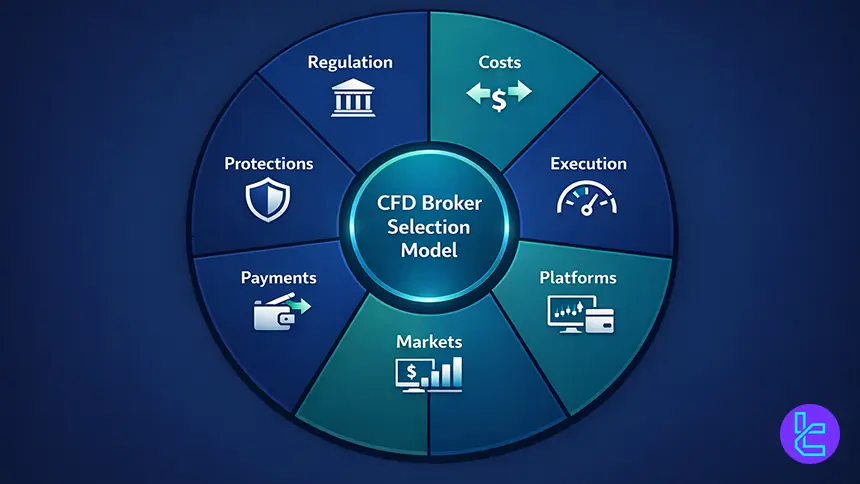
How Are the Best CFD Brokers Selected?
A reliable CFD broker ranking starts with regulation quality and legal entity checks. Tier 1 oversight from FCA, ASIC, BaFin, or CySEC matters because it enforces leverage caps, client money rules, and clear disclosures. Entity-based protections can vary, so the same brand may deliver different safeguards by jurisdiction.
Next, the review process measures trading costs and execution quality across major CFD markets. This includes average spreads, commission models on raw accounts, overnight financing formulas, and slippage behavior during volatility. Payment reliability also matters, including deposit and withdrawal speed, fee transparency, and supported base currencies.
Finally, platform depth and risk controls decide long-term suitability. Strong brokers support MT4, MetaTrader 5, cTrader, TradingView, or stable proprietary terminals, with robust order types, margin monitoring, and fast support. Research quality, education, and client protections like negative balance protection and margin closeout rules complete the final score.
- Regulation: Entity verification across FCA, ASIC, CySEC, BaFin, DFSA, and comparable supervisors
- Client fund handling: Segregated accounts, bank partners, and audit friendly reporting
- Total cost model: Spreads, commissions, swaps, inactivity fees, and withdrawal charges
- Execution quality: Order routing, requotes, slippage behavior, and fill speed benchmarks
- Platform stack: MT4, MT5, cTrader, TradingView, and mobile app stability
- Risk controls: Margin closeout, negative balance protection, and clear leverage tiers
- Market coverage: Forex, indices, commodities, shares, ETFs, and crypto, where permitted
What is a Contract for Difference (CFD)?
A Contract for Difference (CFD) is a derivative agreement between a trader and a broker to exchange the price difference of an underlying asset between entry and exit. You do not own the asset, which means no physical delivery. CFDs typically track forex pairs, indices, commodities, and shares on a 1:1 basis.
CFD trading supports both long and short trading positions. Going long means you buy a CFD expecting the underlying price to rise. Going short means you sell a CFD expecting the underlying price to fall. This two-way structure is one reason CFDs are used for speculation and short-term hedging in volatile markets.
Unlike futures, CFDs usually have no fixed expiry date. Positions can remain open as long as margin requirements are met, but holding trades overnight can trigger financing charges. Because CFDs are leveraged and margin-based, profits and losses scale with exposure, not just the deposit, making risk management essential.
CFD Trading Pros and Cons
CFDs offer flexible access to global markets from one margin account, often with small contract sizes. Traders can speculate on forex, indices, commodities, cryptocurrencies, and shares without owning the underlying assets. The ability to short sell makes CFDs usable in both rising and falling markets, which can support tactical hedging during risk events.
Leverage is the most powerful, and most risky, CFD feature. A small margin can control large notional exposure, which can amplify gains and losses quickly. Overnight financing, spreads, and slippage can also affect outcomes, especially in volatile sessions or when holding positions beyond the daily rollover window.
Pros | Cons |
Multi-asset exposure from one account | Some products restricted by region |
Long and short trading available | Shorting costs can be higher on some markets |
Low margin entry, higher capital efficiency | Losses can exceed the deposit without protections |
No typical expiry date like many futures | Overnight financing can erode returns |
Often low commission on many CFDs | Spreads, swaps, and fees vary widely by broker |
What Are CFDs Legal Limitations?
CFD legality depends on the trader’s country and the broker’s licensing. CFDs are banned for US residents, and other jurisdictions have restrictions or prohibitions depending on local rules.
In many regulated regions, CFD trading is legal but tightly controlled through leverage caps, standardized risk disclosures, and suitability questionnaires designed to reduce retail harm. Regulators like FCA and ASIC impose leverage limits that typically align with ESMA style ratios, such as 1:30 on major FX pairs and lower caps on shares and crypto.
Some regulators also ban crypto derivatives for retail clients. These restrictions reduce risk, but they can also limit strategy flexibility for high-leverage approaches.
Legal limitations also apply at the broker policy level. Many brokers restrict onboarding from sanctioned regions or high-risk jurisdictions, and product lists can differ by entity. Always confirm the exact legal entity shown in the account application.
Associated Costs with CFD Trading Brokers
CFD broker costs usually include spreads, commissions, and overnight financing. Spreads are the bid ask difference and can be the main cost on forex and commodities. Commission is common on raw spread accounts and on share CFDs. Overnight financing applies when positions remain open beyond the daily close and can be positive or negative.
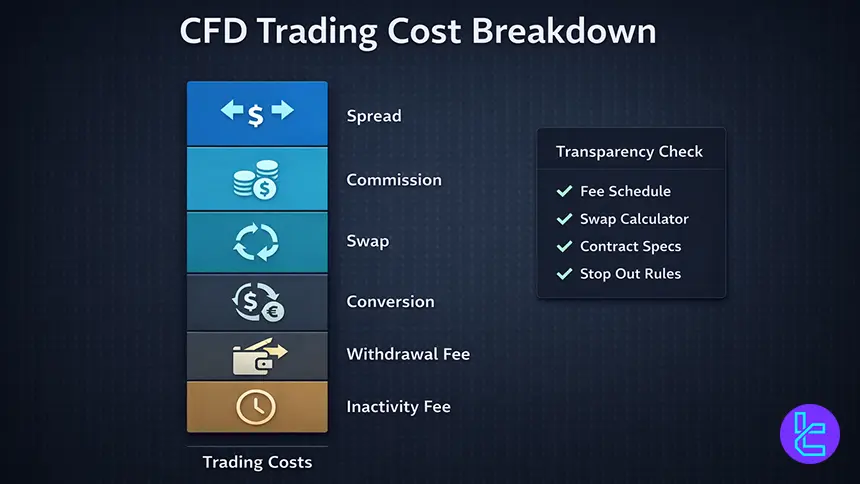
Non-trading fees also matter in real world performance. Many brokers charge inactivity fees after a set period, and some apply withdrawal fees or currency conversion markups when the instrument currency differs from the account base currency. Market data subscriptions may apply for certain exchanges, especially for share CFD pricing feeds.
Cost transparency separates strong brokers from risky ones. A good broker publishes fee schedules, swap calculators, and contract specifications. Traders should test cost impact using demo accounts, verify the symbol contract size, check stop out rules, and compare effective costs across account types, especially during volatile sessions.
Is CFD Trading Safe?
CFD trading safety depends on the broker’s regulation, the trader’s risk management, and the asset’s volatility. Regulated brokers apply client money segregation and standardized risk warnings. Many also provide negative balance protection so losses do not exceed account equity, but this protection can differ by entity and may not apply everywhere.
Leverage is the main safety risk. Because CFDs are margin products, a small move against the position can trigger a margin call or stop out, especially during news spikes or gaps. Safety improves when traders limit exposure, keep free margin buffers, use stop losses, and avoid oversized positions in highly volatile markets.
Broker selection also influences safety through execution quality and transparency. Clear contract specs, fast order handling, and reliable support reduce operational risk. Traders should verify the legal entity, test platforms on demo, review fees and rollover rules, and avoid unregulated brokers that lack clear protections or complaint mechanisms.
- Choose Tier 1 regulated entities when possible, because rules on funds and leverage are stricter;
- Confirm segregated client funds and read the broker’s client money policy disclosure;
- Prefer negative balance protection and clear margin closeout thresholds for retail accounts;
- Use lower leverage, smaller position sizing, and predefined stop loss levels consistently;
- Avoid holding leveraged positions through major news if you cannot manage gap risk;
- Test execution and slippage behavior on demo before scaling into live conditions;
- Treat CFDs as high-risk instruments and align exposure with your loss tolerance.
How Do CFDs Differ from Futures and Options?
CFDs are broker-issued derivatives that typically have no fixed expiry, while futures are exchange traded contracts with standardized expirations and contract sizes. CFD pricing usually tracks the underlying market closely, but execution and financing depend on the broker. Futures require understanding roll schedules, exchange fees, and margin rules set by clearinghouses.
Options differ because they embed optionality, meaning the buyer has a right but not an obligation to buy or sell at a strike price. Options pricing depends on volatility, time decay, and Greeks, not just spot movement. CFDs are more linear, meaning profit and loss usually move 1:1 with price changes, before costs.
Accessibility also differs. CFDs often allow smaller trade sizes than futures and can cover many assets in one account, but they are not available everywhere and may be banned in some jurisdictions. Futures and options are widely regulated in exchange frameworks, but they can require higher knowledge, larger margins, and complex strategy controls.
Differences Between CFD and Spot Trading
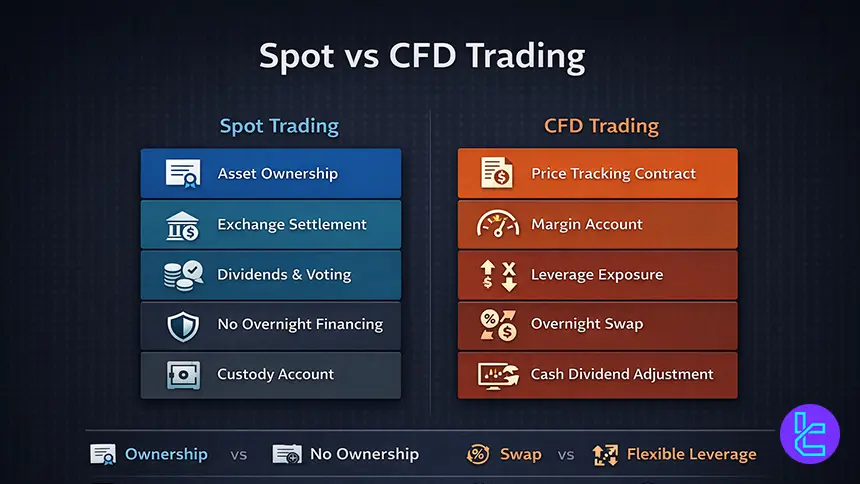
Spot trading means buying or selling the actual underlying asset, while CFD trading is a derivative contract that tracks price movement without ownership. With spot shares, you can receive shareholder rights and sometimes dividends, but CFDs typically adjust dividends as cash credits or debits depending on position direction and broker rules.
Costs differ as well. Spot markets can involve commissions and exchange fees, but they typically do not charge overnight financing for fully paid assets. CFDs often charge overnight financing when held beyond rollover because the broker funds part of the exposure. This makes CFDs more expensive for long holds, depending on rates and spreads.
Leverage availability is another key difference. Spot trading may allow limited margin depending on market rules, while CFDs commonly provide leverage tiers by asset class and entity. Spot settlement and custody also differ from CFD margin accounts, so your broker’s execution policy and protections become more important in CFD trading.
- Spot involves ownership or delivery, CFDs involve price tracking without owning the underlying asset;
- Spot investing can include dividends and voting rights, CFD dividends are cash adjustments only;
- CFDs commonly include overnight financing, spot fully paid holdings typically do not;
- CFD leverage can be higher and more flexible, increasing both opportunity and liquidation risk;
- Spot settlement uses exchange and custody processes, CFDs remain within broker margin accounts;
- CFD spreads can be wider than spot execution in some conditions, depending on broker pricing;
- Suitability depends on time horizon, as CFDs fit short term trading more than long holding.
What Markets Can I Trade as CFDs?
Most CFD brokers focus on four core markets: forex pairs, indices, commodities, and shares. Forex CFDs include major pairs like EUR/USD and USD/JPY, plus minors and exotics depending on the broker. Index CFDs offer exposure to baskets like S&P 500, NASDAQ 100, FTSE 100, and DAX 40.
Some brokers also offer ETFs, bonds, and crypto CFDs, but availability varies by jurisdiction and entity. Crypto CFDs often have lower leverage caps due to volatility and may be restricted for retail traders in certain regions. Always check the instrument list inside the specific legal entity you will be onboarded under.
- Forex: Majors, minors, exotics, and sometimes NDF style products by broker
- Indices: US, Europe, and Asia benchmarks, plus sector indices in some platforms
- Commodities: Precious metals, energies, and selected soft commodities were offered
- Shares: Across major exchanges, often with region-based commission and data requirements
- ETFs and Bonds: Available at multi-asset brokers with advanced market coverage
- Crypto: CFDs on major digital assets like Bitcoin and Ethereum
Best Strategies for CFD Trading
CFD strategies should match market structure, volatility, and cost model. Short term traders often use trend following on indices, breakout setups on forex, or mean reversion in range bound markets. Because CFDs allow short selling, strategies can be symmetric, using the same framework for bullish and bearish setups with adjusted risk parameters.
Risk management is the trading strategy backbone. Position sizing based on margin and stop distance, predefined stop loss levels, and consistent take profit logic matter more than prediction. Many traders use limit orders to control entry price, trailing stops to protect gains, and partial exits to reduce exposure during uncertain sessions.
Strategy testing should start on a demo account that mirrors live conditions. Focus on one market, one timeframe, and a repeatable plan, then validate performance across different volatility regimes. Avoid overleveraging, track total costs including swaps, and review execution quality, especially around news releases and low liquidity periods.
- Trend following using moving averages, structure breaks, and pullback entries on indices and forex
- Range trading with support resistance and mean reversion tools when volatility compresses
- Breakout trading around session highs and lows with strict stop placement and slippage awareness
- News risk approach using reduced size and wider stops, or staying flat during high-impact events
- Risk first position sizing, using fixed percentage risk per trade and margin buffer rules
- Use of limit orders, take profit, and trailing stops to systematize execution and reduce emotion
- Demo validation and journaling to track edge, costs, and drawdown before scaling leverage
What Leverage Does Brokers Offer on CFDs?
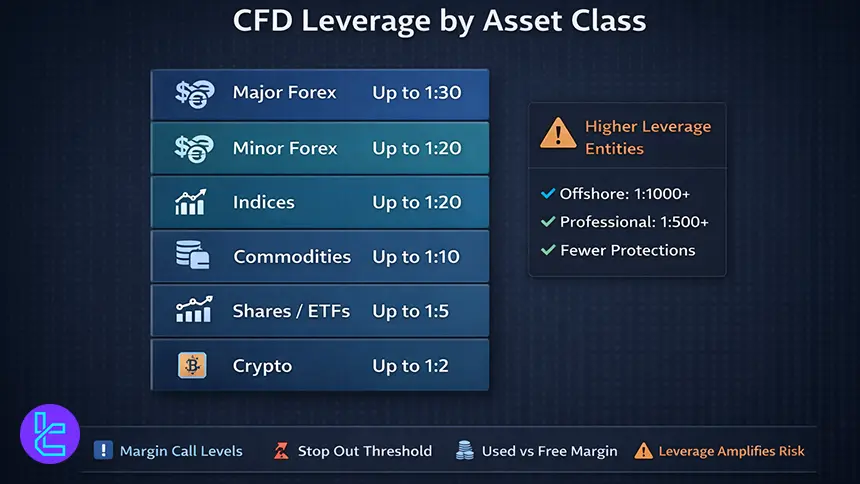
CFD leverage is set by the broker’s regulator and the asset’s volatility. Under stricter rules, retail leverage often caps near 1:30 on major forex pairs, lower on shares, and sometimes as low as 1:2 on crypto. These caps aim to reduce liquidation risk and protect retail accounts from rapid drawdowns.
Higher leverage can exist under offshore entities or professional classifications, sometimes reaching 1:200, 1:500, or even higher in certain brands. However, higher leverage usually comes with fewer protections, and the margin call or stop out thresholds can vary. Entity choice directly impacts your maximum leverage options.
Leverage should be treated as adjustable exposure, not as buying power. Using lower leverage with wider stop distances can reduce forced liquidation. Traders should track used margin, free margin, and equity in real time, especially during volatile sessions, because leverage amplifies both the speed and size of account swings.
- Retail leverage often caps near 1:30 for major forex under FCA, ASIC, and ESMA style rules;
- Lower caps apply to shares, ETFs, and crypto due to higher volatility and gap risk;
- Offshore entities may offer higher leverage, such as 1:200 or 1:500, with fewer safeguards;
- Professional accounts can access higher leverage but lose some compensation and protection rights;
- Margin call and stop out levels vary by broker and account type and affect liquidation behavior;
- High leverage increases sensitivity to spreads, swaps, and slippage, not only price direction.
CFD Trading in Comparison with Spot, Futures, and Options
CFDs, spot, futures, and options all provide market exposure, but they differ in ownership, pricing, and risk. Spot involves ownership or delivery, while CFDs are non-deliverable contracts with broker pricing. Futures and options are exchange traded instruments with standardized contracts, expirations, and exchange level margin frameworks.
Choosing the right instrument depends on time horizon and skill. Short term traders may prefer CFDs for flexibility, while longer term exposure can fit spot investing. Advanced hedging may favor options, and systematic strategies may prefer futures liquidity. Always compare total costs, leverage, and regulatory protections before committing capital.
Features | CFDs | Spot | Futures | Options |
Ownership | No | Yes | No | No |
Expiry | Typically none | No | Yes | Yes |
Pricing drivers | Price plus costs | Price plus fees | Price plus roll and fees | Price, volatility, time, Greeks |
Leverage | Common, entity based | Limited or none | Exchange margin | Premium and margin by strategy |
Typical costs | Spread, commission, swaps | Commission, exchange fees | Exchange fees, roll | Premium, spreads, commissions |
Conclusion and Final Words
CFD trading offers flexible access to forex, indices, commodities, shares, and cryptocurrencies through margin-based exposure without asset ownership. The best CFD brokers combine Tier 1 regulation from authorities such as FCA and ASIC, spreads from 0.0 pips on raw accounts, fast execution, and platforms like MT4, MT5, and TradingView.
Beyond pricing and leverage up to 1:500 or higher under certain entities, traders must evaluate non-trading fees, margin policies, negative balance protection, and fund segregation standards.
At TradingFinder, broker rankings are built using our structured Forex Methodology, which analyzes regulation tiers, pricing transparency, execution quality, platform depth, asset coverage, and investor protection mechanisms.