





The integration of cryptocurrency markets into traditional Forex broker platforms has reshaped the multi-asset trading landscape. Today, many leading Forex brokers offer crypto CFDs alongside currency pairs, indices, commodities, and stocks, allowing traders to access Bitcoin, Ethereum, and major altcoins within the same trading environment.
Whether you are a short-term crypto scalper, a swing trader, or a portfolio diversifier, selecting the right broker can significantly impact execution quality and long-term profitability.
 | AMARKETS | |||
 | FUSION MARKETS | |||
 | FXTM | |||
| 4 |  | TMGM | ||
| 5 |  | AVATRADE | ||
| 6 |  | ERRANTE | ||
| 7 |  | TICKMILL | ||
| 8 |  | pepperstone |
Trustpilot Score Comparison of Crypto Trading Brokers
When selecting a Forex broker for crypto trading, regulatory status and trading conditions are only part of the equation. Below is a comparative overview of major crypto-friendly Forex brokers based on their Trustpilot ratings and review volume.
Broker Name | Trustpilot Rating | Number of Reviews |
AMarkets | 3,571 | |
Fusion Markets | 6,326 | |
AvaTrade | 11,929 | |
3,226 | ||
Errante | 58 | |
1,093 | ||
TMGM | 841 | |
FXTM | 1,082 |
Minimum Trading Spreads Across Crypto Trading Brokers
In crypto CFD trading through Forex brokers, spread structure plays a central role in determining total trading cost. Unlike traditional Forex pairs where spreads can be measured in fractions of a pip, cryptocurrency spreads tend to be wider due to higher volatility and fragmented liquidity sources.
Broker Name | Min. Spread |
0 Pips | |
0 Pips | |
FXTM | 0 Pips |
TMGM | 0 Pips |
FXCC | 0 Pips |
FXPrimus | 0 Pips |
FXOpen | 0 Pips |
IFC Markets | 0.4 Pips |
Additional Charges and Non-Trading Costs in Crypto Trading Brokers
When trading cryptocurrencies through Forex brokers, spreads and commissions represent only part of the total cost structure. Non-trading fees and operational charges can significantly affect long-term profitability, especially for swing traders or investors who hold positions over extended periods.
Broker Name | Deposit Fee | Withdrawal Fee | Inactivity Fee |
$0 | $0 | $10 Monthly | |
$0 | From 1% to 2.5% Based on the Method | $5 Monthly | |
Tickmill | $0 | $0 | $10 Monthly |
Pepperstone | $0 | $0 | $0 |
Grand Capital | Depends on the method | Depends on the method | $15 Monthly |
Markets4you | $0 | $0 | $10 Monthly |
MTrading | $0 | $0 | €50 Monthly |
ETO Markets | $0 | $0 | $0 Monthly |
Available Platforms in Crypto Trading Forex Brokers
The trading platform plays a decisive role in crypto CFD performance, especially given the 24/7 volatility of digital asset markets. Unlike traditional Forex sessions, cryptocurrencies can experience sharp price movements during weekends and low-liquidity hours, making execution speed, order stability, and charting precision critical.
Broker Name | Trading Platforms |
MT4, MT5, FXTM Trader App | |
MT4, MT5, IRESS, TMGM Mobile App | |
AvaTrade | MetaTrader 4, MetaTrader 5, Mobile App, WebTrader |
Errante | MetaTrader 4, MetaTrader 5, cTrader, TradingView |
NAGA | MT4, MT5, NAGA App |
NordFX | MT4 / MT5 |
OneRoyal | MT4, MT5, MT4 Accelerator |
TrioMarkets | MetaTrader 4, TrioTrader |
Top 6 Forex Brokers with Crypto Trading
Below are eight Forex brokers that provide competitive crypto CFD trading conditions alongside traditional asset classes. These brokers were selected based on regulation, spread structure, leverage limits, platform reliability, and the range of available cryptocurrencies.
Each platform offers access to Bitcoin, Ethereum, and major altcoins within a multi-asset trading environment.
AMarkets
AMarkets is a Forex and CFD broker established in 2007, serving more than 2 million clients globally. The broker operates under multiple offshore regulatory bodies including FSA (Saint Vincent and the Grenadines), FSC (Cook Islands), and MISA (Comoros), and is also a member of the Financial Commission, offering compensation coverage up to €20,000 per claim.

The company provides four primary live accounts in AMarkets dashboard including Standard, ECN, Fixed, and Crypto, alongside a Demo account. Minimum deposits start from $100, while leverage can reach up to 1:3000 on most accounts.
The ECN account offers spreads from 0 pips with a $2.5 commission per lot per side, while Standard and Fixed accounts operate commission-free.
AMarkets supports MetaTrader 4, MetaTrader 5, and its proprietary mobile app. The broker offers more than 550 tradable instruments across Forex, stocks, indices, commodities, ETFs, bonds, and 26+ crypto pairs. AMarkets Copy trading is available, although PAMM accounts are not supported.
AMarkets deposit and withdrawal methods include bank cards, cryptocurrencies (USDT, BTC, ETH, BNB, LTC), bank transfers, and e-wallets such as Volet and TC Pay. Deposits are commission-free, while withdrawal fees range between 0.5% and 1.8% depending on the method.
With competitive leverage, broad asset coverage, and multiple promotional programs, AMarkets appeals to high-leverage traders. However, the absence of Tier-1 regulation and restrictions in certain jurisdictions should be considered before opening an account.
Account Types | Standard, ECN, Fixed, Crypto, Demo |
Regulating Authorities | FSA, FSC, MISA, Financial Commission |
Minimum Deposit | $100 |
Deposit Methods | Credit/Debit Cards, Bank Transfer, Cryptocurrencies (USDT, BTC, ETH, BNB, LTC), Volet, TC Pay |
Withdrawal Methods | Credit/Debit Cards, Bank Transfer, Cryptocurrencies, Volet, TC Pay |
Maximum Leverage | Up to 1:3000 |
Trading Platforms & Apps | MetaTrader 4, MetaTrader 5, AMarkets Mobile App |
AMarkets Pros and Cons
AMarkets offers competitive spreads, multi-jurisdiction regulatory coverage, and advanced trading platforms, although regional limitations and the lack of a proprietary platform may affect trader preference.
Pros | Cons |
Established since 2007 | Not regulated by Tier-1 authorities (FCA, CySEC) |
Compensation fund up to €20,000 | Restricted in US, UK, and EU countries |
Leverage up to 1:3000 | $200 minimum deposit for ECN account |
550+ tradable instruments | Withdrawal fees apply |
Crypto account available | No PAMM account option |
MT4, MT5 & proprietary mobile app | Offshore regulatory structure |
Fusion Markets
Fusion Markets is a multi-regulated Forex and CFD broker founded by Phil Horner and operating under ASIC in Australia and VFSC in Vanuatu. The broker positions itself as a low-cost trading provider, frequently recognized as a “Lowest Spread Forex Broker” by industry reviewers.
Client funds are held in segregated accounts with top-tier banks such as HSBC and National Australia Bank, adding an extra layer of operational transparency. Depending on the Fusion Markets registration entity, traders may access leverage up to 1:500, while ASIC-regulated accounts are capped at 1:30 in line with regulatory standards.
Fusion Markets dashboard offers three primary account types: Zero, Classic, and Swap-Free. The Zero account provides raw spreads from 0.0 pips with a $4.5 per lot commission, while the Classic account features spreads from 0.9 pips with zero commission. There is no minimum deposit requirement, making the broker accessible to a wide range of traders.
The platform ecosystem includes MetaTrader 4, MetaTrader 5, cTrader, and TradingView, all available across desktop, web, and mobile. The broker also supports copy trading through Fusion+, DupliTrade integration, and MAM solutions for professional money managers.
With over 250 tradable instruments including Forex, indices, commodities, metals, US share CFDs, and cryptocurrencies, Fusion Markets delivers broad market access.
While its educational content is relatively limited and no investor compensation fund is available under certain entities, the broker remains competitive due to its cost efficiency, platform diversity, and fast execution infrastructure.
Account Types | Zero, Classic, Swap-Free |
Regulating Authorities | ASIC (Australia), VFSC (Vanuatu) |
Minimum Deposit | $0 |
Deposit Methods | Bank Wire, VISA, MasterCard, PayPal, Skrill, Neteller, Crypto, PayID, Perfect Money, BinancePay, Interac |
Withdrawal Methods | Bank Wire, PayPal, Skrill, Neteller, Crypto, Interac, Local Bank Transfer |
Maximum Leverage | Up to 1:500 (1:30 under ASIC) |
Trading Platforms & Apps | MetaTrader 4, MetaTrader 5, cTrader, TradingView |
Fusion Markets Pros and Cons
Fusion Markets delivers tight pricing, strong regulatory presence across multiple jurisdictions, and robust platform support, yet certain geographic restrictions and no in-house platform could impact selection decisions.
Pros | Cons |
Regulated by ASIC and VFSC | No investor compensation scheme |
No minimum deposit requirement | Limited educational resources |
Spreads from 0.0 pips | Relatively new broker (launched 2019) |
Supports MT4, MT5, cTrader & TradingView | Limited proprietary platform features |
Copy trading and MAM accounts available | Restricted in several countries |
No deposit or withdrawal fees | Negative balance protection not available under all entities |
FXTM
FXTM, also known as ForexTime, was established in 2011 and operates under Exinity Limited, regulated by the Financial Services Commission (FSC) of Mauritius. While the broker previously held licenses from FCA, CySEC, and FSCA, its current regulatory coverage is limited to a Tier-3 offshore authority.

FXTM serves clients in over 150 countries and provides access to more than 1,000 tradable instruments across Forex, stocks, indices, commodities, metals, and cryptocurrencies. The broker offers leverage up to 1:3000 under its offshore entity, positioning itself as a high-leverage trading venue. However, there is no investor compensation scheme available.
The broker provides three main account types: Advantage, Advantage Plus, and Advantage Stocks. The Advantage account offers spreads from 0.0 pips with a $3.5 per lot commission, while Advantage Plus is commission-free with spreads starting from 1.5 pips. The minimum deposit requirement is $200 across accounts.
FXTM dashboard supports MetaTrader 4, MetaTrader 5, and its proprietary FXTM Trader App. Copy trading is available via FXTM Invest, allowing users to follow strategy managers with a minimum investment of $100. Beside that, cashback is also available as FXTM rebate.
Although FXTM provides extensive educational resources through its Knowledge Hub and has received over 45 industry awards, its Trustpilot score of 3.3/5 and ForexPeaceArmy score of 2.1/5 reflect mixed user sentiment.
Overall, the broker combines high leverage, multi FXTM deposit and withdrawal methods, and strong educational tools, but its regulatory structure and higher minimum deposit may be considerations for some traders.
Account Types | Advantage, Advantage Plus, Advantage Stocks |
Regulating Authorities | Financial Services Commission (FSC), Mauritius |
Minimum Deposit | $200 |
Deposit Methods | VISA, MasterCard, Maestro, Skrill, Neteller, Perfect Money, FasaPay, TC Pay, M-Pesa, Google Pay, GlobePay, Bank Wire, Crypto |
Withdrawal Methods | VISA, MasterCard, Skrill, Neteller, Perfect Money, Bank Wire, Crypto, Local Payment Systems |
Maximum Leverage | Up to 1:3000 |
Trading Platforms & Apps | MetaTrader 4, MetaTrader 5, FXTM Trader App |
FXTM Pros and Cons
FXTM combines low spreads with diversified regulatory oversight and modern trading technology, though regional constraints and the absence of a proprietary system may influence some traders.
Pros | Cons |
Over 1,000 tradable instruments | Regulated only by FSC (Tier-3) |
Leverage up to 1:3000 | No investor compensation scheme |
MT4, MT5 & FXTM Trader App | $200 minimum deposit |
Copy trading via FXTM Invest | Mixed trust scores |
Strong educational resources (Knowledge Hub) | No US clients accepted |
Swap-free accounts available | Limited cryptocurrency coverage |
TMGM
TMGM (TradeMax Global Markets) is an Australian-based Forex and CFD broker founded in 2013, offering access to over 12,000 tradable instruments across Forex, stocks, indices, commodities, energies, and cryptocurrencies.
The broker operates under multiple regulatory authorities, including ASIC (Tier-1), VFSC, FSC Mauritius, CMA Kenya, and FSA Seychelles, providing segregated client funds and up to AUD 10 million in Professional Indemnity insurance coverage.
TMGM dashboard offers two primary retail account types: EDGE (ECN) and CLASSIC. The EDGE account features spreads from 0.0 pips with a $3.5 commission per lot, while the CLASSIC account provides commission-free trading with spreads from 1.0 pips. Maximum leverage reaches 1:1000 under offshore entities, while ASIC-regulated accounts are capped at 1:30.
The broker supports MetaTrader 4, MetaTrader 5, IRESS (for institutional traders), and its proprietary TMGM mobile app. Copy trading is available via HUBx and ZuluTrade integration, allowing traders to follow strategy providers. Cashbacks are also supported as TMGM rebate.
TMGM maintains competitive execution speeds (under 30ms average), allows EAs, scalping, and news trading, and provides 24/7 multilingual customer support. While TMGM deposits and withdrawals are generally fee-free, a $10 monthly inactivity fee applies after prolonged dormancy.
Overall, the broker combines strong regulatory backing, extensive asset coverage, and flexible trading infrastructure, making it suitable for both active traders and investors seeking copy trading exposure.
Account Types | EDGE/ECN, CLASSIC, IRESS (Standard, Premium, Gold) |
Regulating Authorities | ASIC (Australia), VFSC (Vanuatu), FSC (Mauritius), CMA (Kenya), FSA (Seychelles) |
Minimum Deposit | $100 |
Deposit Methods | VISA, MasterCard, Bank Transfer, RMB Instant, Revolut, WISE, Neteller, Skrill, UnionPay, Fasapay, Crypto (USDT, USDC) |
Withdrawal Methods | Bank Transfer, RMB Instant, Revolut, WISE, Neteller, Skrill, Crypto (USDT, USDC) |
Maximum Leverage | Up to 1:1000 (Entity dependent) |
Trading Platforms & Apps | MetaTrader 4, MetaTrader 5, IRESS, TMGM Mobile App |
TMGM Pros and Cons
TMGM provides efficient spreads, cross-border regulation, and advanced trading infrastructure; however, regional access limits and no proprietary platform may be considerations for some users.
Pros | Cons |
ASIC Tier-1 regulation | Inactivity fee after dormancy |
12,000+ tradable instruments | Limited retail account variety |
Spreads from 0.0 pips (EDGE) | Educational resources not extensive |
Copy trading via HUBx & ZuluTrade | Mixed ratings on some review platforms |
24/7 multilingual support | Leverage restrictions under ASIC |
Islamic accounts available | Not available in several restricted countries |
Fast execution (under 30ms) | — |
AvaTrade
AvaTrade is a globally regulated multi-asset Forex and CFD broker holding 9 regulatory licenses, including oversight from the Central Bank of Ireland (CBI), ASIC, CySEC, FSCA, FSA (Japan), ADGM, ISA, and BVI FSC. Its broad regulatory footprint enhances credibility and ensures segregated client funds across jurisdictions.
The broker requires a minimum deposit of $100 and offers Retail, Professional, Islamic, and Demo account types. Maximum leverage reaches 1:400 under certain entities, while EU-regulated accounts are capped at 1:30. Margin call and stop-out levels are set at 25% and 10%, respectively.
AvaTrade dashboard supports MetaTrader 4, MetaTrader 5, WebTrader, a mobile app, and AvaOptions for options trading. It provides over 1,250 tradable instruments across Forex, stocks, indices, commodities, cryptocurrencies, bonds, and options.
The broker operates on a spread-based pricing model with no trading commissions and cashbacks on AvaTrade rebate. However, inactivity fees apply after two months of dormancy, with an additional annual administration fee after prolonged inactivity.
Copy trading is available via DupliTrade and AvaSocial, offering structured social trading exposure. AvaTrade maintains a Trustpilot score of 4.5/5 based on more than 8,000 reviews.
Overall, The broker combines strong regulatory backing, diversified asset coverage, and multiple AvaTrade deposit and withdrawal methods, making it suitable for both retail and professional traders.
Account Types | Retail, Professional, Islamic, Demo |
Regulating Authorities | ASIC, CySEC, CBI, FSA, FSCA, MiFID, ADGM, PFSA, ISA, BVI FSC |
Minimum Deposit | $100 |
Deposit Methods | Credit/Debit Cards, Bank Wire, Skrill, Neteller, WebMoney, PayPal |
Withdrawal Methods | Credit/Debit Cards, Bank Wire, Skrill, Neteller, WebMoney, PayPal |
Maximum Leverage | Up to 1:400 (Entity dependent) |
Trading Platforms & Apps | MetaTrader 4, MetaTrader 5, WebTrader, Mobile App, AvaOptions |
AvaTrade Pros and Cons
AvaTrade integrates competitive pricing, multi-regulatory supervision, and established third-party platforms, while certain jurisdictional restrictions and the lack of a native platform may shape broker choice.
Pros | Cons |
Regulated by 9 financial authorities | Inactivity and annual admin fees |
1,250+ tradable instruments | Limited account type diversity |
No trading commissions | Not available to U.S. traders |
MT4, MT5, WebTrader & AvaOptions | No PAMM accounts |
Copy trading via DupliTrade & AvaSocial | Support not 24/7 (24/5 only) |
Segregated funds & MiFID compliance | Leverage restrictions in EU |
Trustpilot score 4.5/5 | — |
Errante
Errante is a Forex and CFD broker established in 2018, operating under CySEC (Cyprus) and the FSA (Seychelles). The CySEC-regulated entity participates in the Investor Compensation Fund, offering protection up to €20,000, while the offshore branch provides broader international access and leverage flexibility.
The broker offers four account types after Errante registration process including Standard, Premium, VIP, and Tailor Made. The minimum deposit starts at $50, with leverage reaching up to 1:1000 depending on the jurisdiction. Spreads begin from 0.8 pips on Standard accounts and from 0.0 pips on Tailor Made accounts, where a $3 commission per lot applies. Other accounts are commission-free.
Errante supports MetaTrader 4, MetaTrader 5, cTrader, and TradingView integration. Since 2024, clients can connect cTrader accounts directly to TradingView for advanced chart-based execution. VIP and Tailor Made clients may also qualify for VPS services.
The broker provides over 150 tradable instruments across Forex, metals, indices, energies, stocks, and cryptocurrencies. Investment solutions include Copy Trading, PAMM, Errante rebate and MAM accounts, making it suitable for managed and indirect trading strategies.
Deposit and withdrawal options include bank transfer, cards, Skrill, Neteller, Volet, SticPay, and cryptocurrencies. Customer support operates 24/7 via live chat, email, phone, and ticket system.
Overall, Errante combines competitive pricing, multi-platform support, and managed-account infrastructure, though its relatively short operational history and moderate public trust ratings should be considered.
Account Types | Standard, Premium, VIP, Tailor Made |
Regulating Authorities | CySEC, FSA (Seychelles) |
Minimum Deposit | $50 |
Deposit Methods | Bank Wire, VISA, MasterCard, Skrill, Neteller, Volet, SticPay, Crypto |
Withdrawal Methods | Bank Wire, VISA, MasterCard, Skrill, Neteller, Volet, SticPay, Crypto |
Maximum Leverage | Up to 1:1000 (entity dependent) |
Trading Platforms & Apps | MetaTrader 4, MetaTrader 5, cTrader, TradingView |
Errante Pros and Cons
Errante stands out for its tight spreads and strong regulatory footprint across regions, supported by advanced platforms, though geographic limitations and no proprietary interface may affect decisions.
Pros | Cons |
Regulated by CySEC | Short operational history (since 2018) |
Investor protection up to €20,000 | No Cent account |
Leverage up to 1:1000 | Limited swap-free duration |
Supports PAMM, MAM & Copy Trading | Moderate public review ratings |
MT4, MT5, cTrader & TradingView | Limited crypto asset range |
VPS for higher-tier accounts | Restricted in certain countries |
24/7 multilingual support | - |
What Factors Determined the Selection of Crypto Trading Brokers?
Selecting the best crypto trading Forex brokers requires a structured, data-driven evaluation process. Since traders allocate capital to platforms offering leveraged crypto CFDs, regulatory strength, execution reliability, and cost transparency become critical.
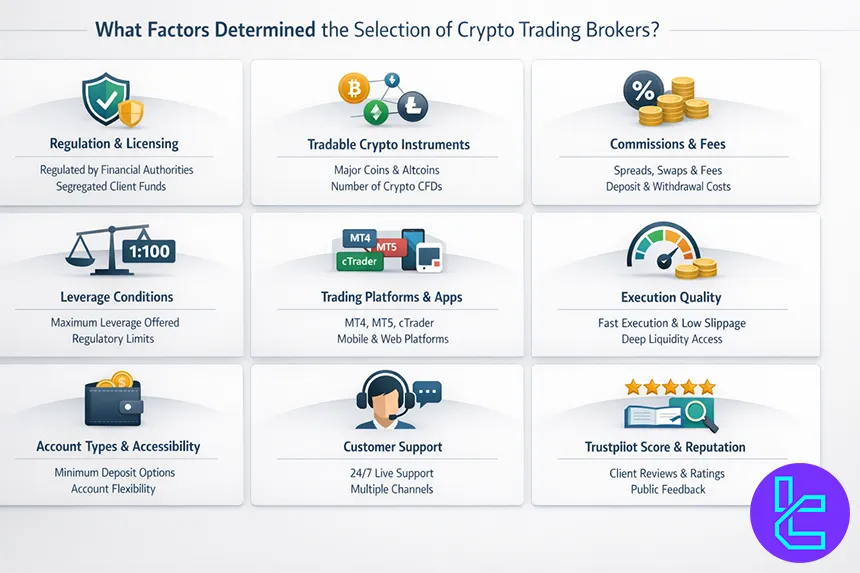
The ranking framework applied here follows a comprehensive methodology built on transparency, objectivity, and measurable performance indicators.
Each broker was assessed using a multi-layer evaluation model built around 19 core metrics. These factors were not limited to crypto spreads alone, but extended to operational integrity, infrastructure depth, and client protection mechanisms.
The primary evaluation elements included:
- Regulation and Licensing: Verification of oversight by recognized financial authorities and confirmation of segregated client fund policies;
- Tradable Crypto Instruments: Number of available crypto CFDs, including major coins and altcoins;
- Commissions and Fee Structure: Analysis of spreads, overnight swaps, deposit and withdrawal fees, and inactivity charges;
- Leverage Conditions: Maximum leverage available under different regulatory entities;
- Trading Platforms and Apps: Availability of MT4, MT5, cTrader, proprietary platforms, and mobile execution stability;
- Execution Quality: Order execution model, slippage control, and liquidity depth;
- Account Types and Accessibility: Minimum deposit requirements and account flexibility;
- Customer Support and Responsiveness: Live testing of response times and support channels;
- Trustpilot Score and Public Reputation: Independent client feedback assessment;
- Education and Analytical Tools: Availability of crypto-related research, calculators, and learning materials.
The evaluation was conducted by experienced market analysts specializing in high-volatility environments. The objective was not only to identify brokers offering crypto trading, but to determine which platforms provide structural safety, competitive pricing, operational transparency, and sustainable trading conditions.
This methodology ensures that broker selection reflects real-world trading priorities rather than marketing claims.
What Makes Cryptocurrencies Attractive for Traders and Investors?
Cryptocurrencies have transformed from niche digital assets into one of the most actively traded markets in global finance. Their appeal lies primarily in volatility, accessibility, and decentralization. Unlike traditional Forex pairs, crypto assets can generate large percentage moves within short timeframes, creating frequent trading opportunities.
Key factors driving their attractiveness include:
- High Volatility: Daily price swings of 5% to 10% are common in major coins
- 24/7 Market Access: No centralized exchange hours, enabling continuous trading
- Global Liquidity: Bitcoin and Ethereum maintain deep liquidity pools
- Low Entry Barrier: Small capital can control larger exposure through CFDs
- Innovation Narrative: Blockchain adoption and technological evolution attract long-term investors
For investors, cryptocurrencies also represent portfolio diversification. Their correlation with traditional asset classes like equities or commodities can vary, offering hedging potential during macroeconomic shifts.
However, volatility cuts both ways. While the opportunity for profit is high, so is the potential for rapid loss. This dual nature is precisely what makes cryptocurrencies both attractive and complex.
What Are the Pros and Cons of Crypto Trading in Forex?
Trading crypto through Forex brokers typically involves CFDs rather than direct ownership. Below is a structured comparison:
Pros | Cons |
Ability to trade long and short | No ownership of underlying coins |
Leverage availability | High volatility risk |
No wallet or private key management | Overnight swap fees |
Regulated broker environment | Spread widening during volatility |
Multi-asset trading from one platform | Weekend liquidity gaps |
Forex-based crypto trading offers convenience and regulation but sacrifices direct blockchain custody. It is suitable for speculative traders rather than long-term holders seeking staking or DeFi participation.
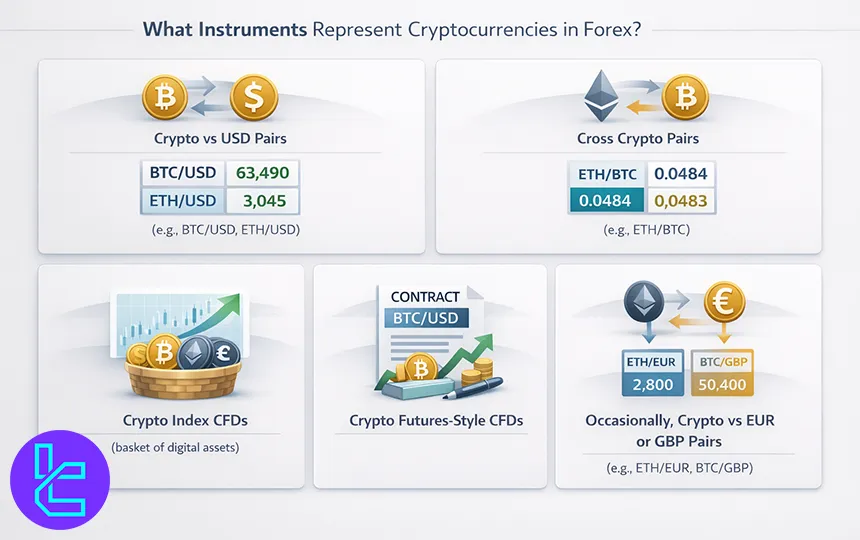
What Instruments Represent Cryptocurrencies in Forex?
In Forex environments, cryptocurrencies are primarily offered as Contracts for Difference (CFDs). Traders speculate on price movements without owning the digital asset itself.
Common instrument formats include:
- Crypto vs USD pairs (e.g., BTC/USD, ETH/USD)
- Cross crypto pairs (e.g., ETH/BTC)
- Crypto index CFDs (basket of digital assets)
- Crypto futures-style CFDs
- Occasionally, crypto vs EUR or GBP pairs
CFDs allow both long and short positioning, enabling traders to profit from rising or falling prices. Settlement occurs in fiat currency, eliminating blockchain transaction requirements.
This structure simplifies execution and integrates seamlessly with platforms like MT4 or MT5, but it does not provide on-chain ownership or custody rights.
Which Cryptocurrencies Are Available at Forex Brokers?
Availability varies significantly between brokers. Most offer a core group of high-cap coins, while fewer provide broad altcoin coverage.
Typical availability:
- Major Coins: Bitcoin (BTC), Ethereum (ETH), Litecoin (LTC)
- Large Caps: Ripple (XRP), Cardano (ADA), Solana (SOL)
- Emerging Tokens: Polkadot (DOT), Avalanche (AVAX), Chainlink (LINK)
- Meme Coins: Dogecoin (DOGE), Shiba Inu (SHIB) at select brokers
Some multi-asset brokers offer 20-50 crypto CFDs, while others limit selection to 5-10 major coins.
Traders focused on volatility prefer altcoin access. Conservative participants often concentrate on BTC and ETH due to liquidity stability.
Spread Structure and Other Fees in Crypto Trading Brokers
Crypto trading costs differ from traditional Forex pairs due to volatility and liquidity characteristics.
Main cost components:
- Floating Spreads: Often wider than major Forex pairs
- Commission: Rare in crypto CFDs, mostly spread-based pricing
- Swap Fees: Applied for overnight positions
- Inactivity Fees: Broker-specific
- Conversion Fees: If base currency differs
During high volatility events, spreads may expand significantly. For scalpers, spread cost becomes the primary factor affecting profitability. Long-term traders are more impacted by swaps.
Cost transparency and real-time spread monitoring are essential when selecting a crypto trading broker.
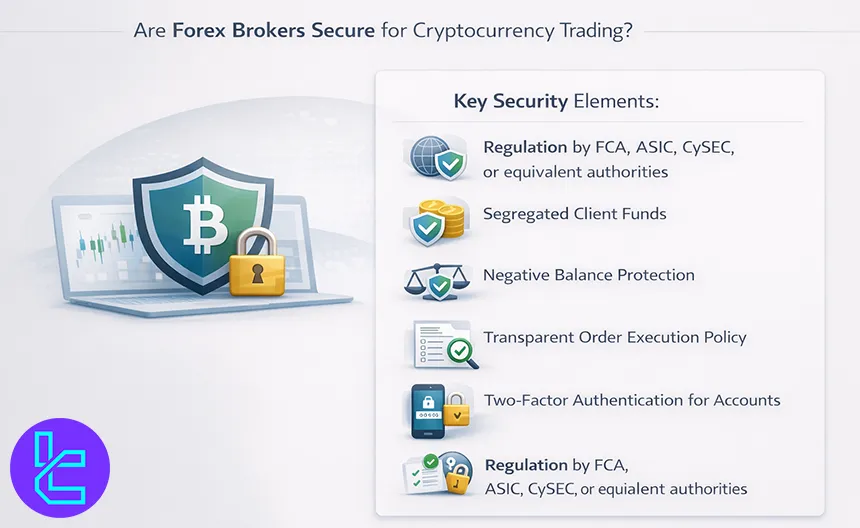
Are Forex Brokers Secure for Cryptocurrency Trading?
Security depends on broker regulation rather than blockchain custody, since traders use CFDs.
Key security elements:
- Regulation by FCA, ASIC, CySEC, or equivalent authorities
- Segregated client funds
- Negative balance protection
- Transparent order execution policy
- Two-factor authentication for accounts
Unlike crypto exchanges, regulated Forex brokers operate under financial compliance frameworks. However, market risk remains independent of operational security.
Traders should verify jurisdiction, compensation schemes (if applicable), and broker reputation before allocating capital.
What is the Best Time to Trade Cryptocurrencies?
Although crypto markets operate 24/7, liquidity and volatility vary by session.
Most active periods:
- Overlap of London and New York sessions
- U.S. macroeconomic news releases
- Weekend breakout phases
- Asian session for BTC-related flows
Bitcoin often leads directional momentum, influencing altcoins. Institutional flows typically increase during U.S. trading hours. Traders should monitor volume patterns rather than relying solely on traditional Forex session logic.
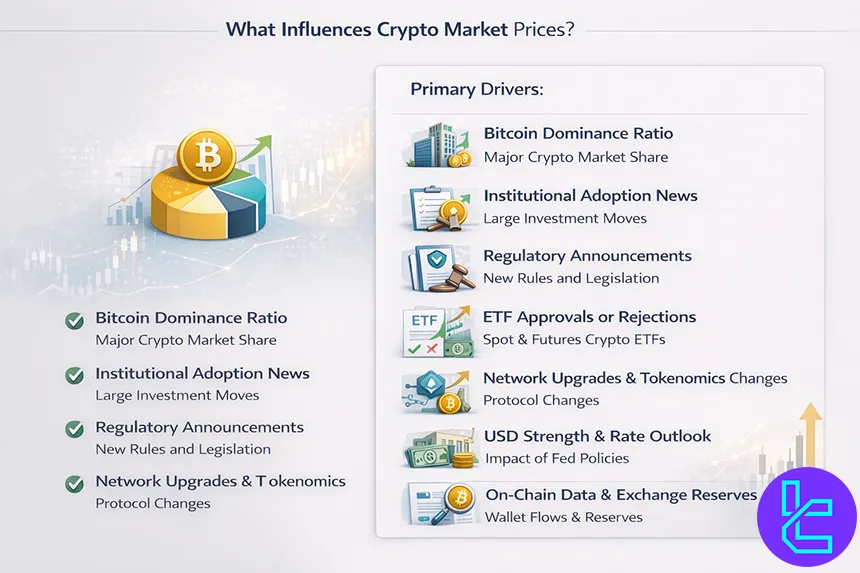
What Influences Crypto Market Prices?
Crypto prices are influenced by a mix of technical, macroeconomic, and sentiment-driven factors.
Primary drivers:
- Bitcoin dominance ratio
- Institutional adoption news
- Regulatory announcements
- ETF approvals or rejections
- Network upgrades and tokenomics changes
- U.S. dollar strength and interest rate expectations
- On-chain data such as wallet flows and exchange reserves
Unlike Forex pairs tied directly to national economies, cryptocurrencies are highly sentiment-sensitive. Social media, funding rates, and derivatives positioning can also impact short-term volatility. Understanding these drivers improves strategic timing and risk management.
How Much Leverage Is Offered on Crypto CFDs?
Leverage limits depend heavily on regulatory jurisdiction.
Typical leverage ranges:
- EU & UK regulated brokers: 1:2 (retail clients)
- Offshore entities: 1:20 to 1:200
- Professional accounts: Higher leverage under specific conditions
While leverage increases capital efficiency, it amplifies volatility risk. A 5% market move under 1:20 leverage translates to a 100% equity impact.
Due to crypto’s inherent volatility, conservative leverage usage is generally recommended even when higher limits are available.
Advanced and Beginner Crypto Trading Strategies
Cryptocurrency markets require a structured trading approach due to their elevated volatility, 24/7 trading cycle, and liquidity fluctuations across sessions. Unlike traditional Forex pairs, crypto assets frequently produce rapid intraday expansions, sharp liquidity sweeps, and momentum-driven breakouts that demand disciplined execution.
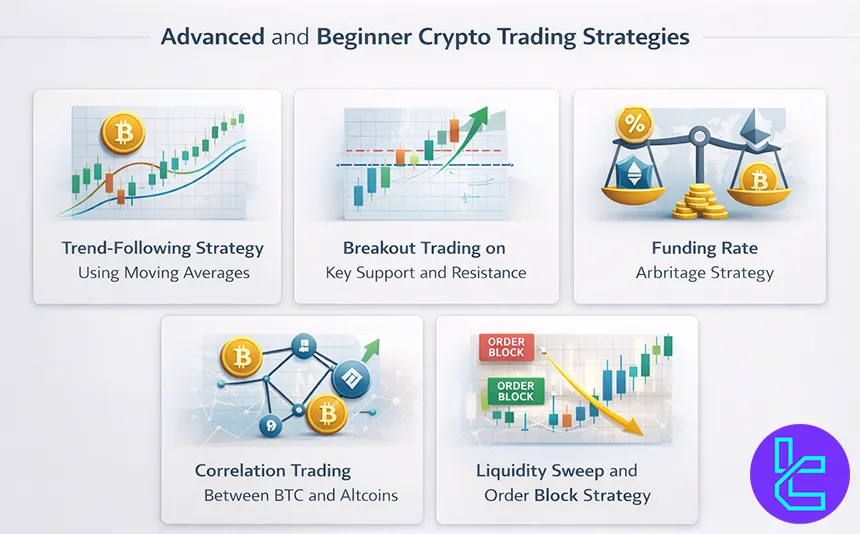
Selecting the right strategy depends on trading experience, risk tolerance, capital size, and time commitment. Beginners typically benefit from rule-based, trend-aligned systems, while advanced traders may integrate derivatives data, liquidity concepts, and intermarket correlation analysis.
Trend-Following Strategy Using Moving Averages
This strategy focuses on identifying directional momentum through indicators such as the 50 EMA and 200 EMA. Traders enter long positions when price trades above key moving averages and short when below.
It works best in trending markets and is particularly suitable for beginners due to its structured rule-based framework. Risk control is usually applied through swing-low or swing-high stop placement.
Breakout Trading on Key Support and Resistance
Breakout traders monitor consolidation ranges and enter positions once price closes beyond significant resistance or support levels.
Crypto markets frequently produce high-momentum breakouts, especially during U.S. session overlap or major news releases. Volume confirmation improves reliability, while false breakouts remain the primary risk.
Funding Rate Arbitrage Strategy
Advanced traders exploit discrepancies between spot and perpetual futures markets. When funding rates become excessively positive or negative, arbitrage opportunities may emerge.
This approach requires understanding derivatives data and exchange mechanics. While relatively lower directional risk, execution precision and capital allocation discipline are critical.
Correlation Trading Between BTC and Altcoins
Bitcoin dominance often dictates broader market direction. Traders monitor correlation shifts between BTC and major altcoins such as ETH or SOL.
For example, if BTC consolidates while altcoins gain momentum, rotation trades may develop. This strategy demands macro awareness and inter-market analysis.
Liquidity Sweep and Order Block Strategy
This advanced price-action method focuses on liquidity zones, stop hunts, and institutional order blocks. Traders identify areas where retail liquidity accumulates and position after liquidity sweeps.
It requires strong chart-reading skills and is commonly applied on lower timeframes during high-volume sessions. Risk-to-reward ratios can be optimized when executed precisely.
Full Comparison of Tradable Cryptocurrencies in Forex
Cryptocurrency trading within Forex broker environments is primarily offered through CFDs rather than direct ownership of digital assets. While the market structure remains decentralized at its core, trading conditions, leverage caps, spread models, and liquidity depth vary depending on the crypto asset’s market capitalization and volatility profile.
The comparison below outlines the key structural and trading characteristics of the most commonly tradable cryptocurrencies available at Forex brokers.
Parameter | Bitcoin (BTC/USD) | Ethereum (ETH/USD) | Major Altcoins (e.g., BNB, SOL, XRP) | High-Volatility Altcoins (e.g., DOGE, SHIB) |
Market Dominance | Highest market cap, benchmark crypto | Second largest market cap | Mid to large cap | Small to mid cap |
Liquidity Depth | Very high | High | Medium | Low to medium |
Typical Spread (CFDs) | Tightest among cryptos | Slightly wider than BTC | Moderate | Wide |
Volatility Profile | High but relatively stable vs alts | High | Very high | Extremely high |
Leverage (Retail, Tier-1 Reg.) | Often up to 1:2 | Often up to 1:2 | 1:2 or lower | Often restricted to 1:1–1:2 |
Trading Hours | 24/7 underlying market (broker-dependent CFDs) | 24/7 underlying market | 24/7 underlying market | 24/7 underlying market |
Main Price Drivers | ETF flows, macro risk sentiment, halving cycles | Network upgrades, DeFi activity, staking demand | Ecosystem growth, token utility, partnerships | Speculation, social media sentiment |
Institutional Participation | Strong ETF and futures presence | Growing institutional adoption | Limited but expanding | Minimal |
Correlation with BTC | Benchmark asset | Strong positive correlation | Moderate to strong correlation | Highly correlated, sentiment-driven |
Risk Profile | High risk | High risk | Very high risk | Extremely high risk |
Comparing Crypto with Stocks, Commodities, and Forex
Cryptocurrency trading differs significantly from traditional asset classes in terms of volatility intensity, regulatory framework, liquidity depth, and market maturity.
While Forex operates as a decentralized interbank market and stocks trade on centralized exchanges, crypto markets function 24/7 with sentiment-driven momentum and high speculative flows.
The table below highlights the structural and trading differences between crypto and other major financial markets.
Parameter | Cryptocurrency (CFDs) | Stocks (Equities) | Forex (Currency Pairs) | Commodities (Oil, Gold, etc.) |
Market Structure | Decentralized blockchain market, traded via CFDs or exchanges | Centralized stock exchanges (NYSE, NASDAQ) | Decentralized interbank OTC market | Futures exchanges (CME, ICE), OTC CFDs |
Trading Hours | 24/7 underlying market (broker-dependent CFDs) | Exchange-specific trading hours | 24/5 global sessions | Mostly 23–24 hours (futures dependent) |
Volatility Level | Very high to extreme | Moderate (earnings-driven spikes) | Low–Medium (majors), High (exotics) | Medium–High (supply-demand shocks) |
Liquidity Depth | Concentrated in BTC & ETH | High in large-cap stocks | Extremely deep in major pairs | High in energy and metals |
Main Price Drivers | Market sentiment, adoption, ETF flows, halving cycles | Earnings, sector growth, macro data | Interest rate differentials, central bank policy | Supply-demand balance, OPEC decisions, inventories |
Regulatory Environment | Evolving, jurisdiction-dependent | Strict exchange and securities regulation | Tier-1 regulatory oversight in major regions | Exchange-regulated futures markets |
Leverage (Retail, Tier-1 Reg.) | Often limited to 1:2 | Often 1:5 or lower (CFDs) | Up to 1:30 (major pairs under ESMA) | Typically 1:10–1:20 |
Correlation Profile | Strongly risk-on correlated | Correlated with economic cycles | Strong cross-currency correlations | Linked to global growth and inflation |
Gap Risk Exposure | Lower due to 24/7 trading | High (earnings & news gaps) | Moderate (weekend gaps possible) | High (inventory reports, geopolitical shocks) |
Risk Classification | Speculative, high-risk asset | Risk asset class | Relative-value macro asset | Cyclical macro asset |
Conclusion
Cryptocurrency trading through Forex brokers has evolved into a structured multi-asset environment where traders can access Bitcoin, Ethereum, and major altcoins alongside traditional instruments.
The integration of crypto CFDs into regulated brokerage platforms allows market participants to trade long or short, apply leverage, and manage positions within familiar infrastructures such as MT4, MT5, cTrader, and proprietary platforms.
However, selecting the right broker remains critical. Factors such as regulatory strength, spread structure, leverage limits, platform reliability, execution quality, and non-trading fees directly impact long-term profitability.
While crypto markets offer exceptional volatility and 24/7 trading opportunities, they also introduce amplified risk, particularly under leveraged conditions. A disciplined broker selection process combined with risk-controlled strategy execution is essential for sustainable performance in this high-volatility asset class.
To understand the criteria and key factors behind our broker selection, please refer to TradingFinder Forex methodology page.