





Exchange-Traded Funds (ETFs) are a type of investment vehicle traded on stock exchanges and Forex brokers. Acting as a basket of various assets, they offer high liquidity and diversification to traders in a single transaction.
The curated list in this article contains 8 of the best brokerages for trading ETFs considering fees, platforms, and other significant factors.
 | eToro | |||
 | AMARKETS | |||
 | fpmarkets | |||
| 4 |  | vt markets | ||
| 5 |  | AETOSCG | ||
| 6 |  | deriv | ||
| 7 |  | HFM | ||
| 8 |  | IFC MATKETS |
Trustpilot Ratings in ETF Brokers
The ratings and reviews on “Trustpilot” reflect the users’ experience and opinions. The table in this section ranks mentioned brokerages based on these scores.
Broker Name | Trustpilot Rating | Number of Reviews |
3,572 | ||
FP Markets | 10,012 | |
HFM | 3,303 | |
Deriv | 70,692 | |
30,665 | ||
VT Markets | 2,364 | |
IFC Markets | 557 | |
AETOSCG | 7 |
Minimum Trading Spread in Mentioned Brokerages
This section is dedicated to the spreads in brokers. Brands are ranked from the lowest to the highest.
Broker Name | Min. Spread |
tastytrade | 0 Pips |
0 Pips | |
HFM | 0 Pips |
0 Pips | |
IFC Markets | 0 Pips |
CapTrader | 0 Pips |
Deriv | 0.24 Pips |
Saxo | 0.4 Pips |
Non-Trading Fees in ETF Trading Forex Brokers
Other factors and operations, including deposits, withdrawals, and inactive periods incur fees in addition to the trading itself. Here’s an overview of these costs in mentioned brokerages.
Broker Name | Deposit Fee | Withdrawal Fee | Inactivity Fee |
Saxo | $0 | $0 | $0 |
tastytrade | $0 | $5 for Check | $0 |
FP Markets | $0 | 1% + Country Fees via Skrill | $0 |
HFM | $0 | $0 | $5 Monthly |
$0 | $0 | $10 Monthly | |
IFC Markets | $0 | 20 GBP for Bank Wire | $0 |
Trading 212 | $0 for Bank Transfers and E-Payment Systems | $0 | $0 |
$0 | $0 | $25 Every Six Months |
Available Trading Platforms in ETF Trading Brokerages
Last but not least, this table demonstrates the trading platforms offered by select brokers to the clients.
Broker Name | Trading Platforms |
Interactive Brokers | Proprietary |
tastytrade | Own Platform (Desktop, Web, Mobile App) |
FP Markets | MT4, MT5, cTrader |
MT4, MT5, Mobile App | |
AETOSCG | MetaTrader 4 (MT4), MetaTrader 5 (MT5) |
MT4, MT5, NetTradeX | |
Trading 212 | Proprietary Platforms |
Deriv | MT5, cTrader, Deriv X |
Top 6 Forex Brokers with ETF Trading Availability
The following sections will review six of the recommended candidates in addition to providing a summary of pros and cons for each.
AMarkets
Founded in 2007, AMarkets is an international multi-asset broker serving over 2 million clients globally. Regulated in jurisdictions including Saint Vincent and the Grenadines (FSA), Cook Islands (FSC), and Mwali (MISA), it maintains membership in The Financial Commission with compensation coverage up to €20,000 per claim.
AMarkets provides access to Forex, stocks, indices, commodities, cryptocurrencies, bonds, and 19 ETF CFDs, making it relevant for diversified ETF trading strategies. Traders can choose between Standard, ECN, Fixed, and Crypto accounts, with a minimum deposit starting at $100 and leverage up to 1:3000.
Trading is available via MetaTrader 4 (MT4), MetaTrader 5 (MT5), and a proprietary mobile app. Spreads start from 0 pips on ECN accounts, with commissions from $2.5 per lot per side. The broker supports instant and market execution, alongside tools such as Autochartist.
To learn about the broker’s personal cabinet features and user interface, check out our AMarkets dashboard review.
Client protection features include segregated funds, negative balance protection, and monthly execution audits by Verify My Trade. With over 30 industry awards and a 4.8/5 Trustpilot rating, AMarkets maintains a strong presence across Latin America, Asia, and CIS markets.
Summary of Specifics
Account Types | Standard, ECN, Fixed, Crypto, Demo |
Regulating Authorities | FSA, FSC, Misa, FinaCom |
Minimum Deposit | $100 |
Deposit Methods | Credit/Debit Cards, Crypto, Bank Transfer |
Withdrawal Methods | Credit/Debit Cards, Crypto, Bank Transfer |
Maximum Leverage | 1:3000 |
Trading Platforms & Apps | Mt4, Mt5, Mobile Proprietary App |
AMarkets Pros & Cons
AMarkets combines high leverage, multiple account structures, and ETF CFD availability. However, regulatory coverage does not include major Tier-1 authorities such as the FCA or ASIC, which may be a consideration for risk-sensitive ETF traders. Be aware of the pros and cons before committing to AMarkets registration.
Pros | Cons |
Operating since 2007 with 2M+ clients | Not regulated by Tier-1 authorities (FCA, ASIC) |
Access to ETF CFDs alongside multi-asset markets | Restricted access for U.S. and EU residents |
High leverage up to 1:3000 | ECN account requires $200 minimum deposit |
MT4 & MT5 support with spreads from 0 pips | Withdrawal fees up to 1.8% on card payments |
FP Markets
Founded in 2005, FP Markets (First Prudential Markets) is an Australian multi-asset broker regulated by top-tier authorities including Australian Securities and Investments Commission (ASIC) and Cyprus Securities and Exchange Commission (CySEC - License No. 371/18).
The broker operates multiple global entities, offering ETF CFDs alongside Forex, stocks, and commodities under strict regulatory oversight.
For ETF trading, FP Markets provides access to 200+ ETF CFDs within a broader suite of 10,000+ instruments. Traders can choose between Standard and RAW accounts, both starting from a $50 minimum deposit, with floating spreads from 0.0 pips and commissions from $3 per lot. Also, you can reduce your commissions via FP Markets rebate.
The broker supports MT4, MT5, and cTrader, enabling manual, algorithmic, and copy trading strategies. With instant order execution, margin call/stop-out levels of 100%/50%, and negative balance protection, FP Markets maintains structured risk controls for retail ETF and CFD traders.
Investor protection varies by entity. EU clients benefit from up to €20,000 coverage under the ICF, while ASIC and other jurisdictions enforce segregated funds and strict compliance standards. Leverage ranges from 1:30 (regulated regions) up to 1:500 for professional accounts. Here’s a table of the broker’s specifics.
Account Types | Standard, RAW |
Regulating Authorities | ASIC, CySEC, FSC, FSCA, FSA |
Minimum Deposit | $50 |
Deposit Methods | Visa and Master card, Skrill, PayPal, Neteller, Bank Transfer |
Withdrawal Methods | Visa and Master card, Skrill, PayPal, Neteller, Bank Transfer |
Maximum Leverage | 1:500 |
Trading Platforms & Apps | MT4, MT5, cTrader |
FP Markets Pros & Cons
FP Markets combines competitive ETF spreads, multi-platform execution, and strong regulatory backing; however, geographic restrictions and the absence of a proprietary platform may influence broker selection, as outlined below.
Pros | Cons |
Regulated by ASIC and CySEC (Tier-1 oversight) | Not available to US clients |
ETF CFDs with spreads from 0.0 pips (RAW account) | No proprietary trading platform |
Access to 10,000+ instruments across asset classes | Leverage capped at 1:30 for EU/AU retail clients |
MT4, MT5, and cTrader with algo & copy trading support | Some investor protection schemes limited by jurisdiction |
HFM
HF Markets, widely known as HFM, has operated since 2010 and serves over 2.5 million live accounts globally. The broker provides multi-asset CFD trading, including ETFs, Forex, indices, stocks, and commodities, supported in more than 27 languages across multiple regulatory jurisdictions.
HFM holds licenses from top-tier regulators such as Financial Conduct Authority (FCA), Cyprus Securities and Exchange Commission (CySEC), Dubai Financial Services Authority (DFSA), and Financial Sector Conduct Authority (FSCA). Client protection mechanisms include segregated funds and negative balance protection across regulated entities.
For ETF trading, HFM offers CFDs on popular exchange-traded funds such as SPY and QQQ, with leverage up to 1:5 for ETFs depending on jurisdiction. Accounts start from $0 minimum deposit (Cent, Zero, Premium), with spreads floating from 0.0 pips on Zero accounts. Also, there is a HFM copy trading feature available for passive earning.
Traders access markets through MT4, MT5, and the proprietary HFM App. Additional tools include Autochartist, VPS hosting, economic calendars, SMS notifications, and copy trading. Order execution supports market, limit, stop, and protective orders, with margin call at 50% and stop-out at 20%.
Specifications and Parameters
Account Types | Cent, Zero, Pro, Premium |
Regulating Authorities | CySEC, DFSA, FCA, FSCA, FSA |
Minimum Deposit | From $0.00 |
Deposit Methods | Wire transfer, E-payments, Credit/Debit cards, Crypto |
Withdrawal Methods | Wire transfer, E-payments, Credit/Debit cards, Crypto |
Maximum Leverage | 1:2000 |
Trading Platforms & Apps | MT4, MT5, Mobile App |
HFM Pros & Cons
HFM combines multi-jurisdictional regulation, flexible account structures, and competitive spreads, but geo-restrictions, limited platform diversity (no cTrader), and mixed customer support reviews should be considered before selecting it as an ETF trading broker. Check out these pros and cons before going through HFM registration.
Pros | Cons |
Regulated by FCA, CySEC, DFSA, FSCA | Restricted in several countries including the U.S. |
Access to ETF CFDs alongside 1,000+ instruments | No support for cTrader or proprietary web terminal alternatives |
Negative balance protection and segregated funds | Inactivity fees after 6 months |
Copy trading and PAMM investment options | Mixed feedback on customer support responsiveness |
Deriv
Founded in 1999 as Binary.com and rebranded in 2020, Deriv operates under the Regent Markets Group with over 2.5 million users and 187M+ monthly trades. The broker reports $650B monthly trading volume and processes more than $46M in withdrawals, reflecting significant global activity.
Deriv provides ETF CFDs alongside Forex, stocks, indices, commodities, and cryptocurrencies via MT5, cTrader, and Deriv X. Spreads start from 0.24 pips with zero commissions, while ETF leverage reaches up to 1:5. Minimum deposit begins at just $5.
The broker is regulated by multiple authorities, including the Malta Financial Services Authority (MFSA - License 70156), Labuan Financial Services Authority, Vanuatu Financial Services Commission, and British Virgin Islands Financial Services Commission, offering segregated funds and negative balance protection across entities.
With 1,300+ employees across 20 global locations and a Trustpilot score of 4.4/5 (52,000+ reviews), Deriv combines multi-jurisdiction oversight, copy trading access to 150+ assets, and 24/7 support. However, 70.78% of retail CFD accounts lose money, highlighting material trading risk. The table below summarizes the broker’s specifics.
Account Types | Standard, Financial, Swap-Free |
Regulating Authorities | MFSA, FSA, VFSC, BVI |
Minimum Deposit | $5 |
Deposit Methods | Credit/Debit Cards, Online Banking, Mobile Payments, E-Wallets, Crypto, Voucher, Deriv P2P |
Withdrawal Methods | Credit/Debit Cards, Online Banking, Mobile Payments, E-Wallets, Crypto, Voucher, Deriv P2P |
Maximum Leverage | 1:1000 |
Trading Platforms & Apps | MT5, cTrader, Deriv X |
Deriv Pros and Cons
Before committing to Deriv registration, it is essential to evaluate Deriv’s cost structure, regulatory tiers, platform ecosystem, and risk disclosures to determine its suitability for ETF trading strategies.
Pros | Cons |
Multi-entity regulation (MFSA Tier-1 + offshore branches) | No top-tier regulators like FCA or ASIC |
Zero-commission model with spreads from 0.24 pips | High retail loss rate (70.78% CFDs) |
Very low $5 minimum deposit | Limited ETF leverage (1:5) |
24/7 multilingual support + copy trading | No PAMM/MAM account solutions |
eToro
Founded in 2007 and headquartered in Tel Aviv, eToro Ltd has evolved into a global multi-asset broker offering access to stocks, ETFs, commodities, indices, forex, and cryptocurrencies. For ETF traders, the platform provides over 700 non-leveraged Exchange-Traded Funds alongside ETF CFDs in supported jurisdictions.

eToro operates through regulated entities including the Financial Conduct Authority (FCA), Cyprus Securities and Exchange Commission (CySEC), Australian Securities and Investments Commission (ASIC), and the Financial Services Regulatory Authority (FSRA).
Investor protection schemes such as FSCS (up to £85,000) and ICF (up to €20,000) apply under respective entities.
The broker offers four account types, including Personal, Professional, Corporate, and Islamic, with a minimum deposit starting from $10. Retail clients access leverage up to 1:30 (region-dependent), while professional clients may qualify for leverage up to 1:400 under specific regulatory frameworks.
ETF investing is supported via eToro’s proprietary web and mobile platform, featuring CopyTrader, Smart Portfolios, and advanced charting tools like ProCharts. Real ETF purchases (1:1 leverage) typically avoid overnight fees, while ETF CFDs incur swap costs if held beyond market close.
Table of Specifics
Account Types | Personal, Professional, Corporate, Islamic |
Regulating Authorities | FCA, CySEC, MFSA, FSRA, ASIC, FSA, Gibraltar FSC |
Minimum Deposit | $10 |
Deposit Methods | eToro Money, Credit/Debit Card, Bank Transfer, PayPal, Neteller, Skrill, Online Banking (Trustly), iDEAL, Sofort, Przelewy24 |
Withdrawal Methods | eToro Money, Credit/Debit Card, Bank Transfer, PayPal, Neteller, Skrill, Online Banking (Trustly), iDEAL, Sofort, Przelewy24 |
Maximum Leverage | 1:400 |
Trading Platforms & Apps | Proprietary App |
eToro Pros & Cons
When evaluating eToro for ETF trading, strengths include regulatory breadth, fractional investing, and integrated social trading. Limitations include the absence of MT4/MT5 and limited direct phone support, which may affect traders seeking traditional terminal-based execution. Get familiar with the two sides before eToro registration.
Pros | Cons |
Regulated by multiple Tier-1 authorities (FCA, ASIC) | No MT4/MT5 platform support |
700+ ETFs available (real and CFD, jurisdiction-dependent) | $5 withdrawal fee (USD accounts) |
Low minimum deposit ($10) | Inactivity fee after 12 months |
Integrated CopyTrader & Smart Portfolios | Limited direct phone-based customer support |
VT Markets
Founded in Australia, VT Markets has evolved into a global multi-asset broker serving over 400,000 active traders and processing more than 30 million trades monthly. It provides access to 1,000+ instruments across seven markets, including Forex, indices, commodities, shares, bonds, and ETFs.
The broker operates through multiple regulated entities, including the Australian Securities and Investments Commission (ASIC - 516246), Financial Sector Conduct Authority (FSCA - 50865), and Financial Services Commission (FSC Mauritius - GB23202269). ASIC supervision applies to wholesale clients, while global traders are onboarded under FSCA or FSC frameworks.
VT Markets offers four primary live accounts, including Standard STP, RAW ECN, Cent STP, and Cent ECN, with a minimum deposit starting from $50 and leverage up to 1:500 (non-ASIC entities). Base currencies include USD, EUR, GBP, AUD, CAD, and HKD, supporting flexible ETF and CFD portfolio allocation.
Platform support centers on MetaTrader 4 and MetaTrader 5, alongside Webtrader+ (TradingView-powered) and the proprietary VT Markets mobile app. ETF trading is offered via CFD structures, enabling exposure to diversified equity baskets without direct asset ownership.
To access all features and benefits, you should go through the VT Markets verification process. Here’s a summary of the broker’s specifications.
Account Types | Standard STP, RAW ECN, Cent STP, Cent ECN, Demo |
Regulating Authorities | FSCA, ASIC, FSC Mauritius |
Minimum Deposit | $50 |
Deposit Methods | Neteller, Skrill, Credit/Debit Cards, Wire Transfer, UnionPay, Fasapay |
Withdrawal Methods | Neteller, Skrill, Credit/Debit Cards, Wire Transfer, UnionPay, Fasapay |
Maximum Leverage | 1:500 |
Trading Platforms & Apps | MetaTrader 4, MetaTrader 5, Webtrader+, VT Markets App |
VT Markets Pros and Cons
From a structural perspective, VT Markets combines competitive ECN pricing and diverse account types with offshore leverage flexibility. However, investor protection differs by entity, and there is no excess loss insurance beyond standard regulatory coverage. Below is a balanced overview of its key strengths and limitations.
Pros | Cons |
Multi-jurisdiction regulation (ASIC, FSCA, FSC) | ASIC entity limited to wholesale clients |
1,000+ instruments including ETFs and bonds | No excess loss insurance coverage |
Low minimum deposit from $50 | Mixed third-party trust ratings |
MT4, MT5, Webtrader+, and mobile app support | Offshore entity carries higher counterparty risk |
How Did We Choose the Best ETF Trading Forex Brokers?
Selecting the Best ETF Trading Forex Brokers requires more than comparing spreads or leverage. At TradingFinder, we apply a structured, data-driven evaluation framework built on 19 key metrics to ensure transparency, regulatory compliance, and trader-focused performance.
Every broker listed in this ETF trading guide has been assessed through a standardized methodology designed for objective comparison.
Our review begins with Regulations and Licenses, verifying supervision by authorities such as the FCA, ASIC, CySEC, or FSCA, and confirming client fund protection mechanisms like segregated accounts and compensation schemes.
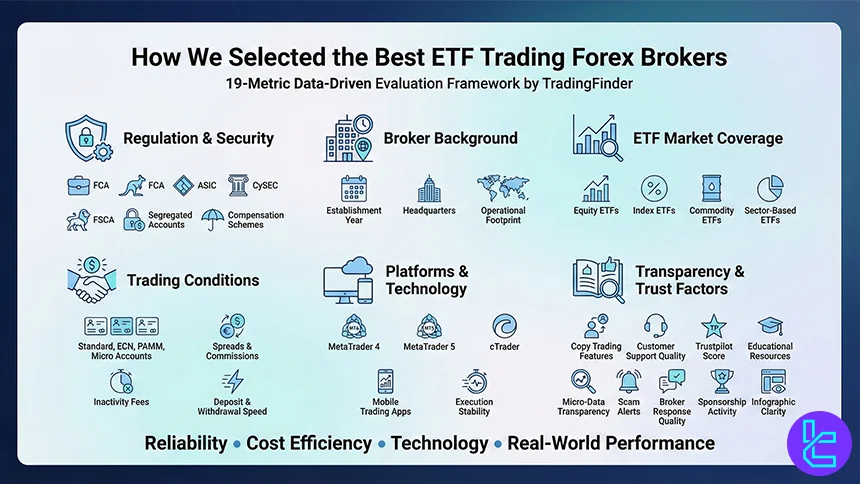
We also analyze the broker’s background, including establishment year, headquarters, and operational footprint. Strong regulatory standing is a non-negotiable factor in ETF trading security.
Next, we examine ETF availability and tradable symbols, ensuring access to diversified exchange-traded funds across equities, indices, commodities, and sector-based markets.
Account type diversity (Standard, ECN, PAMM, Micro), trading costs (spreads, commissions, inactivity fees), and funding efficiency (deposit/withdrawal speed and fees) are carefully tested. Platforms such as MetaTrader 4, MetaTrader 5, and cTrader, along with mobile apps, are evaluated for execution quality and stability.
Beyond trading conditions, we assess copy trading features, customer support responsiveness, Trustpilot score, educational materials, micro-data transparency, scam alerts, broker response quality, sponsorship activity, and infographic clarity. Our analysts combine quantitative data with real platform testing to determine real-world usability.
This methodology ensures that every broker featured in our ETF trading comparison meets strict standards for reliability, cost-efficiency, technology, and overall trader experience.
What is ETF in Forex?
An Exchange-Traded Fund (ETF) is a financial instrument that tracks the performance of an underlying basket of assets, such as stocks, indices, commodities, bonds, or sectors, and is traded on an exchange like a single stock. In the context of Forex brokers, ETFs are typically offered as CFDs (Contracts for Difference) rather than direct ownership of the fund.
Unlike traditional spot currency pairs (EUR/USD, GBP/USD, etc.), ETF trading through Forex brokers allows traders to speculate on broader market themes.
For example, an ETF may track the S&P 500 Index, gold prices, emerging markets, or specific industries such as technology or energy. This provides diversified exposure through a single tradable instrument.
In Forex platforms like MetaTrader 4 (MT4) and MetaTrader 5 (MT5), ETF CFDs are quoted similarly to other instruments. Traders can go long or short, use leverage (subject to regulatory limits such as FCA or ESMA rules), and apply technical analysis strategies just as they would with forex pairs or commodities.
It is important to distinguish between physical ETFs, purchased through stock exchanges, and ETF CFDs offered by Forex brokers. In the CFD model, traders do not own the underlying shares of the fund; instead, they speculate on price movements.
This structure enables lower capital requirements and access to global ETFs within a single trading account, making ETFs a flexible instrument in multi-asset Forex brokerage environments.
What are the Pros and Cons of ETF Trading?
ETF trading offers diversified market exposure through a single instrument, combining stock-like liquidity with portfolio-style risk distribution.
Whether traded physically on exchanges or as CFDs via Forex brokers, ETFs provide access to indices, sectors, commodities, and bonds. However, costs, tracking error, and leverage risks (in CFD trading) must be carefully evaluated before capital allocation decisions.
Pros | Cons |
Diversification through a single instrument (tracks baskets like indices or sectors) | Tracking error may cause ETF performance to deviate from the underlying index |
High liquidity for major ETFs (e.g., S&P 500 or Nasdaq-based funds) | Management fees (expense ratios) reduce long-term returns |
Transparency of holdings (most ETFs disclose portfolios regularly) | Leveraged or inverse ETFs can magnify losses in volatile markets |
Lower expense ratios compared to many mutual funds | CFD-based ETF trading includes overnight swap fees |
Intraday tradability like stocks | Market risk remains; diversification does not eliminate systematic risk |
Access to global markets and niche sectors | Some niche ETFs may have lower liquidity and wider spreads |
How is ETF Trading in the US?
ETF trading in the United States is highly developed and regulated under the supervision of the U.S. Securities and Exchange Commission (SEC). ETFs are listed and traded on major exchanges such as the New York Stock Exchange (NYSE) and Nasdaq, functioning similarly to individual stocks with real-time pricing and intraday liquidity.
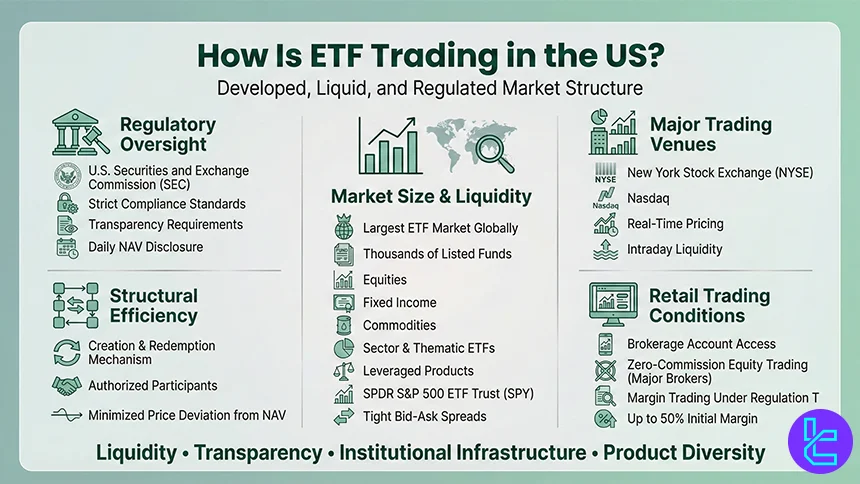
The U.S. hosts the world’s largest ETF market, with thousands of listed funds covering equities, fixed income, commodities, sectors, thematic strategies, and leveraged products. Flagship ETFs such as the SPDR S&P 500 ETF Trust (SPY) regularly rank among the most actively traded securities globally, reflecting deep liquidity and tight bid-ask spreads.
Regulatory frameworks require transparency in holdings, daily NAV (Net Asset Value) disclosure, and strict compliance standards. Additionally, the U.S. benefits from a mature creation/redemption mechanism involving authorized participants, which helps minimize pricing deviations between market price and NAV.
For retail investors, ETFs can be traded through brokerage accounts with standard equity commission structures (often zero-commission at major brokers). Margin trading is permitted under Federal Reserve Regulation T rules, typically allowing up to 50% initial margin for eligible securities.
Overall, the U.S. ETF environment is characterized by strong liquidity, regulatory oversight, product diversity, and institutional-grade infrastructure.
What are Some of the Most Traded ETFs?
The most traded ETFs globally are typically broad-market index funds with deep liquidity, high average daily volume, and tight bid-ask spreads.
In the U.S. market, regulated by the U.S. Securities and Exchange Commission, these ETFs are widely used by institutional investors, hedge funds, and retail traders for hedging, portfolio allocation, and short-term trading strategies.
Below are some of the most actively traded ETFs based on volume and assets under management (AUM):
- SPDR S&P 500 ETF Trust (SPY): Tracks the S&P 500 Index; consistently ranks among the highest-volume securities worldwide;
- Invesco QQQ Trust (QQQ): Follows the Nasdaq-100 Index, offering exposure to major technology and growth stocks;
- Vanguard Total Stock Market ETF (VTI): Provides broad exposure to the entire U.S. equity market, including large-, mid-, and small-cap stocks;
- iShares Russell 2000 ETF (IWM): Tracks U.S. small-cap stocks via the Russell 2000 Index;
- iShares MSCI Emerging Markets ETF (EEM): Offers exposure to emerging market equities;
- SPDR Gold Shares (GLD): Tracks the price of gold bullion and is one of the most traded commodity-backed ETFs.
These ETFs are favored for their liquidity, transparency, and efficient tracking of major benchmarks, making them central instruments in both long-term portfolios and short-term trading strategies.
What Factors Affect the Price of Average ETFs?
The price of an ETF is primarily derived from the value of its underlying assets, but it is also influenced by real-time trading dynamics and broader macroeconomic conditions.
Because ETFs trade intraday on regulated exchanges, their market price may temporarily deviate from Net Asset Value (NAV), although the creation and redemption mechanism help maintain alignment.
- Underlying asset performance: The ETF price moves in line with the benchmark it tracks, such as equities, bonds, commodities, or sector indices;
- Net Asset Value (NAV): The indicative NAV reflects the aggregated value of holdings and acts as a pricing anchor;
- Supply and demand pressure: Intraday order flow and liquidity conditions influence short-term pricing fluctuations;
- Interest rate policy: Monetary decisions by institutions such as the Federal Reserve impact bond, equity, and sector-based ETFs;
- Market volatility and risk sentiment: Shifts between risk-on and risk-off environments redirect capital flows across ETF categories;
- Currency exchange rates: International ETFs are affected by FX movements relative to the fund’s base currency;
- Expense ratios and fund structure: Management fees and replication methods influence long-term performance outcomes.
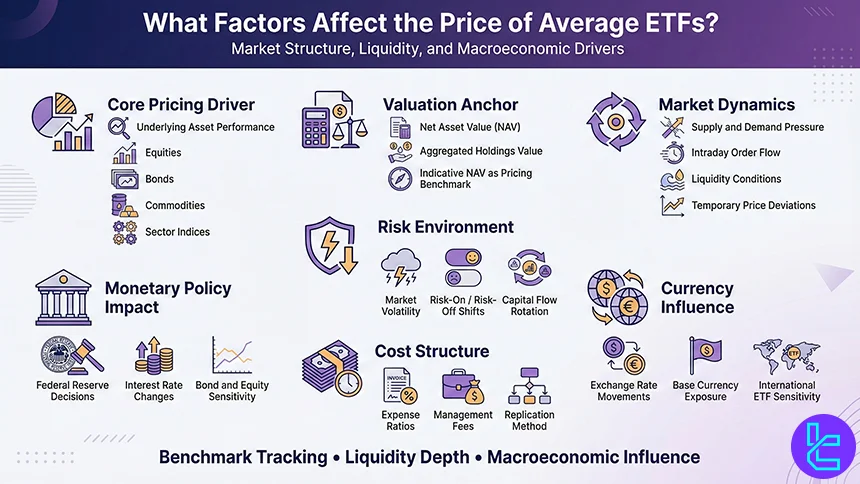
ETF pricing therefore reflects a combination of benchmark tracking efficiency, liquidity depth, and macroeconomic variables.
Available Leverage for ETF Trading in Forex Brokers
Leverage for ETF trading through Forex brokers depends primarily on regulatory jurisdiction and whether the ETF is offered as a CFD (Contract for Difference).
Unlike traditional U.S. stock brokerage accounts, where margin is typically limited to 2:1 under Federal Reserve Regulation T, ETF CFDs can offer higher leverage, subject to financial authority restrictions.
In the European Union and UK, brokers regulated by the European Securities and Markets Authority (ESMA) and the Financial Conduct Authority (FCA) generally cap leverage for retail clients at 1:5 for equity CFDs, which includes most stock-based ETFs. This means traders must maintain at least 20% margin.
In Australia, brokers regulated by the Australian Securities and Investments Commission (ASIC) apply similar retail limits, typically 1:5 for share CFDs. Professional clients who meet eligibility criteria may access higher leverage ratios.
Offshore-regulated brokers (e.g., under certain Caribbean or island jurisdictions) may offer leverage levels ranging from 1:10 up to 1:50 on ETF CFDs. However, higher leverage significantly increases risk exposure and potential drawdowns.
It is important to note that leveraged ETFs (such as 2x or 3x products listed on exchanges) already embed internal leverage at the fund level. When combined with broker-provided leverage, total exposure risk can multiply.
Therefore, effective risk management, including margin monitoring, stop-loss placement, and volatility assessment, is critical when trading leveraged ETF instruments through Forex brokers.
Strategies and Approaches Recommended for ETF Trading in Forex Brokers
ETF trading through Forex brokers, typically via CFDs, combines stock market exposure with leveraged trading mechanics. Because ETFs track indices, sectors, commodities, or bonds, strategy selection should align with the fund’s structure, volatility profile, and macroeconomic drivers.
The following approaches are commonly used by professional traders:
- Trend-Following Strategy: Use moving averages (e.g., 50/200 MA crossover), trendlines, and momentum indicators to capture sustained moves in broad-market ETFs such as S&P 500 or Nasdaq-based funds;
- Sector Rotation Approach: Allocate capital to sector ETFs (technology, energy, healthcare) based on macroeconomic cycles, interest rate trends, and relative strength analysis;
- Breakout Trading: Identify consolidation ranges and trade volatility expansions during earnings seasons, central bank announcements, or major economic data releases;
- Mean Reversion Strategy: In range-bound ETFs, apply RSI or Bollinger Band-based setups to exploit short-term overbought or oversold conditions;
- Hedging and Risk-Off Allocation: Use defensive ETFs (e.g., bond or gold-linked ETFs) to hedge equity exposure during heightened volatility or tightening cycles by institutions such as the Federal Reserve;
- Pairs and Correlation Trading: Trade correlated ETFs (e.g., growth vs. value, large-cap vs. small-cap) to capitalize on relative performance divergence.
Because ETF CFDs may include leverage, disciplined risk management - position sizing, stop-loss placement, and monitoring margin levels - is essential. Strategy effectiveness depends on liquidity, volatility regime, and underlying index behavior rather than short-term speculation alone.
What is the Minimum Investment Amount for ETFs?
The minimum investment required to trade or invest in ETFs depends on whether the investor is purchasing physical ETFs through a stock brokerage or trading ETF CFDs via Forex brokers.
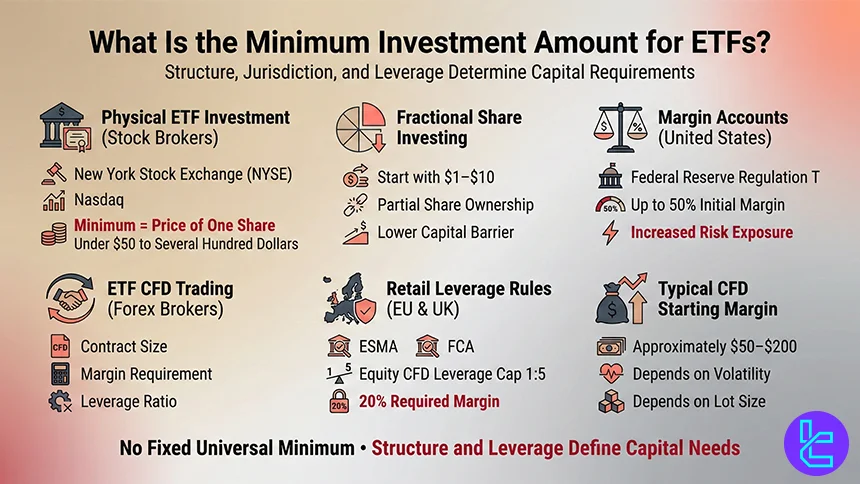
In the United States, ETFs trade on exchanges such as the New York Stock Exchange and Nasdaq. The minimum investment is typically the price of one share, which can range from under $50 to several hundred dollars depending on the ETF. Many modern brokers also offer fractional share investing, allowing investors to start with as little as $1-$10.
In traditional margin accounts, U.S. regulations allow borrowing up to 50% of the purchase price under Federal Reserve Regulation T, effectively reducing upfront capital requirements while increasing risk exposure.
For ETF trading through Forex brokers (usually as CFDs), the minimum investment is determined by contract size, margin requirement, and leverage ratio. Under EU and UK retail rules (e.g., ESMA/FCA), leverage for equity-based CFDs is typically capped at 1:5, meaning traders must post 20% margin.
In practical terms, some brokers allow ETF CFD positions with starting margins ranging from approximately $50 to $200, depending on volatility and lot size.
Therefore, ETF minimum investment varies significantly based on structure, jurisdiction, and leverage conditions rather than a fixed universal amount.
How Does ETF Compare to Other Common Tradable Instruments?
Exchange-Traded Funds (ETFs) combine stock-like tradability with portfolio-level diversification, making them structurally different from single-asset instruments such as gold (XAU/USD), crude oil (WTI/Brent), or cryptocurrencies (BTC, ETH).
Through stock exchanges like NYSE and Nasdaq, or as CFD products via Forex brokers, ETFs provide exposure to indices, sectors, bonds, and commodities. Compared to macro-driven assets like gold and oil, ETFs reflect basket performance, liquidity flows, and Net Asset Value (NAV) alignment, while cryptocurrencies operate in decentralized 24/7 blockchain markets.
Parameter | ETFs (Exchange-Traded Funds) | Gold (XAU/USD) | Oil (WTI/Brent) | Cryptocurrencies (BTC, ETH, etc.) |
Market Structure | Listed on centralized exchanges (NYSE, Nasdaq); also offered as ETF CFDs via Forex brokers | OTC spot (CFDs), Futures (COMEX - CME Group), ETFs (e.g., GLD) | Futures (NYMEX - CME Group for WTI, ICE for Brent), OTC CFDs | Decentralized blockchain networks; spot crypto exchanges (e.g., Binance, Coinbase); futures/CFDs |
Trading Hours | Exchange hours (e.g., 9:30-16:00 ET in US); extended hours; 24/5 via CFDs | Nearly 24/5 global sessions | Nearly 23-24 hours (futures), 24/5 via CFDs | 24/7 continuous trading |
Typical Volatility | Low–Medium (broad indices); Medium-High (sector/thematic ETFs) | Medium-High (macro & real yield sensitive) | High (inventory data, OPEC, geopolitics) | Very High (sentiment-driven, liquidity shifts) |
Main Price Drivers | Underlying asset performance, NAV, supply/demand, interest rates, sector rotation | USD strength (DXY), real yields, inflation, geopolitics | Supply/demand, OPEC+ quotas, EIA inventories, USD strength | Adoption rates, regulation, network activity, macro liquidity |
Leverage (Retail, Tier-1 Reg.) | Typically up to 1:5 for equity-based ETF CFDs (ESMA/FCA frameworks) | Typically up to 1:20 (FCA/ASIC) | Typically up to 1:10 (major commodities under FCA/ESMA) | Often 1:2 for EU retail; higher under offshore entities |
Safe-Haven Status | Broad index ETFs: No; Bond/Gold ETFs: Defensive depending on structure | Yes (historical store of value) | No (cyclical, growth-sensitive asset) | No (risk-on speculative asset class) |
Dividend / Yield | Dividends distributed if underlying holdings pay; reinvestment options available | No yield (non-interest-bearing) | No dividend (carry cost in futures curve) | No intrinsic yield (staking possible for some networks) |
Correlation Profile | Correlated with underlying index/sector; broad ETFs track economic cycles | Often negative correlation with equities in crises | Correlated with global growth & energy demand | Correlated with risk appetite & tech-equity sentiment |
Short-Selling Access | Yes (via margin accounts or ETF CFDs) | Yes (via CFDs/futures) | Yes (via CFDs/futures) | Yes (via futures, margin, CFDs) |
Gap Risk Exposure | Moderate (earnings season, macro news gaps) | Moderate (weekend & macro gaps) | High (inventory reports, geopolitical shocks) | Moderate–High (exchange-driven volatility, weekend moves) |
Conclusion
ETFs are highly efficient instruments for traders seeking diversification and high liquidity in Forex. There are various brokerages that offer these assets; not all of them, however, are worth working with. Based on our examinations, AMarkets, FP Markets, HFM, and Deriv are four of the best options for ETF trading.
If you are interested in the factors and parameters considered in curating brokers, check out our Forex methodology.