










Virtual Private Servers (VPS) can boost one’s trading results and enhance the speed and latency. Professional traders use these servers for automated trading; however, beginners can also benefit from them.
The shortlist below includes some of the best VPS provider brands for Forex traders.
 | HostArmada | |||
| Ultahost | |||
 | Zynoo | |||
| 4 |  | Kamatera | ||
| 5 |  | ProHoster | ||
| 6 | | IONOS | ||
| 7 |  | DedicatedCore | ||
| 8 |  | LinkUpHost |
Trustpilot Ratings and Reviews for the VPS Providers
Users can freely submit and publish their honest, genuine opinions of real experiences with brands on “Trustpilot”. The table below demonstrates the ratings for these brands.
VPS Brand | Trustpilot Rating | Number of Reviews |
HostArmada | 1,116 | |
IONOS | 41,637 | |
DedicatedCore | 43 | |
Kamatera | 345 | |
Zynoo | 41 | |
Ultahost | 807 | |
ProHoster | 54 | |
LinkUpHost | 2 |
Top 7 VPS Providers in Detail
The following sections will briefly and carefully review seven of the top VPS providers introduced in the above shortlists. Pros, cons, and important parameters will be considered and covered.
IONOS
IONOS is one of the largest European VPS and cloud infrastructure providers, operating under the umbrella of United Internet. Based in Germany, the company offers Linux VPS hosting, cloud servers, domains, and web hosting services for both individuals and businesses.
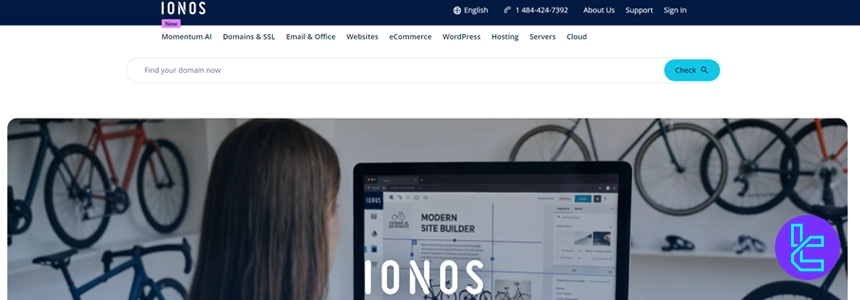
IONOS VPS plans start from just $2 per month, making it one of the most affordable providers in the VPS market. The provider offers six Linux-based plans, ranging from VPS XS with 1 vCore and 1 GB RAM to VPS XXL with 12 vCores and 24 GB RAM.
A major strength of IONOS is its user-friendly management system. The dashboard and Cloud Panel are clean, easy to navigate, and suitable even for beginners with no server management experience. Features such as free Plesk Web Host Edition, firewall configuration, monitoring tools, and unlimited traffic improve usability.
IONOS performs particularly well in RAM throughput and single-core CPU benchmarks, making it suitable for smaller web applications, CMS-based projects, databases, and moderate traffic environments.
However, its SSD performance, network speed, and scaling flexibility are weaker compared to some competitors.
IONOS Pros and Cons
IONOS combines low pricing, unlimited traffic, and strong RAM performance in a package that works well for traditional hosting projects and mid-sized web services. However, the lack of flexible scaling, missing rescue mode, and limited support channels are important drawbacks that should be considered before choosing the provider.
Pros | Cons |
VPS plans start from only $2 per month | No one-click resource scaling |
Unlimited traffic included on all VPS plans | No rescue mode for server recovery |
Free Plesk Web Host Edition included | SSD performance is below several competitors |
Strong RAM and single-core CPU performance | Live chat and email support are limited or unreliable |
ProHoster
ProHoster has built a strong reputation in the hosting market within a relatively short period, offering shared hosting, VPS hosting, and dedicated servers. Founded in Ukraine, the company provides multilingual support, USD-based pricing, and infrastructure designed for users seeking scalable hosting solutions with low entry costs.

Its shared hosting packages include unlimited traffic, subdomains, MySQL databases, FTP accounts, and hosted websites on most plans. Storage ranges from 5 GB to 100 GB, while VPS plans can scale up to 200 GB SSD storage, making ProHoster suitable for websites, trading platforms, and Forex VPS environments.
ProHoster includes several built-in security features such as free SSL certificates, DDoS protection, CloudLinux isolation, antispam tools, and support for PHP, Python, and Perl. The provider also offers Softaculous integration, cron jobs, Zend Optimizer, and a free website builder with more than 190 templates.
One of ProHoster’s biggest advantages is affordability. Hosting plans start from around €2.24 per month, and some packages include a free domain name. The company also offers a 14-day free trial and supports multiple payment methods, including Bitcoin, PayPal, WebMoney, ADVcash, and credit cards.
ProHoster Pros and Cons
Before choosing ProHoster, users should compare its strengths and weaknesses. Its low-cost plans, unlimited resources, and security features make it attractive for budget-conscious traders and website owners, while the lack of a money-back guarantee and Windows hosting may be limitations for some users.
Pros | Cons |
Shared hosting plans include unlimited bandwidth and multiple websites | No money-back guarantee is available |
Free SSL certificates, DDoS protection, and free domain on selected plans | Windows-based shared hosting is not supported |
VPS plans can scale up to 200 GB SSD storage | ISP Panel is less familiar than cPanel for many users |
14-day free trial and support for Bitcoin, PayPal, and WebMoney payments | Live chat support is limited to working hours only |
DedicatedCore
DedicatedCore has spent nearly a decade expanding its VPS hosting portfolio, with a strong focus on affordable plans, scalable resources, and low-latency infrastructure. Its Forex VPS solutions are particularly attractive for traders who need stable uptime, fast execution, and global server coverage in major financial hubs.
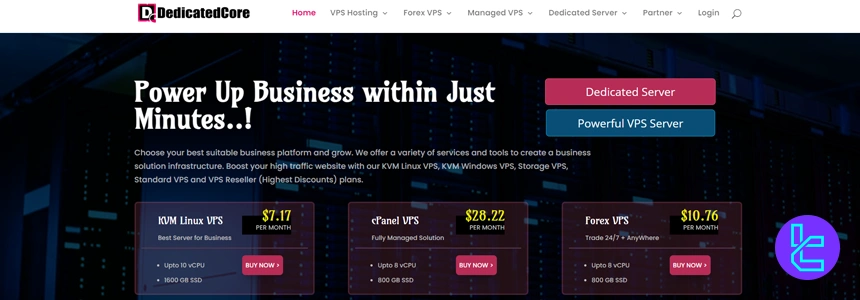
The provider offers managed and unmanaged VPS services with 100% NVMe storage, instant setup, and support for multiple operating systems including Ubuntu, Debian, CentOS, Fedora, Windows Server, and CloudLinux. DedicatedCore is suitable for both experienced Linux users and traders who prefer a fully managed environment.
DedicatedCore operates more than 10 data centers across regions such as the USA, UK, India, Singapore, Germany, Australia, Canada, Japan, and the Netherlands.
With server presence in over 19 cities, including London, New York, Amsterdam, Frankfurt, Tokyo, and Sydney, traders can choose locations close to broker infrastructure to reduce latency.
The company reports 99.99% uptime, 645ms average loading times, and support for enterprise-grade hardware such as DDR4 and DDR5 RAM, NVMe SSD U.2 and U.3 storage, and 10Gbps connectivity in the UK and USA. DedicatedCore also provides DDoS protection, firewall security, free JetBackup services, and one-click scalability.
DedicatedCore Pros and Cons
DedicatedCore combines low-cost VPS plans with high-end infrastructure, making it suitable for traders looking for global server locations, flexible operating systems, and reliable uptime. However, some advanced features are mainly available on higher-tier plans, and dedicated server deployment can take longer than standard VPS activation.
Pros | Cons |
99.99% uptime with redundant power systems and backup generators | Dedicated server setup can take 24 to 48 hours |
19+ server locations across key global financial regions | Advanced storage and RAM options are limited to higher-tier plans |
Managed and unmanaged VPS options for different user needs | Entry-level users may find Linux server management difficult |
7-day free trial, 30-day refund policy, and free JetBackup service | Pricing and feature differences between plans can be complex to compare |
Kamatera
Kamatera stands out in the Forex VPS market through its cloud-based infrastructure, flexible billing model, and wide server coverage. With 24 global data centers across North America, Europe, Asia, and the Middle East, Kamatera gives traders the ability to host trading platforms close to broker servers and reduce latency.
The provider offers highly customizable VPS configurations, ranging from 1 GB to 524 GB RAM and from 1 to 104 vCPUs. Traders can choose between Linux and Windows environments, select their preferred data center location, and scale storage, CPU, or RAM independently as trading requirements grow.
Kamatera’s entry-level cloud plan starts at €3.59 per month and includes 20 GB SSD storage, 5 TB bandwidth, 1 vCPU, and 1 GB RAM. The company also offers a 30-day free trial with $100 credit, making it possible to test its infrastructure before committing to a paid plan.
Performance is one of Kamatera’s strongest areas. During independent testing, its servers delivered average page load speeds of around 1.1 seconds with stable uptime results. The provider also includes built-in firewall protection, load balancing, disaster recovery options, and 24/7 technical support for advanced users.
Kamatera Pros and Cons
Kamatera’s biggest strengths are its scalability, global server network, and deep customization options. However, it is more suitable for experienced users, since server setup, domain configuration, and security management often require technical knowledge or paid managed services.
Pros | Cons |
24 global data centers across 4 continents | Not beginner-friendly for non-technical users |
Flexible hourly and monthly billing options | Backups, SSL, and management services cost extra |
Highly customizable server resources and OS choices | Some preconfigured images may require manual fixes |
30-day free trial with $100 credit | Managed services can become expensive |
Zynoo
ZYNOO positions itself as a cost-effective VPS and WordPress hosting provider with infrastructure designed for speed-sensitive workloads. Its hosting stack includes NVMe storage, AMD EPYC processors, KVM virtualization, RAID 10 storage, and built-in DDoS protection across all plans.
During performance testing, ZYNOO’s VPS achieved 1,435 CPU events per second, 27,052 MiB/s RAM throughput, and network download speeds of nearly 919 Mbps in Sofia. Stress testing across all 8 CPU cores completed without instability, highlighting the platform’s ability to handle sustained workloads.
For WordPress hosting, ZYNOO delivered particularly strong results. A media-heavy site loaded in 1.6 seconds with a 217 ms Time to First Byte, 1.5-second Largest Contentful Paint, and zero Total Blocking Time.
LiteSpeed, Redis caching, LSCache, and AccelerateWP contribute heavily to this performance.
Ease of use is another strength. ZYNOO offers a clean dashboard, one-click cPanel access, real-time VPS monitoring graphs, crypto payment support, and fast support response times. Tickets were answered in under 40 minutes, while live chat immediately offered free LiteSpeed and Redis setup assistance.
Zynoo Pros and Cons
ZYNOO’s advantages become more visible when comparing performance, support quality, and included features against its relatively low pricing. While the provider still has a smaller global footprint than larger hosting brands, it delivers a reliable mix of affordability, speed, and usability.
Pros | Cons |
Very affordable plans starting from around $1.99 per month | No free trial option available |
NVMe storage, LiteSpeed, and Redis improve VPS and WordPress speed | Fewer global data center locations than major competitors |
99.99% uptime guarantee with built-in DDoS protection | Refund period for VPS and dedicated servers is only 7 days |
Fast technical support with proactive ticket handling and free setup assistance | Dedicated server disk I/O performance was weaker than expected |
UltaHost
UltaHost entered the hosting market in 2018, making it one of the newer VPS providers, but it has expanded quickly with shared hosting, VPS, VDS, WordPress, dedicated servers, reseller hosting, and email services. Its infrastructure is aimed at users who want flexible plans without complex setup requirements.
UltaHost has built a strong reputation among users, with a 4.9/5 rating from more than 1,000 reviews on HostAdvice and 4.6/5 on Trustpilot. Much of this feedback highlights its responsive support, beginner-friendly dashboard, and transparent billing structure without aggressive renewal pricing.
For Forex VPS users, UltaHost stands out because of its SSD-based servers, 99.9% uptime target, multi-panel support, real-time malware protection, and server customization options. VPS traders can also benefit from multiple payment cycles, several server locations, and support for both small and resource-intensive workloads.
UltaHost’s pricing is competitive for traders and website owners seeking VPS hosting without enterprise-level costs.
Shared hosting starts from $2.99 per month, while VPS and dedicated plans offer more resources for automated trading systems, Expert Advisors, MetaTrader platforms, and low-latency performance needs.
UltaHost Pros and Cons
UltaHost is particularly suitable for small businesses, developers, bloggers, and Forex traders who need affordable VPS hosting with good support and flexible plans. However, large enterprises with highly specialized infrastructure needs may find its performance and global reach more limited compared to larger hosting brands.
Pros | Cons |
Transparent pricing with no hidden renewal fees | Not the cheapest VPS provider on the market |
Free SSL, domain, migration, and daily backups | Performance is solid but not among the fastest hosts |
24/7 support through live chat, tickets, email, and phone | Limited brand recognition compared to larger providers |
SSD storage, malware protection, and multi-panel support | Some advanced enterprise-level customization options are missing |
HostArmada
Founded in2019, HostArmada has quickly gained attention in the VPS market through its cloud-based infrastructure, managed hosting services, and competitive pricing.
For Forex traders using low-latency strategies, its VPS environment combines strong uptime, security, and server performance without the high costs usually associated with premium hosting.
HostArmada offers managed VPS plans starting from $29.95 per month, with features such as full root access, dedicated IPs, free SSL certificates, daily backups, enhanced caching, and free cPanel accounts. Its VPS plans are designed to give users both server control and the convenience of managed support.
One of HostArmada’s strongest advantages is its global infrastructure. The company provides more than 20 data center locations worldwide, allowing traders to select servers close to major Forex trading hubs such as London, New York, or Tokyo.
This can reduce latency and improve execution speed for Expert Advisors, scalping systems, and automated trading.
Performance is another major strength. During testing, HostArmada’s managed VPS achieved an “A” rating in GTmetrix, with a Largest Contentful Paint of just 522 milliseconds.
Combined with NVMe SSD storage, cloud-based resources, LiteSpeed optimization, and lower-density servers, HostArmada delivers a fast and stable environment suitable for MetaTrader platforms and Forex VPS hosting.
HostArmada Pros and Cons
HostArmada’s main strengths are its cloud-based performance, managed VPS convenience, flexible server locations, and competitive pricing. However, its renewal rates are noticeably higher than introductory pricing, and the SitePad website builder may feel less intuitive for beginners compared to other hosting providers.
Pros | Cons |
Cloud-based VPS infrastructure with strong uptime and stability | Renewal pricing is significantly higher than introductory rates |
More than 20 global data center locations for lower latency | SitePad website builder is less beginner-friendly |
Managed VPS hosting with full root access and cPanel included | Introductory discounts on VPS plans only apply for the first month |
NVMe SSD storage, LiteSpeed optimization, and strong GTmetrix results | Dedicated server plans are more expensive than some competitors |
How We Curated the List of VPS Providers
TradingFinder selected the best Forex VPS providers through a detailed evaluation process designed to measure both trading performance and infrastructure quality.
Since a VPS directly affects execution speed, latency, uptime, and platform stability, our analysts focused on the factors that matter most for automated trading, scalping, and Expert Advisors on platforms such as MetaTrader 4, MetaTrader 5, and cTrader.
Our methodology is based on 19 broker evaluation metrics used across all TradingFinder reviews. For Forex VPS providers, we placed greater emphasis on server location, VPS availability, trading platform compatibility, latency, execution quality, and broker reliability.
Brokers with VPS servers located near major financial hubs such as London, New York City, and Tokyo generally provide faster order routing and lower latency for Forex traders.
What is a VPS?
A VPS, short for Virtual Private Server, is a virtualized environment that functions like a dedicated computer within a larger physical server. Each VPS has its own operating system, CPU allocation, RAM, storage, and network resources, allowing users to run software independently without being affected by other users on the same machine.
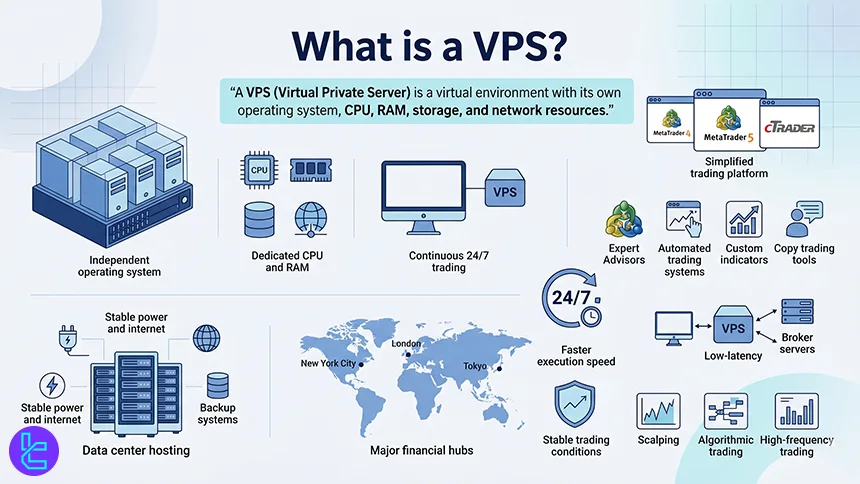
In Forex trading, a VPS is commonly used to host trading platforms such as MetaTrader 4, MetaTrader 5, and cTrader 24 hours a day.
This allows traders to keep Expert Advisors, automated trading systems, custom indicators, and copy trading tools running continuously, even when their personal computer is turned off.
Unlike a standard home internet connection, a VPS usually operates from a professional data center with stable power, high-speed internet, backup systems, and lower downtime risk.
Many Forex brokers place their trading servers in financial hubs such as London, New York City, and Tokyo. Using a VPS located close to those broker servers can reduce latency and improve order execution speed.
A Forex VPS is especially useful for traders who use scalping strategies, high-frequency trading systems, or automated algorithms that depend on fast and stable market execution. Even a delay of a few milliseconds can affect entry price, slippage, or order fill quality during volatile market conditions.
Pros and Cons of Trading with a VPS
Trading through a VPS can improve platform stability, reduce latency, and keep trading systems active around the clock.
It is especially useful for traders using automated strategies, Expert Advisors, scalping systems, or copy trading tools on MetaTrader 4 and MetaTrader 5. However, VPS hosting also introduces additional costs, setup requirements, and dependence on the quality of the hosting provider.
Pros | Cons |
Lower latency between the trading platform and broker server can improve execution speed | VPS hosting usually adds a monthly expense unless it is included by the broker |
Trading platforms remain active 24/7 even if the trader’s computer is turned off | Initial setup and server configuration can be difficult for beginners |
Reduces the risk of missed trades during local internet outages or power failures | Low-quality VPS providers may experience downtime or unstable performance |
Useful for running Expert Advisors, trading bots, and copy trading software continuously | Cheap VPS plans may have limited CPU, RAM, and storage resources |
Can reduce slippage for scalping and high-frequency trading strategies | Traders still need a stable internet connection to access and monitor the VPS remotely |
Allows traders to access their trading platform from multiple devices and locations | Some VPS providers charge extra for Windows licenses, backups, or technical support |
Improves execution consistency during volatile market events and news releases | Poor server location can still lead to high latency if the VPS is far from the broker’s data center |
Separates trading operations from the trader’s personal computer, reducing local hardware dependency | A VPS does not eliminate broker-side issues such as requotes, spread widening, or server outages |
What Makes a VPS Provider Suitable for Forex Brokers?
A VPS provider becomes suitable for Forex brokers when it can deliver low latency, high uptime, stable performance, and direct compatibility with trading platforms.
Since Forex trading often depends on milliseconds, a VPS should be located close to broker servers in financial centers such as London, New York City, and Tokyo. The shorter the physical distance between the VPS and the broker’s infrastructure, the faster trade orders can be transmitted.
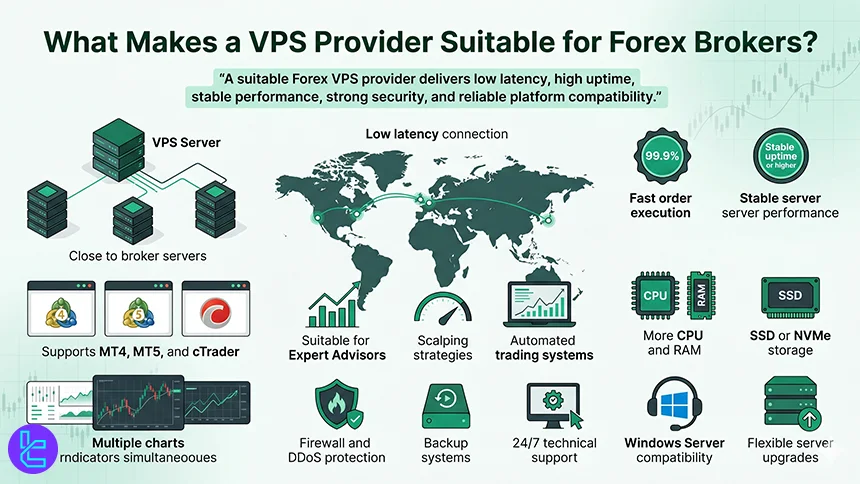
A reliable Forex VPS provider should also guarantee uptime of at least 99.9%. Frequent downtime, unstable internet connections, or unexpected server restarts can interrupt automated trading systems and cause missed trades.
This is especially important for traders using Expert Advisors, scalping strategies, or high-frequency systems on platforms such as MetaTrader 4, MetaTrader 5, and cTrader.
Hardware quality is another important factor. A VPS with sufficient CPU power, RAM, and SSD or NVMe storage can handle multiple charts, indicators, and automated strategies without slowing down.
Low-end VPS plans with limited resources may struggle during periods of high market volatility or when running several trading platforms at the same time.
Security and support also matter. Good VPS providers use firewalls, DDoS protection, backup systems, and secure remote access tools. Fast technical support is important because even short outages can affect trading performance. Forex brokers usually prefer VPS providers that offer 24/7 support, flexible server upgrades, and operating system options such as Windows Server for easier platform installation.
How Important is Server Location for a VPS Provider?
Server location is one of the most important factors when choosing a Forex VPS provider because it directly affects latency, execution speed, and slippage. In Forex trading, latency refers to the time it takes for data to travel between the trader’s platform and the broker’s trading server. The greater the physical distance, the longer the delay.
A VPS located close to a broker’s infrastructure can reduce latency from hundreds of milliseconds to less than 5 milliseconds in some cases. For example, a trader using a VPS in London to connect to a broker with servers in the same city will usually experience much faster execution than a trader using a VPS located in another continent.
This difference becomes more noticeable during volatile market conditions, major economic news releases, and high-frequency trading periods.
Many Forex brokers host their trading infrastructure in financial hubs such as New York City, London, Tokyo, and sometimes Amsterdam or Frankfurt. Choosing a VPS provider with servers in or near these locations can help improve trade execution quality and reduce the chance of requotes or slippage.
Server location is especially important for scalpers, day traders, and traders who use Expert Advisors on MetaTrader 4 and MetaTrader 5. Even small delays can affect entry prices and overall profitability when multiple trades are opened and closed within short periods.
What Uptime Guarantee Should a VPS Provider Offer?
A Forex VPS provider should ideally offer an uptime guarantee of at least 99.9%, although many premium providers advertise 99.95% or 99.99% uptime. Uptime refers to the percentage of time that the VPS server remains available and operational without interruption.
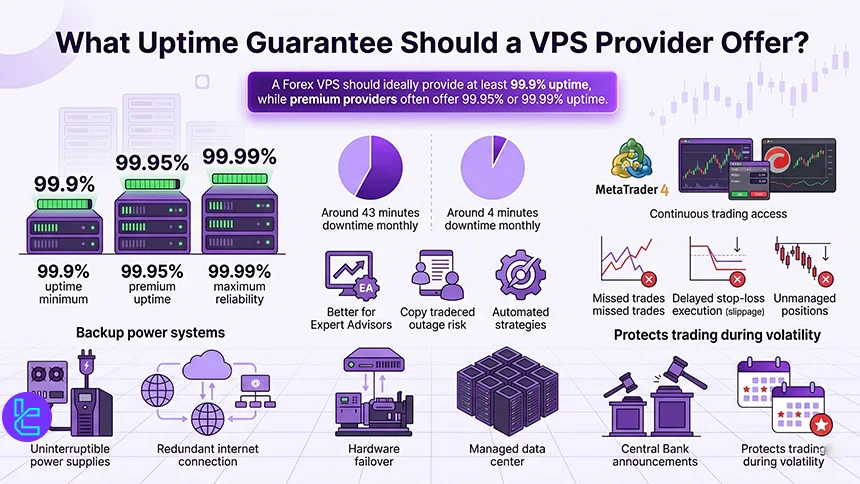
Even small differences in uptime can have a noticeable impact on trading performance. A 99.9% uptime guarantee allows for roughly 43 minutes of downtime per month, while 99.99% reduces that figure to around 4 minutes monthly.
For traders running Expert Advisors, copy trading systems, or automated strategies continuously, unexpected downtime can result in missed entries, unmanaged positions, or delayed stop-loss execution.
The most reliable VPS providers usually support their uptime guarantees with redundant power supplies, backup internet connections, hardware failover systems, and professionally managed data centers. Many data centers also use uninterruptible power supplies and diesel generators to keep servers online during power failures.
For Forex traders using platforms such as MetaTrader 4, MetaTrader 5, and cTrader, a VPS with poor uptime can create more risk than benefit. A server outage during major market events, such as central bank announcements or high-impact economic releases, can prevent trades from being executed or closed correctly.
How do VPS Providers Help Reduce Slippage?
VPS providers help reduce slippage by lowering the time it takes for trade orders to travel from the trading platform to the broker’s server. In Forex trading, slippage occurs when an order is executed at a different price than the trader expected because the market moved before the order reached the broker.
A VPS located close to the broker’s trading infrastructure can reduce latency significantly. For example, if a trader’s home internet connection creates a delay of 100 to 200 milliseconds, a VPS hosted in the same data center or city as the broker’s server may lower that delay to less than 5 milliseconds.
Faster order transmission means there is less time for prices to change before execution.
Many brokers host their servers in financial centers such as London, New York City, and Tokyo. Using a VPS near those locations can improve execution quality on platforms such as MetaTrader 4, MetaTrader 5, and cTrader.
This is especially important for scalpers, news traders, and traders using Expert Advisors, where a few pips of slippage can materially affect profitability. A stable VPS also prevents delays caused by weak home internet connections, device shutdowns, or network interruptions during volatile market conditions.
How Much RAM and CPU Are Needed from a VPS Provider?
The amount of RAM and CPU needed from a VPS provider depends on how many trading platforms, charts, Expert Advisors, and indicators are running at the same time.
A trader using a single platform with a few charts may only need basic resources, while a trader running multiple automated systems across several accounts will require more processing power.
In most cases, Forex traders should avoid the cheapest VPS plans with very limited hardware because low RAM and weak CPU performance can slow down platforms, delay order execution, or cause freezes during volatile market conditions.
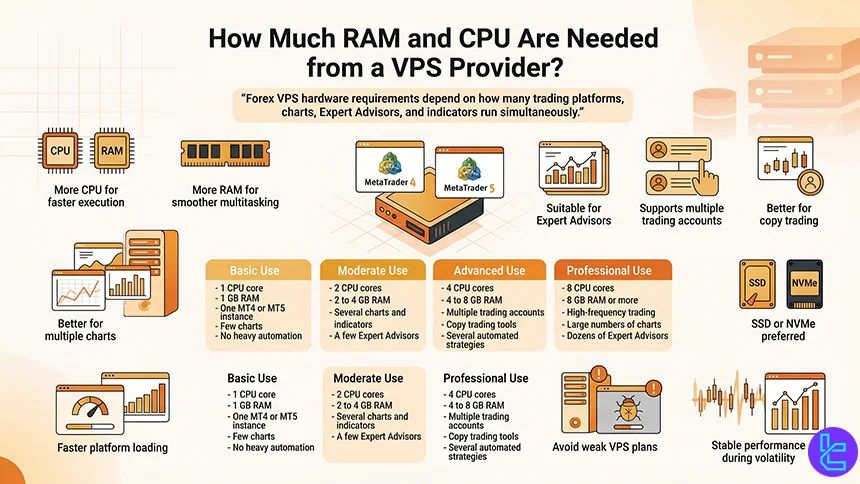
Typical VPS requirements for Forex trading include:
- Basic use: 1 CPU core and 1 GB RAM can support one instance of MetaTrader 4 or MetaTrader 5 with a few charts and no complex automation;
- Moderate use: 2 CPU cores and 2 to 4 GB RAM are usually sufficient for several charts, indicators, and a few Expert Advisors running simultaneously;
- Advanced use: 4 CPU cores and 4 to 8 GB RAM are better for traders using multiple trading accounts, copy trading systems, or several automated strategies at once;
- Professional or institutional use: 8 CPU cores and 8 GB RAM or more may be necessary for high-frequency trading, large numbers of charts, or dozens of Expert Advisors.
Storage also matters. SSD or NVMe storage is generally preferred over HDD because it loads trading platforms faster and improves overall VPS responsiveness.
Can One VPS Provider Support Multiple Trading Accounts?
One VPS provider can support multiple trading accounts, provided the server has enough CPU power, RAM, and storage to handle the workload. Many Forex traders use a single VPS to run several instances of MetaTrader 4, MetaTrader 5, or both at the same time.
Each trading account usually requires its own platform installation because one instance of MetaTrader can only log into one account at a time. For example, a trader running four separate accounts may need four platform installations on the same VPS. This increases RAM usage, CPU load, and storage requirements.
A low-end VPS with 1 GB RAM may only support one or two basic trading accounts comfortably. A more advanced VPS with 4 to 8 GB RAM and multiple CPU cores can often handle several accounts, charts, indicators, and Expert Advisors simultaneously without slowing down.
The number of supported accounts also depends on how resource-intensive the trading setup is. Accounts using simple manual trading require fewer resources than accounts running multiple Expert Advisors, copy trading systems, or complex custom indicators.
For traders managing many accounts, it is important to monitor CPU and RAM usage regularly. If the VPS becomes overloaded, platforms may freeze, disconnect, or delay order execution, especially during periods of high market volatility.
What Security Features Should a VPS Provider Offer?
Security is one of the most important factors when choosing a Forex VPS provider because the server stores trading platform credentials, account data, and open trading positions. A weak security setup can expose traders to hacking attempts, malware, unauthorized access, or service interruptions.
A reliable VPS provider should include several layers of protection to reduce these risks and keep trading platforms running safely.
Important security features to look for include:
- Firewall protection to block suspicious traffic and unauthorized access attempts;
- DDoS protection to prevent large-scale attacks that could slow down or shut down the server;
- Secure remote access through encrypted protocols such as Remote Desktop Protocol (RDP) with strong password requirements;
- Two-factor authentication for VPS login and control panel access;
- Regular operating system updates and security patches to fix known vulnerabilities;
- Automatic backups and restore points to recover trading data if the server fails;
- Antivirus and malware scanning tools to detect harmful files or unauthorized software;
- Isolated virtual environments so other users on the same physical server cannot access your data;
- Data center security, including physical access controls, surveillance systems, and backup power supplies.
For traders using MetaTrader 4, MetaTrader 5, and automated trading systems, security is especially important because compromised access could allow someone to change settings, close trades, or interfere with Expert Advisors.
Conclusion
VPS is a helpful addition to Forex brokers that enable automation, lower latency, and reduced slippage for scalpers and professional traders. Therefore, it is important to do thorough research for choosing the right one.
Based on the investigations and analysis done by our team, IONOS, ProHoster, DedicatedCore, and Kamatera are some of the best VPS providers for Forex trading.