








Professional traders typically trade in higher volumes and seek lower or raw spreads from brokers. Additionally, advanced tools and charts are regarded as strengths, or perhaps essentials.
To choose the best broker, you should take important factors such as fees, account types, platforms, and other features into account. Pay attention to the shortlist below for a lineup of suitable choices.
 | FUSION MARKETS | |||
 | FXCM | |||
 | AVATRADE | |||
| 4 |  | pepperstone | ||
| 5 |  | IC Markets | ||
| 6 |  | GLOBAL PRIME | ||
| 7 |  | eightcap |
Trustpilot Ratings Submitted for the Mentioned Brokers
Trustpilot is a reliable source for evaluating brokers and brands based on user experiences. It is especially a popular website among traders. The table below ranks the brokerages based on their reviews on the mentioned platform.
Broker Name | Trustpilot Rating | Number of Reviews |
7,002 | ||
AvaTrade | 12,246 | |
IC Markets | 53,073 | |
893 | ||
Global Prime | 433 | |
Pepperstone | 3,340 | |
Eightcap | 3,633 |
Minimum Spreads in the Introduced Brokers
Lower spread trading tends to be more popular among experienced users and seasoned traders, as in higher volumes, the spread plays a crucial role in generating profits. The table in this section ranks the mentioned brands based on this parameter.
Broker Name | Min. Spread |
CMC Markets | 0 Pips |
0 Pips | |
IC Markets | 0 Pips |
eToro | 0 Pips |
Global Prime | 0 Pips |
0 Pips | |
Eightcap | 0 Pips |
Account Types Offered by the Mentioned Brokers
Professional traders have more options and features at hand in certain accounts; these accounts are usually known by names such as “Pro”, “Premium”, “Elite”, etc. This section outlines the available account types in the mentioned brokerages.
Broker Name | Account Types |
AvaTrade | Retail, Professional, Islamic, Demo |
Eightcap | Standard, Raw, TradingView, Demo |
CMC Markets | Spread Betting, CFD Trading, FX Active |
Standard, Raw Spread, Islamic | |
Global Prime | Standard, Raw |
Pepperstone | Standard, Razor |
IG | CFD |
Regulation and Financial Supervisions
Highly regulated brokers are typically more trustworthy and satisfactory than those with licenses from offshore authorities. The following table ranks the brokers based on regulation.
Broker Name | Regulatory Licenses |
AvaTrade | ASIC, CySEC, CBI, FSA, FSCA, MiFID, ADGM, PFSA, ISA |
Interactive Brokers | SEC, FINRA, NYSE, FCA, etc. |
IG | ASIC, FCA, FSA, AMF, FMA, MAS, DFSA, FSCA |
Pepperstone | ASIC, SCB, FCA, DFSA, CMA, BaFin, CySEC |
ASIC, FCA, CySEC, SCB | |
IC Markets | FSA, CySEC, ASIC |
VFSC, ASIC |
Details and Specifics of Top 6 Forex Brokers for Professional Traders
The following sections will introduce and briefly review six of the mentioned brokerages. Pros, cons, trading fees, and other important criteria are considered.
Fusion Markets
Fusion Markets was launched in 2019 by Phil Horner and operates under both Australian Securities and Investments Commission and Vanuatu Financial Services Commission oversight. The broker is backed by Gleneagle Securities Pty Limited, which manages more than $400 million in client funds globally.
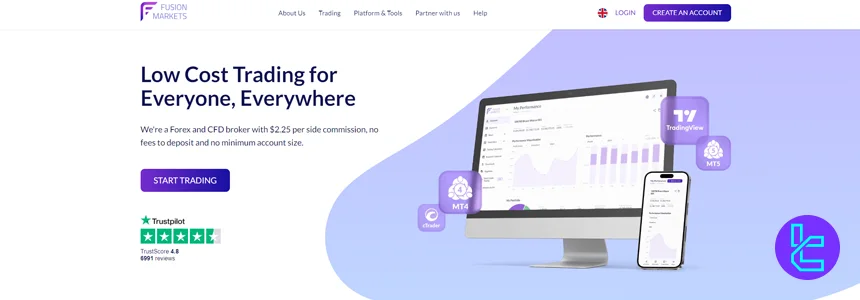
Fusion Markets is known for its ultra-low trading costs, with Zero account spreads starting from 0.0 pips and commissions of $2.25 per side. The broker claims its pricing is around 36% lower than many competitors, making it attractive for high-frequency traders, scalpers, and algorithmic strategies.
Professional traders can access more than 250 instruments across Forex, indices, metals, energies, share CFDs, cryptocurrencies, and commodities. The broker supports multiple platforms, including MetaTrader 4, MetaTrader 5, cTrader, and TradingView, alongside VPS hosting, copy trading, and MAM solutions.
Fusion Markets offers three main account types: Zero, Classic, and Swap-Free. There is no minimum deposit requirement, leverage reaches up to 1:500 under offshore regulation, and traders can fund accounts through more than 30 payment methods, including PayPal, Skrill, Neteller, bank wire, and crypto transfers.
Note that to access all features and options, you must go through the Fusion Markets verification process. The table below summarizes the specifics.
Account Types | Zero, Classic, Swap-Free |
Regulating Authorities | ASIC, VFSC |
Minimum Deposit | $0 |
Deposit Methods | VISA, MasterCard, PayPal, Perfect Money, PayID, Bank Wire, Crypto, Skrill, Neteller, etc. |
Withdrawal Methods | PayPal, Perfect Money, Bank Wire, Crypto, Skrill, Neteller, etc. |
Maximum Leverage | 1:500 |
Trading Platforms & Apps | MetaTrader 4, MetaTrader 5, TradingView, cTrader |
Fusion Markets Pros and Cons
Fusion Markets combines low commissions, fast execution speeds, and broad platform support, which makes it appealing for active traders. However, the broker still has a narrower educational offering than larger competitors and lacks an investor compensation scheme in most jurisdictions.
Pros | Cons |
Spreads from 0.0 pips on the Zero account | No investor compensation fund |
No minimum deposit requirement | Limited educational resources |
Supports MT4, MT5, cTrader, and TradingView | No proprietary trading platform |
VPS hosting, copy trading, and MAM accounts available | Smaller product range than some large multi-asset brokers |
AvaTrade
AvaTrade operates under nine regulatory frameworks, including Central Bank of Ireland, ASIC, CySEC, and FSCA. This broad oversight gives professional traders access to segregated client funds, negative balance protection, and compensation coverage of up to €20,000 for eligible European clients.

With a minimum deposit of $100, AvaTrade provides access to more than 1,250 instruments across forex, stocks, indices, commodities, cryptocurrencies, bonds, ETFs, and options. Professional traders can access leverage of up to 1:400 in certain regions, while margin call and stop-out thresholds are fixed at 25% and 10%.
It’s worth noting that there is an AvaTrade rebate program available that enables discounts in fees.
AvaTrade supports multiple account types, including Retail, Professional, Islamic, and Demo accounts. The broker also offers several trading platforms, including MetaTrader 4, MetaTrader 5, WebTrader, mobile apps, and AvaOptions for traders who need advanced risk management and options trading features.
AvaTrade funding methods include credit cards, wire transfers, Skrill, Neteller, WebMoney, and PayPal, with no deposit or withdrawal fees charged by the broker. AvaTrade also offers copy trading through DupliTrade and AvaSocial, while its educational library includes webinars, market analysis, economic calendars, and platform tutorials.
Table of Specifics
Account Types | Retail, Professional, Islamic, Demo |
Regulating Authorities | ASIC, CySEC, CBI, FSA, FSCA, MiFID, ADGM, PFSA, ISA |
Minimum Deposit | $100 |
Deposit Methods | Credit/Debit Cards, E-Wallets, Bank Wire Transfer, PayPal |
Withdrawal Methods | Credit/Debit Cards, E-Wallets, Bank Wire Transfer, PayPal |
Maximum Leverage | 1:400 |
Trading Platforms & Apps | MetaTrader 4, MetaTrader 5, Mobile App, WebTrader |
AvaTrade Pros and Cons
AvaTrade combines strong regulatory protection, multiple platform options, and a wide range of tradable markets, making it suitable for professional traders who need flexibility across asset classes. However, inactivity fees, limited availability in some countries, and the absence of ECN-style pricing may be disadvantages for certain trading styles.
Pros | Cons |
Regulated by 9 authorities across multiple regions | Inactivity fee starts after 2 months without trading |
Access to more than 1,250 instruments | Not available to traders in the United States |
Supports MT4, MT5, WebTrader, and AvaOptions | Fixed spreads may be less attractive for scalpers |
Copy trading available through DupliTrade and AvaSocial | Limited account variety compared to some ECN brokers |
IC Markets
IC Markets combines institutional-style pricing with a broad multi-asset offering, making it suitable for professional traders focused on low spreads, fast execution, and platform flexibility.

Founded in 2007 in Australia, the broker now operates globally under licenses from the Financial Services Authority, Cyprus Securities and Exchange Commission, and Australian Securities and Investments Commission.
The broker supports 10 base currencies, including USD, EUR, GBP, AUD, JPY, and CHF, while maintaining a relatively accessible $200 minimum deposit. Professional traders can access more than 2,100 stock CFDs, over 60 forex pairs, commodities, bonds, indices, and crypto CFDs from a single account.
IC Markets is widely known for its Raw Spread accounts, where spreads can start from 0.0 pips with commissions from $3 per side on cTrader and $3.50 per lot on MetaTrader.
The Standard account charges no separate commission and offers spreads from 0.8 pips, which appeals to traders who prefer simplified pricing. Furthermore, there is an IC Markets rebate program available for reduced commissions.
Platform coverage is another strength. IC Markets supports MetaTrader 4, MetaTrader 5, cTrader, cTrader Web, and its own mobile app. The broker also allows scalping, Expert Advisors, algorithmic trading, and copy trading through cTrader, making it particularly attractive for high-frequency and systematic traders.
Specifics and Features
Account Types | Standard, Raw Spread, Islamic |
Regulating Authorities | FSA, CySEC, ASIC |
Minimum Deposit | $200 |
Deposit Methods | Bank Cards, Wire Transfers, Electronic payments, etc. |
Withdrawal Methods | Bank Cards, Wire Transfers, Electronic payments, etc. |
Maximum Leverage | 1:500 |
Trading Platforms & Apps | Metatrader 4, Metatrader 5, cTrader, cTrader Web, IC Markets Mobile |
IC Markets Pros and Cons
Despite some regional leverage restrictions under ASIC and CySEC entities, IC Markets remains one of the strongest choices for professional traders because of its low trading costs, fast market execution, deep liquidity, and support for algorithmic strategies. However, you shouldn’t overlook its weaknesses before going through with registration.
Pros | Cons |
Raw spreads from 0.0 pips on MT4, MT5, and cTrader accounts | European and Australian clients are limited to 1:30 leverage |
Access to more than 2,250 tradable instruments | $200 minimum deposit may be high for some traders |
Supports scalping, Expert Advisors, and algorithmic trading | No PAMM account offering |
Regulated by ASIC, CySEC, and FSA with segregated client funds | Some regions, including the US and Iran, are restricted |
FXCM
FXCM has operated in the online trading industry since 1999, making it one of the longest-standing names in Forex and CFD brokerage. The broker is regulated by top-tier authorities including the Financial Conduct Authority, Australian Securities and Investments Commission, Cyprus Securities and Exchange Commission, FSCA, and ISA.
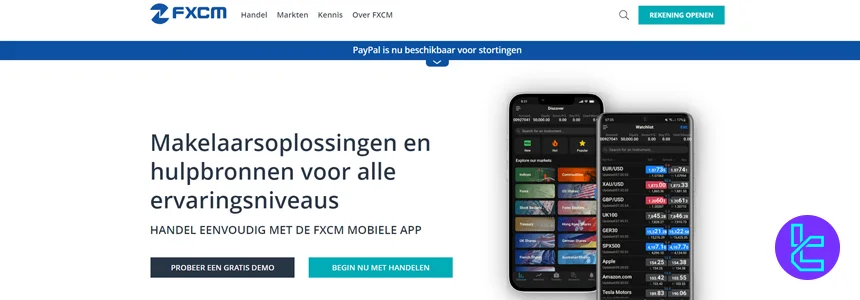
Professional traders can access CFD, Active Trader, and Corporate accounts through FXCM, with leverage reaching 1:1000 in certain jurisdictions. The broker supports trading through MetaTrader 4, TradingView, and TradeStation, offering compatibility with discretionary, algorithmic, and copy trading strategies.
FXCM provides floating spreads from 0.2 pips with no commission on CFD accounts, while Active Trader clients can unlock cash rebates and volume-based discounts. The broker also supports social trading through ZuluTrade and automated strategy building through Capitalise.ai.
Client protection remains a key strength for FXCM. Depending on the entity, traders may benefit from segregated funds, negative balance protection, and compensation schemes such as up to £85,000 under the UK FSCS and up to €20,000 under the Cypriot ICF. FXCM also offers demo accounts with up to $50,000 in virtual funds.
For discount on trading costs, you can participate in the FXCM rebate program. The table below outlines the broker’s specifications.
Account Types | CFD account, Active Trader account, Corporate account |
Regulating Authorities | FCA, ASIC, CySEC, ISA, FSCA |
Minimum Deposit | $50 |
Deposit Methods | Visa/MasterCard, Bank wired, Neteller, Skrill |
Withdrawal Methods | Visa/MasterCard, Bank wired, Neteller, Skrill |
Maximum Leverage | 1:1000 |
Trading Platforms & Apps | MT4, TradingView, TradeStation |
FXCM Pros and Cons
FXCM’s advantages are centered around its long operating history, broad regulatory coverage, and strong platform ecosystem. However, the broker also has notable drawbacks, including its bankruptcy history, inactivity charges, and bank withdrawal fees, which professional traders should consider before opening an account.
Learn about the broker’s pros and cons before FXCM registration.
Pros | Cons |
Regulated by FCA, ASIC, CySEC, FSCA, and ISA | Bankruptcy history and past regulatory fines |
Supports MT4, TradingView, TradeStation, and algorithmic trading | $50 annual inactivity fee after 12 months |
Floating spreads from 0.2 pips with no CFD commission | $40 fee on bank wire withdrawals |
Active Trader rebates and copy trading integration | Limited availability in countries such as the USA and Iran |
Global Prime
Founded in 2010 in Australia, Global Prime has built a strong reputation among professional traders through ASIC regulation, raw spreads from 0.0 pips, and execution speeds from 10 milliseconds. The broker was originally launched by Jeremy Kinstlinger and is now owned by Phil Horner.
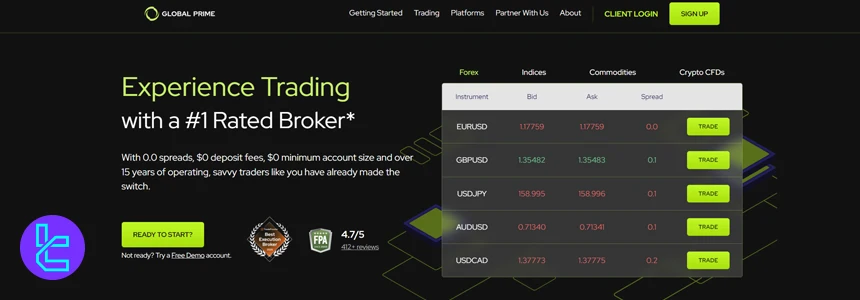
Global Prime gives traders access to more than 150 instruments across Forex, indices, commodities, crypto CFDs, bonds, and US share CFDs. Its Raw account charges $3.5 per side with spreads from 0.0 pips, while the Standard account offers commission-free trading from 0.9 pips. Participate in the Global Prime rebate program for discounts.
The broker holds licenses from ASIC in Australia and VFSC in Vanuatu, allowing it to provide both tightly regulated local services and higher-leverage international accounts. ASIC clients receive segregated funds, negative balance protection, and leverage up to 1:30, while international traders can access leverage up to 1:500.
Global Prime also stands out for its 20+ payment methods, 24/7 customer support, Autochartist integration, ZuluTrade social trading, TradingView Premium rewards, and FT newspaper subscriptions. Client funds are held in segregated accounts with HSBC and National Australia Bank (NAB).
Global Prime Pros and Cons
Global Prime combines strong regulation, low-cost trading, fast execution, and a wide range of payment solutions, making it suitable for active and professional traders. However, the broker still has some limitations, especially for traders looking for more platform variety or Islamic account support.
Pros | Cons |
Regulated by ASIC and VFSC | MT4 is currently the main supported platform |
Raw spreads from 0.0 pips with fast 10ms execution | No Islamic or swap-free account |
20+ payment methods with no deposit or withdrawal fees | Restricted access for traders from several countries |
Segregated client funds with HSBC and NAB | Lower leverage for ASIC retail clients without Pro status |
Pepperstone
Pepperstone has been active since 2010 and has grown from its Melbourne headquarters into a global broker serving more than 400,000 clients. The company processes around $9.2 billion in daily trading volume and provides access to over 1,200 CFDs across forex, indices, commodities, shares, ETFs, and cryptocurrencies.
Pepperstone is regulated by several high-tier authorities, including the Australian Securities and Investments Commission, Financial Conduct Authority, Cyprus Securities and Exchange Commission, Dubai Financial Services Authority, and Federal Financial Supervisory Authority.
Segregated client funds, negative balance protection, and compensation schemes such as FSCS coverage up to £85,000 strengthen its safety profile.
Professional traders can choose between Standard and Razor accounts, with spreads from 0.0 pips and Razor commissions starting from $3.5 per side. Pepperstone supports leverage up to 1:500, order sizes from 0.01 to 100 lots, and ten account base currencies, including USD, EUR, GBP, AUD, and JPY.
It’s worth noting that there is a Pepperstone rebate program available for fee discounts.
Pepperstone supports a wide platform ecosystem, including MetaTrader 4, MetaTrader 5, cTrader, TradingView, and its proprietary web platform. Features such as Expert Advisors, hedging, scalping, copy trading through Signal Start and DupliTrade, plus 24/7 customer support, make it suitable for active and algorithmic traders.
Pepperstone Pros and Cons
Pepperstone stands out for its deep liquidity, extensive regulation, and wide platform selection. However, some limitations remain, including the lack of PAMM accounts, no bonus programs, and reduced leverage under certain regulated entities.
Pros | Cons |
Regulated by FCA, ASIC, CySEC, DFSA, and other major authorities | No PAMM account offering |
Spreads from 0.0 pips with Razor account pricing | Limited promotional campaigns and bonuses |
Supports MT4, MT5, cTrader, TradingView, and proprietary platform | Lower leverage caps for UK and EU retail traders |
Over 1,200 tradable instruments across 6 asset classes | Demo account access may be limited in some regions |
What Parameters were Considered in Curating the Brokers?
Selecting the best Forex broker for professional traders requires more than checking spreads or leverage. At TradingFinder, brokers are evaluated through a 19-metric methodology designed to measure transparency, trading conditions, platform quality, and long-term reliability.
This framework helps identify brokers that can meet the demands of high-volume traders, scalpers, algorithmic traders, and investors managing larger portfolios.
Regulation is one of the most important criteria in our review process. We examine whether a broker operates under respected authorities such as Financial Conduct Authority, Australian Securities and Investments Commission, Cyprus Securities and Exchange Commission, and Financial Sector Conduct Authority.
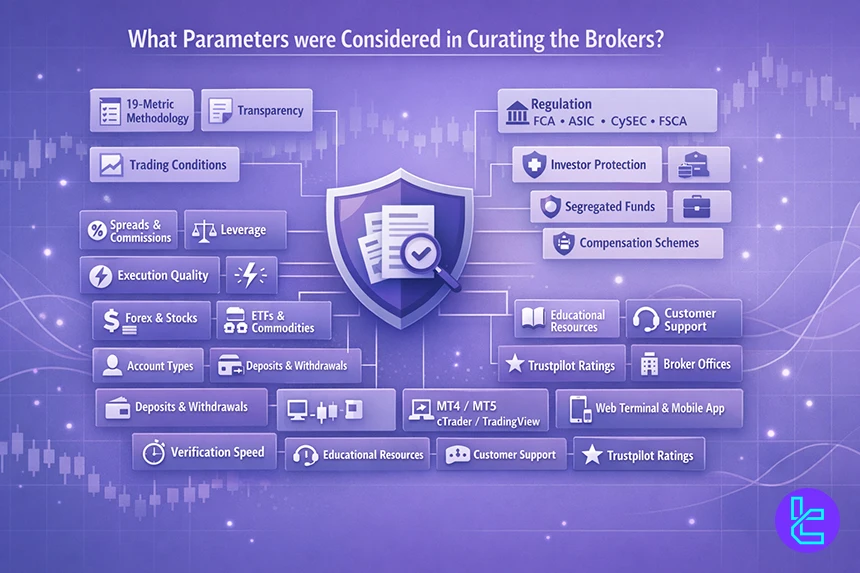
We also review investor protection measures, segregated funds, compensation schemes, and scam alerts.
Trading conditions are another major factor. Our analysts compare spreads, commissions, leverage limits, execution quality, and account variety, including Standard, ECN, RAW, PAMM, and copy trading accounts.
We also analyze the number of tradable instruments, including Forex pairs, stocks, ETFs, commodities, indices, cryptocurrencies, and CFDs. Platform availability is equally important, so we assess support for MetaTrader 4, MetaTrader 5, cTrader, TradingView, web terminals, and mobile apps.
Beyond trading features, TradingFinder reviews deposit and withdrawal methods, account verification speed, educational resources, customer support quality, Trustpilot ratings, broker offices, news coverage, infographics, and response times.
This approach ensures that every broker included in our rankings can deliver a strong experience for professional traders in the Forex market.
What Features are Provided by Forex Brokers for Professional Traders?
Forex brokers for professional traders typically provide advanced tools and trading conditions that go beyond what is available in beginner-friendly accounts. Professional traders often prioritize execution speed, pricing quality, platform flexibility, and access to a wider range of markets rather than educational features or low deposit requirements.
One of the most important features is access to tighter spreads and lower commissions. Many brokers offer RAW, ECN, or DMA accounts with spreads starting from 0.0 pips and fixed commission-based pricing.
This is especially important for scalpers, day traders, and algorithmic traders who open a high number of positions and need to keep trading costs low.
Platform diversity is another key factor. Professional traders usually expect support for MetaTrader 4, MetaTrader 5, cTrader, TradingView, VPS hosting, API trading, custom indicators, and Expert Advisors.
Brokers that support one-click trading, advanced charting tools, Level II pricing, and depth of market data are often more attractive to experienced traders.
Professional traders also look for access to a broad range of tradable assets. In addition to major and minor Forex pairs, many top brokers provide CFDs on indices, commodities, stocks, ETFs, bonds, metals, cryptocurrencies, and futures. Multi-asset access allows traders to diversify strategies and respond to changing market conditions.
Other important features include higher leverage options, faster deposits and withdrawals, multiple base currencies, copy trading, PAMM or MAM accounts, negative balance protection, and dedicated account managers.
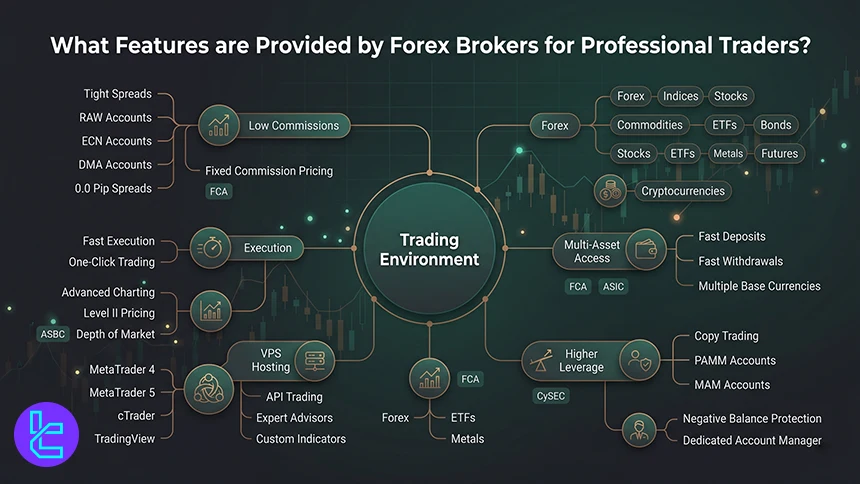
Brokers regulated by authorities such as the Financial Conduct Authority, Australian Securities and Investments Commission, and Cyprus Securities and Exchange Commission are often preferred because they combine advanced trading conditions with stronger client protection standards.
What are the Advantages and Disadvantages of Professional Forex Brokers?
Professional Forex brokers usually provide tighter spreads, faster execution speeds, advanced trading platforms, and access to more markets than beginner-focused brokers. They are often better suited for scalpers, algorithmic traders, and high-volume investors.
However, these brokers may also require higher deposits, charge commissions, and offer more complex tools that can be difficult for inexperienced traders to use effectively.
Advantages | Disadvantages |
RAW, ECN, and DMA accounts often provide lower spreads and better pricing | Commission-based pricing can increase trading costs for low-volume traders |
Faster order execution reduces slippage during volatile market conditions | Advanced platforms and tools may be difficult for beginners to understand |
Support for platforms like MetaTrader 5, cTrader, and TradingView gives traders more flexibility | Some professional brokers require larger minimum deposits or higher account balances |
Access to VPS hosting, API trading, and Expert Advisors benefits algorithmic traders | High leverage can increase the risk of large losses if risk management is poor |
Wider market access includes Forex, indices, stocks, ETFs, commodities, metals, and crypto CFDs | Certain advanced account types may have inactivity fees or platform subscription costs |
Multi-currency accounts help reduce conversion costs for international traders | Institutional-style tools such as Level II pricing and depth of market data may not be useful for all traders |
Brokers regulated by the Financial Conduct Authority, Australian Securities and Investments Commission, and Cyprus Securities and Exchange Commission often provide stronger client protection | Some professional brokers focus more on trading conditions than on educational materials or beginner support |
Are the Common Trading Platforms Suitable for Professional Traders?
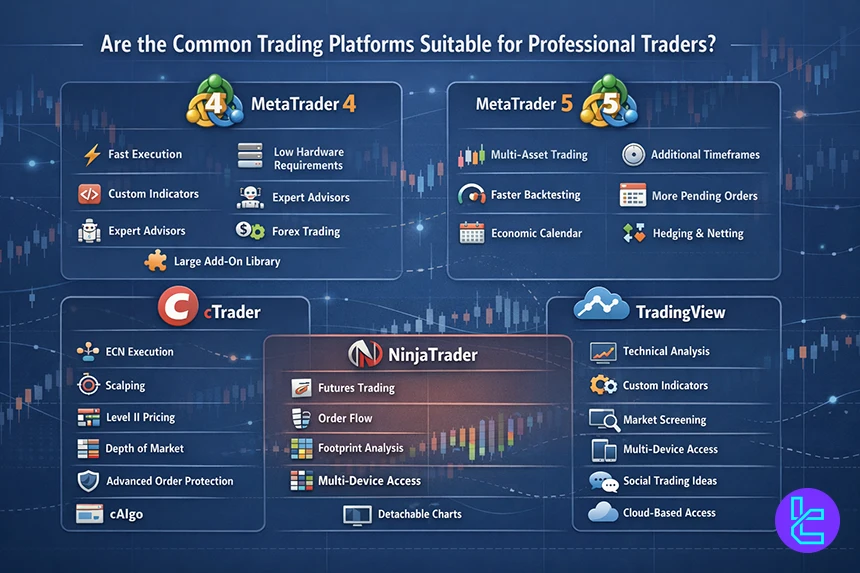
Most major trading platforms are suitable for professional traders, but each platform is designed for different trading styles, asset classes, and levels of technical complexity. Professional traders usually choose a platform based on execution speed, charting tools, automation support, order management features, and access to advanced market data.
MetaTrader 4 remains one of the most widely used platforms among Forex traders because of its fast execution, low hardware requirements, and large library of custom indicators and Expert Advisors.
However, MT4 is more limited than newer platforms when it comes to multi-asset trading, advanced order types, and built-in depth of market tools.
MetaTrader 5 is often considered more suitable for professional traders because it supports more asset classes, additional timeframes, faster backtesting, more pending order types, and an integrated economic calendar. MT5 also offers improved strategy testing for algorithmic traders and supports both hedging and netting account systems.
cTrader is popular among professional traders who focus on ECN execution, scalping, and detailed market depth analysis. Features such as Level II pricing, detachable charts, advanced order protection, and algorithmic trading through cAlgo make cTrader attractive for active traders.
TradingView is widely used for chart analysis, market screening, and multi-device accessibility. It is especially useful for traders who rely heavily on technical analysis, custom indicators, and social trading ideas. However, some brokers only provide partial trading functionality through TradingView integrations.
Professional traders who use futures, order flow, or footprint analysis may also prefer platforms such as NinjaTrader because of its advanced market depth tools, volume profile features, and highly customizable interface. Ultimately, the best platform depends on the trader’s strategy, asset preference, and execution requirements.
Best Account Types in Brokers for Professional Traders
Professional traders usually prefer account types that provide lower trading costs, faster execution, and more flexibility than beginner-oriented accounts. The best account type depends on trading frequency, position size, strategy, and whether the trader focuses on scalping, swing trading, copy trading, or algorithmic systems.
Account Type | Best For | Main Features | Potential Drawbacks |
ECN Account | Scalpers, day traders, algorithmic traders | Direct market access, tighter spreads, fast execution, lower slippage | Usually includes fixed commissions per lot traded |
RAW Spread Account | High-frequency traders and short-term traders | Spreads can start from 0.0 pips, transparent pricing, suitable for low-cost trading | Commission-based structure may be expensive for low-volume traders |
DMA Account | Professional traders who want institutional-style execution | Access to liquidity providers, Level II pricing, reduced dealing desk intervention | May require larger deposits and more trading experience |
Standard Account | Traders who prefer spread-only pricing | No separate commissions, easier cost structure, widely available | Wider spreads compared to ECN or RAW accounts |
Pro Account | Traders with larger balances or higher monthly volumes | Better spreads, lower commissions, premium support, VPS access, dedicated account managers | Often requires higher deposits or minimum trading volume |
PAMM Account | Investors who want passive exposure to Forex trading | Capital is managed by an experienced trader, suitable for passive investing | Performance depends entirely on the strategy manager |
MAM Account | Fund managers and traders managing multiple accounts | Allows a trader to manage several client accounts simultaneously | More complex structure and not designed for individual retail traders |
Islamic Account | Traders who need swap-free trading conditions | No overnight swap charges, available on many Standard and ECN accounts | Some brokers apply additional fees after a holding period |
Cent Account | Traders testing strategies with small capital | Small position sizes and lower risk exposure | Usually not suitable for professional traders due to limited features |
For most professional traders, ECN, RAW Spread, DMA, and Pro accounts are usually the most suitable options because they combine tighter spreads, faster execution, and access to advanced tools.
Traders using automated systems on MetaTrader 5 or cTrader often prefer RAW or ECN accounts, while large-volume traders may benefit more from DMA or Pro accounts.
Tips and Tricks for Choosing the Best Broker for Professional Traders
Choosing the right broker is one of the most important decisions for professional traders because execution quality, trading costs, and platform stability can directly affect long-term profitability. A broker with tight spreads may still be unsuitable if it has slow execution, limited instruments, or poor withdrawal conditions.
- Prioritize brokers regulated by respected authorities such as the FCA, ASIC, CySEC, and FSCA. Strong regulation usually means better client fund protection, segregated accounts, and clearer dispute resolution procedures;
- Compare the total trading cost instead of focusing only on spreads. A broker with 0.0-pip spreads may still be more expensive if commissions, swap charges, inactivity fees, and withdrawal fees are high;
- Choose account types that match your strategy. Scalpers and algorithmic traders often prefer ECN or RAW accounts, while large-volume traders may benefit more from DMA or Pro accounts;
- Check which trading platforms are supported. Professional traders often need access to MetaTrader 5, cTrader, TradingView, VPS hosting, API trading, and custom indicators;
- Review the broker’s execution quality by testing demo accounts or small live accounts. Fast execution, low slippage, and stable servers are especially important for news traders, scalpers, and high-frequency traders;
- Check the range of tradable assets. A broker offering Forex, stocks, commodities, indices, ETFs, crypto CFDs, and bonds can give professional traders more flexibility to diversify strategies;
- Read customer reviews and Trustpilot ratings carefully, but focus on repeated complaints about withdrawals, account restrictions, platform outages, or poor support rather than isolated negative comments;
- Test deposit and withdrawal speed before committing larger capital. Some brokers offer instant card deposits but slow bank wire withdrawals, which can become a problem for active traders managing larger balances.
Conclusion
Spreads, commissions, account types variety, and regulatory licenses are some of the most critical factors in choosing a Forex broker as a professional trader. Moreover, Trustpilot ratings are good measurements of a broker’s services and reputation.
Based on our analyses and examinations, Fusion Markets, AvaTrade, IC Markets, and FXCM are the best Forex brokers for professional traders.
If you are interested in the way we curate the shortlist, check out our Forex methodology.