






Binary options trading offers a simplified approach to financial markets, where traders predict whether the price of an asset will rise or fall within a fixed time frame. Unlike traditional Forex or CFD trading, outcomes in binary options are predefined, with fixed potential profit and loss, making it an attractive choice for traders seeking clear risk parameters.
However, this simplicity comes with unique challenges. Binary options markets are highly sensitive to timing, execution accuracy, and broker reliability. Since trades often expire within minutes or even seconds, platform stability and price feed precision become critical factors.
The guide below evaluates the best binary options brokers based on platform performance, payout rates, asset variety, withdrawal reliability, and regulatory status, helping traders identify secure and efficient environments for short-term speculative trading.
 | Pocket Option | |||
 | Olymptrade | |||
 | QUOTEX | |||
| 4 |  | iq option | ||
| 5 |  | Capitalcore | ||
| 6 |  | ExpertOption | ||
| 7 |  | bubinga | ||
| 8 |  | binomo |
Top Binary Options Brokers Ranked by Trustpilot
When selecting a binary options broker, Trustpilot ratings provide valuable insight into real user experiences, especially in areas such as withdrawals, platform reliability, and trade execution fairness. Since binary options trading relies heavily on timing and accurate price feeds, feedback from active users helps identify brokers that consistently deliver stable performance.
Unlike traditional Forex trading, binary options outcomes are fixed, meaning even minor discrepancies in pricing or execution can directly affect trade results. For this reason, Trustpilot reviews often highlight critical factors such as payout accuracy, order execution timing, and the reliability of withdrawals.
Broker Name | Trustpilot Rating | Number of Reviews |
Capitalcore | 51 | |
IQ Option | 2,548 | |
Bubinga | 3 | |
Quotex | 3.7/5 ⭐ | 4,778 |
Binomo | 652 | |
1,290 | ||
Expert Option | 1,207 | |
16 |
Deposit and Withdrawal Methods of Binary Options Brokers
Deposit and withdrawal systems play a critical role in binary options trading, as traders often need fast access to funds due to the short-term nature of trades. Efficient payment processing ensures that users can quickly fund their accounts and withdraw profits without delays or hidden complications.
Binary options brokers typically support a wide range of payment methods to accommodate global users. However, the speed, fees, and reliability of these methods can vary significantly depending on the broker and region.
Broker Name | Deposit Methods | Withdrawal Methods |
Pocket Option | E-Payments, Crypto Currency, Bank wire, cards, Gcash | E-Payments, Crypto Currency, Bank wire, cards, Gcash |
OlympTrade | Credit/Debit Cards, E-Payments, Bank Transfers | Credit/Debit Cards, E-Payments, Bank Transfers |
Credit cards, e-payments, bank transfers, cryptocurrencies | Credit cards, e-payments, bank transfers, cryptocurrencies | |
Credit/debit cards, e-wallets | Credit/debit cards, e-wallets | |
CloseOption | Perfect Money, WebMoney, PayPal, MasterCard, Cryptocurrency, Wire Transfer | Perfect Money, WebMoney, PayPal, MasterCard, Cryptocurrency, Wire Transfer |
Exnova | Credit/Debit card, E-wallet, Cryptocurrency | Credit/Debit card, E-wallet, Cryptocurrency |
Binarium | Crypto, E-Wallets, Credit/Debit Cards | Crypto, E-Wallets, Credit/Debit Cards |
Crystal Ball Markets | VISA, MasterCard, Perfect Money, Crypto, Bank Transfer | VISA, MasterCard, Perfect Money, Crypto, Bank Transfer |
Payout Structure in Binary Options Brokers
The payout structure is one of the most important factors in binary options trading, as it directly determines potential returns on each trade. Unlike Forex trading, where profits depend on price movement size, binary options offer fixed payouts based on whether the prediction is correct.
In a typical binary options trade, traders risk a fixed amount and receive a predefined return if the trade expires “in the money”. If the prediction is incorrect, the invested amount is usually lost. This makes understanding payout ratios essential for evaluating long-term profitability.
Broker Name | Payout (Maximum Return) |
Tradonex | Up to 98% |
Raceoption | Up to 98% |
Capitalcore | Up to 95% |
Expert Option | Up to 95% |
Up to 90% | |
Zentrader | Up to 90% |
Intrade Bar | Up to 85% |
Varies |
Range of Tradable Instruments in Binary Options Brokers
The range of tradable instruments in binary options brokers plays a key role in shaping trading opportunities, strategy flexibility, and overall portfolio diversification. Since binary options rely on predicting price direction within a fixed timeframe, access to multiple asset classes allows traders to adapt to different market conditions and volatility levels.
Most binary options brokers offer a selection of assets across major financial markets. However, the depth and diversity of these instruments can vary significantly between platforms.
Broker Name | Tradable Instruments |
Quotex | Forex Pairs, Stocks, Commodities, Indices, Crypto |
IQ Option | CFDs on Forex, Commodities, Crypto, Indices, Stocks, ETFs |
Forex, Metals, Crypto | |
| Forex Pairs, Stocks, Cryptocurrencies, and Commodities | |
VideForex | Forex Pairs, Stocks, Indices, Cryptocurrencies, and Commodities |
CloseOption | Forex Pairs, Cryptocurrencies |
Exnova | Forex, Commodities, Stocks, Indices, Crypto, ETFs, Options |
Binarium | Varies Based On The Account Type |
Top 6 Binary Options Brokers Reviewed
Choosing the right binary options broker is essential for ensuring fair execution, competitive payouts, and reliable fund management. Since binary options trading is highly sensitive to timing and pricing accuracy, brokers must provide stable platforms, transparent payout structures, and fast withdrawals.
The top binary options brokers are selected based on a combination of critical performance factors, focusing on both trading conditions and operational reliability.
Pocket Option
Pocket Option is a binary options broker launched in 2017, designed to provide a simplified and accessible trading experience for users across more than 95 countries. Pocket Option trading platform has grown rapidly, attracting over 100,000 active users by combining an intuitive interface with features such as social trading, trading signals, and customizable charting tools.
One of the Pocket Option account types features is the availability of both demo and real accounts. The demo account includes up to $10,000 in virtual funds, allowing traders to practice strategies risk-free. Real accounts start with a minimum deposit as low as $5, making the platform highly accessible for beginners.
Pocket Option also offers multiple account tiers, ranging from novice to VIP levels, each unlocking additional benefits such as increased payouts and priority withdrawals.
Pocket Option dashboard provides access to over 100 tradable assets, including Forex pairs, cryptocurrencies, stocks, commodities, and indices. Maximum returns can exceed 90%, depending on the asset and market conditions. The platform supports proprietary web trading alongside MetaTrader 5 integration, offering flexibility for both basic and advanced users.
In terms of payments, Pocket Option supports over 50 deposit and withdrawal methods, including cards, e-wallets, bank transfers, and cryptocurrencies. Transactions are generally fast, with no broker-side fees for deposits, withdrawals, or inactivity.
However, regulatory concerns remain a key consideration. As noted on page 1 of the document, the platform has been flagged by authorities such as the FCA and CFTC due to lack of licensing in certain jurisdictions.
Overall, Pocket Option stands out for its low entry barrier, high payout potential, and feature-rich platform, although regulatory limitations require careful evaluation.
Account Types | Demo, Novice, Beginner, Experienced, Master, Professional, Expert |
Maximum Return | 90%+ |
Minimum Deposit | $5 |
Deposit Methods | Credit/Debit Cards, E-wallets, Crypto, Bank Transfer, GCash |
Maximum Trade Amount | $5000 |
Maximum Leverage | Up to 1:1000 |
Inactivity Fee | No |
Pocket Option Pros and Cons
Evaluating Pocket Option requires a balanced look at its strengths and limitations within the binary options space. The platform offers user-friendly tools, fast trade execution, and accessible entry conditions, making it attractive for many traders. However, factors such as regulatory status, payout consistency, and risk exposure should also be carefully considered before trading.
Pros | Cons |
Low minimum deposit ($5) | Not regulated by Tier-1 authorities |
High payouts (90%+) | Regulatory warnings (FCA, CFTC) |
50+ payment methods | Limited availability in some countries |
No deposit/withdrawal fees | No 24/7 support |
Social and copy trading features | Mixed user feedback on withdrawals |
Demo account with virtual funds | - |
OlympTrade
OlympTrade is a well-established binary options broker founded in 2014, offering a user-friendly trading environment combined with flexible account tiers and accessible entry requirements. The platform operates under the VFSC regulator and is owned by Saledo Global LLC, positioning it within offshore regulatory frameworks rather than top-tier jurisdictions.
The broker provides multiple account types including Starter, Advanced, and Expert, alongside a fully functional demo account. The minimum deposit starts at $10, making it suitable for beginner traders, while higher-tier accounts unlock benefits such as increased payout rates, priority withdrawals, and access to advanced trading tools. Maximum returns can reach up to 93%, depending on account level and asset selection.
OlympTrade supports both its proprietary trading platform and MetaTrader 4, offering flexibility for traders with different experience levels. OlympTrade trading platform platform includes technical indicators, automated tools, and customizable charting features, enabling traders to execute both short-term and medium-term strategies efficiently.
In terms of OlympTrade instruments, the broker offers over 190 instruments across Forex, stocks, cryptocurrencies, indices, commodities, and ETFs. This range allows traders to diversify their strategies and use OlympTrade strategy across multiple markets.
Payment methods include credit cards, e-wallets such as Skrill and Neteller, and bank transfers, with no fees charged on deposits or withdrawals. However, an inactivity fee of $10 per month applies after 180 days of inactivity.
Overall, OlympTrade stands out for its strong platform usability, high payout potential, and educational tools, although its offshore regulation and mixed user reviews should be considered before trading.
Account Types | Demo, Starter, Advanced, Expert |
Maximum Return | Up to 93% |
Minimum Deposit | $10 |
Deposit Methods | Credit/Debit Cards, E-Wallets, Bank Transfer |
Maximum Trade Amount | Up to $5000 |
Maximum Leverage | Up to 1:500 |
Inactivity Fee | $10/month after 180 days |
OlympTrade Pros and Cons
Evaluating OlympTrade involves a balanced review of its strengths and weaknesses within the binary options market. The platform provides intuitive tools, quick execution, and low entry barriers, though aspects like regulation, payout stability, and risk levels require careful consideration.
Pros | Cons |
High payouts (up to 93%) | Offshore regulation (VFSC) |
Low minimum deposit ($10) | Inactivity fee applies |
Supports MT4 and proprietary platform | No full copy trading system |
24/7 customer support | Mixed user reviews |
Wide range of tradable assets | Limited availability in some countries |
Demo account available | - |
Quotex
Quotex is a binary options broker launched in 2019, offering a simplified and fast trading environment through its proprietary web and mobile platforms. The broker provides access to over 400 tradable instruments, including Forex pairs, stocks, commodities, indices, and cryptocurrencies, making it one of the more diverse platforms in the binary options space.
The platform features three account types: Standard, Pro, and VIP. The minimum deposit starts at $10, making it accessible for beginners, while higher-tier accounts unlock enhanced payout rates and additional tools. Maximum returns can reach up to 98%, which is among the highest in the industry, particularly for VIP account holders.
Quotex stands out for its zero-fee structure, as it does not charge for deposits, withdrawals, inactivity, or trading. This transparent pricing model is especially attractive for frequent traders looking to minimize operational costs. Additionally, the platform offers a free demo account with $10,000 in virtual funds, allowing users to test strategies without financial risk.
Quotex deposit and withdrawal offers multiple payment methods including credit cards, e-wallets, bank transfers, and cryptocurrencies, with most deposits processed instantly. The trading interface includes over 30 Quotex indicators and customizable charting tools, enabling traders to perform detailed market analysis.
However, regulatory concerns are a significant factor. As noted on page 1, Quotex has been flagged by the Financial Commission due to complaints and potential misleading practices, placing it on a warning list.
Overall, the broker offers high returns, Quotex OTC, low entry requirements, and a user-friendly platform, but its regulatory status requires careful consideration.
Account Types | Standard, Pro, VIP |
Maximum Return | Up to 98% |
Minimum Deposit | $10 |
Deposit Methods | Credit/Debit Cards, E-Wallets, Bank Transfer, Crypto |
Maximum Trade Amount | $1000 |
Maximum Leverage | 1:1 |
Inactivity Fee | No |
Quotex Pros and Cons
A proper assessment of Quotex in the binary options space highlights its user-friendly interface, fast order execution, and accessible trading conditions, while factors such as regulatory oversight, payout reliability, and risk exposure should not be overlooked.
Pros | Cons |
High payouts (up to 98%) | Regulatory warning (Financial Commission) |
No fees (deposit, withdrawal, inactivity) | No Tier-1 regulation |
Low minimum deposit ($10) | No live chat support |
400+ tradable instruments | Limited transparency |
Demo account with $10,000 | No leverage flexibility |
Fast and simple platform | - |
IQ Option
IQ Option is one of the most recognized binary options brokers, established in 2013 and known for its rapid global expansion and strong platform development. The broker operates under CySEC regulation, providing a higher level of credibility compared to many offshore-only binary platforms.
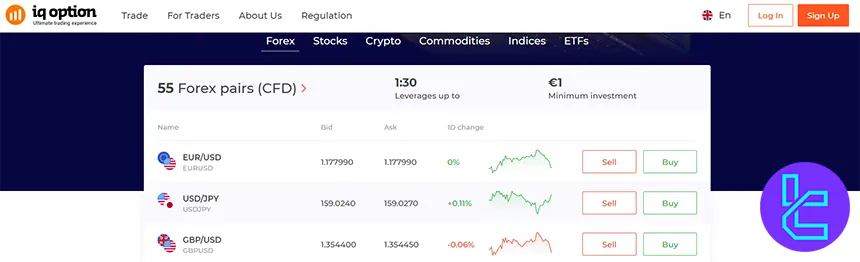
The broker offers a simplified account structure with a single live account and a demo account for practice. The minimum deposit starts at $10, making it accessible to beginner traders, while the platform supports trades from as little as $1. Maximum returns can reach up to 90%, depending on the asset and market conditions.
IQ Option stands out for its proprietary trading platform, available on web, desktop, and mobile devices. IQ Option trading platform offers advanced charting tools, multiple chart types, technical indicators, sentiment analysis, and customizable layouts. These features make it suitable for both beginner and advanced traders looking for deeper market analysis.
IQ Option dashboard provides access to over 250 tradable instruments, including Forex, stocks, cryptocurrencies, commodities, indices, and ETFs. It also offers leveraged trading up to 1:100, which is relatively uncommon in binary options environments.
Funding options include credit/debit cards and e-wallets such as Skrill and Neteller. While deposits are generally smooth, a withdrawal commission may apply after the first monthly withdrawal, and inactivity fees are charged on dormant accounts.
Overall, the broker combines strong platform functionality, IQ Option regulation backing, and diverse asset offerings, although fees and the lack of social trading features may be limitations.
Account Types | Real, Demo |
Maximum Return | Up to 90% |
Minimum Deposit | $10 |
Deposit Methods | Credit/Debit Cards, E-Wallets (Skrill, Neteller) |
Maximum Trade Amount | Up to $20,000 |
Maximum Leverage | Up to 1:100 |
Inactivity Fee | Yes |
IQ Option Pros and Cons
IQ Option presents a competitive binary options environment with easy-to-use tools, efficient execution, and flexible entry requirements. However, its regulatory standing, payout consistency, and inherent risks must be evaluated before engaging.
Pros | Cons |
Regulated by CySEC | Inactivity fee applies |
Advanced proprietary platform | Withdrawal fees after first monthly withdrawal |
Low minimum deposit ($10) | No copy or social trading |
250+ tradable instruments | Limited payment methods |
Supports leveraged trading (1:100) | Mixed Trustpilot rating |
Demo account with $10,000 | - |
Capitalcore
Capitalcore is a relatively new binary options broker established in 2024, offering both Forex and binary trading services through a proprietary platform. The company is registered in Saint Vincent and the Grenadines; The Capitalcore verification process operates under the IFSA, placing it within the offshore regulatory category.
The broker provides four account types including Classic, Silver, Gold, and VIP, each designed with different trading conditions and capital requirements. The minimum deposit starts at $10 for the Classic account, while higher-tier accounts require significantly larger investments but offer additional features such as higher position limits and dedicated account management.
Capitalcore offers access to around 30+ tradable assets across Forex pairs, cryptocurrencies, and metals. While the asset range is limited compared to competitors, the platform compensates with high payout rates reaching up to 95%. Additionally, the broker provides leverage up to 1:2000, which is significantly higher than most binary options platforms.
The trading environment is commission-free, with spreads starting from 0.8 pips and no swap fees, making it suitable for cost-conscious traders. A 40% deposit bonus is available across all account types, enhancing trading capital. The platform also includes over 50 technical indicators and supports demo trading with up to $100,000 in virtual funds.
Funding options include Visa, MasterCard, PayPal, Perfect Money, and cryptocurrencies such as Bitcoin and Ethereum. Withdrawals may incur fees depending on the method and are processed during business days only.
Overall, the broker stands out for its high leverage, easy Capitalcore registration, strong payout structure, and bonus offerings, although limited assets, offshore regulation, and lack of copy trading features remain key drawbacks.
Account Types | Classic, Silver, Gold, VIP |
Maximum Return | Up to 95% |
Minimum Deposit | $10 |
Deposit Methods | Visa, MasterCard, PayPal, Perfect Money, Crypto (BTC, ETH) |
Maximum Trade Amount | Not specified |
Maximum Leverage | Up to 1:2000 |
Inactivity Fee | No |
Capitalcore Pros and Cons
When reviewing Capitalcore for binary options trading, its strengths include simplicity, speed, and accessibility, making it appealing to a wide range of traders. Still, regulation, payout structures, and potential risks remain key considerations.
Pros | Cons |
High payouts (up to 95%) | Limited asset range (30+) |
Very high leverage (up to 1:2000) | Offshore regulation (IFSA) |
Commission-free trading | No copy or social trading |
40% deposit bonus | No mobile app |
Demo account with $100,000 | Withdrawals only on business days |
50+ technical indicators | - |
Expert Option
ExpertOption is a well-known binary options and CFD broker established in 2014, offering access to over 100 tradable assets across Forex, stocks, commodities, and cryptocurrencies. The platform has built a large global user base, exceeding 70 million traders, and is recognized for its intuitive trading environment and social trading capabilities.
ExpertOption account types provides six accounts including Micro, Basic, Silver, Gold, Platinum, and Exclusive, catering to traders with different capital levels and experience. The minimum deposit starts at $10, while the minimum trade size is just $1, making it highly accessible for beginners. Maximum returns can reach up to 95%, depending on the asset and market conditions.
ExpertOption operates through its proprietary trading platform, available on web, Android, and iOS devices. The platform includes advanced charting tools, multiple indicators such as RSI and MACD, and customizable layouts. Built-in social trading is one of the features of the ExpertOption dashboard, allowing users to follow and replicate the strategies of other traders in real time.
ExpertOption deposit and withdrawal is supported through more than 20 payment methods including Visa, MasterCard, Skrill, Neteller, and cryptocurrencies, with fast withdrawal processing typically completed within one business day. However, the broker charges a $5 commission on winning trades and applies a $10 monthly inactivity fee.
A major consideration is regulatory status. Authorities such as FCA, ASIC, and AMF have issued warnings regarding the platform’s operations in certain jurisdictions.
Overall, ExpertOption stands out for its large user base, social trading features, and high payout potential, although regulatory concerns and commission structure should be carefully evaluated.
Account Types | Micro, Basic, Silver, Gold, Platinum, Exclusive |
Maximum Return | Up to 95% |
Minimum Deposit | $10 |
Deposit Methods | Visa, MasterCard, Skrill, Neteller, Crypto, 20+ methods |
Maximum Trade Amount | Varies by account type |
Maximum Leverage | Up to 1:1000 |
Inactivity Fee | $10/month |
ExpertOption Pros and Cons
ExpertOption offers a streamlined binary options experience with intuitive features, rapid trade execution, and low entry thresholds. Despite these advantages, traders should carefully assess its regulatory framework, payout performance, and overall risk exposure.
Pros | Cons |
High payouts (up to 95%) | Regulatory warnings (FCA, ASIC, AMF) |
Social and copy trading features | $5 commission on winning trades |
100+ tradable assets | Inactivity fee ($10/month) |
Low minimum deposit ($10) | Proprietary platform only |
20+ payment methods | Mixed Trustpilot rating |
Mobile and web platforms | - |
What Criteria Define the Best Binary Options Brokers?
Evaluating binary options brokers requires a structured and data-driven approach, as traders rely on these platforms for precise execution, transparent payouts, and secure fund management.
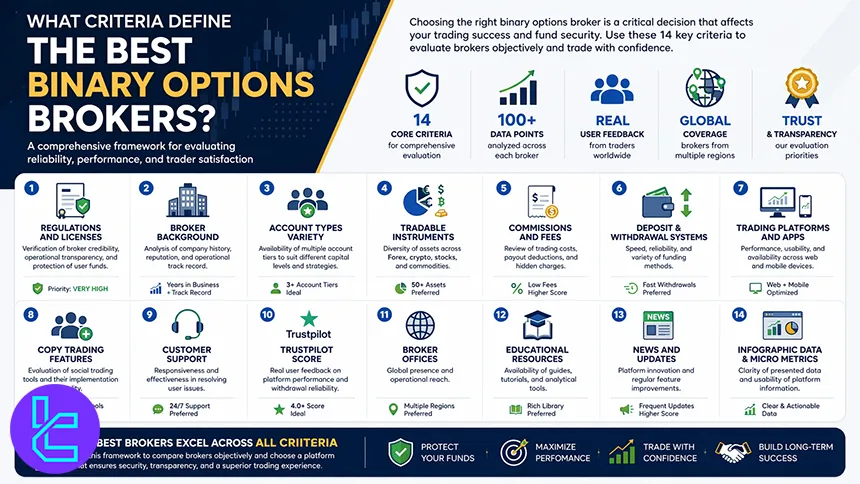
TradingFinder applies a comprehensive methodology based on 15 key metrics, ensuring that each broker is assessed with a focus on reliability, performance, and user experience. This framework is designed to help traders identify platforms that meet the demands of fast-paced, short-term trading environments.
Binary options trading differs from traditional markets due to its fixed return structure and time-sensitive nature. As a result, broker evaluation emphasizes factors such as payout consistency, execution accuracy, and platform stability. The goal is to ensure that traders operate in an environment where pricing is fair, withdrawals are reliable, and trading tools support quick decision-making. Core criteria used in evaluation:
- Regulations and Licenses: Verification of broker credibility, operational transparency, and protection of user funds;
- Broker Background: Analysis of company history, reputation, and operational track record;
- Account Types Variety: Availability of multiple account tiers to suit different capital levels and strategies;
- Tradable Instruments: Diversity of assets across Forex, crypto, stocks, and commodities;
- Commissions and Fees: Review of trading costs, payout deductions, and hidden charges;
- Deposit and Withdrawal Systems: Speed, reliability, and variety of funding methods;
- Trading Platforms and Apps: Performance, usability, and availability across web and mobile devices;
- Copy Trading Features: Evaluation of social trading tools and their implementation quality;
- Customer Support: Responsiveness and effectiveness in resolving user issues;
- Trustpilot Score: Real user feedback on platform performance and withdrawal reliability;
- Broker Offices: Global presence and operational reach;
- Educational Resources: Availability of guides, tutorials, and analytical tools;
- News and Updates: Platform innovation and regular feature improvements;
- Infographic Data and Micro Metrics: Clarity of presented data and usability of platform information.
By combining these factors, TradingFinder ensures a balanced and transparent evaluation process, helping traders select binary options brokers that offer consistent performance, secure operations, and efficient trading conditions.
What Are Binary Options and How Do Brokers Facilitate Them?
Binary options are financial instruments where traders predict whether the price of an asset will move up or down within a fixed time period. The outcome is binary, meaning the trader either earns a fixed return or loses the invested amount. This structure simplifies trading decisions but increases reliance on timing and execution accuracy.
Brokers play a central role in facilitating binary options trading by providing the infrastructure, pricing, and execution environment required for these short-term trades.
How Binary Options work:
- Asset Selection: Traders choose an asset such as a forex market currency pair, stock, or cryptocurrency;
- Direction Prediction: The trader predicts whether the price will rise or fall within a set timeframe;
- Trade Execution: The broker executes the trade instantly based on the selected parameters;
- Expiry Outcome: If the prediction is correct, the trader receives a fixed payout; otherwise, the invested amount is lost.
Binary options brokers act as the intermediary between traders and market pricing, making platform reliability and pricing transparency essential for fair trading conditions. How brokers facilitate trading:
- Provide proprietary trading platforms with real-time price feeds
- Offer fixed payout structures for each asset
- Enable short expiry times ranging from seconds to hours
- Supply charting tools and indicators for technical analysis
- Manage liquidity and order execution internally or via providers
Are Binary Options Legal in Different Countries?
The legal status of binary options varies significantly across different jurisdictions, making it essential for traders to understand regional regulations before choosing a broker. Regulatory status by region:
Region | Legal Status | Notes |
European Union | Restricted | Retail trading largely banned by ESMA |
United Kingdom | Restricted | Regulated as gambling or banned for retail |
United States | Highly Regulated | Allowed only via regulated exchanges (e.g., Nadex) |
Australia | Restricted | Retail binary options banned |
Offshore Jurisdictions | Allowed | Limited oversight and protection |
In many developed markets, binary options are restricted or banned due to concerns about fraud, lack of transparency, and high risk for retail traders. Key legal considerations:
- Regulation differs between countries and authorities
- Some brokers operate offshore without strict oversight
- Legal access does not guarantee safety or reliability
- Traders must verify broker authorization in their jurisdiction
Understanding the legal framework helps traders avoid compliance issues and reduces exposure to unregulated or fraudulent platforms.
Why Are Binary Options Brokers Considered High Risk?
Binary options brokers are often considered high risk due to the structure of the product and the operational model of many platforms. Unlike traditional markets, where traders interact with broader liquidity pools, binary options often rely on internal pricing and execution.
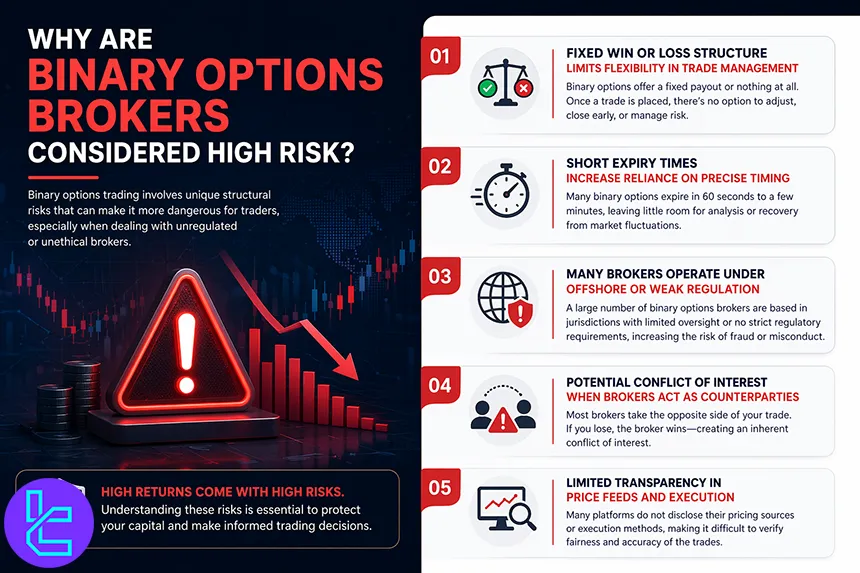
Key risk factors:
- Fixed win or loss structure limits flexibility in trade management
- Short expiry times increase reliance on precise timing
- Many brokers operate under offshore or weak regulation
- Potential conflict of interest when brokers act as counterparties
- Limited transparency in price feeds and execution
Additionally, withdrawal issues and inconsistent payout practices have been reported with some platforms, increasing operational risk.
For traders, choosing a reputable broker with transparent conditions and verified user feedback is essential to reduce exposure to these risks.
What Is the Typical Payout Structure in Binary Options?
The payout structure in binary options determines how much a trader can earn from a successful trade. Since profits are fixed, understanding payout ratios is essential for evaluating long-term viability. Typical payout levels:
Asset Type | Common Payout Range |
Major Forex Pairs | 70% - 90% |
Cryptocurrencies | 60% - 85% |
Commodities | 65% - 85% |
Indices | 60% - 80% |
Payouts vary depending on market conditions, asset volatility, and broker pricing policies. Impact on profitability:
- Higher payouts reduce the required win rate for profitability
- Lower payouts increase pressure on accuracy
- Dynamic payouts may change throughout the trading day
- VIP accounts may receive enhanced payout percentages
For example, with a payout of 80%, traders must win more than half of their trades to maintain profitability. Additional payout features:
- Risk-free trades or partial refunds on losses
- Bonus-based payout boosts
- Tiered payouts based on account level
A transparent and competitive payout structure is essential for maintaining consistency and evaluating the true performance of a binary options trading strategy.
Can Binary Options Be Manipulated by Brokers?
Concerns about manipulation in binary options trading often arise due to the centralized nature of many platforms. Unlike traditional markets where prices are aggregated from multiple liquidity providers, some binary options brokers generate or control their own price feeds, which creates potential risks. How manipulation may occur:
- Price feed discrepancies compared to external market data
- Delayed execution or artificial slippage near expiry time
- Sudden price spikes just before trade expiration
- Rejection of profitable trades under certain conditions
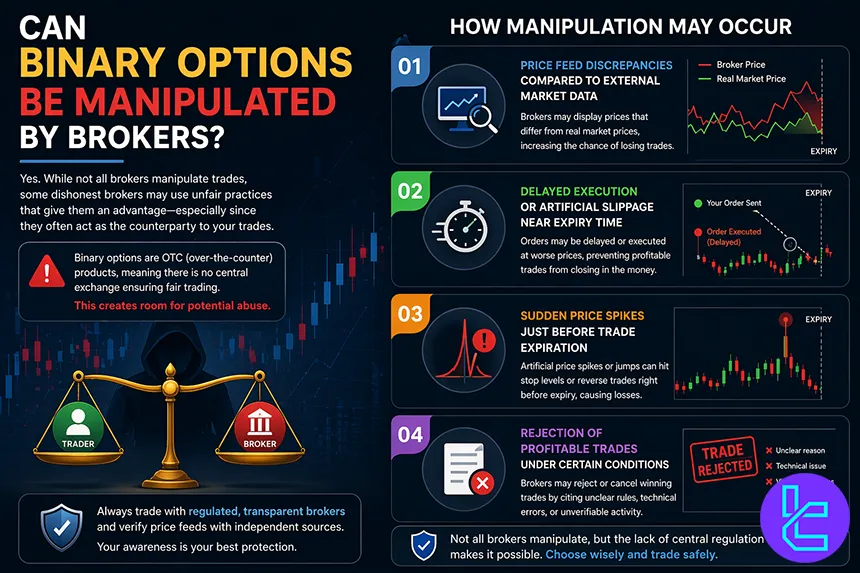
While not all brokers engage in such practices, the risk exists, especially with unregulated or offshore platforms. How to reduce risk:
- Compare broker prices with independent charts
- Choose brokers with strong user feedback
- Verify regulatory status and operational transparency
Selecting a broker with reliable execution systems and transparent pricing significantly reduces exposure to manipulation risks.
What Features Define a Reliable Binary Options Broker?
A reliable binary options broker provides a secure, transparent, and efficient trading environment, ensuring fair execution and consistent payouts. Key features of a trusted broker:
- Clear and transparent payout structure
- Fast and consistent withdrawal processing
- Stable trading platform with minimal downtime
- Accurate and real-time price feeds
- Availability of demo accounts for testing strategies
- Responsive customer support channels
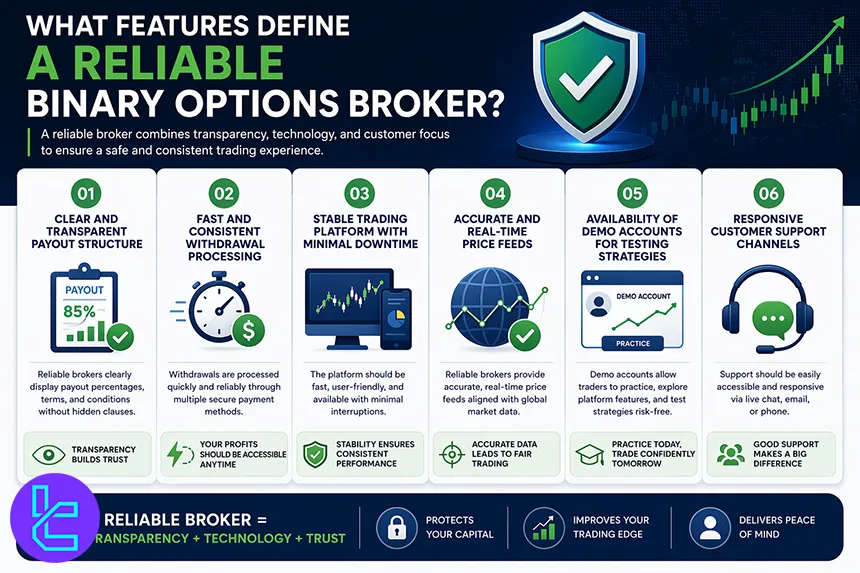
Additionally, brokers offering social trading, educational tools, and risk management features provide a more complete trading experience.
Reliability is not defined by a single factor but by consistent performance across execution, payments, and user experience.
Hidden Fees in Binary Options Brokers
While many binary options brokers promote zero-commission trading, hidden fees can still impact overall profitability if not carefully reviewed. Common hidden fees:
- Withdrawal fees after a certain number of transactions
- Currency conversion charges
- Inactivity fees on dormant accounts
- Fees embedded in payout reductions
- Charges on specific payment methods
These costs may not be immediately visible but can accumulate over time, especially for active traders. How to identify hidden fees:
- Review the broker’s terms and conditions
- Test small withdrawals before committing large funds
- Check user feedback regarding payment issues
Understanding the full cost structure helps traders avoid unexpected deductions and manage capital more effectively.
What Assets Are Available for Binary Options Trading?
Binary options brokers offer access to a wide range of financial instruments, allowing traders to diversify strategies across different markets.
Asset Class | Examples |
Forex | EUR/USD, GBP/USD |
Cryptocurrencies | Bitcoin, Ethereum |
Commodities | Gold, Oil |
Indices | S&P 500, NASDAQ |
Stocks | Apple, Tesla |
Each asset class behaves differently in terms of volatility, liquidity, and trading hours, which influences trading strategies. Why asset diversity matters:
- Enables trading opportunities across different sessions
- Allows adaptation to varying volatility conditions
- Reduces reliance on a single market
A broker offering a diverse and well-balanced asset list provides greater flexibility for traders to explore different market conditions.
Ways to Identify Scam Binary Options Brokers
Identifying scam brokers is essential in the binary options space, where regulatory oversight may be limited. Common warning signs:
- Lack of clear regulatory information
- Unrealistic profit promises or guaranteed returns
- Delays or refusal in processing withdrawals
- Poor or non-existent customer support
- Negative user reviews regarding fund access
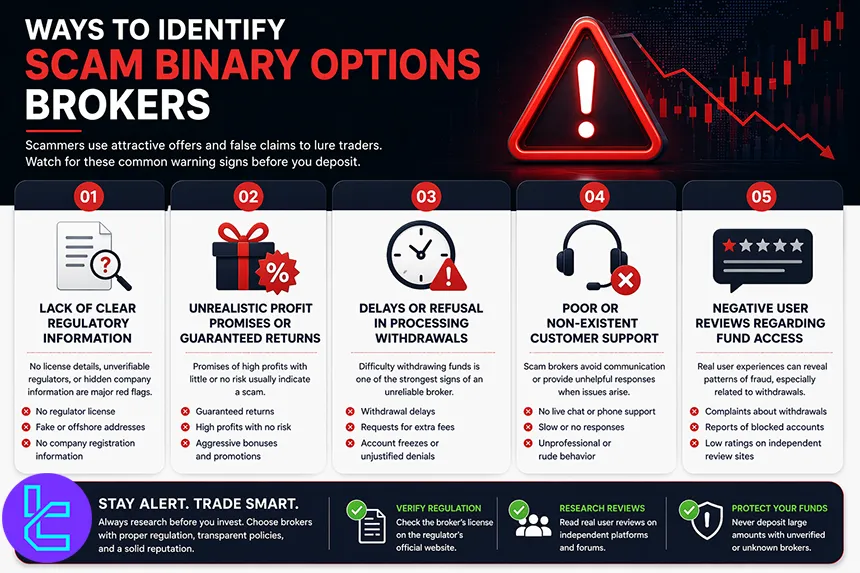
Being cautious and conducting proper research helps traders avoid fraudulent platforms and protects their capital in binary options trading.
Binary Options vs Forex Brokers, Crypto Exchanges and Prop Firms
Different trading environments offer distinct structures, risk profiles, and levels of transparency. Binary options platforms operate on a fixed outcome model where traders predict price direction within a set timeframe, while Forex brokers, crypto exchanges, and prop firms provide access to dynamic markets with variable profit and loss.
These differences affect everything from execution mechanics and regulatory oversight to risk exposure and capital requirements. The table below compares binary options with other major trading environments used by retail traders.
Parameter | ||||
Core Model | Fixed outcome (win or lose predefined payout) | Margin trading via CFDs or spot Forex | Direct buying/selling of crypto assets | Funded trading with firm capital |
Profit Structure | Fixed return or full loss | Variable profit/loss based on price movement | Variable profit/loss based on asset price | Profit split based on performance |
Market Access | Limited asset selection | Wide range (Forex, indices, commodities, crypto CFDs) | Crypto-only markets | Depends on broker/data feed provided |
Ownership of Asset | No ownership | No ownership (CFDs) or partial (some brokers) | Full ownership (spot trading) | No ownership (trading firm capital) |
Trading Hours | Fixed contract durations | 24/5 global market | 24/7 market | Depends on broker/market |
Transparency | Low to moderate (platform dependent) | High (regulated brokers) | High (on-exchange order books) | Moderate (firm rules apply) |
Regulation | Often weak or offshore | Strong in Tier-1 jurisdictions | Varies by jurisdiction | Not financial regulators (firm-based rules) |
Risk Profile | All-or-nothing (high risk) | Flexible risk with stop-loss tools | High volatility but controllable | Controlled risk with drawdown limits |
Leverage | Not applicable (fixed risk) | Available (up to 1:30 or more offshore) | Limited or optional | Provided via funded capital |
Skill Requirement | Low entry, but high risk | Medium to high | Medium | High (evaluation required) |
Capital Requirement | Low | Low to medium | Flexible | Low initial fee, high virtual capital access |
Conclusion
Binary options trading presents a unique approach to financial markets, offering fixed risk and predefined outcomes that appeal to traders seeking simplicity and fast execution. However, this structure also introduces critical dependencies on broker reliability, pricing accuracy, and payout transparency.
As highlighted throughout this guide, factors such as platform stability, withdrawal efficiency, and regulatory status play a decisive role in determining whether a broker provides a fair and sustainable trading environment.
Selecting the best binary options broker requires more than just comparing payout percentages. Traders must evaluate the full ecosystem, including fees, asset variety, execution quality, and real user feedback.
For a deeper understanding of our evaluation and selection process, please refer to TradingFinder’s Binary Optionmethodology page.