









Gold is one of the most popular trading instruments and safe havens for investments, especially during economically difficult times; the reason is it keeps its value over time.
Gold is known by the symbol “XAU” in Forex market. The table below consists of the best brokers for trading this instrument considering costs, platforms, features, and more.
 | fpmarkets | |||
 | BlackBull | |||
 | pepperstone | |||
| 4 |  | vantage | ||
| 5 |  | TICKMILL | ||
| 6 |  | Exness | ||
| 7 |  | IronFX | ||
| 8 |  | TMGM |
Trustpilot Ratings in Gold-Trading Forex Brokers
Trustpilot is a trusted source for reviewing brands in various fields based on user experiences and ratings. The table below summarizes Trustpilot scores for mentioned brokers.
Broker Name | Trustpilot Rating | Number of Reviews |
10,012 | ||
3,128 | ||
Exness | 27,623 | |
Vantage Markets | 11,890 | |
Pepperstone | 3,221 | |
TMGM | 842 | |
Tickmill | 1,088 | |
IronFX | 694 |
Minimum Trading Spreads in Mentioned Brokers
Spread is the difference between the bid and the ask prices in a trading pair. The table in this section demonstrates the minimum spreads in mentioned brands.
Broker Name | Min. Spread |
IronFX | 0 Pips |
0 Pips | |
tastytrade | 0 Pips |
Exness | 0 Pips |
0 Pips | |
TMGM | 0 Pips |
ActivTrades | 0.5 Pips |
Plus500 | 0.5 Pips |
Non-Trading Fees Charged by Brokers for Gold Trading
This section summarizes the fees and costs involved with activities other than trading in Forex brokers, including deposit/withdrawals. Also, dormant accounts might be charged.
Broker Name | Deposit Fee | Withdrawal Fee | Inactivity Fee |
IronFX | $0 | $0 | $0 |
$0 | $0 | $0 | |
Fusion Markets | $0 | $0 | $0 |
tastytrade | $0 | $5 for Check Withdrawals | $0 |
$0 | $0 | $10 Quarterly | |
TMGM | $0 | $0 | $10 Monthly |
ActivTrades | $0 | $0 | €10 Monthly |
Plus500 | $0 | $0 | $10 Monthly |
Trading Platforms Offered by Mentioned Brokerages
The table in this part of the article lists the available platforms and terminals in the brokers recommended for trading gold.
Broker Name | Trading Platforms |
IronFX | MT4 |
Exness | Exness Trade (mobile), Exness Terminal (web), MT4, MT5 |
Fusion Markets | MetaTrader 4, MetaTrader 5, TradingView, cTrader |
tastytrade | Own Platform (Desktop, Web, Mobile App) |
Tickmill | Metatrader 4, Metatrader 5, Metatrader Web, Mobile App |
TMGM | MT4, MT5, IRESS, TMGM Mobile App |
ActivTrades | MetaTrader 4, MetaTrader 5, Mobile App, WebTrader |
Global Prime | MT4 |
Top 6 Forex Brokers for Gold Trading in Detail
In the next six sections, some of the best Forex brokerages mentioned above will be reviewed briefly, considering the critical factors in gold trading.
FP Markets
Founded in 2005, FP Markets is an Australian multi-asset brokerage offering gold trading through spot metals and CFD markets. Regulated by top-tier authorities such as Australian Securities and Investments Commission (ASIC) and Cyprus Securities and Exchange Commission (CySEC 371/18), it operates under strict capital adequacy and client fund segregation standards.

Gold traders can access XAU/USD and other precious metals via Standard and RAW accounts, with spreads from 0.0 pips and commissions from $3 per lot. The minimum deposit starts at $50, making institutional-grade gold trading conditions accessible to retail participants.
FP Markets supports MetaTrader 4, MetaTrader 5, and cTrader, enabling advanced charting, algorithmic execution, and one-click order placement. Instant execution, negative balance protection, and leverage up to 1:500 (under eligible entities) enhance flexibility for gold-focused strategies.
With over 10,000 tradable instruments - including Forex, indices, commodities, ETFs, stocks, and cryptocurrencies - FP Markets provides diversified exposure beyond gold. Client funds are segregated, margin call/stop-out levels are set at 100%/50%, and Islamic (swap-free) accounts are available for Sharia-compliant gold trading.
The table below summarizes the brokerage’s specifics.
Account Types | Standard, RAW |
Regulating Authorities | ASIC, CySEC, FSC, FSCA, FSA |
Minimum Deposit | $50 |
Deposit Methods | Visa and Master card, Skrill, PayPal, Neteller, Bank Transfer |
Withdrawal Methods | Visa and Master card, Skrill, PayPal, Neteller, Bank Transfer |
Maximum Leverage | 1:500 |
Trading Platforms & Apps | MT4, MT5, cTrader |
FP Markets Pros & Cons
FP Markets combines tight spreads, multi-jurisdiction regulation, and advanced trading platforms, though certain regional restrictions and the absence of a proprietary platform may influence broker selection decisions. Check these out before FP Markets registration.
Pros | Cons |
Regulated by ASIC & CySEC (Tier-1 oversight) | Not available to US clients |
RAW spreads from 0.0 pips for gold trading | No proprietary trading platform |
Minimum deposit from $50 | Investor protection varies by entity |
Supports MT4, MT5 & cTrader with algo trading | High leverage increases risk exposure |
BlackBull Markets
Founded in 2014 by Michael Walker and Selwyn Loekman, Black Bull Group Limited is a New Zealand-based multi-asset broker offering 26,000+ instruments across six asset classes. For gold traders, it provides direct market access conditions via ECN infrastructure and Tier-1 banking partners.
BlackBull operates under the supervision of the Financial Markets Authority (FMA – Tier-1, New Zealand) and the Seychelles FSA (Tier-3). The New Zealand entity is an FSCL member (5623), with segregated client funds and negative balance protection available under both jurisdictions.
The broker offers ECN Standard, ECN Prime, and ECN Institutional accounts, with spreads from 0.0 pips and leverage up to 1:500. Gold (XAU/USD) traders benefit from NY4/LD5 Equinix servers, 0.01 lot minimum trade size, and fast market execution suitable for scalping.
Platforms include MT4, MT5, cTrader, and TradingView, alongside BlackBull CopyTrader and BlackBull Invest. With 80+ FX pairs, 15+ commodities (including metals), 23,000+ share CFDs, and 22 crypto pairs, BlackBull supports diversified gold-hedging strategies. To access all broker features, you must pass the BlackBull Markets verification.
Specifics and Parameters
Account Types | ECN Standard, ECN Prime, ECN Institutional |
Regulating Authorities | FSA, FMA |
Minimum Deposit | $0 |
Deposit Methods | Visa, MasterCard, Apple Pay, Google Pay, Bank Wire, Crypto, Neteller, Skrill, SEPA, FasaPay |
Withdrawal Methods | Visa, MasterCard, Apple Pay, Google Pay, Bank Wire, Crypto, Neteller, Skrill, SEPA, FasaPay |
Maximum Leverage | 1:500 |
Trading Platforms & Apps | MT4, MT5, TradingView, cTrader, BlackBull CopyTrader, BlackBull Invest |
BlackBull Markets Pros and Cons
When evaluating BlackBull Markets for gold trading, it is important to weigh its institutional-grade execution, deep instrument range, and multi-platform access against regional restrictions and complex account structures.
Pros | Cons |
Spreads from 0.0 pips on ECN accounts | Not available to U.S. clients |
26,000+ instruments including metals & gold CFDs | Institutional account requires $20,000 deposit |
Regulated by FMA (Tier-1) & FSA | Withdrawal fee of $5 per transaction |
MT4, MT5, cTrader & TradingView integration | High leverage (1:500) may increase risk exposure |
Pepperstone
Founded in 2010 in Melbourne, Pepperstone has grown into a global forex and CFD broker serving over 400,000 clients. The company processes an average of $9.2 billion in daily trading volume, positioning it as a major liquidity venue for gold (XAU/USD) and multi-asset CFD traders worldwide.

Pepperstone operates under top-tier regulators including ASIC, FCA, CySEC, DFSA, BaFin, and CMA, with segregated client funds and negative balance protection across entities. Investor compensation schemes such as FSCS (£85,000) and ICF (€20,000) apply under specific jurisdictions, strengthening capital protection frameworks.
Gold traders benefit from spreads starting from 0.0 pips (Razor account), leverage up to 1:500 (jurisdiction-dependent), and flexible order sizing from 0.01 to 100 lots. With no fixed minimum deposit (from $1), Pepperstone offers accessible entry for both retail and professional participants.
For discounts on trading fees and spreads, you may participate in the Pepperstone rebate program.
The broker supports MT4, MT5, cTrader, TradingView, and its proprietary platform, enabling EAs, hedging, scalping, and copy trading via Signal Start and DupliTrade. Over 1,200 CFDs across forex, commodities, shares, indices, crypto, and ETFs allow portfolio diversification beyond gold markets.
Specifications and Details
Account Types | Standard, Razor |
Regulating Authorities | ASIC, SCB, FCA, DFSA, CMA, BaFin, CySEC |
Minimum Deposit | $1 |
Deposit Methods | Apple Pay, Google Pay, Visa, Mastercard, Bank transfer, PayPal, Neteller, Skrill, Union Pay, USDT, ZotaPay |
Withdrawal Methods | Apple Pay, Google Pay, Visa, Mastercard, Bank transfer, PayPal, Neteller, Skrill, Union Pay, USDT, ZotaPay |
Maximum Leverage | 1:500 |
Trading Platforms & Apps | Proprietary Platform, cTrader, Trading View, MetaTrader 4&5 |
Pepperstone Pros and Cons
Before selecting Pepperstone for gold trading, reviewing its strengths and limitations is essential. Below is a structured overview of the broker’s key advantages and potential drawbacks.
Pros | Cons |
Regulated by multiple Tier-1 authorities (ASIC, FCA, BaFin, CySEC) | No traditional bonuses or promotions |
Raw spreads from 0.0 pips on Razor account | Leverage capped at 1:30 in EU/UK/AU regions |
Over 1,200 CFDs including gold, shares, ETFs | No PAMM account offering |
No inactivity or account maintenance fees | Restricted in several countries (e.g., US, Canada, Iran) |
Exness
Founded in 2008 by Petr Valov and Igor Lychagov, Exness operates with over 2,100 employees across nearly 100 countries. The broker reports monthly trading volumes exceeding $4 trillion, positioning itself as a major liquidity provider for retail traders, including active gold (XAU/USD) participants.

Exness functions through multiple regulated entities such as Exness (UK) Ltd. under the Financial Conduct Authority and Exness (Cy) Ltd. under Cyprus Securities and Exchange Commission. Investor protection includes up to £85,000 via FSCS (UK) and €20,000 under ICF (EU), alongside segregated funds and negative balance protection.
For gold trading, Exness offers spreads from 0.0 pips on Zero and Raw Spread accounts, with commissions ranging from $0.2 to $3.5 per lot. Leverage can reach 1:2000 or even unlimited (subject to eligibility), enabling flexible margin strategies for XAU/USD scalpers and swing traders.
Account types include Standard, Standard Cent, Pro, Zero, and Raw Spread, with a minimum deposit starting at just $10. Traders can access MT4, MT5, Exness Terminal, and the Exness Trade app, supporting market and instant execution models across forex, metals, crypto, and indices.
You can learn about the Exness deposits and withdrawals in detail via our dedicated page on this matter.
Summary of Specifics
Account Types | Standard, Standard Cent, pro, Raw Spread, Zero |
Regulating Authorities | FSA, CySEC, FCA, FSCA, CBCS, FSC, CMA |
Minimum Deposit | $10 |
Deposit Methods | Neteller, Skrill, Perfect Money, Sticpay, Bank cards |
Withdrawal Methods | Neteller, Skrill, Perfect Money, Sticpay, Bank cards |
Maximum Leverage | Unlimited (Subject to account) |
Trading Platforms & Apps | Exness Trade (mobile), Exness Terminal (web), MT4, MT5 |
Exness Pros and Cons
When evaluating Exness for gold trading, it is essential to weigh its institutional-grade liquidity, tight spreads, and high leverage options against regional restrictions and varying instrument availability across account types. Below is a structured overview of its core advantages and disadvantages; these are necessary before Exness registration.
Pros | Cons |
Multi-regulated entities (FCA, CySEC, FSCA, FSA) | Restricted in several jurisdictions (e.g., Canada, Australia) |
Spreads from 0.0 pips on Zero & Raw accounts | Educational resources less extensive than top-tier competitors |
High leverage up to 1:2000 or unlimited (conditions apply) | Not all instruments available on every account type |
Fast crypto withdrawals (often under 60 minutes) | No traditional deposit or trading bonuses |
Vantage Markets
Founded in 2009 and headquartered in Sydney, Australia, Vantage Markets operates through 30+ global offices and serves international traders with multi-asset access. The broker holds licenses from Tier-1 regulators such as Financial Conduct Authority and Australian Securities and Investments Commission, reinforcing its credibility in gold and CFD trading.

Gold traders can access XAU/USD with spreads from 0.0 pips on Raw ECN and Pro ECN accounts, while Standard accounts start from 1.0 pip with zero commission. With leverage up to 1:1000 (jurisdiction-dependent) and a minimum deposit from $20, Vantage offers flexible entry conditions.
The broker supports five platforms: MetaTrader 4, MetaTrader 5, ProTrader, TradingView integration, and its proprietary mobile app. Advanced charting, Expert Advisors, economic calendar integration, and Trading Central signals enhance gold price analysis and execution precision.
Investor protection includes segregated funds, negative balance protection (except certain offshore entities), and coverage such as FSCS protection up to GBP 85,000 under the UK entity plus additional Lloyd’s insurance. Multiple base currencies and market execution further support active gold and commodities traders.
Summary of Parameters and Details
Account Types | Standard STP, Standard Cent, Raw ECN, Pro ECN, Swap Free |
Regulating Authorities | ASIC, FSCA, VFSC, FCA, CIMA |
Minimum Deposit | $20 |
Deposit Methods | E-Wallets, bank transfer, credit/debit cards, Perfect Money, local payment options |
Withdrawal Methods | E-Wallets, bank transfer, credit/debit cards, Perfect Money, local payment options |
Maximum Leverage | Up to 1:1000 |
Trading Platforms & Apps | Metatrader 4, Metatrader 5, ProTrader, TradingView, proprietary application |
Vantage Markets Pros & Cons
Before choosing Vantage for gold trading, it is essential to evaluate its structural strengths and limitations, particularly regarding leverage policies, account requirements, and regional restrictions. It is essential to be aware of pros and cons before Vantage Markets registration.
Pros | Cons |
Regulated by Tier-1 authorities (FCA, ASIC) | High $10,000 minimum deposit for Pro ECN |
Spreads from 0.0 pips on ECN accounts | Offshore entities offer lower investor protection |
Multiple gold trading platforms (MT4, MT5, TradingView, ProTrader) | Restricted countries (e.g., US, Canada) |
Copy trading via ZuluTrade, DupliTrade, Myfxbook | Leverage capped at 1:30 under FCA/ASIC entities |
TMGM
Founded in 2013, TMGM (TradeMax Global Markets) is an Australian multi-asset broker offering access to over 12,000 instruments, including gold (XAU/USD) CFDs. With MT4, MT5, and IRESS support, the broker delivers market execution with spreads from 0.0 pips on its EDGE account.
TMGM operates under multiple regulatory entities, including Australian Securities and Investments Commission (ASIC - Tier-1), alongside VFSC, FSC Mauritius, and CMA Kenya. Client funds are segregated, and coverage includes up to AUD 10 million Professional Indemnity insurance, plus Financial Commission protection (up to EUR 20,000) under Vanuatu.
For gold traders, TMGM provides leverage up to 1:1000 (offshore entities), minimum trade size of 0.01 lots, and competitive commissions of $3.5 per lot (EDGE). Islamic (swap-free) accounts are available, making it suitable for Shariah-compliant gold trading strategies. You can visit the TMGM dashboard review page to learn more about the broker’s features.
Account options include EDGE (ECN-style) and CLASSIC, both with a $100 minimum deposit. Copy trading via HUBx (ZuluTrade integration), fast execution speeds (average under 30ms), and a dedicated rewards program strengthen TMGM’s appeal among active gold and CFD traders. Here’s a summary of the broker’s features and parameters.
Account Types | EDGE/ECN, CLASSIC |
Regulating Authorities | ASIC – Australia, VFSC – Vanuatu, CMA -Kenya, FSC-Mauritius, FSA - |
Minimum Deposit | $100 |
Deposit Methods | VISA, MasterCard, Bank Transfer, RMB Instant, Revolut, WISE, Neteller, Skrill, Union Pay, Fasapay, Crypto (USDT, USDC) |
Withdrawal Methods | Bank Transfer, RMB Instant, Revolut, WISE, Neteller, Skrill, Crypto (USDT, USDC) |
Maximum Leverage | 1:1000 |
Trading Platforms & Apps | MT4, MT5, IRESS, TMGM Mobile App |
TMGM Pros & Cons
TMGM’s strengths lie in its strong regulatory framework, deep liquidity access, and large instrument selection. However, factors such as inactivity fees and limited account diversity may influence broker selection for long-term gold investors.
Pros | Cons |
ASIC Tier-1 regulation with segregated funds | $10 monthly inactivity fee after dormancy |
12,000+ tradable instruments including gold CFDs | Limited retail account variety (EDGE & CLASSIC only) |
Spreads from 0.0 pips with ECN-style execution | Higher leverage only via offshore entities |
Copy trading (HUBx) and Islamic accounts available | Educational resources less comprehensive than competitors |
How Did We Choose Each Broker for Gold Trading?
Selecting the Best Gold Trading Forex Brokers requires more than comparing spreads on XAU/USD. At TradingFinder, our analysts apply a structured 19-metric evaluation framework designed to measure regulatory strength, trading conditions, platform infrastructure, and client protection policies.
Each broker is reviewed using verified data, hands-on testing, and cross-checking with official regulatory sources.
A primary focus in gold trading is regulation and licensing. We verify oversight by authorities such as ASIC, FCA, CySEC, and other international financial regulators to ensure client fund segregation, negative balance protection, and compliance standards.
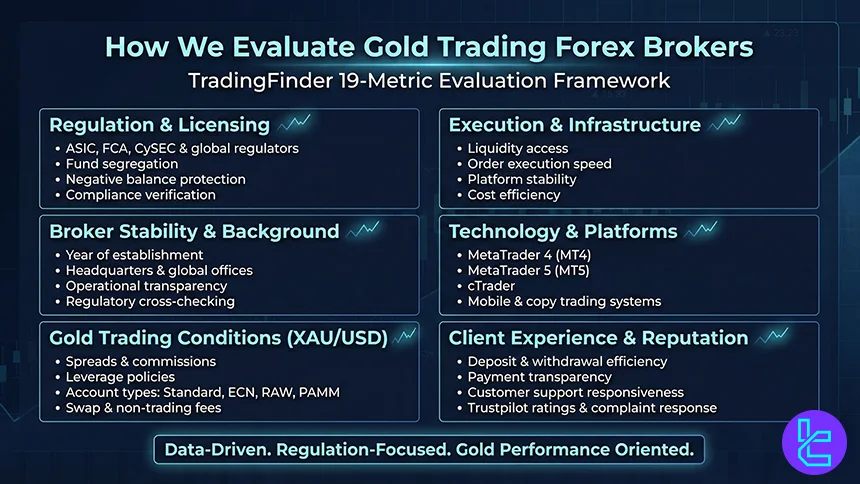
Broker background data, including year of establishment, headquarters, and global offices, are also assessed to determine operational stability.
For gold traders, execution quality and cost structure are critical. We evaluate account types (Standard, ECN, RAW, PAMM), minimum deposits, leverage policies, spreads on XAU/USD, commissions, swap conditions, and non-trading fees.
Deposit and withdrawal efficiency, supported payment methods, and fee transparency are tested directly to reflect real-user experience.
Technology and usability form another core pillar. We assess availability of MetaTrader 4 (MT4), MetaTrader 5 (MT5), cTrader, mobile apps, copy trading systems, and order execution speed.
Customer support responsiveness, educational materials, Trustpilot ratings, broker responses to complaints, scam alerts, and even sponsorship activities are factored into the final score.
Our forex broker review methodology prioritizes metrics that directly impact gold trading performance, such as cost efficiency, liquidity access, platform stability, and regulatory safeguards. Backed by experienced market analysts and transparent editorial standards, TradingFinder ensures that every broker featured meets strict criteria relevant to serious XAU/USD traders.
Why is Gold a Popular Trading/Investment Instrument?
Gold remains one of the most actively traded assets in global financial markets due to its historical role as a store of value and hedge against systemic risk. Unlike fiat currencies, gold is not directly tied to any central bank’s monetary policy.
During periods of inflation, geopolitical tension, or currency depreciation, demand for physical gold and derivatives such as XAU/USD typically increases.
The pricing of gold is influenced by macroeconomic variables including U.S. interest rates, the strength of the U.S. Dollar (USD), inflation data (CPI, PPI), and central bank reserves.
Institutions such as the Federal Reserve, World Gold Council, and major bullion banks closely monitor gold flows. When real yields decline, gold often becomes more attractive compared to interest-bearing assets.
Gold is also highly liquid. It is traded 24 hours a day through the London Bullion Market, COMEX futures under the CME Group, ETFs like SPDR Gold Shares (GLD), and retail forex brokers offering gold CFDs. This deep liquidity results in tight spreads and efficient execution, particularly in major trading sessions.
From a portfolio perspective, gold offers diversification benefits. Historically, it has shown low or negative correlation with equities during market stress. As a result, both short-term traders and long-term investors use gold to hedge exposure, manage volatility, and protect purchasing power in uncertain economic environments.
What are the Pros and Cons of Gold Trading in Forex?
Gold trading in the forex market, primarily through XAU/USD CFDs, offers high liquidity, tight spreads during major sessions, and strong volatility driven by macroeconomic data such as U.S. CPI, Federal Reserve rate decisions, and USD strength.
However, leverage amplifies both gains and losses, and gold’s sensitivity to geopolitical events can result in rapid price swings and gap risk.
Pros | Cons |
High liquidity in global sessions (London, New York) ensuring efficient execution | High volatility can trigger stop-loss orders quickly |
Strong reaction to macroeconomic data creates frequent trading opportunities | Sensitive to USD strength and U.S. interest rate changes |
Availability of leverage increases capital efficiency | Leverage magnifies losses as well as profits |
Tight spreads on major brokers for XAU/USD | Overnight swap fees may increase holding costs for long-term positions |
How is Gold Trading in the United States?
Gold trading in the United States is highly regulated and primarily conducted through futures, ETFs, and physical bullion markets. Retail traders cannot typically trade gold CFDs due to regulatory restrictions imposed by the Commodity Futures Trading Commission (CFTC) and the National Futures Association (NFA).
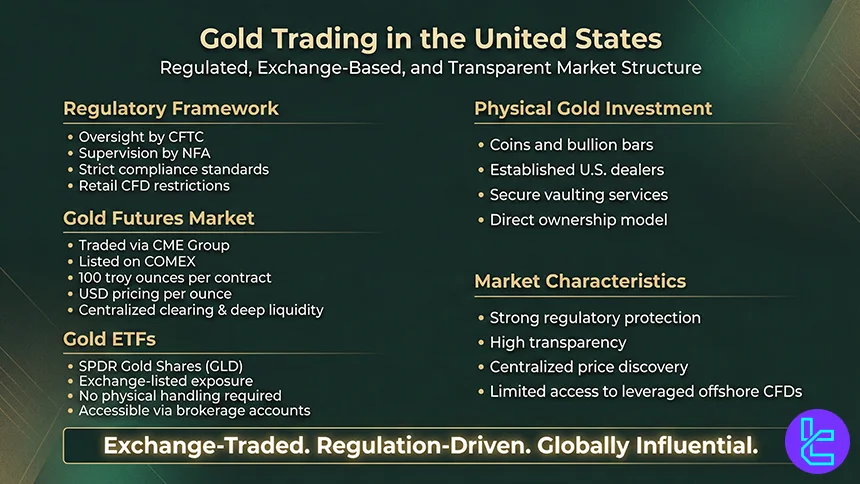
Instead, U.S.-based participants access gold through centralized and transparent exchanges.
The most active gold derivatives market operates via CME Group, where gold futures are listed on COMEX. Standard gold futures contracts represent 100 troy ounces, and pricing is quoted in U.S. dollars per ounce. These contracts offer deep liquidity, centralized clearing, and regulatory oversight, making them the benchmark for global gold price discovery.
Exchange-traded funds (ETFs) are another major vehicle. The SPDR Gold Shares (GLD) is one of the largest gold-backed ETFs globally, allowing investors to gain exposure to gold prices without handling physical bullion. ETFs trade on stock exchanges and are accessible through standard brokerage accounts.
Physical gold investment, such as coins and bars, is also common in the U.S., supported by established dealers and secure vaulting services. Overall, U.S. gold trading is characterized by strong regulatory protection, high transparency, centralized exchanges, and limited access to offshore leveraged CFD products compared to international markets.
How does Spot Gold Trading Differ from Futures Gold Trading?
Spot gold and gold futures represent two distinct mechanisms for gaining exposure to gold prices, differing in settlement structure, contract standardization, leverage mechanics, and market access.
Spot gold refers to the current market price for immediate settlement. In retail trading, it is commonly quoted as XAU/USD and offered through forex brokers as CFDs.
Pricing is derived from global interbank markets such as the London bullion market. Spot trading typically allows flexible position sizing and higher leverage, depending on the broker’s regulatory jurisdiction.
In contrast, gold futures are standardized contracts traded on regulated exchanges such as the CME Group (COMEX division). A standard gold futures contract represents 100 troy ounces and has a defined expiration date. Futures are centrally cleared, require margin deposits, and are subject to exchange-imposed position limits and daily settlement procedures.
Another key difference lies in cost structure. Spot gold positions may incur overnight swap (rollover) fees when held beyond the trading day. Futures contracts embed carrying costs, including interest rates, storage, and insurance, into their pricing via the forward curve (contango or backwardation).
In summary, spot gold offers flexibility and accessibility for short-term traders, while futures gold provides centralized execution, transparent pricing, and institutional-grade risk management within a regulated exchange framework.
What Factors Affect the Price of Gold?
Gold prices are influenced by a combination of macroeconomic, monetary, geopolitical, and market-structure factors. As a globally traded asset priced primarily in U.S. dollars (XAU/USD), gold reacts strongly to changes in interest rates, currency strength, inflation expectations, and risk sentiment.
Key factors affecting the price of gold include:
- S. Interest Rates: Decisions by the Federal Reserve significantly impact gold. Higher real yields increase the opportunity cost of holding non-yielding assets like gold, often pressuring prices;
- S. Dollar Strength (DXY): Since gold is priced in USD, a stronger dollar typically makes gold more expensive for foreign buyers, reducing demand;
- Inflation Expectations: Gold is widely viewed as an inflation hedge. Rising CPI data or persistent inflation trends can increase demand for gold;
- Geopolitical Risk: Wars, trade tensions, or financial instability often drive safe-haven flows into gold;
- Central Bank Demand: Institutions tracked by the World Gold Council report that central banks are significant buyers, influencing long-term demand dynamics;
- ETF Flows & Investment Demand: Large inflows or outflows from gold-backed ETFs can shift short- to medium-term price momentum;
- Supply Dynamics: Mining production levels and recycling supply also contribute, though demand-side drivers typically dominate price movement.
Together, these variables shape both short-term volatility and long-term gold price trends in global markets.
What Leverage Do Forex Brokers Offer for Gold Trading?
Leverage for gold trading (XAU/USD) varies significantly depending on the broker’s regulatory jurisdiction, client classification (retail vs. professional), and risk management policies. Since gold is categorized as a commodity CFD, regulators often apply stricter leverage caps compared to major forex pairs.
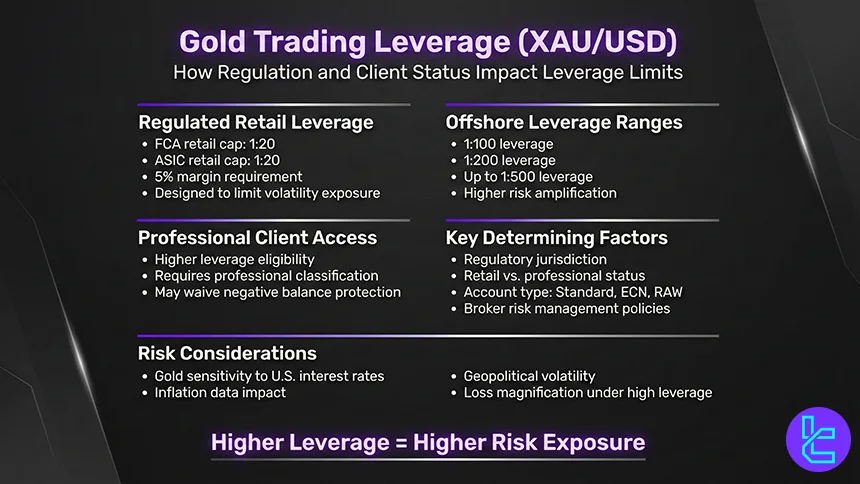
Under regulators such as the Financial Conduct Authority (FCA) and Australian Securities and Investments Commission (ASIC), retail leverage on gold is typically capped at 1:20. This means traders must maintain a 5% margin requirement. These limits aim to reduce excessive risk exposure during volatile market conditions.
In contrast, offshore or less restrictive jurisdictions may offer leverage ranging from 1:100 to 1:500 on gold CFDs. While higher leverage increases capital efficiency, it also magnifies losses, especially given gold’s sensitivity to U.S. interest rates, inflation data, and geopolitical developments.
Professional clients classified under stricter regulators may access higher leverage than retail traders, but they often waive certain investor protections such as negative balance protection.
Overall, gold leverage depends on regulation, account type (Standard, ECN, RAW), and client status. Traders should balance capital efficiency with risk control, particularly when trading a volatile instrument like XAU/USD.
Best Strategies and Approaches for Gold Trading
Gold (XAU/USD) behaves differently from major currency pairs due to its sensitivity to U.S. interest rates, inflation data, USD strength, and geopolitical risk. Effective gold trading strategies typically combine macroeconomic awareness with technical precision, especially during the London and New York sessions when liquidity is highest.
Trend Trading Strategy
Gold often develops strong directional moves during monetary policy cycles. When the Federal Reserve shifts toward rate cuts or dovish guidance, gold may enter sustained bullish trends. Traders use moving averages (50/200 EMA), higher highs–higher lows structures, and pullback entries to align with dominant momentum.
Breakout Trading
Gold frequently reacts sharply to U.S. CPI, NFP, or FOMC announcements. Breakout traders monitor consolidation ranges and key liquidity zones before major economic releases. Volatility expansion following data releases can produce rapid 100–300 pip intraday moves.
Support and Resistance / Liquidity-Based Trading
Institutional price levels, including daily highs/lows, weekly ranges, and psychological levels (e.g., $2,000 per ounce), often act as liquidity pools. Strategies based on order blocks, liquidity sweeps, and false breakouts are widely applied in gold markets.
Intraday Scalping
Due to gold’s high intraday volatility, short-term traders use 1-15 minute charts during high-liquidity sessions. Tight risk management and low spreads are essential.
What Are the Differences Between Physical Gold and CFD Gold?
Physical gold and gold CFDs provide exposure to the same underlying asset but differ significantly in ownership structure, cost profile, liquidity access, and regulatory framework. One represents tangible bullion ownership, while the other is a derivative contract based on price movements.
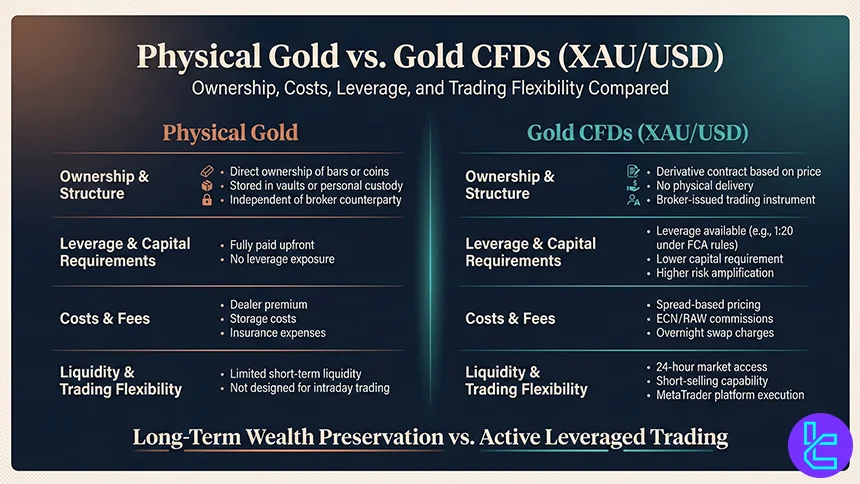
Ownership and Structure:
- Physical Gold: Investors purchase actual bars or coins stored in vaults or personal custody. Ownership is direct and not dependent on a broker;
- Gold CFDs (XAU/USD): Traders speculate on price movements through contracts offered by forex brokers. No physical delivery occurs.
Leverage and Capital Requirements:
- Physical gold is fully paid upfront with no leverage;
- CFDs allow leveraged exposure (e.g., 1:20 under the Financial Conduct Authority), increasing capital efficiency but also risk.
Costs and Fees:
- Physical gold involves premiums, storage, insurance, and dealer spreads;
- CFDs involve spreads, commissions (in ECN/RAW accounts), and potential overnight swap fees.
Liquidity and Trading Flexibility:
- Physical gold is less flexible for short-term trading;
- CFDs offer 24-hour market access, short-selling capability, and rapid execution via platforms like MetaTrader.
In summary, physical gold is typically used for long-term wealth preservation, while gold CFDs are structured for active trading and speculative strategies.
Gold in Comparison to Other Common Tradable Instruments
Gold (XAU/USD) occupies a hybrid position between currency and commodity markets. It is traded globally via spot CFDs, futures on COMEX (CME Group), and ETFs such as SPDR Gold Shares (GLD).
Compared to stocks, forex pairs, and other commodities, gold offers high liquidity, macro-driven volatility, and safe-haven characteristics.
Unlike equities, it carries no earnings risk, and unlike currencies, it is not directly tied to a single central bank’s policy framework.
Parameter | Gold (XAU/USD) | Stocks (Equities) | Currencies (Forex Pairs) | Commodities (Oil, Silver, etc.) |
Market Structure | OTC spot (CFDs), Futures (COMEX - CME Group), ETFs (e.g., GLD) | Centralized stock exchanges (NYSE, NASDAQ, LSE) | Decentralized interbank OTC market | Futures exchanges (CME, ICE), OTC CFDs |
Trading Hours | Nearly 24/5 (global sessions: Sydney-NY) | Exchange-specific hours (limited daily sessions) | 24/5 global market | Mostly 23-24 hours (futures-dependent) |
Typical Volatility | Medium–High (macro-driven, CPI/FOMC sensitive) | Varies by stock (earnings-driven spikes) | Low-Medium (majors), High (exotics) | Medium-High (supply/demand shocks) |
Main Price Drivers | USD strength (DXY), real yields, inflation, geopolitics, central bank demand | Earnings reports, sector performance, macro data | Interest rate differentials, central bank policy, macro data | Supply/demand, OPEC decisions, weather, inventories |
Leverage (Retail, Tier-1 Reg.) | Typically up to 1:20 (FCA/ASIC) | Often 1:5 or lower (CFDs), margin-regulated | Up to 1:30 (major pairs under ESMA) | Often 1:10-1:20 (commodity CFDs) |
Safe-Haven Status | Yes (historical store of value) | No (risk-on asset class) | Limited (USD, CHF, JPY considered defensive) | No (cyclical, demand-sensitive) |
Dividend / Yield | No yield (non-interest-bearing) | Dividends possible | Interest rate differentials (swap) | No dividend (carry cost in futures curve) |
Correlation Profile | Often negative correlation with equities in crisis | Correlated with economic cycles | Strong inter-currency correlations | Correlated with global growth trends |
Short-Selling Access | Yes (via CFDs/futures) | Yes (via margin/CFDs) | Yes (intrinsic two-sided market) | Yes (via futures/CFDs) |
Gap Risk Exposure | Moderate (weekend gaps possible) | High (earnings & news gaps) | Lower in majors, higher in exotics | High (inventory reports, geopolitical shocks) |
Conclusion
Gold is a popular investment vehicle which is traded by many, many traders around the world on a daily basis. XAU is the trading symbol for gold in Forex, paired with various currencies such as EUR, USD, GBP, etc. According to our examinations, FP Markets, BlackBull Markets, Pepperstone, and Exness are among the best choices for gold.
To learn about the parameters and factors in choosing these brokers, check out our Forex methodology.