



Monetary Authority of Singapore (MAS) is the main financial body that regulates Forex brokers in this country and issues Capital Markets Services license (CMS).
Traders residing in Singapore can benefit from various top-tier brokers that offer strong regulation, negative balance protection, various tradable products, and leverage of up to 1:30.
 | MultiBank Group | MAS-Regulated | |||
 | eToro | MAS-Regulated | |||
 | Moneta Markets | Not MAS-Regulated | |||
| 4 |  | TeleTrade | Not MAS-Regulated | ||
| 5 |  | IFC Markets | Not MAS-Regulated | ||
| 6 |  | Errante | Not MAS-Regulated | ||
| 7 |  | FXOpen | Not MAS-Regulated | ||
| 8 |  | MTrading | Not MAS-Regulated | ||
| 9 |  | NAGA | Not MAS-Regulated | ||
| 10 |  | OneRoyal | Not MAS-Regulated |
Trustpilot Ratings of MAS-Regulated Forex Brokers
Traders must consider the Trustpilot ratings of the top MAS-regulated brokers before opening a trading account.
Broker | Trustpilot Rating | Number of Reviews |
MultiBank Group | 4.6/5 ⭐ | 1600+ |
| One Royal | 4.5/5 ⭐ | 400+ |
| 4.4/5 ⭐ | 400+ | |
| Errante | 4.2/5 ⭐ | 50+ |
eToro | 4.2/5 ⭐ | 30000+ |
| NAGA | 4.1/5 ⭐ | 4000+ |
| MTrading | 4.0/5 ⭐ | 100+ |
| IFC Markets | 3.7/5 ⭐ | 500+ |
| FXOpen | 3.6/5 ⭐ | 400+ |
| TeleTrade | 2.6/5 ⭐ | 50+ |
Minimum Spreads of Forex Brokers Licensed By MAS
The table below outlines the minimum spreads across different account types (including Standard, Zero, and ECN) in the best Forex brokers regulated by MAS in Singapore.
Brokers | Minimum Spreads |
0.0 Pips | |
Moomoo | 0.0 Pips |
| TeleTrade | 0.0 Pips |
| IFC Markets | 0.4 Pips |
City Index | 0.5 Pips |
IG | 0.6 Pips |
Philip Securities SG | 0.6 Pips |
Saxo Bank | 0.7 Pips |
| NAGA | 0.8 Pips |
1.0 Pips |
Non-Trading Fees in Forex Brokers Regulated by MAS
Non-trading fees, including deposit, withdrawal, and inactivity cost, add to the overall trading costs and traders must consider them before choosing a Forex broker.
Broker | Deposit Fee | Withdrawal Fee | Inactivity Fee |
| OneRoyal | $0 | $0 | $0 |
| Moneta Markets | $0 | $0 | $0 |
Plus500 | $0 | Varies | $10 |
| XM Group | $0 | $0 | $10 |
Moomoo | 0.49% | Varies (up to $70) | $0 |
eToro | $0 | $5 | $10 |
| Errante | $0 | Varies | $15 |
Forex.com | $0 | $0 | $15 |
| MTrading | $0 | 1 to 3% | $50 |
MultiBank Group | $0 | $0 | $60 |
Number of Tradable Instruments in Forex Brokers Regulated by MAS
Having access to a wide variety of instruments such as Forex, stocks, crypto, commodities, and indices is crucial for diversifying your portfolio. Here are the top MAS-regulated brokers’ number of tradable assets.
Broker | Number of Tradable Assets |
Saxo Bank | 71,000+ |
IG Markets | 17,000+ |
City Index | 13,500+ |
| NAGA | 4000+ |
| IC Markets | 2250+ |
| FX Pro | 2100+ |
| FXTM | 1000+ |
| Eightcap | 800+ |
| HFM | 500+ |
| TeleTrade | 200+ |
Top 6 Forex Brokers Regulated by MAS
Here is a detailed overview of the best Forex brokers regulated by the Monetary Authority of Singapore.
MultiBank Group
MultiBank is a global multi-asset broker established in 2005, offering access to Forex, commodities, indices, shares, and cryptocurrency CFDs through MetaTrader 4, MetaTrader 5, and its proprietary MultiBank-Plus platform.
Trading conditions include leverage of up to 1:500, commission-free accounts, and minimum deposits starting from $200, depending on the account type and region.
The broker operates under a broad regulatory framework, with oversight from authorities such as ASIC, CySEC, MAS, SCA, BaFin, CIMA, and AUSTRAC. All these entities require traders to complete the MultiBank verification process.
Client protection measures include segregated accounts, negative balance protection in selected jurisdictions, and excess loss insurance of up to $1 million per account.
Funds are held with Tier 1 banks, and the company holds a “B” rating from Standard & Poor’s.
After completing the MultiBank registration, traders can choose between Standard, Pro, and ECN accounts, each designed for different trading profiles, alongside Islamic and demo accounts.
Supported services include copy trading, MAM/PAMM structures, and automated trading via Expert Advisors.
Deposit and withdrawal options cover cards, bank transfers, cryptocurrencies, SEPA, and regional payment systems, all available on the MultiBank dashboard.
Services are restricted in several countries, including the USA, UK, Iran, Russia, and North Korea. Overall, MultiBank positions itself as a compliance-focused broker with diversified instruments and technology-driven infrastructure.
Account Types | Standard, Pro, ECN |
Regulating Authorities | FSAS, FSCM, VFS, TFG, MAS, FMA, FSC, CySEC, ESCA, CIMA, BAFIN, AUSTRAC, ASIC |
Minimum Deposit | $200 |
Deposit Methods | credit or debit card, Bank Transfer, Crypto, SEPA |
Withdrawal Methods | bank wire, credit cards, Neteller |
Maximum Leverage | 1:500 |
Trading Platforms & Apps | MultiBank-Plus, MT4 Platform, MT5 Platform, Web Trader MT4 |
MultiBank Group Pros and Cons
The table below outlines the main benefits and drawbacks of trading with the MultiBank Group broker.
Pros | Cons |
FSAS, FSCM, VFS, TFG, MAS, FMA, FSC, CySEC, ESCA, CIMA, BAFIN, AUSTRAC, and ASIC | High minimum deposit of $200 |
Over 20,000 tradable instruments | Limited educational resources |
24/7 customer support | - |
Supports MultiBank-Plus, MT4 Platform, MT5 Platform, Web Trader MT4 | - |
eToro
eToro is an Israel based broker founded in January 2007 by David Ring, Ronen Assia, and Yoni Assia, operating under eToro Ltd and headquartered in Tel Aviv.

The company is regulated across multiple jurisdictions through entities supervised by FCA, CySEC, MFSA, ADGM FSRA, ASIC, FSA Seychelles, GFSC, MAS, and in the United States by SEC and FINRA.
The broker runs a proprietary trading app only, offering exposure to Stocks, ETFs, Forex, Indices, Commodities, and Crypto, plus three investment tools: CopyTrader, Smart Portfolios, and Crypto Staking for assets such as ETH, SOL, ADA, and TRX.
Account options after completing the eToro registration include Personal, Professional, Corporate, and Islamic, with a $10 minimum deposit, and leverage ranging from 1:30 for retail clients to 1:400 for eligible professional clients.
Costs vary by instrument and region, including a 1% crypto fee, a $5 withdrawal fee from USD accounts, conversion charges, and a $10 monthly inactivity fee after 12 months.
Funding methods include bank transfer, cards, PayPal, Skrill, Neteller, Trustly, iDEAL, Sofort, and Przelewy24.
Reported limitations include no MT4 or MT5 support and customer service channels centered on email, ticketing, and live chat rather than phone calls.
Account Types | Personal, Professional, Corporate, Islamic |
Regulating Authorities | FCA, CySEC, MFSA, FSRA, ASIC, FSA, Gibraltar FSC |
Minimum Deposit | $10 |
Deposit Methods | eToro Money, Credit/Debit Card, Bank Transfer, PayPal, Neteller, Skrill, Online Banking (Trustly), iDEAL, Sofort, Przelewy24 |
Withdrawal Methods | eToro Money, Credit/Debit Card, Bank Transfer, PayPal, Neteller, Skrill, Online Banking (Trustly), iDEAL, Sofort, Przelewy24 |
Maximum Leverage | 1:400 |
Trading Platforms & Apps | Proprietary App |
Pros and Cons of eToro
Check the table below to learn about the pros and cons of trading with eToro.
Pros | Cons |
Proprietary Platform | No MT4/MT5 Support |
5000+ tradable instruments | No Phone Call Option for Customer Service |
Top-tier social trading platform | - |
Regulated by FCA, CySEC, MFSA, FSRA, ASIC, FSA, Gibraltar FSC | - |
Moneta Markets
Moneta Markets is a Forex and CFD brokerage established in 2020 and headquartered in Johannesburg, South Africa.
The company operates under the supervision of the Financial Sector Conduct Authority (FSCA, No. 47490) and maintains corporate registration in Saint Lucia.
Prior to becoming an independent brand, Moneta Markets functioned as part of the Vantage International Group Limited network.
The broker provides access to more than 1,000 tradable instruments spanning multiple asset classes such as forex pairs, commodities, indices, shares, bonds, and cryptocurrencies.
Traders must finalize Moneta Markets verification process to access all account features.
Trading services are delivered through MetaTrader 4 (MT4), MetaTrader 5 (MT5), Pro Trader, and the proprietary App Trader platform, allowing users to implement discretionary or automated strategies with market execution via STP and ECN models.
Account options after completing Moneta Markets registration include Direct, Prime, and Ultra, each supporting position sizes from 0.01 lots. The minimum deposit begins at $50, while leverage can reach up to 1:1000 depending on jurisdictional requirements.
Spreads may start from 0.0 pips on ECN-based accounts, with commission structures varying between $0 and $3 per lot per side.
Operational safeguards include segregated client funds and negative balance protection.
Additional features such as Islamic (swap-free) accounts, PAMM allocation systems, and integrated copy trading through Moneta CopyTrader are available in the Moneta Markets dashboard.
Margin parameters typically follow an 80% margin call and 50% stop-out level across supported account environments.
Account Types | Direct, Prime, Ultra |
Regulating Authorities | FSCA, FSRA |
Minimum Deposit | $50 |
Deposit Methods | Wire Transfer, Visa/MasterCard, Fasapay, Stickpay, JCB, Cryptocurrency (USDT, BTC, ETH, USDC) |
Withdrawal Methods | Wire Transfer, Visa/MasterCard, Fasapay, Stickpay, JCB, Cryptocurrency |
Maximum Leverage | Up to 1:1000 |
Trading Platforms & Apps | MetaTrader 4 (MT4), MetaTrader 5 (MT5), Pro Trader, App Trader |
Moneta Markets Pros and Cons
The table below outlines the main benefits and drawbacks of trading with the Moneta Markets broker.
Pros | Cons |
Access to 1,000+ tradable instruments | Limited top-tier regulatory coverage |
Support for MT4, MT5, Pro Trader, and App Trader | Not available for US traders |
STP and ECN execution models | Relatively new brand (founded in 2020) |
Islamic accounts, PAMM, and Copy Trading support | Regional service restrictions in some countries |
FXOpen
FXOpen is a Forex and CFD broker that began operations in 2005 after initially launching as a financial education platform in 2003.
The company delivers trading services through an ECN and STP execution framework, enabling direct market access and liquidity aggregation suited to algorithmic trading, scalping, and high-frequency strategies.
The broker operates through several regulated entities across different jurisdictions.
These include FXOpen EU Ltd under CySEC (License 194/13), FXOpen Ltd under the FCA (No. 579202), and FXOpen AU Pty Ltd authorized by ASIC (AFSL 412871).
Each regional branch applies distinct investor protection mechanisms such as the Investor Compensation Fund (ICF) in the EU and the Financial Services Compensation Scheme (FSCS) in the United Kingdom.
Account structures include ECN, STP, and Micro, with minimum deposits starting from $1 and leverage reaching up to 1:500 for international clients.
Traders can lower trading costs in this broker by using FXOpen rebate services.
Commission-free trading is available on STP accounts, while ECN accounts feature raw spreads from 0.0 pips with volume-based commission tiers.
Trading is supported via MetaTrader 4 (MT4), MetaTrader 5 (MT5), TickTrader, and TradingView after completing FXOpen registration. The broker provides access to over 600 tradable instruments across asset classes including Forex, commodities, indices, ETFs, cryptocurrencies, and equities.
Additional features include PAMM account integration, economic calendar tools, margin calculators, and support for advanced order types such as OCO and Iceberg.
FXOpen deposit and withdrawal methods, include credit and debit cards, bank transfers, and e-wallets.
Account Types | ECN, STP, Micro |
Regulating Authorities | CySEC, FCA, ASIC |
Minimum Deposit | From $1 |
Deposit Methods | Bank Transfer, Visa/MasterCard, Instant Bank Transfer |
Withdrawal Methods | Bank Transfer, Visa/MasterCard, Easy Bank Transfer |
Maximum Leverage | Up to 1:500 |
Trading Platforms & Apps | MetaTrader 4 (MT4), MetaTrader 5 (MT5), TickTrader, TradingView |
FXOpen Pros and Cons
FXOpen users must consider the following advantages and drawbacks.
Pros | Cons |
Regulated by CySEC, FCA, and ASIC | Inactivity fee after 90 days |
ECN/STP execution model | Limited account currencies in some regions |
Minimum deposit starting from $1 | Restricted in countries such as the US |
Supports MT4, MT5, TickTrader, and TradingView | Educational resources are limited |
TeleTrade
TeleTrade is a Cyprus-based Forex and CFD broker with a long operating history dating back to 1994.
Its regulated entity, Top Markets Solutions Ltd, is supervised by the Cyprus Securities and Exchange Commission (CySEC) under license 158/11, which also links eligible clients to the Investor Compensation Fund (ICF) coverage up to €20,000.
Client-side protections mentioned for this structure include segregated funds and negative balance protection.
To benefit from all these client protection measures, traders must complete the TeleTrade verification.
The broker offers access to a multi-market CFD lineup that typically includes forex pairs, metals, indices, energy products, shares, cryptocurrencies, bonds, and soft commodities.
Trading is available through MetaTrader 4 (MT4) and MetaTrader 5 (MT5), with execution that can be described as market or instant depending on the account environment.
TeleTrade’s published pricing references spreads from 0.2 pips and commissions starting around 0.007%, while margin settings show a 100% margin call and 20% stop-out level.
Account choices after TeleTrade registration are commonly presented as ECN, NDD, and CENT, with a minimum deposit of $10 and order sizing from 0.01 lot. Leverage is listed up to 1:500, although availability may depend on client classification and region.
For copy trading, TeleTrade uses a service branded as Synchronous Trading. Support access is routed through four channels: live chat, call back request, ticket, and email.
Deposit and withdrawal rails in the TeleTrade dashboard include bank transfers, credit and debit cards, e-payment systems, local payment methods, and in some cases cryptocurrencies, with Neteller referenced as having a fee on deposits.
Account Types | ECN, NDD, CENT |
Regulating Authorities | CySEC |
Minimum Deposit | $10 |
Deposit Methods | Bank Transfer, Credit/Debit Cards, E-Payment Systems, Local Payment Options, Cryptocurrencies |
Withdrawal Methods | Bank Transfer, Credit/Debit Cards, E-Payment Systems, Local Payment Options, Cryptocurrencies |
Maximum Leverage | Up to 1:500 |
Trading Platforms & Apps | MetaTrader 4 (MT4), MetaTrader 5 (MT5) |
TeleTrade Pros and Cons
The table below outlines the main benefits and drawbacks of trading with the TeleTrade broker.
Pros | Cons |
Regulated by CySEC | Not available in some countries |
Supports MT4 and MT5 | Limited transparency on inactivity fees |
Minimum deposit starting from $10 | Neteller deposits incur fees |
Offers Synchronous Trading copy trading | Instrument availability varies by region |
NAGA
NAGA is a Germany-headquartered online brokerage operating under NAGA Group AG, a publicly listed fintech company on the Frankfurt Stock Exchange.
Its European entity, NAGA Markets Europe Ltd, is regulated by the Cyprus Securities and Exchange Commission (CySEC) under license 204/13 and aligned with MiFID requirements.
The broker provides a tiered account structure in the NAGA dashboard including Iron, Bronze, Silver, Gold, Diamond, and Crystal, with entry requirements starting from a $250 minimum deposit and leverage capped at 1:30 for retail clients.
Trading is conducted via MetaTrader 4 (MT4), MetaTrader 5 (MT5), or the proprietary NAGA App, with access to a multi-asset environment covering Forex, CFD Stocks, Indices, ETFs, Commodities, Cryptocurrencies, Futures, and Real Stocks.
Pricing is primarily spread-based with variable spreads that adjust to market conditions. Commission charges typically apply to equity CFDs from approximately $2.5 per transaction.
Margin parameters are commonly structured around a 100% margin call and 50% stop-out level.
Social trading functionality is integrated through NAGA copy trading, allowing users to replicate strategies within a networked trading environment.
Additional analytical support is available through built-in tools such as an economic calendar. Naga deposit and withdrawal channels may include Bank Wire, Neteller, Skrill, and NAGA Pay, although inactivity fees can apply after extended account dormancy.
Account Types | Iron, Bronze, Silver, Gold, Diamond, Crystal |
Regulating Authorities | CySEC |
Minimum Deposit | $250 |
Deposit Methods | Bank Wire, Neteller, Skrill, NAGA Pay |
Withdrawal Methods | Bank Wire, Neteller, Skrill |
Maximum Leverage | 1:30 |
Trading Platforms & Apps | MT4, MT5, NAGA App |
NAGA Pros and Cons
The table below outlines the main benefits and drawbacks of trading with the Moneta Markets broker.
Pros | Cons |
Regulated by CySEC under MiFID framework | Minimum deposit starts from $250 |
Integrated social and copy trading (NAGA Autocopy) | Withdrawal fees may apply depending on method |
Access to 4,000+ instruments across multiple asset classes | Leverage limited to 1:30 for retail clients |
Supports MT4, MT5, and proprietary NAGA App | Inactivity fee after 60 days of no trading |
How Did We Choose the Best MAS-Regulated Brokers?
TradingFinder team of experts have reviewed all the available Forex brokers with an MAS license based on the factors listed below to choose the best ones based on traders’ needs.
- Account types
- Funding and withdrawal methods
- Leverage
- Tradable instruments
- Client protection schemes
- Customer support
We have also considered the brokers that were mentioned in our best Forex brokers in Singapore to design the current list.
What is MAS?
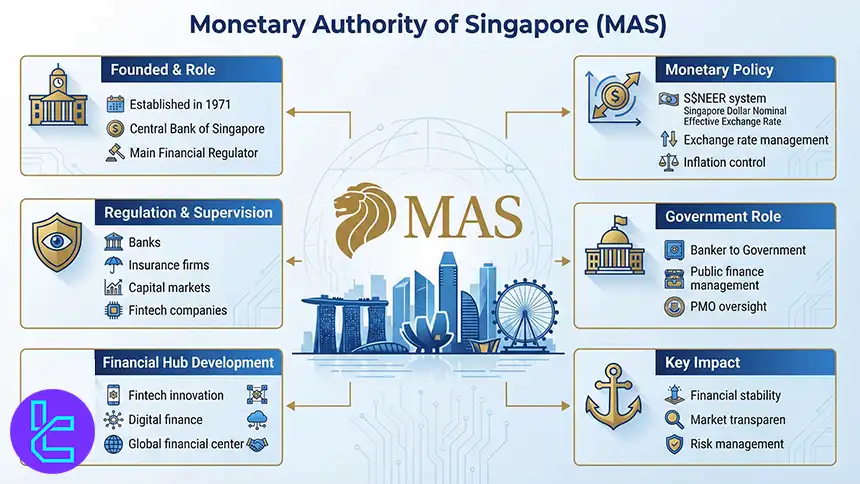
The Monetary Authority of Singapore (MAS) functions as Singapore’s central bank and primary financial supervisor, operating as an integrated regulatory institution since 1971.
Its mandate focuses on maintaining macroeconomic stability, supporting sustainable growth, and ensuring the resilience of the national financial system.
Unlike many central banks that rely mainly on interest rate adjustments, MAS conducts monetary policy through the management of the Singapore Dollar Nominal Effective Exchange Rate (S$NEER).
By guiding the exchange rate within a defined policy band, the authority aims to preserve price stability and manage inflationary pressures.
In its regulatory capacity, MAS oversees a wide range of financial institutions, including commercial banks, insurance providers, capital market intermediaries, financial advisors, and fintech companies.
This comprehensive supervisory framework is designed to strengthen risk management practices and promote market transparency.
MAS also serves as the banker and financial agent of the Singapore Government, handling public sector financial operations and contributing to overall fiscal efficiency.
At the institutional level, it operates under the oversight of the Prime Minister’s Office, reflecting its strategic role within national economic governance.
Beyond regulation, MAS supports the development of Singapore as an international financial hub by encouraging innovation, digital finance, and responsible fintech adoption.
Through its integrated policy, supervisory, and developmental functions, MAS remains a central pillar in shaping Singapore’s financial stability and long-term competitiveness.
What Powers Does MAS Have?
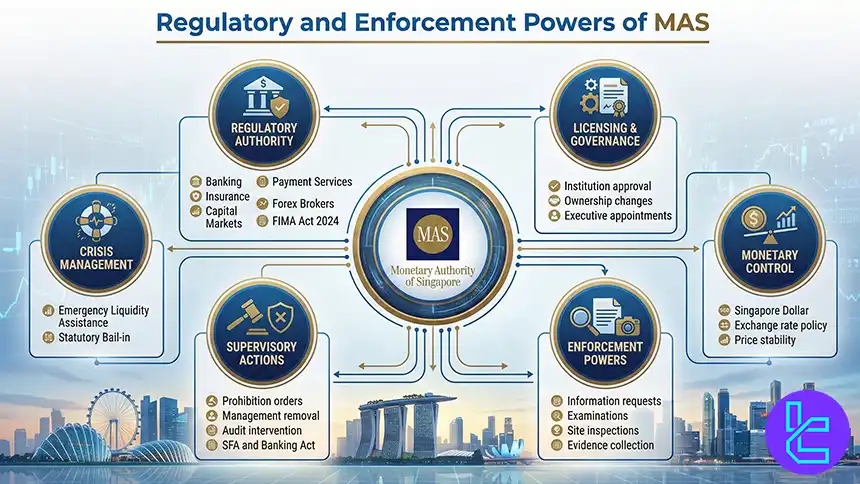
The Monetary Authority of Singapore (MAS) holds extensive regulatory, supervisory, and enforcement powers aimed at preserving the stability and integrity of Singapore’s financial system.
Its authority covers banking, insurance, capital markets, and payment services, Forex brokers and has been further reinforced by the Financial Institutions (Miscellaneous Amendments) Act 2024 (FIMA Act).
As the central licensing body, MAS approves the establishment, ownership changes, and key appointments of financial institutions.
Under the Banking Act and the Securities and Futures Act (SFA), it may issue prohibition orders, remove unsuitable executives, and intervene in audit arrangements.
In the enforcement sphere, MAS can compel information disclosure, conduct examinations, and, where justified, enter premises and secure evidence.
The authority also plays a role in financial crisis management through emergency liquidity assistance and statutory bail-in mechanisms.
In parallel, it manages the Singapore Dollar exchange rate to support price stability. Together, these powers enable MAS to address risks, misconduct, and systemic vulnerabilities in a timely manner.
What Are the Monetary Authority of Singapore Responsibilities?
Here are the main responsibilities of the MAS in Singapore:
- Develops and enforces regulatory guidelines on accountability, ESG standards, technology risk management, outsourcing, environmental risk, and business continuity to support financial system stability;
- Publishes financial statements, financial stability reviews, and assets under management reports, while maintaining the Investor Alert List and licensed representatives register for public verification;
- Manages the licensing and authorization of banks, brokers, insurers, and financial institutions through centralized regulatory directories;
- Oversees monetary and operational frameworks by managing exchange rate mechanisms, conducting resilience testing, and implementing enterprise-wide risk assessments;
- Applies supervisory and disciplinary measures, including targeted financial sanctions, prohibition orders, civil penalties, reprimands, and formal warnings in cases of regulatory violations.
Do MAS-Regulated Brokers offer Negative Balance Protection?
Negative balance protection is an important risk management feature within the Singapore forex trading environment, designed to prevent traders from incurring losses that exceed their deposited funds.
This mechanism ensures that trading accounts do not fall below zero, even during periods of extreme market volatility or sharp price fluctuations.
In practice, most MAS-regulated brokers extend negative balance protection primarily to retail clients, reflecting regulatory standards focused on investor protection and financial stability.
By limiting downside exposure, this safeguard reduces the risk of unexpected debt arising from leveraged trading positions. As a result, it is particularly relevant for less experienced participants who may lack advanced risk management strategies.
Professional account holders are typically treated under a different regulatory framework and may not benefit from the same level of protection, as they are considered capable of managing higher levels of risk independently.
This distinction aligns with international regulatory practices applied by authorities such as the Monetary Authority of Singapore (MAS). Overall, leading forex brokers authorized in Singapore generally incorporate negative balance protection into their client protection policies.
When combined with leverage restrictions, margin controls, and transparent risk disclosures, this mechanism contributes to a more controlled trading environment and supports responsible participation in leveraged financial markets.
Are MAS-Regulated Brokers Safe?
The safety of client funds with forex brokers in Singapore depends on both regulatory safeguards and individual risk management practices.
Trading in leveraged markets inherently involves exposure to market volatility, pricing fluctuations, and execution risks, which can affect account performance regardless of broker oversight.
Under the supervision of the Monetary Authority of Singapore (MAS), licensed brokers are required to operate within a structured compliance framework designed to promote transparency and financial stability.
This includes maintaining internal risk controls, implementing client fund segregation, and following strict operational standards. Such measures aim to reduce counterparty risk and enhance the protection of retail investors.
MAS-regulated brokers also provide access to risk management tools such as stop-loss orders, limit orders, guaranteed stops, and price alerts.
These features enable traders to define potential losses and manage position exposure more effectively. In addition, many retail accounts benefit from negative balance protection, which limits losses to the amount deposited.
From a compliance perspective, regulated providers must adhere to Anti-Money Laundering (AML) and Countering the Financing of Terrorism (CFT) requirements, aligned with international standards supported by the Asia/Pacific Group on Money Laundering.
These obligations strengthen institutional integrity and monitoring practices.
Overall, while MAS regulation establishes a secure operational environment, effective capital protection ultimately depends on disciplined trading strategies, informed decision-making, and appropriate use of available risk controls.
Forex Trading Tax for MAS Regulated Brokers
In Singapore, the taxation of forex trading activities is governed by guidelines set by the Inland Revenue Authority of Singapore (IRAS). Under this framework, trading profits are generally subject to income tax when forex activities constitute a primary or regular source of income.
This classification typically applies to professional or full-time traders who generate consistent earnings from market participation. In contrast, individuals who trade on an occasional or non-commercial basis are less likely to be assessed under the same criteria.
Corporate entities engaged in forex trading are subject to a standard corporate income tax rate of 17%. For individual traders, tax obligations depend on progressive income brackets, ranging from zero percent for low-income earners to higher rates for elevated income levels.
As taxable income increases, marginal rates may reach above 20%, reflecting Singapore’s graduated personal tax structure. From an accounting perspective, trading losses are generally categorized as business-related losses rather than capital losses when trading qualifies as a commercial activity.
These losses may be applied to offset future taxable income, subject to regulatory conditions. However, they are not eligible for retrospective adjustment against prior-year earnings.
Overall, the tax treatment of forex income in Singapore depends largely on trading frequency, income dependency, and professional classification, making accurate recordkeeping and regulatory compliance essential.
How can I Check If a Broker is Regulated by MAS?
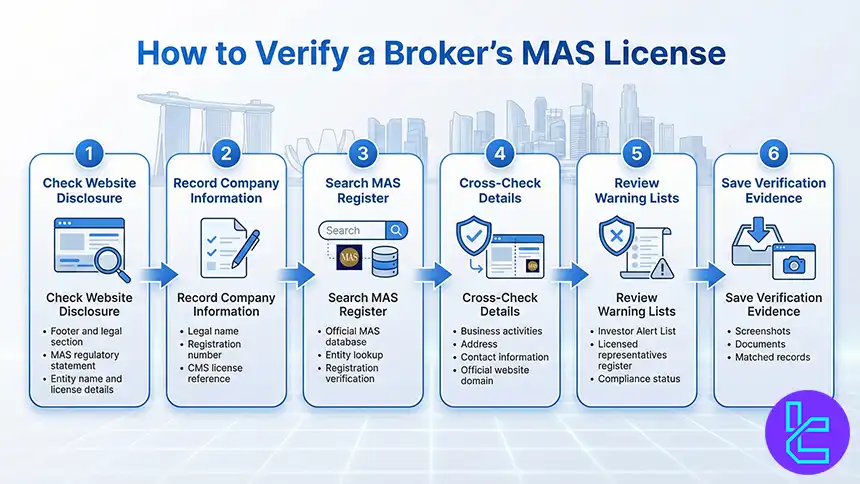
Here are the exact steps you must take to ensure the broker you choose is under oversight of MAS:
- Check the broker’s website footer or legal section and find the regulatory disclosure showing its relationship with the Monetary Authority of Singapore (MAS), including the legal entity name and license details;
- Note the official company name, registration number, and stated authorization, such as a Capital Markets Services (CMS) license;
- Visit the official MAS register and search for the same legal entity using the recorded name or registration number;
- Compare the register information with the broker’s website, including business activities, address, contact details, and official domain;
- Review the MAS Investor Alert List and licensed representatives register to confirm that neither the company nor its key personnel are flagged as unregulated.
- Keep records of the matched disclosure and register entry as verification evidence.
Rules Set by MAS for Forex Brokers
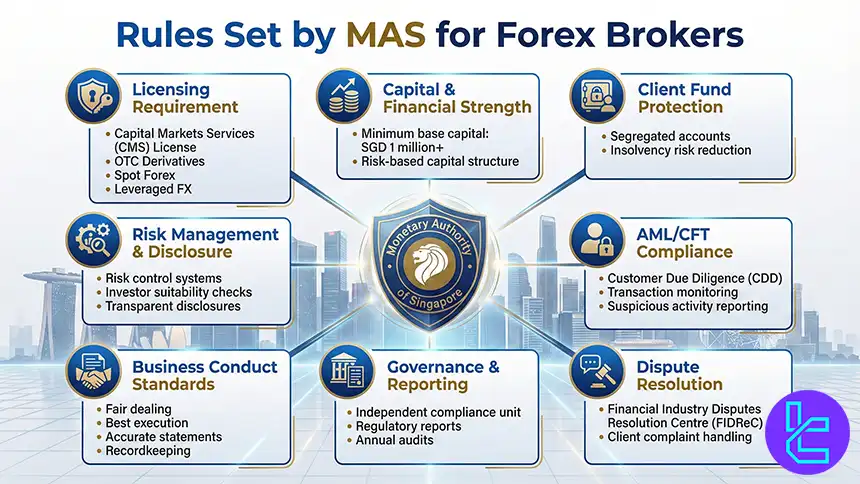
Forex brokers operating in Singapore must comply with a structured regulatory framework established by the Monetary Authority of Singapore (MAS), which governs participation in the local foreign exchange and derivatives markets.
A fundamental requirement is holding a Capital Markets Services license for dealing in OTC derivatives, spot foreign exchange, and leveraged FX products.
MAS mandates minimum base capital thresholds, commonly starting from SGD 1 million, depending on business scope and risk exposure.
Brokers are required to segregate client funds from operational capital to strengthen client asset protection and reduce insolvency risk.
In addition, firms must implement formal risk management systems, publish comprehensive risk disclosures, and conduct investor suitability assessments.
Regulatory compliance also extends to Anti-Money Laundering and Countering the Financing of Terrorism (AML/CFT) obligations, including Customer Due Diligence (CDD), transaction monitoring, and reporting of suspicious activities.
Business conduct standards emphasize fair dealing, best execution, accurate statements of account, and systematic recordkeeping.
From a governance perspective, brokers must maintain an independent compliance function in Singapore and submit regular regulatory reports and annual financial audits to MAS.
When disputes arise, affected clients may escalate complaints to the Financial Industry Disputes Resolution Centre (FIDReC), which provides an external mechanism for dispute resolution within the Singapore financial system.
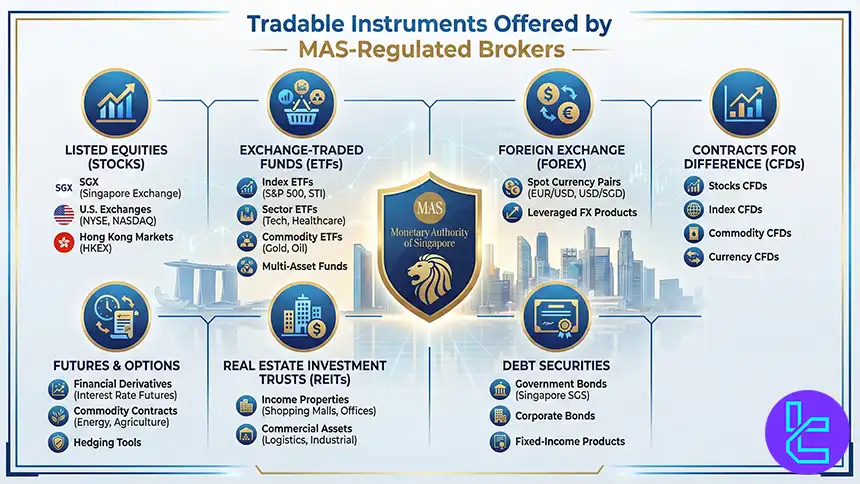
Tradable Instruments in the MAS Regulated Brokers
Here’s a list of trading products you have access to in the brokers regulated by the Monetary Authority of Singapore:
- Listed equities (stocks) traded on the Singapore Exchange (SGX) and major international exchanges in the U.S. and Hong Kong markets;
- Exchange-Traded Funds (ETFs) covering equity indices, sectors, commodities, and multi-asset strategies;
- Foreign Exchange (Forex) products, including spot currency pairs and leveraged FX trading instruments;
- Contracts for Difference (CFDs) on stocks, indices, commodities, and currencies without direct asset ownership.
- Futures contracts and options on financial instruments and commodity markets for hedging and speculative purposes;
- Real Estate Investment Trusts (REITs) providing exposure to income-generating property portfolios;
- Debt securities, including government bonds, corporate bonds, and other fixed-income instruments.
Can I Trade Crypto in the MAS-regulated Forex Brokers?
Yes, cryptocurrency trading through MAS-regulated forex brokers in Singapore is generally offered in the form of derivative instruments rather than direct ownership of digital assets.
In most cases, traders gain exposure through Cryptocurrency Contracts for Difference (CFDs), which track the price movements of major cryptocurrencies such as Bitcoin (BTC) and Ether (ETH) against fiat currencies.
Although these brokers operate under the supervision of the Monetary Authority of Singapore (MAS) for forex and capital markets activities, the underlying crypto assets themselves are not regulated as legal tender or securities.
As a result, digital currencies remain outside the formal regulatory scope of MAS, which places them in a higher-risk category compared to traditional financial instruments.
MAS regularly emphasizes the importance of risk awareness when dealing with crypto-related products.
Key concerns include high market volatility, limited price transparency, and the absence of statutory investor protection mechanisms. These factors may restrict access to legal remedies in the event of disputes or losses.
In addition, certain leveraged or complex crypto-linked products may be available only to accredited or professional investors, depending on regulatory classification.
Overall, crypto trading through MAS-regulated brokers focuses on price exposure via derivatives, rather than asset custody, and requires careful consideration of regulatory boundaries and risk profiles.
MAS vs Other Top-tier Regulatory Entities
Here’s how the Monetary Authority of Singapore compares to other top-tier regulators in the world.
Parameter | MAS (Singapore) | CySEC (Cyprus) | FCA (UK) | ASIC (Australia) |
Minimum Capital Requirement | $1 million SGD | €750,000+ depending on firm type | £125,000–£730,000+ depending on model | Between AU$500,000 and AU$1,000,000 |
Client Fund Segregation | Required | Required | Required | Required |
Compensation Scheme | No | Investor Compensation Fund (~€20,000) | FSCS (~£85,000) | Investor Compensation Fund (AU$10,000) |
Leverage Limits | 1:30 | Set under MiFID (often 1:30 for retail in EU) | Retail max ~1:30 on majors | 1:30 |
Negative Balance Protection | Required | Often required | Required | Required |
Reporting & Audits | Ongoing financial reporting | Ongoing financial reporting | Ongoing reporting standard | Ongoing financial reporting |
Conclusion
Based on our evaluation of the best MAS regulated brokers, eToro, MultiBank Group, Swissquote, Forex.com, Plus500, Saxo Bank, and Interactive brokers are the best available options.
Now you must weigh the pros and cons of trading with each broker and choose the one that fits your trading goals and risk tolerance.
All brokers have been evaluated based on the TradingFinder Forex Methodology.