







Unlike traditional dealing desk brokers, non-dealing desk (NDD) brokers route orders directly to liquidity providers via ECN or STP systems, eliminating conflicts of interest and offering market-based pricing.
This guide highlights the top 8 NDD brokers, each evaluated across key metrics including regulation, spreads, account types, leverage, instruments, platforms, and customer support. Our selection features brokers with proven track records.
The list of the best brokers offering non-dealing desk (NDD) account types includes:
 | FUSION MARKETS | |||
 | XM Group | |||
 | Exness | |||
| 4 |  | fpmarkets | ||
| 5 |  | IC Markets | ||
| 6 |  | pepperstone | ||
| 7 |  | FxPro | ||
| 8 |  | FBS |
Trustpilot Ratings in NDD Brokers
Trustpilot scores offer a snapshot of customer satisfaction and reliability for brokers. By reviewing these ratings, traders can gauge overall user experience, service quality, and trustworthiness before choosing an NDD broker. Here’s how some of the top NDD brokers rank according to user reviews:
Broker | Trustpilot Score | Number of Reviews |
4.8/5 ⭐️ | 27,602 | |
FP Markets | 4.8/5 ⭐️ | 9,991 |
IC Markets | 4.8/5 ⭐️ | 51,402 |
4.8/5 ⭐️ | 6,261 | |
FBS | 4.3/5 ⭐️ | 8,634 |
Pepperstone | 4.2/5 ⭐️ | 3,214 |
FxPro | 3.5/5 ⭐️ | 813 |
XM Group | 3.1/5 ⭐️ | 3,033 |
Minimum Spreads in NDD Brokers
Low spreads are a key advantage for NDD brokers, allowing traders to minimize trading costs and execute strategies more efficiently. The minimum spread indicates the tightest pricing a broker offers, which is particularly crucial for scalping and high-frequency trading. Let’s compare the minimum spreads offered by leading NDD brokers:
Broker | Minimum Spread |
Fusion Markets | 0.0 pips |
0.0 pips | |
Tickmill | 0.0 pips |
Global Prime | 0.0 pips |
IC Markets | 0.0 pips |
Exness | 0.0 pips |
FxPro | 0.0 pips |
0.6 pips |
Available Account Types in NDD Brokers
NDD brokers provide a variety of account types to suit different trading styles, risk preferences, and capital levels. From standard accounts to high-leverage professional accounts, understanding these options helps traders pick the setup that aligns with their goals.
Below is an overview of the account types and leverage limits across popular NDD brokers:
Broker Name | Account Types | Max. Leverage |
FxPro | Standard, Raw+, Elite | 1:30 |
AvaTrade | Retail, Professional, Islamic, Demo | 1:400 |
Pepperstone | Standard, Razor | 1:500 |
Standard | 1:500 | |
Standard, Raw Spread, Islamic | 1:500 | |
Interactive Brokers | Individual, Joint, Trust, Retirement, Institutional, Non-Professional Advisor | 1:1000 |
XM Group | Standard, Ultra Low, Shares | 1:1000 |
Exness | Standard, Standard Cent, pro, Raw Spread, Zero | Unlimited (Subject to account) |
Trading Instruments Available in NDD Brokers
A broker’s range of trading instruments defines the opportunities traders can explore, from forex pairs to commodities, indices, and beyond. The wider the selection, the more flexibility for portfolio diversification.
Here’s a look at how many instruments each NDD broker offers:
Broker | Number of Trading Instruments |
10,000+ | |
FxPro | 2100+ |
1,400+ | |
Pepperstone | 1,200+ |
FBS | 550+ |
Fusion Markets | 250+ |
Axi | 280+ |
OctaFX | 270+ |
Details of the Top 7 NDD Brokers
Choosing the right Non-Dealing Desk (NDD) broker can significantly impact your trading experience, from execution speed and spreads to platform flexibility and regulatory security.
To help traders navigate the options, we’ve compiled a detailed overview of the top 8 NDD brokers, highlighting their founding history, regulation, account types, trading instruments, leverage, platforms, and key advantages and disadvantages.
Whether you prioritize low spreads, extensive instrument selection, high leverage, or strong regulatory oversight, this guide provides a comprehensive snapshot to make informed decisions before opening an account.
Fusion Markets
Founded by Phil Horner in 2019, Fusion Markets is a low-cost forex and CFD broker operating under the legal entity Gleneagle Securities Pty Limited. The company is registered in Vanuatu (Company No. 40256) and backed by Gleneagle Securities, which manages over $400 million in client funds.
Fusion Markets is regulated by the Australian Securities and Investments Commission (ASIC) and the Vanuatu Financial Services Commission (VFSC). Client funds are held in segregated accounts with HSBC and National Australia Bank (NAB), enhancing transparency and operational security across its multi-jurisdictional structure.
After the Fusion Markets registration process, the broker provides access to 250+ instruments, including 55 forex pairs, US share CFDs, indices, commodities, metals, and cryptocurrencies. Traders can use MetaTrader 4, MetaTrader 5, cTrader, and TradingView, with ultra-fast execution speeds averaging 0.02ms and leverage up to 1:500 (VFSC).
According to the Fusion Markets dashboard, the broker offers Zero, Classic, and Swap-Free accounts with spreads from 0.0 pips and commissions from $0. With no minimum deposit, 30+ funding methods, copy trading (Fusion+), MAM/PAMM solutions, and 24/7 support, it positions itself as a cost-efficient global broker.
Account Types | Zero, Classic, Swap-Free |
Regulating Authorities | ASIC, VFSC |
Minimum Deposit | $0 |
Deposit Methods | Bank Wire, VISA/MasterCard, PayPal, Skrill, Neteller, PayID, Crypto, Interac, BinancePay |
Withdrawal Methods | Bank Transfer, PayPal, Skrill, Neteller, Crypto, Interac, Jetonbank, DragonPay |
Maximum Leverage | 1:500 (VFSC) / 1:30 (ASIC Retail) |
Trading Platforms & Apps | MetaTrader 4 (MT4), MetaTrader 5 (MT5), cTrader, TradingView |
Fusion Markets Pros and Cons
Below, you can review a balanced overview of Fusion Markets’ main advantages and disadvantages before opening an account.
Pros | Cons |
Spreads from 0.0 pips (Zero Account) | No investor compensation scheme |
No minimum deposit requirement | Limited in-house educational resources |
Regulated by ASIC (Tier-1) and VFSC | No proprietary trading platform |
250+ tradable instruments with copy trading support | Restricted in several major countries (e.g., US) |
XM Group
Founded in 2009, XM Group serves over 15 million clients worldwide and processes nearly 14 million trades daily. The broker provides access to 1,400+ CFDs, including 55+ forex pairs and 1,200+ global stock CFDs, positioning itself as a high-volume, multi-asset trading provider.
XM operates through multiple regulated entities, including oversight from Cyprus Securities and Exchange Commission (CySEC), Financial Sector Conduct Authority (FSCA), Dubai Financial Services Authority (DFSA), and the Financial Services Commission (FSC). This multi-jurisdictional framework enhances transparency and compliance standards globally.
With a minimum deposit of just $5 for various XM deposit methods and leverage up to 1:1000 (depending on entity), XM appeals to both beginners and experienced traders. The broker guarantees order execution without requotes for volumes up to 50 lots and offers negative balance protection for retail clients.
Traders can access MetaTrader 4 and MetaTrader 5 across desktop, web, and mobile. Spreads start from 0.6 pips on Ultra Low accounts, and deposits/withdrawals are commission-free. The broker also offers XM copy trading, multilingual 24/7 support, and extensive educational resources.
Account Types | Cent (Micro), STP (Standard / Ultra Low), ECN (Shares-style structure) |
Regulating Authorities | FSC, CySEC, FSCA, DFSA |
Minimum Deposit | $5 |
Deposit Methods | Local Bank Transfers, International Wire Transfers, Credit/Debit Cards, E-wallets (Skrill, Neteller, etc.) |
Withdrawal Methods | Local Bank Transfers, International Wire Transfers, Credit/Debit Cards, E-wallets |
Maximum Leverage | 1:1000 |
Trading Platforms & Apps | MetaTrader 4 (MT4), MetaTrader 5 (MT5), XM Mobile App |
XM Group Pros and Cons
Below is a balanced overview of XM Group’s main advantages and disadvantages to help you evaluate whether this broker aligns with your trading goals:
Pros | Cons |
Regulated by multiple Tier-1 authorities | Inactivity fee after dormancy |
Low minimum deposit ($5) | Not available in the US and some countries |
1,400+ tradable CFD instruments | Mixed public review ratings |
Negative balance protection for retail clients | No proprietary trading platform |
Exness
Founded in 2008 by Petr Valov and Igor Lychagov, Exness has grown into a global brokerage serving 700,000+ active traders. The company processes over $4 trillion in monthly trading volume and employs 2,100+ professionals across nearly 100 countries.

Exness operates under multiple regulated entities, including oversight from the Financial Conduct Authority (FCA), Cyprus Securities and Exchange Commission (CySEC), Financial Sector Conduct Authority (FSCA), and Financial Services Authority (FSA). Client funds are segregated, and negative balance protection applies across accounts.
Exness deposit and withdrawal methods are varied and the broker offers five account types, Standard, Standard Cent, Pro, Raw Spread, and Zero, with spreads from 0.0 pips and commissions between $0.2 and $3.5 per lot. Eligible traders can access unlimited leverage, while margin calls range from 30% to 60%. Also, the broker offers the Exness rebate program with up to $112.5 cashback.
After completing the Exness registration process, traders can access over 200 instruments, including 96 forex pairs, commodities, indices, stocks, and cryptocurrencies. Platforms include MetaTrader 4, MetaTrader 5, Exness Terminal, and the Exness Trade mobile app, supporting both manual and algorithmic trading strategies.
Account Types | Cent (Standard Cent), STP (Standard), ECN (Raw Spread, Zero, Pro) |
Regulating Authorities | FCA, CySEC, FSCA, FSA, FSC, CMA, CBCS |
Minimum Deposit | $10 |
Deposit Methods | Local Bank Transfers, International Wire Transfers, Credit/Debit Cards, E-wallets (Skrill, Neteller, SticPay), Crypto |
Withdrawal Methods | Local Bank Transfers, International Wire Transfers, Credit/Debit Cards, E-wallets, Crypto |
Maximum Leverage | Unlimited (Eligibility conditions apply) |
Trading Platforms & Apps | MetaTrader 4 (MT4), MetaTrader 5 (MT5), Exness Terminal, Exness Trade App |
Exness Pros and Cons
Below is a concise overview of Exness’ key advantages and disadvantages to help evaluate whether its trading conditions match your strategy and risk profile:
Pros | Cons |
Regulated by multiple top-tier authorities | Restricted in several countries |
Spreads from 0.0 pips on select accounts | Limited educational depth for beginners |
No deposit or withdrawal fees | Some instruments unavailable on all accounts |
Unlimited leverage option (conditions apply) | No traditional deposit bonuses |
FP Markets
Established in 2005, FP Markets (First Prudential Markets) is a globally recognized CFD and Forex broker headquartered in Sydney. With over 10,000 tradable instruments, it delivers institutional-grade liquidity, ultra-fast execution, and competitive pricing for retail and professional traders.
FP Markets operates under multiple regulators, including the Australian Securities and Investments Commission (ASIC) and the Cyprus Securities and Exchange Commission (CySEC - License 371/18). Client funds are segregated, and negative balance protection is provided across regulated entities to enhance security.
The broker offers Standard and RAW accounts with spreads from 0.0 pips and commissions from $3 per lot. Maximum leverage reaches 1:500 for eligible clients, while EU/Australian retail traders trade under 1:30 caps in line with regulatory requirements. Users can take advantage of multiple FP Markets deposit and withdrawal options.
Traders access MetaTrader 4, MetaTrader 5, and cTrader across desktop, web, and mobile. FP Markets supports algorithmic trading, copy trading, FP Markets rebate program, PAMM/MAMM solutions, and multi-asset exposure, including Forex, indices, commodities, ETFs, stocks, and cryptocurrencies.
Account Types | Cent, STP, ECN |
Regulating Authorities | VFSC, FSC |
Minimum Deposit | $0 |
Deposit Methods | Local Bank Transfers, E-wallets, International Wire Transfers, Credit/Debit Card |
Withdrawal Methods | Local Bank Transfers, E-wallets, International Wire Transfers, Credit/Debit Card |
Maximum Leverage | 1:1000 |
Trading Platforms & Apps | MetaTrader 4, MetaTrader 5, Doo Prime InTrade |
FP Markets Pros and Cons
Below is a balanced overview of FP Markets’ main advantages and disadvantages to help evaluate whether its pricing model, regulation, and platform selection align with your trading strategy:
Pros | Cons |
Regulated by ASIC & CySEC (Tier-1 oversight) | Not available to US clients |
Spreads from 0.0 pips (RAW account) | No proprietary trading platform |
10,000+ tradable instruments | Mixed ratings on some review portals |
No deposit/withdrawal fees | Higher minimum deposit ($50) than some competitors |
IC Markets
Founded in 2007, IC Markets is a global multi-asset brokerage offering Forex and CFD trading with institutional-grade liquidity. Headquartered in Australia, the broker supports 10 base currencies and provides access to more than 2,200 tradable instruments across global markets.

IC Markets operates under multiple regulators, including the Australian Securities and Investments Commission (ASIC), theCyprus Securities and Exchange Commission (CySEC), and the Financial Services Authority (FSA). EU clients benefit from Investor Compensation Fund protection up to €20,000 under CySEC regulation.
The broker offers three primary account types: Standard, Raw Spread (MT4/MT5), and cTrader Raw Spread. Spreads start from 0.0 pips, with commissions from $3 per lot. Maximum leverage reaches 1:500 for eligible clients, while retail traders under ASIC and CySEC trade with 1:30 limits.
Traders can choose between MetaTrader 4, MetaTrader 5, cTrader, cTrader Web, and IC Markets mobile apps. The infrastructure supports scalping, algorithmic trading, IC Markets rebate program, Expert Advisors, and high-frequency strategies with market execution and deep liquidity pools.
Account Types | Cent, STP, ECN |
Regulating Authorities | VFSC, FSC |
Minimum Deposit | $0 |
Deposit Methods | Local Bank Transfers, E-wallets, International Wire Transfers, Credit/Debit Card |
Withdrawal Methods | Local Bank Transfers, E-wallets, International Wire Transfers, Credit/Debit Card |
Maximum Leverage | 1:500 |
Trading Platforms & Apps | MetaTrader 4, MetaTrader 5, Doo Prime InTrade |
IC Markets Pros and Cons
Below, we outline IC Markets’ main advantages and disadvantages to help you assess whether its pricing structure, regulation, and trading environment align with your strategy.
Pros | Cons |
Spreads from 0.0 pips (Raw accounts) | $200 minimum deposit |
Regulated by ASIC & CySEC | Limited leverage (1:30) for EU/AU retail clients |
2,200+ tradable instruments | No proprietary trading platform |
Strong reputation (high Trustpilot rating) | Not available to US clients |
Pepperstone
Founded in 2010 in Melbourne, Pepperstone has grown into a global Forex and CFD broker serving over 400,000 clients. The company processes an average of $9.2 billion in daily trading volume, positioning itself as a high-liquidity provider for retail and professional traders.
Pepperstone operates under multiple top-tier regulators, including the Australian Securities and Investments Commission (ASIC), Financial Conduct Authority (FCA), Cyprus Securities and Exchange Commission (CySEC), Dubai Financial Services Authority (DFSA), Federal Financial Supervisory Authority (BaFin), and the Capital Markets Authority (CMA), ensuring strong compliance and fund segregation.
Upon completing the Pepperstone registration process, the broker offers Standard and Razor accounts with spreads from 0.0 pips and commissions from $3.5 per side. Traders can access over 1,200 instruments across Forex, indices, commodities, shares, ETFs, and cryptocurrencies, with leverage up to 1:500 and order sizes from 0.01 to 100 lots.
Supported platforms include MetaTrader 4, MetaTrader 5, cTrader, TradingView, and Pepperstone’s proprietary app. With 10 base currencies and instant execution, the broker supports scalping, hedging, Pepperstone rebate program, Expert Advisors, and copy trading integrations for diversified strategies.
Account Types | Cent, STP, ECN |
Regulating Authorities | VFSC, FSC |
Minimum Deposit | $0 |
Deposit Methods | Local Bank Transfers, E-wallets, International Wire Transfers, Credit/Debit Card |
Withdrawal Methods | Local Bank Transfers, E-wallets, International Wire Transfers, Credit/Debit Card |
Maximum Leverage | 1:500 |
Trading Platforms & Apps | MetaTrader 4, MetaTrader 5, Doo Prime InTrade |
Pepperstone Pros and Cons
Below is a concise overview of Pepperstone’s key advantages and disadvantages to help evaluate whether its trading conditions, regulatory framework, and platform selection align with your investment goals.
Pros | Cons |
Regulated by multiple Tier-1 authorities | No deposit bonuses or promotions |
Spreads from 0.0 pips (Razor account) | Limited passive investment solutions |
1,200+ tradable instruments | PAMM accounts not available |
Supports MT4, MT5, cTrader & TradingView | Certain countries restricted |
FxPro
Established in 2006, FxPro has evolved into a global multi-asset broker serving over 7.8 million client accounts. With more than 635 million orders executed and company capital exceeding €120 million, FxPro combines scale, stability, and institutional-grade infrastructure for modern traders.
FxPro is regulated by top-tier authorities, including the Financial Conduct Authority (FCA), Cyprus Securities and Exchange Commission (CySEC), and Financial Sector Conduct Authority (FSCA), alongside the Securities Commission of The Bahamas (SCB). Client funds are segregated, and negative balance protection applies across entities.
The broker provides access to 2,100+ instruments after FxPro verification process, including Forex, shares, indices, metals, energies, futures, and cryptocurrencies. Traders benefit from execution speeds under 12 milliseconds, spreads from 0.0 pips on Raw+ accounts, and leverage up to 1:500 depending on jurisdiction.
FxPro supports MetaTrader 4, MetaTrader 5, cTrader, WebTrader, and its proprietary mobile app. With copy trading via FxPro CopyTrade, Islamic accounts, rich FxPro dashboard, and algorithmic trading support, the broker delivers flexible solutions for beginners and advanced traders alike.
Account Types | Cent, STP, ECN |
Regulating Authorities | VFSC, FSC |
Minimum Deposit | $0 |
Deposit Methods | Local Bank Transfers, E-wallets, International Wire Transfers, Credit/Debit Card |
Withdrawal Methods | Local Bank Transfers, E-wallets, International Wire Transfers, Credit/Debit Card |
Maximum Leverage | 1:30 |
Trading Platforms & Apps | MetaTrader 4, MetaTrader 5, Doo Prime InTrade |
FxPro Pros and Cons
Below is a balanced overview of FxPro’s main advantages and disadvantages to help determine whether its pricing model, platform ecosystem, and regulatory coverage align with your trading objectives.
Pros | Cons |
Regulated by FCA, CySEC & other authorities | No 24/7 customer support (24/5 only) |
2,100+ tradable instruments | Inactivity fees after 6 months |
Fast execution under 12ms | Limited bonus promotions |
Multiple professional platforms (MT4, MT5, cTrader) | Not available in the US & some countries |
How We Choose the No Dealing Desk Brokers
Selecting a trustworthy Non-Dealing Desk (NDD) broker is a critical decision, as traders rely on these platforms to execute their strategies and safeguard their capital. At Trading Finder, we take this responsibility seriously, applying a rigorous, transparent, and objective methodology to evaluate every broker.
Our team of seasoned forex market specialists examines 19 key metrics, ranging from regulatory oversight and account types to spreads, trading platforms, instruments, customer support, and educational resources, to provide a comprehensive and balanced assessment.
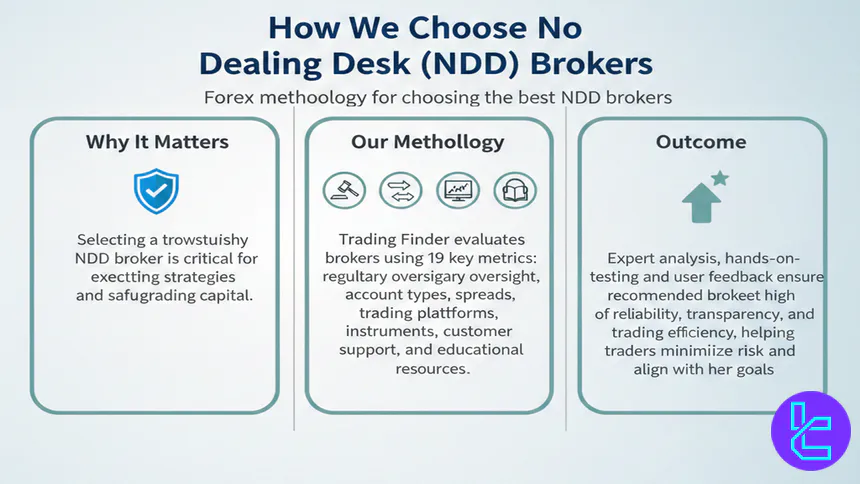
By combining expert knowledge with hands-on testing and user feedback, Trading Finder ensures that every broker we recommend meets high standards of reliability, transparency, and trading efficiency.
This methodology empowers traders to make informed choices, minimize risk, and access the tools and services that best align with their individual goals and trading styles.
What is No Dealing Desk (NDD)?
No Dealing Desk brokers route client orders directly to the market without a broker acting as counterparty. This means trades go straight to liquidity providers like banks, hedge funds, or other institutions with no internal price manipulation.
NDD execution typically uses ECN (Electronic Communication Network) or STP (Straight Through Processing) systems to match or route orders automatically. Traders benefit from transparent pricing and a reduced conflict of interest versus dealing desk brokers.
Key Features:
- Direct order routing to liquidity providers
- No broker taking the opposite trade
- Raw or variable spreads
- Execution via ECN or STP models
- Greater pricing transparency
The Pros and Cons of No Dealing Desk (NDD) Brokers
NDD brokers offer transparent execution and potentially tighter spreads, often benefiting scalpers and high-volume traders. They do not manipulate prices or trade against clients, reducing conflict of interest.
However, variable spreads can widen during news events, and many NDD brokers charge commission fees, which may increase trading costs compared with simpler fixed-spread models. Here is an overview of the pros and cons:
Advantages | Disadvantages |
No dealing desk interference | Spreads can vary with volatility |
Potential for tight market-based pricing | Commission fees per trade |
Access to deeper liquidity pools | More complex pricing for beginners |
Faster execution speeds | Possible slippage issues |
How Do NDD Brokers Operate?
No Dealing Desk (NDD) brokers operate differently from traditional dealing desk brokers by connecting traders directly to a network of external liquidity providers instead of executing trades internally.
These liquidity providers can include major banks, hedge funds, and other financial institutions that supply real-time market prices. By bypassing a dealing desk, NDD brokers eliminate conflicts of interest where a broker might otherwise trade against the client’s position.
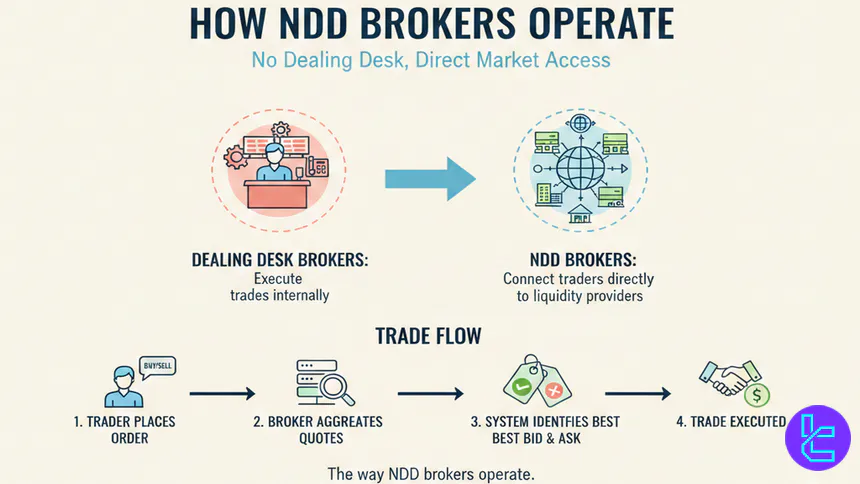
There are two primary execution models used by NDD brokers: Straight Through Processing (STP) and Electronic Communication Network (ECN). STP systems automatically route client orders to selected liquidity providers, ensuring trades are executed at the best available market prices.
ECN systems, on the other hand, electronically match buy and sell orders from multiple participants in the network, creating a transparent and competitive marketplace for pricing.
When a trader places an order with an NDD broker, the broker’s advanced technology aggregates price quotes from several liquidity providers. The system then identifies the best available bid and ask prices, allowing the trade to be executed quickly and accurately.
Operational Workflow:
- The trader submits a buy or sell order through their trading platform;
- The broker routes the order to the STP or ECN network for processing;
- Liquidity providers respond with available prices for the requested instrument;
- The broker’s system selects the best price from the available options and executes the trade;
- The execution confirmation is sent back to the trader, often within milliseconds, ensuring transparency and efficiency.
What Are the Usual Spreads in NDD Brokers?
In No Dealing Desk (NDD) trading environments, spreads are variable and derived directly from the interbank market. This means the difference between the bid and ask prices reflects real-time supply and demand rather than being set or adjusted by the broker.
Unlike fixed spreads offered by some dealing desk brokers, variable spreads in NDD setups provide a more transparent view of true market conditions, giving traders a realistic understanding of pricing at any given moment.
During periods of high liquidity, such as major market sessions when trading activity peaks, spreads can narrow considerably, sometimes reaching near 0.0 pips on major currency pairs. This allows traders to enter and exit trading positions at minimal cost, which is particularly advantageous for scalpers and high-frequency trading strategies.
However, spreads in NDD environments are dynamic, and they can widen during times of market volatility, low liquidity, or unexpected economic events. Traders must therefore be aware that while spreads can be extremely tight under optimal conditions, they are not guaranteed to remain constant.
Spread Characteristics:
- Variable, not fixed
- May tighten during peak market hours
- Can widen in volatile conditions
- Tighter than many dealing desk models
How Much NDD Brokers Charge as Non-Trading Fees?
Non-trading fees in No Dealing Desk (NDD) brokerage accounts can vary widely depending on the broker and the type of account selected. While NDD brokers are known for offering tight spreads and transparent pricing, traders should still be aware of additional costs that can impact overall profitability.
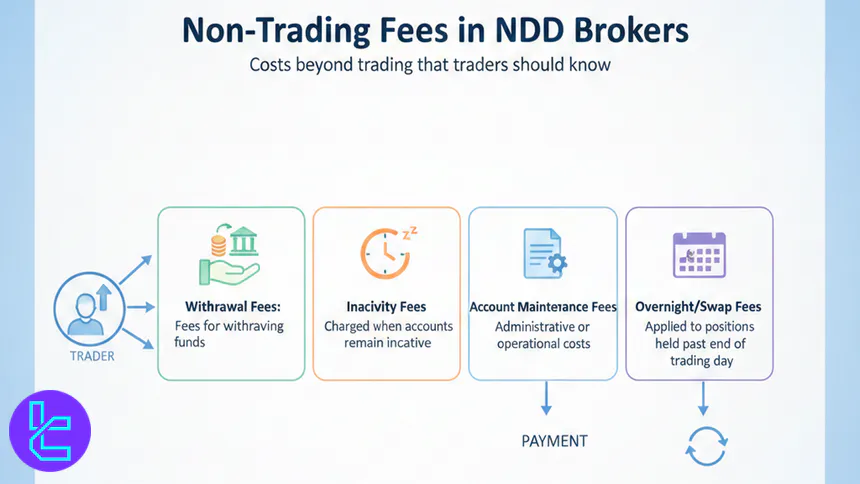
Common non-trading fees include withdrawal charges, inactivity fees for dormant accounts, and general account maintenance costs. These fees are separate from trading costs and are typically designed to cover administrative or operational expenses.
Other fees to consider include overnight or swap fees, which apply to positions held past the end of the trading day, particularly in leveraged accounts. Inactivity fees are charged when an account remains dormant for a certain period, incentivizing regular trading or account closure.
Funding and withdrawal charges may apply depending on the deposit method, such as wire transfers, credit cards, or e-wallets, and can vary from broker to broker.
Typical Fees:
- Commission per lot (ECN)
- Swap/overnight fees
- Inactivity and service fees
- Funding/withdrawal charges
Who Should Take Advantage of an NDD Forex Broker?
No Dealing Desk (NDD) forex brokers are particularly well-suited for traders who prioritize speed, transparency, and direct access to market liquidity. These brokers eliminate the conflict of interest that can occur when a broker acts as a counterparty, allowing client orders to flow directly to external liquidity providers.
This makes NDD accounts ideal for active traders, scalpers, and algorithmic trading systems that rely on fast execution and minimal interference.
Traders who require precise pricing and low-latency execution, especially during volatile market events such as economic releases or geopolitical news, benefit significantly from NDD brokers.
The direct market access provided by NDD platforms ensures that orders are executed at competitive, market-driven prices, reducing the risk of slippage and requotes that can occur with dealing desk brokers. Scalpers, in particular, gain an advantage because tight spreads and rapid execution are critical for implementing high-frequency strategies successfully.
Institutional and professional traders also find NDD brokers advantageous due to access to deep liquidity pools, which allows them to place large orders without causing significant market impact.
Best Suited For:
- Scalpers and day traders
- High-frequency traders
- Institutional and professional traders
- Those needing deep liquidity
Why the NDD Forex Brokers Need Regulation?
Regulation is a cornerstone of trust and safety in the forex industry, particularly for No Dealing Desk (NDD) brokers who provide direct access to liquidity markets. By operating under the oversight of reputable financial authorities, regulated NDD brokers are required to follow strict rules that ensure transparency, proper handling of client funds, and fair trade execution.
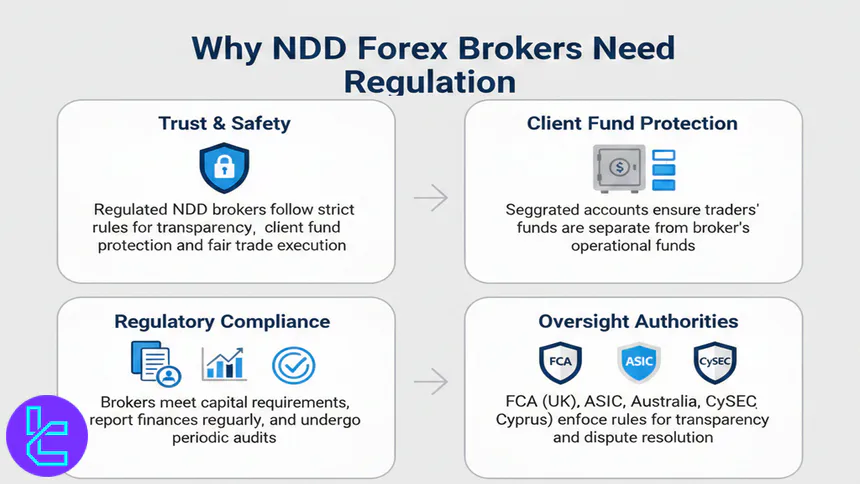
Regulated brokers must maintain segregated accounts for client funds, ensuring that traders’ capital is kept separate from the company’s operational funds. This segregation minimizes the risk of losing client money in the event of a broker’s insolvency.
Additionally, these brokers are obligated to meet minimum capital requirements, adhere to regular financial reporting standards, and undergo periodic audits, all of which reinforce the broker’s reliability and operational stability.
For traders, choosing a regulated NDD broker provides peace of mind and additional layers of protection. Strong oversight from authorities such as the UK’s Financial Conduct Authority (FCA), the Australian Securities and Investments Commission (ASIC), or the Cyprus Securities and Exchange Commission (CySEC) ensures that brokers follow strict guidelines for transparency, reporting, and dispute resolution.
Regulatory Benefits:
- Client fund safety
- Fair trade execution standards
- Transparency in pricing and fees
- Dispute resolution frameworks
Availability of Swap-Free Accounts in NDD Brokers
Some NDD brokers offer swap-free (Islamic) accounts that eliminate overnight interest charges for eligible traders. This can be important for those adhering to specific financial rules or strategies.
Swap-free options may be available on certain account types and sometimes include higher spreads or altered fee structures to compensate for the removed swaps.
Swap-Free Features:
- No interest on overnight positions
- Often available on ECN or STP accounts
- May include adjusted cost structure
- Suitable for long-term traders
Considerations When Choosing an NDD Broker
When selecting an NDD broker, review execution speed, regulation, fee transparency, platform quality, and customer service. Tight spreads alone are not enough; reliable infrastructure and fair pricing matter.
Also consider account types offered, minimum deposits, and educational resources, which can improve your trading experience and flexibility.
Key Considerations:
- Regulatory status and capital adequacy
- Real spreads vs commission cost
- Trading tools and platform quality
- Support and educational resources
NDD Brokers vs. Dealing Desk Brokers vs. STP Brokers
NDD Brokers bypass a dealing desk, routing orders via ECN or STP, enhancing transparency and reducing conflicts of interest.
Dealing Desk Brokers act as the counterparty and may set fixed spreads but can manipulate prices and requote during volatility. STP Brokers are technically NDD but differ from pure ECN in routing and fee structure.
Here is a detailed comparison:
Parameter | NDD Brokers | Dealing Desk (Market Maker) | STP Brokers |
Order Routing | Orders routed directly to liquidity providers (banks, ECNs) without internal dealing desk | Orders executed internally; broker may act as counterparty | Orders automatically routed to external liquidity providers |
Spread Type | Variable spreads; often raw spreads from liquidity pool | Fixed or variable spreads set by broker | Variable spreads aggregated from liquidity providers |
Commission | Usually charged (especially ECN accounts) | Often no commission; revenue from spread | Often no separate commission; markup included in spread |
Conflict of Interest | Low; broker does not trade against client | Higher; broker may profit from client losses | Low; broker passes trades externally |
Transparency | High; market-based pricing | Lower; prices may be broker-controlled | Moderate to high |
Execution Speed | Fast; direct access to liquidity | Fast; internal execution | Fast; automated routing |
Market Access | Deep liquidity from multiple providers | Limited to broker’s internal pricing | Access through selected liquidity providers |
Conclusion
Choosing the right Non-Dealing Desk (NDD) broker can make a significant difference in your trading experience, from execution speed and pricing transparency to access to liquidity and trading tools. In this guide, we reviewed the top 8 NDD brokers, evaluating them on key factors such as Trustpilot ratings, spreads, leverage, account types, trading instruments, and regulatory oversight.
Brokers like Exness, with over $4 trillion in monthly trading volume, and IC Markets, with more than 51,000 Trustpilot reviews averaging 4.8/5, demonstrate the reliability and scale that active traders value. Meanwhile, brokers like FP Markets offer an impressive 10,000+ instruments, providing exceptional flexibility for portfolio diversification.
For a deeper dive into how we evaluate brokers, explore our detailed Forex methodology article.