






Oil is a highly traded commodity from a global standpoint, available in various forms, such as CFDs in Forex brokers. Many regulated and unregulated brokerages offer this investment vehicle to their clients, but different parameters should be considered for choosing one.
The list below mentions 8 of the best Forex brokers for those interested in oil trading.
 | AVATRADE | |||
 | IC Markets | |||
 | IronFX | |||
| 4 |  | BlackBull | ||
| 5 |  | eToro | ||
| 6 |  | FxGLORY | ||
| 7 |  | FXGT | ||
| 8 |  | MONETA MARKETS |
Trustpilot Ratings for Oil Trading Brokers
Traders submit their reviews and opinions on brokerages on “Trustpilot”, a reputable source. The shortlist in this section ranks mentioned names based on these ratings.
Broker Name | Trustpilot Rating | Number of Reviews |
11,928 | ||
51,564 | ||
BlackBull Markets | 3,129 | |
FXGT | 1,497 | |
Moneta Markets | 473 | |
eToro | 30,658 | |
FXGlory | 65 | |
IronFX | 697 |
Trading Spreads in Oil Trading Brokerages
The table in this section ranks abovementioned brands based on the lowest spread examined in them.
Broker Name | Min. Spread |
FXTM | 0 Pips |
0 Pips | |
FXGT | 0 Pips |
Moneta Markets | 0 Pips |
FOREX.com | 0 Pips |
FXGlory | 0 Pips |
0 Pips | |
IG | 0.3 Pips |
Non-Trading Fees Charged by Mentioned Brokers
Forex brokers charge clients for making deposits and withdrawals. Also, dormant accounts might incur fees over time. The table below ranks mentioned brokerages based on these parameters.
Broker Name | Deposit Fee | Withdrawal Fee | Inactivity Fee |
IronFX | $0 | $0 | $0 |
Moneta Markets | $0 | $0 | $0 |
$0 | 9% for PayPal, Varies for Other Methods | $0 | |
FXGT | $0 | $0 | $10 Monthly |
FXTM | $0 | $0 for E-Wallets | $10 Monthly |
$0 | $5 | $10 Monthly | |
XTB | $0 for Credit/Debit Cards | $0 for Credit/Debit Cards | $10 Monthly |
IG | $0 for Debit Cards and Bank Transfers | $0 | $18 Monthly |
Trading Platforms Offered by Oil Trading Brokers
Last table in this part of the article demonstrates the trading platforms offered by select brokers.
Broker Name | Trading Platforms |
MT4, MT5, Pro Trader, App Trader | |
FXTM | MT4, MT5, FXTM Trader App |
XTB | xStation 5, MT4, Mobile app |
IronFX | MT4 |
FXGlory | Metatrader 4, Metatrader 5 |
MT4, MT5 | |
eToro | Proprietary App |
Plus500 | Own platform |
Top 6 Forex Brokers for Oil Trading in Detail
In the next sections, six of the best brokers from those mentioned above will be briefly reviewed considering important factors and parameters in trading.
AvaTrade
Founded in 2006, AvaTrade is a globally regulated broker operating under nine financial authorities, including the Central Bank of Ireland, Australian Securities and Investments Commission (ASIC), Cyprus Securities and Exchange Commission (CySEC), and Financial Sector Conduct Authority (FSCA).
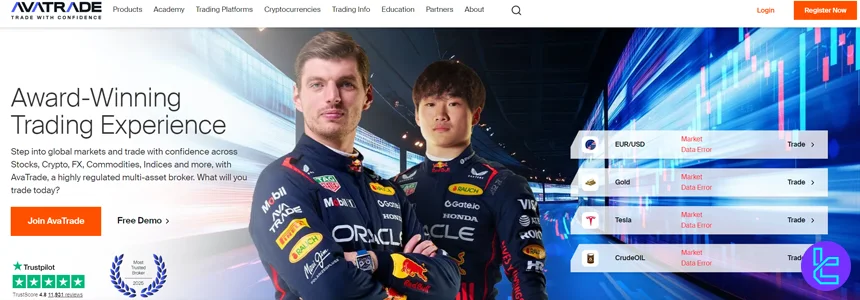
Its broad regulatory footprint enhances credibility for oil CFD traders across Europe, the Middle East, Africa, and Asia-Pacific.
For oil trading, AvaTrade provides CFDs on major energy benchmarks such as WTI and Brent, alongside 1,250+ instruments across Forex, metals, indices, stocks, and crypto. Maximum leverage reaches 1:400 under select jurisdictions, while margin call and stop-out levels are set at 25% and 10%, respectively.
It’s worth noting that you can participate in AvaTrade rebate program for discount on trading fees and spreads.
The broker supports MetaTrader 4, MetaTrader 5, WebTrader, AvaOptions, and a mobile app, ensuring flexible access to oil price movements. Instant execution, negative balance protection, and segregated client funds align its structure with MiFID II standards in the European Union.
AvaTrade requires a $100 minimum deposit and supports six funding methods, including credit/debit cards, wire transfer, Skrill, Neteller, WebMoney, and PayPal (availability may vary by region). Deposits and withdrawals are commission-free from the broker’s side, while inactivity fees apply after prolonged dormancy.
Table of Specifics
Account Types | Retail, Professional, Islamic, Demo |
Regulating Authorities | ASIC, CySEC, CBI, FSA, FSCA, MiFID, ADGM, PFSA, ISA |
Minimum Deposit | $100 |
Deposit Methods | Credit/Debit Cards, E-Wallets, Bank Wire Transfer, PayPal |
Withdrawal Methods | Credit/Debit Cards, E-Wallets, Bank Wire Transfer, PayPal |
Maximum Leverage | 1:400 |
Trading Platforms & Apps | MetaTrader 4, MetaTrader 5, Mobile App, WebTrader |
AvaTrade Pros and Cons
AvaTrade’s strengths and limitations reflect its institutional regulation, platform diversity, and fixed-spread model. Below is a balanced overview of its key advantages and drawbacks for oil traders; check them out before AvaTrade registration.
Pros | Cons |
Regulated by 9 authorities across multiple jurisdictions | Not available to U.S. traders |
Commission-free trading with fixed spreads | Inactivity fee after 2 months without trading |
Supports MT4, MT5, WebTrader, and AvaOptions | No PAMM account offering |
Negative balance protection and segregated funds | 24/5 support instead of 24/7 |
IC Markets
IC Markets is a multi-asset broker established in 2007, offering access to Forex, oil CFDs, commodities, indices, bonds, crypto, and over 2,100 stock CFDs. With 10 base currencies (USD, EUR, GBP, AUD, SGD, NZD, JPY, CHF, HKD, CAD) and a $200 minimum deposit, it serves global oil traders efficiently.
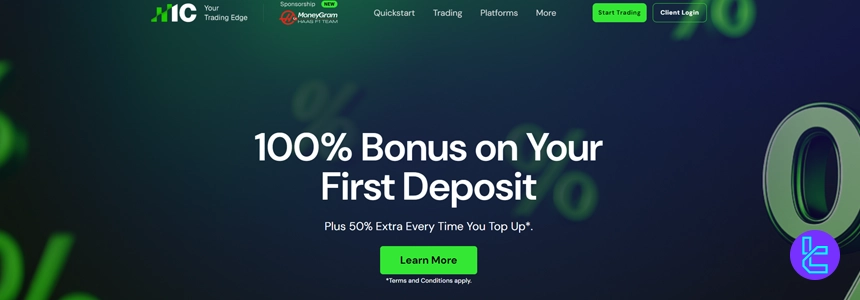
Regulated by Australian Securities and Investments Commission (ASIC), Cyprus Securities and Exchange Commission (CySEC), and the Financial Services Authority (FSA Seychelles), IC Markets segregates client funds and undergoes external audits. EU clients benefit from Investor Compensation Fund coverage up to €20,000 under CySEC regulation.
Oil traders can access tight spreads from 0.0 pips on Raw Spread accounts, with average EUR/USD spreads around 0.1 pips. You can trade with lower trading fees and spreads by participating in the IC Markets rebate program.
Maximum leverage reaches 1:500 under offshore entities, while EU/Australian clients are capped at 1:30. Execution is market-based, supporting scalping and algorithmic strategies.
Platforms include MetaTrader 4, MetaTrader 5, cTrader, and mobile apps. Commissions average $3–$3.50 per lot on raw accounts, while Standard accounts feature spreads from 0.8 pips without additional trading fees. There are no inactivity, deposit, or withdrawal fees, enhancing cost efficiency for active oil CFD traders.
Specifications and Parameters
Account Types | Standard, Raw Spread, Islamic |
Regulating Authorities | FSA, CySEC, ASIC |
Minimum Deposit | $200 |
Deposit Methods | Bank Cards, Wire Transfers, Electronic payments, etc. |
Withdrawal Methods | Bank Cards, Wire Transfers, Electronic payments, etc. |
Maximum Leverage | 1:500 |
Trading Platforms & Apps | Metatrader 4, Metatrader 5, cTrader, cTrader Web, IC Markets Mobile |
IC Markets Pros and Cons
Despite leverage restrictions in Europe and a $200 minimum deposit, IC Markets remains highly competitive for oil CFD traders seeking deep liquidity, scalable execution, and institutional-style pricing. Below is a structured overview of its main strengths and limitations.
Pros | Cons |
Spreads from 0.0 pips on Raw accounts | Leverage limited to 1:30 under ASIC/CySEC |
Strong multi-jurisdiction regulation (ASIC, CySEC, FSA) | $200 minimum deposit may deter small beginners |
Supports MT4, MT5, cTrader, and mobile trading | No PAMM account offering |
No inactivity, deposit, or withdrawal fees | Bonuses currently unavailable |
BlackBull Markets
Founded in 2014 in Auckland, Black Bull Group Limited operates as a multi-award-winning broker with 7+ industry recognitions. Regulated by the Financial Markets Authority (Tier-1) and Financial Services Authority, it offers global access to 26,000+ instruments across six asset classes, including energy CFDs such as crude oil.
BlackBull Markets provides ECN Standard, ECN Prime, and ECN Institutional accounts with spreads from 0.0 pips and leverage up to 1:500. Oil traders benefit from market execution, Equinix NY4/LD5 server connectivity, and deep liquidity designed for scalping, hedging, and intraday commodity strategies.
The broker supports MT4, MT5, cTrader, and TradingView, alongside proprietary platforms like BlackBull CopyTrader and BlackBull Invest. With a minimum deposit of $0, nine base currencies, and order sizes from 0.01 lots, the structure accommodates both retail and institutional oil traders.
Client protection includes segregated accounts, negative balance protection, and FSCL dispute resolution (NZ branch). BlackBull maintains 24/7 multilingual support and partnerships with Tier-1 banking institutions, reinforcing operational reliability for high-volume oil CFD trading.
Specifications and Details
Account Types | ECN Standard, ECN Prime, ECN Institutional |
Regulating Authorities | FSA, FMA |
Minimum Deposit | $0 |
Deposit Methods | Visa, MasterCard, Apple Pay, Google Pay, Bank Wire, Crypto, Neteller, Skrill, SEPA, FasaPay |
Withdrawal Methods | Visa, MasterCard, Apple Pay, Google Pay, Bank Wire, Crypto, Neteller, Skrill, SEPA, FasaPay |
Maximum Leverage | 1:500 |
Trading Platforms & Apps | MT4, MT5, TradingView, cTrader, BlackBull CopyTrader, BlackBull Invest |
BlackBull Markets Pros & Cons
When evaluating the broker for oil trading, understanding its advantages and structural limitations is essential, especially before BlackBull Markets registration. The following pros and cons summarize execution quality, cost efficiency, regulatory standing, and accessibility factors.
Pros | Cons |
Spreads from 0.0 pips with ECN execution | Institutional account requires $20,000 minimum deposit |
Access to 26,000+ instruments including oil CFDs | Tier-3 Seychelles regulation for international clients |
Integration with MT4, MT5, cTrader, and TradingView | $5 withdrawal processing fee |
No minimum deposit on Standard and Prime accounts | Services not available in the US and certain regions |
FXGT
Since its launch in 2019, FXGT has positioned itself as a multi-asset broker offering Forex, energies, indices, stocks, and crypto CFDs. With leverage up to 1:5000 and a minimum deposit starting from $5, it provides flexible access for oil and commodity traders.
FXGT operates under multiple regulators, including Cyprus Securities and Exchange Commission (institutional clients), Financial Sector Conduct Authority, Financial Services Authority Seychelles, and Vanuatu Financial Services Commission. Client funds are segregated, and negative balance protection applies across entities.
The broker supports both MetaTrader 4 and MetaTrader 5, enabling algorithmic trading, copy trading, and advanced charting. Oil traders can access CFDs on crude oil with market execution, variable spreads from 0 points on ECN Zero, and commissions starting at $3 per side. An FXGT rebate program is available for discount on trading fees.
Five account types, including Mini, Standard+, Pro, ECN Zero, and Optimus, accommodate different strategies. The Optimus account offers leverage up to 1:5000, while ECN Zero provides raw spreads with transparent commission. Margin call and stop-out levels are set at 50% and 20%, respectively.
Broker Specifications
Account Types | Standard+, ECN Zero, Mini Optimus, Pro |
Regulating Authorities | VFSC, CySEC, FSA, FSCA |
Minimum Deposit | $5 |
Deposit Methods | VISA, Mastercard, Bitwallet, Sticpay, Instant Local Bank Transfers / QR, Neteller, Apple Pay, Google Pay |
Withdrawal Methods | VISA, Mastercard, Bitwallet, Sticpay, Neteller, Apply Pay, Google Pay |
Maximum Leverage | 1:5000 |
Trading Platforms & Apps | MT4, MT5 |
FXGT Pros and Cons
FXGT combines high leverage, low entry capital, and ECN-style pricing with multi-jurisdiction regulation. Below, its key advantages and drawbacks are summarized to help oil traders evaluate overall suitability.
Pros | Cons |
Very low minimum deposit ($5) | Limited number of tradable symbols (~185) |
Leverage up to 1:5000 (offshore entities) | No bonds or ETFs available |
Raw spreads from 0 points (ECN Zero) | Educational resources mainly blog-based |
Multiple regulatory licenses & segregated funds | Restricted in the US, Canada, and EU retail markets |
Moneta Markets
Founded in 2020 and headquartered in Johannesburg, Moneta Markets operates under the supervision of the Financial Sector Conduct Authority (FSCA No. 47490) and is registered in Saint Lucia (No. 2023-00068). The broker previously operated under Vantage International Group Limited before becoming an independent entity.
Moneta Markets provides access to 1,000+ tradable instruments across Forex, commodities, indices, shares, bonds, ETFs, and crypto CFDs. Oil traders can access energy CFDs, including spot and selected futures contracts, with floating spreads from 0.0 pips and execution via STP and ECN models.
The broker offers three account types, including Direct (STP), Prime (ECN), and Ultra (ECN), with a minimum deposit of $50 and leverage up to 1:1000. Raw ECN pricing starts from 0.0 pips, with commissions from $1 per lot per side, while the Direct account remains commission-free.
Trading is supported on MT4, MT5, Pro Trader (TradingView-integrated), and App Trader. Additional features include copy trading, PAMM accounts, swap-free Islamic accounts, and demo access. Margin call and stop-out levels are set at 80% and 50%, respectively.
You may learn about the broker’s funding methods in the Moneta Markets deposit and withdrawal methods article. The table below summarizes the broker’s specifics.
Account Types | Direct, Prime, Ultra |
Regulating Authorities | FSCA, FSRA |
Minimum Deposit | $50 |
Deposit Methods | Wire transfer, Visa/MasterCard, Fasapay, Stickpay, JCB |
Withdrawal Methods | Wire transfer, Visa/MasterCard, Fasapay, Stickpay, JCB |
Maximum Leverage | 1:1000 |
Trading Platforms & Apps | MT4, MT5, Pro Trader, App Trader |
Moneta Markets Pros and Cons
Moneta Markets combines low entry capital requirements with multi-platform access and flexible execution models. However, regulatory coverage remains primarily Tier-2, and geographic restrictions apply in several jurisdictions.
Below is a structured overview of its core advantages and limitations for oil traders, recommended before Moneta Markets registration.
Pros | Cons |
1,000+ tradable instruments including oil CFDs | Tier-2 primary regulation (FSCA) |
Raw ECN spreads from 0.0 pips | Not available to US traders |
Low minimum deposit ($50) | Ultra account requires $20,000 deposit |
Multiple platforms including TradingView-integrated Pro Trader | Limited Tier-1 regulatory footprint |
eToro
Founded in 2007 in Tel Aviv by David Ring, Ronen Assia, and Yoni Assia, eToro Ltd has evolved into a multi-asset brokerage serving millions globally. For oil trading, eToro offers commodity CFDs alongside 6,000+ assets, integrating social investing with regulated cross-border operations.
eToro operates through regulated entities including the FCA (UK), CySEC (EU), ASIC (Australia), and ADGM FSRA (UAE). Retail leverage is capped at 1:30 under Tier-1 regulators, while professional clients may access up to 1:400, depending on jurisdiction and eligibility.
The broker supports four account types, including Personal, Professional, Corporate, and Islamic, with a minimum deposit starting from $10. Oil traders can access commodities via the proprietary web and mobile platform, which includes stop loss, take profit, ProCharts, and one-click execution tools.
eToro distinguishes itself through CopyTrader, Smart Portfolios, and Crypto Staking. Oil-focused investors can replicate experienced commodity traders with a $1 minimum copy allocation. However, it does not support MT4 or MT5, and customer service is limited to live chat, ticket, and email channels.
Parameters and Specifics
Account Types | Personal, Professional, Corporate, Islamic |
Regulating Authorities | FCA, CySEC, MFSA, FSRA, ASIC, FSA, Gibraltar FSC |
Minimum Deposit | $10 |
Deposit Methods | eToro Money, Credit/Debit Card, Bank Transfer, PayPal, Neteller, Skrill, Online Banking (Trustly), iDEAL, Sofort, Przelewy24 |
Withdrawal Methods | eToro Money, Credit/Debit Card, Bank Transfer, PayPal, Neteller, Skrill, Online Banking (Trustly), iDEAL, Sofort, Przelewy24 |
Maximum Leverage | 1:400 |
Trading Platforms & Apps | Proprietary App |
eToro Pros and Cons
Before going through with eToro registration, evaluating its strengths and structural limitations is essential, particularly regarding platform ecosystem, fee model, and execution transparency.
Pros | Cons |
Regulated by FCA, ASIC, CySEC, FSRA, and more | No MT4 or MT5 support |
Innovative CopyTrader and Smart Portfolios | No direct phone support |
Access to 6,000+ assets including oil CFDs | CFD spreads can be relatively wide |
Low $10 minimum deposit | $5 fixed withdrawal fee (USD accounts) |
How Did We Choose Forex Brokers for Oil Trading?
Selecting the Best Oil Trading Forex Brokers requires more than reviewing spreads on WTI or Brent. At TradingFinder, our evaluation is built on a 19-metric framework designed to assess transparency, execution quality, regulatory strength, and overall trader experience. Every broker is analyzed using structured, data-driven criteria.
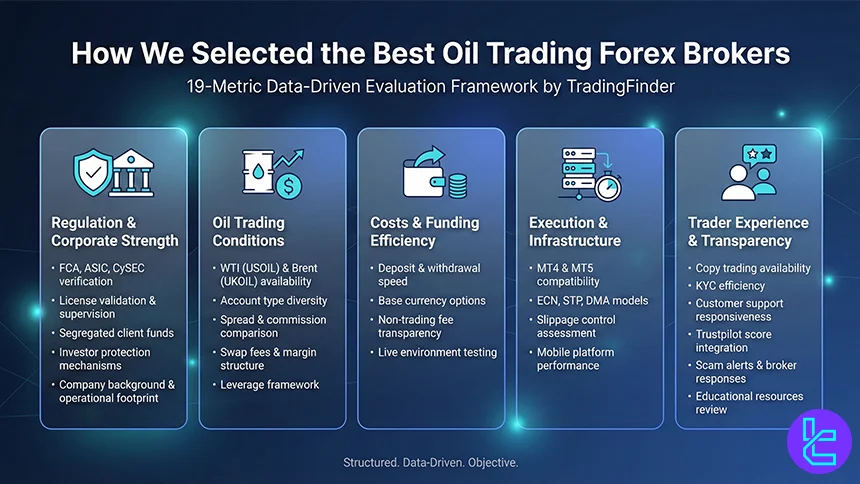
We begin with Regulations and Licenses, verifying supervision by authorities such as the FCA, ASIC, CySEC, or other recognized regulators.
We also examine corporate background, including year of establishment, headquarters location, and operational footprint. Strong compliance, segregated funds, and investor protection mechanisms are fundamental for oil CFD traders.
Next, we assess Account Types Variety, trading conditions, and the breadth of tradable symbols, with particular attention to energy CFDs like WTI (USOIL) and Brent (UKOIL).
We compare spreads, commissions, overnight swap fees, margin requirements, and leverage structures. Deposit and withdrawal efficiency, base currencies, and non-trading fees are carefully tested using live environments.
Execution infrastructure is another key factor. We evaluate support for MetaTrader 4 (MT4), MetaTrader 5 (MT5), and other platforms, order execution models (ECN, STP, DMA), slippage control, and mobile app performance.
Additionally, we review copy trading availability, account opening procedures, KYC efficiency, and customer support responsiveness across live chat, email, and social media.
To ensure objectivity, we incorporate Trustpilot scores, scam alerts, broker responses, educational resources, and infographic-based data transparency.
What Symbols are Oil Traded In?
Oil is traded in global financial markets through standardized benchmark contracts and CFD instruments. The two dominant benchmarks are West Texas Intermediate (WTI) and Brent Crude, which serve as global pricing references for physical and derivative oil markets.
These benchmarks are quoted in U.S. dollars per barrel and reflect supply-demand dynamics across different regions.
- WTI Crude Oil (USOIL, WTI, CL): Traded primarily on the New York Mercantile Exchange (NYMEX), WTI represents light sweet crude delivered in Cushing, Oklahoma. In forex and CFD platforms, it is commonly listed under symbols such as USOIL or WTI;
- Brent Crude Oil (UKOIL, BRENT, BRN): Traded on the Intercontinental Exchange (ICE), Brent is the leading benchmark for Europe, the Middle East, and Africa. Retail brokers typically display it as UKOIL or BRENT.
In addition to these benchmarks, some brokers provide exposure through oil futures contracts, energy-sector CFDs, and exchange-traded funds such as the United States Oil Fund (USO).
However, within the forex and CFD industry, USOIL (WTI) and UKOIL (Brent) remain the primary symbols used by traders analyzing volatility, spreads, and leverage conditions in oil trading environments.
What are the Pros and Cons of Oil Trading in Forex?
Oil trading in the forex and CFD market offers leveraged exposure to major energy benchmarks like WTI and Brent without owning physical barrels. It provides high liquidity and nearly 24-hour access during market sessions.
However, oil prices are highly sensitive to geopolitical events, OPEC decisions, inventory data, and macroeconomic conditions, which can amplify volatility and trading risk.
Pros | Cons |
High liquidity in major benchmarks like WTI (NYMEX) and Brent (ICE) | High volatility driven by geopolitical tensions and supply shocks |
Ability to use leverage, increasing capital efficiency | Leverage magnifies losses as well as gains |
Opportunity to trade both long and short via CFDs | Overnight swap fees can increase holding costs |
Access to global macro-driven price movements (OPEC, EIA reports, USD strength) | Exposure to sudden price gaps during major news or weekend events |
Oil Trading in the United States: Status and Conditions
The United States is one of the largest oil producers and consumers globally, making it a central hub for crude oil pricing and derivatives trading. The primary benchmark, West Texas Intermediate (WTI), is traded through futures contracts listed on the New York Mercantile Exchange (NYMEX), a subsidiary of the CME Group.
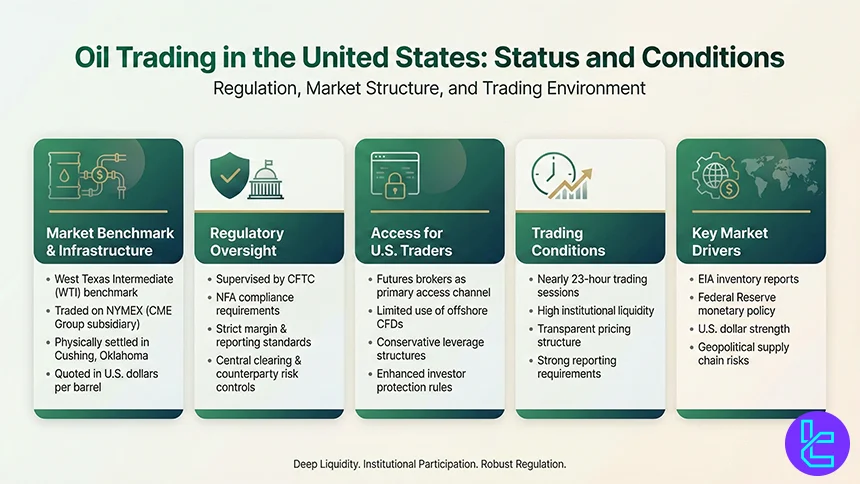
WTI contracts are physically settled in Cushing, Oklahoma, and quoted in U.S. dollars per barrel.
Oil trading in the U.S. futures market is regulated by the Commodity Futures Trading Commission (CFTC), which oversees market transparency, reporting standards, and anti-manipulation enforcement.
Exchanges must comply with strict margin, reporting, and clearing requirements, ensuring high levels of regulatory oversight and counterparty risk management. Retail traders in the United States face different conditions compared to international forex clients.
Due to regulatory restrictions under the CFTC and the National Futures Association (NFA), U.S.-based traders typically access oil through regulated futures brokers rather than offshore CFD providers. Leverage is more conservative compared to many international CFD brokers, reflecting stricter investor protection rules.
Trading hours for WTI futures are nearly 23 hours per day during the business week, allowing participation across global time zones. Market conditions are heavily influenced by U.S.
Energy Information Administration (EIA) inventory reports, Federal Reserve monetary policy, USD strength, and geopolitical developments affecting supply chains. Overall, the U.S. oil trading environment combines deep liquidity, institutional participation, and robust regulatory supervision.
Is Oil Traded Against Currencies in Pairs?
Oil is not traditionally traded as a currency pair in the same structure as EUR/USD or GBP/JPY. Instead, crude oil is priced globally in U.S. dollars per barrel, meaning its quotation already reflects a relationship with the USD.
Benchmarks such as WTI and Brent are dollar-denominated commodities traded on exchanges like the New York Mercantile Exchange and the Intercontinental Exchange.
In the forex and CFD market, oil is typically listed under standalone symbols such as USOIL (WTI) or UKOIL (Brent) rather than in a base/quote currency format. The price movement reflects supply-demand dynamics, geopolitical risks, OPEC production policies, and macroeconomic indicators rather than direct currency cross-flows.
However, oil has a well-documented inverse correlation with certain currencies, particularly the U.S. dollar. Since oil is priced in USD, a stronger dollar often puts downward pressure on oil prices, and vice versa.
Additionally, currencies of oil-exporting nations, such as the Canadian dollar (CAD) and Norwegian krone (NOK), tend to show positive correlation with crude oil prices.
While oil is not traded as a classic forex pair, its strong macroeconomic linkage to currencies makes it an important cross-asset instrument for traders analyzing commodity–FX relationships in global financial markets.
What Parameters Affect the Price of Oil?
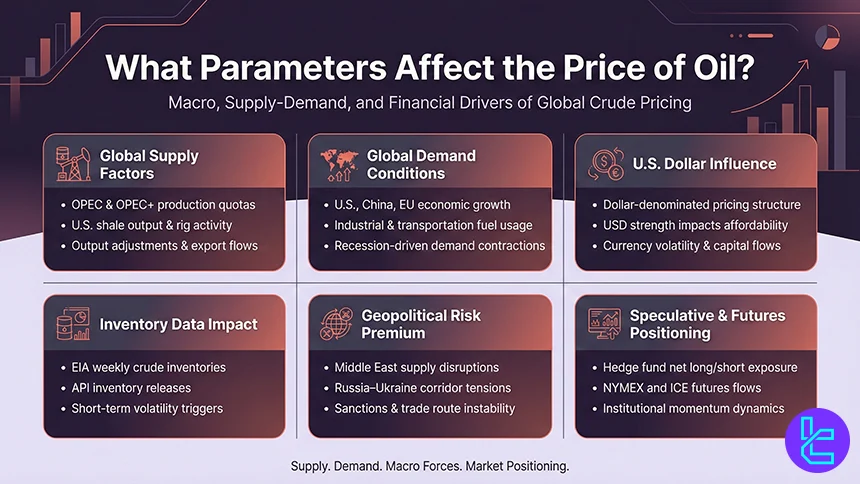
Oil prices are determined by a combination of supply-demand fundamentals, macroeconomic conditions, geopolitical risks, and financial market dynamics. As globally traded benchmarks like WTI and Brent are priced in U.S. dollars per barrel, multiple structural and cyclical factors influence short-term volatility and long-term trends.
- Global Supply Levels: Production decisions by Organization of the Petroleum Exporting Countries (OPEC) and OPEC+ significantly affect output quotas. U.S. shale production and rig activity also influence global supply expectations;
- Global Demand Conditions: Economic growth in major consumers such as the United States, China, and the European Union impacts industrial and transportation fuel demand. Recession fears typically reduce demand forecasts and pressure prices;
- S. Dollar Strength: Since oil is dollar-denominated, movements in the USD affect affordability for non-U.S. buyers. A stronger dollar often weighs on oil prices;
- Inventory Reports: Weekly crude inventory data published by the U.S. Energy Information Administration (EIA) and the American Petroleum Institute (API) can trigger sharp short-term price swings;
- Geopolitical Tensions: Conflicts in key producing regions (Middle East, Russia-Ukraine corridor) can disrupt supply chains and increase risk premiums;
- Speculative Activity and Futures Positioning: Hedge funds and institutional traders in futures markets, particularly on the New York Mercantile Exchange (NYMEX) and Intercontinental Exchange (ICE), influence price momentum through positioning flows.
Together, these parameters create a highly dynamic pricing environment, making oil one of the most macro-sensitive commodities in global financial markets.
What Leverage is Allowed by Brokers for Oil Trading?
Leverage for oil trading depends primarily on regulatory jurisdiction and broker classification (retail vs. professional client). Since oil is traded as a CFD or futures contract, leverage limits are typically set by financial regulators rather than the broker itself.
In highly regulated jurisdictions such as the United Kingdom and European Union, leverage is capped under rules from the Financial Conduct Authority (FCA) and European Securities and Markets Authority (ESMA). For retail clients, major commodities like crude oil are generally limited to 1:10 leverage, meaning traders must post at least 10% margin.
In Australia, the Australian Securities and Investments Commission (ASIC) also limits leverage for major commodities to 1:10 for retail traders. These caps are designed to reduce excessive risk exposure and protect inexperienced investors.
In offshore jurisdictions (e.g., Seychelles, Mauritius, or other international regulators), brokers may offer significantly higher leverage; sometimes 1:100 or more on oil CFDs. However, higher leverage increases both profit potential and downside risk.
In the United States, retail traders typically access oil via regulated futures markets under the supervision of the Commodity Futures Trading Commission (CFTC). Futures margin requirements are exchange-set and fluctuate based on market volatility, rather than being expressed as fixed leverage ratios.
Ultimately, allowable leverage for oil trading varies by regulatory framework, broker structure, and client classification, making jurisdiction a critical factor when selecting an oil trading forex broker.
What Strategies and Approaches are Useful for Oil Trading?
Oil trading requires a combination of macroeconomic awareness, technical precision, and volatility management. Because crude oil (WTI and Brent) is highly sensitive to geopolitical events, inventory data, and U.S. dollar movements, traders typically apply structured, data-driven strategies rather than purely speculative approaches.
- Trend Following Strategy: Oil often develops strong directional trends driven by supply constraints, OPEC production cuts, or macroeconomic cycles. Traders use moving averages, market structure analysis, and breakout confirmation to capture medium- to long-term trends;
- Inventory Report Trading: Weekly crude oil inventory data released by the U.S. Energy Information Administration (EIA) can trigger sharp volatility. Short-term traders position around inventory surprises versus market expectations;
- Breakout and Volatility Trading: Oil markets frequently react to geopolitical headlines and economic data. Breakouts from consolidation ranges, supported by rising volume or momentum indicators, are commonly used for intraday setups;
- Correlation-Based Trading: Oil shows macro correlations with the U.S. dollar and commodity-linked currencies such as CAD. Traders may combine oil analysis with USD index or USD/CAD technical structure for confirmation;
- Range Trading in Stable Conditions: During periods of balanced supply-demand dynamics, oil can trade within defined support and resistance zones, allowing structured range-bound strategies.
Successful oil trading typically integrates technical analysis, macroeconomic context, risk management discipline, and awareness of exchange trading hours, particularly for WTI futures listed on the New York Mercantile Exchange (NYMEX).
What is the Minimum Investment Amount for Oil?
The minimum investment required to trade oil depends on the instrument type (futures, CFDs, ETFs) and the broker’s contract specifications. There is no universal fixed amount, as capital requirements vary based on margin rules, lot size, and leverage conditions.
In the U.S. futures market, standard WTI crude oil futures (CL) are listed on the New York Mercantile Exchange (NYMEX), part of the CME Group.
A standard contract represents 1,000 barrels of oil. Initial margin requirements fluctuate depending on volatility but often range in the several-thousand-dollar level per contract, making futures trading capital-intensive for retail participants.
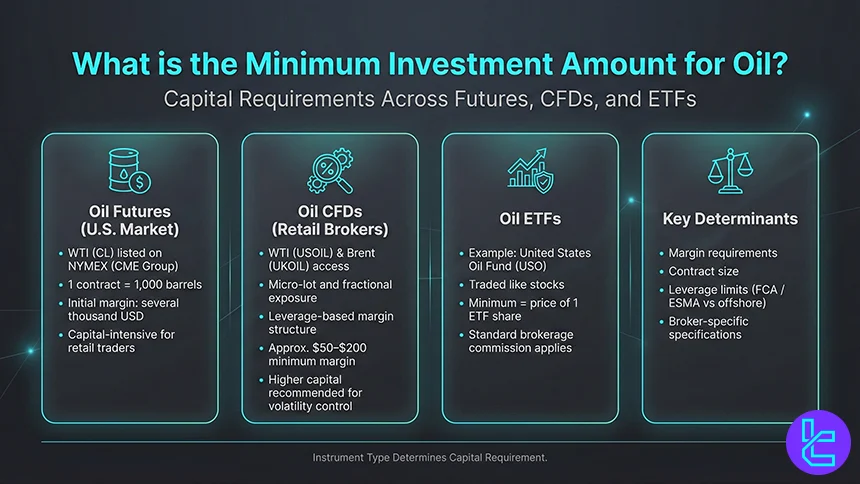
In contrast, retail forex brokers offering oil CFDs allow significantly smaller position sizes. Many brokers provide micro-lot trading, where traders can control fractional exposure to WTI (USOIL) or Brent (UKOIL).
Depending on leverage (e.g., 1:10 under FCA/ESMA rules or higher offshore), the minimum margin required can start from approximately $50 to $200, though practical trading capital should be higher to manage volatility risk effectively.
Another lower-capital alternative is investing in oil exchange-traded funds such as the United States Oil Fund (USO), where the minimum investment equals the price of one ETF share plus brokerage commission.
Ultimately, the minimum investment for oil trading varies widely; from a few hundred dollars in CFD accounts to several thousand dollars for regulated futures contracts.
Oil vs. Other Common Tradable Instruments
Oil (WTI/Brent) is one of the most macro-sensitive and volatility-driven instruments available through Forex brokers, typically traded as CFDs or futures-linked contracts.
Unlike gold’s safe-haven profile, oil is strongly tied to global growth, OPEC+ policy, and inventory data. Compared to currencies and cryptocurrencies, oil reflects physical supply-demand dynamics, making it structurally different in pricing behavior, leverage limits, and gap risk exposure.
Parameter | Oil (WTI/Brent) | Gold (XAU/USD) | Currencies (Forex Pairs) | Cryptocurrencies (BTC, ETH, etc.) |
Market Structure | Futures (NYMEX - CME Group for WTI, ICE for Brent), OTC CFDs via brokers | OTC spot (CFDs), Futures (COMEX - CME), ETFs (e.g., GLD) | Decentralized interbank OTC market (spot FX), futures (CME FX) | Decentralized blockchain networks; spot exchanges (Binance, Coinbase), futures/CFDs |
Trading Hours | Nearly 23-24 hours (futures sessions), 24/5 via CFDs | Nearly 24/5 (global sessions) | 24/5 global market | 24/7 continuous trading |
Typical Volatility | High (inventory reports, OPEC, geopolitics) | Medium-High (macro & USD driven) | Low-Medium (majors), High (exotics) | Very High (sentiment, liquidity shifts) |
Main Price Drivers | Supply/demand, OPEC+ quotas, EIA inventories, geopolitical risk, USD strength | Real yields, USD (DXY), inflation, central bank demand | Interest rate differentials, central bank policy, macro data | Adoption, regulation, network activity, liquidity flows |
Leverage (Retail, Tier-1 Reg.) | Typically up to 1:10 (FCA/ESMA major commodities) | Typically up to 1:20 (FCA/ESMA) | Up to 1:30 (major FX pairs under ESMA) | Often 1:2 (EU retail), higher offshore |
Safe-Haven Status | No (cyclical, growth-sensitive asset) | Yes (historical store of value) | Limited (USD, CHF, JPY considered defensive) | No (risk-on, speculative asset class) |
Dividend / Yield | No dividend (futures curve may imply carry cost) | No yield (non-interest-bearing) | Interest rate differentials (swap/rollover) | No intrinsic yield (staking possible for some coins) |
Correlation Profile | Correlated with global growth & energy demand cycles | Often negative correlation with equities in crisis | Strong inter-currency correlations | Correlated with risk appetite & tech-equity sentiment |
Short-Selling Access | Yes (via CFDs/futures) | Yes (via CFDs/futures) | Yes (intrinsically two-sided market) | Yes (via futures, margin, CFDs) |
Gap Risk Exposure | High (inventory data, geopolitical shocks) | Moderate (weekend & macro gaps) | Lower in majors, higher in exotics | Moderate-High (exchange-driven volatility) |
Conclusion
Oil is a popular tradable instrument found in various Forex brokers and platforms in spot and futures contracts. To find a suitable broker for trading this investment vehicle, you should consider various factors such as leverage, spreads, account types, and more.
Based on the examinations done by our analysis team, AvaTrade, IC Markets, BlackBull Markets, and FXGT are some of the best choices you have for trading oil.
To learn how the examinations were done, you may check out the Forex methodology article.