










When choosing a Forex broker, capital protection is just as important as spreads and leverage. One of the most critical safety mechanisms in the industry is the use of segregated accounts, where client funds are held separately from the broker’s operational capital.
Below is a a review of the best Forex brokers with segregated accounts based on regulatory strength, banking partnerships, negative balance protection policies, operational transparency, and overall trust metrics.
 | fxcm | |||
 | Exness | |||
 | pepperstone | |||
| 4 |  | XM | ||
| 5 |  | FBS | ||
| 6 |  | AVATRADE | ||
| 7 |  | HFM |
Trustpilot Rankings of Segregated-Account Forex Brokers
When comparing Forex brokers that offer segregated accounts, regulation alone is not enough. Client fund segregation means that broker-held capital is kept separate from operational company funds, but trader experience still varies significantly across platforms.
Trustpilot rankings provide additional insight into how these brokers perform in real-world conditions. While segregation enhances capital protection, user reviews often highlight practical factors such as withdrawal speed, dispute handling, execution quality, platform stability, and transparency in fee structures.
Broker Name | Trustpilot Rating | Number of Reviews |
Exness | 27,612 | |
AvaTrade | 11,907 | |
HFM | 3,283 | |
856 | ||
FBS | 8,651 | |
Pepperstone | 3,213 | |
3,045 |
Segregated Account Brokers with the Lowest Spread Conditions
When evaluating Forex brokers that offer segregated accounts, traders often look beyond capital protection and focus on trading costs. While fund segregation enhances financial safety, spreads and commissions directly impact day-to-day profitability, especially for scalpers, day traders, and high-frequency strategies.
Brokers with segregated client funds can still operate under different pricing models, including STP, ECN, and hybrid execution. The lowest spread conditions are typically found on Raw or ECN-style accounts, where spreads may start from 0.0 pips, combined with a fixed commission per lot
Broker Name | Min. Spread |
0.0 Pips | |
AvaTrade | 0.0 Pips |
HFM | 0.0 Pips |
Tickmill | 0.0 Pips |
FXCM | 0.2 Pips |
0.7 Pips | |
IC Markets | 0.8 Pips |
Types of Trading Accounts in Segregated Account Brokers
Forex brokers that operate segregated client accounts usually provide multiple trading account structures to accommodate different experience levels, capital sizes, and strategy requirements.
While fund segregation focuses on capital protection, account type determines pricing model, execution style, leverage structure, and platform access.
Broker Name | Account Types | Max. Leverage |
Exness | Standard, Standard Cent, pro, Raw Spread, Zero | Unlimited |
FBS | Standard | 1:3000 |
Cent, Zero, Pro, Premium | 1:2000 | |
FXCM | CFD account, Active Trader account, Corporate account | 1:1000 |
Standard, Razor | 1:500 | |
FxPro | Standard, Raw+, Elite | 1:500 |
AvaTrade | Retail, Professional, Islamic, Demo | 1:400 |
Tradable Assets in Segregated Account Forex Brokers
Forex brokers that maintain segregated client accounts typically operate under recognized regulatory frameworks, which often require transparency in product offerings and risk disclosures. As a result, these brokers usually provide access to a broad range of tradable instruments while ensuring client funds are held separately from operational capital.
The most common asset classes available include major, minor, and exotic Forex pairs, often exceeding 40 to 70 currency pairs depending on the broker.
In addition, many segregated-account brokers offer Contracts for Difference (CFDs) on global indices such as the S&P 500, NASDAQ 100, FTSE 100, and DAX 40, along with commodities like Gold, Silver, WTI, and Brent Crude.
Broker Name | Number of Instruments |
FXCM | 13,000+ |
1250+ | |
Pepperstone | 1,200+ |
HFM | 1,000+ |
Vantage Markets | 1,000+ |
FBS | 550+ |
Exness | 200+ |
Top 5 Forex Brokers Offering Segregated Accounts
Below are five well-known Forex brokers that publicly state the use of segregated client accounts under their regulated entities. These brokers are selected based on regulatory strength, transparency of fund handling policies, trading conditions, and overall market reputation.
FXCM
FXCM, short for Forex Capital Markets, is a multi-regulated Forex and CFD broker established in 1999. With over two decades of industry experience, the company operates under several top-tier regulators, including the FCA (UK), ASIC (Australia), CySEC (Cyprus), FSCA (South Africa), and ISA (Israel).
This regulatory structure strengthens its global credibility, particularly under FCA supervision where client funds are protected up to £85,000 through the FSCS scheme.
The broker provides access to Forex, indices, commodities, shares, and cryptocurrencies, offering spreads from 0.2 pips with no commission on most CFD trades. FXCM supports multiple trading platforms, including MetaTrader 4, TradingView, TradeStation, and its proprietary Trading Station platform. Maximum leverage can reach up to 1:1000 under certain entities.
The broker offers three primary account types after FXCM registration including CFD, Active Trader, and Corporate accounts. The Active Trader account is tailored for high-volume clients, requiring a $25,000 minimum deposit while offering volume-based rebates. A swap-free Islamic account and demo account are also available.
In terms of safety measures, FXCM implements segregated client funds, negative balance protection, and regular audits. However, traders should note its historical bankruptcy event in 2017 and the $50 annual inactivity fee, along with a $40 withdrawal fee for bank transfers.
Overall, FXCM remains a well-established broker combining strong regulation, diverse platforms, and competitive spreadsm offering various features such as FXCM rebate.
Account Types | CFD Account, Active Trader Account, Corporate Account |
Regulating Authorities | FCA, ASIC, CySEC, FSCA, ISA |
Minimum Deposit | $50 |
Deposit Methods | Visa, MasterCard, Bank Wire, Neteller, Skrill |
Withdrawal Methods | Visa, MasterCard, Bank Wire, Neteller, Skrill |
Maximum Leverage | Up to 1:1000 (entity dependent) |
Trading Platforms & Apps | MetaTrader 4, TradingView, TradeStation, Trading Station |
FXCM Pros and Cons
FXCM provides a competitive trading ecosystem backed by reliable infrastructure and broad market coverage. Still, certain cost structures, platform constraints, or jurisdictional limits may influence its suitability for some traders. Below is a balanced assessment of its advantages and drawbacks.
Pros | Cons |
Regulated by Tier-1 authorities (FCA, ASIC, CySEC) | History of bankruptcy (2017) |
Client fund segregation | $50 annual inactivity fee |
Negative balance protection | $40 bank wire withdrawal fee |
Spreads from 0.2 pips | Limited leverage under FCA/ASIC (1:30 retail) |
Multiple platforms (MT4, TradingView, TradeStation) | Active Trader requires $25,000 deposit |
Investor compensation up to £85,000 (UK) | Mixed reviews on some platforms |
Exness
Exness was founded in 2008 by Petr Valov and Igor Lychagov and has grown into one of the largest retail Forex and CFD brokers globally. The company operates in nearly 100 countries with more than 2,000 employees and reports monthly trading volumes exceeding $4 trillion. Its rapid expansion and transparent reporting model have strengthened its position in the global brokerage industry.
Exness is regulated by multiple reputable authorities, including the Financial Conduct Authority (FCA) in the UK, the Cyprus Securities and Exchange Commission (CySEC), the Financial Sector Conduct Authority (FSCA) in South Africa, the Capital Markets Authority (CMA) in Kenya, and the Financial Services Authority (FSA).
Certain entities provide investor compensation coverage of up to £85,000 under FSCS and €20,000 under ICF.
The broker offers competitive trading conditions such as Exness bonus and spreads starting from 0.0 pips and commissions ranging between $0 and $3.5 per lot depending on the account type.
The minimum deposit requirement is just $10, making it accessible to beginner traders. Under specific conditions, the broker also provides unlimited leverage and Exness rebate.
Exness dashboard offers five account types: Standard, Standard Cent, Pro, Raw Spread, and Zero. Trading platforms include MetaTrader 4, MetaTrader 5, Exness Terminal (web-based), and the Exness Trade mobile app. Clients can access over 200 instruments across Forex, stocks, indices, commodities, and cryptocurrencies.
Account Types | Standard, Standard Cent, Pro, Raw Spread, Zero |
Regulating Authorities | FCA, CySEC, FSCA, CMA, FSA, FSC, CBCS |
Minimum Deposit | $10 |
Deposit Methods | Neteller, Skrill, Perfect Money, SticPay, Bank Cards, Crypto (USDT, BTC, USDC) |
Withdrawal Methods | Neteller, Skrill, Perfect Money, SticPay, Bank Cards, Crypto |
Maximum Leverage | Unlimited (subject to trading conditions) |
Trading Platforms & Apps | MT4, MT5, Exness Terminal (Web), Exness Trade App, Social Trading App |
Exness Pros and Cons
Exness delivers a strong trading environment with stable systems and access to multiple markets. However, variations in fees, feature availability, or regional policies could impact specific users. The following section outlines its key strengths and limitations.
Pros | Cons |
Regulated by multiple Tier-1 authorities | Limited educational resources compared to some competitors |
Low minimum deposit ($10) | Services restricted in certain jurisdictions |
Spreads from 0.0 pips | Some instruments unavailable on all account types |
No deposit or withdrawal fees | Mixed third-party review scores |
Unlimited leverage option | — |
24/7 multilingual customer support | — |
Pepperstone
Pepperstone is a globally recognized multi-asset broker founded in 2010 in Melbourne, Australia. It processes billions in daily trading volume and serves clients across multiple jurisdictions under a strong regulatory framework that includes ASIC, FCA, CySEC, BaFin, DFSA, and CMA oversight.

After Pepperstone registration, the broker provides access to more than 1,200 CFDs across Forex, indices, commodities, cryptocurrencies, shares, and ETFs. With spreads starting from 0.0 pips on Razor accounts and no minimum deposit requirement, Pepperstone appeals to both beginner and professional traders.
Pepperstone supports multiple base currencies and allows order sizes from 0.01 to 100 lots. Leverage goes up to 1:500 depending on the regulatory entity. Client funds are held in segregated accounts, and negative balance protection is available across regulated branches.
Traders can choose between Standard and Razor accounts, with Islamic (swap-free) options available upon request. The broker supports MetaTrader 4, MetaTrader 5, cTrader, TradingView integration, and its proprietary mobile platform.
Pepperstone does not charge inactivity or account maintenance fees and offers 24/7 multilingual support. With its deep liquidity, fast execution, and Pepperstone rebate, it remains one of the leading choices for global CFD traders.
Account Types | Standard, Razor, Islamic, Demo |
Regulating Authorities | ASIC, FCA, CySEC, BaFin, DFSA, CMA |
Minimum Deposit | $1 (no fixed minimum, payment-method dependent) |
Deposit Methods | Apple Pay, Google Pay, Visa, Mastercard, Bank Transfer, PayPal, Neteller, Skrill, UnionPay, USDT, ZotaPay |
Withdrawal Methods | Apple Pay, Google Pay, Visa, Mastercard, Bank Transfer, PayPal, Neteller, Skrill, UnionPay, USDT, ZotaPay |
Maximum Leverage | Up to 1:500 (entity dependent) |
Trading Platforms & Apps | MetaTrader 4, MetaTrader 5, cTrader, TradingView, Proprietary Web & Mobile App |
Pepperstone Pros and Cons
Pepperstone combines robust infrastructure with diverse asset access to create a competitive trading setup. That said, factors such as pricing models, platform flexibility, or geographic restrictions may present limitations for certain traders. Below is an objective evaluation of its pros and cons.
Advantages | Disadvantages |
Regulated by multiple Tier-1 authorities (ASIC, FCA, CySEC, BaFin) | No PAMM accounts |
Spreads from 0.0 pips on Razor account | Limited promotional offers |
No minimum deposit requirement | Leverage capped to 1:30 under EU/UK entities |
No inactivity or account maintenance fees | Islamic account requires eligibility verification |
Wide platform selection (MT4, MT5, cTrader, TradingView) | Some regional restrictions |
1,200+ tradable instruments | - |
XM Group
XM Group, founded in 2009, has grown into a globally recognized forex and CFD broker serving over 15 million clients, executing nearly 14 million trades per day.
The company operates through multiple entities regulated by authorities such as CySEC (Cyprus), FSCA (South Africa), DFSA (Dubai), FSC (Belize & Mauritius), and FSA (Seychelles).

With a minimum deposit of just $5 for most accounts, XM positions itself as a beginner-friendly broker while still offering advanced features for experienced traders. Clients can access more than 1,400 CFDs, including 55+ forex pairs, over 1,200 stock CFDs, commodities, indices, cryptocurrencies, and precious metals.
XM Group dashboard supports MetaTrader 4 and MetaTrader 5 across desktop, web, and mobile devices. The broker provides spreads starting from 0.6 pips on Ultra Low accounts, with no commissions except on the Shares account and XM Group rebate for cashback. Leverage is available up to 1:1000, depending on the regulatory entity.
The broker offers Islamic (swap-free) accounts, negative balance protection, hedging, and access to XM copy trading with thousands of strategies. Deposits and withdrawals are generally fee-free from XM’s side, though third-party charges may apply.
Customer support is available 24/7 in over 30 languages. While XM has strong global coverage and competitive trading conditions, traders should consider inactivity fees and regional restrictions before opening an account.
Account Types | Micro, Standard, Ultra Low, Shares, Demo |
Regulating Authorities | CySEC, FSCA, DFSA, FSC (Belize & Mauritius), FSA Seychelles |
Minimum Deposit | $5 (except Shares: $10,000) |
Deposit Methods | Credit/Debit Cards, Bank Transfers, Skrill, Neteller, Perfect Money, Google Wallet, Apple Pay |
Withdrawal Methods | Credit/Debit Cards, Bank Transfers, Skrill, Neteller, E-wallets |
Maximum Leverage | Up to 1:1000 |
Trading Platforms & Apps | MetaTrader 4 (MT4), MetaTrader 5 (MT5), XM Mobile App |
XM Group Pros and Cons
XM Group maintains a solid trading framework supported by advanced infrastructure and multi-market exposure. Nevertheless, elements like fee structure or regional compliance rules may affect overall appeal. Here is a concise overview of its strengths and weaknesses.
Pros | Cons |
Regulated by multiple international authorities | $10 monthly inactivity fee |
Very low minimum deposit ($5) | Not available for US & Canada clients |
1,400+ tradable instruments | Shares account requires $10,000 deposit |
Negative balance protection | Mixed online review scores |
Islamic (swap-free) account available | Swap fees apply on standard accounts |
24/7 multilingual customer support | Not publicly traded |
FBS
FBS is an international Forex and CFD broker established in 2009, serving more than 27 million traders globally. The company operates through multiple regulated entities, including CySEC in Europe, ASIC in Australia, and FSC for its international branch.
This multi-jurisdictional structure allows FBS to offer different leverage limits and compliance standards depending on the client’s region.

FBS dashboard provides access to over 550 tradable instruments across Forex, stocks, indices, commodities, metals, and cryptocurrencies. Spreads start from 0.7 pips on the Standard account with zero commission, positioning FBS as a cost-efficient option for retail traders. Depending on the entity, leverage can go as high as 1:3000.
FBS supports MetaTrader 4, MetaTrader 5, and its proprietary mobile trading application, which includes more than 90 technical indicators and advanced charting tools.
After completing the FBS registration and the first deposit, client funds move to held in segregated accounts, and negative balance protection is available to help manage downside risk.
The broker has simplified its account structure and now mainly offers a Standard account alongside demo and Islamic (swap-free) options. With a minimum deposit starting from just $5 and 24/7 multilingual customer support, FBS appeals strongly to beginner and high-leverage traders seeking flexible conditions.
Account Types | Standard, Demo, Islamic (Swap-Free) |
Regulating Authorities | CySEC, ASIC, FSC |
Minimum Deposit | $5 |
Deposit Methods | Bank Transfer, Credit/Debit Cards, Skrill, Neteller, Sticpay, Local Methods |
Withdrawal Methods | Bank Transfer, Credit/Debit Cards, Skrill, Neteller, Sticpay, Local Methods |
Maximum Leverage | Up to 1:3000 |
Trading Platforms & Apps | MetaTrader 4, MetaTrader 5, FBS Mobile App |
FBS Pros and Cons
FBS offers traders broad market access and dependable technical infrastructure. Even so, some cost-related considerations and feature restrictions should be carefully reviewed. Below is a balanced breakdown of its advantages and limitations.
Pros | Cons |
Very low minimum deposit ($5) | Limited account type variety |
High leverage up to 1:3000 | Regulatory strength varies by entity |
Regulated by CySEC and ASIC entities | No active PAMM or copy trading system |
24/7 customer support | Some spreads wider than ECN competitors |
MT4, MT5, and mobile app available | Bonus programs limited in some regions |
What is Segregated Account?
A segregated account in Forex trading refers to a structure where a broker keeps client funds separate from the company’s own operational capital.
Instead of pooling trader deposits into a single corporate account, the broker places client money in dedicated bank accounts, typically held with reputable financial institutions.
This separation ensures that client funds are not used for business expenses, hedging activities, payroll, or company liabilities. In the event of insolvency, segregated funds are legally distinguished from the broker’s assets, reducing the risk of misappropriation.
Segregation is commonly required by Tier-1 regulators such as FCA, ASIC, and CySEC, but offshore regulators may apply lighter oversight. It is important to understand that segregation does not eliminate trading risk; it only protects deposits from misuse by the broker itself.
In short, segregated accounts are a structural safeguard designed to protect capital custody, not trading performance.
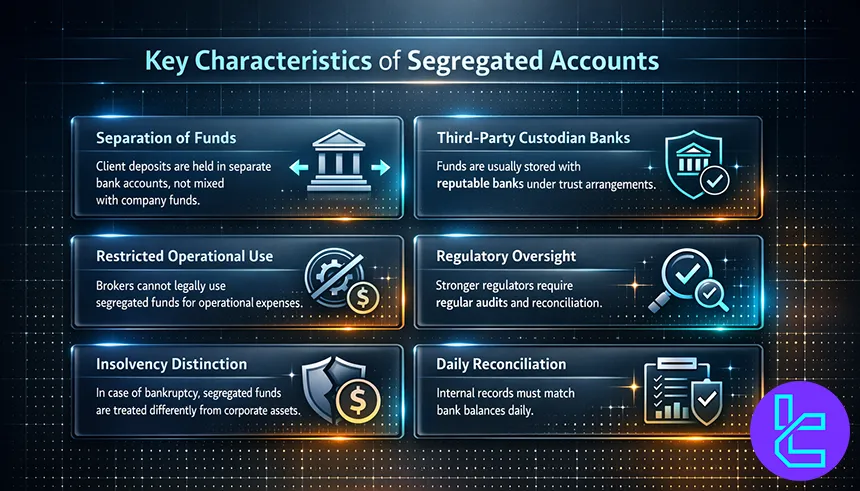
Key Characteristics of Segregated Accounts
Below are the core characteristics of Segregated accounts, as one of the main safety features in forex industry:
- Separation of Funds: Client deposits are held in separate bank accounts, not mixed with company funds;
- Third-Party Custodian Banks: Funds are usually stored with reputable banks under trust arrangements;
- Restricted Operational Use: Brokers cannot legally use segregated funds for operational expenses;
- Regulatory Oversight: Stronger regulators require regular audits and reconciliation of client balances;
- Insolvency Distinction: In case of bankruptcy, segregated funds are treated differently from corporate assets;
- Daily Reconciliation: Many regulated brokers must match internal records with bank balances daily;
- Transparency Requirements: Disclosure policies explain how funds are stored and protected.
These characteristics collectively reduce counterparty risk but do not protect against market losses.
Segregated Accounts Pros and Cons
When evaluating segregated accounts, traders benefit from a balanced comparison.
Pros | Cons |
Improved capital protection in case of broker insolvency | Does not protect against trading losses |
Reduced risk of misuse or misallocation of client deposits | Offshore regulators may enforce segregation less strictly |
Often associated with stronger regulatory frameworks | May not guarantee full recovery in extreme insolvency scenarios |
Higher transparency and compliance standards | Can create false sense of absolute safety among inexperienced traders |
Higher transparency and compliance standards; | Legal recovery processes may still be lengthy |
What Criteria Were Used to Select the Best Forex Brokers with Segregated Accounts?
Ranking the best Forex brokers that support crypto payments requires a structured and objective evaluation process. Since traders fund accounts using digital assets like Bitcoin or USDT, factors such as security, regulatory oversight, transaction speed, and fee transparency become critical.
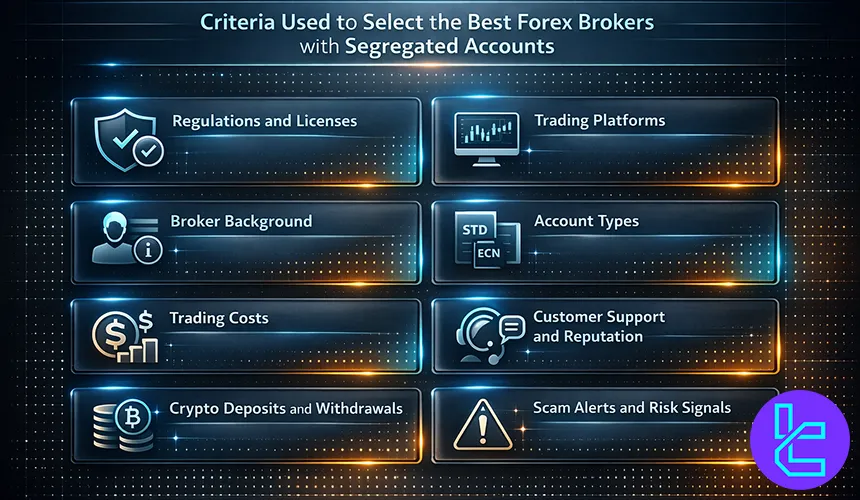
TradingFinder applies a 19-metric data-driven framework to assess brokers based on reliability, trading conditions, and overall user experience.
Our evaluation focuses on the most impactful criteria:
- Regulations and Licenses: Verification of legal status, supervisory authority, and client fund protection;
- Broker Background: Operational history, headquarters location, and transparency;
- Trading Costs: Spreads, commissions, swaps, and hidden fees affecting crypto-funded accounts;
- Crypto Deposits and Withdrawals: Supported coins, processing time, network confirmations, and conversion charges;
- Trading Platforms: Stability and availability of MetaTrader 4, MetaTrader 5, cTrader, and mobile apps;
- Account Types: Diversity including Standard, ECN, and RAW models;
- Customer Support and Reputation: Response quality, Trustpilot trends, and dispute handling;
- Scam Alerts and Risk Signals: Monitoring regulatory warnings and fraud reports.
Each metric carries a specific weight, with regulation, withdrawal reliability, and cost structure influencing rankings the most. Our analysts combine quantitative research with practical testing to ensure objectivity.
The final ranking reflects brokers that deliver secure crypto payment integration, competitive trading conditions, and consistent client satisfaction.
What Is the Mechanism Behind Segregated Accounts?
The mechanism behind segregated accounts is built on three coordinated pillars: legal structure, banking custody, and regulatory supervision.
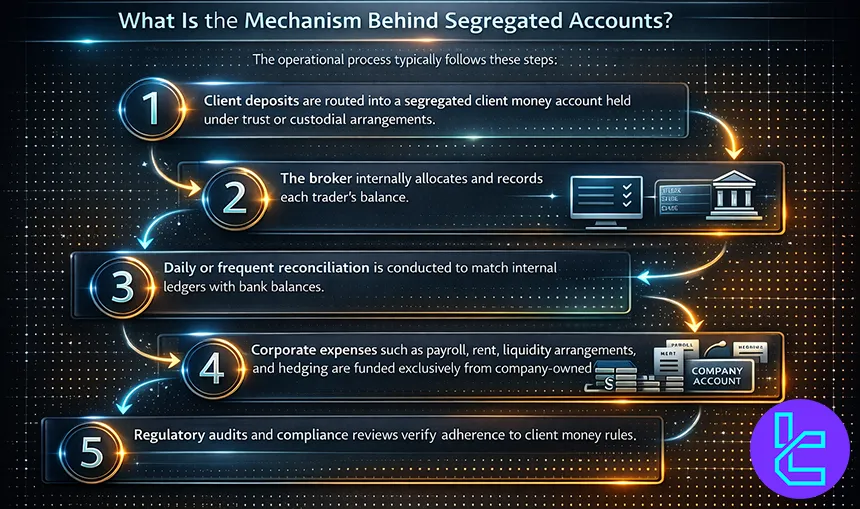
When a trader deposits funds, the money is not placed into the broker’s operational account. Instead, it is transferred into a designated client trust account held at a third-party bank. This account is legally separate from the broker’s working capital.
The operational process typically follows these steps:
- Client deposits are routed into a segregated client money account held under trust or custodial arrangements;
- The broker internally allocates and records each trader’s balance;
- Daily or frequent reconciliation is conducted to match internal ledgers with bank balances;
- Corporate expenses such as payroll, rent, liquidity arrangements, and hedging are funded exclusively from company-owned accounts;
- Regulatory audits and compliance reviews verify adherence to client money rules.
Under strong regulatory regimes, segregated funds are legally shielded from creditors during insolvency proceedings. This means they are not treated as corporate assets in bankruptcy claims.
However, implementation strength varies by jurisdiction. Tier-1 regulators often require strict capital adequacy, external audits, and real-time reconciliation. Offshore regulators may mandate segregation in principle but enforce it with less frequent supervision.
Therefore, the robustness of segregation depends not only on broker policy, but also on the legal framework under which it operates.
Are There Any Regulatory Requirements for Providing a Segregated Account?
In many major financial jurisdictions, segregated accounts are not optional-they are mandatory.
Regulators such as the FCA, ASIC, and CySEC impose detailed “client money rules” that brokers must follow. These typically include:
- Mandatory separation of client funds from operational capital
- Daily reconciliation of client balances
- Maintenance of minimum regulatory capital
- Submission of audited financial statement
- Independent compliance oversight
- Clear disclosure of custody arrangements
Under these frameworks, failure to comply can result in fines, license suspension, or revocation.
By contrast, offshore regulators may require segregation at a structural level but apply lighter reporting obligations and fewer audit cycles. In some jurisdictions, enforcement visibility is limited, and capital requirements are lower.
When evaluating a broker, traders should confirm:
- Whether segregation is a regulatory obligation or voluntary policy
- Whether reconciliation is audited by external firms
- Whether client funds are protected by an investor compensation scheme
- Whether the regulator enforces capital adequacy rules
Regulatory backing determines whether segregated accounts function as a legally enforceable safeguard or merely a marketing claim.
Is Regulation Mandatory for Brokers Providing Segregated Accounts?
A broker can claim to segregate funds without strong regulation-but enforcement becomes uncertain without oversight.
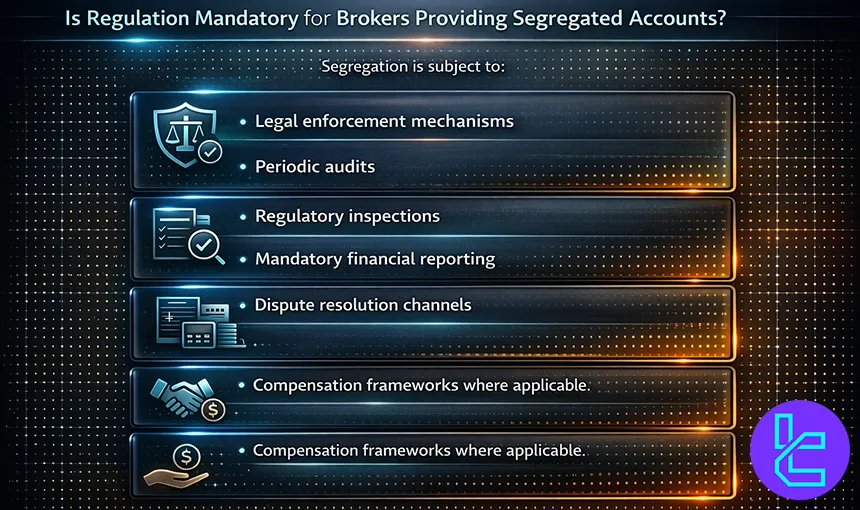
Regulation transforms segregation from a policy statement into a legal obligation. When a broker operates under a recognized authority, segregation is subject to:
- Legal enforcement mechanisms
- Periodic audits
- Regulatory inspections
- Mandatory financial reporting
- Dispute resolution channels
- Compensation frameworks where applicable
Without regulation, there is no independent body verifying whether funds are truly segregated, reconciled, or protected. In such cases, traders must rely solely on the broker’s internal governance.
Additionally, regulated brokers are typically required to disclose where client funds are held and under which legal entity the account is opened. This transparency significantly reduces counterparty risk.
While segregation and regulation are technically separate concepts, in practice they are interdependent. A segregated account under Tier-1 regulation offers materially stronger protection than segregation under loosely supervised offshore environments.
Why Choose a Forex Broker with Segregated Accounts?
Choosing a broker with segregated accounts directly reduces counterparty risk, which is one of the primary structural risks in leveraged trading.
When client funds are segregated, they cannot legally be used for:
- Company operating expenses
- Liquidity provider margin obligations
- Proprietary trading
- Corporate debt repayment
This legal separation ensures that client capital remains distinct from the broker’s financial health.
Segregation also enhances:
- Financial transparency
- Operational accountability
- Institutional credibility
- Compliance standards
For traders with substantial account balances, capital custody becomes as important as spreads and leverage. During market turbulence or financial stress, brokers without strong capital controls may face liquidity pressure.
Segregation helps reduce the risk that client deposits become entangled in corporate liabilities.
However, segregation does not protect against:
- Market losses
- Poor risk management
- Slippage or execution issues
It protects capital custody-not trading outcomes. For professional and long-term traders, segregated accounts form a core component of broker due diligence.
Are Segregated Client Accounts a Sign of Broker Safety?
Segregated accounts are a strong positive signal-but not a complete safety guarantee. They demonstrate that a broker operates under structured capital management principles. However, overall broker safety depends on multiple interconnected factors.
Segregation indicates:
- Separation of client and corporate funds
- Compliance with client money rules
- Reduced risk of capital misuse
But traders must also evaluate:
- Regulatory tier strength
- Capital adequacy levels
- Negative balance protection
- Investor compensation schemes
- Transparency of financial disclosures
- Length of operational history
- Quality of liquidity providers
A broker may offer segregated accounts yet operate under a lightly supervised regulator. In contrast, a Tier-1 regulated broker combines segregation with strict leverage caps, dispute resolution frameworks, and capital requirements.
Segregation is one pillar of safety-not the entire structure. A comprehensive safety assessment requires analyzing the full regulatory ecosystem.
What Traders Should Know About Segregated Account Brokers?
Before opening an account, traders should conduct structured verification rather than relying solely on marketing claims.
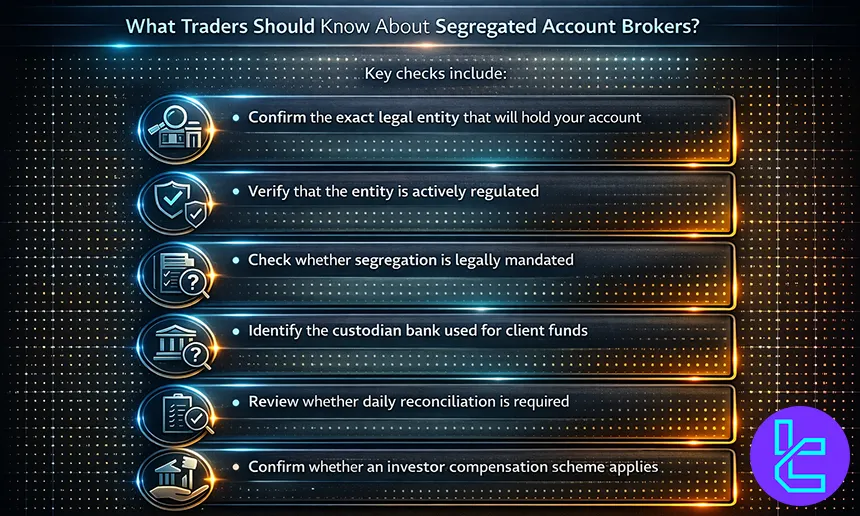
Key checks include:
- Confirm the exact legal entity that will hold your account
- Verify that the entity is actively regulated
- Check whether segregation is legally mandated
- Identify the custodian bank used for client funds
- Review whether daily reconciliation is required
- Confirm whether an investor compensation scheme applies
- Understand how funds are treated during insolvency
It is also important to recognize that segregation does not guarantee immediate access to funds in a liquidation scenario. Legal processes may still delay recovery.
Additionally, segregation does not prevent brokers from failing-it only reduces the probability that client capital becomes part of corporate liabilities.
A broker combining segregated accounts, strong regulation, negative balance protection, audited financials, and transparent reporting offers significantly stronger structural protection than brokers relying solely on offshore licensing.
Segregated Account Vs Other Investment Protection Methods; Which is Better?
When comparing Segregated Accounts with other investment protection mechanisms, it is important to understand that each tool addresses a different layer of risk.
Some measures protect client funds from broker insolvency, others prevent traders from falling into debt, and some aim to ensure the financial stability of the brokerage itself.
Parameters | Segregated Account | Investor Compensation Fund | Negative Balance Protection | Capital Adequacy Requirements |
Protection Scope | Separates client funds from broker operational funds | Compensates clients if broker becomes insolvent | Prevents clients from owing more than deposited funds | Ensures broker maintains sufficient financial reserves |
Trigger Condition | Broker insolvency or liquidation | Official declaration of broker insolvency | Extreme market volatility causing negative equity | Regulatory capital falling below required threshold |
Maximum Coverage | No fixed cap, depends on client balance held | Fixed statutory limit (e.g., €20,000 or £85,000 depending on jurisdiction) | Limited to deposited capital | No direct client payout; depends on capital buffer size |
Regulatory Backing | Required by most Tier-1 regulators | Backed by national regulatory frameworks | Mandatory in many regulated jurisdictions (e.g., EU under ESMA) | Enforced by financial regulators |
Mandatory Status | Mandatory in most regulated environments | Mandatory where compensation schemes exist | Mandatory for retail clients in certain regions | Mandatory for licensed brokers |
Risk Type Covered | Broker misuse of funds or insolvency risk | Broker bankruptcy risk | Market risk leading to negative balance | Operational and systemic financial risk |
Timing of Protection | Post-insolvency protection | Post-insolvency compensation | During extreme market events | Continuous, pre-emptive financial safeguard |
Primary Beneficiary | All clients with deposited funds | Eligible retail clients | Primarily retail traders | Overall client base through broker stability |
Conclusion
Choosing a Forex broker with segregated accounts is fundamentally about capital custody and structural risk management. While spreads, leverage, and platform features influence trading performance, the way a broker handles client funds directly impacts financial security.
Segregated accounts ensure that trader deposits remain legally separated from company operational capital, reducing the risk of misuse or exposure to corporate liabilities.
However, segregation alone does not define broker safety. The strength of regulatory oversight, capital adequacy requirements, investor compensation schemes, negative balance protection, and operational transparency all play interconnected roles.
Tier-1 regulatory supervision significantly enhances the enforceability of client money rules, while weaker jurisdictions may offer limited oversight despite claiming fund segregation.
To gain a full insight into how we assess and rank brokers, we recommend reviewing the detailed TradingFinder Forex methodology article.