





The Securities and Futures Commission (SFC) is an independent regulatory organization, operating since 1989, which supervises Forex brokers as part of securities and futures markets in Hong Kong. This authority is considered high-tier and provides superior customer protections in comparison to offshore regulators.
The shortlist below contains both regulated and not regulated SFC brokers
 | Alpari | Not SFC-regulated | |||
 | FXTM | Not SFC-regulated | |||
 | FP Markets | Not SFC-regulated | |||
| 4 |  | XM | Not SFC-regulated | ||
| 5 |  | Swissquote | SFC-Regulated | ||
| 6 |  | ATFX | SFC-Regulated | ||
| 7 |  | FOREX.com | SFC-Regulated | ||
| 8 |  | Interactive Brokers | SFC-Regulated |
Trustpilot Ratings of SFC and Not SFC-Regulated Brokers
This section ranks the candidate SFC-regulated brokerages based on the Trustpilot user reviews and scores.
Broker Name | Trustpilot Rating | Number of Reviews |
FP Markets | 9,982 | |
FOREX.com | 2,251 | |
Swissquote | 3,861 | |
Interactive Brokers | 5,088 | |
XM | 3,019 | |
70 | ||
FXTM | 1,078 | |
299 |
Trading Spreads in SFC-Regulated Brokerages (Not SFC-regulated Brokers included)
Brokers charge clients with spreads as difference between buy and sell prices in trading assets. The table below ranks mentioned brokers based on the minimum spread amount.
Broker Name | Min. Spread |
FOREX.com | 0 Pips |
Swissquote | 0 Pips |
0 Pips | |
ATFX | 0 Pips |
0 Pips | |
AvaTrade | 0 Pips |
IC Markets | 0 Pips |
Pepperstone | 0 Pips |
Non-Trading Fees Charged by SFC and Not SFC-Regulated Brokers
Non-trading fees often include deposit/withdrawal costs and inactivity charges. This section compares brokers based on these parameters.
Broker Name | Deposit Fee | Withdrawal Fee | Inactivity Fee |
Pepperstone | $0 | $0 | $0 |
IC Markets | $0 | $0 | $0 |
AvaTrade | $0 | $0 | $10 Monthly |
$0 | $0 | €15 Monthly | |
Interactive Brokers | $0 | One Free Withdrawal per Month | $0 |
$0 | $0 for E-Wallets | $10 Monthly | |
FOREX.com | $0 | $5 for Transactions less than $100 | $10 Monthly |
ATFX | $0 | $5 for Transactions less than $100 | $10 Monthly |
Number of Instruments in SFC Brokerages (Not SFC-Regulated Brokers Included)
The table here ranks select SFC-regulated brokers based on the number of available trading assets.
Broker Name | Number of Instruments |
5,500+ | |
Interactive Brokers | 4,900+ |
IC Markets | 2,250+ |
1,400+ | |
AvaTrade | 1,250+ |
Pepperstone | 1,200+ |
Swissquote | 1,100+ |
ATFX | 120+ |
Top 6 Forex Brokers in Detail
Each of the following sections offers a brief review of each abovementioned broker for those interested in SFC regulation.
FOREX.com
Launched in 2001, FOREX.com is a global brokerage brand backed by the financial strength of StoneX Group Inc. With 800+ employees and 1,200+ partners, the broker serves over one million clients across major financial hubs.
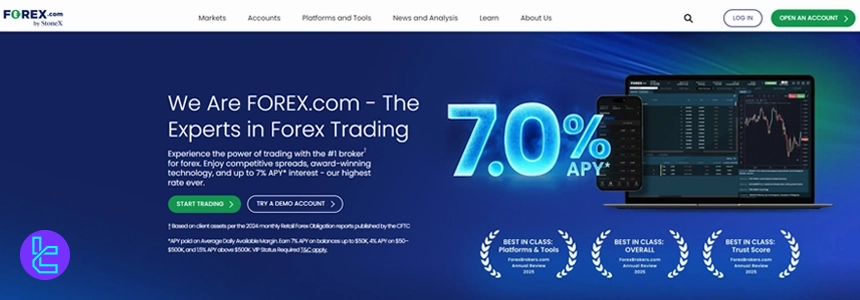
Following its acquisition by StoneX in 2020, FOREX.com expanded rapidly in Europe and Asia. StoneX’s published figures show $19.68B in total assets and $277M in pre-tax income, reinforcing balance-sheet depth behind the trading brand.
In Asia, FOREX.com operates through Securities and Futures Commission oversight via StoneX Financial (HK) Ltd. This SFC authorization places the broker within Hong Kong’s tier-1 regulatory framework, emphasizing capital adequacy, segregation of funds, and strict conduct rules.
From a trading perspective, FOREX.com offers 1,000+ instruments across forex, indices, shares CFDs, commodities, metals, and crypto CFDs. With 0.02-second average execution speed, support for MT5, TradingView, and a proprietary web platform, it targets both active and professional traders. Here’s a table of specifics.
Account Types | Standard, Raw Spread, MetaTrader |
Regulating Authorities | CFTC, SEC, FCA, ASIC, MAS, CIRO, FSA, CySEC |
Minimum Deposit | $100 |
Deposit Methods | Local Transfer, Credit/Debit Cards, Wire Transfer, Neteller, Skrill |
Withdrawal Methods | Credit/Debit Cards, Wire Transfer |
Maximum Leverage | 1:50 |
Trading Platforms & Apps | MT5, TradingView, Proprietary Platform |
FOREX.com Pros & Cons
Overall, FOREX.com combines institutional backing, top-tier regulation, and broad market access. The following pros and cons highlight where the broker excels and where limitations may matter.
Pros | Cons |
Regulated by top-tier authorities including SFC (Hong Kong) | Leverage tightly capped under SFC rules |
Backed by StoneX Group with strong financial disclosures | No dedicated copy-trading or PAMM programs |
Fast execution (≈0.02s) and deep liquidity | Inactivity fees after prolonged non-use |
MT5, TradingView, and proprietary platforms available | Trading conditions vary by legal entity |
Swissquote
Swissquote is a Swiss-based banking and brokerage group offering access to 3+ million products, including Forex, stocks, ETFs, bonds, and derivatives across NYSE, NASDAQ, AMEX, and SIX. Trading starts from $1,000, with spreads from 0.0 pips on select instruments.
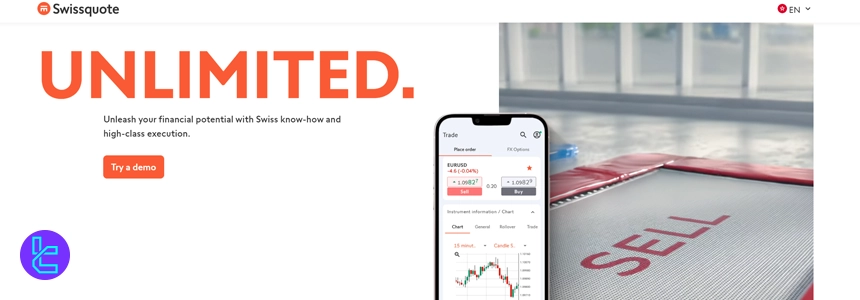
Founded in 1990, Swissquote became a licensed bank and publicly listed company in 2000, trading on the SIX Swiss Exchange under ticker SQN. Today, it serves 500,000+ clients and safeguards CHF 56B+ in client assets.
The broker operates 10 global offices and employs 1,100+ staff. Platform options include MT4, MT5 (50+ indicators), and the proprietary CFXD, plus the SQX crypto exchange supporting 30+ cryptocurrencies with real-time market data.
Swissquote’s regulatory footprint spans FINMA, FCA, DFSA, CySEC, MAS, MFSA, CSSF, and notably Securities and Futures Commission (SFC Type 3) via its Hong Kong entity-making it a strong fit for SFC-focused comparisons. Leverage reaches up to 1:100, with CHF 100,000 Swiss depositor protection.
Table of Specifics
Account Types | Standard, Premium, Prime, Professional |
Regulating Authorities | FINMA, DFSA, CySEC, CSSF, FCA, SFC, MFSA, MAS, FSCA |
Minimum Deposit | $1,000 |
Deposit Methods | Credit/Debit Cards, Bank Wire |
Withdrawal Methods | Credit/Debit Cards |
Maximum Leverage | 1:100 |
Trading Platforms & Apps | MT5, MT4, CFXD |
Swissquote Pros & Cons
Before going through the Swissquote registration process, check the table below, which is a balanced snapshot of its main pros and cons to help assess fit for different trading profiles.
Pros | Cons |
Bank-level security with CHF 100,000 Swiss deposit protection | High minimum deposit ($1,000) |
Multi-tier regulation incl. FINMA & SFC Hong Kong | Fees can be higher than non-bank brokers |
Access to 3M+ products across global exchanges | Product suite may feel complex for beginners |
Robust platforms (MT4, MT5, CFXD) + SQX crypto | Leverage capped at 1:100 |
Interactive Brokers
Interactive Brokers is a globally established brokerage serving 2.9+ million client accounts with direct access to 150+ markets worldwide. The broker supports trading across 100+ forex pairs and 90+ global stock exchanges, positioning itself as a true multi-asset, institutional-grade platform.
Founded in 1977 by Thomas Peterffy, Interactive Brokers has evolved into a technology-driven firm operating in 34 countries and supporting 27 base currencies. Its long operating history and scale make it one of the most recognized names in electronic brokerage.
For Hong Kong traders, Interactive Brokers operates via Interactive Brokers Hong Kong Limited, regulated by the Securities and Futures Commission (SFC). This ensures compliance with strict local standards, including client fund segregation and capital adequacy requirements.
As a NASDAQ-listed company, Interactive Brokers publishes audited financials and adheres to rigorous governance rules. Combined with oversight from top-tier regulators such as the U.S. Securities and Exchange Commission and Financial Conduct Authority, the broker delivers a high level of transparency and structural reliability.
Summary of Features and Parameters
Account Types | Individual, Joint, Trust, Retirement, Institutional, Non-Professional Advisor |
Regulating Authorities | SEC, FINRA, NYSE, FCA, etc. |
Minimum Deposit | $1 |
Deposit Methods | Bank Transfer, Check |
Withdrawal Methods | Bank Transfer, Check |
Maximum Leverage | 1:1000 |
Trading Platforms & Apps | Proprietary |
Interactive Brokers Pros & Cons
Overall, Interactive Brokers combines regulatory depth, global market reach, and advanced trading infrastructure. The following pros and cons summarize the broker’s key strengths and limitations before diving into a detailed comparison. Pay attention to this table before Interactive Brokers registration.
Pros | Cons |
SFC-regulated Hong Kong entity with strong global oversight | Limited payment methods (mainly bank transfers) |
Access to 150+ markets and 90+ global exchanges | Complex platforms may overwhelm beginners |
Very low spreads and institutional-grade commissions | No bonuses or promotional offers |
NASDAQ-listed company with audited financials | Customer support quality can vary by region |
ATFX
Founded in 2017 in London, ATFX is a multi-regulated forex and CFD broker serving clients through a global network of licensed entities. The broker offers over 120 tradable instruments across Forex, commodities, indices, and share CFDs via MT4 and MT5 platforms.
Under its Hong Kong entity, Securities and Futures Commission oversight places ATFX among the regulated choices for traders seeking SFC-supervised brokers. This entity applies strict rules on client fund segregation, transparency, and operational compliance in line with Hong Kong standards.
ATFX provides Standard, Edge, and Premium accounts with a minimum deposit starting from $500. Spreads begin from 1 pip on Standard accounts and from 0.0 pips on Premium accounts, while execution is handled through an STP model designed to reduce dealing-desk intervention.
Across its global entities, ATFX combines top-tier licenses (FCA, ASIC, CySEC, SFC) with additional offshbore registrations, allowing leverage flexibility by jurisdiction. Client protection features include segregated funds, negative balance protection, and an additional $1 million insurance coverage on client funds.
Table of Parameters
Account Types | Standard, Edge, Premium |
Regulating Authorities | ASIC, FCA, FSCA, SCA, CySEC, FSC, FSA, SFC |
Minimum Deposit | $500 |
Deposit Methods | Credit/debit Cards, E-wallets, Bank Transfers |
Withdrawal Methods | Credit/debit Cards, E-wallets, Bank Transfers |
Maximum Leverage | 1:30 |
Trading Platforms & Apps | MT4, MT5 |
ATFX Pros & Cons
The following pros and cons summarize the broker’s main strengths and limitations, which one must pay attention to before ATFX registration.
Pros | Cons |
Regulated by multiple Tier-1 authorities (SFC, FCA, ASIC, CySEC) | Higher minimum deposit compared to many competitors |
Strong client protection with segregated funds and NBP | Limited proprietary or advanced trading platforms |
MT4 and MT5 support across global entities | No bonuses or promotions due to regulatory limits |
Additional $1M insurance coverage for client funds | Product range narrower than some multi-asset brokers |
FP Markets
FP Markets, officially First Prudential Markets, was founded in 2005 and is headquartered in Sydney, Australia. The broker has expanded globally through multiple regulated entities, offering access to over 10,000 tradable instruments across Forex, CFDs, ETFs, stocks, indices, commodities, and cryptocurrencies.
The group operates under several financial authorities, including ASIC (Australia) and CySEC (license 371/18), alongside FSCA, FSC, and offshore regulators. Under its CySEC entity, EU clients benefit from segregated funds, negative balance protection, and Investor Compensation Fund (ICF) coverage up to €20,000.
FP Markets provides two core account types, including Standard and RAW, both requiring a $50 minimum deposit. RAW accounts feature spreads from 0.0 pips with a $3 commission per lot, while Standard accounts offer commission-free trading with spreads from 1.0 pip, accommodating different cost structures. For a reduction in costs, participate in FP Markets rebate.
Platform support includes MetaTrader 4, MetaTrader 5, and cTrader, enabling algorithmic trading, Expert Advisors, copy trading, PAMM/MAM solutions, and advanced charting. Professional clients may access leverage up to 1:500 under eligible entities, while EU retail leverage remains capped in line with regulatory rules.
Table of Specifics
Account Types | Standard, RAW |
Regulating Authorities | ASIC, CySEC, FSC, FSCA, FSA |
Minimum Deposit | $50 |
Deposit Methods | Visa and Master card, Skrill, PayPal, Neteller, Bank Transfer |
Withdrawal Methods | Visa and Master card, Skrill, PayPal, Neteller, Bank Transfer |
Maximum Leverage | 1:500 |
Trading Platforms & Apps | MT4, MT5, cTrader |
FP Markets Pros & Cons
Before going with FP Markets registration, check out this overview of its key strengths and limitations to help traders evaluate whether it fits their trading strategy and risk profile.
Pros | Cons |
Regulated by ASIC and CySEC with investor protections | Not available to U.S. clients |
RAW spreads from 0.0 pips with competitive $3 commission | No proprietary trading platform |
Access to 10,000+ instruments across multiple markets | Leverage capped at 1:30 for EU retail clients |
Supports MT4, MT5, and cTrader with copy/PAMM options | Educational materials less extensive than some competitors |
FXTM
FXTM (ForexTime), established in 2011, is a global Forex and CFD broker serving over 1 million users across 150+ countries. Headquartered in Mauritius, the company operates under Exinity Limited and is regulated by the Financial Services Commission (FSC), classified as a Tier-3 authority.
FXTM offers access to 1,000+ tradable instruments across Forex, stocks, indices, commodities, metals, and cryptocurrencies. Traders can choose between Advantage Stocks, Advantage, and Advantage Plus accounts, with spreads from 0.0 pips and market execution across all account types.
One of FXTM’s most aggressive features is its maximum leverage of 1:3000, available under its offshore entity. The broker also integrates copy trading via FXTM Invest, allowing clients to follow strategy managers with a minimum investment of $100. For a review of the broker’s user interface, go to FXTM dashboard.
Platform coverage includes MetaTrader 4, MetaTrader 5, and the proprietary FXTM Trader App, supporting algorithmic trading, EAs, and mobile account management. The minimum deposit starts at $200, with funding methods including cards, e-wallets, bank transfers, and crypto (ERC20/TRC20).
Specifications and Details
Account Types | Advantage, Stocks Advantage, Advantage Plus |
Regulating Authorities | FSC |
Minimum Deposit | $200 |
Deposit Methods | FasaPay, TC Pay, M-Pesa, VISA, MasterCard, Maestro, Google Pay, GlobePay, Skrill, PayRedeem, Perfect Money, Neteller, Bank Wire Transfer |
Withdrawal Methods | FasaPay, TC Pay, M-Pesa, VISA, MasterCard, Maestro, Google Pay, GlobePay, Skrill, PayRedeem, Perfect Money, Neteller, Bank Wire Transfer |
Maximum Leverage | 1:3000 |
Trading Platforms & Apps | MT4, MT5, FXTM Trader App |
FXTM Pros & Cons
While FXTM stands out for high leverage, tight spreads, and broad asset coverage, its regulatory structure is limited to an offshore FSC license. Below is a balanced summary of the broker’s strengths and limitations; check these out before FXTM registration.
Pros | Cons |
Maximum leverage up to 1:3000 | Only regulated by FSC (Tier-3) |
Spreads from 0.0 pips (Advantage) | No investor compensation scheme |
1,000+ tradable instruments | Trustpilot and ForexPeaceArmy ratings are average |
Copy trading via FXTM Invest | $200 minimum deposit higher than some competitors |
How Were SFC-Regulated Brokers Selected?
Choosing the Best SFC-regulated Forex brokers requires more than comparing spreads or platform names. At TradingFinder, every broker featured in this article is evaluated using a 19-metric review framework designed to reflect real trading conditions, regulatory strength, and long-term reliability under the supervision of the Securities and Futures Commission (SFC).
Regulation and licensing form the foundation of our analysis. We verify SFC authorization, assess compliance with Hong Kong’s regulatory standards, and examine how brokers safeguard client funds through segregation policies and internal risk controls.
Beyond compliance, our analysts review broker background data such as establishment year, corporate structure, headquarters, and regional presence to evaluate operational credibility.
Trading conditions are then analyzed in depth. This includes account type diversity, leverage policies, margin rules, and access to global markets such as forex, indices, commodities, stocks, ETFs, and CFDs.
Trading costs are tested using live data, covering spreads, commissions, deposit and withdrawal fees, and inactivity charges to measure their real impact on trader performance.
Technology and usability play a critical role in broker selection. We assess platform availability and execution quality across solutions like MetaTrader 4, MetaTrader 5, cTrader, and proprietary web or mobile apps. The account opening and verification process is reviewed end-to-end to ensure efficiency and transparency.
Finally, qualitative factors complete the evaluation. Customer support responsiveness, educational resources, copy trading availability, data presentation (including infographics), broker communications, and verified user feedback from Trustpilot are all incorporated. Scam alerts, dispute handling, and broker responses to client issues are also monitored.
This structured, data-driven methodology ensures that every SFC-regulated broker listed meets practical, trader-focused standards, through going beyond regulatory labels to highlight brokers that deliver consistent, high-quality trading experiences in Hong Kong’s financial markets.
What is the SFC of Hong Kong?
The Securities and Futures Commission is Hong Kong’s statutory regulatory authority responsible for supervising the securities and futures markets. It was established in 1989 under the Securities and Futures Ordinance (SFO) in response to the 1987 market crash, with the goal of strengthening market stability, transparency, and investor protection.
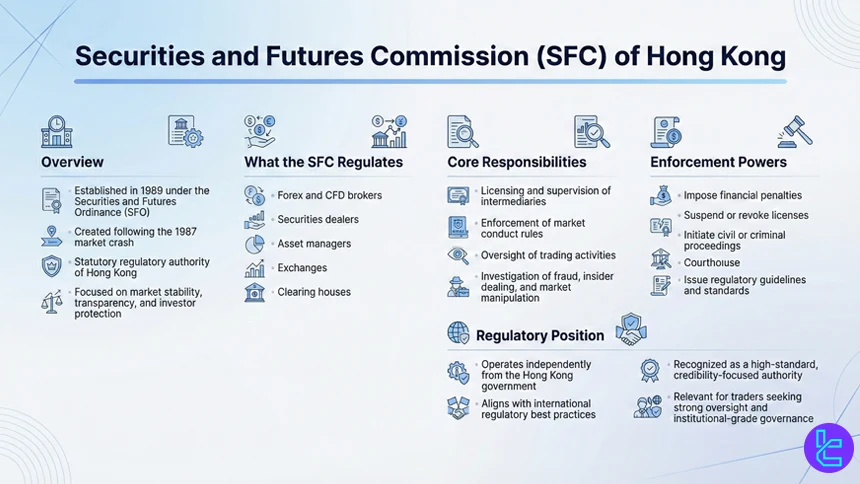
The SFC regulates a wide range of financial market participants, including forex and CFD brokers, securities dealers, asset managers, exchanges, and clearing houses.
Its mandate covers licensing and supervision of intermediaries, enforcement of market conduct rules, oversight of trading activities, and investigation of misconduct such as fraud, market manipulation, and insider dealing.
Operating independently from the Hong Kong government, the SFC has broad enforcement powers, including the ability to impose fines, suspend or revoke licenses, and initiate civil or criminal proceedings.
It also plays a key role in setting regulatory standards, issuing guidelines, and aligning Hong Kong’s financial markets with international best practices.
Due to Hong Kong’s position as a global financial hub, SFC regulation is widely regarded as high-standard and credibility-focused, making it particularly relevant for traders seeking strong oversight and institutional-grade market governance.
What are the Pros and Cons of SFC Regulation?
The Securities and Futures Commission applies a rigorous regulatory framework that prioritizes market integrity, transparency, and professional conduct. Its oversight is designed to protect investors and maintain confidence in Hong Kong’s financial system.
However, the SFC’s strict compliance standards and conservative risk controls can limit flexibility for brokers and retail traders compared to offshore regulators.
Pros | Cons |
Strong regulatory oversight in a major global financial hub | No statutory investor compensation scheme for forex/CFD clients |
Strict licensing, capital, and compliance requirements | Lower leverage availability compared to offshore jurisdictions |
Robust enforcement powers, including fines and license revocation | High compliance costs for brokers |
Emphasis on transparency and market integrity | Limited promotional incentives and bonuses |
High credibility among institutional and professional traders | Smaller number of retail-focused forex brokers |
Does SFC Enforce Any Leverage Limitations?
Yes, the SFC enforces strict leverage limitations on licensed intermediaries offering leveraged products such as forex and CFDs to retail clients.
In Hong Kong, margin requirements are regulated under the SFC’s Code of Conduct for Persons Licensed by or Registered with the SFC. Unlike offshore jurisdictions that may allow leverage of 1:500 or higher, SFC-regulated brokers typically operate under significantly more conservative leverage structures.
In practice, leverage for retail forex trading is often capped around 1:20, depending on the currency pair and internal risk classification.
These limitations are designed to reduce excessive risk exposure and protect retail investors from rapid capital erosion during volatile market conditions. Brokers must also implement proper risk management controls, including margin call procedures and client risk disclosures.
For professional investors, leverage conditions may differ, but eligibility is strictly defined and requires meeting asset or income thresholds under Hong Kong regulations.
Overall, SFC leverage rules reflect a risk-based regulatory approach, prioritizing capital preservation and market stability over aggressive trading conditions.
What Rules Must SFC Brokers Adhere to?
Brokers regulated by the Securities and Futures Commission must comply with a strict legal and supervisory framework primarily governed by the Securities and Futures Ordinance and the SFC Code of Conduct.
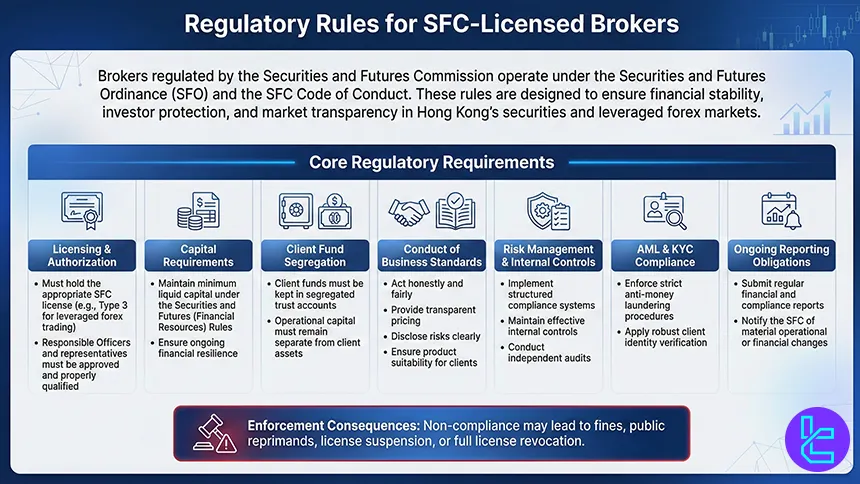
These rules are designed to ensure financial stability, protect investors, and maintain transparency within Hong Kong’s securities and leveraged forex markets.
- Licensing & Authorization: Brokers must hold the appropriate SFC license (e.g., Type 3 for leveraged forex trading) and ensure responsible officers and representatives are properly approved and qualified;
- Capital Requirements: Firms must maintain minimum liquid capital under the Securities and Futures (Financial Resources) Rules to ensure financial resilience;
- Client Fund Segregation: Client funds must be held in segregated trust accounts separate from operational capital;
- Conduct of Business Standards: Brokers must act honestly and fairly, provide transparent pricing, disclose risks clearly, and ensure product suitability;
- Risk Management & Internal Controls: Firms must implement robust compliance systems, internal controls, and independent audit mechanisms;
- AML & KYC Compliance: Strict anti-money laundering and client verification procedures are mandatory;
- Ongoing Reporting Obligations: Brokers must submit regular financial reports and notify the SFC of material operational or financial changes.
Non-compliance may result in disciplinary action, including fines, public reprimands, license suspension, or revocation.
How Can I Check if a Broker is Regulated by the SFC?
Verifying whether a broker is genuinely regulated by the Securities and Futures Commission is a critical step before opening a trading account. Hong Kong maintains a publicly accessible licensing database that allows investors to independently confirm a firm’s authorization status.
To check a broker’s SFC regulation, follow these steps:
- Review the Broker’s Legal Disclosure: Reputable brokers display their SFC license number, licensed entity name, and regulated activity type (e.g., Type 3 - Leveraged Foreign Exchange Trading) in the website footer or legal documents;
- Visit the Official SFC Public Register: Go directly to the SFC’s official website and access the Public Register of Licensed Persons and Registered Institutions. Avoid clicking links provided by the broker to reduce the risk of phishing or clone websites;
- Search by License Number or Company Name: Enter the broker’s legal entity name or CE (Central Entity) number exactly as shown on its website. The register will display licensing status, approved activities, responsible officers, and business address;
- Confirm the Status Is “Licensed”: Ensure the firm’s status is listed as “Licensed” or “Registered”. Suspended, revoked, or ceased licenses indicate regulatory issues;
- Check for Regulatory Warnings: The SFC regularly publishes alert lists of suspicious websites and unlicensed entities. If a broker appears on this list, it should be avoided.
By independently verifying a broker through the SFC register, traders can significantly reduce the risk of dealing with unlicensed or clone firms operating in Hong Kong’s financial markets.
Are SFC-Regulated Brokers Allowed to Offer Crypto Trading?
Yes, brokers regulated by the SFC may offer crypto-related services, but only within a clearly defined regulatory framework.
In Hong Kong, the regulatory treatment of cryptocurrencies depends on whether the digital asset qualifies as a “security” or “futures contract” under the SFO. If a crypto product falls within this definition, it becomes subject to SFC oversight and licensing requirements.
For virtual asset trading platforms (VATPs), the SFC introduced a dedicated licensing regime requiring operators to comply with strict standards related to custody, capital adequacy, cybersecurity, risk disclosure, and investor protection.
Since June 2023, Hong Kong has implemented a formal virtual asset regulatory framework allowing licensed platforms to serve retail investors under controlled conditions.
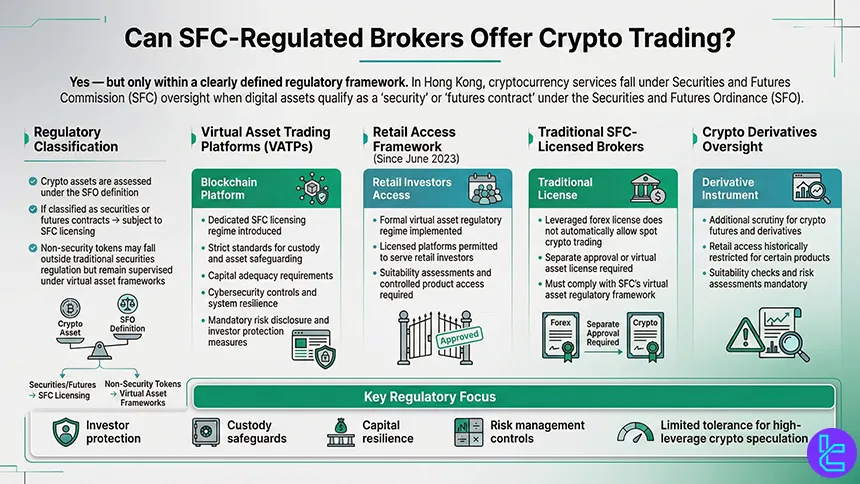
However, traditional SFC-licensed leveraged forex brokers do not automatically receive authorization to offer spot crypto trading. If they intend to provide virtual asset services, they must obtain the appropriate license or approval under the SFC’s virtual asset framework.
Crypto derivatives are subject to additional scrutiny. The SFC has historically restricted retail access to certain crypto futures products and applies suitability and risk assessment requirements before intermediaries can distribute virtual asset-related products.
In summary, SFC-regulated entities can offer crypto trading, but only under specific licensing categories and compliance standards. The regulatory focus emphasizes investor protection, custody safeguards, and risk management rather than broad, high-leverage crypto speculation.
SFC Investor Compensation Schemes
Hong Kong operates an investor compensation framework under the supervision of the Securities and Futures Commission. The scheme is administered through the Investor Compensation Company Limited (ICC) and funded by the Investor Compensation Fund (ICF).
The Investor Compensation Fund is designed to compensate investors if a licensed intermediary or authorized financial institution defaults in relation to exchange-traded products. Coverage generally applies to transactions conducted on recognized exchanges such as the Hong Kong Exchanges and Clearing Limited(HKEX).
Under current rules, eligible claimants may receive compensation of up to 500,000 HKD per investor per default for exchange-traded securities and futures contracts.
However, it is important to note that leveraged forex trading conducted over-the-counter (OTC) is typically not covered by the Investor Compensation Fund. Therefore, retail forex traders using SFC-licensed leveraged forex brokers do not benefit from the same statutory compensation scheme that applies to exchange-traded securities.
In practice, investor protection in Hong Kong relies more heavily on strict licensing requirements, capital adequacy rules, client fund segregation, and strong enforcement powers rather than broad compensation coverage for all product types.
Does SFC Enforce Any Tax Obligations?
No, the Securities and Futures Commission does not impose or collect taxes on brokers or traders. Its role is strictly regulatory and supervisory, focusing on licensing, market conduct, investor protection, and enforcement under the SFO.
Taxation in Hong Kong is administered separately by the Inland Revenue Department (IRD) under the Inland Revenue Ordinance. The SFC has no authority over tax policy, tax reporting, or tax collection.
From a trader’s perspective, Hong Kong is known for its relatively simple tax structure. There is no capital gains tax in Hong Kong.
However, if trading activity is deemed to constitute a business, profits may be subject to profits tax, currently capped at 16.5% for corporations and 15% for unincorporated businesses (subject to prevailing tax rules and assessments by the IRD).
For brokers, tax obligations depend on their corporate structure and place of incorporation. SFC licensing does not grant tax exemptions, nor does it determine tax liability.
In summary, the SFC is a financial regulator, not a tax authority. Any tax obligations related to trading activities fall under Hong Kong’s tax laws and the jurisdiction of the Inland Revenue Department and not the SFC.
How Does SFC Differ from Offshore Regulatory Authorities?
The SFC is considered a high-standard financial regulator operating within one of Asia’s leading international financial centers.
In contrast, offshore regulatory authorities, often based in jurisdictions such as the Bahamas, Seychelles, or Vanuatu, generally apply lighter supervision and lower entry requirements for brokers.
The key differences lie in regulatory intensity, investor protection standards, capital requirements, and enforcement powers.
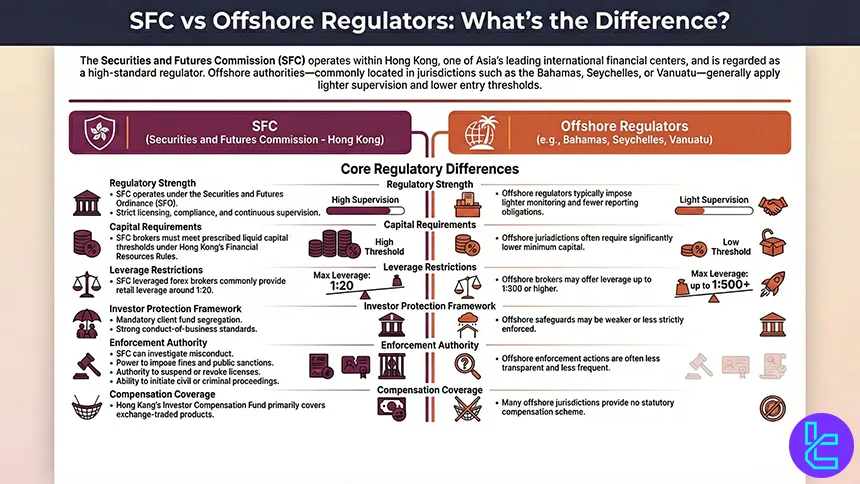
Core Differences Between SFC and Offshore Regulators:
- Regulatory Strength: The SFC operates under the Securities and Futures Ordinance (SFO) with strict licensing, compliance, and ongoing supervision; offshore regulators typically impose less rigorous monitoring and reporting obligations;
- Capital Requirements: SFC-licensed brokers must meet prescribed liquid capital thresholds under Hong Kong’s Financial Resources Rules; offshore jurisdictions often require significantly lower minimum capital;
- Leverage Restrictions: SFC-regulated leveraged forex brokers commonly offer lower leverage (often around 1:20 for retail clients); offshore brokers may offer leverage up to 1:500 or higher;
- Investor Protection Framework: Hong Kong enforces client fund segregation and strong conduct-of-business rules; offshore regulators may have weaker or less strictly enforced client asset safeguards;
- Enforcement Authority: The SFC has broad powers to investigate misconduct, impose fines, suspend licenses, and pursue civil or criminal proceedings; enforcement in offshore jurisdictions is often less transparent and less frequent;
- Compensation Coverage: Hong Kong’s Investor Compensation Fund applies primarily to exchange-traded products, whereas many offshore jurisdictions provide no statutory compensation scheme at all.
SFC in Comparison to Other Regulating Authorities
The SFC of Hong Kong is widely regarded as a Tier-1 regulator in Asia, emphasizing capital adequacy, strict supervision, and investor protection.
Compared to the FCA (UK) and ASIC (Australia), SFC oversight is similarly stringent, while the IFSC (Belize) follows a lighter, offshore-oriented framework. The table below outlines key regulatory differences in capital requirements, leverage limits, compensation schemes, and client protection mechanisms across these four authorities.
Parameter | SFC (Hong Kong) | ASIC (Australia) | FCA (UK) | IFSC (Belize) |
Minimum Capital Requirement | Variable; typically HKD 5 million+ depending on license type and activity | Between AU$500,000 and AU$1,000,000 | £125,000–£730,000+ depending on model | Generally lower; depends on license category (offshore framework) |
Client Fund Segregation | Required under SFO client money rules | Required | Required under CASS rules | Required under IFSC guidelines |
Compensation Scheme | Investor Compensation Fund (up to HKD 500,000 per investor) | No broad statutory national compensation fund (AFCA dispute resolution applies) | FSCS (up to £85,000 per eligible client) | No formal investor compensation fund |
Leverage Limits (Retail) | Generally capped around 1:20–1:30 depending on asset class | Up to 1:30 for retail clients | Up to 1:30 on major FX pairs | Often allows higher leverage (e.g., 1:500+) |
Negative Balance Protection | Required for licensed intermediaries offering leveraged products | Required for retail clients | Mandatory for retail clients | Not strictly mandated in all cases |
Reporting & Audits | Strict financial reporting, on-site inspections, and continuous monitoring | Ongoing financial and compliance reporting | Ongoing reporting and supervisory reviews | Periodic reporting; comparatively lighter supervision |
Conclusion
SFC is a high-tier regulatory authority for the Forex industry. Usually, brokers supervised by top-tier bodies are reliable and reputable, but come with limitations in leverage and bonuses. Nevetheless, FOREX.com, Swissquote, Interactive Brokers, and ATFX are some of the recommended brokers regulated by the SFC.
To learn how we chose each of the brokers listed in this article, check out our Forex methodology.