







Corporate traders can choose from 6leading global business brokerage providers offering access to 3,000+ to 3,000,000+ financial instruments, leverage up to 1:1000, and minimum spreads starting from 0.0 pips. Trustpilot scores range between 3.5 and 4.4 out of 5, based on more than 48,000 combined user reviews, reflecting measurable client satisfaction across platforms.
Here are the best business brokers currently available:
 | Interactive Brokers | |||
 | eToro | |||
 | SAXO Bank | |||
| 4 |  | AMP | ||
| 5 |  | Optimus | ||
| 6 |  | Swissquote |
Trustpilot Ratings for Business Brokerages
Trustpilot ratings provide insight into real client experiences, service reliability, platform usability, and withdrawal efficiency. For corporate traders evaluating business brokerage accounts, third-party reviews can highlight strengths and recurring issues that may not appear in marketing materials. While ratings should not be the sole decision factor, they offer useful sentiment analysis at scale.
Among leading firms, AMP Futures holds a 4.4/5 rating from 891 reviews, while eToro maintains a 4.2/5 score from over 30,000 users. Interactive Brokers, Swissquote, and Saxo Bank reflect moderate ratings between 3.5 and 3.6, often influenced by complexity and professional-level platforms:
Broker | Trustpilot Score | Number of Reviews |
AMP Futures | 4.4/5 ⭐️ | 891 |
4.3/5 ⭐️ | 152 | |
eToro | 4.2/5 ⭐️ | 30,656 |
Interactive Brokers | 3.6/5 ⭐️ | 5,041 |
Swissquote | 3.6/5 ⭐️ | 3,884 |
3.5/5 ⭐️ | 8,061 |
Minimum Spreads in Business Brokerages
Minimum spread data is essential for corporate traders seeking cost efficiency, especially for high-volume forex and CFD trading. The spread, the difference between bid and ask prices, directly impacts transaction costs. Business accounts operating on ECN or DMA models often advertise raw spreads starting from 0.0 pips under optimal liquidity conditions.
Brokers such as Swissquote, CapTrader, Optimus Futures, eToro, and Interactive Brokers list minimum spreads starting at 0.0 pips, while Saxo Bank reports minimum spreads from 0.4 pips depending on asset class and account tier:
Broker | Minimum Spread |
Swissquote | 0.0 pips |
CapTrader | 0.0 pips |
Optimus Futures | 0.0 pips |
0.0 pips | |
0.0 pips | |
Saxo Bank | 0.4 pips |
Variety of Accounts in Business Brokerages
The range of available account types determines how flexible a broker is for corporate and institutional clients. Business traders may require specialized structures such as corporate entities, trusts, partnerships, retirement accounts, or advisory accounts depending on jurisdiction and compliance requirements.
Interactive Brokers offers one of the widest selections, including institutional and trust accounts with leverage up to 1:1000 (jurisdiction dependent). eToro and Optimus Futures provide corporate and professional options, while Swissquote and Tastytrade focus on tiered or entity-based models with more conservative leverage structures:
Broker Name | Account Types | Max. Leverage |
Interactive Brokers | Institutional, Individual, Joint, Trust, Retirement, Non-Professional Advisor | 1:1000 |
eToro | Corporate, Personal, Professional, Islamic | 1:400 |
Optimus Futures | Corporate, Individual, Joint, IRA, Superannuation, LLC, Trust, Partnership | 1:400 |
Corporate, Individual, Joint, IRA, LLC, Partnership, Trust | 1:100 | |
Swissquote | Prime, Premium, Standard, Professional | 1:100 |
TastyTrade | Entity Corporate, Retirement, Standard | 1:2 |
Instruments Offered by Business Brokerages
The number of tradable instruments reflects the breadth of diversification opportunities available to corporate clients. A broader asset offering allows businesses to hedge risk, access global markets, and diversify across forex, stocks, ETFs, bonds, futures, and derivatives from a single platform.
Swissquote reports access to over 3 million instruments, while CapTrader offers more than 1.2 million. Saxo Bank lists 71,000+ instruments, and eToro and Interactive Brokers provide thousands of tradable assets across global exchanges:
Broker | Number of Trading Instruments |
3M+ | |
CapTrader | 1.2M+ |
Saxo Bank | 71,000+ |
eToro | 7,000+ |
Interactive Brokers | 4,900+ |
Optimus Futures | N/A |
Introduction to the Top 5 Business Brokers
In this section, we analyze five globally recognized brokers, Interactive Brokers, eToro, Saxo Bank, AMP Futures, and Optimus Futures, comparing their regulation, leverage, platforms, minimum deposits, and overall suitability for business and corporate accounts.
These brokers vary significantly in focus: some emphasize global multi-asset access and institutional-grade platforms, while others specialize in futures trading or social investment ecosystems. The following breakdown will help you evaluate which provider aligns best with your company’s trading strategy, compliance requirements, and capital structure.
Interactive Brokers
Interactive Brokers (IBKR) is a global electronic brokerage serving over 2.9 million client accounts across 150+ markets. After completing the Interactive Brokers registration process, traders gain access to 100+ forex pairs and 90+ global exchanges, making it a powerful multi-asset platform for stocks, ETFs, options, futures, bonds, and more.
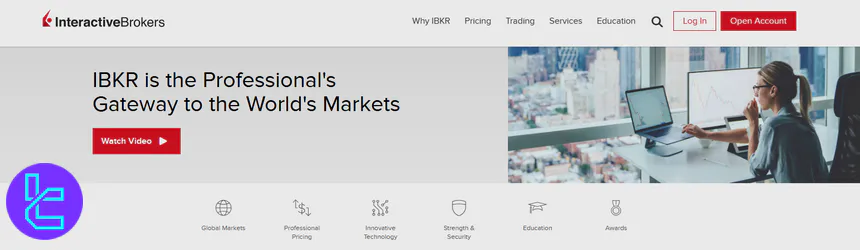
Founded in 1977 by Thomas Peterffy in Greenwich, Connecticut, IBKR evolved from Timber Hill into a NASDAQ-listed financial powerhouse. Today, it operates in 34 countries, supports 27 currencies, and serves institutional and retail traders seeking direct global market access.
Interactive Brokers is regulated by top-tier authorities including the U.S. Securities and Exchange Commission (SEC), Financial Industry Regulatory Authority (FINRA), Financial Conduct Authority (FCA), and other international bodies. U.S. accounts receive SIPC protection up to $500,000, while UK clients benefit from FSCS coverage up to £85,000.
Under CEO Milan Galik since 2019, IBKR continues expanding its electronic brokerage dominance. With proprietary platforms like Trader Workstation (TWS) and IBKR Mobile, spreads from 0.1 pips, and commissions from $0, the broker appeals strongly to active and professional traders.
Account Types | Individual, Joint, Trust, Retirement, Institutional, Non-Professional Advisor |
Regulating Authorities | SEC, FINRA, NYSE, FCA, CBI, ASIC, MAS, etc. |
Minimum Deposit | $1 |
Deposit Methods | Bank Transfer, Check |
Withdrawal Methods | Bank Transfer, Check |
Maximum Leverage | Up to 1:1000 (varies by entity & region) |
Trading Platforms & Apps | Trader Workstation (TWS), IBKR Mobile, Client Portal, IBKR APIs |
Interactive Brokers Pros and Cons
Before opening an account, traders should weigh Interactive Brokers’ competitive pricing, global market depth, and strong regulation against its limited payment methods and occasionally inconsistent customer support:
Pros | Cons |
Low commissions and tight spreads | Limited payment methods (no cards/e-wallets) |
Access to 150+ global markets | Customer support quality can vary |
Strong top-tier regulation | Complex platform for beginners |
Advanced proprietary trading platforms | Trustpilot score below industry leaders |
eToro
eToro is a globally recognized multi-asset broker founded in 2007 and headquartered in Tel Aviv. Serving millions of users worldwide, it offers access to 6,000+ instruments across forex, stocks, ETFs, commodities, indices, and cryptocurrencies through a proprietary social trading platform.
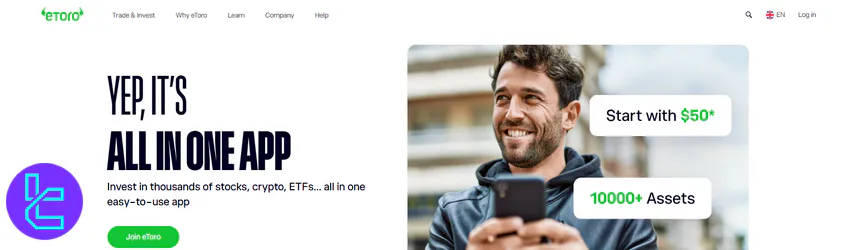
The broker is regulated by top-tier authorities, including the Financial Conduct Authority (FCA), Cyprus Securities and Exchange Commission (CySEC), Australian Securities and Investments Commission (ASIC), and Securities and Exchange Commission (SEC) for its U.S. entity, reinforcing credibility and client fund protection.
eToro stands out for its innovative investment features, including CopyTrader, Smart Portfolios, and Crypto Staking, which are available upon completing eToro registration and verification steps. Retail traders can start with a $10 minimum deposit, while professional clients may access leverage up to 1:400, depending on regulatory jurisdiction.
The platform supports multiple payment options such as PayPal, Skrill, Neteller, Trustly, and bank transfers. However, it does not offer MetaTrader 4 or MetaTrader 5, focusing entirely on its in-house web and mobile trading ecosystem.
Account Types | Personal, Professional, Corporate, Islamic |
Regulating Authorities | FCA, CySEC, MFSA, FSRA, ASIC, FSA Seychelles, GFSC |
Minimum Deposit | $10 |
Deposit Methods | eToro Money, Credit/Debit Card, Bank Transfer, PayPal, Neteller, Skrill, Trustly, iDEAL, Sofort, Przelewy24 |
Withdrawal Methods | eToro Money, Credit/Debit Card, Bank Transfer, PayPal, Neteller, Skrill, Trustly, iDEAL |
Maximum Leverage | 1:400 (Professional) / 1:30 (Retail) |
Trading Platforms & Apps | Proprietary Web Platform, Android App, iOS App |
eToro Pros and Cons
Before choosing eToro, traders should balance its powerful social investing ecosystem, strong regulation, and wide asset coverage against higher CFD fees and the absence of MT4/MT5 integration:
Pros | Cons |
Innovative social & copy trading features | No MT4/MT5 support |
Regulated in multiple tier-1 jurisdictions | No phone support |
Access to 6,000+ tradable instruments | CFD spreads can be relatively high |
User-friendly proprietary platform | $5 withdrawal fee |
Saxo Bank
Saxo Bank, a prominent Danish investment bank founded in 1992, offers a broad range of trading services globally. With over 71,000 financial instruments available across various markets, including forex, stocks, commodities, and crypto, it caters to both retail and institutional investors seeking comprehensive trading solutions.
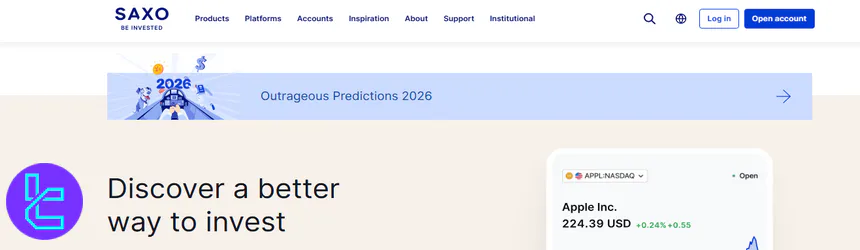
The broker boasts strong regulatory oversight, operating under the jurisdiction of seven Tier-1 authorities, including the FCA (UK), ASIC (Australia), and FINMA (Switzerland). With over $100 billion in client assets, Saxo Bank ensures that client funds are safe, supported by segregated accounts and negative balance protection.
Saxo Bank is renowned for its cutting-edge trading platforms, including SaxoTrader Go, SaxoTrader Pro, and Saxo Investor. These platforms offer advanced charting tools, algorithmic trading capabilities, and comprehensive market research to aid investors in making informed decisions. It is consistently recognized for its high-quality service, winning awards like "Best FX Prime" and "Best Trading Platform."
The broker provides access to over 50 global exchanges upon completing the Saxo Bank registration process and a variety of asset classes, making it a powerful platform for professional traders. With a focus on both traditional investing and sophisticated trading strategies, Saxo Bank delivers an excellent environment for those looking to diversify their portfolios.
Account Types | Classic, Platinum, VIP, Pro |
Regulating Authorities | FSA, FCA, ASIC, FINMA, MAS, SFC, JFSA |
Minimum Deposit | $0 (Classic), $200,000 (Platinum), $1,000,000 (VIP), $500,000 (Pro) |
Deposit Methods | Bank Wire, Virtual Account Number (VAN), EFT/Telegraphic Transfer |
Withdrawal Methods | Bank Wire (online and manual withdrawals) |
Maximum Leverage | 1:30 (Classic, Platinum, VIP), 1:66 (Pro) |
Trading Platforms & Apps | Saxo Investor, SaxoTrader Go, SaxoTrader Pro |
Saxo Bank Pros and Cons
Saxo Bank offers a wide range of benefits that make it an appealing choice for both novice and professional traders. However, like any broker, it has its limitations. Below, we explore the main advantages and drawbacks of trading with Saxo Bank, helping you decide if it aligns with your trading needs:
Pros | Cons |
Extensive range of 71,000+ tradable assets | High fees for smaller accounts |
Strong regulatory oversight across 7 Tier-1 authorities | A complex fee structure may overwhelm beginners |
Advanced trading platforms for professional traders | Limited cryptocurrency offerings |
High-level security with segregated funds and negative balance protection | No services for U.S. clients |
AMP Futures
AMP Futures, based in Chicago, is a futures brokerage that provides access to a variety of financial instruments, including stock indices, currencies, metals, and more. The broker offers its services through over 50 advanced trading platforms such as MetaTrader 5 and TradingView. Founded in 2010, AMP Futures operates under Tier-1 regulations from the CFTC and NFA, ensuring a secure trading environment for its clients.

One of AMP Futures' key advantages is its low entry barrier. With a minimum deposit of just $100, traders can access diverse markets and take advantage of leverage of up to 1:100. AMP Futures is regulated in the U.S. by the Commodity Futures Trading Commission (CFTC) and the National Futures Association (NFA), ensuring a high level of trust and accountability in its operations.
AMP Futures provides various account types to cater to different traders, including Individual, Joint, IRA, Corporate, LLC, Partnership, and Trust accounts. The broker also supports unique features like auto trading and copy trading, making it suitable for both beginner and experienced traders looking to expand their strategies.
The broker offers comprehensive customer support available 24/7 and an straightforward AMP Futures registration process with multiple channels such as live chat, email, phone, and even remote desktop support. This ensures that traders can get the help they need, regardless of the time zone or trading issue.
Account Types | Individual, Joint, IRA, Corporate, LLC, Partnership, Trust |
Regulating Authorities | CFTC, NFA (U.S.) |
Minimum Deposit | $100 |
Deposit Methods | Bank Wire, ACH, Check |
Withdrawal Methods | Bank Wire, ACH |
Maximum Leverage | 1:100 |
Trading Platforms & Apps | MetaTrader 5, TradingView, NinjaTrader, Rithmic, and 46+ more solutions |
AMP Futures Pros and Cons
AMP Futures offers several advantages, including ultra-low pricing and access to a wide variety of trading platforms. However, there are some limitations such as geo-restrictions and limited market offerings. Below, we highlight the key pros and cons of using AMP Futures as a futures trading broker:
Pros | Cons |
Ultra-low pricing structure | Geo-restrictions in certain regions |
Multiple free trading platforms | Limited market offerings |
24/7 customer support | Limited account types |
Various data feed options (CQG, Rithmic) | No investor protection fund |
Optimus Futures
Optimus Futures, established in 2004, is a highly regarded U.S.-based futures broker offering advanced trading solutions. The company is regulated by top-tier authorities like the National Futures Association (NFA) and the Commodity Futures Trading Commission (CFTC), providing a secure and compliant trading environment for U.S. traders.
The broker offers 7 diverse account types, including Individual, Joint, IRA, and Corporate accounts, along with low commissions starting from $0.05 per side. Optimus Futures caters to a wide range of futures traders with 20 different micro futures contracts, enabling flexible and cost-effective trading across major markets.
Optimus Futures supports a variety of platforms, including proprietary solutions like Optimus Flow and Optimus Web, alongside popular platforms like TradingView, Sierra Chart, and MetaTrader 5. The broker provides robust charting tools, technical analysis features, and seamless integration for all trading strategies, from discretionary to algorithmic.
Focused on providing institutional-grade access, Optimus Futures connects clients with major Futures Clearing Merchants (FCMs) and ensures segregated client funds for each user who has completed Optimus Futures registration steps. The broker also offers a volume-based rebate system and flexible leverage, making it a solid choice for active futures traders seeking low-latency execution.
Account Types | Individual, Joint, IRA, Corporate, LLC, Trust, Partnership |
Regulating Authorities | NFA, CFTC |
Minimum Deposit | $50 |
Deposit Methods | Bank Wire, ACH, Checks |
Withdrawal Methods | Bank Transfer |
Maximum Leverage | 1:400 |
Trading Platforms & Apps | Optimus Flow, MetaTrader 5, TradingView, Sierra Chart |
Optimus Futures Pros and Cons
Below, we outline the main advantages and disadvantages of trading with Optimus Futures to help you evaluate whether its execution-only model fits your trading strategy:
Pros | Cons |
Regulated by NFA & CFTC (Tier-1 oversight) | High minimum deposit of $50 |
Low commissions from $0.05 | Limited withdrawal methods (bank transfers only) |
Multiple advanced trading platforms | No e-wallet or credit card funding options |
Segregated client funds for security | No Islamic or PAMM accounts available |
How We Choose the Best Business Forex Brokers
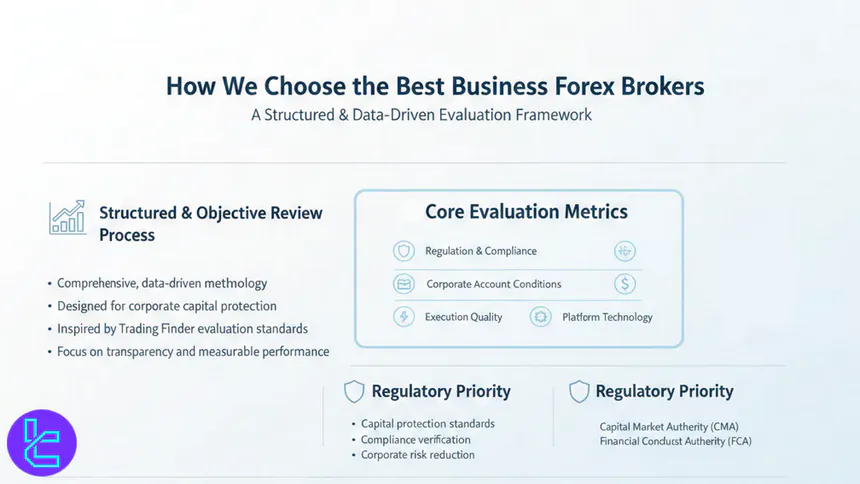
Choosing the best business forex brokers requires a structured and data-driven evaluation process. Because companies entrust significant corporate capital to these platforms, we apply a comprehensive review framework inspired by the methodology of Trading Finder, emphasizing transparency, objectivity, and measurable performance indicators.
Our analysis is based on 19 core metrics that assess regulation, corporate account conditions, fee transparency, execution quality, and platform technology. Regulatory verification through authorities such as the Capital Market Authority and the Financial Conduct Authority is prioritized to ensure capital protection and compliance standards.
Beyond licensing, we evaluate broker background, trading instruments, spreads, commissions, deposit and withdrawal processes, and the availability of advanced platforms like MetaTrader and cTrader.
Additional factors include customer support responsiveness, corporate onboarding efficiency, copy trading infrastructure, educational resources, and independent client feedback. This balanced scoring system ensures that only brokers meeting strict regulatory, operational, and cost-efficiency standards qualify among the best business forex brokers.
What is a Business or Corporate Account?
A business or corporate brokerage account is a trading or investment account opened under a registered legal entity such as an LLC, corporation, partnership, or trust. Unlike personal accounts, ownership and legal responsibility belong to the company. These accounts allow businesses to invest retained earnings, hedge currency exposure, or actively trade forex, equities, commodities, and derivatives.
Opening a corporate account requires enhanced due diligence under AML and KYC rules. Brokers typically request incorporation documents, tax IDs, proof of business address, and identification of directors and ultimate beneficial owners (UBOs). Corporate accounts often support larger capital allocations and structured financial reporting aligned with company accounting standards.
Key Characteristics:
- Registered under a legal entity
- Requires corporate documentation
- Separate from personal finances
- Suitable for business capital management
- Supports multi-user access
What Are the Pros and Cons of Business Brokers?
Business brokers facilitate the buying and selling of companies, managing valuation, marketing, negotiations, and due diligence. Commission fees commonly range between 5% and 10% of transaction value, depending on deal size and industry. Their networks and expertise can accelerate deal timelines and improve pricing outcomes.
However, broker fees reduce net returns, and not all brokers have industry-specific knowledge. Some may represent both buyer and seller, creating potential conflicts of interest. Proper due diligence on track record and fee structure is essential before engagement.
Pros | Cons |
Professional valuation expertise | Commission costs |
Access to confidential buyer networks | Possible conflict of interest |
Negotiation and deal structuring support | No guaranteed deal closure |
Reduced time-to-sale | Variable industry specialization |
How Does Business Accounts Work?
Business brokerage accounts function under a legal entity rather than an individual, meaning the company itself becomes the account holder. The onboarding process typically involves submitting incorporation documents, proof of directors and beneficial owners, tax identification details, and a corporate resolution authorizing trading activity.
Once approved, the account is linked to the company’s official bank account, ensuring all funding and withdrawals are conducted transparently and in compliance with AML and regulatory standards.
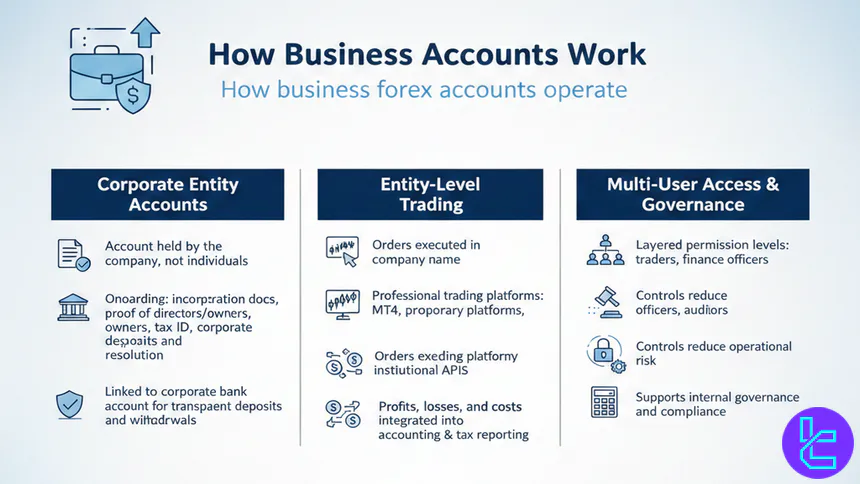
Funds are deposited directly from the corporate bank account, and all trading activity is executed in the entity’s name. Orders are placed through professional trading platforms such as MetaTrader 4, MetaTrader 5, proprietary broker platforms, or institutional APIs for automated and high-frequency strategies.
Profits, losses, commissions, swaps, and other costs are reflected within the company’s accounting system and integrated into financial statements, treasury management, and tax reporting.
Many brokers offer structured access controls, allowing companies to assign different permission levels to directors, traders, compliance officers, and accountants. For example, a trader may execute positions, while a finance officer can approve withdrawals, and an auditor may access read-only reporting. This layered control reduces operational risk and strengthens internal governance.
Operational Structure:
- Company-funded deposits only
- Entity-level trade execution
- Corporate tax reporting
- Multi-user permission settings
- Dedicated relationship management (often available)
How Wide Are the Spreads in Business Accounts?
Spreads in business brokerage accounts depend on several structural and market variables, including the broker’s execution model, underlying liquidity providers, asset class, and the company’s trading volume.
For major forex pairs such as EUR/USD, institutional or ECN-style corporate accounts can offer raw spreads starting from 0.0 to 0.3 pips during high-liquidity sessions (typically London–New York overlap). These accounts usually charge a transparent commission per lot instead of widening the spread.
In contrast, market-maker or dealing-desk models often bundle trading costs directly into the spread, resulting in average spreads of 1-2 pips on major pairs under normal conditions. While this simplifies pricing, it can be less cost-efficient for high-frequency or large-volume strategies.
Spreads are not static. During major macroeconomic releases (e.g., central bank decisions, CPI reports, geopolitical shocks), liquidity can temporarily thin, causing spreads to widen significantly, sometimes several multiples of their normal range. For corporate traders executing sizable orders, this can materially impact execution cost and slippage.
Spread Factors:
- Broker pricing model (ECN/STP/Market Maker)
- Market volatility
- Trade volume size
- Asset liquidity
- Trading session timing
Non-Trading Fees in Business Accounts
Beyond spreads and commissions, corporate brokerage accounts often include operational costs that can materially impact total trading expenses over time. These non-trading fees are not directly linked to trade execution but relate to account maintenance, funding logistics, platform access, and administrative services.
For businesses operating with lower trading frequency or holding positions long-term, these costs can meaningfully affect overall profitability.
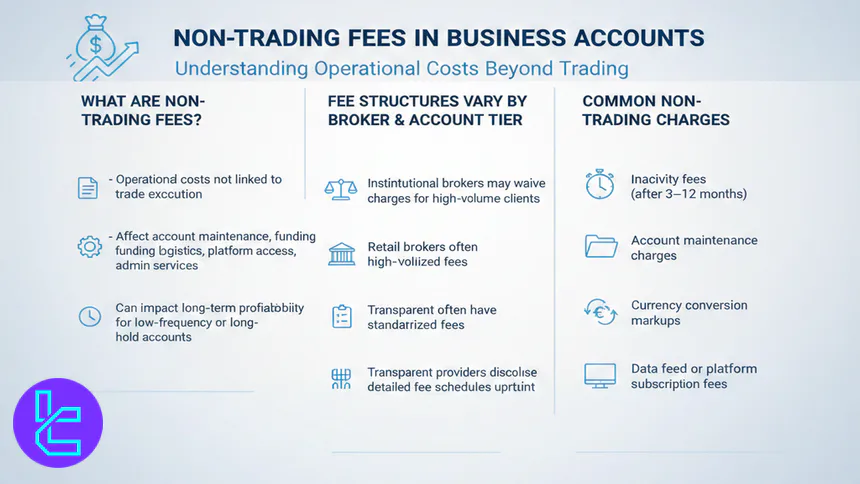
Fee structures vary significantly depending on the broker, jurisdiction, and account tier. Institutional-focused brokers may waive certain charges for high-volume clients, while retail-oriented brokers may apply standardized fees across all account types. Transparent providers disclose a detailed fee schedule prior to activation, enabling companies to evaluate total cost of ownership rather than focusing solely on spreads.
One common charge is the inactivity fee, typically applied after 3 to 12 months without trading activity. This can range from a fixed monthly amount to a percentage deduction from the account balance. Account maintenance fees may also apply, especially for corporate or institutional accounts that require enhanced reporting, compliance monitoring, or dedicated relationship management.
Typical Non-Trading Costs:
- Inactivity fees (after 3-12 months)
- Account maintenance charges
- Withdrawal or wire transfer fees
- Currency conversion markups
- Data feed or platform subscription fees
Who is a business account designed for?
Business brokerage accounts are structured for legal entities that need to invest, hedge, or actively trade using company capital. Unlike personal accounts, these accounts are opened in the name of a registered entity, such as a corporation, LLC, or partnership, allowing financial activity to remain fully separated from individual ownership. This structural distinction strengthens accounting clarity, regulatory compliance, and corporate governance.
These accounts are particularly valuable for companies managing surplus cash reserves. Instead of leaving retained earnings idle, corporations can allocate capital into diversified portfolios including equities, ETFs, bonds, commodities, or forex markets.
For firms exposed to currency fluctuations, such as import/export businesses or multinational startups, corporate trading accounts also provide direct access to FX hedging strategies that help stabilize cash flow and protect margins.
Professional investment entities such as hedge funds and proprietary trading firms rely on business brokerage accounts for high-volume execution, leverage access, advanced reporting, and multi-user permission controls. Similarly, family offices managing generational wealth often prefer entity-based structures for tax planning, centralized oversight, and asset protection.
Ideal Users:
- Corporations investing retained earnings
- Hedge funds and trading firms
- Import/export companies hedging FX risk
- Family offices
- Partnerships with shared capital
The Importance of Regulation in Business Forex Brokers
Regulation is one of the most critical factors when selecting a business forex broker, particularly for corporate clients allocating significant capital. Regulatory oversight ensures that brokers operate under strict financial, operational, and compliance standards designed to protect client assets and maintain market integrity.
Well-established authorities such as the Financial Conduct Authority, Australian Securities and Investments Commission, U.S. Securities and Exchange Commission, and Cyprus Securities and Exchange Commission impose licensing requirements that include minimum capital thresholds, internal risk controls, compliance reporting, and operational transparency.
Brokers under these regulators must maintain segregated client accounts, meaning company funds are held separately from the broker’s operating capital. This reduces the risk of misuse and provides a layer of protection if the broker faces financial distress.
For corporate traders executing large positions or maintaining substantial balances, counterparty risk is a serious consideration. A regulated broker is subject to periodic audits, financial reporting obligations, and supervisory reviews, which increase transparency and accountability. In contrast, unregulated or offshore entities may lack enforceable investor protections, increasing exposure to operational or solvency risk.
Regulatory Benefits:
- Segregated client funds
- Capital adequacy requirements
- Regular financial audits
- Investor protection frameworks
- Reduced fraud risk
Do the Business Accounts Offer Swap-Free Options?
Swap-free or Islamic accounts eliminate overnight interest charges on open positions. Some brokers extend this option to corporate entities where applicable, particularly in regions where Sharia-compliant finance is relevant.
Some brokers extend swap-free options to corporate entities, particularly in regions where Islamic finance is widely practiced. However, corporate eligibility is not automatic. Brokers typically review documentation to determine whether the business qualifies under their internal compliance policies. In many cases, swap-free access is more readily available to individual clients than to corporate accounts.
It is important to understand that swap-free does not necessarily mean cost-free. To offset the removal of overnight interest, brokers may implement alternative fee structures. These can include slightly wider spreads, fixed administrative fees per lot, or charges applied after a specific holding period.
Jurisdiction also plays a significant role. Regulatory frameworks in certain countries may restrict how swap-free accounts are structured, particularly for leveraged corporate trading. As a result, availability and pricing models can vary substantially between brokers and regions.
Swap-Free Considerations:
- Eligibility criteria for businesses
- Alternative fee structures
- Maximum holding period rules
- Regulatory approval limitations
- Spread adjustments
What Should I Consider When Choosing a Business Account?
Selecting the right business brokerage account requires evaluating cost structure, regulation, execution quality, and operational flexibility. Corporate trading often involves larger capital allocations, making risk management features particularly important.
First, assess the broker’s regulatory standing and jurisdiction. Strong oversight under reputable financial authorities enhances capital protection and operational transparency. For corporate accounts, where balances may be substantial, counterparty stability and fund segregation policies are critical risk-management factors.
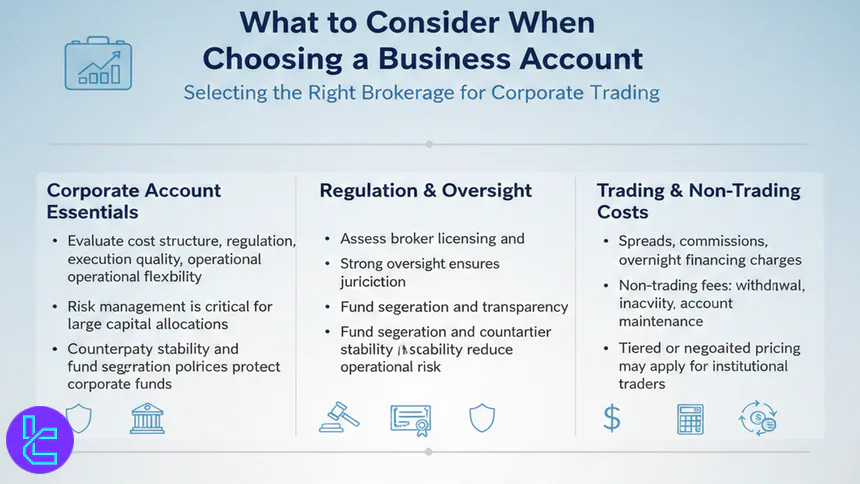
Next, analyze the full cost structure. This includes spreads, commissions, overnight financing charges, and non-trading fees such as withdrawal or inactivity costs. Institutional or high-volume corporate traders may qualify for tiered pricing models, so it’s important to determine whether negotiated rates are available.
Execution quality is another key consideration. Look for brokers with deep liquidity pools, fast order routing, and minimal slippage, especially if your strategy involves high-frequency trading, scalping, or large-ticket orders. Ask about order execution models (ECN, STP, DMA) and whether the broker provides transparency on execution statistics.
Evaluation Checklist:
- Regulatory license strength
- Spread + commission transparency
- Leverage and margin rules
- Execution speed and slippage history
- Reporting and compliance tools
- Multi-user access controls
What is the Best Forex Account for Business?
There is no single “best” forex account for every company; the optimal choice depends on trading volume, capital size, risk tolerance, and strategic objectives.
Businesses executing high-frequency or large-volume trades typically favor institutional ECN or DMA accounts because they offer raw spreads starting near 0.0 pips, transparent commission-based pricing, and access to deeper liquidity pools. This structure can significantly reduce trading costs over time, especially for active strategies.
For companies prioritizing capital preservation and regulatory assurance, accounts offered by strongly regulated brokers with conservative leverage policies and comprehensive reporting tools may be more appropriate. While leverage may be lower compared to offshore providers, the trade-off often includes enhanced fund segregation, stricter compliance oversight, and improved operational transparency.
Execution quality is another defining factor. Corporate traders placing sizable orders benefit from brokers that aggregate liquidity from multiple providers, reducing slippage and improving fill consistency. Businesses using algorithmic or API-based strategies should also confirm that the broker supports low-latency infrastructure and stable connectivity.
Best Account Features:
- Direct Market Access (DMA)
- Competitive commission rates
- Institutional liquidity
- Negative balance protection (where applicable)
- Dedicated corporate support
Business Account vs. Personal Account vs. Professional Account
A business account is structured for legal entities, offering corporate governance tools and higher transaction capacities. A personal account is intended for individual traders and has simpler onboarding requirements.
Professional accounts, often offered under FCA frameworks, are designed for experienced traders who meet wealth or experience criteria. They provide higher leverage but may reduce certain regulatory protections compared to retail accounts.
Here is a detailed comparison between these accounts:
Parameter | Business Account | Personal Account | Professional Account |
Account Ownership | Registered legal entity (LLC, corporation, partnership) | Individual trader | Individual meeting professional eligibility criteria |
Regulatory Classification | Corporate / Institutional client | Retail client | Professional client (opt-up status under FCA / ESMA rules) |
Leverage Limits | Negotiable; may exceed retail caps depending on jurisdiction | Limited (e.g., 1:30 in FCA/ESMA regions) | Higher leverage (e.g., up to 1:200 or more, jurisdiction dependent) |
Onboarding Requirements | Corporate documents, board resolution, authorized signatories | ID + proof of address | Proof of experience, trading volume, financial portfolio |
Investor Protection | Depends on regulator; may differ from retail protections | Full retail protections (e.g., negative balance protection) | Reduced retail protections |
Risk Management Tools | Advanced tools, multi-user access, treasury integration | Basic trading tools | Advanced trading features |
Capital Requirements | Usually higher minimum deposit | Low to moderate minimum deposit | Moderate to high deposit requirements |
Multi-User Access | Yes (team-based permissions) | No | No |
Purpose | Corporate hedging, proprietary trading, treasury operations | Individual trading and speculation | Experienced high-volume trading |
Compliance Level | High (corporate governance & AML checks) | Standard KYC/AML | Enhanced eligibility verification |
Conclusion
Selecting the right business brokerage account requires balancing cost efficiency, instrument access, leverage, and regulatory strength. Among top providers, AMP Futures leads with a 4.4/5 Trustpilot rating and low minimum deposits of $100, while Interactive Brokers offers 1:1000 leverage across 4,900+ instruments.
eToro stands out with 6,000+ tradable assets and a social trading ecosystem, whereas Saxo Bank and Swissquote deliver broad global market coverage of 71,000+ and 3 million+ instruments, respectively.
Each broker was evaluated according to the criteria outlined in TradingFinder’s Forex methodology.