





Commissions are fees charged by Forex brokers for various operations and transactions made by clients. Keeping them low can make a tangible difference in profits from a trade. Therefore, choosing a broker that is generous in this aspect is important.
The shortlist below consists of brands with the optimal conditions and parameters for low-commission trading.
 | pepperstone | |||
 | XM | |||
 | Exness | |||
| 4 |  | AVATRADE | ||
| 5 |  | BlackBull | ||
| 6 |  | eightcap | ||
| 7 |  | fpmarkets |
Trustpilot Ratings for Low Commission Brokers
Users can freely express their opinions and talk about their experiences with brokers on “Trustpilot”. The table below ranks the mentioned brands based on their ratings on the website.
Broker Name | Trustpilot Rating | Number of Reviews |
AvaTrade | 12,226 | |
FP Markets | 10,059 | |
Exness | 27,149 | |
BlackBull Markets | 3,268 | |
3,337 | ||
Eightcap | 3,629 | |
2.7/5⭐ | 2,992 |
Minimum Trading Commissions in the Candidate Brokers
Trading fees make up the main part of commissions in a broker and must be considered before choosing one. This section outlines the trading fees and ranks the brands based on them.
Broker Name | Min. Trading Commission |
$0 | |
FP Markets | $0 |
$0 | |
BlackBull Markets | $0 |
IC Markets | $0 |
Eightcap | $0 |
Tickmill | $0 |
Maximum Available Leverage in Low Commission Brokers
Brokers can offer different leverages regardless of their approach towards commissions and other fees. Here’s a ranking of the mentioned brokerages based on their leverage offerings.
Broker Name | Max. Leverage |
Exness | Unlimited |
Tickmill | 1:1000 |
City Index | 1:1000 |
FP Markets | 1:500 |
1:500 | |
1:500 | |
AvaTrade | 1:400 |
Number of Tradable Instruments in Brokerages
Every broker offers a specific list of assets and currency pairs. Those with higher reputation and higher-quality services try to keep them updated and growing. Here’s a comparison of mentioned brokers based on this parameter.
Broker Name | Number of Instruments |
BlackBull Markets | 26,000+ |
City Index | 13,500+ |
10,000+ | |
AvaTrade | 1,250+ |
Eightcap | 800+ |
GO Markets | 500+ |
Exness | 200+ |
Top 6 Low Commission Forex Brokers Introduced
In the following sections, six of the brokers mentioned above will be briefly reviewed according to the important parameters for trading with low commissions and decent conditions.
AvaTrade
AvaTrade operates under nine regulatory licenses across Europe, Asia-Pacific, the Middle East, and Africa, making it one of the most widely supervised brokers in the retail trading industry. The broker is authorized by major regulators including the Central Bank of Ireland, ASIC, CySEC, FSCA, ADGM, and ISA.
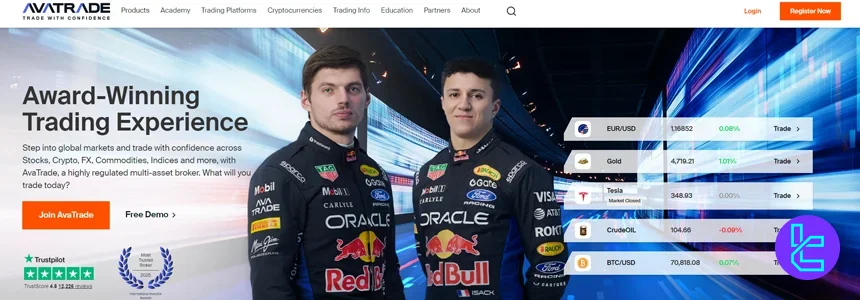
With a minimum deposit of $100, AvaTrade gives traders access to Forex, commodities, indices, stocks, ETFs, cryptocurrencies, and options. The broker supports MetaTrader 4, MetaTrader 5, WebTrader, AvaOptions, and mobile trading apps for both iOS and Android devices.
AvaTrade uses a spread-based pricing model with no direct commissions on trades, deposits, or withdrawals. Margin call and stop out levels are set at 25% and 10%, while negative balance protection and segregated client funds are available across all regulated entities.
The broker supports multiple account types, including Retail, Professional, Islamic, and Demo accounts. Traders can fund accounts through bank wire transfers, credit cards, Skrill, Neteller, WebMoney, and PayPal, while copy trading is available through DupliTrade and AvaSocial.
You can sign up in the AvaTrade rebate program for discounts on trading fees. The table below summarizes the broker’s details.
Account Types | Retail, Professional, Islamic, Demo |
Regulating Authorities | ASIC, CySEC, CBI, FSA, FSCA, MiFID, ADGM, PFSA, ISA |
Minimum Deposit | $100 |
Deposit Methods | Credit/Debit Cards, E-Wallets, Bank Wire Transfer, PayPal |
Withdrawal Methods | Credit/Debit Cards, E-Wallets, Bank Wire Transfer, PayPal |
Maximum Leverage | 1:400 |
Trading Platforms & Apps | MetaTrader 4, MetaTrader 5, Mobile App, WebTrader |
AvaTrade Pros and Cons
AvaTrade is suitable for traders seeking a low-commission broker with strong regulatory oversight, diversified trading platforms, and broad asset coverage. However, its inactivity fees, fixed spread structure on some instruments, and limited advanced account customization may not appeal to every trading style.
Pros | Cons |
Regulated by nine financial authorities globally | Inactivity fee charged after two months without trading |
No commissions on deposits, withdrawals, or most trades | No PAMM or MAM account support |
Supports MT4, MT5, WebTrader, AvaOptions, and mobile trading | U.S. clients are not accepted |
Offers copy trading through AvaSocial and DupliTrade | Fixed spreads on some instruments can be higher during volatile periods |
FP Markets
Established in 2005, FP Markets is a Sydney-based broker known for low-cost trading conditions, institutional-grade execution, and broad regulatory coverage. The broker operates under major authorities including ASIC, CySEC, FSCA, FSC, and FSA entities across multiple jurisdictions.
FP Markets offers two primary account types: Standard and RAW. The Standard account includes spreads from 1.0 pips with no commission, while the RAW account features spreads from 0.0 pips and a commission of $3 per side. Both accounts require a minimum deposit of $50.
It’s worth noting that there is a FP Markets rebate program available for cashback on commissions.
The broker supports a wide range of platforms, including MetaTrader 4, MetaTrader 5, and cTrader. FP Markets also provides access to copy trading, PAMM and MAM solutions, algorithmic trading through Expert Advisors, and more than 10,000 instruments across Forex, stocks, indices, ETFs, commodities, metals, and cryptocurrencies.
Client protection measures include segregated funds, negative balance protection, and compensation schemes of up to €20,000 under selected entities. European clients regulated under CySEC may access the Investor Compensation Fund, while global traders can benefit from leverage up to 1:500 through offshore branches.
You can go through our FP Markets registration guide if you are considering this broker. Here’s a summary of its specifics.
Account Types | Standard, RAW |
Regulating Authorities | ASIC, CySEC, FSC, FSCA, FSA |
Minimum Deposit | $50 |
Deposit Methods | Visa and Master card, Skrill, PayPal, Neteller, Bank Transfer |
Withdrawal Methods | Visa and Master card, Skrill, PayPal, Neteller, Bank Transfer |
Maximum Leverage | 1:500 |
Trading Platforms & Apps | MT4, MT5, cTrader |
FP Markets Pros and Cons
FP Markets combines low commissions, flexible account types, and strong platform support, making it suitable for both active traders and long-term investors. However, the broker does not provide services to US clients and lacks a proprietary trading platform.
Pros | Cons |
Regulated by ASIC, CySEC, FSCA, FSC, and FSA | Not available to US clients |
RAW account spreads from 0.0 pips | No proprietary trading platform |
Supports MT4, MT5, and cTrader | Offshore leverage may increase risk |
Offers copy trading, PAMM, and MAM accounts | Educational content is less extensive than some competitors |
Exness
Founded in 2008 by Petr Valov and Igor Lychagov, Exness has grown into one of the largest retail trading brands worldwide. The broker processes more than $4 trillion in monthly trading volume and employs over 2,100 staff members across nearly 100 countries.

Exness stands out in the low-commission broker segment with spreads from 0.0 pips and commissions between $0.2 and $3.5 per lot. Traders can choose between Standard, Standard Cent, Pro, Zero, and Raw Spread accounts depending on their preferred trading style and cost structure.
The broker operates under multiple regulatory entities, including oversight from the Financial Conduct Authority, Cyprus Securities and Exchange Commission, Financial Sector Conduct Authority, and Capital Markets Authority.
Client protections include segregated funds, negative balance protection, and compensation coverage of up to £85,000 under FSCS in the UK.
Exness supports more than 200 tradable instruments across forex, stocks, indices, commodities, cryptocurrencies, and metals. Traders can access markets through MetaTrader 4, MetaTrader 5, Exness Terminal, Exness Trade, and Social Trading apps, with minimum deposits starting from only $10.
If you are interested in the broker’s funding options, check out the Exness deposit/withdrawal methods article.
Specifics and Details
Account Types | Standard, Standard Cent, pro, Raw Spread, Zero |
Regulating Authorities | FSA, CySEC, FCA, FSCA, CBCS, FSC, CMA |
Minimum Deposit | $10 |
Deposit Methods | Neteller, Skrill, Perfect Money, Sticpay, Bank cards |
Withdrawal Methods | Neteller, Skrill, Perfect Money, Sticpay, Bank cards |
Maximum Leverage | Unlimited (Subject to account) |
Trading Platforms & Apps | Exness Trade (mobile), Exness Terminal (web), MT4, MT5 |
Exness Pros and Cons
Exness combines ultra-low spreads, low commissions, high leverage, and multiple platform options, making it attractive for scalpers, algorithmic traders, and high-frequency strategies.
However, traders should also consider its country restrictions, limited educational materials, and the fact that some instruments vary depending on the selected account type.
Pros | Cons |
Spreads from 0.0 pips on Zero and Raw Spread accounts | Educational content is less extensive than some competitors |
Minimum deposit starts from only $10 | Certain countries are restricted from opening accounts |
Regulated by FCA, CySEC, FSCA, CMA, and other authorities | Not all instruments are available across every account type |
Supports MT4, MT5, Social Trading, and proprietary platforms | No traditional deposit or welcome bonus programs |
BlackBull Markets
BlackBull Markets is a New Zealand-based broker founded in 2014 by Michael Walker and Selwyn Loekman. Operating under Black Bull Group Limited, the company is regulated by the New Zealand FMA and Seychelles FSA, combining Tier-1 oversight with offshore flexibility for international traders.
The broker gives access to more than 26,000 instruments across forex, stocks, commodities, indices, cryptocurrencies, metals, and energies. Traders can choose between ECN Standard, ECN Prime, and ECN Institutional accounts, with spreads starting from 0.0 pips and leverage reaching 1:500.
BlackBull Markets supports a broad platform ecosystem, including MT4, MT5, cTrader, TradingView, BlackBull CopyTrader, and BlackBull Invest. The broker also provides API trading, copy trading, PAMM accounts, Islamic accounts, and 24/7 multilingual customer support through live chat, phone, email, and WhatsApp.
One of BlackBull Markets’ strongest points is its pricing structure. The ECN Standard account has no commission, while ECN Prime charges $6 per lot and ECN Institutional charges $4 per lot. With no minimum deposit requirement on Standard and Prime accounts, the broker remains accessible to both beginners and professional traders.
If you are interested in the broker, check out our BlackBull Markets registration guide. Here’s a summary of specifics.
Account Types | ECN Standard, ECN Prime, ECN Institutional |
Regulating Authorities | FSA, FMA |
Minimum Deposit | $0 |
Deposit Methods | Visa, MasterCard, Apple Pay, Google Pay, Bank Wire, Crypto, Neteller, Skrill, SEPA, FasaPay |
Withdrawal Methods | Visa, MasterCard, Apple Pay, Google Pay, Bank Wire, Crypto, Neteller, Skrill, SEPA, FasaPay |
Maximum Leverage | 1:500 |
Trading Platforms & Apps | MT4, MT5, TradingView, cTrader, BlackBull CopyTrader, BlackBull Invest |
BlackBull Markets Pros and Cons
BlackBull Markets stands out for its deep market coverage, low-cost ECN accounts, and strong platform selection. However, the broker’s broad range of products and account options may feel complex for new traders, while some regions remain restricted due to regulatory limitations.
Pros | Cons |
Access to 26,000+ tradable instruments | Not available in several regions, including the U.S. |
ECN accounts with spreads from 0.0 pips | ECN Institutional account requires a $20,000 deposit |
Supports MT4, MT5, cTrader, and TradingView | Wide product range may overwhelm beginner traders |
No minimum deposit on Standard and Prime accounts | $5 withdrawal fee applies to all withdrawal methods |
Pepperstone
Pepperstone has grown into one of the largest low-cost forex brokers since its launch in 2010. Founded in Melbourne, the broker now processes more than $9.2 billion in daily trading volume for over 400,000 clients across multiple regions and trading jurisdictions.
The broker operates under a strong regulatory structure, holding licenses from authorities such as the Australian Securities and Investments Commission, Financial Conduct Authority, Cyprus Securities and Exchange Commission, Dubai Financial Services Authority, and Federal Financial Supervisory Authority.
Segregated client funds and negative balance protection further strengthen its safety profile.
Pepperstone offers two main account types, Standard and Razor, with spreads from 0.0 pips and commissions from $0. Razor accounts are especially popular among scalpers and algorithmic traders because they combine raw spreads with commissions from $3.5 per side.
For those interested in discounts, there is a Pepperstone rebate program available, offering cashback on commissions.
The broker supports 10 base currencies, leverage up to 1:500, and order sizes from 0.01 to 100 lots. Traders can access more than 1,200 instruments across forex, shares, indices, commodities, cryptocurrencies, and ETFs through platforms such as MetaTrader 4, MetaTrader 5, cTrader, and TradingView.
Table of Specifics
Account Types | Standard, Razor |
Regulating Authorities | ASIC, SCB, FCA, DFSA, CMA, BaFin, CySEC |
Minimum Deposit | $1 |
Deposit Methods | Apple Pay, Google Pay, Visa, Mastercard, Bank transfer, PayPal, Neteller, Skrill, Union Pay, USDT, ZotaPay |
Withdrawal Methods | Apple Pay, Google Pay, Visa, Mastercard, Bank transfer, PayPal, Neteller, Skrill, Union Pay, USDT, ZotaPay |
Maximum Leverage | Up to 1:500 |
Trading Platforms & Apps | Proprietary Platform, cTrader, Trading View, MetaTrader 4&5 |
Pepperstone Pros and Cons
Pepperstone stands out for its institutional-grade execution, wide platform selection, and strong global regulation. However, some traders may find its leverage restrictions under tier-1 entities, lack of PAMM accounts, and limited bonus programs less attractive compared to offshore competitors.
Consider these upsides and downsides before going through with Pepperstone registration.
Pros | Cons |
Regulated by FCA, ASIC, CySEC, BaFin, and DFSA | No PAMM account service |
Razor account spreads from 0.0 pips | Limited promotions and bonuses |
Supports MT4, MT5, cTrader, TradingView, and proprietary platforms | Lower leverage under FCA, CySEC, and BaFin entities |
Over 1,200 tradable instruments across 6 asset classes | Demo account availability may be limited in some regions |
Eightcap
Founded in 2009 in Melbourne, Eightcap has grown into a multi-regulated broker serving traders across Forex, commodities, metals, crypto, indices, and share CFDs. The broker supports leverage up to 1:500 and provides access to more than 800 tradable instruments.
Eightcap is regulated by top-tier authorities including the Australian Securities and Investments Commission, Financial Conduct Authority, Cyprus Securities and Exchange Commission, and the Securities Commission of The Bahamas.
These licenses help the broker maintain segregated funds, negative balance protection, and compensation coverage in selected regions.
The broker offers Standard, Raw, and TradingView accounts with spreads starting from 1.0 pip on Standard accounts and from 0.0 pips on Raw accounts. Traders can access MetaTrader 4, MetaTrader 5, and TradingView, alongside tools such as Capitalise.ai, FlashTrader, and an AI-powered economic calendar.
You can participate in the Eightcap rebate program for discounts and cashbacks in trading fees.
Eightcap stands out for its cryptocurrency CFD offering, with more than 200 crypto CFDs available in some regions. The broker also supports seven base currencies, requires a minimum deposit of $100, and provides 24/5 customer support through live chat, phone, and email.
Table of Specifics
Account Types | Standard, Raw, TradingView, Demo |
Regulating Authorities | ASIC, FCA, CySEC, SCB |
Minimum Deposit | $100 |
Deposit Methods | Crypto, e-wallets, credit/debit card, bank transfer, Online Payment Systems |
Withdrawal Methods | Crypto, e-wallets, credit/debit card, bank transfer, Online Payment Systems |
Maximum Leverage | 1:500 |
Trading Platforms & Apps | MT4, MT5, TradingView |
Eightcap Pros and Cons
Eightcap combines low-cost trading conditions with strong platform integration and advanced trading tools. While its crypto CFD selection and TradingView support are major strengths, the broker has some limitations, including the lack of copy trading services, Islamic accounts, and advanced educational filtering tools.
Pros | Cons |
Regulated by ASIC, FCA, CySEC, and SCB | No copy trading or PAMM services |
Raw account spreads from 0.0 pips | No Islamic account option |
Supports MT4, MT5, and TradingView | Educational materials are relatively basic |
Offers over 200 cryptocurrency CFDs | $100 minimum deposit may be high for beginners |
How Was Each Broker Selected?
Selecting the best low commission forex brokers requires more than comparing spreads and trading fees. At TradingFinder, each broker is reviewed through a data-driven framework built around 19 evaluation metrics designed to measure cost efficiency, platform quality, regulatory safety, and overall trading conditions.
The first step focuses on regulation and trust. Brokers supervised by authorities such as Financial Conduct Authority, Australian Securities and Investments Commission, and Cyprus Securities and Exchange Commission receive additional attention because strong oversight can reduce operational risks for traders.
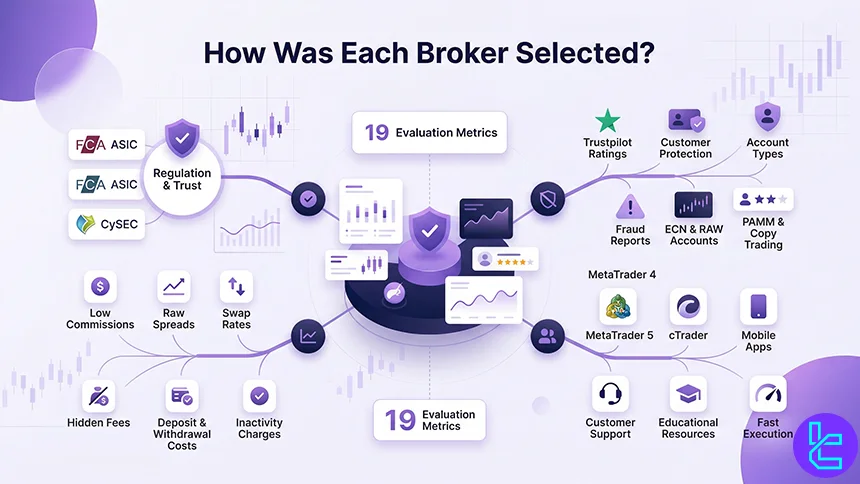
Company background, office locations, fraud reports, Trustpilot ratings, and customer protection programs are also considered.
TradingFinder then analyzes the broker’s pricing structure in detail. This includes raw spreads, commissions per lot, swap rates, inactivity charges, deposit and withdrawal fees, and any hidden costs that can impact profitability. Brokers with low spreads but expensive withdrawal fees or inactivity charges do not rank highly in our evaluations.
Account diversity is another important factor. Standard, ECN, RAW, micro, PAMM, and copy trading accounts are compared to determine which brokers serve different trading styles effectively. Platform availability also matters, especially access to MetaTrader 4, MetaTrader 5, cTrader, and mobile trading apps.
Finally, TradingFinder tests support quality, account opening procedures, educational resources, market updates, infographics, and response speed. This comprehensive methodology helps identify forex brokers that combine low commissions with strong execution, reliable customer support, and secure trading environments.
What is Commission?
Commission is usually a fixed trading fee charged by a forex broker for executing a position. Unlike the spread, which is the difference between the bid and ask price, commission is usually charged separately and is commonly found in RAW, ECN, or Zero Spread accounts.
In most cases, forex brokers charge commission per lot traded. A standard lot equals 100,000 units of the base currency. For example, a broker may charge $3 per side per lot, meaning a trader pays $3 when opening the position and another $3 when closing it. This creates a total round-turn commission of $6 per standard lot.
Commission structures vary between brokers and account types. Standard accounts often advertise commission-free trading, but the cost is usually built into wider spreads. By contrast, ECN and RAW accounts generally offer lower spreads, sometimes starting from 0.0 pips, but charge a separate commission fee.
The total trading cost in forex is usually calculated through the combination of spread and commission. For example, a broker offering a 0.1 pip spread with a $6 round-turn commission may still be cheaper than a broker offering a 1.2 pip spread with no commission, especially for high-frequency traders, scalpers, and day traders.
Commission can also vary depending on the asset class. Forex pairs often have lower commission rates than stock CFDs, crypto CFDs, or futures CFDs. Some brokers further adjust commissions based on trading volume, offering discounted pricing for active traders.
Understanding how commission works is essential when comparing low commission forex brokers because a lower headline spread does not always mean lower overall trading costs.
What are the Benefits and Drawbacks of Low-Commission Brokers?
Low-commission forex brokers can reduce trading costs, especially for scalpers, day traders, and high-volume traders. Lower commissions often make RAW and ECN accounts more attractive because they usually come with tighter spreads and faster execution.
However, low commissions do not always mean lower total costs, since some brokers compensate through wider spreads, swap charges, inactivity fees, or weaker trading conditions.
Pros | Cons |
Lower transaction costs for frequent trading | Some brokers offset low commissions with wider spreads |
Better suitability for scalping and day trading strategies | Hidden fees may appear through deposits, withdrawals, or inactivity charges |
Often paired with RAW or ECN accounts offering tighter spreads | Ultra-low commission accounts may require higher minimum deposits |
Can improve profitability for high-volume traders | Some low-cost brokers provide fewer research or educational tools |
Access to volume discounts and commission rebates | Customer support quality may be weaker at some discount brokers |
More transparent pricing when commission is charged separately | Overnight swap fees can still make trading expensive |
Faster execution and deeper liquidity in some cases | Certain asset classes, such as crypto CFDs or stock CFDs, may still have high commissions |
Greater cost efficiency when trading major currency pairs | Low-cost conditions are not always available in all regions because of regulatory restrictions |
What Types of Commission Do Brokers Charge?
Forex brokers can apply several types of commissions depending on the account model, asset class, and payment method. Understanding these charges is important because low spreads do not always mean low overall trading costs.
The most common fee is the trading commission charged per lot. This is usually found in ECN, RAW, or Zero Spread accounts, where brokers charge a fixed amount for opening and closing a trade. For example, a broker may charge $3 per side per standard lot, creating a $6 round-turn cost.
Another common cost is the spread-based commission. In Standard accounts, brokers often advertise commission-free trading, but their revenue is built into wider spreads. Instead of charging a fixed fee, the broker earns from the difference between the bid and ask price.
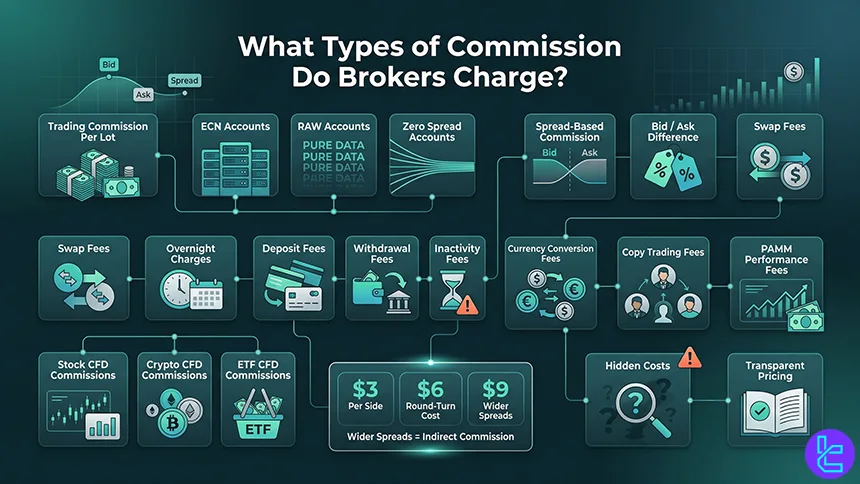
Some brokers also charge swap or overnight commissions. These fees apply when positions remain open after the daily rollover period. Swap rates depend on the interest rate difference between the two currencies in a pair and whether the trader is holding a long or short position.
Deposit and withdrawal commissions can also affect profitability. While many brokers offer free card deposits or bank transfers, some apply fees for certain payment methods, e-wallets, or international wire transfers.
Additional charges may include inactivity fees, currency conversion fees, and commissions for copy trading or PAMM services. For example, some copy trading platforms charge a performance fee based on profits generated by the strategy provider.
Brokers offering stock CFDs, crypto CFDs, or ETF CFDs may also apply separate commissions for those instruments. These costs are often higher than forex trading commissions because of exchange fees, liquidity costs, and market access expenses.
Choosing a broker with transparent pricing is essential because hidden commissions can significantly increase the total cost of trading.
Do All Forex Brokers Charge Their Clients with Commissions?
No, not all forex brokers charge direct commissions on trades. Many brokers offer commission-free accounts, especially Standard accounts, where the broker earns revenue through wider spreads instead of charging a separate trading fee.
In commission-free accounts, the trading cost is built into the difference between the bid and ask price. For example, a broker may offer EUR/USD with a spread of 1.2 pips and no extra commission. This model is common among beginner-friendly brokers because it is simpler to understand and calculate.
However, many ECN, RAW, and Zero Spread accounts do charge direct commissions. These accounts often provide tighter spreads, sometimes starting from 0.0 pips, but add a fixed fee per lot traded. A common pricing model is $3 to $3.5 per side per standard lot, creating a round-turn commission of around $6 to $7.
Whether a commission-based account is cheaper depends on the trader’s strategy. Scalpers, day traders, and high-volume traders often prefer RAW or ECN accounts because lower spreads can reduce total trading costs despite the extra commission fee.
On the other hand, swing traders or beginners may prefer commission-free accounts for their simpler pricing structure.
Some brokers also offer both models simultaneously. For example, traders may choose between a Standard account with no commission and an ECN account with tighter spreads plus fixed fees. This flexibility allows traders to select the pricing structure that best matches their trading style and position size.
The most important factor is not whether a broker charges commissions, but the broker’s total trading cost after combining spreads, commissions, swaps, and other fees.
Do High-Volume Traders Have Any Advantage in Commissions?
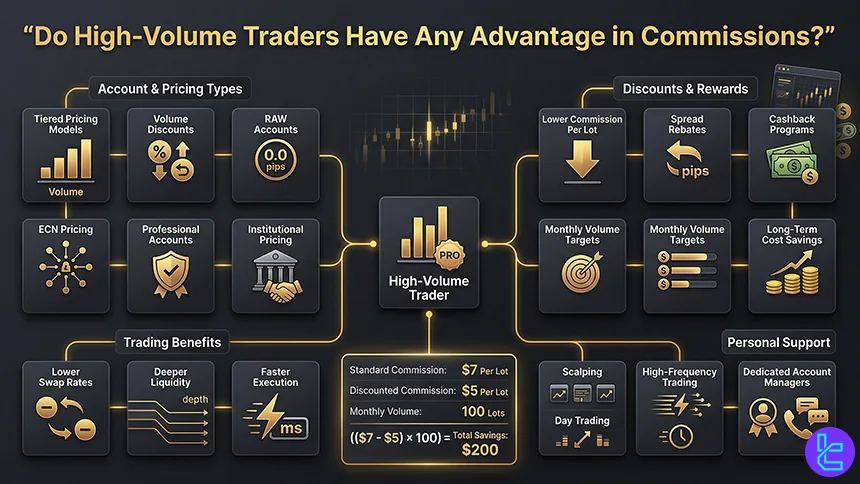
Yes, high-volume traders often receive lower commissions and better pricing conditions than casual traders. Many forex brokers use tiered pricing models that reward traders who generate larger monthly trading volumes.
The most common benefit is a reduction in commission per lot. For example, a broker may normally charge $7 round-turn per standard lot on a RAW account, but reduce that cost to $5 or even lower for traders who reach a certain monthly volume threshold. These discounts are common among brokers offering ECN and institutional-style pricing.
Some brokers also provide spread rebates or cashback programs. Under these models, active traders receive part of the spread or commission back after reaching specific trading targets.
This can significantly reduce total trading costs for scalpers, algorithmic traders, and day traders who open dozens or even hundreds of positions per month.
Institutional and professional clients may receive even more favorable conditions. These can include custom commission agreements, lower swap rates, access to deeper liquidity pools, dedicated account managers, and faster order execution. Brokers often reserve these benefits for traders with high monthly volume, larger deposits, or professional account status.
Volume-based discounts are especially important for strategies that depend on small price movements, such as scalping or high-frequency trading. When a trader executes hundreds of lots each month, even a $1 reduction in commission per lot can save a significant amount over time.
For example, reducing commission from $7 to $5 per lot would save a trader $200 after 100 standard lots of monthly volume.
Before choosing a broker, active traders should compare commission tiers, rebate programs, and volume requirements because these factors can materially affect long-term profitability.
Best Strategies for Commission-Based Trading
Commission-based trading works best when traders use strategies that can benefit from tighter spreads and fast execution. RAW and ECN accounts usually offer spreads close to 0.0 pips, making them more suitable for short-term trading methods where even small differences in pricing matter.
Some of the most effective strategies for commission-based accounts include:
- Scalping: Scalpers aim to capture small price movements over a few seconds or minutes. Since they place many trades each day, tighter spreads are often more important than avoiding commissions;
- Day Trading: Day traders open and close positions within the same session, avoiding overnight swap charges. Lower spreads can improve profitability because intraday price targets are often relatively small;
- High-Frequency Trading (HFT): Algorithmic traders and high-frequency systems rely on fast execution, deep liquidity, and very low spreads. Commission-based accounts are usually better suited for these strategies because they reduce slippage and pricing friction;
- News Trading: Major economic releases, such as decisions from the Federal Reserve or the European Central Bank, can cause sharp price movements. Commission-based accounts often provide faster market access and tighter pricing during volatile conditions;
- Trading Major Currency Pairs: Highly liquid pairs such as EUR/USD, GBP/USD, and USD/JPY usually have the lowest spreads in commission-based accounts. These pairs can help reduce total trading costs because of their strong liquidity and lower transaction expenses;
- Volume-Based Trading: Traders who execute large monthly volumes can often qualify for commission rebates or reduced fees, making commission-based accounts even more cost-effective over time.
Commission-based trading is generally less suitable for long-term position trading because the savings from tighter spreads become less important when trades remain open for weeks or months.
How Can I Manage Trading Commissions?
Managing trading commissions is important because transaction costs directly affect net profitability. Even small commission differences can become significant for traders who place many trades each month.
Some of the most effective ways to reduce commission costs include:
- Choose the Right Account Type: Standard accounts may be more cost-effective for low-frequency traders, while RAW or ECN accounts can be cheaper for scalpers and day traders because of their tighter spreads;
- Compare Round-Turn Costs: Do not focus only on spreads or only on commissions. Compare the total trading cost, including spread, commission, swap fees, and any hidden charges;
- Trade Major Currency Pairs: Highly liquid pairs such as EUR/USD, USD/JPY, and GBP/USD usually have lower spreads and lower commissions than exotic pairs or less liquid CFDs;
- Avoid Overtrading: Entering too many low-quality trades increases commission expenses without necessarily improving returns. Fewer, higher-quality trades can lower overall costs;
- Use Volume Discounts: Many brokers reduce commission rates for active traders. Reaching higher monthly trading volumes may qualify traders for rebates or lower fees;
- Monitor Swap Charges: Holding positions overnight can create additional costs through rollover fees. Traders should consider both commissions and swap rates when evaluating long-term trades;
- Reduce Deposit and Withdrawal Fees: Some brokers charge fees for bank wires, card payments, or currency conversion. Using lower-cost payment methods can help preserve capital;
- Test Brokers with a Demo or Small Account: Before committing larger capital, traders can compare real spreads, execution quality, and commission structures through a demo account or a small live account.
A broker with slightly higher commission but lower spreads may still be cheaper overall, especially for active traders.
Conclusion
Brokers charge clients with commission for each transaction made; however, most brokers provide a zero-commission option with increased costs in other forms. Therefore, it is critical to choose a good brokerage.
According to our analysis, AvaTrade, FP Markets, Exness, and BlackBull Markets are among the best choices for traders who target low-commission trading.
To learn about the details and parameters involved with evaluating brokers, check out our Forex methodology.