






Currently, over 7 top-rated brokers dominate the silver trading market, offering 0.0-0.9 pip minimum spreads, leverage up to 1:500, and account types suitable for both beginners and professionals.
With Trustpilot ratings from 3.4 to 4.8/5 across up to 30,000+ reviews, traders can compare costs, platforms, and services to find the most reliable silver trading options.
Here are the top silver trading brokers currently available:
 | BlackBull | |||
 | AVATRADE | |||
 | eToro | |||
| 4 |  | eightcap | ||
| 5 |  | fpmarkets | ||
| 6 |  | FxPro | ||
| 7 |  | pepperstone |
Trustpilot Ratings of Silver Trading Forex Brokers
Trustpilot ratings offer a real-world perspective on broker reliability, service quality, and client satisfaction. For silver traders, these ratings help identify brokers that deliver smooth trading experiences, fast withdrawals, and responsive support:
Broker | Trustpilot | Number of Reviews |
4.8/5 ⭐ | 11,928 | |
BlackBull Markets | 3,128 | |
10,015 | ||
eToro | 30,657 | |
Pepperstone | 3,226 | |
Eightcap | 3,489 | |
FxPro | 822 |
Minimum Trading Spreads in Silver Trading Brokers
For silver traders, tight spreads are crucial to maximize profitability, especially for scalpers and short-term strategies. The minimum spreads offered by brokers highlight cost efficiency per trade, which directly impacts net returns:
Brokers | Minimum Spreads |
eToro | 0.0 Pips |
0.0 Pips | |
AvaTrade | 0.0 Pips |
Pepperstone | 0.0 Pips |
0.0 Pips | |
XM Group | 0.6 Pips |
Axi | 0.9 Pips |
Non-Trading Fees Charged by Brokers for Silver Trading
Non-trading fees can significantly affect long-term profitability in silver trading. These fees include deposit, withdrawal, and inactivity charges, which vary widely among brokers:
Broker Name | Deposit Fee | Withdrawal Fee | Inactivity Fee |
Pepperstone | $0 | $0 | $0 |
FP Markets | $0 | $0 | $0 |
Global Prime | $0 | $0 | $0 |
AvaTrade | $0 | $0 | $10 monthly |
$0 | $0 | $10 Monthly | |
Plus500 | $0 | $0 | $10 Monthly |
$0 | $0 | $15 Monthly |
Trading Platforms in Silver Trading Forex Brokers
The choice of trading platform directly influences a trader’s experience, execution speed, and analytical capabilities. Popular platforms like MetaTrader 4, MetaTrader 5, TradingView, cTrader, and proprietary apps allow silver traders to access charts, indicators, and automated tools efficiently:
Broker Name | Trading Platforms |
Proprietary App | |
Eightcap | MetaTrader 4, MetaTrader 5, TradingView |
AvaTrade | MetaTrader 4, MetaTrader 5, Mobile App, WebTrader |
Capital.com | MetaTrader 4, Web Trader, Mobile App, TradingView |
Tickmill | Metatrader 4, Metatrader 5, Metatrader Web, Mobile App |
Pepperstone | Proprietary Platform, cTrader, Trading View, MetaTrader 4&5 |
Blackbull Markets | MetaTrader 4, MetaTrader 5, TradingView, cTrader, BlackBull CopyTrader, BlackBull Invest |
Details of the Top 6 Silver Trading Brokers
Choosing the right broker is critical for successful silver trading, as it impacts costs, execution speed, leverage, and overall trading experience. This section highlights the top six brokers: BlackBull Markets, AvaTrade, eToro, Eightcap, FP Markets, and FxPro, providing key details on their account types, regulation, trading platforms, minimum deposits, and leverage.
BlackBull Markets
Founded in 2014 by Michael Walker and Selwyn Loekman, BlackBull Markets (officially Black Bull Group Limited) is a New Zealand-based multi-asset broker offering access to 26,000+ instruments across 6 asset classes. The company has earned 7 prestigious industry awards and serves traders globally with ECN-based pricing and institutional-grade infrastructure.
BlackBull operates under the oversight of the Financial Markets Authority (FMA - Tier-1) and the Financial Services Authority of Seychelles (FSA - Tier-3). Client funds are held in segregated accounts, and negative balance protection is available. Maximum leverage reaches 1:500, with margin call and stop-out levels set at 75% and 50%.
The broker provides three ECN account types after completing the BlackBull Markets registration: ECN Standard ($0 commission, spreads from 0.8 pips), ECN Prime ($6 per lot, spreads from 0.1 pips), and ECN Institutional ($4 per lot, spreads from 0.0 pips, $20,000 minimum deposit). Trading platforms include MetaTrader 4, MetaTrader 5, cTrader, TradingView, BlackBull CopyTrader, and BlackBull Invest. API trading, PAMM accounts, Islamic accounts, and advanced order types are supported.
Deposits are free and processed instantly in most cases via Visa, Mastercard, Apple Pay, Google Pay, bank transfers, SEPA, crypto (BTC, ETH, USDT, and others), Neteller, Skrill, and FasaPay. Withdrawals incur a flat $5 fee and are typically processed within 24 hours. BlackBull Markets verification is necessary to access features.
Account Types | ECN Standard, ECN Prime, ECN Institutional |
Regulating Authorities | FMA (New Zealand), FSA (Seychelles) |
Minimum Deposit | $0 (Standard & Prime), $20,000 (Institutional) |
Deposit Methods | Visa, MasterCard, Apple Pay, Google Pay, Bank Wire, SEPA, Crypto, Neteller, Skrill, FasaPay |
Withdrawal Methods | Visa, MasterCard, Apple Pay, Google Pay, Bank Wire, SEPA, Crypto, Neteller, Skrill, FasaPay |
Maximum Leverage | Up to 1:500 |
Trading Platforms & Apps | MetaTrader 4, MetaTrader 5, cTrader, TradingView, BlackBull CopyTrader, BlackBull Invest |
BlackBull Markets Pros and Cons
Before opening an account, traders should evaluate both advantages and limitations to determine whether BlackBull fits their strategy and risk profile.
Pros | Cons |
26,000+ tradable instruments | $5 withdrawal fee |
Spreads from 0.0 pips (ECN accounts) | Institutional account requires $20,000 deposit |
Regulated by FMA (Tier-1) & FSA | Not available in the U.S. and certain regions |
24/7 customer support & multiple advanced platforms | Wide offering may overwhelm beginners |
AvaTrade
Founded in 2006, AvaTrade has grown into a globally recognized multi-asset broker serving clients in 150+ countries. The company operates under 9 regulatory licenses, including the Central Bank of Ireland, Australian Securities and Investments Commission, Cyprus Securities and Exchange Commission, and Financial Sector Conduct Authority.
AvaTrade offers competitive trading conditions with a $100 minimum deposit and maximum leverage up to 1:400 (1:30 in the EU). Margin call and stop-out levels are set at 25% and 10%, respectively, helping traders manage risk efficiently. The broker provides access to 1,250+ instruments across Forex (60+ pairs), stocks, indices, commodities, cryptocurrencies, bonds, and FX options.
Traders can choose from multiple account types, including Retail, Professional, Islamic (swap-free), and Demo accounts. Platforms supported include MetaTrader 4, MetaTrader 5, WebTrader, a dedicated mobile app, and AvaOptions for FX options trading. The broker also offers an AvaTrade rebate program.
Copy trading is available via DupliTrade and AvaSocial, while instant order execution supports fast-paced strategies. Base currencies include USD, EUR, GBP, JPY, CHF, and AUD. AvaTrade Deposit and withdrawal requests are processed through credit/debit cards, bank wire transfers, Skrill, Neteller, WebMoney, and PayPal (region-dependent). Card and e-wallet deposits are typically instant, while wire transfers may take 3-7 business days.
Account Types | Cent, STP, ECN |
Regulating Authorities | VFSC, FSC |
Minimum Deposit | $0 |
Deposit Methods | Local Bank Transfers, E-wallets, International Wire Transfers, Credit/Debit Card |
Withdrawal Methods | Local Bank Transfers, E-wallets, International Wire Transfers, Credit/Debit Card |
Maximum Leverage | 1:1000 |
Trading Platforms & Apps | MetaTrader 4, MetaTrader 5, Doo Prime InTrade |
AvaTrade Pros and Cons
Before choosing AvaTrade, it is important to evaluate its strengths and limitations. Below is a balanced overview of its key pros and cons:
Pros | Cons |
Regulated by 9 financial authorities globally | No services for U.S. clients |
1,250+ tradable instruments across 7 asset classes | Inactivity fees after 2 months |
Multiple platforms including MT4, MT5, and AvaOptions | No PAMM account support |
Copy trading via DupliTrade & AvaSocial | Bonuses are not available in all regions |
eToro
eToro is a globally recognized Israeli broker founded in 2007 by David Ring, Ronen Assia, and Yoni Assia. Headquartered in Tel Aviv, Israel, eToro provides a wide range of investment options, including copy trading service named CopyTrader, Smart Portfolios, and Crypto Staking.
The platform is renowned for its social trading capabilities, allowing users to automatically copy the trades of successful investors. Upon completing the eToro registration process, its proprietary platform offers an easy-to-use interface, making it ideal for both beginner and experienced traders looking for exposure to a variety of assets.
Operating under stringent regulations, eToro is licensed by major financial bodies including the UK’s Financial Conduct Authority (FCA), Cyprus Securities and Exchange Commission (CySEC), the Australian Securities and Investments Commission (ASIC), and the Financial Services Authority (FSA) in Seychelles.
While eToro offers a comprehensive range of investment instruments, one notable limitation is the absence of MetaTrader 4 or 5 (MT4/MT5) support. Instead, it relies on its proprietary trading platform, which may not appeal to traders accustomed to these popular MetaTrader tools. Additionally, customer support is provided via email, live chat, and a ticket system, but phone support is not available, which some users find limiting.
Account Types | Personal, Professional, Corporate, Islamic |
Regulating Authorities | FCA, CySEC, MFSA, FSRA, ASIC, FSA, Gibraltar FSC |
Minimum Deposit | $10 |
Deposit Methods | eToro Money, Credit/Debit Card, Bank Transfer, PayPal, Neteller, Skrill, Trustly, iDEAL, Sofort, Przelewy24 |
Withdrawal Methods | eToro Money, Credit/Debit Card, Bank Transfer, PayPal, Neteller, Skrill, Trustly, iDEAL, Sofort, Przelewy24 |
Maximum Leverage | 1:400 |
Investment Options | CopyTrader, Crypto Staking, Smart Portfolios |
eToro Pros and Cons
As with any broker, eToro has its strengths and weaknesses. While it excels in areas such as social trading and regulatory oversight, it does come with some limitations that may not suit every trader. Below is an overview of the key pros and cons of using eToro, which will help you decide if this platform fits your trading needs:
Pros | Cons |
Social trading features (CopyTrader, Smart Portfolios) | No MT4/MT5 support |
Wide range of tradable assets (7,000+ instruments) | No phone support |
Regulated in multiple jurisdictions (FCA, ASIC, CySEC) | High fees on some assets (1% crypto buy/sell fee) |
Low minimum deposit ($10 for Personal accounts) | $10 monthly inactivity fee |
Eightcap
Eightcap is a global online forex and CFD broker known for offering competitive trading conditions and robust support for both beginner and professional traders. Established in 2009, the company operates under regulation by tier-1 bodies such as the Australian Securities and Investments Commission (ASIC), making it a reliable choice for traders looking for security and transparency.
One of the standout features of Eightcap is its commitment to low spreads and fast execution speeds. With an average spread of 0.0 pips on the ECN account, traders can access highly competitive market conditions. Also there is an Eightcap rebate program, so users can get cashback for trading forex on its standard account.
Eightcap provides access to a variety of financial markets, including forex, commodities, indices, and cryptocurrencies. Traders can access these markets using MetaTrader 4 (MT4) and MetaTrader 5 (MT5), two of the most popular trading platforms worldwide. The platform's user-friendly interface, combined with powerful charting and analysis tools, allows traders to execute strategies with ease and precision.
Additionally, Eightcap offers both mobile and desktop versions of MT4/MT5, ensuring that traders can trade on the go or from their preferred devices. Users are able to complete Eightcap registration process through each of these versions.
Account Types | Standard, STP, ECN |
Regulating Authorities | ASIC (Australia), VFSC (Vanuatu), FSC (Mauritius) |
Minimum Deposit | $0 (varies by account type) |
Deposit Methods | Credit/Debit Card, Bank Transfers, E-wallets (Neteller, Skrill, etc.) |
Withdrawal Methods | Credit/Debit Card, Bank Transfers, E-wallets (Neteller, Skrill, etc.) |
Maximum Leverage | Up to 1:500 |
Trading Platforms & Apps | MetaTrader 4 (MT4), MetaTrader 5 (MT5), WebTrader (for non-MT4/MT5 users) |
Eightcap Pros and Cons
While Eightcap offers competitive trading conditions and a broad range of tools, it has its strengths and limitations. Below, we summarize the main advantages and drawbacks of trading with Eightcap:
Pros | Cons |
Low spreads starting from 0.0 pips | Limited educational resources compared to competitors |
High leverage of up to 1:500 | No support for MT4/MT5 automated strategies on all accounts |
Regulation under ASIC for increased security | Withdrawal fees on certain methods |
Multiple deposit/withdrawal methods (e-wallets, bank transfers) | No dedicated mobile app for advanced charting features |
FP Markets
FP Markets, established in 2005, is an Australian brokerage renowned for offering diverse trading services. Regulated by top-tier authorities such as ASIC, CySEC, and FSCA, FP Markets ensures high levels of trust and security for its clients. Upon FP Markets registration, the broker provides access to over 10,000 financial instruments, including forex, CFDs, stocks, commodities, and cryptocurrencies.
Known for low spreads, FP Markets gives traders access to both Standard and RAW accounts, which are ideal for various trading strategies. With a minimum deposit requirement of just $50, there are diverse FP Markets deposit and withdrawal methods.
Offering a choice between MetaTrader 4 (MT4), MetaTrader 5 (MT5), and cTrader, FP Markets provides a robust and flexible trading experience. These platforms are packed with advanced charting tools, technical indicators, and expert advisors, allowing traders to make informed decisions. The broker also supports algorithmic trading and copy trading, providing a platform for automated and social trading strategies.
FP Markets stands out for its competitive pricing model, with spreads starting from as low as 0.0 pips on the RAW account and for its beneficial FP Markets rebate program. The broker also offers leverage up to 1:500, allowing traders to amplify their positions.
Account Types | Standard, RAW |
Regulating Authorities | ASIC, CySEC, FSCA, FSC, FSA |
Minimum Deposit | $50 |
Deposit Methods | Visa/MasterCard, Skrill, PayPal, Neteller, Bank Transfer |
Withdrawal Methods | Visa/MasterCard, Skrill, PayPal, Neteller, Bank Transfer |
Maximum Leverage | 1:500 |
Trading Platforms & Apps | MT4, MT5, cTrader |
FP Markets Pros and Cons
Below is a summary of the key pros and cons based on user feedback, regulatory standards, and service offerings. This will help you make an informed decision about whether FP Markets aligns with your trading goals and preferences:
Pros | Cons |
Regulated by top-tier authorities such as ASIC and CySEC | Not available to US clients and other restricted regions |
Tight spreads from 0.0 pips on RAW accounts | Educational materials could be more detailed |
Wide range of platforms including MT4, MT5, and cTrader | No proprietary trading platform; relies on third-party software |
Multiple account types (Standard, RAW) and investment options (copy trading, PAMM) | Limited customer support channels compared to some competitors |
FxPro
Founded in 2006, FxPro has established itself as a leading global forex and CFD broker, serving over 7.8 million client accounts across more than 170 countries. The broker is renowned for its fast order execution, taking less than 12 milliseconds on average, and its wide range of financial instruments, over 2,100, including forex, indices, stocks, metals, energy, and cryptocurrencies.
FxPro operates under multiple regulated entities to ensure client protection and regulatory compliance. Its licenses include the FCA in the UK, CySEC in Cyprus, FSCA in South Africa, and the SCB in the Bahamas. Completing FxPro verification steps is necessary to access its features.
Tier 1 regulators oversee its main entities, and segregated client funds, negative balance protection, and compensation schemes of up to £85,000 (FSCS) or €20,000 (ICF) highlight the broker’s commitment to security. These measures make FxPro a trustworthy choice for retail and institutional traders.
The broker offers three main account types accessible through the FxPro dashboard: Standard, Raw+, and Elite, with leverage up to 1:500, spreads starting from 0.0 pips, and commission structures tailored to each account. Swap-free Islamic accounts are available, alongside copy trading via the FxPro CopyTrade platform.
Account Types | Standard, Raw+, Elite |
Regulating Authorities | FCA, CySEC, FSCA, SCB |
Minimum Deposit | $0 (Standard) |
Deposit Methods | Bank Transfers, E-wallets, Visa/Mastercard, PayPal |
Withdrawal Methods | Bank Transfers, E-wallets, Visa/Mastercard, PayPal |
Maximum Leverage | 1:500 |
Trading Platforms & Apps | MT4, MT5, cTrader, Web Trader, Mobile App |
FxPro Pros and Cons
Below is a summary of FxPro’s main advantages and potential drawbacks to help traders make an informed decision:
Advantages | Disadvantages |
Multiple regulated entities (FCA, CySEC, FSCA, SCB) | Restrictions in certain countries (e.g., USA, Canada, Iran) |
Access to 2,100+ financial instruments | High minimum deposit for Elite account ($15,000) |
Competitive spreads from 0.0 pips and fast execution | Limited bonuses and promotions |
Diverse funding options and segregated client funds | Customer support is available only 24/5 |
How Did We Select Each Sliver Trading Broker?
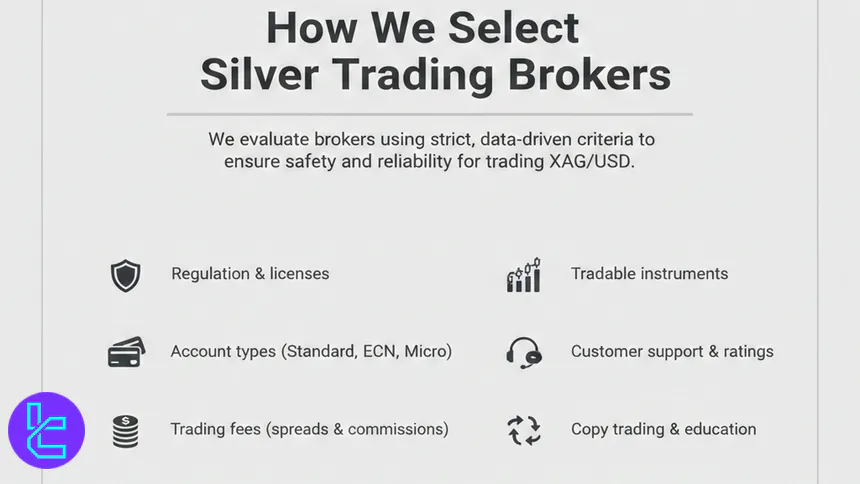
Selecting the right silver trading broker requires a meticulous and structured evaluation, as traders entrust their capital to these platforms. At Trading Finder, we apply a comprehensive methodology that blends transparency, objectivity, and expert insight.
Our team of seasoned forex market analysts examines each broker’s offerings across 19 key metrics, from regulatory compliance to account variety, trading platforms, and customer support. This rigorous approach ensures traders receive reliable, data-driven recommendations tailored to diverse investment styles and risk preferences. The goal is to empower investors to make informed and confident decisions when trading XAG/USD or other silver instruments.
Trading Finder’s evaluation dives into core elements of broker services, assessing everything from license verification to deposit and withdrawal processes. We also analyze the range of tradable symbols, commissions, spreads, and leverage, while considering copy trading options, educational resources, and the broker’s global presence. Additional metrics include Trustpilot ratings, responsiveness to customer queries, fraud reports, and philanthropic activity.
Each of these components is carefully weighted to ensure that the final broker selection reflects both practical usability and market reliability, giving silver traders a well-rounded and trustworthy platform for trading.
Key Broker Selection Criteria:
- Regulations & licenses under top authorities
- Account types: standard, ECN, micro, PAMM
- Tradable instruments: silver, currencies, CFDs, ETFs
- Fees: commissions, spreads, deposit/withdrawal charges
- Platforms: MetaTrader 4/5, cTrader, mobile apps
- Customer support & Trustpilot score
- Copy trading & educational resources
- Scam alerts and philanthropic efforts
Reasons for the Popularity of Silver Among Traders
Silver’s popularity stems from its unique dual role as both an industrial metal and a financial asset. Historically seen as a store of value, silver is easier for new traders to access due to its lower per‑ounce cost than gold, often 40-80 times cheaper, which means lower capital barriers and more accessible margin trading.
Silver also displays higher volatility than gold, offering greater short‑term price moves that many speculative traders seek for potential high returns.
In the FX and CFD markets, silver (typically quoted as XAG/USD) acts as a proxy for market risk appetite and inflation expectations. It often moves in tandem with macro factors like currency strength, interest rates, and industrial demand.
This makes it a favorite for scalpers and swing traders alike. The fact that silver’s name and money are closely related in 14 languages reflects its longstanding financial significance.
Why Traders Love Silver:
- Lower cost entry than gold
- Higher volatility ⇒ bigger price swings
- Industrial + investment demand boosts liquidity
- Trades well with leverage in FX brokers
What Are the Advantages and Disadvantages of Trading Silver?
Silver trading offers several advantages for forex and CFD traders. Tight spreads on major brokers and high leverage options (sometimes up to 1:500 or more) magnify potential profit opportunities. Traders can go long or short easily, capturing value in both rising and falling markets.
Silver’s heavy industrial usage also ties it to real economic activity, adding fundamental drivers beyond pure speculation.
However, there are also disadvantages. High leverage increases risk of rapid losses if markets swing against you. Silver’s volatility can lead to significant drawdowns even within a single session.
CFD silver trading often incurs overnight swap/financing fees, which may erode gains over long holds. Additionally, geopolitical shifts or changes in macroeconomic policy can create unpredictable price whipsaws. Learning risk controls is essential.
Advantages (Pros) | Disadvantages (Cons) |
Tight spreads available with major brokers, reducing transaction costs | High leverage (up to 1:500 or more) can amplify losses just as quickly as gains |
High leverage increases potential profit opportunities | Silver’s volatility can cause sharp drawdowns within a single session |
Ability to go long or short, allowing profit in both rising and falling markets | CFD trading often includes overnight swap/financing fees that reduce long-term profitability |
Strong industrial demand provides real economic fundamentals beyond speculation | Geopolitical events and macroeconomic policy changes can trigger unpredictable price whipsaws |
High liquidity in global markets | Requires strong risk management discipline to avoid rapid capital erosion |
In What Countries is trading Silver the Most Popular?
Silver trading is particularly strong in major financial hubs such as the United States, the United Kingdom, Australia, and Japan, places with developed forex and CFD regulatory frameworks. These markets have robust retail participation and institutional involvement in metals, driving high daily trading volumes. Silver futures on the CME and OTC silver in London remain global benchmarks.
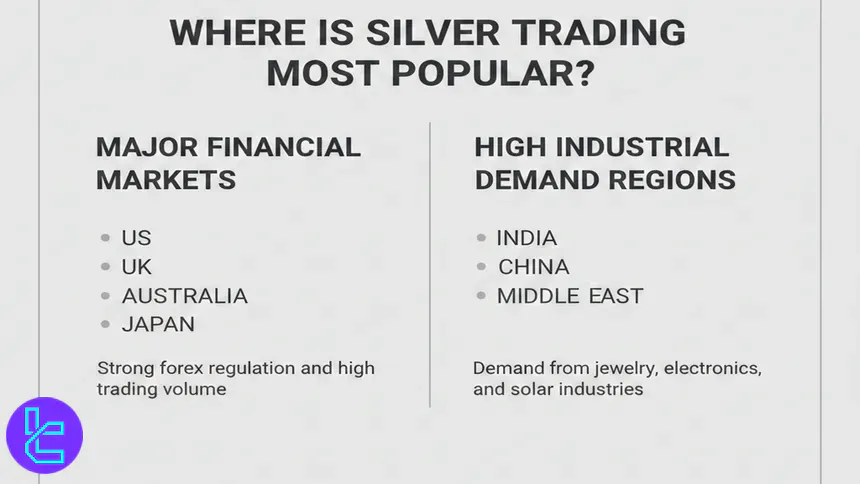
Emerging markets like India, China, and the Middle East also see significant silver trading interest, often tied to physical demand and hedging needs in jewelry, electronics, and solar industries. Exchanges like the Chinese Gold and Silver Exchange Society in Hong Kong reflect long‑standing regional trading cultures.
Top Silver Trading Regions:
- US, UK - deep financial markets
- Australia, Japan - regulated FX participation
- India, China - industrial + physical demand
How high are the Non-Trading Fees for Silver Trading in Forex Brokers?
Most forex brokers do not charge direct non‑trading fees specifically for silver trades. However, there are indirect costs which can add up if you hold trades for days or weeks. In some cases, brokers may also charge inactivity or account maintenance fees.
Deposit and withdrawal fees vary by broker, some charge none (0%), while others may apply standard banking or payment processor fees. Always review a broker’s terms and conditions since regulatory jurisdictions (e.g., EU vs. non‑EU) impact what fees can be applied to clients. Understanding these ancillary costs helps traders more accurately calculate net returns.
Non‑Trading Fees:
- Inactivity fees
- Deposit/withdrawal charges (varies)
- Regulatory fee disclosures
Spot Silver Trading vs. Futures Silver Trading
Spot silver trading involves buying or selling silver at the current market price with near‑instant settlement, typically via CFD platforms or OTC markets. Spot positions don’t usually require contract expiry, making them a good choice for short-term trading strategies in volatile markets.
Futures trading, conducted on exchanges like CME, uses standardized contracts with set expiry dates. Futures prices reflect expectations for future delivery, and traders must manage rollovers or delivery obligations. Futures markets can show higher liquidity in certain sessions and offer arbitrage opportunities between spot and futures pricing.
Feature | Spot Silver Trading | Futures Silver Trading |
Market Type | Typically traded via CFD platforms or OTC markets | Traded on regulated exchanges like CME Group |
Pricing | Based on current market (live) price | Based on standardized contracts reflecting future delivery expectations |
Settlement | Near-instant settlement | Settlement at contract expiry (unless closed earlier) |
Expiry Date | No fixed expiry date | Fixed expiry dates per contract |
Contract Standardization | Flexible position sizing (broker dependent) | Standardized contract sizes set by the exchange |
What Are the Trading Pairs of Silver in Forex?
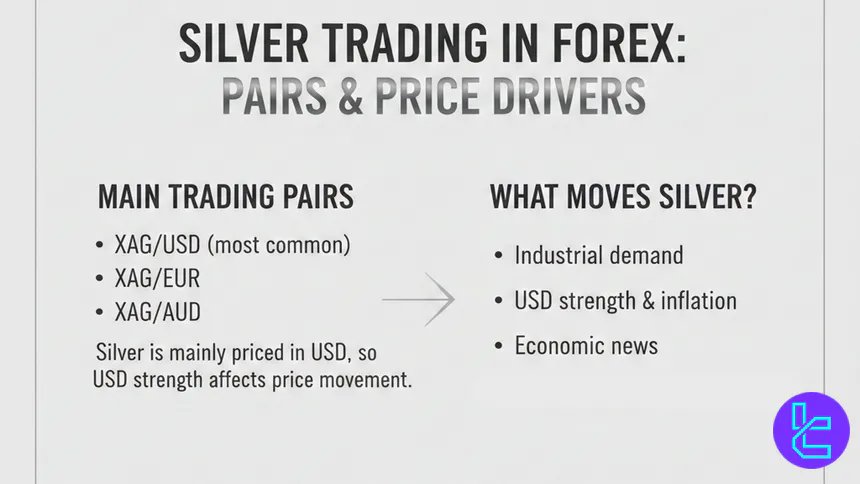
In forex trading, silver is typically represented as XAG/USD, meaning the price of one troy ounce of silver quoted in U.S. dollars. Some brokers also offer XAG/EUR or XAG/AUD, which express silver prices against other major currencies, though these are less common.
These XAG pairs function similarly to forex currency pairs - the rate reflects how many units of the quoted currency purchase one ounce of silver. Because silver is priced in USD most heavily, FX volatility and USD strength/weakness significantly influence trading outcomes and technical analysis.
Common Silver Pairs:
- XAG/USD (most common)
- XAG/EUR (available at select brokers)
- XAG/AUD (less frequent)
What Factors Influence the Price of Silver in Forex?
Silver prices are influenced by a mix of fundamental and technical factors. Industrial demand is significant, as over 50% of silver is used in electronics, solar panels, and medical devices. Inflation expectations, interest rates, and USD strength also impact silver’s FX-traded value, since it is primarily priced in dollars. Geopolitical risks or financial crises often drive investors toward silver as a “safe haven.”
Technical trends also play a major role, particularly for short-term traders. Patterns like support/resistance levels, moving averages, and RSI indicators help forecast potential swings. Volume spikes during major economic announcements often amplify volatility, making silver a favorite among active traders seeking price swings within intraday or multi-day ranges.
Silver Price Drivers:
- Industrial demand (electronics, solar)
- USD strength and inflation
- Macro-economic data
- Technical chart patterns (MA, RSI, volume)
What Leverage Do Forex Brokers Provide for Silver Trading?
Leverage in silver trading varies by broker and jurisdiction. In Europe (ESMA-regulated), brokers offer maximum leverage of 1:20 for retail clients, while outside Europe, brokers can offer up to 1:500, magnifying both potential profits and risks. High leverage allows traders to control large positions with small capital but also increases the risk of margin calls.
Professional or institutional clients often gain higher leverage options due to their trading experience and capital reserves. When using leverage, effective risk management, including stop-losses and position sizing, becomes essential to prevent excessive losses in volatile silver markets.
What Is the Minimum Spread for Sliver Trading in Forex Brokers?
The minimum spread on XAG/USD varies by broker type. ECN brokers often provide ultra-tight spreads as low as 0.3-0.5 pips, while market maker brokers may offer wider spreads of 1-2 pips. Tight spreads are crucial for short-term traders, especially scalpers, as even small differences affect profitability.
Spreads can fluctuate based on market volatility, session timing, and liquidity. Major news releases or low-liquidity periods (like Asian session early hours) can temporarily widen spreads. Traders should compare average spreads alongside commission structures to calculate effective trading costs accurately.
Spread Considerations:
- ECN: 0.3-0.5 pips
- Market maker: 1-2 pips
- Volatility widens spreads
- Check commissions + spreads
How Does CFD Silver Trading Differ from Physical Silver Trading?
CFD silver trading allows traders to speculate on price movements without owning physical metal. CFDs are highly liquid, can be leveraged, and allow short-selling, making them ideal for both up and down markets. Traders also avoid storage, insurance, and transportation costs.
Physical silver trading involves bars, coins, or ETFs that require storage, security, and delivery logistics. Investors can hold real assets as a hedge against systemic risk, but liquidity is lower than that of CFDs. CFDs offer flexibility and smaller capital requirements, while physical silver provides tangible ownership and long-term value preservation.
Feature | CFD Silver Trading | Physical Silver Trading |
Ownership | No physical ownership; trade price movements | Owns tangible metal or ETFs |
Liquidity | High, easy to enter/exit | Lower, harder to sell quickly |
Leverage | Available; magnifies gains/losses | Usually no leverage |
Flexibility | Can go long or short | Only profits if price rises |
Costs | No storage, insurance, or transport | Requires storage, security, and logistics |
Capital Requirement | Smaller due to leverage | Higher upfront investment |
Risk/Use Case | Short-term speculative trading | Long-term hedge and tangible wealth |
What Regulators Supervise Silver Trading in Brokers?
Silver trading through brokers is typically regulated by financial authorities to protect investors and ensure market integrity. In Europe, brokers fall under ESMA (European Securities and Markets Authority) guidelines, limiting leverage and enforcing transparent reporting. In the US, the CFTC (Commodity Futures Trading Commission) supervises silver futures, while NFA (National Futures Association) oversees brokers offering retail access.
Other key regulators include ASIC (Australia), FCA (UK), and MAS (Singapore), all of which enforce capital requirements, client fund segregation, and fair trading practices. Choosing a regulated broker ensures safeguards against fraud, platform manipulation, and unfair pricing, which is especially important for high-volatility instruments like silver.
Top Silver Regulators
- ESMA (EU)
- CFTC + NFA (US)
- FCA (UK), ASIC (Australia), MAS (Singapore)
- Protect against fraud & unfair practices
The Best Trading Accounts for Silver Trading in Forex
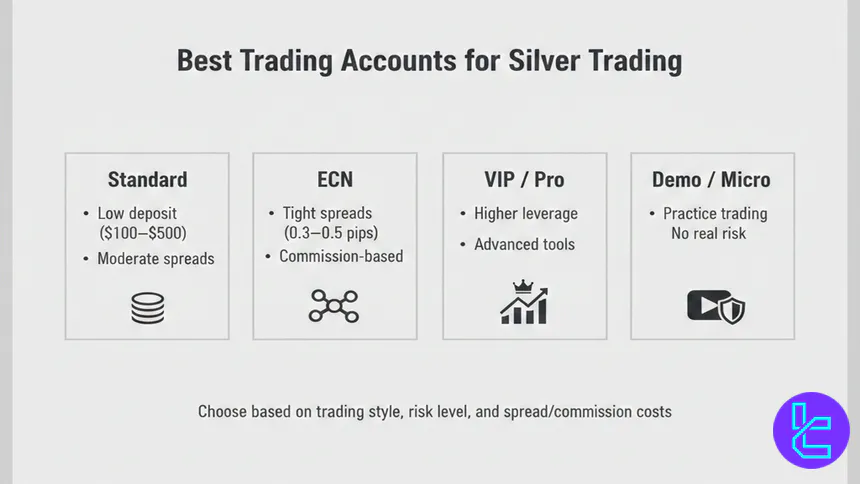
For silver, brokers offer accounts tailored to trading style and capital. Standard accounts allow small initial deposits ($100-$500), suitable for retail traders, while ECN accounts cater to high-volume traders with tighter spreads (0.3-0.5 pips) and commission-based pricing. VIP/pro accounts often include personal account managers, higher leverage, and advanced analytics tools.
Account selection depends on trading frequency and risk appetite. Beginners benefit from demo accounts to practice XAG/USD trading without risk, while professional traders prefer ECN or institutional accounts for direct market access and minimal slippage. Comparing spreads, commissions, and swap rates is crucial to optimizing net returns.
Account Types
- Standard: low deposit, moderate spreads
- ECN: tight spreads, commissions, high volume
- VIP/pro: advanced tools, higher leverage
- Demo/micro: practice trading safely
What Are the Best Strategies in Forex Silver Trading?
Silver trading strategies often combine technical analysis, risk management, and macroeconomic awareness. Popular approaches include:
- Scalping: exploiting small intraday moves, especially with tight spreads;
- Swing trading: capturing medium-term trends based on industrial demand and USD strength;
- Hedging: using silver to offset currency or commodity exposure.
Fundamental traders focus on macro data releases, inflation reports, and mining supply news, while technical traders rely on Fibonacci levels, Bollinger Bands, and moving averages to spot entry and exit points. Diversifying strategies and limiting leverage are key for consistent profitability.
Silver vs. Gold in Forex Trading
Silver and gold are two of the most traded precious metals in the forex and CFD markets, but they exhibit distinct characteristics. Gold (XAU/USD) is traditionally seen as a safe-haven asset, preferred during market uncertainty and inflation fears. It is less volatile than silver and typically requires higher capital to trade due to its higher price per ounce.
Gold’s price movements are often influenced by macroeconomic factors like interest rates, central bank policies, and geopolitical events.
Silver (XAG/USD), in contrast, is more volatile, making it attractive for short-term traders and speculative strategies. It is heavily tied to industrial demand, electronics, solar panels, and medical devices, which can create unique market swings.
Lower per-ounce prices make silver more accessible to retail traders, and it responds strongly to USD fluctuations and macroeconomic data. Understanding these differences helps traders optimize strategies for either hedging, speculation, or portfolio diversification.
In the table below, we have compared Silver with Gold and other trading pairs:
Feature | Silver (XAG/USD) | Gold (XAU/USD) | EUR/USD | USD/JPY | GBP/USD |
Volatility | Higher; larger short-term swings | Lower; steadier price movement | Moderate; stable but active | Moderate; often reacts to yield changes | Higher; sharp moves during UK/US news |
Capital Requirement | Lower, accessible to retail traders | Higher, more expensive per ounce | Low; micro & nano lots available | Low; flexible lot sizing | Low; flexible lot sizing |
Market Drivers | Industrial demand, USD strength | Safe-haven demand, inflation, macro policies | Eurozone vs US economic data, ECB/Fed policy | US yields, BoJ policy, risk sentiment | BoE policy, UK data, USD strength |
Liquidity | High, but less than gold futures | Very high, major global trading | Extremely high; most traded pair globally | Very high; strong Asian & US session activity | Very high; strong London session liquidity |
Leverage | Often higher, up to 1:500 | Usually lower, regulated limits apply | Often high (broker & regulation dependent) | Often high (broker & regulation dependent) | Often high (broker & regulation dependent) |
Best For | Short-term trading, speculation | Long-term hedge, wealth preservation | Day trading & macro positioning | Carry trades & macro strategies | News trading & volatility strategies |
Price Sensitivity | Moves sharply with economic data | Moves with broader market sentiment | Sensitive to interest rate differentials | Sensitive to bond yields & risk appetite | Sensitive to political & economic headlines |
Conclusion
silver traders can choose from brokers offering access to 2,100-26,000+ instruments, minimum deposits from $0-$50, and leverage up to 1:500. With Trustpilot reviews ranging from 822 to over 30,000, these top brokers combine tight spreads, fast execution, and multiple platforms to meet both beginner and professional trading needs, making it easier to trade XAG/USD confidently.
For a full breakdown of how we conducted our evaluation, please refer to our detailed Forex methodology article.