







Traders use AI tools such as technical indicators, expert advisors, and other software to enhance their trading activities and analysis of the market. AI acts as an assistant for interested investors.
However, it is important to choose a broker with due diligence and research. The shortlist below includes the 7 best brokers with AI capabilities.
 | AVATRADE | |||
 | IC Markets | |||
 | FXTM | |||
| 4 |  | Vantage | ||
| 5 |  | XM | ||
| 6 |  | FxPro | ||
| 7 |  | BlackBull |
Trustpilot Ratings in the AI Forex Brokers
Users can submit their ratings and reviews on “Trustpilot”, a reliable source for evaluating trader experiences. The table below outlines the scores for the mentioned brokers.
Broker Name | Trustpilot Rating | Number of Reviews |
12,272 | ||
53,139 | ||
BlackBull Markets | 3,278 | |
Vantage Markets | 12,305 | |
FxPro | 777 | |
XM | 2.7/5 ⭐ | 3,010 |
FXTM | 1,074 |
Regulation Status and Licenses
Reputable brokers usually have operation licenses from top-tier financial authorities, such as the FCA, CySEC, etc. The following table ranks the brands based on their regulatory licenses.
Broker Name | Regulating Authorities |
Plus 500 | FCA, ASIC, CySEC, MAS, EFSA, DFSA, AFSC, FMA |
IG | ASIC, FCA, FSA, AMF, FMA, MAS, DFSA, FSCA |
XM | FSC Belize, CySEC Cyprus, FSCA South Africa, DFSA Dubai, FSC Mauritius, FSA Sechelles |
ASIC, FSCA, VFSC, FCA, CIMA | |
FxPro | FCA, FSCA, CySEC, SCB |
BlackBull Markets | FSA, FMA |
FSC |
Minimum Spread in AI Brokers
Brokers provide zero-spread trading with certain commissions and fees to traders. The table in this section demonstrates the minimum spread in the mentioned brokerages.
Broker Name | Min. Spread |
FP Markets | 0 Pips |
0 Pips | |
Vantage Markets | 0 Pips |
FxPro | 0 Pips |
BlackBull Markets | 0 Pips |
FXTM | 0 Pips |
Plus 500 | 0.5 Pips |
Non-Trading Fees and Costs
Deposits, withdrawals, account maintenance, and other operations might cost you a few dollars in some brokers. This section clarifies the matter on the introduced brands.
Broker Name | Deposit Fee | Withdrawal Fee | Inactivity Fee |
Vantage Markets | $0 | $0 | $0 |
AvaTrade | $0 | $0 | $10 Monthly |
$0 | $5 | $0 | |
FP Markets | $0 | 1% via Skrill and Paysafe | $0 |
$0 | $0 | $15 Once, then $5 Monthly | |
Plus500 | $0 | $0 | $10 Monthly |
FXTM | $0 | From $3 | $10 Monthly |
Top 6 Forex Brokers with AI Tools in Detail
In the following sections, we will briefly review six of the mentioned brokerages based on important parameters, including trading platforms, account types, tradable instruments, and more.
AvaTrade
AvaTrade stands out among AI Forex brokers because of its strong regulatory profile and access to automated trading tools. The broker holds 9 licenses from authorities including the Central Bank of Ireland, Australian Securities and Investments Commission, and Cyprus Securities and Exchange Commission.
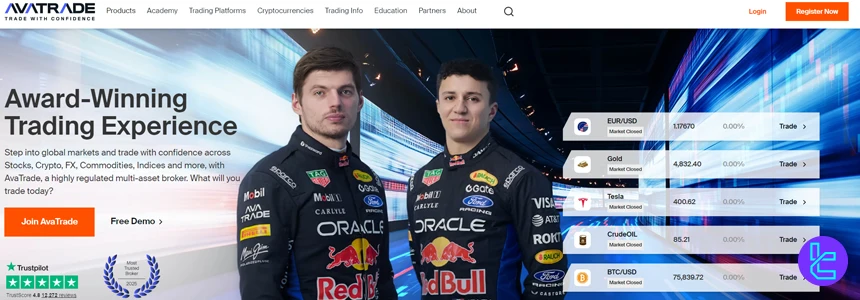
AvaTrade supports automated and copy trading through platforms such as MetaTrader 4, MetaTrader 5, DupliTrade, and AvaSocial. These tools make the broker suitable for traders interested in algorithmic strategies, signal copying, and AI-assisted decision-making.
The broker requires a minimum deposit of $100 and supports six funding methods, including cards, bank transfers, Skrill, Neteller, WebMoney, and PayPal. AvaTrade also provides access to more than 1,250 instruments across Forex, stocks, indices, commodities, ETFs, bonds, options, and cryptocurrencies.
AvaTrade combines instant execution, commission-free trading, and negative balance protection across all regulated entities. Traders can choose between Retail, Professional, Islamic, and Demo accounts, while leverage reaches up to 1:400 in selected jurisdictions and margin call / stop out levels are set at 25% and 10%.
If you are interested in signing up with this broker, check out our AvaTrade registration guide.
Table of Specifics
Account Types | Retail, Professional, Islamic, Demo |
Regulating Authorities | ASIC, CySEC, CBI, FSA, FSCA, MiFID, ADGM, PFSA, ISA |
Minimum Deposit | $100 |
Deposit Methods | Credit/Debit Cards, E-Wallets, Bank Wire Transfer, PayPal |
Withdrawal Methods | Credit/Debit Cards, E-Wallets, Bank Wire Transfer, PayPal |
Maximum Leverage | 1:400 |
Trading Platforms & Apps | MetaTrader 4, MetaTrader 5, Mobile App, WebTrader |
AvaTrade Pros and Cons
AvaTrade appeals to traders looking for a regulated broker with strong copy trading features, broad platform availability, and low entry requirements. However, its limited account variety and inactivity fees may be disadvantages for some users, especially compared to brokers with more specialized account structures.
Pros | Cons |
Regulated by 9 financial authorities worldwide | Limited account types compared to some competitors |
Supports AI-friendly tools like DupliTrade and AvaSocial | Inactivity fee charged after two months without trading |
Access to MT4, MT5, WebTrader, mobile app, and AvaOptions | No PAMM account support |
More than 1,250 tradable instruments across multiple markets | 24/5 support instead of full 24/7 availability |
IC Markets
IC Markets is a multi-asset broker established in Australia in 2007, offering access to Forex, stocks, commodities, indices, bonds, and crypto CFDs. The broker supports 10 base currencies, including USD, EUR, GBP, AUD, and JPY, making it suitable for international traders with different funding preferences.
The broker provides access to more than 2,250 tradable instruments, including over 2,100 stock CFDs and more than 60 currency pairs. IC Markets is especially attractive for AI and algorithmic traders due to its low-latency infrastructure, market execution model, Expert Advisor support, and spreads starting from 0.0 pips.
IC Markets is regulated by multiple authorities, including ASIC, CySEC, and the FSA of Seychelles. Client funds are held in segregated accounts, and European traders under CySEC receive investor compensation coverage of up to €20,000. The company also follows strict anti-money laundering and audit procedures.
The broker offers Standard, Raw Spread, and Islamic accounts with a minimum deposit of $200 and leverage of up to 1:500. Traders can use MetaTrader 4, MetaTrader 5, cTrader, WebTrader, and mobile apps. Average EUR/USD spreads start from 0.1 pips, while commissions on Raw accounts remain competitive.
It’s worth noting that an IC Markets rebate program is available for discounts on trading commissions. The table below summarizes the broker’s specifics.
Account Types | Standard, Raw Spread, Islamic |
Regulating Authorities | FSA, CySEC, ASIC |
Minimum Deposit | $200 |
Deposit Methods | Bank Cards, Wire Transfers, Electronic payments, etc. |
Withdrawal Methods | Bank Cards, Wire Transfers, Electronic payments, etc. |
Maximum Leverage | 1:500 |
Trading Platforms & Apps | Metatrader 4, Metatrader 5, cTrader, cTrader Web, IC Markets Mobile |
IC Markets Pros and Cons
IC Markets combines low-cost pricing, deep liquidity, and strong platform support, making it a suitable choice for AI trading systems, scalpers, and high-frequency traders. However, some traders may find the $200 minimum deposit relatively high, while leverage restrictions apply in certain regulated regions.
Pros | Cons |
Spreads from 0.0 pips on Raw accounts | $200 minimum deposit may be high for beginners |
Supports MT4, MT5, cTrader, and algorithmic trading | European and ASIC-regulated clients face leverage limits |
Access to more than 2,250 CFD instruments | No PAMM account support |
Strong regulation under ASIC, CySEC, and FSA | Bonuses and promotions are limited or unavailable |
BlackBull Markets
BlackBull Markets stands out in the AI trading broker segment with access to more than 26,000 instruments across Forex, stocks, commodities, indices, metals, and cryptocurrencies. Founded in 2014 in New Zealand, the broker has earned 7 industry awards and supports both active traders and long-term investors.
The broker offers three ECN account types: ECN Standard, ECN Prime, and ECN Institutional. Spreads can start from 0.0 pips, while leverage reaches up to 1:500. Traders can also choose between MT4, MT5, TradingView, cTrader, BlackBull CopyTrader, and BlackBull Invest.
BlackBull Markets is regulated by New Zealand’s Financial Markets Authority (FMA) and the Seychelles Financial Services Authority (FSA). Client protections include segregated accounts, negative balance protection, and FSCL membership for New Zealand clients. The broker also supports Islamic accounts and PAMM accounts.
One of BlackBull Markets’ strongest advantages is its technology-focused ecosystem. The broker offers API trading, copy trading, Equinix NY4 and LD5 servers, over 3,000 educational videos, and access to TradingView Premium. With no minimum deposit requirement on Standard accounts, it remains accessible to a wide range of traders.
Note that to access all features, you need to pass the BlackBull verification process. The table below outlines the broker’s details.
Account Types | ECN Standard, ECN Prime, ECN Institutional |
Regulating Authorities | FSA, FMA |
Minimum Deposit | $0 |
Deposit Methods | Visa, MasterCard, Apple Pay, Google Pay, Bank Wire, Crypto, Neteller, Skrill, SEPA, FasaPay |
Withdrawal Methods | Visa, MasterCard, Apple Pay, Google Pay, Bank Wire, Crypto, Neteller, Skrill, SEPA, FasaPay |
Maximum Leverage | 1:500 |
Trading Platforms & Apps | MT4, MT5, TradingView, cTrader, BlackBull CopyTrader, BlackBull Invest |
BlackBull Markets Pros and Cons
BlackBull Markets combines institutional-grade execution, broad market access, and powerful trading technology. However, the platform variety and advanced features may feel overwhelming for complete beginners, while some services remain unavailable in certain regions.
Before going through with the BlackBull Markets registration, consider the benefits and drawbacks.
Pros | Cons |
Access to 26,000+ instruments across 6 asset classes | Can be complex for beginner traders |
Spreads from 0.0 pips with ECN account options | Some countries and regions are restricted |
Supports MT4, MT5, TradingView, cTrader, and copy trading | ECN Institutional account requires a $20,000 deposit |
No minimum deposit requirement for ECN Standard account | $5 withdrawal fee applies to all methods |
Vantage Markets
Vantage Markets has operated in the online trading industry since 2009 and is headquartered in Sydney. The broker maintains more than 30 global offices and offers access to forex, indices, commodities, shares, ETFs, and cryptocurrencies through a multi-regulated structure.

One of the strongest aspects of Vantage Markets is its regulation. The broker is supervised by authorities such as the Financial Conduct Authority, Australian Securities and Investments Commission, Financial Sector Conduct Authority, and Vanuatu Financial Services Commission.
Depending on the entity, traders may receive segregated funds protection, negative balance protection, and compensation coverage.
Vantage Markets supports five trading platforms, including MetaTrader 4, MetaTrader 5, TradingView, ProTrader, and its proprietary mobile application. The broker also supports copy trading through ZuluTrade, DupliTrade, and Myfxbook AutoTrade>, making it suitable for both active and passive investors.
The broker offers five account types, including Standard STP, Standard Cent, Raw ECN, Pro ECN, and Swap Free. Traders can start with a minimum deposit of just $20, access spreads from 0.0 pips, and trade with leverage up to 1:1000 depending on their region and account type.
Raw ECN and Pro ECN accounts are particularly attractive for traders who prioritize lower spreads and faster execution.
If you have chosen this broker, you may check out our Vantage Markets registration guide. The table below provides a summary of features.
Account Types | Standard STP, Standard Cent, Raw ECN, Pro ECN, Swap Free |
Regulating Authorities | ASIC, FSCA, VFSC, FCA, CIMA |
Minimum Deposit | $20 |
Deposit Methods | E-Wallets, bank transfer, credit/debit cards, Perfect Money, local payment options |
Withdrawal Methods | E-Wallets, bank transfer, credit/debit cards, Perfect Money, local payment options |
Maximum Leverage | Up to 1:1000 |
Trading Platforms & Apps | Metatrader 4, Metatrader 5, ProTrader, TradingView, proprietary application |
Vantage Markets Pros and Cons
Vantage Markets combines low entry requirements, flexible account types, and broad platform support with strong regulatory coverage. However, restrictions in several countries, mixed user review scores, and the high deposit requirement for the Pro ECN account may be drawbacks for some traders.
Pros | Cons |
Regulated by multiple authorities including FCA and ASIC | Pro ECN account requires a $10,000 minimum deposit |
Supports MT4, MT5, TradingView, ProTrader, and proprietary app | Not available in countries such as the US and Canada |
Offers copy trading via ZuluTrade, DupliTrade, and Myfxbook AutoTrade | Trustpilot score is weaker than some competitors |
Minimum deposit starts from only $20 | No dedicated desktop proprietary trading platform |
FxPro
Founded in 2006, FxPro has built a strong reputation through fast execution speeds below 12 milliseconds, more than 7.8 million client accounts, and over 125 international industry awards. The broker supports Forex, CFDs, cryptocurrencies, indices, futures, shares, metals, and energy markets.

FxPro offers access to more than 2,100 instruments across 70+ currency pairs, stock CFDs, crypto CFDs, indices, futures, and commodities. Traders can choose between Standard, Raw+, and Elite accounts, with spreads from 0.0 pips and leverage up to 1:500 for international clients. Discounts are available through FxPro rebate.
The broker is regulated by multiple authorities including the Financial Conduct Authority, Cyprus Securities and Exchange Commission, Financial Sector Conduct Authority, and the Securities Commission of The Bahamas.
Client protection features include segregated funds, negative balance protection, and compensation schemes of up to £85,000 in the UK and €20,000 in the EU.
FxPro supports multiple trading platforms including MetaTrader 4, MetaTrader 5, cTrader, WebTrader, and its proprietary mobile app. Additional features include copy trading, Islamic accounts, PAMM accounts, Expert Advisors, scalping support, and funding methods such as PayPal, Skrill, Neteller, Visa, and bank transfer.
You can visit our FxPro dashboard article to learn about the broker’s personal cabinet features and capabilities.
Specifics and Details
Account Types | Standard, Raw+, Elite |
Regulating Authorities | FCA, FSCA, CySEC, SCB |
Minimum Deposit | $100 |
Deposit Methods | Visa, Mastercard, Bank Wire Transfer, Broker to Broker Transfer, Skrill, Neteller, PayPal |
Withdrawal Methods | Visa, Mastercard, Bank Wire Transfer, Broker to Broker Transfer, Skrill, Neteller, PayPal |
Maximum Leverage | 1:500 |
Trading Platforms & Apps | MT4, MT5, cTrader, Web Trader, Mobile App |
FxPro Pros and Cons
FxPro stands out because of its regulatory coverage, wide platform selection, and fast execution infrastructure. However, some traders may find the higher Raw+ deposit requirement, limited promotions, and restricted country availability less attractive compared to some competitors.
Pros | Cons |
Regulated by FCA, CySEC, FSCA, and SCB | Not available in the USA, Canada, and Iran |
Access to more than 2,100 instruments | Raw+ account requires a $200 deposit |
Fast execution under 12 milliseconds | Limited bonus and promotion programs |
Supports MT4, MT5, cTrader, WebTrader, and mobile trading | Customer support is available only 24/5 |
XM
XM Group has operated since 2009 and serves more than 15 million clients globally, processing nearly 14 million trades per day. The broker maintains offices in Cyprus, South Africa, Dubai, Belize, Mauritius, and Seychelles, giving it a broad international presence across multiple regulated regions.
XM offers access to more than 1,400 CFDs, including 55+ forex pairs, over 1,200 stock CFDs, commodities, indices, cryptocurrencies, and precious metals. Traders can choose between Standard, Ultra Low, Shares, Micro, and Demo accounts with a minimum deposit starting from just $5.
One of XM’s strongest advantages is its regulatory coverage. The broker operates under multiple authorities including CySEC, DFSA, FSC Belize, FSCA South Africa, FSC Mauritius, and FSA Seychelles. XM also provides negative balance protection, leverage up to 1:1000, and guaranteed execution for orders up to 50 lots.
The broker remains a MetaTrader-focused broker, supporting both MT4 and MT5 across desktop, web, and mobile devices. Features such as XM copy trading, MQL5 signal integration, swap-free accounts, multilingual support, and instant deposits make the broker suitable for both beginner and experienced traders.
To access all of the available features and benefits, you must go through the XM verification process.
Specifics and Details
Account Types | Standard, Ultra Low, Shares |
Regulating Authorities | FSC Belize, CySEC Cyprus, FSCA South Africa, DFSA Dubai, FSC Mauritius, FSA Sechelles |
Minimum Deposit | $5 |
Deposit Methods | Credit/Debit Cards, Bank Transfers, E-Wallet Payments |
Withdrawal Methods | Credit/Debit Cards, Bank Transfers, E-Wallet Payments |
Maximum Leverage | Up To 1:1000 |
Trading Platforms & Apps | MT4, MT5, Mobile App |
XM Pros and Cons
XM’s advantages mainly revolve around low entry requirements, broad market access, and strong regulatory coverage. However, the broker also has some drawbacks, including inactivity fees, limited platform variety outside MetaTrader, and regional restrictions for traders in countries such as the United States and Canada.
Pros | Cons |
Minimum deposit starts from just $5 | Charges a $10 monthly inactivity fee |
Access to more than 1,400 CFDs and 55+ forex pairs | Not available for traders in the US and Canada |
Regulated by multiple authorities including CySEC, DFSA, and FSC | No proprietary desktop trading platform |
Negative balance protection and leverage up to 1:1000 | Shares account requires a high $10,000 minimum deposit |
How Was Each Broker Chosen?
Selecting the best AI Forex brokers requires more than comparing spreads or platform names. At TradingFinder, each broker is reviewed through a 19-metric evaluation framework designed to measure reliability, technology, trading conditions, and overall user experience.
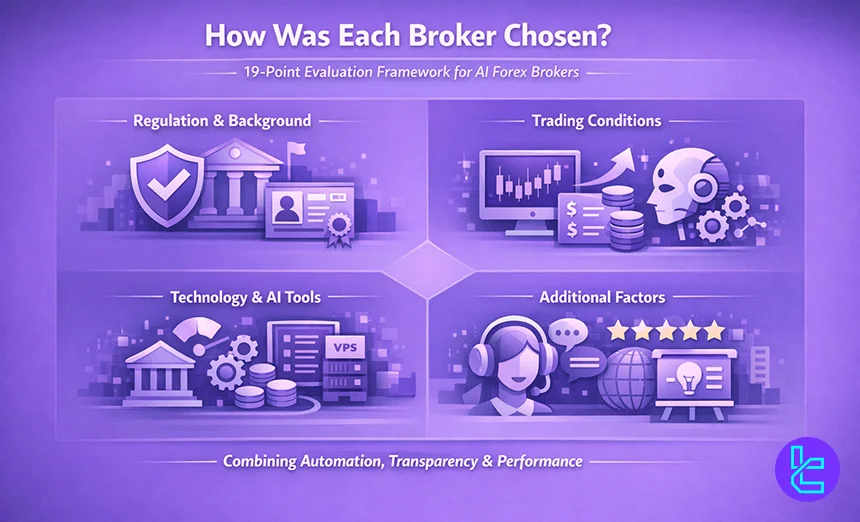
This process helps traders identify which AI-powered brokers provide the strongest combination of automation, transparency, and performance.
The first stage of the review focuses on regulation, licenses, and broker background. TradingFinder examines whether a broker is supervised by trusted financial authorities, offers investor protection programs, and maintains a transparent company structure with clear information about its founders, headquarters, and years of operation.
Scam alerts, customer complaints, and the broker’s response to issues are also reviewed carefully.
The second stage analyzes the trading environment itself. This includes account types, spreads, commissions, deposit and withdrawal methods, minimum deposit requirements, copy trading availability, and the variety of tradable instruments such as Forex pairs, stocks, ETFs, commodities, indices, and CFDs.
TradingFinder also evaluates whether the broker supports advanced platforms like MetaTrader 4, MetaTrader 5, cTrader, and mobile trading apps.
Technology is another major factor when reviewing AI Forex brokers. TradingFinder studies platform stability, execution speed, algorithmic trading tools, VPS support, API access, social trading systems, and AI-based features such as trading signals, automated strategies, and risk management tools.
Finally, Trustpilot ratings, customer support quality, educational materials, office locations, news updates, social media activity, infographics, and sponsorship programs are included in the final score. This detailed methodology ensures every broker is reviewed fairly, objectively, and based on real trader needs.
What Makes a Forex Broker Suitable for AI Trading?
A Forex broker becomes suitable for AI trading when it provides the infrastructure needed for automated systems to run efficiently, consistently, and without unnecessary delays. Unlike manual trading, AI-based strategies depend heavily on execution speed, platform stability, and uninterrupted access to market data.
The most important factor is low-latency execution. AI trading systems, Expert Advisors, and algorithmic strategies can place multiple orders within seconds. A broker with fast order execution, minimal slippage, and stable pricing helps reduce the risk of delayed entries and exits.
This is especially important for scalping, high-frequency trading, and short-term automated strategies.
Platform compatibility is another key requirement. Brokers that support MetaTrader 4, MetaTrader 5, cTrader, API connectivity, and VPS hosting are usually better suited for AI trading. These platforms allow traders to use Expert Advisors, custom indicators, copy trading tools, and external trading bots without major limitations.
A suitable AI Forex broker should also provide deep liquidity, low spreads, and transparent commissions. Since many AI systems open a high number of trades, even small differences in spreads and fees can significantly affect long-term profitability.
Brokers with ECN or Raw Spread accounts are often preferred because they provide tighter spreads and more accurate market pricing.
Reliable uptime is equally important. AI systems may operate 24/5 without supervision, so frequent platform outages, requotes, or server interruptions can damage strategy performance. Many traders prefer brokers that offer VPS services, dedicated servers, and multiple data centers to keep automated strategies running continuously.
Finally, brokers that offer copy trading, social trading, advanced analytics, and built-in risk management tools are often more attractive for AI traders. Features such as stop-loss automation, exposure limits, position sizing tools, and performance tracking can improve the efficiency and safety of algorithmic trading systems.
Execution Speed for AI-Based Forex Strategies
Execution speed is one of the most important factors in AI-based Forex trading because automated systems react to price movements much faster than manual traders. When a broker processes an order too slowly, even a small delay can lead to slippage, worse entry prices, and reduced profitability.
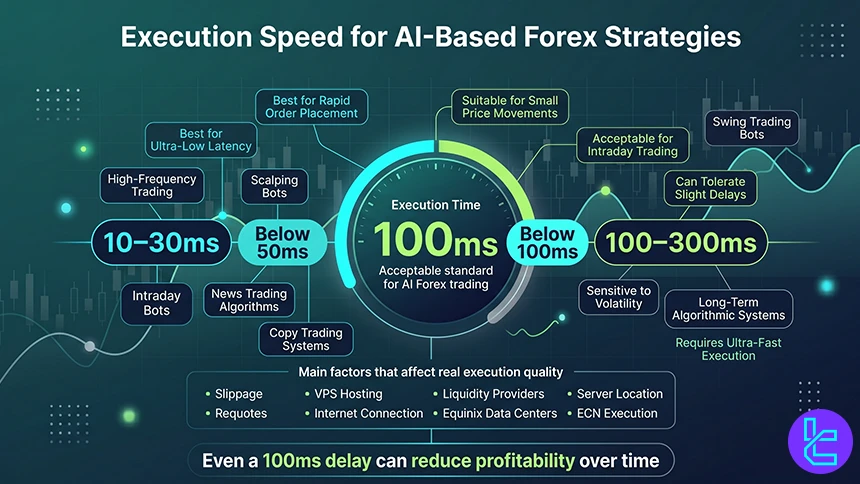
For most AI Forex strategies, an execution speed below 100 milliseconds is considered acceptable. However, high-frequency trading systems, scalping bots, and news trading algorithms often require execution speeds below 50 milliseconds.
Some brokers advertise average execution speeds between 10 and 30 milliseconds, which is more suitable for strategies that rely on rapid order placement and small price movements.
The required speed depends on the type of AI strategy being used:
- Long-term algorithmic systems and swing trading bots can usually tolerate execution speeds of 100 to 300 milliseconds because they focus on larger price moves;
- Intraday bots, short-term Expert Advisors, and copy trading systems usually perform better when execution speeds stay below 100 milliseconds;
- Scalping algorithms, arbitrage systems, and high-frequency trading models often require execution speeds under 50 milliseconds to remain effective;
- News trading bots are especially sensitive to speed because price volatility can change dramatically within a few seconds after major economic releases.
Execution speed is not only about the broker’s server response time. Other factors such as slippage, requotes, VPS location, internet connection quality, and proximity to liquidity providers also affect real trading performance.
Brokers with dedicated VPS hosting, Equinix data centers, and ECN execution models usually provide better conditions for AI trading systems.
Because many AI strategies generate a high number of trades, even a delay of 100 milliseconds can reduce profitability over time. This is why traders often prefer brokers with consistently fast execution rather than brokers that only advertise low spreads or advanced platforms.
How Do AI Trading Bots Connect to Forex Brokers?
AI trading bots connect to Forex brokers through trading platforms, APIs, or bridge software that allows the bot to send trading instructions directly to the broker’s servers. The connection method depends on the broker, the platform being used, and the complexity of the trading system.
Through Trading Platforms
The most common method is through platforms such as MetaTrader 4, MetaTrader 5, and cTrader. On MT4 and MT5, AI bots are usually installed as Expert Advisors (EAs), which can automatically analyze charts, place orders, manage stop losses, and close positions. On cTrader, automated systems are often built using cBots.
Through APIs
Some Forex brokers offer API connectivity, allowing traders to connect custom-built AI systems directly to the broker’s infrastructure.
Common options include REST APIs, FIX APIs, and WebSocket APIs. API access is often used by advanced traders, quantitative funds, and developers who want greater flexibility than standard trading platforms can provide.
Through VPS Hosting
Many AI trading bots run continuously on a Virtual Private Server (VPS). A VPS keeps the trading platform online 24/5, even if the trader’s personal computer is turned off. Brokers that provide VPS services or support third-party VPS providers are often preferred for automated Forex trading because they reduce downtime and improve execution stability.
Through Copy Trading Systems
Some AI bots connect indirectly through copy trading or social trading networks. In this model, traders subscribe to an automated strategy provider, and the broker mirrors trades automatically in the client’s account. This approach is common on platforms such as MetaTrader 5 Signals, ZuluTrade, and Myfxbook AutoTrade.
Through Third-Party Bridge Software
Some traders use bridge software to connect AI tools, machine learning systems, or external analytics platforms to a Forex broker. These bridges can link trading bots developed in languages such as Python, C++, or Java with broker platforms and allow the automated system to execute trades based on external signals or market conditions.
Are AI Forex Trading Bots Legal?
AI Forex trading bots are legal in most countries and are widely used by retail traders, professional traders, hedge funds, and financial institutions. Automated trading itself is not illegal because the bot is simply executing trades according to predefined rules set by the trader.
Most major Forex brokers allow the use of trading bots, Expert Advisors, and algorithmic systems on platforms such as MetaTrader 4, MetaTrader 5, and cTrader.
Many brokers even encourage automated trading by offering VPS hosting, API access, copy trading tools, and dedicated servers for faster execution.
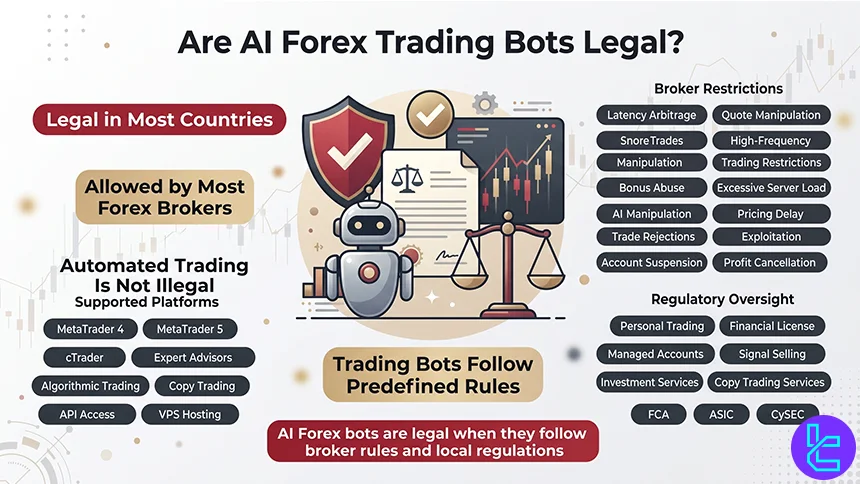
However, legality does not mean every strategy is allowed. Some brokers restrict certain forms of automated trading, especially if they create excessive server load or exploit pricing delays.
For example, latency arbitrage, quote manipulation, bonus abuse, and some high-frequency trading techniques may violate broker terms and conditions. In these cases, the broker may reject trades, suspend the account, or cancel profits generated from prohibited activities.
The legal status of AI trading bots can also depend on local financial regulations. In most countries, using a bot for personal trading is permitted, but selling trading signals, managing other people’s money, or offering automated investment services may require a financial license.
Companies that operate AI trading funds or copy trading services often need approval from regulators such as the Financial Conduct Authority, the Australian Securities and Investments Commission, or the Cyprus Securities and Exchange Commission.
For most individual traders, AI Forex bots are fully legal as long as they follow the broker’s rules, operate within local regulations, and do not use manipulative or abusive trading practices.
Most Important Costs and Fees in AI Forex Trading
AI Forex trading can involve more costs than manual trading because automated systems often place a large number of trades. Even small fees can have a significant impact on long-term profitability when a strategy executes hundreds or thousands of positions each month.
The most important cost is the spread. The spread is the difference between the bid and ask price, and it applies every time a trade is opened. AI trading systems that scalp or trade frequently are highly sensitive to spread costs because they often target small price movements.
Commissions are another major expense, especially on ECN and Raw Spread accounts. Brokers may charge a fixed fee per lot traded in exchange for lower spreads. For high-frequency trading bots, commission costs can accumulate quickly if the system opens many positions per day.
Swap fees, also called overnight financing charges, are important for bots that keep trades open for more than one trading session. Depending on the currency pair, direction of the trade, and broker policy, swap fees can either increase costs or provide a positive credit.
Other important AI trading costs include:
- VPS hosting fees for keeping automated systems online 24/5
- Copy trading fees for following signal providers or automated portfolios
- Deposit and withdrawal fees charged by the broker or payment processor
- Currency conversion fees when the trading account uses a different base currency
- Inactivity fees on accounts that remain unused for several months
- Slippage costs caused by delayed execution or volatile market conditions
- Data feed or API access fees for advanced algorithmic trading systems
- Subscription costs for premium AI bots, trading signals, or external analytics tools
Brokers that offer low spreads, competitive commissions, free VPS hosting, and minimal non-trading fees are usually more suitable for AI Forex trading. Since automated systems can generate a large number of trades, controlling costs is often just as important as improving strategy performance.
Conclusion
AI can automate trading with pre-designed algorithms in certain structures based on decision-making. Brokers operating with this in mind should include certain features, such as low spread options, fast execution, and support for common platforms.
Our investigations show that AvaTrade, IC Markets, BlackBull Markets, and Vantage Markets are the best choices for trading based on AI features and tools.
For more details and information on the way the list was curated, check out our Forex methodology.