






Bond trading brokers provide access to one of the most fundamental segments of global financial markets, allowing traders to speculate on or invest in government and corporate debt instruments. Unlike Forex or equities, bond markets are heavily influenced by interest rates, central bank policies, inflation expectations, and macroeconomic conditions, making broker selection a critical factor in trading performance.
Most Forex brokers offer bond trading through CFDs, enabling traders to gain exposure to instruments such as US Treasury bonds, UK Gilts, and European government debt without owning the underlying asset. This structure allows both long and short positions, along with the use of leverage, which increases flexibility but also introduces additional risk.
The guide below analyzes the best bond trading brokers based on tradable instruments, pricing structure, platform availability, regulatory status, and overall trading conditions, helping traders identify reliable environments for fixed-income trading strategies.
 | IC Markets | |||
 | MONETA | |||
 | PUPRIME | |||
| 4 |  | vt markets | ||
| 5 |  | TeleTrade | ||
| 6 |  | DEGIRO | ||
| 7 |  | GLOAL PRIME | ||
| 8 |  | ALB |
Customer Reviews on Trustpilot for Bond Trading Brokers
Trustpilot reviews provide a practical lens into how bond trading brokers perform in real trading environments, especially in areas that directly impact fixed-income strategies such as pricing stability, execution reliability, and withdrawal efficiency. Since bond markets often involve longer holding periods and sensitivity to macroeconomic shifts, user feedback tends to focus less on speed alone and more on consistency and trust.
Unlike high-frequency Forex trading, bond trading requires brokers to maintain stable spreads and accurate pricing over extended periods. As a result, Trustpilot reviews frequently highlight whether brokers can deliver reliable conditions during interest rate announcements, inflation data releases, and central bank decisions.
Broker Name | Trustpilot Rating | Number of Reviews |
53,134 | ||
Global Prime | 435 | |
Degiro | 5,456 | |
VT Markets | 2,612 | |
498 | ||
PU Prime | 3.3/5 ⭐ | 1,754 |
TeleTrade | 104 | |
ALB | 7 |
Minimum Spread Levels for Bond Trading Brokers
Spreads play a central role in bond trading, as they represent the primary cost of entering and exiting positions, especially when trading bond CFDs through Forex brokers. Unlike major Forex pairs where spreads can be extremely tight, bond instruments typically have wider and more variable spreads due to lower liquidity and sensitivity to macroeconomic factors.
Bond spreads are influenced by elements such as interest rate expectations, central bank policies, and overall market demand for fixed-income assets. As a result, traders must evaluate not only the minimum spread advertised by brokers but also how stable those spreads remain under different market conditions.
Broker Name | Min. Spread |
IC Markets | From 0.0 pips |
Moneta Markets | From 0.0 pips |
From 0.0 pips | |
From 0.0 pips | |
HFM | From 0.0 pips |
Esperio | From 0.0 pips |
Tickmill | From 0.0 pips |
Markets.com | From 0.5 Pips |
Non-Trading Costs in Bond Trading Forex Brokers
Non-trading costs are a critical component in bond trading, often having a greater long-term impact than spreads or commissions. Since bond strategies frequently involve holding positions over extended periods, fees outside direct trade execution can significantly influence overall profitability.
Unlike short-term trading, where entry and exit costs dominate, bond traders must account for ongoing expenses such as swap rates and account-related charges. These costs can accumulate over time and reduce net returns if not carefully managed.
Broker Name | Deposit Fee | Withdrawal Fee | Inactivity Fee |
TeleTrade | $0 | $0 | N/A |
Degiro | $0 | $0 | $0 |
$0 | $0 | $0 | |
$0 | $0 | $0 | |
ICM.com | $0 | $0 | N/A |
ActivTrades | $0 | $0 | $10 Monthly After 12 Month |
City Index | $0 | $0 | $12 Monthly |
CAPEX | $0 | $0 | $15 Monthly After 12 Month |
Trading Platforms Offered by Bond Trading Brokers
Trading platforms play a decisive role in bond trading, as they determine how effectively traders can analyze interest rate movements, monitor yields, and execute positions. Unlike fast-paced Forex trading, bond markets require tools that support macro analysis, longer timeframes, and intermarket correlation tracking.
Most bond trading brokers provide access through CFD platforms rather than direct bond exchanges, which makes platform quality even more important for accurate pricing and execution. Platforms must handle not only price charts but also yield-driven analysis and cross-asset relationships with currencies, indices, and commodities.
Broker Name | Trading Platforms |
PU Prime | MT4, MT5, PU Prime app |
VT Markets | MetaTrader 4, MetaTrader 5, Webtrader+, VT Markets App |
MT4, MT5 | |
Proprietary Platform | |
GO Markets | MT4, MT5, cTrader |
Interactive Investor | Proprietary Web-Platform, Mobile App |
Albprime | MT4 |
Admirals | MT4, MT5, Web Trader, Mobile App |
Top 6 Bond Brokers Reviewed
Selecting the best bond trading Forex brokers requires a different evaluation approach compared to traditional Forex trading. Since bond instruments are heavily influenced by interest rates and macroeconomic factors, traders need brokers that offer stable pricing, reliable execution, and access to a diverse range of fixed-income CFDs.
Top brokers in this category typically provide exposure to major government bonds such as US Treasuries, UK Gilts, and European Bunds, along with competitive spreads and low overnight costs. Execution quality is also essential, as bond markets can react sharply to economic data and central bank announcements.
IC Markets
IC Markets is a globally recognized multi-asset forex market and CFD contract broker established in 2007, known for its institutional-grade trading conditions and deep liquidity access. The broker operates under multiple regulatory authorities including ASIC, CySEC, and FSA, ensuring a high level of compliance, client fund segregation, and operational transparency.

The broker offers three primary account types including Standard, Raw Spread, and Islamic accounts, designed to suit different trading strategies. The Raw Spread account provides spreads from 0.0 pips with commissions starting from $3 to $3.5 per lot per side, making it particularly attractive for scalpers and algorithmic traders.
Meanwhile, the Standard account offers spreads from 0.8 pips with no commission. The minimum deposit is $200, aligning with its professional-grade infrastructure.
IC Markets supports a wide range of platforms including MetaTrader 4, MetaTrader 5, cTrader, cTrader Web, and a proprietary mobile application. These platforms enable advanced charting, one-click trading, and automated strategies through Expert Advisors. The broker uses a market execution model, ensuring fast order processing and minimal intervention.
Traders gain access to over 2,200 tradable instruments, including Forex pairs, stocks, indices, commodities, cryptocurrencies, and bond CFDs. The broker also supports copy trading through cTrader, allowing users to follow professional strategies.
Funding options include bank cards, wire transfers, PayPal, Skrill, Neteller, and other electronic payment systems, with no deposit or withdrawal fees charged by the broker. Additionally, the broker provides IC Markets rebate and does not apply inactivity fees, which enhances cost efficiency for long-term traders.
Overall, IC Markets stands out for its ultra-tight spreads, advanced platforms, and strong execution environment, although the $200 minimum deposit may be a consideration for beginners.
Account Types | Standard, Raw Spread, Islamic |
Regulating Authorities | ASIC, CySEC, FSA |
Minimum Deposit | $200 |
Deposit Methods | Bank Cards, Wire Transfer, PayPal, Skrill, Neteller, UnionPay, POLI |
Withdrawal Methods | Bank Cards, Wire Transfer, PayPal, Skrill, Neteller |
Maximum Leverage | Up to 1:500 |
Trading Platforms & Apps | MetaTrader 4, MetaTrader 5, cTrader, cTrader Web, Mobile App |
IC Markets Pros and Cons
IC Markets offers competitive spreads, multi-jurisdiction regulatory coverage, and advanced trading platforms, although regional limitations and the lack of a proprietary platform may affect trader preferences.
Pros | Cons |
Spreads from 0.0 pips on RAW accounts | Minimum deposit ($200) may be high for beginners |
Strong regulation (ASIC, CySEC) | Lower leverage in EU regions |
2200+ tradable instruments | No PAMM accounts |
Multiple platforms (MT4, MT5, cTrader) | - |
No deposit/withdrawal or inactivity fees | - |
Fast market execution with deep liquidity | - |
Moneta Markets
Moneta Markets is a relatively new Forex and CFD broker established in 2020 and based in South Africa, offering a flexible trading environment with access to over 1,000 financial instruments across multiple asset classes.
The broker operates under FSCA regulation and is also associated with offshore registration structures, which provides global accessibility but slightly lower regulatory strength compared to top-tier jurisdictions.

The broker offers three main account types including Direct, Prime, and Ultra, each designed for different trading styles. The Direct account provides commission-free trading with spreads starting from 1.2 pips, while Prime and Ultra accounts offer spreads from 0.0 pips with commissions starting from $3 and $1 per lot per side respectively. With a minimum deposit of just $50, Moneta Markets maintains a low entry barrier suitable for beginner traders.
Moneta Markets dashboard supports multiple trading platforms including MetaTrader 4, MetaTrader 5, Pro Trader, and App Trader. The Pro Trader platform integrates with TradingView, offering advanced charting and analytical tools, while mobile and web-based solutions ensure flexibility across devices. Execution models include both STP and ECN, depending on the account type.
The broker also provides copy trading and PAMM account services, enabling passive investment opportunities. After completing Moneta Markets registration, Traders can access a wide range of markets including Forex, stocks, indices, commodities, cryptocurrencies, ETFs, and bond CFDs.
Moneta Markets deposit and withdrawal options include bank transfers, credit/debit cards, e-wallets, and cryptocurrencies, with no deposit or withdrawal fees charged by the broker. Withdrawals are typically processed within 24 hours, enhancing operational efficiency.
Overall, Moneta Markets stands out for its low minimum deposit, flexible account structure, and modern platform ecosystem, although its relatively lighter regulatory framework may be a consideration for risk-sensitive traders.
Account Types | Direct, Prime, Ultra |
Regulating Authorities | FSCA, FSRA |
Minimum Deposit | $50 |
Deposit Methods | Wire Transfer, Visa/MasterCard, Fasapay, Stickpay, JCB, Crypto |
Withdrawal Methods | Wire Transfer, Visa/MasterCard, Fasapay, Stickpay, JCB, Crypto |
Maximum Leverage | Up to 1:1000 |
Trading Platforms & Apps | MetaTrader 4, MetaTrader 5, Pro Trader, App Trader |
Moneta Markets Pros and Cons
Moneta Markets combines tight pricing with broad regulatory oversight and robust platform support, though geographic restrictions and the absence of an in-house platform could influence decisions.
Pros | Cons |
Low minimum deposit ($50) | Limited top-tier regulation |
Spreads from 0.0 pips on ECN accounts | Relatively new broker (founded 2020) |
Multiple platforms (MT4, MT5, Pro Trader) | Not available in some regions |
Copy trading and PAMM accounts available | - |
1000+ tradable instruments | - |
No deposit/withdrawal or inactivity fees | - |
PU Prime
PU Prime is a multi-asset Forex and CFD broker established in 2016, offering access to over 800 tradable instruments across six asset classes, including Forex, indices, commodities, shares, ETFs, and bonds. The broker operates under multiple regulatory entities such as ASIC, FSCA, and offshore authorities, combining global accessibility with a moderate level of regulatory oversight.

The broker provides four main account types including Standard, Prime, ECN, and Cent accounts, allowing traders to select conditions based on their strategy and capital. Spreads start from 1.3 pips on Standard accounts, while Prime and ECN accounts offer spreads from 0.0 pips with commissions ranging from $3.5 to $1 per lot per side. The minimum deposit starts from just $20, making PU Prime highly accessible for beginner traders.
PU Prime dashboard supports MetaTrader 4, MetaTrader 5, WebTrader, and its proprietary mobile application, ensuring flexibility across desktop and mobile environments. The broker uses STP and ECN execution models with market execution, enabling relatively fast and transparent order processing.
Traders can also access copy trading and social trading features through the PU Prime app, allowing them to follow experienced traders and diversify strategies. PU Prime deposit and withdrawal methods supports multiple funding methods including bank transfers, credit cards, e-wallets, and cryptocurrencies, which are available based on PU Prime verification entity.
Additional features include Islamic accounts, negative balance protection, and extensive educational resources such as webinars and trading guides.
Overall, PU Prime stands out for its low minimum deposit, diverse account types, and broad asset coverage, although mixed user reviews and offshore regulatory elements may require careful evaluation by traders.
PU Prime Pros and Cons
PU Prime provides efficient spreads, operates under multiple regulators, and supports industry-standard platforms, while regional constraints and no proprietary solution may be considerations.
Pros | Cons |
Low minimum deposit ($20) | Mixed user reviews on platforms |
Multiple regulations (ASIC, FSCA) | Offshore regulatory exposure |
800+ tradable instruments | Not available in some regions |
Spreads from 0.0 pips on ECN accounts | - |
Copy trading and social trading available | - |
Multiple platforms (MT4, MT5, App) | - |
VT Markets
VT Markets is a multi-asset Forex and CFD broker headquartered in Australia, offering access to over 1,000 tradable instruments across seven financial markets, including Forex, indices, commodities, shares, ETFs, and bond CFDs. Since its establishment, the broker has expanded globally, serving more than 400,000 active traders and processing millions of trades monthly.
The broker operates under multiple regulatory authorities, including ASIC, FSCA, and FSC Mauritius. While ASIC provides strong oversight, many international clients are onboarded under offshore entities, which may offer higher leverage but slightly lower investor protection. Segregated funds and negative balance protection are available under certain entities, enhancing client safety.
VT Markets dashboard offers a variety of account types, including Standard STP, RAW ECN, Cent STP, and Cent ECN accounts. Spreads start from 1.2 pips on Standard accounts, while RAW ECN accounts provide zero spread conditions with commissions around $6 per round turn. The minimum deposit starts from $50, making the broker accessible to a wide range of traders.
The platform ecosystem includes MetaTrader 4, MetaTrader 5, WebTrader+ powered by TradingView, and the VT Markets mobile app. These platforms support both manual and algorithmic trading, with additional tools such as Trading Central and sentiment analysis integrations.
VT Markets also offers copy trading and PAMM investment solutions, which are available after going through VT Markets verification. Funding methods include cards, bank transfers, Skrill, Neteller, and regional payment systems, with fast processing times.
Overall, the broker stands out for its broad asset coverage, easy VT Markets registration, multiple account types, and platform flexibility, although offshore regulation and mixed trust scores may require careful consideration.
VT Markets Pros and Cons
VT Markets maintains low spreads alongside strong regulatory presence and advanced trading systems, although certain regional restrictions and platform limitations may impact users.
Pros | Cons |
Regulated by ASIC, FSCA | Offshore entities reduce protection |
1000+ tradable instruments | No crypto trading availability |
Zero spread ECN accounts | Withdrawal fees may apply |
Multiple platforms (MT4, MT5, WebTrader+) | Not available in some countries |
Copy trading and PAMM options | - |
Low minimum deposit ($50) | - |
TeleTrade
TeleTrade is a long-established Forex and CFD broker founded in 1994, offering access to a wide range of financial markets including Forex, stocks, indices, commodities, cryptocurrencies, and bond CFDs. With nearly three decades of industry presence and offices in multiple countries, the broker has built a reputation for stability and global reach.
The broker operates under the regulation of the Cyprus Securities and Exchange Commission (CySEC), a Tier 1 authority within the European Union. This provides access to investor protection schemes up to €20,000 under the ICF, along with segregated client funds and negative balance protection. TeleTrade primarily serves European clients under this regulatory framework.
Selectable in TeleTrade registration, the broker offers three main account types including ECN, NDD, and Cent accounts, all starting with a minimum deposit of just $10, making it highly accessible for beginners. Spreads begin from 0.2 pips on ECN accounts, while commissions start from approximately 0.007%, depending on the account type. The broker supports both market and instant execution models.
TeleTrade dashboard trading platforms include MetaTrader 4 and MetaTrader 5, providing a familiar environment for both manual and automated trading strategies. TeleTrade also offers a copy trading service called “Synchronous Trading,” allowing users to replicate the trades of experienced traders with customizable risk settings.
Funding options include bank transfers, credit/debit cards, e-wallets like Neteller and FasaPay, as well as cryptocurrencies. While deposits are mostly free, some methods such as Neteller may incur fees, and may not available because of TeleTrade verification entity.
Overall, TeleTrade stands out for its strong regulatory backing, low minimum deposit, and long-standing market presence, although limited cost transparency and regional restrictions may be considerations.
Account Types | ECN, NDD, Cent |
Regulating Authorities | CySEC |
Minimum Deposit | $10 |
Deposit Methods | Bank Transfer, Credit/Debit Cards, Neteller, FasaPay, Crypto |
Withdrawal Methods | Bank Transfer, Credit/Debit Cards, Neteller, FasaPay, Crypto |
Maximum Leverage | Up to 1:500 |
Trading Platforms & Apps | MetaTrader 4, MetaTrader 5 |
TeleTrade Pros and Cons
TeleTrade delivers a competitive trading setup with tight spreads, global regulatory licensing, and reliable platforms, though the lack of a proprietary platform and geographic limits may affect selection.
Pros | Cons |
Regulated by CySEC (Tier 1) | Limited transparency on some fees |
Very low minimum deposit ($10) | Not available in several countries |
Long operational history (since 1994) | Withdrawal fees apply |
MT4 and MT5 platforms | No PAMM accounts |
Copy trading (Synchronous Trading) | - |
Investor protection up to €20,000 | - |
DEGIRO
DEGIRO is a European-based brokerage founded in 2008 and headquartered in Amsterdam, offering access to a wide range of financial markets including stocks, ETFs, bonds, options, commodities, and funds. The broker has expanded significantly across Europe, now serving over 3 million users in more than 15 countries, with strong regulatory oversight from BaFin, AFM, and the Dutch Central Bank (DNB).
Unlike traditional Forex brokers, DEGIRO focuses on direct market access rather than CFD-based trading. This makes it particularly attractive for bond investors seeking real exposure instead of speculative derivatives. The broker provides access to over 45 global exchanges across 30 countries, enabling diversified portfolio construction across multiple asset classes.
DEGIRO operates with a transparent commission-based pricing model. For bond trading, fees typically start from €2 per trade with an additional €1 handling fee, while other instruments such as stocks and ETFs have similarly low-cost structures. Notably, the broker does not charge inactivity or withdrawal fees, although currency conversion fees of around 0.25% may apply for foreign transactions.
The platform is proprietary and available via web and mobile applications, offering features such as real-time market data, advanced charting tools, and access to global financial news. However, the broker does not support MetaTrader platforms, copy trading, or automated trading features, which may limit flexibility for some users.
DEGIRO requires no minimum deposit, making it highly accessible for new investors. Funding is conducted via bank transfer only, which may be less convenient compared to multi-method brokers.
Overall, DEGIRO stands out for its low-cost structure, straightforward Degiro registration, strong European regulation, and direct access to bond markets, although the lack of trading leverage and advanced trading tools may not suit active traders.
Account Types | Not specified |
Regulating Authorities | BaFin, AFM, DNB |
Minimum Deposit | $0 |
Deposit Methods | Bank Transfer |
Withdrawal Methods | Bank Transfer |
Maximum Leverage | Not Available |
Trading Platforms & Apps | Proprietary Web Platform, Mobile App |
DEGIRO Pros and Cons
DEGIRO integrates cost-efficient spreads, multi-regulatory supervision, and established trading platforms, while regional access restrictions and no native platform may influence trader choice.
Pros | Cons |
Strong regulation (BaFin, AFM, DNB) | No leverage available |
No minimum deposit required | Limited deposit methods (bank only) |
Direct access to real bonds and markets | No MetaTrader or advanced platforms |
Low and transparent commission structure | No copy trading or automation |
No inactivity or withdrawal fees | Currency conversion fees apply |
Access to 45+ global exchanges | Restricted to EU clients |
Criteria to Select the Best Metals Trading Brokers
Selecting a reliable metals trading broker requires focusing on factors that directly impact pricing accuracy, execution quality, and overall trading costs. Since metals like gold and silver are highly sensitive to macroeconomic conditions, traders must evaluate brokers beyond basic spreads and consider stability during volatile periods.
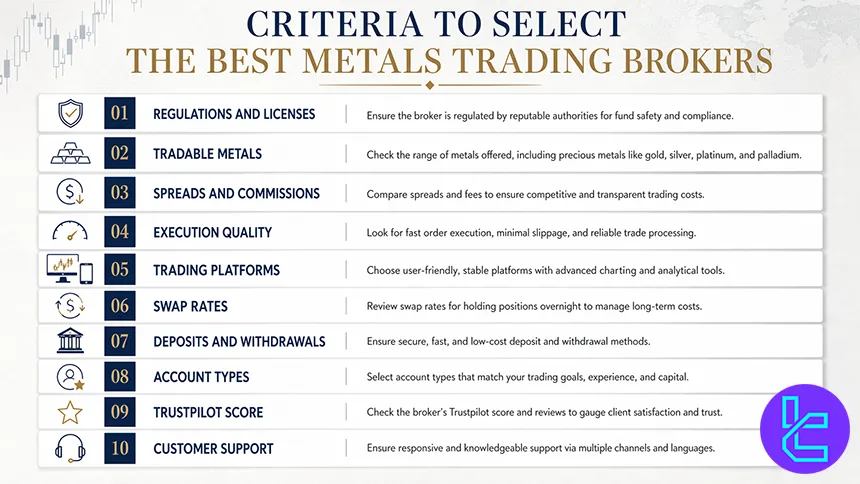
TradingFinder uses a structured methodology to identify forex brokers that provide consistent performance across different market conditions. Core evaluation criteria:
- Regulations and Licenses: Strong oversight from authorities like FCA, ASIC, or CySEC;
- Tradable Metals: Access to gold, silver, and other key metal CFDs;
- Spreads and Commissions: Competitive pricing with transparent cost structure;
- Execution Quality: Fast and stable order execution during volatility;
- Trading Platforms: Availability of MT4, MT5, TradingView, and mobile apps;
- Swap Rates: Fair overnight fees for holding metals positions;
- Deposits and Withdrawals: Reliable and low-cost funding methods;
- Account Types: Availability of ECN, RAW, and swap free account;
- Trustpilot Score: Real user feedback on performance and withdrawals;
- Customer Support: Responsive service for technical and account issues.
By focusing on these key factors, traders can identify metals trading brokers that offer stable pricing, efficient execution, and a transparent trading environment suitable for both short-term and long-term strategies.
What Are Bonds and How Are They Traded in Forex Brokers?
Bonds are fixed-income financial instruments issued by governments or corporations to raise capital, where investors lend money in exchange for periodic interest payments and the return of principal at maturity.
In traditional markets, bonds are traded through exchanges or over-the-counter networks, but Forex brokers provide access to bonds primarily through CFDs, allowing traders to speculate on price movements without owning the underlying asset.
In Forex trading environments, bond CFDs are typically based on government debt such as US Treasuries, UK Gilts, or German Bunds. These instruments are closely tied to macroeconomic factors, particularly interest rates and inflation expectations. Key features of bond trading via brokers:
- No physical ownership of the bond asset
- Ability to trade both rising and falling markets
- Use of leverage to amplify exposure
- Real-time pricing based on global bond markets
This structure makes bond trading more accessible, especially for retail traders who want exposure to fixed-income markets without large capital requirements.
How Do Bond CFDs Work Compared to Traditional Bonds?
Bond CFDs allow traders to speculate on price changes rather than investing in the bond itself. This creates a significant difference in how profits, risks, and costs are structured compared to traditional bond investing. Bond CFDs vs traditional bonds:
Feature | Bond CFDs | Traditional Bonds |
Ownership | No | Yes |
Income | Price-based | Coupon payments |
Leverage | Available | Not typical |
Direction | Long & Short | Mostly Long |
Holding Period | Flexible | Fixed maturity |
Unlike traditional bonds, where returns come from interest payments, CFD traders profit from price fluctuations driven by yield changes and macroeconomic events.
This flexibility makes CFDs suitable for active trading strategies, while traditional bonds are more aligned with long-term income generation.
What Types of Bonds Are Available for Trading?
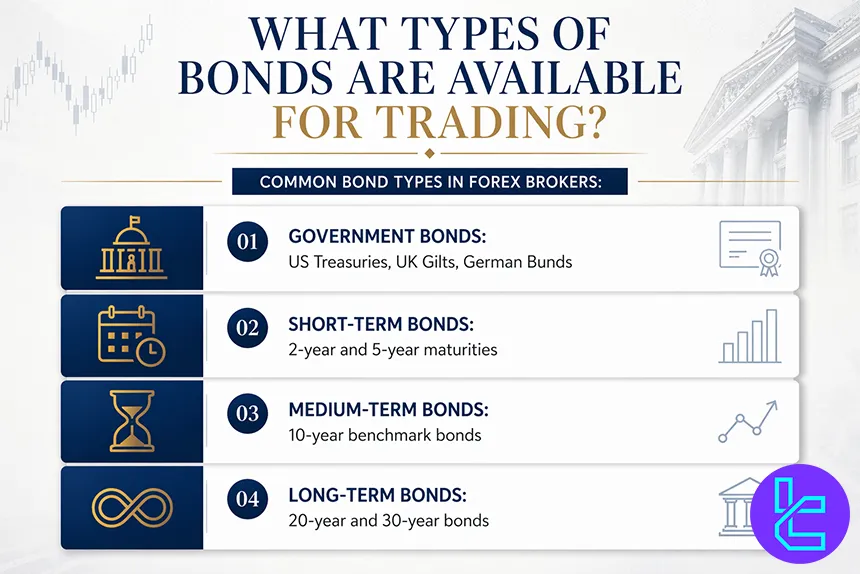
Forex brokers typically offer access to a range of government bond CFDs, with limited exposure to corporate bonds. The availability depends on liquidity and global market demand. Common bond types in forex brokers:
- Government Bonds: US Treasuries, UK Gilts, German Bunds
- Short-Term Bonds: 2-year and 5-year maturities
- Medium-Term Bonds: 10-year benchmark bonds
- Long-Term Bonds: 20-year and 30-year bonds
Government bonds dominate broker offerings due to their liquidity and strong correlation with global economic indicators. Popular bond instruments include:
Instrument | Description |
US10Y | 10-year US Treasury bond |
US30Y | 30-year US Treasury bond |
DE10Y | German Bund |
UK10Y | UK Gilt |
Why Do Traders Choose Bonds Over Other Assets?
Bonds offer unique advantages compared to Forex, stocks, and commodities, particularly in terms of stability and macroeconomic relevance. Key reasons traders choose bonds:
- Lower volatility compared to equities and crypto
- Strong correlation with interest rate cycles
- Safe-haven demand during economic uncertainty
- Predictable reaction to macroeconomic data
Understanding this relationship is essential for predicting bond market direction and aligning trades with macroeconomic trends.
How Do Interest Rates Affect Bond Prices
Interest rates are the primary driver of bond prices, and their relationship is fundamentally inverse. When interest rates rise, existing bonds with lower yields become less attractive, causing their prices to decline.
On the other hand, when rates fall, older bonds with higher yields gain value, pushing prices upward. This dynamic is central to all bond trading strategies.
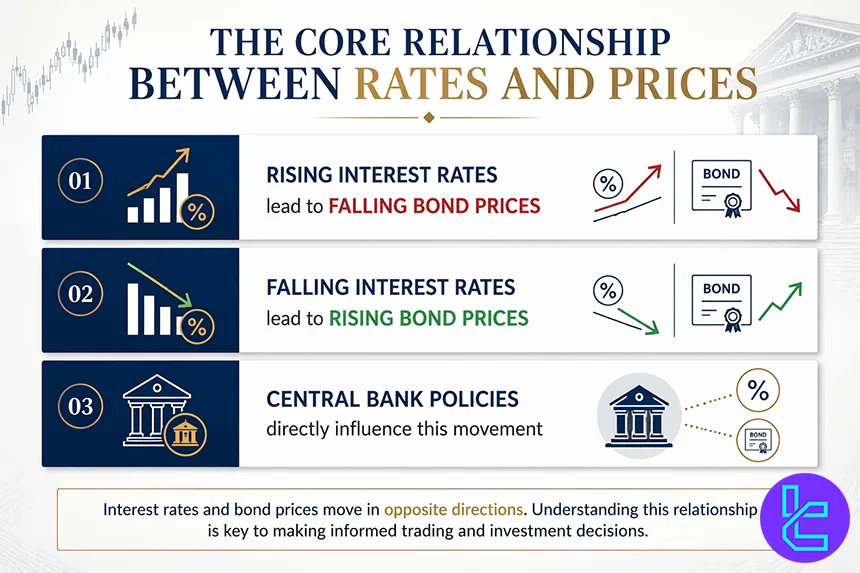
Core relationship between rates and prices:
- Rising interest rates lead to falling bond prices
- Falling interest rates lead to rising bond prices
- Central bank policies directly influence this movement
Understanding this relationship helps traders anticipate market direction before major economic events. To simplify this dynamic, the relationship can be summarized as follows.
Rate Movement | Price Reaction |
Increase | Price falls |
Decrease | Price rises |
What Are the Key Risks of Trading Bonds?
Although bonds are considered relatively stable, trading them through CFDs introduces additional risks that must be carefully managed.
Unlike traditional investing, leveraged trading amplifies both gains and losses, making risk management essential. Main risks in bond trading:
- Interest rate volatility affecting price direction
- Liquidity issues in less active instruments
- Sudden market reactions to economic data
- Swap costs for long-term positions
- Leverage amplifying exposure
Each of these risks can impact trading outcomes differently depending on market conditions. To better understand their relative importance, they can be categorized as follows. Risk breakdown:
Risk Type | Impact |
Interest Rate Risk | High |
Liquidity Risk | Medium |
Execution Risk | Medium |
Cost Risk | Medium |
How Do Bond Yields Impact Trading Decisions?
Bond yields represent the return investors receive and serve as a key indicator of market expectations. Traders monitor yield movements closely because they directly influence bond prices.
When yields rise, prices fall, and when yields decline, prices increase. This inverse relationship creates trading opportunities based on economic outlook and monetary policy.
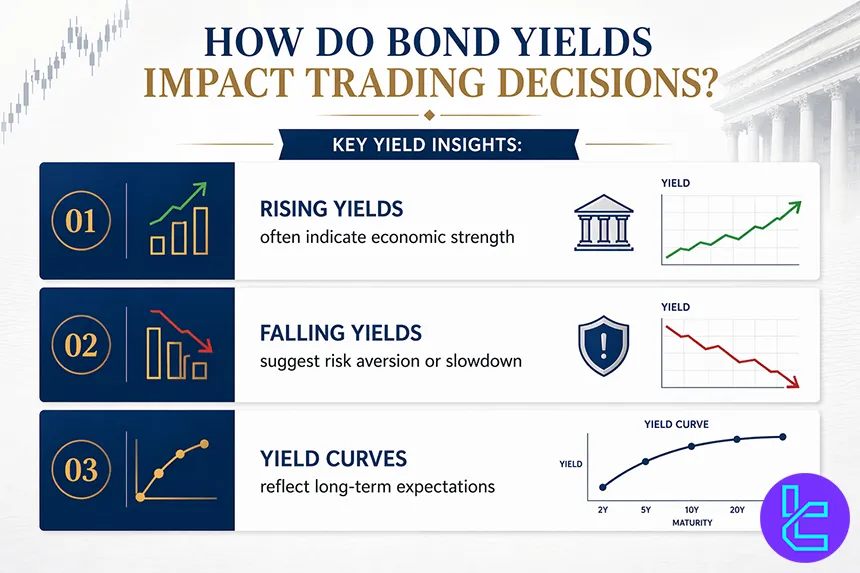
Key yield insights:
- Rising yields often indicate economic strength
- Falling yields suggest risk aversion or slowdown
- Yield curves reflect long-term expectations
Yield analysis is often combined with macro data to improve trading accuracy. This relationship becomes clearer when viewed in a simplified format.
Which Bond Markets Are Offered by Brokers?
Forex brokers mainly provide access to major global bond markets where liquidity is high and pricing is reliable. These markets are closely linked to global financial conditions.
The United States bond market is the most dominant, followed by European and UK markets. Main bond markets:
- United States Treasury market
- European government bonds
- United Kingdom Gilts
- Limited access to Asian bonds
Each market offers different characteristics in terms of volatility and economic sensitivity. To better understand availability, comparing regions helps clarify coverage.
Region | Availability | Key Instruments |
USA | High | US10Y, US30Y |
Europe | Moderate | Bunds |
UK | Moderate | Gilts |
Asia | Limited | Government bonds |
How Do Brokers Handle Bond Price Data and Execution?
Bond pricing in Forex brokers is derived from institutional liquidity providers and financial data feeds. This ensures that CFD prices closely track real market movements.
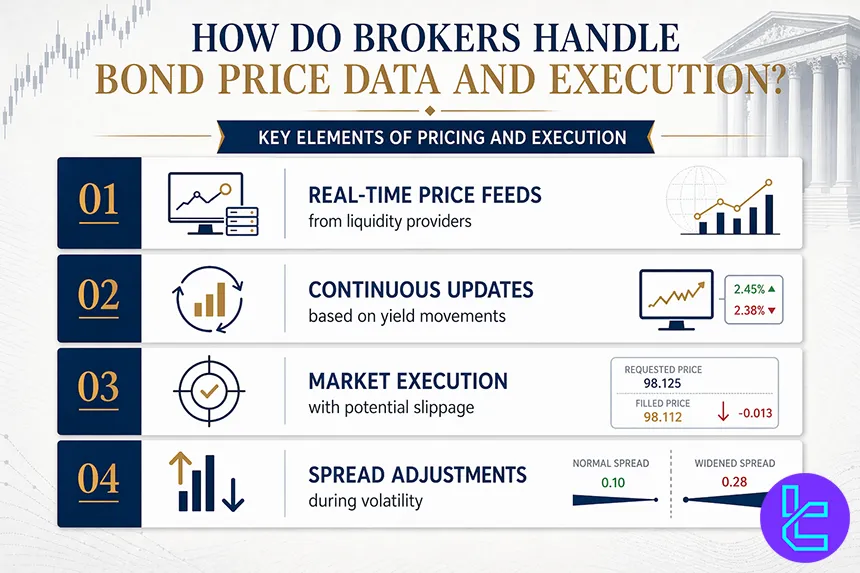
Execution quality depends on the broker’s infrastructure, with ECN and STP model generally offering more transparent pricing compared to market makers. Key elements of pricing and execution:
- Real-time price feeds from liquidity providers
- Continuous updates based on yield movements
- Market execution with potential slippage
- Spread adjustments during volatility
These factors determine how accurately traders can enter and exit positions. To understand execution differences, comparing models is essential.
Comparing Bond Trading with Forex, Stocks, and Commodity Markets
Bond trading within Forex brokers is typically offered through CFDs on government debt instruments, positioning bonds alongside major asset classes such as currencies, equities, and commodities. Unlike growth-driven stocks or highly liquid Forex pairs, bonds are primarily yield-driven instruments influenced by interest rates, inflation expectations, and central bank policy.
Their relatively lower volatility and inverse relationship with yields create a different risk-return profile. The table below compares bond trading with other major markets based on structure, drivers, and trading conditions at brokers.
Parameter | Bonds (Government Bond CFDs) | Forex (Currency Pairs) | Stocks (Equities) | Commodities (Gold, Oil, etc.) |
Core Nature | Debt instruments (fixed income exposure) | Relative value between currencies | Ownership in companies | Physical assets (energy, metals, etc.) |
Trading Format | CFDs based on bond futures/yields | Spot Forex (CFDs) | Shares or CFDs | CFDs or futures-based |
Market Structure | Central bank & institutional-driven markets | Decentralized interbank OTC market | Centralized exchanges | Futures exchanges + OTC CFDs |
Trading Hours | Limited to futures/CFD sessions | 24/5 global sessions | Exchange-specific hours | 23-24 hours (futures dependent) |
Volatility Level | Low to medium | Low-Medium (majors) | Moderate | Medium-High |
Main Price Drivers | Interest rates, inflation, central bank policy | Interest rate differentials, macro data | Earnings, sector growth | Supply-demand, geopolitics |
Yield Component | Yes (bond yield movement) | Indirect (interest rate differential via swap) | Dividends possible | No yield (carry cost in futures) |
Correlation Behavior | Often inverse to equities in risk-off periods | Inter-currency correlations | Correlated with economic cycles | Linked to global growth and inflation |
Safe-Haven Status | Strong (especially US Treasuries) | Limited (USD, CHF, JPY) | No | Partial (Gold only) |
Leverage (Retail, Tier-1 Reg.) | Typically 1:5-1:10 | Up to 1:30 (majors) | Often 1:5 or lower | Typically 1:10-1:20 |
Risk Profile | Lower risk, income-focused | Macro-driven, moderate risk | Growth/risk asset | Cyclical macro asset |
Conclusion
Bond trading through Forex brokers provides a structured way to access fixed-income markets without direct ownership, allowing traders to benefit from price movements driven by interest rates, inflation, and macroeconomic trends.
As highlighted throughout this guide, the performance of bond trading strategies depends heavily on broker conditions such as execution quality, spread stability, swap rates, and platform capabilities. Brokers that offer deep liquidity, transparent pricing, and reliable infrastructure create a more consistent environment for both short-term speculation and longer-term macro positioning.
At the same time, understanding how bonds differ from other asset classes remains essential. Unlike Forex or stocks, bonds are primarily yield-driven instruments, meaning traders must closely monitor central bank policies and economic data.
Combining the right broker selection with a solid understanding of bond pricing dynamics allows traders to manage risk more effectively and take advantage of opportunities across different market cycles.
To understand the standards applied in choosing these brokers, please visit the TradingFinder Forex methodology page.