





Ethereum has evolved beyond a cryptocurrency into a foundational layer for decentralized finance, smart contracts, and blockchain-based applications. As a result, ETH has become one of the most actively traded digital assets, attracting traders due to its high liquidity, strong volatility, and close correlation with both Bitcoin and broader crypto market sentiment.
Forex brokers provide access to Ethereum primarily through CFD instruments, allowing traders to speculate on price movements without directly owning ETH. This approach enables the use of leverage, short-selling opportunities, and seamless integration with professional trading platforms such as MetaTrader, cTrader, and TradingView-based systems.
The guide below evaluates the best Ethereum trading brokers based on pricing structure, execution quality, available leverage, platform diversity, and regulatory oversight. Whether focusing on short-term trading strategies or incorporating ETH into a broader portfolio, selecting the right broker is essential for managing risk and optimizing trading performance.
 | HFM | |||
 | eightcap | |||
 | FxPro | |||
| 4 |  | ERRANTE | ||
| 5 |  | alpari | ||
| 6 |  | fpmarkets | ||
| 7 |  | TeleTrade | ||
| 8 |  | D prime |
Trustpilot Rankings of Ethereum Trading Forex Brokers
When selecting brokers for Ethereum trading, technical conditions such as spreads, leverage, and platform performance are essential, but user feedback provides an additional layer of insight into real trading conditions. Trustpilot rankings reflect actual client experiences, helping traders evaluate broker reliability beyond marketing claims.
Ethereum markets are highly sensitive to news, network upgrades, and liquidity shifts, often leading to sharp price movements. During these periods, broker performance becomes critical. Issues such as delayed execution, slippage, or withdrawal problems are commonly reflected in user reviews, making Trustpilot scores a valuable benchmark.
Broker Name | Trustpilot Rating | Number of Reviews |
FP Markets | 10,062 | |
Eightcap | 3,633 | |
Errante | 53 | |
HFM | 3.4/5⭐ | 782 |
103 | ||
Alpari | 3.2/5 ⭐ | 992 |
FxPro | 774 | |
436 |
Commission and Spread Breakdown for ETH Trading in Forex Brokers
Ethereum trading through Forex brokers involves a layered cost structure where spreads and commissions form the core of trading expenses. Since ETH is typically offered as a CFD, traders do not pay blockchain transaction fees, but instead face broker-defined pricing models that vary based on account type and execution method.
A balanced cost structure with transparent pricing is essential for maintaining profitability when trading Ethereum in volatile market conditions.
Broker Name | Min. Spread | Commission |
Floating from 0.0 pips | $6.00 to $8.00 | |
0 pips | $3.5 | |
FxPro | 0 pips | $3.5 |
Errante | From 0.0 pips | $3 |
InstaForex | From 0.0 pips | $0 |
FXCC | From 0.0 Pips | $0 |
FXPrimus | Floating from 1.5 pips | $0 |
OneRoyal | 0.0 pips | $3.5 |
Funding and Withdrawal Methods in ETH Trading Brokers
Efficient funding and withdrawal systems are essential when trading Ethereum, as market conditions can change rapidly and require immediate capital access. Since ETH markets operate 24/7, traders benefit from brokers that provide fast, flexible, and reliable payment channels.
Forex brokers offering Ethereum trading typically support a combination of traditional and crypto-based payment methods to serve a global user base.
Broker Name | Deposit Methods | Withdrawal Methods |
Local Payment Solutions, Credit/Debit Cards, E-Wallets, Bank Wire Transfers (in some regions), Crypto Payments | Local Payment Solutions, Credit/Debit Cards, E-Wallets, Bank Wire Transfers (in some regions), Crypto Payments | |
Visa and Master card, Skrill, PayPal, Neteller, Bank Transfer | Visa and Master card, Skrill, PayPal, Neteller, Bank Transfer | |
D Prime | Local bank Transfers, E-wallets, International Wire Transfers, Credit/Debit Card | Local bank Transfers, E-wallets, International Wire Transfers, Credit/Debit Card |
TeleTrade | Bank Transfers, Credit/Debit Cards, E-Payment Systems, Local Payment Options | Bank Transfers, Credit/Debit Cards, E-Payment Systems, Local Payment Options |
NordFX | Bank wire transfer, Credit/debit cards, E-wallets, Cryptocurrencies | Bank wire transfer, Credit/debit cards, E-wallets, Cryptocurrencies, Internal Transfer |
ACY Securities | Credit/Debit Cards, E-wallets, Bank Wire Transfer, China Union Pay, BTC & USDT, Local Payment Methods (Varies by Region) | Credit/Debit Cards, E-wallets, Bank Wire Transfer, China Union Pay, BTC & USDT, Local Payment Methods (Varies by Region) |
Blueberry Markets | Visa/MasterCard, Bank wired | Visa/MasterCard, Bank wired |
SimpleFX | Visa/MasterCard, Bank wired, crypto | Visa/MasterCard, Bank wired, crypto |
Broker Background and Licensing in Ethereum Trading
The background and regulatory status of a broker play a critical role in evaluating its reliability for Ethereum trading. Since ETH is typically offered through CFD instruments, traders rely on brokers to provide accurate pricing, secure fund handling, and stable execution under volatile conditions.
A broker’s background, including its founding year, operational history, and global presence, reflects its ability to handle different market environments. Brokers with longer track records have typically experienced multiple crypto cycles, allowing them to refine execution systems, liquidity access, and risk management frameworks.
Broker Name | Founding Year | Regulation |
2006 | FCA, FSCA, CySEC, SCB | |
2018 | CySEC, FSA | |
Alpari | 1998 | MISA |
FP Markets | 2024 | ASIC, CySEC, FSC, FSCA, FSA |
FinPros | 2021 | CySEC, FSA |
Taurex | 2017 | FCA, FSA |
FXNovus | 2020 | FSCA |
Windsor Brokers | 1988 | FSA, JSC, CMA, FSC |
Top 6 Ethereum Trading Forex Brokers Reviewed
Ethereum trading requires brokers that can handle high volatility, fast price movements, and continuous market activity. Unlike traditional assets, ETH reacts quickly to network developments, DeFi trends, and broader crypto sentiment, making execution quality and platform stability essential.
The top Ethereum trading brokers typically offer ETH through CFD instruments, allowing traders to take both long and short positions, apply leverage, and integrate Ethereum into diversified portfolios alongside Forex, indices, and commodities.
HFM
HFM (HF Markets) is a globally recognized Forex and CFD broker established in 2010, serving over 2.5 million clients across more than 27 languages. The broker has built a strong reputation through its multi-regulated structure and wide range of trading services, offering access to over 1000 financial instruments including Forex, cryptocurrencies, stocks, indices, commodities, and ETFs.
HFM operates under several regulatory authorities such as FCA, CySEC, DFSA, FSCA, and FSA, providing a mix of Tier-1 and offshore supervision. This multi-jurisdictional framework enhances client protection through segregated funds and negative balance protection, while also allowing flexible leverage conditions depending on the entity.
HFM dashboard offers diverse account types including Cent, Zero, Pro, and Premium, catering to both beginners and professional traders. The minimum deposit starts from $0, making it highly accessible, while leverage can reach up to 1:2000 under offshore entities. Spreads begin from 0.0 pips on Zero accounts, with commission-free trading available on most account types.
HFM supports MetaTrader 4, MetaTrader 5, and its proprietary mobile app, enabling flexible trading across devices. Additional features include HFM copy trading, PAMM accounts, Autochartist integration, VPS services, HFM rebate and extensive educational resources.
Funding options include bank transfers, credit/debit cards, e-wallets, and cryptocurrencies, with most deposits processed instantly and withdrawals completed within minutes to a few days depending on the method.
Overall, HFM stands out for its strong regulatory coverage, flexible account structure, and comprehensive trading ecosystem, although some users report technical issues and mixed customer support experiences.
Account Types | Cent, Zero, Pro, Premium |
Regulating Authorities | FCA, CySEC, DFSA, FSCA, FSA |
Minimum Deposit | From $0 |
Deposit Methods | Bank Transfer, Credit/Debit Cards, Skrill, Neteller, Perfect Money, Crypto |
Withdrawal Methods | Bank Transfer, Credit/Debit Cards, Skrill, Neteller, WebMoney, Crypto |
Maximum Leverage | Up to 1:2000 |
Trading Platforms & Apps | MetaTrader 4, MetaTrader 5, Mobile App |
HFM Pros and Cons
When assessing HFM for Ethereum trading, key strengths include strong regulatory oversight, competitive spreads, and diverse investment options, though certain limitations may influence overall suitability.
Pros | Cons |
Multi-regulated (FCA, CySEC, DFSA, FSCA) | Reports of technical issues |
Minimum deposit from $0 | Mixed customer support reviews |
Wide range of instruments (1000+) | Geo-restrictions in some countries |
High leverage up to 1:2000 | Limited proprietary platform innovation |
Copy trading and PAMM accounts | - |
MT4 and MT5 support | - |
Eightcap
Eightcap is a well-established Forex and CFD broker founded in 2009 in Melbourne, Australia, offering access to a wide range of global markets including Forex, cryptocurrencies, indices, commodities, metals, and shares.
The broker provides over 800 tradable instruments, with a particularly strong offering in crypto CFDs, making it a competitive choice for Ethereum and digital asset traders.
Eightcap operates under multiple regulatory authorities, including ASIC, FCA, CySEC, and SCB, ensuring a mix of Tier-1 and offshore supervision. This regulatory framework supports key safety measures such as segregated client funds and negative balance protection, although leverage and protections vary depending on the entity.
The broker offers four account types: Standard, Raw, TradingView, and Demo. The minimum deposit starts at $100, while spreads begin from 0.0 pips on Raw accounts with commissions, and from 1.0 pip on commission-free accounts. Maximum leverage reaches up to 1:500, making it suitable for traders seeking higher exposure.
Eightcap supports MetaTrader 4, MetaTrader 5, and TradingView (choosable through Eightcap registration), providing strong flexibility for both technical and algorithmic trading. Additional tools such as Capitalise.ai and FlashTrader enhance automation and execution efficiency.
Funding and withdrawals are supported through cards, bank transfers, e-wallets, and cryptocurrencies, with most transactions processed instantly or within a few business days.
Overall, the broker stands out for its strong regulation, advanced platform integration, Eightcap rebate and competitive pricing, although it lacks copy trading and passive investment features.
Account Types | Standard, Raw, TradingView, Demo |
Regulating Authorities | ASIC, FCA, CySEC, SCB |
Minimum Deposit | $100 |
Deposit Methods | Bank Transfer, Credit/Debit Cards, Skrill, Neteller, PayPal, Crypto |
Withdrawal Methods | Bank Transfer, Credit/Debit Cards, Skrill, Neteller, PayPal, Crypto |
Maximum Leverage | Up to 1:500 |
Trading Platforms & Apps | MetaTrader 4, MetaTrader 5, TradingView |
Eightcap Pros and Cons
Eightcap demonstrates notable advantages in Ethereum trading, such as solid regulation, tight spreads, and a broad selection of investment opportunities, although some constraints may apply.
Pros | Cons |
Strong regulation (ASIC, FCA, CySEC) | No copy trading or PAMM accounts |
Integration with TradingView | Limited passive investment options |
Competitive spreads from 0.0 pips | Basic educational resources |
High leverage up to 1:500 | $100 minimum deposit |
Wide crypto CFD offering | Platform restrictions in some regions |
FxPro
FxPro is a globally established Forex and CFD broker founded in 2006, offering access to more than 2100 financial instruments across Forex, cryptocurrencies, indices, shares, metals, and futures markets.
With over 15 years of industry experience and more than 125 international awards, FxPro has positioned itself as a high-performance broker known for fast execution speeds, averaging under 12 milliseconds per order.
The broker operates under multiple regulatory authorities including FCA, CySEC, FSCA, and SCB, providing strong oversight and investor protection. Under FCA and CySEC, clients benefit from compensation schemes such as FSCS (up to £85,000) and ICF (up to €20,000), along with segregated client funds and negative balance protection.
FxPro dashboard offers three main account types: Standard, Raw+, and Elite. The minimum deposit starts at $100, while spreads begin from 0.0 pips on Raw+ accounts with commissions, and from around 1.2 pips on Standard accounts without commission. Leverage can reach up to 1:500 depending on the FxPro verification region and client classification.
The broker supports multiple trading platforms including MetaTrader 4, MetaTrader 5, cTrader, WebTrader, and its proprietary mobile app, making it suitable for both discretionary and algorithmic trading. Execution models include both market and instant execution, ensuring flexibility across strategies.
Funding methods include cards, bank transfers, Skrill, Neteller, and PayPal, with most deposits and withdrawals processed quickly and without broker-side fees.
Overall, the broker stands out for its strong regulation, FxPro rebate, advanced platform ecosystem, and fast execution, although higher minimum deposits on certain accounts and limited bonuses may be considerations.
Account Types | Standard, Raw+, Elite |
Regulating Authorities | FCA, CySEC, FSCA, SCB |
Minimum Deposit | $100 |
Deposit Methods | Visa, MasterCard, Bank Transfer, Skrill, Neteller, PayPal |
Withdrawal Methods | Visa, MasterCard, Bank Transfer, Skrill, Neteller, PayPal |
Maximum Leverage | Up to 1:500 |
Trading Platforms & Apps | MetaTrader 4, MetaTrader 5, cTrader, WebTrader, Mobile App |
FxPro Pros and Cons
In evaluating FxPro for ETH trading, its regulatory framework, cost-efficient pricing, and wide market access stand out, while a few limitations may impact its appeal.
Pros | Cons |
Strong regulation (FCA, CySEC) | High minimum deposit on Elite account |
Fast execution (<12 ms) | Limited bonus offerings |
2100+ tradable instruments | Not available in some countries |
Multiple platforms (MT4, MT5, cTrader) | No 24/7 support |
Copy trading available | - |
Investor protection schemes | - |
Errante
Errante is a Forex and CFD broker established in 2018, offering trading services under CySEC and FSA regulation. The broker combines European regulatory oversight with offshore flexibility, allowing it to serve a global client base while providing investor protection such as fund segregation and compensation coverage up to €20,000 under the ICF.

Errante provides access to over 150 tradable instruments across Forex, cryptocurrencies, stocks, indices, metals, and energy markets. While the asset range is smaller compared to top-tier brokers, it covers all major asset classes required for diversified trading strategies.
The broker offers four account types including Standard, Premium, VIP, and Tailor Made, designed to suit different trader profiles. The minimum deposit starts at $50, making it accessible for beginners, while spreads begin from 0.8 pips on standard accounts and from 0.0 pips on Tailor Made accounts with a $3 commission. Maximum leverage can reach up to 1:1000, depending on the entity and account type.
Errante supports multiple platforms including MetaTrader 4, MetaTrader 5, cTrader, and TradingView, which are choosable after Errante registration. It also offers copy trading, PAMM, and MAM account solutions, making it suitable for passive investment strategies.
After completing Errante verification Funding options include bank transfers, cards, e-wallets, and cryptocurrencies such as Bitcoin, Ethereum, USDT, and XRP, with fast processing and low fees.
Overall, this broker stands out for its flexible leverage, Errante rebate, platform diversity, and investment features, although its shorter track record and limited instrument range may be considerations.
Account Types | Standard, Premium, VIP, Tailor Made |
Regulating Authorities | CySEC, FSA |
Minimum Deposit | $50 |
Deposit Methods | Bank Transfer, Visa, MasterCard, Skrill, Neteller, Volet, SticPay, Crypto (BTC, ETH, USDT, XRP) |
Withdrawal Methods | Bank Transfer, Visa, MasterCard, Skrill, Neteller, Volet, SticPay, Crypto |
Maximum Leverage | Up to 1:1000 |
Trading Platforms & Apps | MetaTrader 4, MetaTrader 5, cTrader, TradingView |
Errante Pros and Cons
Errante offers a well-rounded Ethereum trading environment with reliable regulation, attractive spreads, and multiple investment choices, though certain factors may limit its suitability.
Pros | Cons |
Regulated by CySEC (EU) | Short operational history |
Low minimum deposit ($50) | Limited number of instruments (150+) |
High leverage up to 1:1000 | No Cent account |
Supports MT4, MT5, cTrader, TradingView | Limited swap-free duration |
Copy trading, PAMM, and MAM accounts | Mixed user ratings |
Wide range of payment methods including crypto | - |
Alpari
Alpari is one of the oldest Forex and CFD brokers in the industry, established in 1998, with a global presence spanning over 150 countries and serving more than 1 million clients. The broker has built its reputation on long-term market experience, diverse account offerings, and strong support for high-leverage trading environments.
Alpari verification requirements operate under offshore regulatory authorities including MISA and NBRB, providing segregated client funds and negative balance protection. While it lacks Tier-1 regulation, it compensates with flexible trading conditions such as leverage up to 1:3000, making it attractive for traders seeking higher exposure.
The broker offers multiple account types including Standard, ECN, and Pro ECN, along with a demo account. The minimum deposit starts at $50, while spreads begin from 0.3 pips on standard accounts and from 0.0 pips on ECN accounts. Commission structures vary depending on account type, with competitive pricing for both retail and advanced traders.
Alpari supports MetaTrader 4, MetaTrader 5, and WebTrader, enabling manual, algorithmic, and multi-device trading. The broker also provides PAMM accounts, allowing investors to allocate capital to professional traders and participate in passive trading strategies.
Funding options include bank transfers, cards, e-wallets, local payment systems, and cryptocurrencies, with most deposits processed instantly and withdrawals completed within 1–5 business days depending on the method.
Overall, Alpari stands out for its long-standing reputation, high leverage, and PAMM investment features, although limited regulatory strength and moderate user ratings may be important considerations.
Account Types | Standard, ECN, Pro ECN, Demo |
Regulating Authorities | MISA, NBRB |
Minimum Deposit | $50 |
Deposit Methods | Local Payment Solutions, Credit/Debit Cards, E-Wallets, Bank Transfer, Crypto |
Withdrawal Methods | Local Payment Solutions, Credit/Debit Cards, E-Wallets, Bank Transfer, Crypto |
Maximum Leverage | Up to 1:3000 |
Trading Platforms & Apps | MetaTrader 4, MetaTrader 5, WebTrader |
Alpari Pros and Cons
From an Ethereum trading perspective, Alpari benefits from strong regulatory backing, efficient spreads, Alpari rebate and diversified investment options, although some drawbacks should be considered.
Pros | Cons |
Established broker (since 1998) | Weak regulatory coverage (offshore only) |
High leverage up to 1:3000 | No investor compensation scheme |
Multiple account types (ECN, Pro ECN) | Moderate user ratings |
PAMM investment system | Limited Tier-1 oversight |
Supports MT4 and MT5 | Inactivity fees apply |
Wide range of payment methods | - |
FP Markets
FP Markets is a well-established Forex and CFD broker founded in 2005 in Australia, known for its institutional-grade trading conditions and strong regulatory framework. The broker operates under multiple authorities including ASIC and CySEC, alongside FSCA and offshore regulators, ensuring a mix of high-level oversight and flexible trading conditions.
FP Markets offers access to more than 10,000 tradable instruments across Forex, stocks, indices, commodities, metals, ETFs, and cryptocurrencies. This extensive asset coverage allows traders to build diversified portfolios while accessing Ethereum and other crypto CFDs within a multi-asset environment.
The broker provides two main account types, Standard and RAW. The minimum deposit starts from $50, with spreads beginning at 1.0 pips on Standard accounts and from 0.0 pips on RAW accounts, where a $3 commission per lot applies. Maximum leverage can reach up to 1:500 depending on the FP Markets verification entity and client classification.
FP Markets supports MetaTrader 4, MetaTrader 5, and cTrader, offering advanced charting, algorithmic trading capabilities, and fast execution speeds. The broker also provides investment solutions such as copy trading, FP Markets rebate, PAMM, and MAM accounts, enabling both active and passive trading strategies.
FP Markets deposit and withdrawal include credit/debit cards, PayPal, Skrill, Neteller, and bank transfers, with most deposits processed instantly and no broker-side fees applied. Withdrawals are generally fast, especially via e-wallets.
Overall, FP Markets stands out for its strong regulation, deep liquidity, and competitive pricing, although the lack of a proprietary platform and mixed third-party review scores may be considerations.
Account Types | Standard, RAW |
Regulating Authorities | ASIC, CySEC, FSCA, FSA, FSC |
Minimum Deposit | $50 |
Deposit Methods | Visa, MasterCard, Skrill, Neteller, PayPal, Bank Transfer |
Withdrawal Methods | Visa, MasterCard, Skrill, Neteller, PayPal, Bank Transfer |
Maximum Leverage | Up to 1:500 |
Trading Platforms & Apps | MetaTrader 4, MetaTrader 5, cTrader |
FP Markets Pros and Cons
FP Markets stands out in ETH trading due to its regulatory strength, competitive pricing, and broad product range, though certain limitations may affect trader preference.
Pros | Cons |
Strong regulation (ASIC, CySEC) | No proprietary trading platform |
Tight spreads from 0.0 pips | Not available in some countries |
10,000+ tradable instruments | Mixed third-party review scores |
Supports MT4, MT5, cTrader | - |
Copy trading, PAMM, MAM accounts | - |
No deposit/withdrawal fees (broker side) | - |
Criteria for Choosing the Best Ethereum Trading Brokers
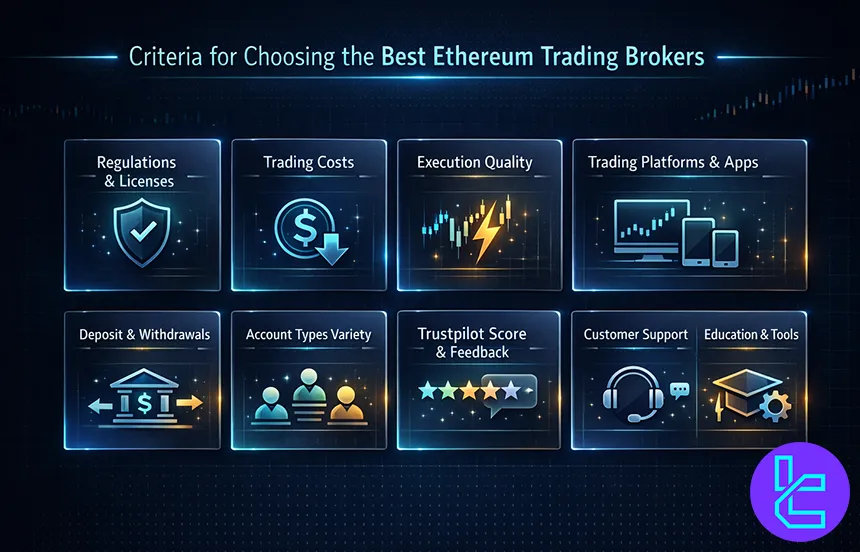
Selecting the best Ethereum trading brokers requires a structured evaluation process, as traders rely on these platforms to execute positions in a highly volatile and continuously active market. TradingFinder applies a comprehensive methodology based on 19 data-driven metrics to ensure objective and transparent broker selection, focusing on execution quality, pricing efficiency, and operational reliability.
Ethereum trading introduces specific challenges such as rapid price fluctuations, liquidity shifts, and sensitivity to network developments. As a result, broker performance must be assessed not only on general Forex standards but also on crypto-specific conditions such as spreads, swaps, and platform stability during high-impact events.
The core criteria used in evaluating Ethereum trading brokers include:
- Regulations and Licenses: Verification of broker legitimacy, regulatory oversight, and availability of client fund protection mechanisms;
- Trading Costs: Detailed analysis of spreads, commissions, overnight fees, and hidden charges affecting ETH trading efficiency;
- Execution Quality: Order execution speed, slippage control, and reliability during volatile Ethereum price movements;
- Trading Platforms and Apps: Availability of MT4, MT5, cTrader, and TradingView-based systems with advanced charting tools;
- Asset Diversity: Access to Ethereum alongside other cryptocurrencies and multi-asset trading instruments;
- Deposit and Withdrawal Systems: Speed, flexibility, and transparency of funding methods including crypto payments;
- Account Types Variety: Availability of Standard, ECN, and professional accounts tailored to different trading strategies;
- Trustpilot Score and User Feedback: Real user insights on execution quality, withdrawals, and platform performance;
- Customer Support and Operations: Responsiveness of support teams and efficiency in resolving trading-related issues;
- Educational Resources and Tools: Availability of learning materials, calculators, and analytical tools for informed decision-making.
This multi-dimensional framework ensures that selected Ethereum brokers deliver not only competitive trading conditions but also a secure, transparent, and high-performance environment suitable for navigating the fast-moving crypto market.
How Does Ethereum Trading Work Through Brokers?
Ethereum trading through Forex brokers is primarily conducted via CFD instruments, allowing traders to speculate on ETH price movements without owning the underlying asset. This structure enables both long and short positions, making it suitable for different market conditions. Step-by-Step ETH trading process:
- Open and Verify an Account: Complete registration and KYC verification to access trading features and funding options;
- Deposit Funds: Use available payment methods such as cards, e-wallets, or crypto transfers to fund the account;
- Select ETH Instrument: Choose ETH/USD or other Ethereum pairs available on the trading platform;
- Perform Market Analysis: Apply technical indicators, price action strategies, or fundamental analysis based on Ethereum network activity;
- Execute Trades: Open buy or sell positions depending on market direction, with optional leverage;
- Apply Risk Management: Set stop-loss and take-profit levels to manage downside risk;
- Close Position: Exit trades manually or automatically based on predefined levels.
This workflow highlights how brokers simplify Ethereum trading while providing advanced tools and leveraged exposure.
Pros and Cons of Ethereum Trading in Brokers
Trading Ethereum through brokers offers flexibility and efficiency, but also includes structural limitations that traders must consider.
Advantages | Disadvantages |
Ability to trade both rising and falling markets | No direct ownership of ETH |
Access to leverage for increased exposure | Swap fees for overnight positions |
Integration with professional trading platforms | Wider spreads compared to major Forex pairs |
No need for wallet or private key management | Execution risks during high volatility |
Multi-asset trading within a single account | Regulatory limitations in certain regions |
Understanding these factors helps traders align broker-based ETH trading with their overall strategy.
What Makes Brokers Suitable for Ethereum Trading?
Not all brokers are optimized for Ethereum trading. Suitable brokers provide infrastructure capable of handling crypto-specific volatility and liquidity conditions.
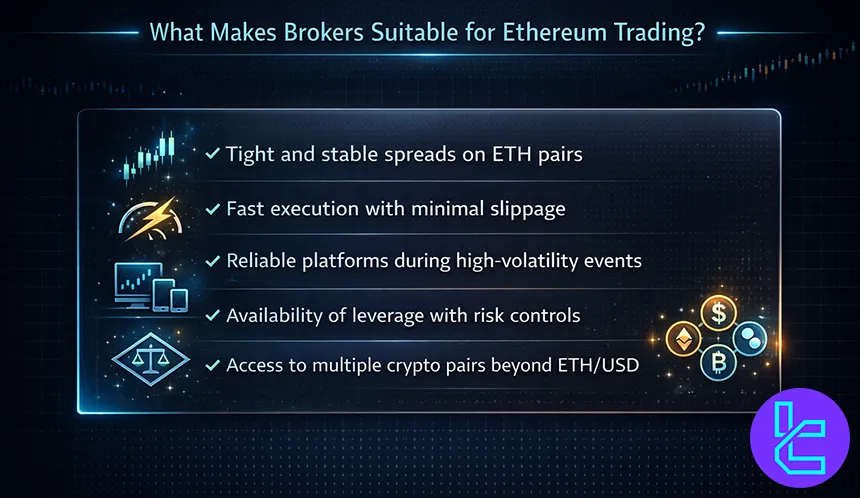
Key characteristics include:
- Tight and stable spreads on ETH pairs
- Fast execution with minimal slippage
- Reliable platforms during high-volatility events
- Availability of leverage with risk controls
- Access to multiple crypto pairs beyond ETH/USD
Additionally, brokers offering advanced charting tools, algorithmic trading support, and copy trading features provide a more comprehensive trading environment.
A broker’s ability to maintain pricing consistency and execution quality during market spikes is a key differentiator in Ethereum trading.
How Brokers Provide Access to Ethereum Markets?
Brokers connect traders to Ethereum markets through liquidity providers and internal pricing systems, offering ETH exposure via CFDs rather than direct blockchain transactions.
Component | Role |
Liquidity Providers | Supply real-time ETH pricing |
Broker Platform | Executes trades and manages positions |
Pricing Engine | Determines spreads and quotes |
Risk System | Manages leverage and margin |
Execution Model | Processes orders (ECN, STP, Market Maker) |
This structure allows brokers to mirror Ethereum price movements without requiring users to interact with crypto wallets or exchanges.
It also enables features such as leverage and short-selling, which are not typically available on standard crypto exchanges.
Is ETH Trading Allowed by Forex Regulators?
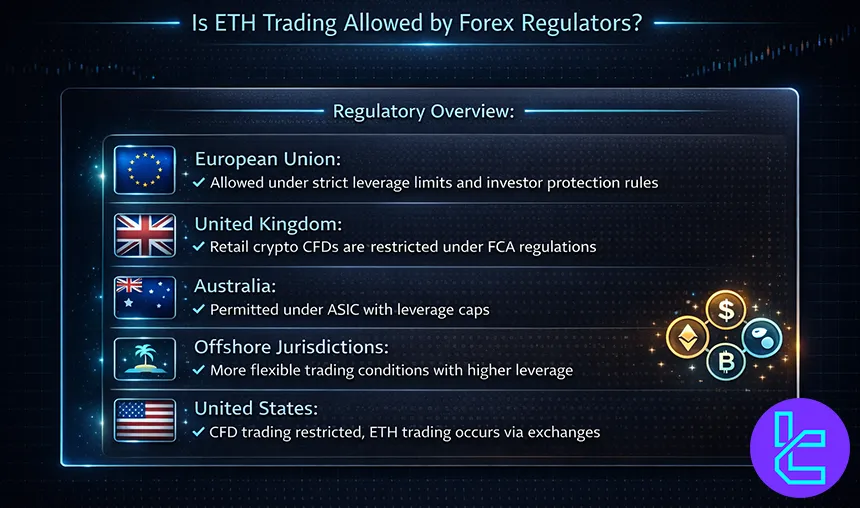
The legality of Ethereum trading through brokers depends on regional regulations and how crypto CFDs are classified. Regulatory overview:
- European Union: Allowed under strict leverage limits and investor protection rules
- United Kingdom: Retail crypto CFDs are restricted under FCA regulations
- Australia: Permitted under ASIC with leverage caps
- Offshore Jurisdictions: More flexible trading conditions with higher leverage
- UnitedStates: CFD trading restricted, ETH trading occurs via exchanges
Traders must verify local laws before trading, as regulatory policies vary significantly. Regulated brokers offer safer environments through compliance measures such as segregated funds and negative balance protection.
How to Confirm Regulatory Status of ETH Brokers؟
Verifying a broker’s regulatory status is essential for reducing risk and ensuring fund safety. Verification steps:
- Check license numbers on official regulator websites
- Confirm regulatory authority such as FCA, ASIC, or CySEC
- Review broker legal entity and jurisdiction
- Ensure client funds are held in segregated accounts
- Verify participation in compensation schemes
- Analyze user reviews related to withdrawals and compliance
Reliable brokers provide transparent regulatory information and clear documentation. Avoid brokers that lack verifiable licenses or provide inconsistent regulatory claims.
Which Brokers Are Suitable for ETH Trading?
Suitable brokers for Ethereum trading combine strong regulation, competitive pricing, and advanced trading infrastructure. Key selection criteria:
- Availability of ETH and multiple crypto pairs
- Competitive spreads and commission structure
- Stable execution during volatility
- Support for MT4, MT5, cTrader, or TradingView
- Flexible funding and withdrawal options
Brokers that integrate crypto trading into a broader multi-asset environment offer better diversification opportunities.
Selecting a broker with proven performance in crypto markets ensures more consistent trading conditions.
What New Traders Should Know About ETH Trading?
Ethereum trading requires an understanding of volatility, market structure, and risk management. Beginners often underestimate how quickly ETH prices can move.
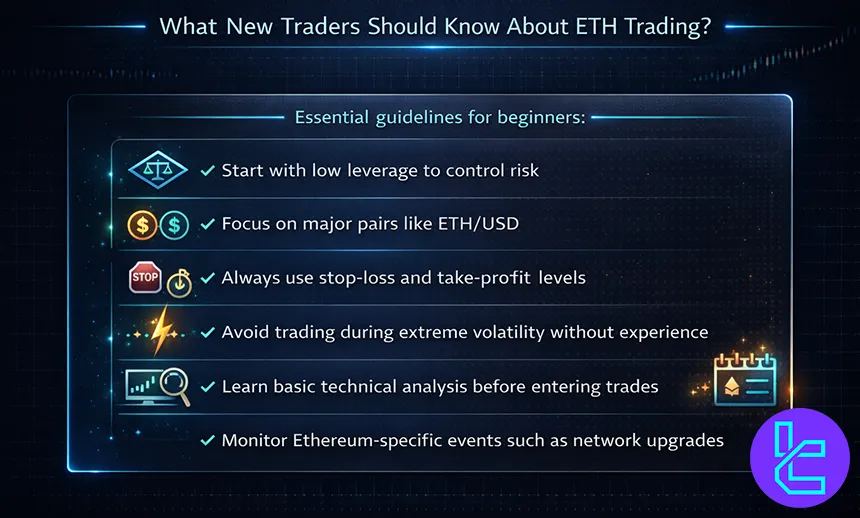
Essential guidelines for beginners:
- Start with low leverage to control risk
- Focus on major pairs like ETH/USD
- Always use stop-loss and take-profit levels
- Avoid trading during extreme volatility without experience
- Learn basic technical analysis before entering trades
- Monitor Ethereum-specific events such as network upgrades
Ethereum markets operate continuously, which can lead to overtrading and emotional decisions. A disciplined approach with clear risk management rules helps beginners build consistency and avoid common mistakes in ETH trading.
Ethereum Compared to Other Top Tradable Assets in Forex
Ethereum trading through Forex brokers is typically offered via CFDs, placing it alongside major asset classes such as Forex, stocks, commodities, and indices. Compared to Bitcoin, Ethereum’s value is more closely tied to network activity, DeFi growth, and smart contract adoption.
While it shares the high-volatility nature of crypto assets, its trading conditions, liquidity profile, and regulatory treatment differ from traditional markets. The table below compares Ethereum with other top tradable assets based on how they are structured and traded at brokers.
Parameter | Ethereum (ETH CFDs) | Forex (Currency Pairs) | Stocks (Equities CFDs) | Commodities (Gold, Oil) | Indices (S&P 500, NASDAQ) |
Trading Format | CFD (no ownership), sometimes futures-linked | Spot Forex (CFDs) | Share CFDs or direct shares | CFDs or futures-based | Index CFDs |
Market Structure | Decentralized blockchain network | Decentralized OTC interbank market | Centralized stock exchanges | Futures exchanges + OTC CFDs | Derived from stock exchanges |
Trading Hours | 24/7 underlying market (broker-dependent) | 24/5 global sessions | Exchange-specific hours | 23-24 hours (futures dependent) | 23-24 hours (CFDs) |
Volatility Level | Very high | Low–Medium (majors) | Moderate | Medium-High | Moderate |
Liquidity Depth | High but below Bitcoin | Extremely deep | High in large-cap stocks | High in major commodities | High in major indices |
Leverage (Retail, Tier-1 Reg.) | Often limited to 1:2 | Up to 1:30 (majors) | Often 1:5 or lower | Typically 1:10-1:20 | Typically 1:10-1:20 |
Regulatory Treatment | Evolving, jurisdiction-dependent | Well-established global regulation | Strict securities regulation | Exchange-regulated markets | Regulated derivative markets |
Main Price Drivers | Network usage, staking demand, DeFi growth, upgrades | Interest rates, central bank policy | Earnings, sector growth | Supply-demand, geopolitics | Economic outlook, corporate performance |
Gap Risk Exposure | Lower due to 24/7 trading | Moderate (weekend gaps) | High (earnings/news gaps) | High (macro shocks) | Moderate–High |
Risk Classification | Highly speculative tech-driven asset | Macro-driven relative value | Growth/risk asset | Cyclical macro asset | Broad market benchmark |
Conclusion
Ethereum trading through Forex brokers offers structured access to crypto markets using CFDs, allowing traders to profit from both rising and falling prices while applying leverage. This approach supports multi-asset strategies but involves costs such as spreads, commissions, and overnight fees.
Additionally, factors like liquidity conditions, execution speed, and platform stability can significantly influence trading outcomes. Success depends on choosing well-regulated brokers with transparent pricing, strong execution, and reliable funding, combined with disciplined risk management and a clear understanding of Ethereum’s market volatility.
For a comprehensive overview of how these brokers were assessed and shortlisted, please visit TradingFinder’s Forex methodology page.