





Commodity trading continues to attract millions of traders worldwide, with gold, silver, crude oil, and agricultural products ranking among the top 4 most traded CFD asset classes. Currently, competition among brokers has intensified, with spreads starting from 0.0 pips, leverage reaching up to 1:500, and over 6,000+ tradable instruments available on some platforms.
Here are the best commodity forex brokers currently available:
 | AVATRADE | |||
 | pepperstone | |||
 | eToro | |||
| 4 |  | fpmarkets | ||
| 5 |  | FUSION MARKETS | ||
| 6 |  | GLOBAL PRIME | ||
| 7 |  | BlackBull |
Trustpilot Ratings for the Best Commodities Forex Brokers
Below, we review the Trustpilot ratings of leading commodity brokers including Fusion Markets, AvaTrade, BlackBull Markets, FP Markets, Global Prime, eToro, and Pepperstone, comparing both their overall ratings and the number of verified reviews:
Broker | Trustpilot | Number of Reviews |
Fusion Markets | 6,330 | |
4.8/5 ⭐ | 11,928 | |
BlackBull Markets | 3,128 | |
10,015 | ||
Global Prime | 422 | |
eToro | 30,657 | |
Pepperstone | 3,226 |
Minimum Spreads in Commodities Brokers
In this section, we compare the minimum advertised spreads offered by major brokers such as IC Markets, Capital.com, alongside others listed above, to help traders evaluate cost efficiency in commodity markets:
Brokers | Minimum Spreads |
eToro | 0.0 Pips |
0.0 Pips | |
AvaTrade | 0.0 Pips |
Pepperstone | 0.0 Pips |
0.0 Pips | |
IC Markets | 0.0 Pips |
Capital.Com | 0.67 Pips |
Non-Trading Fees Charged by Brokers for Commodity Trading
This section examines whether brokers such as Exness and FxPro impose additional costs beyond trading spreads. Understanding these fees ensures traders can calculate their true cost of participation in commodity markets:
Broker Name | Deposit Fee | Withdrawal Fee | Inactivity Fee |
Pepperstone | $0 | $0 | $0 |
FP Markets | $0 | $0 | $0 |
Global Prime | $0 | $0 | $0 |
Exness | $0 | $0 | $0 |
$0 | $0 | $0 | |
AvaTrade | $0 | $0 | $10 monthly |
FxPro | $0 | $0 | $15 Monthly |
Various Trading Platforms in Commodities Brokers
In this section, we review the platform offerings of brokers including Axi and Tickmill, along with other leading commodity brokers, to determine which platforms provide the best technical tools, usability, and flexibility for trading metals, energy, and agricultural CFDs:
Broker Name | Trading Platforms |
Proprietary App | |
Axi | MetaTrader 4, Axi Copy Trade |
AvaTrade | MetaTrader 4, MetaTrader 5, Mobile App, WebTrader |
Fusion Markets | MetaTrader 4, MetaTrader 5, TradingView, cTrader |
Tickmill | Metatrader 4, Metatrader 5, Metatrader Web, Mobile App |
Proprietary Platform, cTrader, Trading View, MetaTrader 4&5 | |
Blackbull Markets | MetaTrader 4, MetaTrader 5, TradingView, cTrader, BlackBull CopyTrader, BlackBull Invest |
Top 6 Forex Brokers Offering Commodity Trading
The following breakdown provides a detailed overview of each broker’s regulatory framework, account types, leverage policies, available platforms, funding options, and key advantages and disadvantages. This structured comparison will help commodity traders identify which broker best aligns with their trading strategy, risk tolerance, and preferred market access.
AvaTrade
AvaTrade is a globally recognized financial brokerage operating under 9 regulatory licenses from top authorities, including the Central Bank of Ireland (CBI), ASIC (Australia), FSA (Japan), FSCA (South Africa), ADGM (UAE), CySEC (Cyprus), and ISA (Israel). Established to provide secure and transparent trading, AvaTrade enforces margin call and stop out levels at 25% and 10%, respectively, safeguarding client positions.
Traders can start with a minimum deposit of $100, using one of six convenient payment methods: credit/debit cards, bank wire transfers, Skrill, AvaTrade Neteller deposit, WebMoney, and PayPal. The broker supports multiple base currencies, including USD, EUR, GBP, CHF, JPY, and AUD, catering to a global client base.
AvaTrade offers diverse account types to match different trader profiles: Standard for retail users, Professional for experienced traders, Islamic swap-free accounts, and Demo accounts for practice. Its maximum leverage ranges from 1:30 to 1:400, depending on jurisdiction, allowing flexible trading strategies.
Upon completing the AvaTrade registration process, the broker provides access to over 1,250 tradable instruments across Forex, stocks, commodities, indices, and cryptocurrencies. Notably, it supports copy trading via platforms like DupliTrade and AvaSocial, offering real-time strategy replication and social interaction with top traders.
When it comes to platforms, AvaTrade covers all major options. MetaTrader 4 and MetaTrader 5 provide professional charting and advanced trading tools, while the AvaTrade WebTrader requires no download and offers a clean interface. The broker also offers an AvaTrade rebate program to the users.
Account Types | Cent, STP, ECN |
Regulating Authorities | VFSC, FSC |
Minimum Deposit | $0 |
Deposit Methods | Local Bank Transfers, E-wallets, International Wire Transfers, Credit/Debit Card |
Withdrawal Methods | Local Bank Transfers, E-wallets, International Wire Transfers, Credit/Debit Card |
Maximum Leverage | 1:1000 |
Trading Platforms & Apps | MetaTrader 4, MetaTrader 5, Doo Prime InTrade |
AvaTrade Pros and Cons
Trading with AvaTrade brings a balanced mix of advantages and potential limitations. While the broker excels in regulation, platform variety, and instrument coverage, some traders may find its account types slightly limited compared to other brokers. Below is a concise overview of the key pros and cons:
Pros | Cons |
Well-regulated by multiple top-tier authorities | Limited account type variety |
Access to 1,250+ tradable instruments | No 24/7 customer support |
Multiple platforms including MT4/MT5 & AvaOptions | Inactivity fees for dormant accounts |
Copy trading via DupliTrade & AvaSocial | Bonuses vary by region and are not universally available |
Pepperstone
Founded in 2010 and headquartered in Melbourne, Australia, Pepperstone has rapidly become one of the most recognized online brokers worldwide. Serving over 400,000 clients daily, the broker processes an average of $9.2 billion in trades every day, reflecting its deep liquidity and active user base.
Pepperstone supports 10 base currencies and allows leverage of up to 1:500 for eligible clients. Traders can place orders ranging from 0.01 to 100 lots, providing flexibility for both retail and professional trading strategies. Pepperstone operates under a robust regulatory framework, ensuring strong client protection and compliance.
After Pepperstone registration and deposit, all client funds are held in segregated accounts, and negative balance protection is available across all regulated entities. These measures create a secure environment for traders worldwide while reflecting Pepperstone’s reputation as a credible and reliable brokerage.
The broker offers a range of account types designed for different trading needs. The Standard account is commission-free, ideal for beginners, while the Razor account provides ultra-tight spreads from 0.0 pips with a $3.5 per lot commission, catering to scalpers and high-frequency traders. Islamic (swap-free) accounts are available for clients in eligible regions. There is also a Pepperstone rebate program.
Account Types | Cent, STP, ECN |
Regulating Authorities | VFSC, FSC |
Minimum Deposit | $0 |
Deposit Methods | Local Bank Transfers, E-wallets, International Wire Transfers, Credit/Debit Card |
Withdrawal Methods | Local Bank Transfers, E-wallets, International Wire Transfers, Credit/Debit Card |
Maximum Leverage | 1:500 |
Trading Platforms & Apps | MetaTrader 4, MetaTrader 5, Doo Prime InTrade |
Pepperstone Pros and Cons
Trading with Pepperstone comes with a balance of advantages and minor limitations. The broker excels in regulatory compliance, trading platform variety, and access to global markets. However, some features, such as demo account availability and PAMM account options, are limited compared to other brokers. Below is a concise overview of Pepperstone’s key pros and cons:
Pros | Cons |
Regulated by ASIC, FCA, CySEC, and other top-tier authorities | Limited access to demo accounts |
Extensive selection of tradable instruments (1,200+ assets) | Limited leverage for retail clients outside certain regions |
Multiple trading platforms: MT4, MT5, cTrader, TradingView | No PAMM accounts offered |
Deep liquidity and fast order execution | Limited promotional offerings and bonuses |
eToro
Founded in January 2007 and headquartered in Tel Aviv, Israel, eToro is a globally recognized online broker founded by David Ring, Ronen Assia, and Yoni Assia. Operating as eToro Ltd., the company has expanded internationally with branches in the UK, Cyprus, Australia, Gibraltar, the US, Seychelles, and Abu Dhabi.
eToro is regulated by multiple authorities, including the FCA (UK), CySEC (Cyprus), ASIC (Australia), and SEC/FINRA (US), offering tiered regulatory protection. eToro provides four account types to suit diverse traders: Personal, Professional, Corporate, and Islamic (swap-free). The Personal Account requires a minimum deposit of $10 and grants access to social trading features, while Professional Accounts allow higher leverage up to 1:400 for eligible clients.
The broker supports multiple currencies (USD, EUR, GBP) and offers flexible funding methods after the eToro registration process, including credit/debit cards, PayPal, Neteller, Skrill, Trustly, and iDEAL. Investors on eToro can access over 6,000 tradable assets across six markets: Forex, stocks, indices, commodities, ETFs, and cryptocurrencies.
The platform supports innovative investment options such as Copy Trading service named CopyTrader, enabling automatic replication of successful traders’ strategies; Smart Portfolios, offering long-term thematic investment baskets curated by analysts; and Crypto Staking, which allows users to earn rewards from Ethereum (ETH), Solana (SOL), Cardano (ADA), and Tron (TRX).
Account Types | Personal, Professional, Corporate, Islamic |
Regulating Authorities | FCA, CySEC, MFSA, FSRA, ASIC, FSA, Gibraltar FSC |
Minimum Deposit | $10 |
Deposit Methods | eToro Money, Credit/Debit Card, Bank Transfer, PayPal, Neteller, Skrill, Trustly, iDEAL, Sofort, Przelewy24 |
Withdrawal Methods | eToro Money, Credit/Debit Card, Bank Transfer, PayPal, Neteller, Skrill, Trustly, iDEAL, Sofort, Przelewy24 |
Maximum Leverage | 1:400 |
Investment Options | CopyTrader, Crypto Staking, Smart Portfolios |
eToro Pros and Cons
Before choosing eToro, it’s important to weigh its strengths against its drawbacks. The broker excels in social trading, platform accessibility, and global regulation but has limitations, including the absence of MT4/MT5 support and no phone-based customer service. Here’s a concise overview:
Pros | Cons |
Proprietary, user-friendly trading platform | No MT4/MT5 support |
Innovative social trading features (CopyTrader & Smart Portfolios) | No phone support for customer service |
Access to 6,000+ instruments across 6 markets | Higher CFD fees and swap charges |
Regulated in multiple jurisdictions with investor protection | Limited leverage for retail clients (max 1:30) |
FP Markets
First Prudential Markets (FP Markets), founded in 2005, is a multi-regulated Australian broker offering institutional-grade trading conditions to a global clientele. Regulated by top-tier authorities including ASIC (Australia) and CySEC (Cyprus), as well as tier-2 and tier-3 regulators like FSCA, FSA, and FSC, FP Markets ensures secure trading through strict compliance, segregation of client funds, and regular audits.
FP Markets offers two primary account types: Standard and RAW, both requiring a minimum deposit of $50. Both of them require completing the FP Markets verification steps. Standard accounts feature spreads from 1.0 pips with zero commissions, while RAW accounts offer ultra-low spreads starting at 0.0 pips and a $3 commission per lot.
The broker also provides flexible leverage options up to 1:500 for professional traders, along with negative balance protection, Islamic accounts, and segregated funds.
The broker supports a diverse range of trading instruments across seven asset classes, with over 10,000 symbols available. Traders can access Forex, CFDs on stocks, indices, commodities, ETFs, metals, and cryptocurrencies, all via popular platforms such as MetaTrader 4, MetaTrader 5, and cTrader. FP Markets’ platforms support both manual and algorithmic trading, copy trading, and PAMM/MAMM account management.
Advanced features include customizable charts, integrated economic calendars, technical indicators, and automated strategies through Expert Advisors. FP Markets deposit and withdrawal methods are fast and fee-free, supporting Visa, MasterCard, PayPal, Neteller, Skrill, and bank transfers.
Account Types | Standard, RAW |
Regulating Authorities | ASIC, CySEC, FSCA, FSC, FSA |
Minimum Deposit | $50 |
Deposit Methods | Visa/MasterCard, Skrill, PayPal, Neteller, Bank Transfer |
Withdrawal Methods | Visa/MasterCard, Skrill, PayPal, Neteller, Bank Transfer |
Maximum Leverage | 1:500 |
Trading Platforms & Apps | MT4, MT5, cTrader |
FP Markets Pros and Cons
FP Markets delivers competitive trading conditions and global access, but like any broker, it has both strengths and limitations. Below is a concise overview of the main advantages and potential drawbacks to help traders decide if FP Markets aligns with their strategy and goals:
Pros | Cons |
Regulated by multiple top-tier authorities (ASIC, CySEC) | No proprietary trading platform |
Tight spreads with low commissions ($3 per lot on RAW) | Not available to clients from the USA and several restricted countries |
Wide range of tradable instruments (10,000+ assets) | Lower trust scores on ForexPeaceArmy (2.9) and Reviews.io (2.8) |
Multiple platforms (MT4, MT5, cTrader) and advanced trading tools | Bonuses and promotions are limited and subject to change |
Fusion Markets
Fusion Markets is a multi-regulated broker, licensed under the Vanuatu Financial Services Commission (VFSC) and Australian Securities and Investment Commission (ASIC). Founded by Phil Horner, the broker operates through Gleneagle Securities Pty Limited and FMGP Trading Group Pty Ltd, combining transparency with institutional-level support.
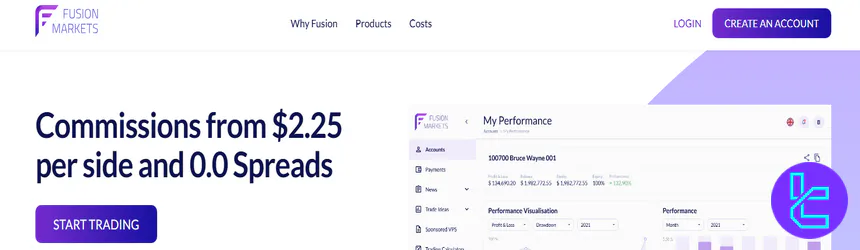
Upon Fusion Markest registration, the broker offers three main account types: Zero, Classic, and Swap-Free, all with $0 minimum deposit. The Zero account features spreads from 0.0 pips with a $4.5 commission per lot, while the Classic account offers spreads from 0.9 pips with no commission. Swap-Free accounts cater to Islamic traders with weekly fees ranging from $20-$200 per lot.
Accessible through Fusion Markets dashboard, the broker supports over 250 tradable instruments across Forex, indices, commodities, metals, energy, cryptocurrencies, and US shares. Forex traders can access 55 currency pairs, while metals CFDs include gold, silver, platinum, and more. US stock trading offers commission-free leveraged exposure on 1000+ US shares.
Funding is straightforward, with 30+ deposit methods including bank transfers, credit/debit cards, PayPal, crypto, and e-wallets like Skrill and Neteller. Deposit and withdrawal fees are largely zero, with minimum deposits as low as $0-$10 depending on the method. Withdrawals are processed instantly via e-wallets or within 1-5 business days for banks.
Account Types | Zero, Classic, Swap-Free |
Regulating Authorities | ASIC, VFSC |
Minimum Deposit | $0 |
Deposit Methods | Bank Wire, VISA/MasterCard, PayPal, Skrill, Neteller, PayID, Crypto, Interac, BinancePay |
Withdrawal Methods | Bank Transfer, PayPal, Skrill, Neteller, Crypto, Interac, Jetonbank, DragonPay |
Maximum Leverage | 1:500 (VFSC) / 1:30 (ASIC Retail) |
Trading Platforms & Apps | MetaTrader 4 (MT4), MetaTrader 5 (MT5), cTrader, TradingView |
Fusion Markets Pros and Cons
Overall, Fusion Markets excels in low-cost trading, high leverage, and fast execution, but has some limitations in educational resources and proprietary tools. Traders benefit from multiple account types, a wide variety of instruments, and strong platform support, while areas like investor protection funds and educational content could be improved:
Pros | Cons |
Ultra-low trading costs | Limited educational resources |
$0 minimum deposit | No proprietary trading platform |
Regulated by ASIC & VFSC | Relatively new broker (2019) |
Full suite of platforms (MT4, MT5, cTrader, TradingView) | Limited financial instruments outside Forex & US shares |
Global Prime
Global Prime is an Australian-founded brokerage with over 13 years of industry experience, providing traders access to 150+ financial instruments. Established in 2010 by Jeremy Kinstlinger, the broker offers raw spreads from 0.0 pips on Forex majors and charges no commissions on Standard accounts.
With regulatory oversight from the tier-1 Australian Securities and Investments Commission (ASIC) and a Vanuatu Financial Services Commission (VFSC) license, Global Prime ensures a secure trading environment. Client funds are held in segregated accounts with HSBC and National Australia Bank (NAB), offering additional protection. The broker’s fast execution times, starting at just 10 milliseconds, cater to both retail and professional traders seeking efficiency and reliability in their trades.
Global Prime provides two main account types: Standard and Raw. Each of them requires completing the Global Prime verification process. The Standard account features spreads from 0.9 pips with no commission, while the Raw account offers ultra-tight spreads from 0.0 pips with a $3.5 per lot commission. Leverage is flexible, up to 1:500 for international clients, with a minimum trade size of 0.01 lots and a maximum of 1000 lots.
Traders on Global Prime can access a diverse range of markets, including Forex, US Share CFDs, Indices, Commodities, and Cryptocurrencies. The broker offers 56 currency pairs, 100+ US stocks, 15+ global indices, 20+ commodities, and 35+ cryptocurrency CFDs, positioning it as a versatile platform for global market exposure. Moreover, the broker offers a Global Prime rebate program.
Account Types | Standard, Raw |
Regulating Authorities | ASIC, VFSC |
Minimum Deposit | No minimum (Unlimited) |
Deposit Methods | Credit/Debit Cards, Crypto, PayPal, Neteller, Skrill, FasaPay, Perfect Money, Bank Wire, Apple Pay, Visa, MasterCard, Gate8, Dragon Pay, VN Pay, QR Code, Pagsmile, Interac, PayID, Jeton Bank, X Pay |
Withdrawal Methods | Credit/Debit Cards, Crypto, PayPal, Neteller, Skrill, AstroPay, Perfect Money, Bank Wire, Local Bank Transfer, Dragon Pay, Jeton Bank, Interac, Gate8, VN Pay, X Pay |
Maximum Leverage | 1:500 (international clients), 1:30 (Australian clients) |
Trading Platforms & Apps | MetaTrader 4 (MT4), MetaTrader 5 (MT5), soon TradingView & cTrader |
Global Prime Pros and Cons
Global Prime offers competitive trading conditions, fast execution, and secure account management, but there are limitations to consider. The broker provides strong regulatory oversight, low spreads, and diverse markets. However, it currently supports only the MetaTrader 4 platform and restricts clients from several countries:
Pros | Cons |
Regulated by ASIC and VFSC for security | MT4 is currently the only trading platform |
Ultra-low spreads and fast execution | Restricted access for traders in multiple countries |
24/7 customer support | Limited promotional offers and bonuses |
Segregated client funds for added safety | No Swap-free/Islamic account options |
How Did We Choose These Commodity Forex Brokers?
Selecting the best commodity forex brokers requires more than comparing spreads or leverage. At Trading Finder, our evaluation process is built on a transparent and data-driven methodology designed to protect traders’ capital and promote informed decision-making. Since traders entrust brokers with real funds, we apply strict analytical standards to ensure objectivity and reliability.
Our team of experienced market analysts uses 19 structured evaluation metrics to assess every broker. These metrics cover regulation, trading conditions, platform performance, fees, security, and overall user experience. Each broker featured in this commodity ranking has passed a comprehensive review process tailored to traders who focus on metals, energy, and agricultural CFDs.
Core Evaluation Criteria for Commodity Brokers:
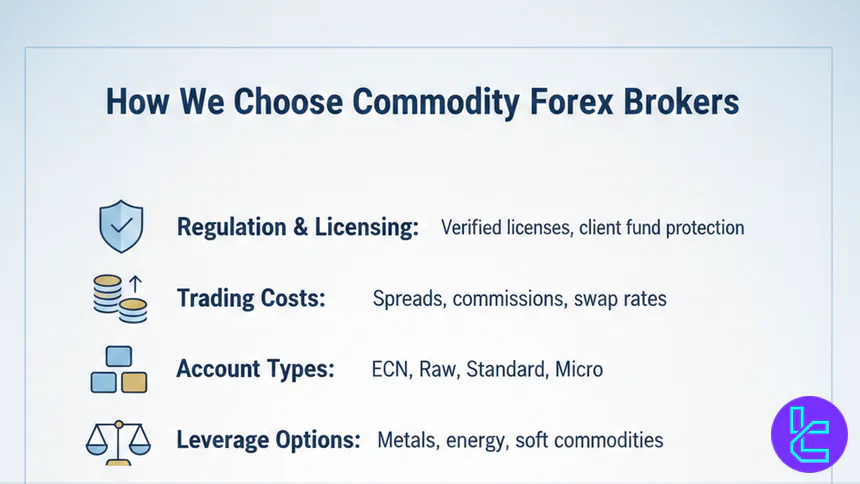
- Regulation & Licensing: Verification of licenses under recognized authorities and confirmation of client fund protection measures;
- Trading Costs: Detailed analysis of spreads on gold (XAU/USD), silver (XAG/USD), crude oil, and other commodities, plus commission structures and swap rates;
- Account Types: Availability of ECN, Raw, Standard, or Micro accounts suitable for commodity trading strategies;
- Leverage Options: Maximum leverage offered on metals, energy, and soft commodities;
- Tradable Symbols: Breadth of commodity CFDs including precious metals, oil benchmarks, natural gas, and agricultural products;
- Deposit & Withdrawal Conditions: Processing speed, supported payment methods, and non-trading fees;
- Trading Platforms: Support for MetaTrader 4, MetaTrader 5, cTrader, or other advanced platforms with commodity-specific tools;
- Execution Quality: Order execution speed, slippage control, and liquidity depth for volatile commodity markets.
Why Commodities Are Popular Among Forex Traders?
Commodities such as gold, silver, crude oil, and agricultural products are popular among forex traders because they provide exposure to physical assets whose prices are influenced by global economic trends.
These instruments often act as hedges against inflation or currency volatility, allowing traders to diversify beyond currency pairs. Commodities are also linked to global supply chains, making their movements relevant for macroeconomic trading strategies.
Additionally, trading commodities through CFDs or forex brokers allows for smaller capital outlays compared to purchasing physical goods. Traders can speculate on rising or falling prices without worrying about storage or delivery. Hard commodities like metals and energy products tend to have higher liquidity, while soft commodities, such as wheat or coffee, allow traders to explore seasonal patterns in their strategies.
Key Points:
- Hedge against inflation and economic uncertainty
- Diversification beyond traditional forex pairs
- Accessible through CFD trading without physical ownership
- High liquidity for metals and energy markets
The Pros and Cons of Trading Commodities in Forex
Trading commodities in forex has several advantages. Traders benefit from high liquidity, which ensures quick execution of trades and tight spreads. Commodities also provide a diversified portfolio, as their price movements often differ from those of forex pairs or stocks. The market reacts to tangible factors such as production reports, geopolitical events, and weather conditions, creating opportunities for both short-term and long-term strategies.
However, commodity trading comes with risks. High volatility can lead to substantial losses if positions are mismanaged. Unlike stocks, commodities do not provide dividends or passive income. Prices can also fluctuate due to unpredictable events like natural disasters or political instability. Some brokers may limit access to certain commodities, restricting flexibility.
Pros | Cons |
High liquidity and active markets | High volatility increases potential losses |
Portfolio diversification opportunities | No dividends or passive income |
Influenced by tangible supply and demand | Market influenced by geopolitical or environmental factors |
Low initial capital requirement through CFD trading | Some brokers restrict access to certain commodities |
How High are Non-Trading Fees for Commodity Trading in Forex?
Non-trading fees in commodities trading include inactivity charges, and currency conversion costs. Brokers offering futures contracts may also impose exchange fees or data access fees.
While some brokers waive deposit and withdrawal fees, others may apply minimal charges for bank transfers or specific payment gateways. Understanding non-trading costs is essential for longer-term traders, as even small daily financing fees can accumulate, especially on high-leverage positions or multiple commodity trades.
Key Points:
- Inactivity or account maintenance fees vary by broker
- Currency conversion or intermediary bank fees may occur
- CFD brokers often waive deposit and withdrawal fees
What Are the Best Commodities to Trade in Forex?
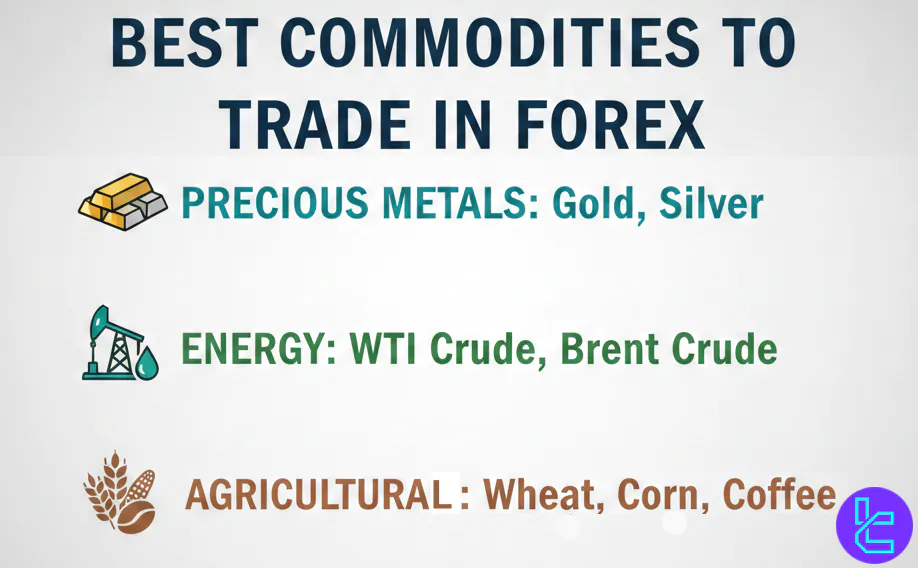
Some of the most popular commodities among forex traders include gold (XAU/USD), silver (XAG/USD), WTI crude oil, and Brent crude oil. Precious metals like gold and silver are often considered safe-haven assets and respond to global economic indicators such as inflation, interest rates, and currency movements.
Energy commodities like oil are highly liquid and influenced by supply-demand balances, geopolitical events, and OPEC decisions. Agricultural commodities, including wheat, corn, and coffee, provide opportunities for traders who analyze seasonal production cycles and global demand. The combination of metals, energy, and agricultural commodities allows traders to diversify strategies across various market drivers.
The best commodities:
- Precious metals: gold, silver
- Energy: WTI and Brent crude oil
- Agricultural products: wheat, corn, coffee
What Factors Affect the Price of Commodities in Forex?
Commodity prices are driven by multiple factors. Supply and demand dynamics are critical, as production disruptions or surpluses directly affect pricing. Geopolitical tensions, weather events, and macroeconomic indicators like interest rates, inflation, and currency strength also influence prices.
Forex correlations further impact commodity trading. For example, commodity-linked currencies like the Australian dollar (AUD) or Canadian dollar (CAD) often move in line with metal or oil prices. Traders can use these relationships to predict market trends and hedge positions. Seasonal cycles in agricultural products also create recurring trading opportunities.
Key Points:
- Supply and demand fluctuations influence prices
- Economic data and macro events drive market sentiment
- Commodity-linked currencies affect trading positions
- Seasonal cycles impact agricultural commodities
What Leverage Do Forex Brokers Offer for Commodities?
Leverage for commodities varies significantly by broker and asset type. Many brokers provide up to 1:500 leverage for precious metals, while energy products may have lower limits like 1:100-1:200 to manage volatility. Some brokers allow soft commodities with leverage up to 1:50.
Higher leverage increases potential profit and risk, allowing traders to maximize returns with smaller capital. Brokers often adjust leverage based on regulatory requirements and market conditions, ensuring trader protection while providing sufficient flexibility for active and professional trading strategies.
Typical leverages:
- Precious metals leverage: up to 1:500
- Energy commodities: typically 1:100-1:200
- Soft commodities: often limited to 1:50
What is the Minimum Spread for Commodity Trading in Forex Brokers?
Commodity spreads reflect both market liquidity and broker structure. For highly liquid assets like spot gold, spreads can be as low as 0.3-0.6 pips, while crude oil spreads are often 0.05–0.10 USD per barrel. Less liquid agricultural commodities may have wider spreads to reflect trading costs.
Tight spreads benefit active traders by reducing transaction costs, particularly for scalping or short-term strategies. Traders should compare brokers’ spreads across commodities to optimize trading efficiency and cost management.
Key Points:
- Spot gold spreads: 0.3-0.6 pips
- Crude oil spreads: 0.05-0.10 USD per barrel
- Agricultural commodity spreads vary more widely
- Tight spreads improve short-term trading performance
Minimum Investment Amount for Commodities in Forex Brokers
Minimum investment depends on broker type and account. CFD brokers often allow trading from 0.01 lots, making commodities accessible with minimal capital. Futures contracts on exchanges require higher margins, often several thousand dollars per contract.
Traders can scale investments according to risk tolerance and account size. Micro or demo accounts allow beginners to learn strategies without financial exposure, while professional accounts accommodate high-volume traders seeking deep liquidity and advanced features.
Key Points:
- CFD positions from 0.01 lots
- Futures contracts require larger margins
- Beginner accounts enable low-risk exposure
- Professional accounts support high-volume trading
What Regulatory Authorities Supervise Commodity Trading in Brokers?
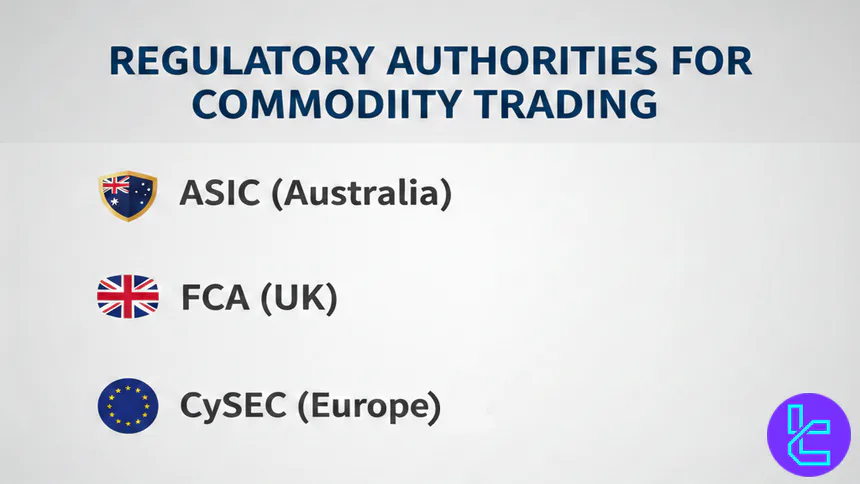
Commodity trading in forex is regulated by global authorities such as ASIC (Australia), FCA (UK), and CySEC (Europe). These regulators ensure transparency, segregated client funds, and fair execution practices. Futures trading is supervised by organizations like the CFTC and exchange-level authorities such as CME Group, enforcing compliance and clearing standards.
Proper regulation protects traders from fraud and operational risks while maintaining market integrity. Licensed brokers must follow capital requirements, reporting, and client fund protection standards to maintain credibility.
What Are the Best Accounts for Trading Commodities in Forex Brokers?
The best accounts for commodities offer low spreads, minimal commissions, and flexible leverage. ECN or Raw Spread accounts are ideal for active traders, while demo accounts help beginners practice without financial risk. Professional accounts often provide enhanced liquidity, faster execution, and advanced analytical tools.
Some brokers also offer Micro accounts, allowing small investments on commodities with fractional lot sizes. Account selection depends on trading style, capital, and risk tolerance. Choosing the right account ensures cost-efficient trading and optimal access to commodity markets.
Best accounts include:
- ECN/Raw Spread accounts minimize trading costs
- Demo accounts allow risk-free practice
- Micro accounts support small investments
- Professional accounts provide deep liquidity and advanced tools
Best Strategies for Commodity Trading in Forex Brokers
Popular strategies for commodities include trend following, where traders capitalize on sustained price movements, and breakout trading, exploiting key support and resistance levels. Range trading works when prices oscillate within a defined band, especially for agricultural commodities.
Traders also combine technical indicators like moving averages, RSI, and Bollinger Bands with fundamental analysis such as inventory reports, production data, and economic releases. Effective risk management with stop-losses and proper position sizing is essential for handling volatility in commodity markets.
Best Strategies:
- Trend following Strategies
- Breakout Strategies
- Range Trading
- Combining moving Averages, RSI, and Bollinger Bands
Commodity Trading vs. Other Common Tradable Instruments
Commodity trading differs from forex pairs and stocks due to higher volatility and unique market drivers. Unlike currencies that reflect macroeconomic conditions, commodities react to tangible supply-demand factors and geopolitical events. This creates both risk and diversification opportunities.
Compared to stocks or ETFs, commodities provide sharper price swings, allowing day traders to exploit short-term volatility. Long-term traders can use commodities as hedges against inflation and currency depreciation, complementing traditional investment portfolios.
Feature | Commodities | Currency Pairs | Stocks (Equities) | Cryptocurrencies |
Market Drivers | Supply & demand, geopolitics, weather, inflation | Interest rates, central banks, macroeconomic data | Company earnings, economic growth, sector performance | Market sentiment, adoption, regulation, technology |
Volatility Level | Medium to High | Medium | Medium | Very High |
Liquidity | High (metals & oil), moderate (agriculture) | Extremely High (major pairs) | High (large-cap stocks) | High for major coins, low for altcoins |
Leverage Availability (CFDs) | Up to 1:500 (varies by asset) | Up to 1:500 or higher | Usually 1:5-1:20 | Often 1:2-1:20 (regulated brokers) |
Trading Hours | 24/5 (most CFDs) | 24/5 | Exchange hours | 24/7 |
Income Potential | Price speculation only | Price speculation only | Price growth + dividends | Price speculation only |
Inflation Hedge | Strong (e.g., gold) | Weak to moderate | Moderate | Limited / speculative |
Risk Level | High (due to volatility & leverage) | Moderate to High | Moderate | Very High |
Conclusion
Commodity trading offers exposure to 3 key sectors, metals, energy, and agriculture, each driven by global economic forces. In this guide, we compared 7 top brokers using 19 evaluation criteria, covering spreads, leverage, fees, and regulation. With leverage often above 1:100 and tight pricing on major commodities, traders have multiple competitive options. The best broker ultimately depends on your strategy, budget, and risk tolerance.
Want to dive into how we evaluate brokers? Explore our Forex methodology article.