






Some Forex brokers are more beginner-friendly; they enable low initial deposits of down to $1, provide access to common trading platforms, and offer suitable account types.
If you are a beginner, you would likely do better in these brokerages with limited investments. The list below mentions some of the best choices for novice traders.
 | GLOBAL PRIME | |||
 | BlackBull | |||
 | eToro | |||
| 4 |  | ACTIVTRADES | ||
| 5 |  | eightcap | ||
| 6 |  | AVATRADE | ||
| 7 |  | TICKMILL |
Trustpilot Ratings for Beginner Brokers
Forex traders submit their reviews and experiences on the internet; “Trustpilot” is a highly reputation website for checking out these ratings. The table below outlines these ratings for mentioned brokers.
Broker Name | Trustpilot Rating | Number of Reviews |
AvaTrade | 12,233 | |
3,267 | ||
434 | ||
ActivTrades | 4.4/5⭐ | 1,069 |
eToro | 31,140 | |
Eightcap | 3,632 | |
Tickmill | 3.8/5⭐ | 1,134 |
Minimum Deposit Amount in Beginner Brokerages
If you are a beginner, most likely, you prefer to start with little investment; so, the minimum deposit requirement must be low. The table here ranks the brokerages based on this parameter.
Broker Name | Min. Deposit |
$0 | |
Oanda | $0 |
XTB | $0 |
$10 | |
AvaTrade | $100 |
Eightcap | $100 |
Tickmill | $100 |
Available Account Types in the Mentioned Brokers
Account types provide various ways and approaches towards trading. This section outlines the available accounts in the introduced brokers.
Broker Name | Account Types |
eToro | Personal, Professional, Corporate, Islamic, Demo |
ActivTrades | Professional, Individual, Demo, Islamic |
Oanda | Standard, Elite Trader, Demo |
Plus500 | Retail, Professional, Demo |
AvaTrade | Retail, Professional, Islamic, Demo |
Standard, Raw, TradingView, Demo | |
Tickmill | Classic, Raw, Demo |
Regulatory Licenses and Financial Supervisions
Having high-tier licenses can make the difference between a broker being trustworthy and not. Beginners should start their trading journey with a safe and reliable broker.
Broker Name | Regulation |
ASIC, CySEC, CBI, FSA, FSCA, MiFID, ADGM, PFSA, ISA | |
Plus500 | FCA, ASIC, CySEC, MAS, EFSA, DFSA, AFSC, FMA |
eToro | FCA, CySEC, MFSA, FSRA, ASIC, FSA, Gibraltar FSC |
Exness | FSA, CySEC, FCA, FSCA, CBCS, FSC, CMA |
ActivTrades | FCA, SCB, CMVM, BACEN, CVM |
FSA, FCA, CySEC, LFSA, FSCA | |
Eightcap | ASIC, FCA, CySEC, SCB |
Top 6 Forex Brokers for Beginners in Detail
In the following sections, six of the mentioned brokerages will be briefly reviewed. Account types, spreads, commissions, platforms, and other important criteria are considered in these introductions.
AvaTrade
Founded in 2006, AvaTrade operates under multiple entities across Europe, the Middle East, Asia, Africa, and Australia. The broker is licensed by regulators including the Central Bank of Ireland, ASIC, CySEC, and FSCA.
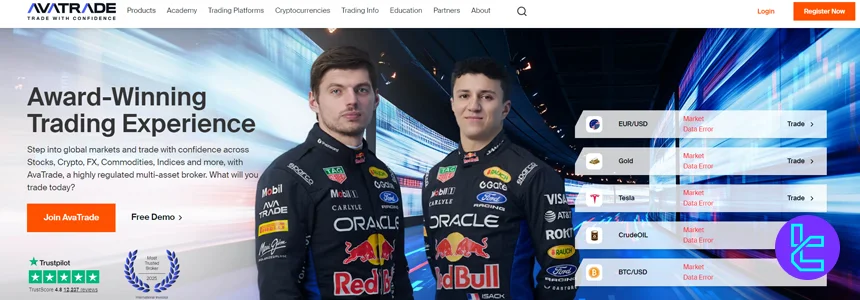
AvaTrade supports more than 1,250 tradable instruments across Forex, stocks, commodities, indices, cryptocurrencies, ETFs, bonds, and options. Traders can access the market through multiple platforms, including MetaTrader 4, MetaTrader 5, WebTrader, AvaOptions, and mobile trading apps for iOS and Android.
The broker offers Retail, Professional, Islamic, and Demo accounts with a minimum deposit of $100 and order sizes starting from 0.01 lots. Depending on the regulatory entity, leverage can reach up to 1:400, while margin call and stop-out levels are set at 25% and 10%, helping traders manage risk exposure more efficiently.
There is an AvaTrade rebate program available for discounts on spreads. Participate in it if you are considering this broker.
AvaTrade does not charge deposit or withdrawal fees and provides several payment methods, including cards, bank transfers, Skrill, Neteller, WebMoney, PayPal, Apple Pay, and Google Pay in selected regions.
Additional features such as copy trading through DupliTrade and AvaSocial, educational content, and multilingual 24/5 customer support make the broker accessible to a broad range of traders.
Table of Specifics
Account Types | Retail, Professional, Islamic, Demo |
Regulating Authorities | ASIC, CySEC, CBI, FSA, FSCA, MiFID, ADGM, PFSA, ISA |
Minimum Deposit | $100 |
Deposit Methods | Credit/Debit Cards, E-Wallets, Bank Wire Transfer, PayPal |
Withdrawal Methods | Credit/Debit Cards, E-Wallets, Bank Wire Transfer, PayPal |
Maximum Leverage | 1:400 |
Trading Platforms & Apps | MetaTrader 4, MetaTrader 5, Mobile App, WebTrader |
AvaTrade Pros and Cons
AvaTrade’s strengths are centered around regulatory diversity, broad platform coverage, and accessible account conditions. However, traders should also consider its inactivity charges, lack of PAMM accounts, and restrictions in several countries before opening an account.
Pros | Cons |
Regulated by multiple authorities across several jurisdictions | Inactivity fee charged after two months of no trading activity |
Supports MT4, MT5, WebTrader, AvaOptions, and mobile apps | No PAMM or MAM account options |
Offers copy trading through DupliTrade and AvaSocial | Limited availability in countries such as the US and Belgium |
No deposit or withdrawal fees charged by the broker | Fewer account types than some ECN-focused competitors |
BlackBull Markets
BlackBull Markets is a New Zealand-based broker founded in 2014 by Michael Walker and Selwyn Loekman. Operating under Black Bull Group Limited, the company is regulated by both the New Zealand FMA and Seychelles FSA, providing access to over 26,000 instruments across Forex, stocks, commodities, indices, metals, and crypto markets.

The broker offers three ECN account types: ECN Standard, ECN Prime, and ECN Institutional. Traders can access spreads from 0.0 pips, leverage up to 1:500, and commissions starting from $0 on the Standard account. The minimum deposit requirement starts from $0 for most account types.
BlackBull Markets supports multiple trading platforms, including MT4, MT5, TradingView, cTrader, BlackBull Invest, and BlackBull CopyTrader.
Features such as API trading, copy trading, Islamic accounts, PAMM accounts, and access to Equinix NY4 and LD5 servers make the broker suitable for active and professional traders.
The company has received 7 industry awards and offers 24/7 customer support via live chat, email, phone, and WhatsApp. Additional strengths include segregated client funds, negative balance protection, fast execution speeds, and partnerships with organizations such as Starship Foundation and Milford Asset Management.
If you are interested in this broker, you may go through our BlackBull Markets registration guide. The table below summarizes the broker’s specifics.
Account Types | ECN Standard, ECN Prime, ECN Institutional |
Regulating Authorities | FSA, FMA |
Minimum Deposit | $0 |
Deposit Methods | Visa, MasterCard, Apple Pay, Google Pay, Bank Wire, Crypto, Neteller, Skrill, SEPA, FasaPay |
Withdrawal Methods | Visa, MasterCard, Apple Pay, Google Pay, Bank Wire, Crypto, Neteller, Skrill, SEPA, FasaPay |
Maximum Leverage | 1:500 |
Trading Platforms & Apps | MT4, MT5, TradingView, cTrader, BlackBull CopyTrader, BlackBull Invest |
BlackBull Markets Pros and Cons
BlackBull Markets combines low-cost ECN trading with broad market access and advanced platform support. While the broker is well-suited for experienced traders seeking tight spreads and institutional-style execution, its wide product range and regional restrictions may create challenges for beginners.
Pros | Cons |
Spreads starting from 0.0 pips | Some services are unavailable in certain countries |
No minimum deposit requirement on Standard and Prime accounts | Wide range of tools and products may overwhelm beginner traders |
Access to over 26,000 tradable instruments | Institutional account requires a $20,000 minimum deposit |
Supports MT4, MT5, TradingView, cTrader, and copy trading | $5 withdrawal fee applies to all payment methods |
Global Prime
Global Prime has operated since 2010 and was founded in Australia by Jeremy Kinstlinger. The broker is regulated by ASIC and VFSC, giving traders access to both strict Tier-1 oversight and higher-leverage offshore trading conditions. Its parent company, FMGP Trading Group Pty Ltd, focuses on transparent pricing and fast trade execution.
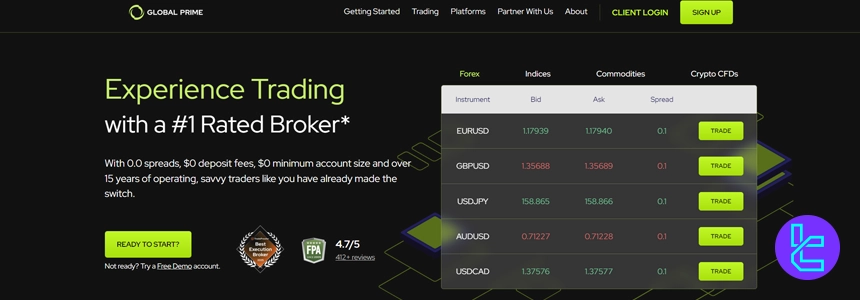
The broker offers more than 150 tradable instruments across Forex, indices, commodities, crypto CFDs, bonds, and U.S. share CFDs.
Traders can choose between Standard and Raw accounts, with spreads starting from 0.9 pips on Standard accounts and 0.0 pips on Raw accounts. Also, there are cashbacks and discounts available through the Global Prime rebate program.
Global Prime supports leverage up to 1:500 for international clients and provides execution speeds from 10 milliseconds. The broker also offers additional services such as Autochartist trading signals, ZuluTrade copy trading, VPS hosting, and promotional perks like TradingView Premium and Financial Times subscriptions.
One of Global Prime’s strongest features is its flexible account structure. There is no minimum deposit requirement, trading starts from 0.01 lots, and the broker supports more than 20 payment methods, including PayPal, Skrill, Neteller, crypto, bank wire, and regional gateways.
Table of Specifics
Account Types | Standard, Raw |
Regulating Authorities | VFSC, ASIC |
Minimum Deposit | Unlimited |
Deposit Methods | Credit/Debit Cards, Crypto, PayPal, Neteller, Skrill, FasaPay, Perfect Money, Bank Wire, etc. |
Withdrawal Methods | Credit/Debit Cards, Crypto, PayPal, Neteller, Skrill, AstroPay, Perfect Money, Bank Wire |
Maximum Leverage | 1:500 |
Trading Platforms & Apps | MT4 |
Global Prime Pros and Cons
Global Prime combines low trading costs, fast execution, and strong regulatory oversight, making it suitable for scalpers, algorithmic traders, and cost-conscious Forex traders. However, the broker still has a limited platform offering and does not provide Islamic accounts or proprietary copy trading services.
Pros | Cons |
Regulated by ASIC and VFSC | MT4 is currently the main trading platform |
Raw spreads from 0.0 pips | No Islamic or swap-free account |
No minimum deposit requirement | No proprietary copy trading platform |
20+ payment methods with no deposit or withdrawal fees | Restricted access for traders in several countries |
ActivTrades
ActivTrades is a London-headquartered forex and CFD broker founded in 2001, making it one of the more established names in the retail trading industry. For beginners, that long operating history matters, especially when combined with service coverage across 170 countries and a client base exceeding 100,000 users.
The broker is regulated by multiple authorities, including the FCA in the UK, CMVM in Portugal, SCB in the Bahamas, and BACEN/CVM in Brazil. It also combines segregated client funds, negative balance protection, FSCS coverage up to £85,000, and additional insurance up to £1,000,000 per client.
ActivTrades keeps entry barriers relatively low with a $0 minimum deposit, 0.01-lot minimum trade size, and access to Demo, Individual, Professional, and Islamic accounts. Beginners can also choose between MT4, MT5, TradingView, and the proprietary ActivTrader platform, which is known for its clean interface and practical trading tools.
Its product range covers forex, shares, indices, commodities, ETFs, bonds, and cryptocurrencies on eligible entities, with spreads starting from 0.5 pips. ActivTrades also uses a No Dealing Desk model and reports average execution speeds of around 4 milliseconds, a feature that may appeal to traders seeking efficient order handling.
You can check out our ActivTrades registration guide for opening an account with the broker. Here are the brokerage’s specifics.
Account Types | Professional, Individual, Demo, Islamic |
Regulating Authorities | FCA, SCB, CMVM, BACEN, CVM |
Minimum Deposit | $0 |
Deposit Methods | Bank Wire, Credit/Debit Cards (Visa, MasterCard), E-Wallets (Skrill, Neteller), Local Payment Methods |
Withdrawal Methods | Bank Wire, Credit/Debit Cards (Visa, MasterCard), E-Wallets (Skrill, Neteller), Local Payment Methods |
Maximum Leverage | 1:400 |
Trading Platforms & Apps | MT4, MT5, ActivTrader, TradingView |
ActivTrades Pros and Cons
For beginners, ActivTrades stands out through its long market presence, strong regulatory profile, demo access, and platform flexibility. At the same time, traders should weigh its lack of copy trading, geographic restrictions, and limited bonus structure before deciding whether it fits their first trading experience.
Pros | Cons |
Founded in 2001 with a long operating track record | No copy trading or social trading features |
FCA regulation plus multi-jurisdiction oversight | Services unavailable in several countries, including the US |
Demo account and $0 minimum deposit for easier entry | Promotions are limited compared with some competitors |
Supports MT4, MT5, TradingView, and ActivTrader | Some advanced benefits are reserved for professional clients |
eToro
eToro was founded in 2007 in Tel Aviv by David Ring, Ronen Assia, and Yoni Assia. The broker operates globally through several regulated entities and serves clients across stocks, forex, crypto, ETFs, commodities, and indices. Its long operating history and simple interface make it suitable for beginners.

The broker is regulated by multiple authorities, including the Financial Conduct Authority, Australian Securities and Investments Commission, Cyprus Securities and Exchange Commission, and Financial Services Regulatory Authority. Investor protections vary by region, with UK clients covered up to GBP 85,000 through FSCS.
eToro offers four account types: Personal, Professional, Corporate, and Islamic. Beginners can start with a minimum deposit of $10 and use the free demo account with $100,000 in virtual funds. Funding methods include PayPal, Skrill, Neteller, Trustly, bank transfer, and credit cards.
One of eToro’s strongest features is its social investing ecosystem. Through CopyTrader, users can automatically copy experienced traders, while Smart Portfolios provide themed investment baskets. The broker also supports crypto staking for selected coins such as Ethereum, Solana, Cardano, and Tron.
If you are considering this broker, there is an eToro registration tutorial available on the website. The table below demonstrates the broker’s specifics.
Account Types | Personal, Professional, Corporate, Islamic |
Regulating Authorities | FCA, CySEC, MFSA, FSRA, ASIC, FSA, Gibraltar FSC |
Minimum Deposit | $10 |
Deposit Methods | eToro Money, Credit/Debit Card, Bank Transfer, PayPal, Neteller, Skrill, Online Banking (Trustly), iDEAL, Sofort, Przelewy24 |
Withdrawal Methods | eToro Money, Credit/Debit Card, Bank Transfer, PayPal, Neteller, Skrill, Online Banking (Trustly), iDEAL, Sofort, Przelewy24 |
Maximum Leverage | 1:400 |
Trading Platforms & Apps | Proprietary App |
eToro Pros and Cons
eToro stands out because of its beginner-friendly design, copy trading tools, and access to over 6,000 instruments. However, the lack of MT4/MT5 integration, inactivity charges, and limited customer support channels may be disadvantages for traders seeking advanced platforms or direct phone assistance.
Pros | Cons |
Low minimum deposit starting from $10 | No MT4 or MT5 support |
CopyTrader and Smart Portfolios available | No phone support for customer service |
Regulated by multiple top-tier authorities | $10 monthly inactivity fee after 12 months |
Access to more than 6,000 tradable instruments | Withdrawal fee charged on USD accounts |
Eightcap
Founded in 2009 in Melbourne, Eightcap has grown into a globally recognized forex and CFD broker with access to more than 800 tradable instruments. The broker supports six major markets, including Forex, crypto, indices, commodities, metals, and shares.
Eightcap offers three main live account types: Standard, Raw, and TradingView. Beginners can start with a $100 minimum deposit, while experienced traders may prefer the Raw account with spreads from 0.0 pips and round-turn commissions from $7 per lot.
The broker supports popular platforms such as MetaTrader 4, MetaTrader 5, and TradingView. Additional tools like Capitalise.ai, FlashTrader, and an AI-powered economic calendar make Eightcap especially appealing to beginners who want advanced functionality without complicated setup.
One of Eightcap’s strongest advantages is its multi-jurisdiction regulation. The broker operates under the supervision of authorities such as Australian Securities and Investments Commission, Financial Conduct Authority, Cyprus Securities and Exchange Commission, and the Securities Commission of The Bahamas.
It also received the title of Global Broker of the Year 2023.
It’s worth noting that there is an Eightcap rebate program available for reduced commissions and costs. The table below provides a summary of details.
Account Types | Standard, Raw, TradingView, Demo |
Regulating Authorities | ASIC, FCA, CySEC, SCB |
Minimum Deposit | $100 |
Deposit Methods | Crypto, e-wallets, credit/debit card, bank transfer, Online Payment Systems |
Withdrawal Methods | Crypto, e-wallets, credit/debit card, bank transfer, Online Payment Systems |
Maximum Leverage | 1:500 |
Trading Platforms & Apps | MT4, MT5, TradingView |
Eightcap Pros and Cons
Eightcap combines strong regulation, competitive pricing, and platform flexibility in a way that suits both new and experienced traders. While its educational section is useful for beginners, the lack of copy trading, Islamic accounts, and more advanced educational filtering may be limiting for some users.
Pros | Cons |
Regulated by ASIC, FCA, CySEC, and SCB | No copy trading or PAMM services |
Access to MT4, MT5, and TradingView | No Islamic account option |
Raw account spreads from 0.0 pips | Educational materials are relatively basic |
Supports advanced tools like Capitalise.ai and FlashTrader | Inactivity fee applies after 3 months |
How Each Broker Was Evaluated and Chosen
Choosing the best forex broker for beginners requires more than comparing spreads or checking platform availability.
At TradingFinder, each broker is reviewed through a structured methodology built around 19 key evaluation metrics. This process helps identify brokers that offer a beginner-friendly environment, strong regulation, reliable trading conditions, and accessible educational support.
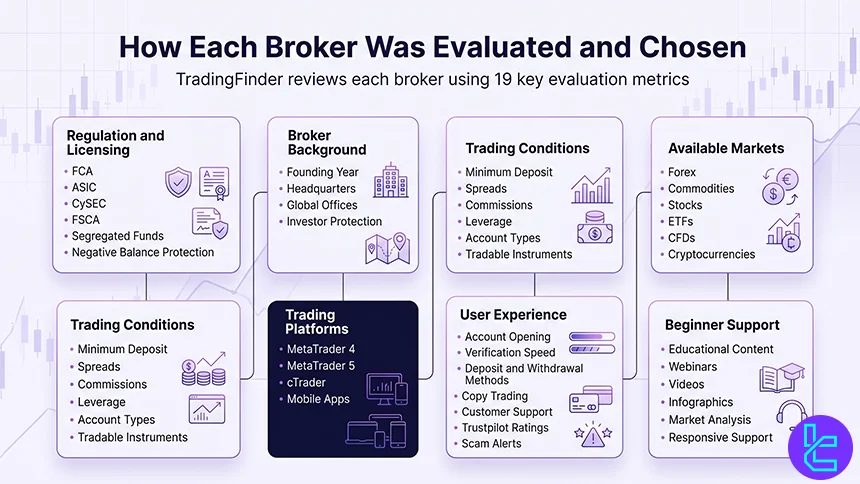
The first stage of the review focuses on regulation and company background. TradingFinder verifies whether a broker operates under trusted financial authorities such as the Financial Conduct Authority, Australian Securities and Investments Commission, Cyprus Securities and Exchange Commission, and Financial Sector Conduct Authority.
Analysts also review each broker’s founding year, headquarters location, global offices, and investor protection measures, including segregated funds and negative balance protection.
TradingFinder also examines trading conditions that matter most to beginners. This includes account types, minimum deposit requirements, leverage, spreads, commissions, and the range of tradable instruments such as Forex pairs, commodities, stocks, ETFs, CFDs, and cryptocurrencies.
Platform availability is another important factor, especially support for MetaTrader 4, MetaTrader 5, cTrader, and mobile trading apps.
In addition, TradingFinder evaluates the account opening process, verification speed, deposit and withdrawal methods, copy trading features, customer support quality, Trustpilot ratings, scam alerts, and educational content.
Brokers that provide webinars, videos, infographics, market analysis, and responsive support are generally more suitable for new traders who need guidance while building experience in the forex market.
What Features Do Forex Brokers for Beginners Have?
Forex brokers designed for beginners usually focus on simplicity, lower costs, and educational support rather than advanced institutional features. A beginner-friendly broker should make it easy to open an account, understand trading conditions, and access tools without requiring extensive market experience.
One of the most important features is strong regulation. Brokers supervised by authorities such as the Financial Conduct Authority, Australian Securities and Investments Commission, or Cyprus Securities and Exchange Commission are generally more reliable because they must follow strict rules regarding client fund protection, transparency, and operational standards.
Beginner brokers also tend to offer low minimum deposits, user-friendly account types, and simplified pricing. Standard accounts with fixed or low spreads, commission-free trading, and minimum deposits between $10 and $200 are common. Many brokers also provide demo accounts so new traders can practice strategies without risking real money.
Easy-to-use trading platforms are another key feature. Most beginner-friendly brokers support MetaTrader 4, MetaTrader 5, or proprietary mobile apps with simple layouts, one-click trading, and integrated charts.
Brokers that provide educational videos, webinars, trading guides, glossaries, and market analysis are often better suited for inexperienced traders.
Additional features that can benefit beginners include copy trading, fast customer support, negative balance protection, multiple payment methods, and responsive mobile apps. Some brokers also offer social trading tools, allowing users to follow experienced traders and learn how positions are managed in real market conditions.
Pros and Cons of Beginner Forex Brokers
Beginner forex brokers are designed to make trading more accessible through simple account structures, educational content, lower deposits, and easy-to-use platforms. These features can reduce the learning curve for new traders.
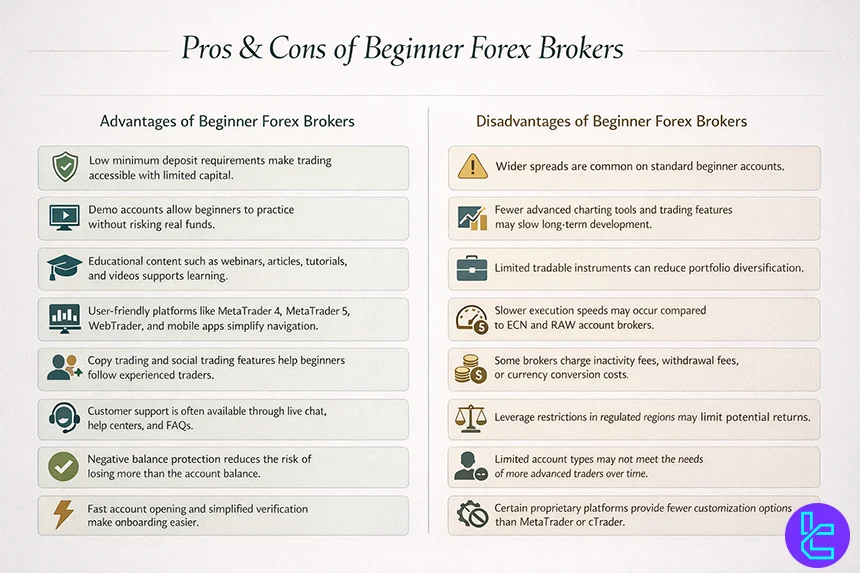
However, beginner-focused brokers may also offer fewer advanced tools, limited account customization, wider spreads, or lower-quality execution compared to brokers designed for experienced traders.
Pros | Cons |
Low minimum deposit requirements make it easier to start trading with limited capital | Wider spreads are common on beginner-friendly standard accounts |
Access to demo accounts helps new traders practice without risking real money | Fewer advanced tools and charting features may limit long-term growth |
Educational resources such as webinars, articles, and videos improve market understanding | Some brokers provide limited tradable instruments compared to professional platforms |
User-friendly platforms like MetaTrader 4 and mobile apps simplify navigation | Beginner-focused brokers may offer slower execution speeds than ECN or RAW account brokers |
Copy trading and social trading features allow beginners to learn from experienced traders | Certain brokers charge inactivity, withdrawal, or conversion fees |
Customer support is often more accessible through live chat, FAQs, and help centers | Leverage restrictions in regulated regions may reduce potential returns |
Lower-risk features such as negative balance protection can protect inexperienced traders | Limited account types may not suit traders as they become more advanced |
Fast account opening and simplified verification improve the onboarding process | Some beginner brokers rely heavily on proprietary platforms with fewer customization options |
Which Trading Platforms Are Best for Novice Traders?
The best trading platforms for novice traders are usually the ones that combine ease of use, reliable charting tools, mobile access, and educational features. Beginners generally benefit from platforms with a simple layout, fast order execution, and enough built-in tools to learn market basics without becoming overwhelmed.
- MetaTrader 4: One of the most popular platforms for beginners due to its simple interface, wide broker support, and large library of indicators and tutorials. It is mainly focused on Forex and CFD trading;
- MetaTrader 5: A more advanced version of MT4 with additional timeframes, more technical indicators, an economic calendar, and support for stocks, ETFs, and futures. It is suitable for beginners who may want more tools over time;
- cTrader: Known for its clean design, modern interface, and advanced order execution features. While it is slightly more complex than MT4, many novice traders find its charting and depth-of-market tools easier to understand;
- TradingView: Popular among new traders because of its user-friendly charts, social community, and browser-based design. It offers a wide range of indicators, drawing tools, and shared trade ideas;
- Proprietary broker platforms: Many brokers provide their own web and mobile platforms with simplified layouts, one-click trading, integrated news feeds, and educational content. These platforms are often easier for beginners than more advanced third-party software.
For most novice traders, MetaTrader 4 remains the easiest starting point because of its broad availability and straightforward interface. Traders looking for more advanced features later can move to MetaTrader 5 or TradingView as their skills improve.
What are the Best Account Types for Beginner Traders?
The best account types for beginner traders are usually the ones that provide lower risk, simple pricing, and flexible position sizing. Beginners often benefit from accounts that allow them to trade smaller volumes, test strategies, and limit potential losses while learning how the forex market works.
Standard accounts are among the most common options for new traders. These accounts usually have no commission charges and instead include trading costs within the spread. They are easy to understand and widely available across most brokers, making them suitable for beginners who want a straightforward trading experience.
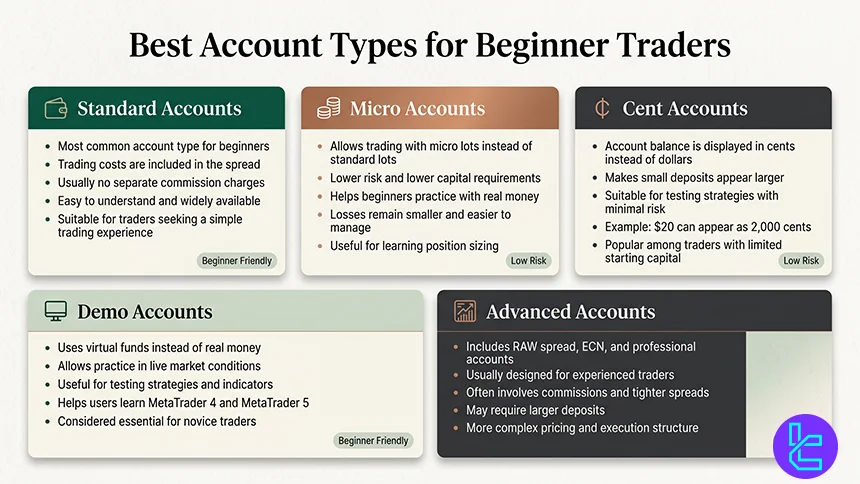
Micro accounts are another beginner-friendly option because they allow traders to open smaller positions than a standard account. Instead of trading full standard lots, users can trade micro lots, which reduces both risk and required capital. This makes micro accounts useful for traders who want to practice with real money while keeping losses manageable.
Cent accounts are also popular among beginners. In these accounts, balances are shown in cents rather than dollars, which makes small deposits appear larger and allows traders to test strategies with minimal financial exposure. For example, a $20 deposit may appear as 2,000 cents in the account balance.
Demo accounts are often considered essential for novice traders. They provide access to real-time market conditions using virtual funds, allowing users to practice trading, test indicators, and learn platforms such as MetaTrader 4 or MetaTrader 5 without risking capital.
RAW spread, ECN, and professional accounts are generally better suited for experienced traders because they often involve commissions, tighter spreads, larger deposits, and more complex pricing structures.
What Should I Consider Before Choosing a Broker as a Beginner?
Before choosing a broker as a beginner, it is important to focus on safety, trading costs, ease of use, and the availability of educational support. A broker may offer attractive leverage or bonuses, but these features matter less if the company lacks proper regulation or provides poor trading conditions.
- Regulation should be the first priority. Brokers supervised by high-tier authorities, such as the ASIC, CySEC, and FCA, are generally more trustworthy;
- Review the broker’s trading costs, including spreads, commissions, deposit fees, withdrawal fees, and inactivity charges. Some beginner brokers advertise commission-free trading but compensate with wider spreads;
- Check the minimum deposit requirement. Many beginner-friendly brokers allow account opening with $10 to $200, which reduces the risk of committing too much capital too early;
- Make sure the broker offers a demo account. Practicing with virtual funds can help beginners learn how to place trades, manage risk, and understand platform functions before using real money;
- Look at the available platforms. Many beginners prefer brokers that support MetaTrader 4, MetaTrader 5, cTrader, or simple proprietary mobile apps;
- Educational content is another important factor. Brokers that provide webinars, articles, tutorials, videos, glossaries, and market analysis can help new traders build their skills faster;
- Customer support quality should also be considered. Live chat, email, phone support, and responsive help centers can be important when technical or account-related issues appear.
Should I Start Trading with a Demo Account as a Beginner?
Starting with a demo account is usually one of the best decisions for beginner traders. A demo account allows users to trade in real market conditions using virtual funds, which means they can practice without risking actual money.
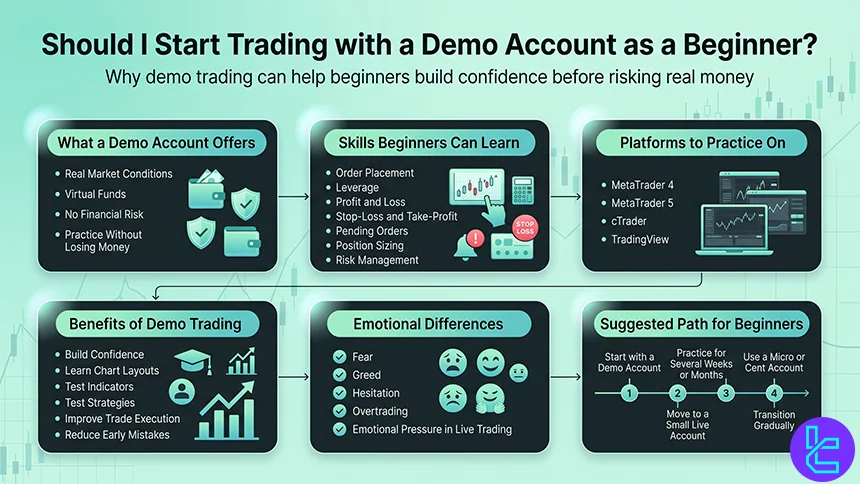
This helps beginners understand how orders work, how leverage affects positions, and how price movements impact profit and loss.
Demo accounts are also useful for learning trading platforms such as MetaTrader 4, MetaTrader 5, cTrader, and TradingView. New traders can test indicators, place pending orders, use stop-loss and take-profit levels, and become familiar with chart layouts before moving to a live account.
Another advantage of demo trading is the ability to test strategies without financial pressure. Beginners can learn position sizing, risk management, and trade execution while avoiding emotional decisions caused by real gains and losses. This can help build confidence and reduce mistakes during the early stages of trading.
However, demo accounts also have limitations. Since no real money is involved, traders may take larger risks than they would in a live environment. Emotional factors such as fear, greed, hesitation, and overtrading are usually much stronger when trading with real funds.
For most beginners, it is often better to start with a demo account for several weeks or months, then gradually move to a small live account such as a micro or cent account once they are comfortable with basic trading principles.
Conclusion
Novice traders are more prone to losing funds than seasoned investors; therefore, they should be more careful and choose Forex brokers based on their experience level. Also, it is essential to work with a broker that is regulated by a top-tier financial authority.
Based on the investigations and examinations done by our team, AvaTrade, BlackBull Markets, Global Prime, and ActivTrades are the best brokerages for beginners.
If you are interested in learning about the parameters and criteria considered in curating these brands, check out our Forex methodology.