





Forex options brokers provide access to one of the more advanced segments of the currency market, allowing traders to speculate on exchange rate movements with defined risk and flexible strategies. Unlike spot Forex trading, options give traders the right, but not the obligation, to buy or sell a currency pair at a predetermined price before a specific expiration date.
This structure introduces a different approach to risk management, as traders can control potential losses through premium payments while still benefiting from directional market moves. Forex options are commonly used for hedging, volatility trading, and strategic positioning around major economic events such as central bank decisions or inflation releases.
In this guide, the best Forex options brokers are evaluated based on trading conditions, available instruments, platform capabilities, and overall reliability, helping traders identify suitable environments for implementing options-based trading strategies.
In this guide, the best Forex options brokers are evaluated based on trading conditions, available instruments, platform capabilities, and overall reliability, helping traders identify suitable environments for implementing options-based trading strategies.
 | AvaTrade Canada | |||
 | deriv | |||
 | DEGIRO | |||
| 4 |  | darwinex | ||
| 5 |  | easyMarkets | ||
| 6 |  | BlackBull | ||
| 7 |  | TICKMILL UK | ||
| 8 |  | interactive investor |
Trustpilot Ratings for Forex Brokers Offering Options Trading
Trustpilot ratings provide valuable insight into how Forex options brokers perform from a real user perspective, especially in areas that are difficult to evaluate through specifications alone. Since options trading involves more complexity than standard Forex, traders often rely on user feedback to assess platform reliability, pricing transparency, and execution quality.
Unlike basic trading accounts, Forex options require stable pricing, accurate contract data, and consistent performance during volatile market conditions. As a result, Trustpilot reviews for options brokers tend to focus heavily on platform usability, order execution, and withdrawal reliability rather than just spreads or commissions.
Broker Name | Trustpilot Rating | Number of Reviews |
BlackBull Markets | 3,280 | |
Interactive Investor | 28,028 | |
Darwinex | 261 | |
71,456 | ||
DEGIRO | 5,456 | |
easyMarkets | 1,778 | |
Tickmill UK | 3.4/5⭐ | 1,137 |
7 |
Regulatory Status of Top Forex Options Brokers
Regulation is one of the most critical factors when selecting a Forex options broker, as it directly impacts fund security, pricing transparency, and overall trading reliability. Since options trading involves complex instruments and premium-based pricing, working with a regulated broker ensures that contract terms, execution practices, and risk disclosures follow strict financial standards.
Top Forex options brokers typically operate under Tier-1 regulatory authorities, which enforce strong investor protection rules such as segregated client funds, negative balance protection, and regular audits. These safeguards are especially important in options trading, where pricing models and contract structures can vary significantly between brokers.
Broker Name | Regulatory Status |
AvaTrade Canada | CIRO |
Deriv | MFSA, FSA, VFSC, BVI |
BaFIN, AFM, DNB | |
FCA, CNMV, FSA | |
eToro US | FINRA, SIPC |
Saxo Bank | FSA, ASIC, FCA, FINMA, MAS, SFC, JFSA |
IG | ASIC, FCA, FSA, AMF, FMA, MAS, DFSA, FSCA |
Garanti BBVA | CMB |
Tradable Instruments in Forex Options Brokerages
Forex options brokers provide access to a range of instruments that go beyond standard currency pairs, allowing traders to build more advanced and diversified strategies. While the core focus remains on major and minor Forex pairs, many brokers expand their offerings to include options on indices, commodities, and even cryptocurrencies, depending on their infrastructure and regulatory scope.
The availability of instruments plays a key role in strategy flexibility. Traders who rely on volatility trading, hedging, or multi-asset correlation need brokers that offer a broader selection of underlying assets alongside Forex options.
Broker Name | Tradable Instruments |
easyMarkets | Forex, Indices, Metals, Commodities, Crypto, Stocks |
BlackBull Markets | FX, Crypto, Commodities, Energies, Metals, Indices, Stocks |
Forex, Stock Indices, Commodities, Bonds, Stocks, Futures, Options | |
Stocks, Bonds, Mutual Investment Funds, ETFs | |
Activotrade | Stocks, Forex, CFDs, Bonds, ETFs, Futures, Options |
Plus500 | Forex, Indices, Commodities, Options, Crypto, ETFs, Stocks |
TradeZero | U.S Stocks, Options, ETFs |
LYNX | Forex, Shares, Options, Futures, ETFs, Commodities, CFDs |
Spread and Commission Comparison of Forex Options Brokers
Trading costs in Forex options brokers are structured differently from standard Forex accounts, as they combine spreads, commissions, and option-specific pricing elements such as premiums. Understanding how these costs interact is essential for evaluating the true profitability of any options strategy.
In most cases, Forex options brokers generate revenue through the bid-ask spread on option contracts, along with fixed or volume-based commissions. Additionally, the option premium itself reflects implied volatility, time value, and market expectations, making cost analysis more complex than simple spread comparison.
Broker Name | Spreads | Commission |
From 0.0 Pips | $0.0 | |
GCM Forex | From 0.0 Pips | $0.0 |
Just2Trade | From 0.0 Pips | From $2 |
Darwinex | From 0.0 Pips | 2.5 units of the base currency |
0.7 Pips | $0.0 | |
Bourse Direct | From 0.6 Pips | From $0.0 |
WH Selfinvest | From 0.6 Pips | €2.20 for Forex |
DEGIRO | N/A | Starting from €0.75 |
Top 6 Options Trading Brokers Reviewed
Selecting the best Forex options brokers requires a more specialized evaluation compared to standard Forex trading, as options involve contract pricing, implied volatility, and advanced execution mechanics. Traders need brokers that provide accurate pricing, reliable platforms, and access to a wide range of option contracts across currency pairs and other asset classes.
Top brokers in this category typically offer institutional-grade infrastructure, deep liquidity, and advanced analytical tools such as options chains, Greeks (Delta, Gamma, Theta), and volatility metrics. These features are essential for executing strategies like straddles, strangles, and hedging positions around major economic events.
AvaTrade Canada
AvaTrade Canada is the Canadian division of the global AvaTrade brokerage, operating under Friedberg Direct, a subsidiary of Friedberg Mercantile Group Ltd., which has been active since 1971. The broker is regulated by the Canadian Investment Regulatory Organization (CIRO), providing a high level of oversight and ensuring compliance with strict financial standards in Canada.
The broker offers access to multiple asset classes including Forex market, commodities, indices, stocks, bonds, and options, making it a multi-asset platform suitable for diversified trading strategies. More than 60 Forex pairs and over 170 total instruments are available, although its primary focus remains on regulated Canadian clients.
AvaTrade Canada provides three account types including Standard, Islamic, and Demo accounts. The minimum deposit starts at $250 (or 300 CAD), which aligns with industry averages. The broker operates on a spread-based pricing model with no commissions on trades, although spreads may vary depending on market conditions.
Trading platforms include MetaTrader 4, MetaTrader 5, WebTrader, and AvaOptions, the latter being a dedicated platform for Forex and precious metals options trading. This makes the broker particularly relevant for options-focused strategies.
Funding methods include credit/debit cards, bank transfers, and Google Pay, with no fees on deposits or withdrawals. However, inactivity fees apply after 3 months, along with additional administrative charges for long-term inactive accounts.
With leverage capped at 1:20 due to Canadian regulations, AvaTrade Canada prioritizes risk control over high leverage. Overall, it stands out for strong regulation, AvaTrade Canada rebate, solid platform offering, and options trading capabilities, though limited leverage and regional availability may restrict some traders.
Account Types | Standard, Islamic, Demo |
Regulating Authorities | CIRO |
Minimum Deposit | $250 / 300 CAD |
Deposit Methods | Credit/Debit Card, Bank Transfer, Google Pay |
Withdrawal Methods | Credit/Debit Card, Bank Transfer, Google Pay |
Maximum Leverage | Up to 1:20 |
Trading Platforms & Apps | MetaTrader 4, MetaTrader 5, AvaOptions, WebTrader |
AvaTrade Canada Pros and Cons
When assessing AvaTrade Canada as an options trading broker, its key strengths include strong regulatory coverage, reliable execution, and a diverse range of instruments, though certain limitations may impact overall suitability.
Pros | Cons |
Strong regulation (CIRO Tier 1) | Limited to Canadian clients |
Supports options trading (AvaOptions) | Low leverage (max 1:20) |
Multiple platforms (MT4, MT5, WebTrader) | Inactivity and admin fees |
No trading commissions | Spreads not the lowest |
Segregated funds & negative balance protection | No copy trading or PAMM |
Multi-asset coverage | Limited payment methods |
Deriv
Deriv is a global derivatives broker established in 1999 (formerly Binary.com), offering a wide range of trading products including Forex, CFDs, options, and multipliers across multiple asset classes. With over 2.5 million users and more than 187 million monthly trades, the platform has built a strong presence in the online trading industry, focusing on accessibility and innovative trading solutions.

The broker operates under several regulatory entities, including MFSA (Malta), Labuan FSA, VFSC, and BVI FSC. While this multi-jurisdictional structure provides global reach, only the European entity offers Tier 1 regulation, while other branches fall under offshore oversight. Client funds are segregated and negative balance protection is available across entities.
Deriv dashboard offers multiple account types including Standard, Financial, and Swap-Free accounts, along with a demo account for beginners. The minimum deposit starts from just $5, making it one of the most accessible brokers in the market. Spreads start from 0.24 pips with zero commission on trades, making it attractive for cost-sensitive traders.
The platform ecosystem includes MetaTrader 5, cTrader, Deriv X, and Deriv Trader, the latter specifically designed for options trading. This gives traders access to both CFD and options markets within a unified environment.
Traders can access a wide range of instruments including Forex, stocks, indices, commodities, cryptocurrencies, ETFs, and synthetic indices. Copy trading is also available through cTrader, allowing users to replicate strategies across 150+ assets.
With leverage up to 1:1000 (depending on Deriv verification entity), flexible Deriv deposit and withdrawal, and 24/7 support, Deriv stands out for accessibility and product diversity, although offshore regulation and platform complexity may be considerations.
Account Types | Standard, Financial, Swap-Free, Demo |
Regulating Authorities | MFSA, FSA, VFSC, BVI FSC |
Minimum Deposit | $5 |
Deposit Methods | Credit/Debit Cards, E-wallets, Online Banking, Crypto, P2P |
Withdrawal Methods | Credit/Debit Cards, E-wallets, Online Banking, Crypto, P2P |
Maximum Leverage | Up to 1:1000 |
Trading Platforms & Apps | MetaTrader 5, cTrader, Deriv X, Deriv Trader |
Deriv Pros and Cons
Deriv offers several advantages in options trading, including solid regulatory oversight, efficient trade execution, and broad market access, although some constraints may influence trader decisions.
Pros | Cons |
Very low minimum deposit ($5) | Limited Tier 1 regulation |
Wide range of instruments (200+) | Complex platform ecosystem |
Zero commission trading | No PAMM/MAM accounts |
High leverage (up to 1:1000) | Restricted in some countries |
Multiple platforms (MT5, cTrader, Deriv X) | - |
Copy trading available | - |
DEGIRO
DEGIRO is a European-based brokerage founded in 2008 in Amsterdam, designed to provide low-cost access to global financial markets. Since opening its services to retail investors in 2013, the broker has expanded across 15 European countries and now serves more than 3 million users.
It operates under strong regulatory oversight from BaFin (Germany), AFM (Netherlands), and the Dutch Central Bank (DNB), ensuring a high level of transparency and investor protection.
Unlike most Forex brokers, DEGIRO focuses on direct market access rather than CFD trading. It provides exposure to stocks, ETFs, bonds, options, commodities, futures trading, and funds across more than 45 exchanges in 30 countries. This makes it particularly suitable for long-term investors and traders looking for real asset ownership rather than leveraged derivatives.
The broker offers a commission-based pricing model, with fees starting from €0.75 depending on the instrument. For example, bond trading typically costs around €2 per trade plus a €1 handling fee, while selected ETFs may have zero commission with a small processing fee. Notably, DEGIRO does not charge inactivity, withdrawal, or custody fees, although a currency conversion fee of approximately 0.25% applies to foreign trades.
DEGIRO uses a proprietary web and mobile platform, offering features such as advanced charting, watchlists, and are available after DEGIRO registration. However, it does not support MetaTrader platforms, copy trading, or automated strategies.
With no minimum deposit requirement and strong regulatory backing, DEGIRO stands out for cost efficiency and direct market access, although limited funding methods and lack of leverage may not suit active traders.
Account Types | Not specified |
Regulating Authorities | BaFin, AFM, DNB |
Minimum Deposit | $0 |
Deposit Methods | Bank Transfer |
Withdrawal Methods | Bank Transfer |
Maximum Leverage | Not Available |
Trading Platforms & Apps | Proprietary Web Platform, Mobile App |
DEGIRO Pros and Cons
In evaluating DEGIRO for options trading, its regulatory framework, execution quality, and extensive instrument selection stand out, while a few limitations may affect its appeal.
Pros | Cons |
Strong EU regulation (BaFin, AFM, DNB) | No leverage available |
No minimum deposit required | Only bank transfer funding |
Access to 45+ exchanges globally | No MetaTrader or automation |
Transparent and low commissions | Currency conversion fees |
No inactivity or withdrawal fees | No copy trading features |
Real asset ownership (no CFDs) | Limited to EU clients |
Darwinex
Darwinex is a hybrid brokerage and asset management platform founded in 2012, offering access to over 1,500 financial instruments across Forex, CFDs, stocks, ETFs, futures, and options. The broker stands out for its unique ecosystem, where traders can convert their strategies into investable assets called DARWINs, allowing them to attract external capital and earn performance-based fees.
Darwinex verification operates under multiple regulatory authorities including the UK FCA and Spain’s CNMV, both Tier 1 regulators, along with an offshore entity regulated by the Seychelles FSA. Client funds are held in segregated accounts, and investor protection schemes cover up to £85,000 in the UK and €100,000 in Spain, enhancing overall fund security.
The broker offers several account types including Live, Professional, Darwin IBKR, and Classic IBKR accounts. The minimum deposit starts from $500, which is higher than average, but aligns with its professional-focused environment. Spreads start from 0.0 pips, with commissions varying depending on asset class and account structure.
Darwinex provides a wide range of trading platforms, including MetaTrader 4, MetaTrader 5, TradingView, NinjaTrader, and Interactive Brokers’ TWS. This multi-platform ecosystem supports both manual and algorithmic trading, along with API integrations for advanced users.
Funding methods include bank transfers and credit/debit cards, with transparent fee structures and processing times of 1-3 business days. The platform also offers investment services such as DarwinIA, a seed capital allocation program for top-performing strategies, which is available after Darwinex registration.
Overall, Darwinex is best suited for advanced traders and strategy providers seeking capital allocation opportunities, although its higher entry barrier and complex ecosystem may not be ideal for beginners.
Account Types | Live, Professional, Darwin IBKR, Classic IBKR |
Regulating Authorities | FCA, CNMV, FSA |
Minimum Deposit | $500 |
Deposit Methods | Credit/Debit Cards, Bank Transfer |
Withdrawal Methods | Credit/Debit Cards, Bank Transfer |
Maximum Leverage | Up to 1:200 |
Trading Platforms & Apps | MetaTrader 4, MetaTrader 5, TradingView, NinjaTrader, TWS, WebTrader |
Darwinex Pros and Cons
Darwinex provides a competitive options trading environment with dependable regulation, consistent execution, and a wide variety of tradable instruments, though certain factors may limit its suitability.
Pros | Cons |
Strong regulation (FCA, CNMV) | High minimum deposit ($500) |
Unique DARWIN investment system | Complex for beginners |
Access to 1500+ instruments | No Islamic (swap-free) account |
Spreads from 0.0 pips | Limited availability in some regions |
Advanced platforms (MT4, MT5, TWS, TradingView) | No PAMM accounts |
Investor protection schemes | - |
easyMarkets
easyMarkets is a globally recognized Forex and CFD contract broker known for its fixed spread model, commission-free trading, and strong regulatory coverage. The company operates under multiple authorities including CySEC, ASIC, FSCA, FSA Seychelles, and FSC BVI, offering a mix of Tier 1 and offshore regulation to serve a wide international client base.
The broker provides access to over 200 tradable instruments across Forex, commodities, indices, stocks, cryptocurrencies, and options. One of its key differentiators is the availability of options trading alongside CFDs, making it relevant for traders looking to implement more advanced strategies within a single platform environment.
easyMarkets offers a low minimum deposit starting from $25, making it highly accessible for beginner traders. The pricing model is based entirely on spreads, with no commissions charged on trades. Fixed spreads start from 0.7 pips on major pairs like EUR/USD, while variable spreads are also available via MT4 and MT5 platforms.
The platform ecosystem includes MetaTrader 4, MetaTrader 5, TradingView, and a proprietary platform with unique features such as dealCancellation and Freeze Rate, which allow traders to manage risk and execution more effectively. These tools provide an added layer of control, especially during volatile market conditions.
Leverage reaches up to 1:2000 for international clients, offering significant exposure, although regulatory restrictions apply in certain regions. Funding methods include cards, bank transfers, and e-wallets such as Skrill and Neteller, with generally no deposit or withdrawal fees.
Overall, the broker stands out for its user-friendly pricing, innovative risk management tools, straightforward easyMarkets registration and broad market access, although limited advanced features and fewer tradable assets compared to some competitors may be considerations.
Account Types | Web/App, TradingView, MT4, MT5 |
Regulating Authorities | CySEC, ASIC, FSCA, FSA, FSC |
Minimum Deposit | $25 |
Deposit Methods | VISA, MasterCard, Bank Wire, Skrill, Neteller |
Withdrawal Methods | VISA, MasterCard, Bank Wire, Skrill, Neteller |
Maximum Leverage | Up to 1:2000 |
Trading Platforms & Apps | MetaTrader 4, MetaTrader 5, TradingView, Proprietary Platform |
easyMarkets Pros and Cons
From an options trading perspective, easyMarkets benefits from strong regulatory backing, efficient execution systems, and a comprehensive product range, although some drawbacks should be considered.
Pros | Cons |
Commission-free trading | Limited number of tradable assets |
Low minimum deposit ($25) | No copy trading or investment plans |
Strong multi-regulation (ASIC, CySEC, FSCA) | Not available in some regions |
Fixed spreads available | No crypto deposit/withdrawal support |
Unique tools (dealCancellation, Freeze Rate) | Limited advanced trading features |
Supports MT4, MT5, TradingView | - |
BlackBull Markets
BlackBull Markets is a New Zealand-based ECN broker founded in 2014, offering access to over 26,000 tradable instruments across Forex, commodities, indices, equities, and cryptocurrencies. The broker is regulated by the Financial Markets Authority (FMA) in New Zealand and the Financial Services Authority (FSA) in Seychelles, combining Tier 1 oversight with offshore flexibility.
The broker is designed primarily for high-performance trading, providing ECN Standard, ECN Prime, and ECN Institutional accounts with spreads starting from 0.0 pips. This structure supports both retail and professional traders, particularly those using scalping or high-frequency strategies that require low latency and deep liquidity.
BlackBull Markets offers a wide platform ecosystem including MetaTrader 4, MetaTrader 5, TradingView, cTrader, and proprietary solutions like BlackBull CopyTrader and BlackBull Invest. These platforms support advanced analytics, API trading, and copy trading, available after BlackBull Markets registration.
The minimum deposit starts from $0 for standard accounts, which significantly lowers the entry barrier, while leverage reaches up to 1:500 depending on the BlackBull verification entity. The broker uses a hybrid pricing model, offering commission-free trading on Standard accounts and low commissions starting from $4 per lot on Institutional accounts.
Funding options include cards, bank transfers, crypto, and e-wallets such as Skrill and Neteller, with no deposit fees and a flat $5 withdrawal fee. Processing times are generally fast, with many transactions completed within 24 hours.
Overall, BlackBull Markets stands out for its deep liquidity, ultra-low spreads, and extensive instrument range, although its advanced features and multi-platform environment may be complex for beginner traders.
Account Types | ECN Standard, ECN Prime, ECN Institutional |
Regulating Authorities | FMA, FSA |
Minimum Deposit | $0 |
Deposit Methods | Visa, MasterCard, Bank Transfer, Crypto, Skrill, Neteller |
Withdrawal Methods | Visa, MasterCard, Bank Transfer, Crypto, Skrill, Neteller |
Maximum Leverage | Up to 1:500 |
Trading Platforms & Apps | MetaTrader 4, MetaTrader 5, TradingView, cTrader, BlackBull CopyTrader, BlackBull Invest |
BlackBull Markets Pros and Cons
BlackBull Markets delivers a balanced options trading setup supported by regulatory strength, optimized execution, and diverse instrument availability, while certain limitations may still play a role in overall evaluation.
Pros | Cons |
26,000+ tradable instruments | Complex for beginners |
ECN pricing with spreads from 0.0 pips | Limited availability in some regions |
Strong platform variety (MT4, MT5, cTrader, TradingView) | Offshore regulation (FSA) |
No minimum deposit for Standard account | Commission on advanced accounts |
Copy trading and investment features | - |
Fast execution and deep liquidity | - |
Key Criteria to Choose the Best Forex Options Brokers
Choosing the best Forex options broker requires a more detailed evaluation compared to standard Forex trading, as options involve contract pricing, implied volatility, and multi-layered cost structures.
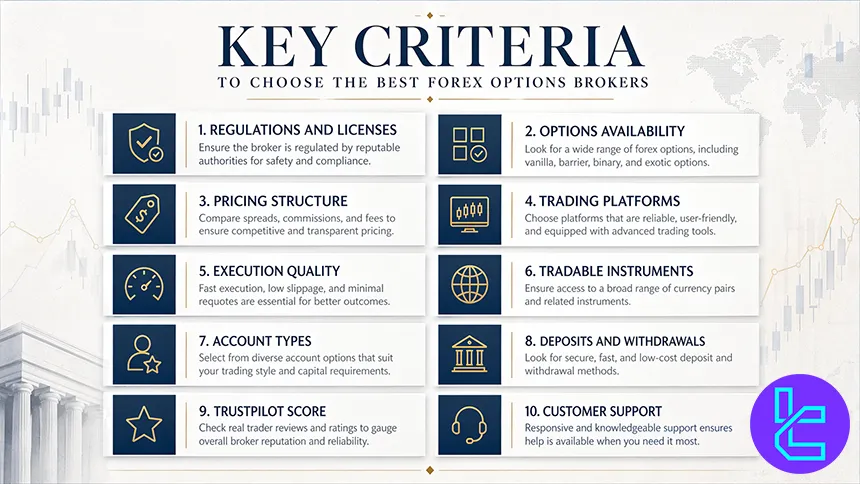
Traders are not only relying on spreads and execution, but also on the accuracy of option pricing, platform tools, and the broker’s ability to handle complex trading strategy. TradingFinder applies a structured methodology to ensure brokers are assessed based on factors that directly impact options trading performance and reliability.
Forex options trading demands precision in both pricing and execution, especially during high-impact events such as central bank announcements. Therefore, brokers must be evaluated based on their infrastructure, transparency, and ability to provide consistent trading conditions. Core evaluation criteria:
- Regulations and Licenses: Oversight by authorities such as FCA, ASIC, or CySEC to ensure fund security and transparency;
- Options Availability: Access to Forex options on major pairs like EURUSD and GBP/USD;
- Pricing Structure: Transparent spreads, commissions, and accurate option premium calculation;
- Trading Platforms: Advanced tools such as AvaOptions, TWS, or proprietary options platforms;
- Execution Quality: Stable and fast execution during volatile market conditions;
- Tradable Instruments: Availability of multi-asset options including indices and commodities;
- Account Types: Flexibility in account structures for different trading styles;
- Deposits and Withdrawals: Reliable funding methods with minimal fees and delays;
- Trustpilot Score: Real user feedback on execution, pricing, and withdrawals;
- Customer Support: Responsive assistance for technical and trading-related issues.
Focusing on these criteria allows traders to identify Forex options brokers that offer accurate pricing, strong execution infrastructure, and a transparent trading environment, all of which are essential for implementing advanced options strategies effectively.
What Are Forex Options and How Do They Work?
Forex options are derivative contracts that give traders the right, but not the obligation, to buy or sell a currency pair at a predetermined price before a specific expiration date. Unlike spot Forex trading, where positions are executed instantly, options allow traders to structure trades based on time, volatility, and price expectations.
These instruments are widely used for hedging currency exposure, trading macroeconomic events, or building advanced strategies such as straddles and strangles. The key advantage lies in defined risk, as the maximum loss is limited to the premium paid for the option. Core mechanics of forex options:
- Strike Price: The level at which the currency can be bought or sold
- Expiration Date: The time limit of the contract
- Premium: The cost paid to enter the trade
- Directional Bias: Call (buy) or Put (sell)
This structure enables traders to benefit from both directional movements and volatility shifts without directly holding the underlying asset.
How Do Brokers Offer Forex Options Trading?
Forex options are typically offered by brokers through specialized platforms or integrated trading environments. Unlike standard CFD trading, options require advanced pricing engines and access to liquidity providers capable of delivering real-time volatility data.
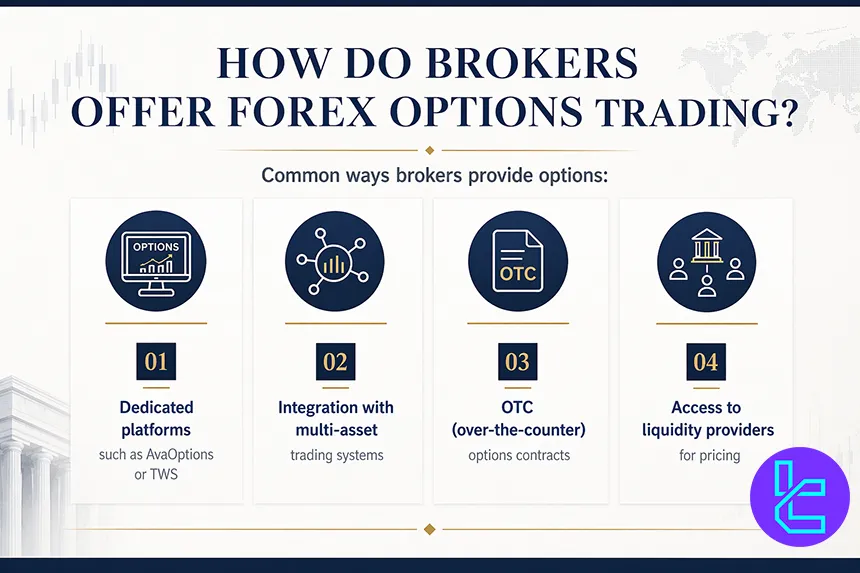
Brokers may provide options as standalone products or alongside Forex and CFD accounts, depending on their infrastructure and regulatory permissions.
Common ways brokers provide options:
- Dedicated platforms such as AvaOptions or TWS
- Integration with multi-asset trading systems
- OTC (over-the-counter) options contracts
- Access to liquidity providers for pricing
These methods determine how accurately options are priced and executed. To better understand platform differences, comparing delivery models provides clarity. Options delivery models:
Model | Description |
OTC Options | Broker-created contracts with internal pricing |
Exchange-Traded | Standardized contracts via regulated exchanges |
Hybrid | Combination of OTC and liquidity provider pricing |
What Types of Forex Options Are Available?
Forex options come in different forms, each designed for specific trading strategies and market conditions. Understanding these types is essential for selecting the right approach.
The most common classification is based on how and when the option can be exercised. Main types of forex options:
- European Options: Exercised only at expiration
- American Options: Exercised at any time before expiration
- Vanilla Options: Standard call and put contracts
- Exotic Options: Customized structures like barrier or digital options
These variations allow traders to tailor strategies based on market expectations. After understanding the structure, comparing their characteristics highlights their practical differences. Comparison of option types:
Type | Flexibility | Complexity |
European | Low | Simple |
American | High | Moderate |
Exotic | Very High | Advanced |
How Are Forex Options Priced?
Forex options pricing is influenced by multiple variables, making it more complex than standard trading instruments. The premium of an option reflects both intrinsic value and time value.
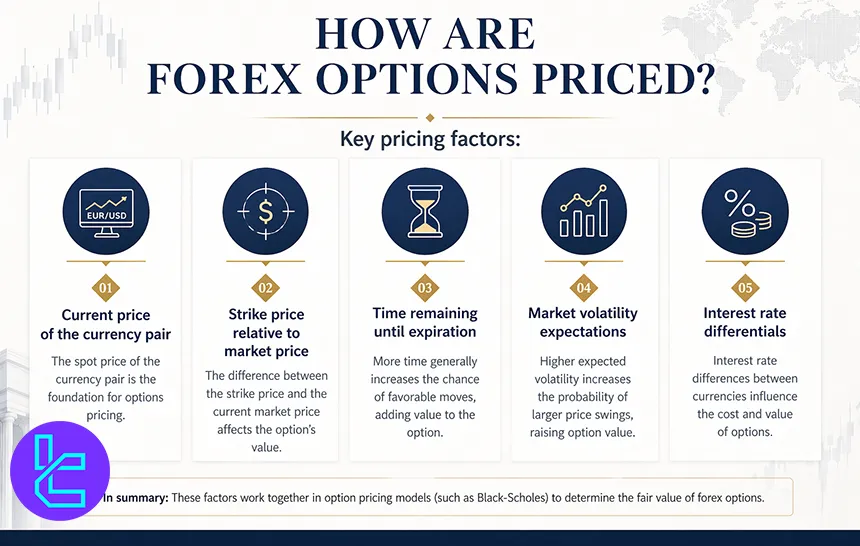
Pricing models such as Black-Scholes are commonly used to estimate fair value based on market inputs. Key pricing factors:
- Current price of the currency pair
- Strike price relative to market price
- Time remaining until expiration
- Market volatility expectations
- Interest rate differentials
Each factor contributes to the final premium traders pay. Understanding how these inputs interact helps clarify pricing behavior.
What Is the Role of Implied Volatility in Forex Options?
Implied volatility represents the market’s expectation of future price fluctuations and is one of the most important variables in options trading. It directly impacts the premium of an option.
Higher implied volatility increases option prices because it raises the probability of significant price movement before expiration. Key effects of implied volatility:
- Higher volatility increases premiums
- Lower volatility reduces option costs
- Volatility spikes during major news events
- Implied volatility reflects market sentiment
Traders often use volatility as a primary input when selecting strategies. To simplify its impact, the relationship can be summarized as follows.
Key Greeks in Forex Options Trading
Options Greeks are mathematical measures that describe how different factors affect the price of an option. These metrics are essential for managing risk and optimizing strategies.
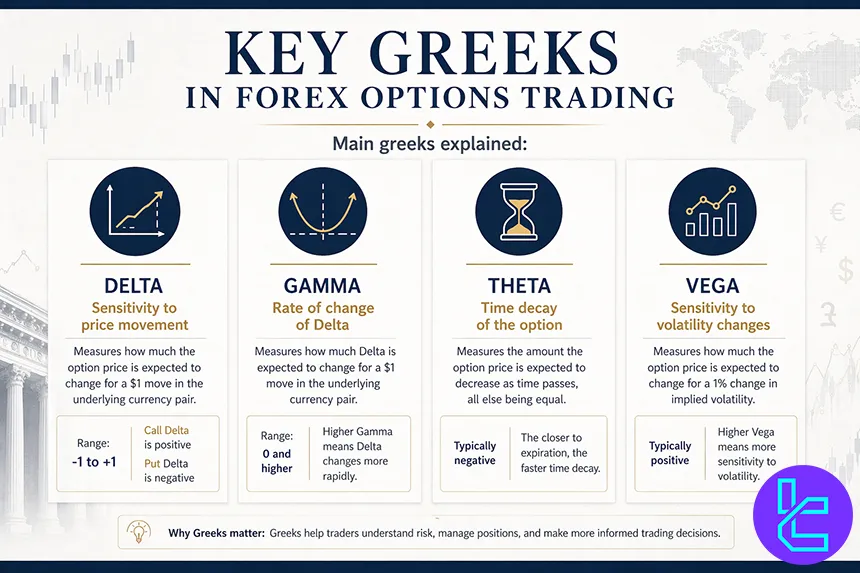
Professional traders rely heavily on Greeks to adjust positions based on market changes. Main greeks explained:
- Delta: Sensitivity to price movement
- Gamma: Rate of change of Delta
- Theta: Time decay of the option
- Vega: Sensitivity to volatility changes
Each Greek provides insight into a specific dimension of risk. Understanding their combined effect improves trade precision. Greeks overview:
Greek | Function |
Delta | Price sensitivity |
Gamma | Delta acceleration |
Theta | Time decay |
Vega | Volatility impact |
How Do Forex Options Brokers Make Money
Forex options brokers generate revenue through multiple channels, combining trading costs with pricing structures embedded in option premiums.
Unlike traditional Forex brokers, a portion of their revenue is built into the option pricing model itself. Main revenue sources:
- Bid-ask spread on option contracts
- Commission per contract or trade
- Markup within option premiums
- Swap or holding costs (in some cases)
These elements together form the broker’s income model. Understanding these sources helps traders evaluate cost transparency.
What Fees Are Involved in Forex Options Trading?
Forex options trading involves several cost components that extend beyond simple spreads. Traders must consider all fees to accurately calculate profitability.
The total cost depends on the broker’s pricing model and the structure of the option contract. Common fees in options trading:
- Option premium (primary cost)
- Spread between bid and ask
- Commission per trade
- Currency conversion fees
- Inactivity or withdrawal fees
These costs can vary significantly between brokers. To better evaluate cost structure, grouping them provides clarity.
What Risk Management Advantages Do Forex Options Offer?
Forex options provide unique risk management benefits compared to spot trading, making them attractive for both hedging and strategic positioning.
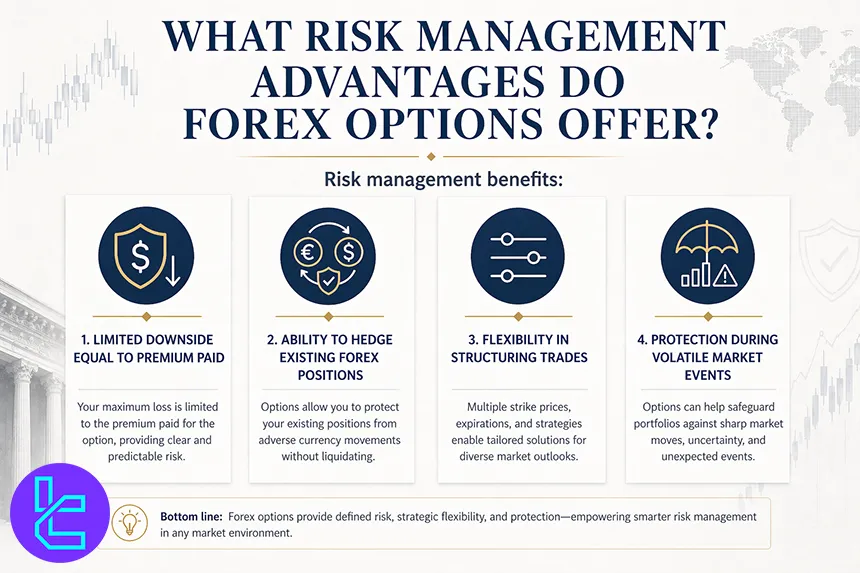
The key advantage is the ability to define maximum risk while maintaining exposure to potential gains. Risk management benefits:
- Limited downside equal to premium paid
- Ability to hedge existing Forex positions
- Flexibility in structuring trades
- Protection during volatile market events
These features allow traders to control exposure more effectively. To better understand their advantages, comparing them with spot trading is useful. Forex options create a structured environment where traders can manage uncertainty, making them a powerful tool in advanced trading strategies.
Comparing Forex Options with Spot Forex, CFDs, and Futures Trading
Forex options introduce a contract-based approach to currency trading where the trader gains the right, but not the obligation, to buy or sell a currency pair at a predefined price. This differs from spot Forex and CFDs, where positions are directly exposed to market price movements, and from futures, which are standardized exchange-traded contracts with fixed expiries.
Each instrument offers a distinct balance between flexibility, risk control, cost structure, and execution environment. The table below compares Forex options with spot Forex, CFDs, and futures trading across key trading parameters.
Parameter | Forex Options | Spot Forex | CFDs (Forex & Multi-Asset) | Futures (Currency Futures) |
Core Structure | Derivative contract (right, not obligation) | Direct currency exchange (OTC) | Derivative tracking underlying price | Standardized exchange-traded contract |
Obligation | No obligation to exercise | Full exposure to price movement | Full exposure to price movement | Obligation to settle or offset before expiry |
Risk Profile | Limited to premium paid | Unlimited (depends on stop-loss) | Unlimited (depends on stop-loss) | Potentially unlimited (margin-based) |
Cost Structure | Premium + possible spreads | Spread + swap | Spread + commission + swap | Commission + exchange fees + margin |
Trading Venue | OTC or exchange (limited broker offering) | Decentralized OTC market | Broker-based OTC model | Centralized exchanges (CME, etc.) |
Expiry Date | Yes (fixed expiration) | No expiry | No expiry | Yes (fixed contract expiry) |
Leverage | Implicit (premium-based exposure) | High (up to 1:30 retail Tier-1) | High (varies by asset and broker) | Margin-based leverage |
Flexibility | High (strategies like hedging, spreads) | Medium | High | Medium |
Pricing Drivers | Spot price, volatility, time decay (theta) | Supply/demand, macro data | Underlying asset price | Spot price, interest rates, contract demand |
Best Use Case | Hedging, volatility trading, structured strategies | Short-term and intraday trading | Multi-asset speculation | Institutional trading and hedging |
Conclusion
Forex options trading introduces a structured and strategy-driven approach to currency markets, allowing traders to manage risk more precisely while maintaining exposure to price movements and volatility.
As outlined in this guide, successful options trading depends not only on understanding core concepts such as pricing, implied volatility, and Greeks, but also on selecting brokers that provide accurate pricing models, stable execution, and advanced trading platforms. Brokers like AvaTrade, Deriv, and Darwinex demonstrate how infrastructure, regulation, and instrument availability can directly influence trading performance.
At the same time, Forex options stand out from other trading instruments due to their flexibility and defined risk structure. Traders can design strategies tailored to different market conditions, whether focusing on hedging, volatility, or directional moves.
For a clearer understanding of how we evaluate and select brokers, please refer to TradingFinder’s Forex methodology page.