





The Financial Services Unit of Dominica operates under the Ministry of Finance and supervises selected non-bank financial entities within the Commonwealth of Dominica. Unlike tier 1 regulators such as FCA, ASIC, or CySEC, FSU primarily oversees corporate registrations and limited financial services activities.
Most brokers referencing FSU Dominica are incorporated as International Business Companies rather than licensed retail forex dealers. Traders should verify the exact legal entity, license scope, and client fund handling structure, as Dominica does not provide investor compensation schemes or strict capital adequacy frameworks.
Here’s a list of the best forex brokers for traders in Dominica:
 | FUSION MARKETS | |||
 | vantage | |||
 | IC Markets | |||
| 4 |  | TICKMILL | ||
| 5 |  | GLOBAL PRIME | ||
| 6 |  | tiomarkets | ||
| 7 |  | GO MARKETS | ||
| 8 |  | MONETA MARKETS |
Brokers for Dominican Traders Ranked by Trustpilot
Trustpilot ratings offer valuable insight into broker credibility and client satisfaction for Dominican traders. Several leading brokers maintain excellent scores close to five stars, supported by a very large base of verified user reviews, reflecting consistent service quality and global reputation.
Other well-established brokers hold solid mid to high four star ratings with moderate to strong review volumes. A smaller group shows more mixed feedback, indicating varying client experiences in areas such as execution quality, withdrawals, and customer support responsiveness.
Broker | Trustpilot Rating | Number of Reviews |
IC Markets | 51,528 | |
6,267 | ||
Global Prime | 414 | |
Vantage | 11,898 | |
GO Markets | 701 | |
691 | ||
Moneta Markets | 473 | |
Tickmill | 1,090 |
FSU Dominica Brokers’ Minimum Spreads
Several brokers accessible to Dominican traders advertise minimum spreads starting from 0.0 pips on major currency pairs. A 0.0 spread typically reflects raw market pricing with no broker markups, where costs are applied through commission instead. Other providers list slightly wider spreads, indicating built-in pricing adjustments.
While tight spreads are attractive, traders should also assess execution quality, access to deep liquidity providers, and overall commission structure. Brokers connected to multiple tier one liquidity providers often deliver more stable pricing and reduced slippage, particularly during high volatility sessions.
Broker | Min. Spread |
Fusion Markets | 0.0 Pips |
FP Markets | 0.0 pips |
0.0 Pips | |
Tickmill | 0.0 Pips |
IUX | 0.0 Pips |
0.0 Pips | |
TIOmarkets | 0.4 Pips |
XTB | 0.5 Pips |
Non-Trading Fees in Dominica Brokers
Most brokers serving Dominican traders apply zero deposit and withdrawal fees, reducing friction when funding or accessing trading capital. The majority also avoid account maintenance charges, making them cost-efficient for active forex and CFD participants operating across multiple asset classes.
However, inactivity fees may apply if accounts remain dormant. Some brokers charge a quarterly or monthly inactivity fee after a defined period without trading activity. Reviewing these policies is essential, especially for occasional traders or long-term investors holding positions infrequently.
Broker | Deposit Fee | Withdrawal Fee | Inactivity Fee |
$0 | $0 | $0 | |
IC Markets | $0 | $0 | $0 |
IUX | $0 | $0 | $0 |
GO Markets | $0 | $0 | $0 |
Moneta Markets | $0 | $0 | $0 |
$0 | $0 | $10/quarter | |
XTB | $0 | $0 | €10/month |
XM | $0 | $0 | $10/month |
FSU Brokers’ Number of Trading Instruments
Brokers accessible to Dominican traders offer a broad range of tradable instruments across the forex market, stock CFDs, indices, commodities, and cryptocurrencies. Product coverage varies significantly, with some global platforms providing tens of thousands of instruments across multiple international exchanges and derivative markets.
Other brokers focus on a more streamlined offering, ranging from a few hundred to several thousand CFD contracts and currency pairs. The depth of available instruments can impact diversification strategies, portfolio allocation flexibility, and access to niche sectors such as thematic equities or regional indices.
Broker | Tradable Instruments |
XTB | 36,400+ |
IG | 17,000+ |
FP Markets | 10,000+ |
2,250+ | |
Vantage | 1,000+ |
1,000+ | |
TIOmarkets | 300+ |
Fusion Markets | 250+ |
Top 6 FSU Dominica Forex Brokers
The top FSU Dominica forex brokers operate under multi-jurisdictional regulation, such as FCA, CySEC, and ASIC, while also maintaining offshore entities for international clients. They offer spreads from 0.0 pips, leverage up to 1:1000 depending on the branch, and support MT4, MT5, and multi-asset CFD trading across global markets.
TIOmarkets
TIOmarkets is a Forex and CFD broker established in 2018, serving more than 160,000 clients globally. The company offers leveraged trading across over 300 instruments in five major markets, positioning itself as a technology-driven provider focused on fast execution, competitive pricing, and streamlined account access.
The broker operates through multiple entities, including FCA-regulated TIO Markets UK Ltd and CySEC-regulated TIO Markets CY Ltd. Its UK entity provides client fund segregation and eligibility for the Financial Services Compensation Scheme, covering up to £85,000 per client under applicable conditions.
TIOmarkets also maintains an offshore entity regulated by MISA, serving international clients outside the EU and UK. Retail leverage under FCA and CySEC is capped at 1:30, while higher leverage is available to professional or offshore eligible clients, depending on regulatory jurisdiction.
Account types include Spread, Standard, VIP, VIP Black, and Nano, with minimum deposits starting from $20, all available after completing the TIOmarkets registration process. Spreads begin from 0.4 pips on select accounts, while commissions can start from $2 to $5 depending on the pricing model and account structure selected.
The broker supports MetaTrader 4 and MetaTrader 5, offering automated trading via Expert Advisors, multi asset CFDs, and advanced charting tools. Additional features include copy trading, PAMM accounts, Islamic accounts, and integrated risk management tools such as margin call and stop out levels.
Account Types | Spread, Standard, VIP, VIP Black, Nano |
Regulating Authorities | MISA, FCA, CySEC |
Minimum Deposit | $20 |
Deposit Methods | Visa/MasterCard, Bank wired, Neteller, Skrill, Fasapay, PayTrust, DivPay, Pay Retailers |
Withdrawal Methods | Visa/MasterCard, Bank wired, Neteller, Skrill, Fasapay, PayTrust, DivPay, Pay Retailers |
Maximum Leverage | Unlimited |
Trading Platforms & Apps | MT4, MT5 |
TIOmarkets Pros and Cons
Overall, TIOmarkets presents a structured multi entity brokerage model combining tier 1 regulation, competitive spreads, and flexible account types. However, regulatory protections vary depending on the chosen entity, and the CFD-only product structure may not suit investors seeking direct asset ownership. The following pros and cons summarize its core strengths and limitations.
Pros | Cons |
Regulated by FCA and CySEC (Tier 1 oversight) | No proprietary trading platform |
Low minimum deposit requirement | Unlimited leverage means more exposure for beginners |
Competitive spreads from 0.4 pips | CFD focused, no direct spot asset ownership |
Multiple account types, including Islamic and PAMM | An offshore entity offers lower regulatory protection |
GO Markets
GO Markets is a multi-regulated Forex and CFD broker founded in 2006 and headquartered in Melbourne, Australia. The company focuses on transparent pricing, fast execution, and reliable access to global markets through a streamlined account setup designed for both retail and professional traders.

The broker operates through several entities regulated by ASIC in Australia and CySEC in Cyprus, both considered tier 1 authorities. Additional branches are overseen by the FSC in Mauritius and the FSA in Seychelles, allowing the broker to serve regional and international clients under different compliance rules.
Under CySEC regulation, eligible clients may access the Investor Compensation Fund with protection up to EUR 20,000. Across its regulated entities, GO Markets applies segregated client fund policies and negative balance protection, supporting client fund safety and standardized risk controls.
GO Markets offers two main account types, Standard and GO Plus+, alongside a PAMM account option for managed allocations. The GO Plus+ account uses a commission model with raw pricing and spreads that can start from 0.0 pips, while the Standard account applies spread only pricing for simpler cost planning.
Supported platforms include MetaTrader 4, MetaTrader 5, cTrader, and a web based trading interface. Traders can access CFDs on Forex, shares, indices, commodities, cryptocurrencies, metals, ETFs, and treasury products, with leverage limits depending on the chosen entity and client classification.
The GO Markets rebate program offers cashbacks of up to 15% per lot on forex pairs if you register with the broker through the TradingFinder IB.
Account Types | Standard, GO Plus+ |
Regulating Authorities | CySEC, FSC, ASIC, FSA |
Minimum Deposit | €100 |
Deposit Methods | Credit/Debit Cards, Bank Transfers, E-wallets |
Withdrawal Methods | Credit/Debit Cards, Bank Transfers, E-wallets |
Maximum Leverage | 1:500 |
Trading Platforms & Apps | MT4, MT5, cTrader |
GO Markets Pros and Cons
Before going through with the GO Markets registration, traders should evaluate the broker’s competitive advantages alongside its structural limitations. Below is a balanced overview of GO Markets’ main pros and cons.
Pros | Cons |
Regulated by ASIC and CySEC (Tier 1 oversight) | Higher minimum deposit compared to some competitors |
Raw pricing available with spreads starting from 0.0 pips | No trading bonuses due to regulatory limits |
Multiple platforms including MT4, MT5, and cTrader | Offshore leverage options increase risk exposure |
Segregated funds and negative balance protection | CFD focused offering without direct asset ownership |
IC Markets
IC Markets is an international multi-asset Forex and CFD broker founded in 2007, offering access to a wide range of global markets. The broker supports 10 base currencies, including USD, EUR, GBP, AUD, and JPY, with a minimum deposit requirement of $200 for live trading accounts.
The company operates through multiple regulated entities, including ASIC in Australia and CySEC in Cyprus, both classified as tier 1 regulators. An additional entity is supervised by the FSA in Seychelles, allowing the broker to provide flexible leverage structures for international clients outside strict European and Australian limits.
Under CySEC regulation, eligible clients are covered by the Investor Compensation Fund up to EUR 20,000. Across its entities, IC Markets applies segregated client fund policies, external audits, and anti-money laundering procedures to strengthen transparency and operational reliability.
IC Markets offers three main account types: Standard, Raw Spread for MetaTrader, and Raw Spread for cTrader. The Standard account features spreads from 0.8 pips with no commission, while Raw accounts provide spreads from 0.0 pips with commission-based pricing suited for scalpers and algorithmic traders.
Traders gain access to over 2,100 stock CFDs alongside forex, indices, commodities, bonds, and cryptocurrencies. Platforms include MetaTrader 4, MetaTrader 5, cTrader, web interfaces, and mobile apps, with leverage up to 1:30 under tier 1 regulators and up to 1:500 under offshore structures. The IC Markets rebate program provides cashbacks of up to $3 per lot on Forex pairs.
Account Types | Standard, Raw Spread, Islamic |
Regulating Authorities | FSA, CySEC, ASIC |
Minimum Deposit | $200 |
Deposit Methods | Bank Cards, Wire Transfers, Electronic payments, etc. |
Withdrawal Methods | Bank Cards, Wire Transfers, Electronic payments, etc. |
Maximum Leverage | 1:500 |
Trading Platforms & Apps | Metatrader 4, Metatrader 5, cTrader, cTrader Web, IC Markets Mobile |
IC Markets Pros and Cons
IC Markets is widely recognized for its institutional-style pricing, deep liquidity access, and strong infrastructure for algorithmic trading. Despite its competitive spreads and broad instrument range, investor protection and leverage conditions depend on the regulatory entity selected. The table below outlines the broker’s key benefits and structural trade-offs.
Pros | Cons |
Regulated by ASIC and CySEC with segregated funds | $200 minimum deposit may be high for beginners |
Raw Spread accounts with spreads from 0.0 pips | Lower leverage limits under EU and Australian regulation |
Wide range of platforms including MT4, MT5, and cTrader | Offshore entity offers reduced investor protection |
Access to 2,100+ stock CFDs and multi asset markets | No PAMM account structure |
Vantage
Vantage Markets is a multi-asset Forex and CFD broker founded in 2009 and headquartered in Sydney, Australia, with a network of more than 30 global offices. The broker provides access to forex, indices, commodities, shares, ETFs, and crypto CFDs, positioning itself as a broad market provider for retail and professional clients.
The company operates through several entities regulated by ASIC and the FCA, which are commonly viewed as tier 1 authorities. It also maintains oversight through the FSCA in South Africa and offshore regulators such as VFSC and CIMA, allowing different leverage and onboarding conditions based on client location and entity selection.
Client protection varies by jurisdiction. FCA regulated accounts can be eligible for FSCS coverage up to GBP 85,000, while EU style compensation referenced in broker materials can apply under specific structures. Across most entities, Vantage states it uses segregated client funds and negative balance protection, though conditions differ by branch.
By completing the Vantage registration process, traders get access to multiple account types, including Standard STP, Standard Cent, Raw ECN, Pro ECN, and Swap Free.
Pricing ranges from spread only models for simpler cost planning to commission based ECN accounts designed for tighter spreads and faster execution, especially for high frequency traders and strategy automation.
Platform availability is a core strength, with MetaTrader 4, MetaTrader 5, ProTrader, TradingView integration, and a proprietary application. For passive and social trading, the broker supports ZuluTrade, DupliTrade, and Myfxbook AutoTrade, giving traders additional options beyond manual execution.
Account Types | Standard STP, Standard Cent, Raw ECN, Pro ECN, Swap Free |
Regulating Authorities | ASIC, FSCA, VFSC, FCA, CIMA |
Minimum Deposit | $20 |
Deposit Methods | E-Wallets, bank transfer, credit/debit cards, Perfect Money, local payment options |
Withdrawal Methods | E-Wallets, bank transfer, credit/debit cards, Perfect Money, local payment options |
Maximum Leverage | 1:1000 |
Trading Platforms & Apps | Metatrader 4, Metatrader 5, ProTrader, TradingView, proprietary application |
Vantage Pros and Cons
Overall, Vantage Markets offers a strong platform variety, multiple account structures, and flexible access across entities, but protection levels and leverage rules depend on the selected jurisdiction. The following pros and cons summarize its main strengths and potential limitations for different trader profiles.
Pros | Cons |
Multiple tier 1 regulators, including ASIC and FCA | Protections and features vary by entity and jurisdiction |
Five platform options, including TradingView integration | Some countries restricted, including the US and Canada |
Copy and social trading via ZuluTrade, DupliTrade, Myfxbook | Pro ECN account requires a high minimum deposit |
Segregated funds and negative balance protection in most entities | Offshore leverage can increase risk exposure |
Moneta Markets
Moneta Markets is a Johannesburg-based Forex and CFD broker launched in 2020, offering access to more than 1,000 tradable markets through a multi-platform setup. Traders can use Pro Trader, MT4, MT5, and App Trader, while choosing from Direct, Prime, or Ultra accounts, depending on pricing preference and trading intensity.

The broker is regulated by the Financial Sector Conduct Authority in South Africa under license 47490 and also lists registration in Saint Lucia as an International Business Company. Moneta Markets previously operated under the Vantage group structure before becoming an independent brand, which shaped its infrastructure, market access, and product delivery model.
Moneta Markets dashboard supports leverage up to 1:1000 and requires a minimum deposit of $50 for its entry level accounts. Pricing varies by account, with Direct designed for commission free trading and Prime or Ultra structured around raw spreads with commission. Execution is offered through STP and ECN routing, depending on account type.
After completing the Moneta Markets registration, traders get access to a wide range of products, including forex, shares, indices, commodities, bonds, and cryptocurrency CFDs. The wide instrument coverage provides broad diversification options for multi-asset strategies.
The broker also supports copy trading and PAMM accounts for traders seeking hands off exposure, alongside swap free Islamic accounts available upon request.
Moneta Markets deposit and withdrawal methods include bank transfer, cards, and select e wallet services, and the broker generally promotes a low friction fee model for deposits, withdrawals, and inactivity. Traders should still review payment method conditions, regional availability, and any third party charges that can apply during cross border transfers or specific withdrawal routes.
Account Types | Direct, Prime, Ultra |
Regulating Authorities | FSCA, FSRA |
Minimum Deposit | $50 |
Deposit Methods | Wire transfer, Visa/MasterCard, Fasapay, Stickpay, JCB |
Withdrawal Methods | Wire transfer, Visa/MasterCard, Fasapay, Stickpay, JCB |
Maximum Leverage | 1:1000 |
Trading Platforms & Apps | MT4, MT5, Pro Trader, App Trader |
Moneta Markets Pros and Cons
Moneta Markets combines broad instrument coverage, flexible platform access, and several account structures, but the level of regulatory protection is not equal to tier 1 regimes and the brand remains relatively new. The following pros and cons summarize its main strengths and practical trade offs.
Pros | Cons |
Access to 1,000+ CFD instruments across multiple markets | Not regulated by a tier 1 authority like FCA or ASIC |
Multiple platforms including Pro Trader, MT4, MT5, App Trader | Brand history is shorter compared to long established brokers |
Raw spread pricing available on Prime and Ultra accounts | Availability is limited in several countries including the US |
Copy trading, PAMM, and swap free Islamic accounts supported | Higher entry requirement for Ultra account compared to others |
Tickmill
Tickmill is a global Forex and CFD broker with more than 785,000 registered users and a presence across over 180 countries. Founded in 2014, the broker runs a no-dealing desk model that routes orders directly to liquidity providers, supporting fast execution and deeper pricing transparency for active strategies.
The group follows a multi-jurisdiction regulatory structure, with entities overseen by FCA in the United Kingdom, CySEC in Cyprus, and FSCA in South Africa, alongside additional supervision through FSA Seychelles and LFSA. Under the FCA entity, eligible clients can access FSCS coverage up to GBP 85,000, while CySEC clients may be covered by the ICF up to EUR 20,000.
Tickmill offers spreads from 0.0 pips on Raw pricing with commission-based costs, while Classic accounts use spread-only pricing for simpler fee planning.
After completing the Tickmill registration, traders can select various account base currencies, including USD, EUR, GBP, ZAR, PLN, and CHF, giving traders flexibility for funding and reporting based on their local payment rails and currency exposure.
Tradable markets include forex, indices, commodities, stocks, bonds, and crypto CFDs, supported by MetaTrader 4, MetaTrader 5, web trading, and mobile apps. Leverage limits depend on the selected entity, with stricter caps under FCA and CySEC and higher leverage available via offshore or non-tier 1 branches.
The Tickmill rebate program provides access to cashbacks of up to $7.75 per lot for Forex and metals trading for clients who register through the TradingFinder IB.
Account Types | Classic, Raw |
Regulating Authorities | FSA, FCA, CySEC, LFSA, FSCA |
Minimum Deposit | $100 |
Deposit Methods | Crypto, Payment Systems, Credit/Debit Cards, Bank Transfers |
Withdrawal Methods | Crypto, Payment Systems, Credit/Debit Cards, Bank Transfers |
Maximum Leverage | 1:1000 |
Trading Platforms & Apps | MetaTrader 4, MetaTrader 5, MetaTrader Web, Mobile App |
Tickmill Pros and Cons
Tickmill positions itself as a cost-focused broker with a transparent no-dealing desk model, multi-jurisdiction oversight, and competitive raw spread accounts. However, leverage limits, investor protection coverage, and certain features vary by regulatory entity. The table below outlines its core strengths and structural limitations for different trader profiles.
Pros | Cons |
Regulated by multiple authorities, including FCA and CySEC | Fewer account types compared to some competitors |
NDD execution with direct liquidity provider routing | Lower variety of forex pairs than some large brokers |
Raw spreads from 0.0 pips available | Some features vary by entity and client location |
Supports MT4, MT5, web, and mobile trading | An inactivity fee can apply under specific dormancy conditions |
What is the Financial Services Unit of Dominica?
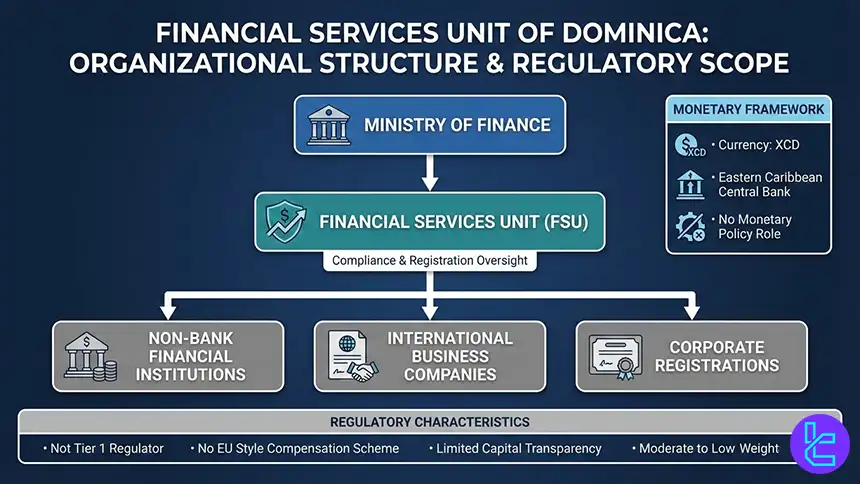
The Financial Services Unit operates under the Ministry of Finance of the Commonwealth of Dominica. It supervises selected non-bank financial institutions and oversees company registrations within the jurisdiction.
Dominica uses the Eastern Caribbean Dollar XCD and falls under the monetary authority of the Eastern Caribbean Central Bank. The FSU is not a central bank and does not manage monetary policy or currency issuance.
Unlike regulators such as FCA in the UK or ASIC in Australia, FSU Dominica primarily oversees compliance and corporate registration structures rather than imposing strict retail forex capital adequacy or investor compensation frameworks.
- Operates under Dominica’s Ministry of Finance;
- Supervises selected non-bank financial institutions;
- Oversees International Business Company registrations;
- Works within the Eastern Caribbean financial framework;
- Does not control monetary policy or currency issuance;
- Does not function as a tier 1 global forex regulator;
- Limited capital requirement transparency for retail brokers;
- No formal EU style investor compensation program;
- Focused primarily on compliance and registration oversight;
- Regulatory weight considered moderate to low globally.
Is Forex Trading Legal in Dominica?
Forex trading is legal in Dominica and accessible to residents without specific prohibitions. The activity falls under the oversight of the Financial Services Unit for local compliance matters.
Many Dominican traders use international online brokers regulated by FCA, ASIC, CySEC, or FSC. Cross-border brokerage services are common due to limited domestic forex intermediaries.
Legality does not automatically imply investor protection. Traders must verify regulatory standing, operational history, and fund safety policies before opening accounts with offshore or internationally regulated brokers.
- Forex trading permitted for residents and citizens
- Overseen generally by the Financial Services Unit
- Eastern Caribbean Dollar XCD is the local currency
- Cross border brokerage services widely used
- No blanket restrictions on retail forex participation
Important Factors in Selecting the Best FSU Brokers
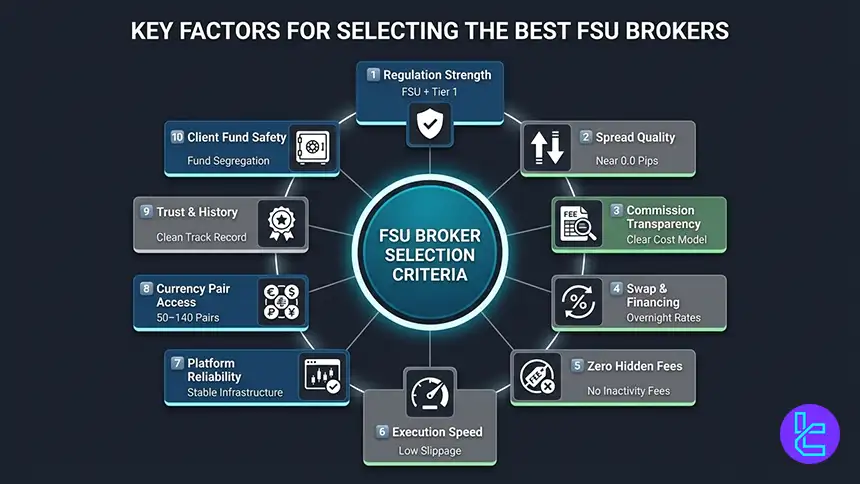
Choosing the best Dominica forex brokers requires focusing on regulation quality, trading costs, and platform reliability. Since the Financial Services Unit is not a tier 1 authority like FCA or ASIC, traders often prioritize brokers additionally regulated by globally recognized entities.
Spreads remain a major cost factor. Among top international brokers, EURUSD spreads can average 0.29 pips, compared to 0.6 across the wider market. Zero withdrawal fees and no account maintenance charges are common among competitive brokers accepting Dominican traders.
Financing costs also matter. Overnight rates on EURUSD range from -2.4% to -3.5% for long positions, depending on the broker. Swing traders and long-term position holders must evaluate swap rates carefully alongside execution speed and leverage flexibility.
Key selection criteria include:
- Verification of legal entity and regulatory scope under FSU Dominica
- Presence of additional top tier licenses such as FCA, ASIC, or BaFin
- Competitive spreads, ideally near 0.0 pips on major pairs
- Transparent commission and financing structure
- Zero withdrawal and deposit fees
- No inactivity or hidden maintenance charges
- Access to 50 to 140 currency pairs
- Strong trust score and clean operational history
- Fast execution with minimal slippage
- Secure client fund segregation policies
Does FSU Dominica Regulate Forex Brokers?
FSU Dominica does not operate as a specialized retail forex supervisory authority comparable to CySEC, FCA, or ASIC. Many brokers incorporated in Dominica function as International Business Companies rather than licensed investment firms with strict prudential oversight.
Incorporation in Dominica differs from full scale regulatory supervision. Brokers may legally register locally while serving international clients, yet remain primarily regulated elsewhere or operate under lighter compliance standards within the jurisdiction.
For this reason, Dominican traders often select brokers that combine FSU registration with top tier regulatory oversight. Multi jurisdiction licensing enhances transparency, enforces periodic audits, and strengthens client fund segregation practices.
- Company incorporation is not equal to full forex licensing;
- Many brokers operate as International Business Companies;
- Limited publicly disclosed capital adequacy frameworks;
- No standardized retail investor compensation fund;
- Compliance obligations are lighter than FCA or ASIC rules;
- Traders must verify the scope of the broker’s license;
- Check whether retail forex is explicitly authorized;
- Confirm segregated client fund policies;
- Evaluate additional international regulatory coverage;
- Review enforcement history and compliance transparency.
What Safety Protocols Should Dominican Traders Look for in Forex Brokers?
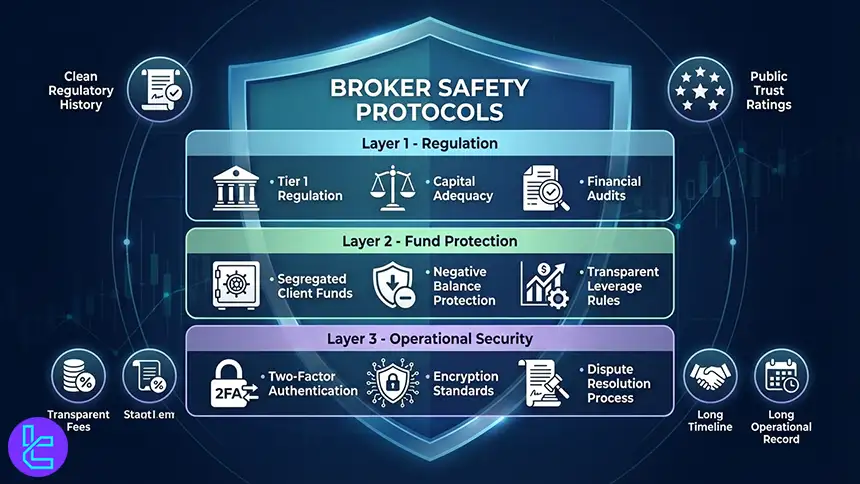
Strong safety protocols begin with regulation by reputable authorities such as the FCA, ASIC, or BaFin. Brokers under these regulators must maintain capital adequacy, conduct regular audits, and adhere to strict client fund segregation standards.
Client money segregation ensures operational expenses like payroll or hedging are not mixed with trader deposits. Daily reconciliation between internal ledgers and custodian bank accounts improves transparency and financial discipline.
Dominican traders should also examine negative balance protection, cybersecurity standards, two-factor authentication, and the broker’s historical record, including whether it has avoided major regulatory sanctions or scandals.
- Regulation by recognized tier 1 authorities
- Segregated client funds held in reputable banks
- Negative balance protection policies
- Transparent leverage and margin disclosure
- Two-factor authentication and encryption protocols
- Regular financial audits and reporting standards
- Clear dispute resolution procedures
- Publicly available trust scores and ratings
- Long operational history without major scandals
- Transparent fee and commission disclosure
Does Dominica FSU Offer an Investor Protection Scheme?
Dominica does not provide a formal investor compensation scheme comparable to European Union frameworks. Regulators such as the UK Financial Conduct Authority (FCA) operate structured compensation mechanisms that may reimburse clients within predefined limits under insolvency scenarios.
The absence of a statutory compensation fund increases the importance of selecting brokers with multiple global licenses and strong financial backing. Traders should carefully review the broker’s capital position and regulatory footprint.
Dominican investors may rely on segregated accounts, voluntary insurance policies, and negative balance protection features offered by internationally regulated brokers to mitigate counterparty and insolvency risks.
Crypto Trading in Dominica; Is It Legit?
Crypto trading is accessible to Dominican residents primarily through international exchanges and CFD brokers. There is no explicit prohibition against cryptocurrency trading within the existing regulatory environment.
Most crypto CFDs are offered by brokers regulated by FCA, ASIC, or CySEC, even when clients reside in Dominica. Traders must verify whether assets are offered as derivatives or as direct spot cryptocurrencies.
Cryptocurrency markets exhibit higher volatility compared to major FX pairs. Proper leverage management, platform security, and liquidity depth are essential when trading Bitcoin, Ethereum, or other digital assets.
- Crypto trading accessible via international platforms
- No explicit prohibition under the current framework
- Offered as CFDs or spot digital assets
- Higher volatility than major FX pairs
- Importance of leverage control
Most Popular Trading Platforms among Dominican Traders
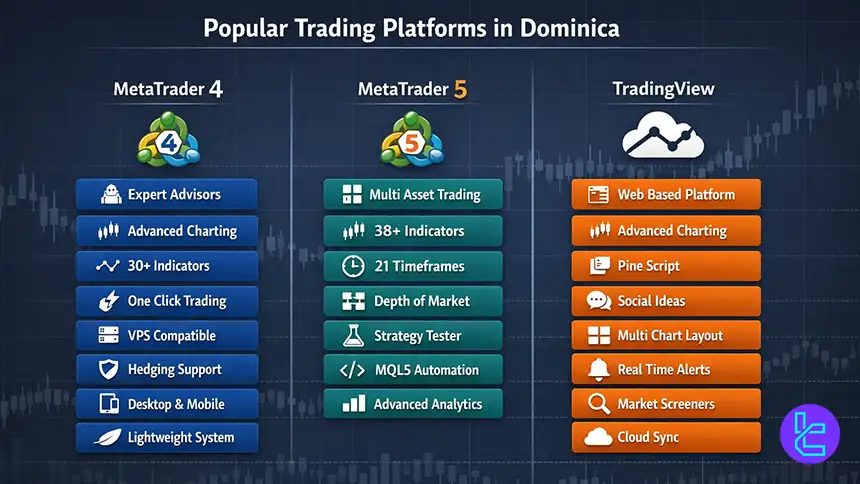
MetaTrader 4 and MetaTrader 5 remain dominant platforms among Dominican forex traders. These platforms support advanced charting, automated trading through Expert Advisors, and multi-asset execution.
Some brokers provide proprietary web based platforms or TradingView integration. Platform selection influences execution speed, order types, and analytical depth, particularly for scalpers and algorithmic traders.
Demo accounts are widely available and allow traders to simulate real market conditions using virtual funds. Advanced users often prioritize VPS hosting compatibility and customizable leverage settings.
MetaTrader 4 (MT4)
MetaTrader 4 continues to be one of the most widely used trading platforms among Dominican retail traders, especially in the forex market. Its long standing presence, stable infrastructure, and broker compatibility make it a preferred choice for both beginners and experienced traders. MT4 is particularly popular for scalping strategy and algo trading.
MT4 supports automated trading through Expert Advisors, allowing users to deploy custom built or third party trading robots. The platform also offers strong customization capabilities, enabling traders to tailor indicators, scripts, and chart templates to fit specific trading strategies. Key MT4 features include:
- Support for Expert Advisors and automated trading
- Advanced charting with multiple timeframes
- 30+ built in technical indicators
- Custom indicator and script integration
- One click trading functionality
- VPS compatibility for uninterrupted algorithmic trading
- Hedging and scalping allowed (broker dependent)
- Desktop, web, and mobile versions
- Lightweight system requirements
- Strong global community support
MetaTrader 5 (MT5)
MetaTrader 5 represents the next generation of the MetaTrader ecosystem and is increasingly adopted by Dominican traders seeking expanded market access and enhanced analytical tools. While MT4 remains popular for forex, MT5 supports a broader range of asset classes including stocks, futures market, and exchange traded instruments in addition to CFDs. Key MT5 features:
- Multi asset trading including forex and CFDs
- 38+ built in technical indicators
- 21 timeframes for advanced charting
- Depth of Market (DOM) functionality
- Multi threaded strategy tester
- Support for algorithmic trading via MQL5
TradingView
TradingView has grown rapidly in popularity among Dominican traders who prioritize charting quality, social trading insights, and cloud based accessibility. Unlike traditional downloadable platforms, TradingView operates primarily through a web interface, making it highly accessible across devices without installation.
The platform is particularly valued for its advanced charting engine, customizable layouts, and Pine Script programming language for building indicators and strategies. Many brokers now integrate TradingView directly into their execution systems, allowing users to trade from charts while maintaining access to institutional grade visual tools.
- Browser based cloud platform
- Advanced charting with extensive drawing tools
- Pine Script for custom indicators and strategies
- Social trading idea sharing
- Multi chart layout support
- Cross device synchronization
- Built in market screeners
- Real time alerts and notifications
Forex Taxation in Dominica
Publicly available information on forex specific taxation in Dominica remains limited. Traders should consult licensed tax professionals to clarify reporting obligations, residency criteria, and income classification rules under local legislation.
In many jurisdictions, forex income may fall under general income tax categories. Accurate record keeping of trading profits, losses, commissions, and overnight financing costs is essential for compliance.
Cross-border brokerage activity can complicate taxation. Reporting requirements may depend on residency status, source of income, and international financial account disclosures.
Dominica FSU Compared to Other Regulatory Authorities
Compared to the FCA, ASIC, or BaFin, the Financial Services Unit of Dominica applies lighter prudential standards. It does not impose equivalent structured capital adequacy ratios or comprehensive investor compensation mechanisms for retail forex traders.
Tier 1 regulators require periodic audits, strict financial reporting, negative balance protection, and formal dispute resolution frameworks. These measures enhance transparency, reduce systemic risk, and strengthen investor confidence.
Dominican traders often select brokers regulated by multiple authorities. Multi-jurisdiction oversight improves trust scores, strengthens enforcement accountability, and provides more robust client fund protection.
Parameter | FSU (Dominica) | AMF (France) | CySEC (Cyprus) | FSC (Bulgaria) |
Minimum Capital Requirement | Not required | €730,000 | €750,000+ depending on firm type | €750,000 |
Client Fund Segregation | Not required | Required | Required | Required |
Compensation Scheme | No | No | Investor Compensation Fund (~€20,000) | Investor Compensation Fund (~€20,000) |
Leverage Limits | No | 1:30 | Set under MiFID (often 1:30 for retail in EU) | 1:30 |
Negative Balance Protection | Not required | Required | Often required | Required |
Reporting & Audits | Ongoing financial reporting | Ongoing financial reporting | Ongoing financial reporting | Ongoing financial reporting |
Conclusion and Final Words
The Financial Services Unit of Dominica operates under the Ministry of Finance and mainly supervises selected non-bank financial entities, with many broker references linked to International Business Company registration rather than full retail forex licensing. For that reason, Dominican traders typically prioritize brokers that also hold tier 1 regulation, such as FCA, ASIC, or CySEC.
Cost and product depth still separate the strongest options. Many providers advertise raw pricing with 0.0 spreads that reflect market spreads with no markups, while fee policies often include zero deposit and withdrawal charges. Traders should still compare liquidity providers, execution quality, inactivity rules, and instrument coverage before funding an account.
For a comprehensive understanding of how brokers are assessed, refer to TradingFinder Forex Methodology, which evaluates regulation and legal entity scope, client fund protection, pricing transparency, platform reliability, and operational track record using standardized review criteria.