





Futures are contracts determining the price direction of a specific asset or group of assets that traders can buy/sell. Many asset classes are available in futures contracts, including crypto, commodities, and more. One of the benefits of these instruments are that they enable traders to trade in sell direction, which is impossible in spot market.
The shortlist in this article includes some of the best choices among Forex brokers with futures trading availability.
 | AVATRADE | |||
 | eToro | |||
 | FxPro | |||
| 4 |  | MONETA MARKETS | ||
| 5 |  | D Prime | ||
| 6 |  | darwinex | ||
| 7 |  | TICKMILL |
Trustpilot Ratings in Futures Forex Brokers
Trustpilot is a reliable and reputable platform for reviewing a brand’s performance based on user experiences. The table here ranks mentioned brokers according to their ratings.
Broker Name | Trustpilot Rating | Number of Reviews |
11,946 | ||
Moneta Markets | 474 | |
30,686 | ||
Darwinex | 230 | |
Tickmill | 1,065 | |
FxPro | 781 | |
D Prime | 439 |
Minimum Spread in Futures Trading
This section of the article demonstrates the minimum spread, a highly impactful parameter, in abovementioned brands.
Broker Name | Min. Spread |
Swissquote | 0 Pips |
0 Pips | |
Darwinex | 0 Pips |
0 Pips | |
D Prime | 0 Pips |
Interactive Brokers | 0 Pips |
Capital.com | 0.67 Pips |
Non-Trading Fees Charged by Futures Brokers
Some brokers charge traders with fees beyond only trading; deposits, withdrawals, and inactive accounts incur commissions in them.
Broker Name | Deposit Fee | Withdrawal Fee | Inactivity Fee |
Moneta Markets | $0 | $0 | $0 |
$0 | $0 | $0 | |
FxPro | $0 | $0 | $5 Monthly |
Capital.com | $0 | $0 | $10 Monthly |
Interactive Brokers | $0 | One Free Withdrawal Per Month | $0 |
Darwinex | $0 for Credit/Debit Cards | 1% for Credit/Debit Cards | $0 |
Swissquote | $0 for Bank Transfers | $0 for Bank Transfers | €15 Monthly for Clients Outside the EU and UK |
Trading Platforms and Terminals in Select Brokers
Last section of this part of the article outlines the available platforms for the brokers introduced above.
Broker Name | Trading Platforms |
Moneta Markets | MT4, MT5, Pro Trader, App Trader |
Metatrader 4, Metatrader 5, Metatrader Web, Mobile App | |
FxPro | MT4, MT5, cTrader, Web Trader, Mobile App |
Capital.com | MT4,Web Trader, Mobile App, TradingView |
Interactive Brokers | Proprietary |
MT4, MT5, WebTrader, TradingView, NinjaTrader, TWS, MultiCharts, DARWIN API, FIX, ZORRO IB Bridge, IB Gateway | |
IG | MT4, TradingView, L2 Dealer, ProRealTime, Proprietary Platform |
Top 6 Forex Brokers for Futures Trading
In the following sections, mentioned brokers will be reviewed in detail. Pros, cons, account types, available leverage, and other parameters will be discussed.
AvaTrade
Founded in 2006, AvaTrade is a globally regulated multi-asset broker operating under nine regulatory licenses, including the Central Bank of Ireland (CBI), Australian Securities and Investments Commission (ASIC), Cyprus Securities and Exchange Commission (CySEC), and Financial Sector Conduct Authority (FSCA).
The broker also complies with MiFID II standards in Europe and maintains segregated client accounts across jurisdictions.
For futures-oriented traders using CFDs on indices, commodities, and financial instruments, AvaTrade offers leverage up to 1:400 (depending on regulatory entity), with margin call and stop-out levels set at 25% and 10%, respectively. These predefined risk thresholds support structured capital management under volatile market conditions.
The broker requires a minimum deposit of $100 and supports multiple base currencies, including USD, EUR, GBP, CHF, JPY, and AUD. Funding methods cover credit/debit cards, bank transfers, Skrill, Neteller, WebMoney, and PayPal, with no broker-imposed deposit or withdrawal commissions, although inactivity fees apply after prolonged dormancy.
If you are willing to learn more about the broker’s payment methods, go to the AvaTrade deposit and withdrawal page.
AvaTrade provides access to MetaTrader 4, MetaTrader 5, WebTrader, mobile applications, and AvaOptions. Tradable markets exceed 1,250 instruments across Forex, indices, commodities, stocks, ETFs, cryptocurrencies, and bonds.
Futures-style exposure is primarily offered through CFDs, enabling smaller contract sizing compared to exchange-traded futures.
Table of Specifics
Account Types | Retail, Professional, Islamic, Demo |
Regulating Authorities | ASIC, CySEC, CBI, FSA, FSCA, MiFID, ADGM, PFSA, ISA |
Minimum Deposit | $100 |
Deposit Methods | Credit/Debit Cards, E-Wallets, Bank Wire Transfer, PayPal |
Withdrawal Methods | Credit/Debit Cards, E-Wallets, Bank Wire Transfer, PayPal |
Maximum Leverage | 1:400 |
Trading Platforms & Apps | MetaTrader 4, MetaTrader 5, Mobile App, WebTrader |
AvaTrade Pros and Cons
AvaTrade’s advantages and limitations reflect its regulatory strength, platform diversity, and defined cost structure. Below is a balanced overview of the broker’s core pros and cons for futures-focused CFD traders. Check them out before AvaTrade registration.
Pros | Cons |
Regulated by multiple tier-1 authorities (CBI, ASIC, CySEC) | No direct access to exchange-traded futures markets |
Leverage up to 1:400 (entity-dependent) | Inactivity and annual administration fees apply |
Wide range of 1,250+ tradable CFD instruments | Not available to U.S. residents |
Supports MT4, MT5, AvaOptions, and WebTrader | Fixed spread structure may be less flexible than ECN pricing |
Moneta Markets
Founded in 2020 and headquartered in Johannesburg, Moneta Markets is an FSCA-regulated multi-asset broker (License No. 47490). Registered in Saint Lucia (No. 2023-00068), the company operates as an independent entity following its separation from Vantage International Group, focusing on global Forex and CFD services.
Moneta Markets provides access to 1,000+ tradable instruments across Forex, indices, commodities (including selected futures CFDs), bonds, shares, ETFs, and cryptocurrencies. Traders can choose between Direct (STP), Prime (ECN), and Ultra (ECN) accounts, with a minimum deposit starting from $50 and leverage up to 1:1000.
The broker supports four trading platforms: MT4, MT5, Pro Trader (TradingView-integrated), and App Trader. Pro Trader offers 100+ indicators and 12 chart types, while MT5 enhances multi-asset functionality and backtesting. Minimum order size starts at 0.01 lot, accommodating both micro and high-volume futures-oriented CFD traders.
Execution models include STP and ECN, with spreads from 0.0 pips on Prime and Ultra accounts. Commission structures range from $0 (Direct) to $1-$3 per lot per side (ECN). Additional features include Islamic swap-free accounts, PAMM, copy trading, 24/5 support, and segregated client funds with negative balance protection.
Specifications and Parameters
Account Types | Direct, Prime, Ultra |
Regulating Authorities | FSCA, FSRA |
Minimum Deposit | $50 |
Deposit Methods | Wire transfer, Visa/MasterCard, Fasapay, Stickpay, JCB |
Withdrawal Methods | Wire transfer, Visa/MasterCard, Fasapay, Stickpay, JCB |
Maximum Leverage | 1:1000 |
Trading Platforms & Apps | MT4, MT5, Pro Trader, App Trader |
Moneta Markets Pros and Cons
Moneta Markets combines high leverage flexibility, multi-platform access, and a broad product range suitable for futures-style CFD traders. However, its regulatory profile and regional restrictions require careful evaluation. Before going through Moneta Markets registration, check out this balanced overview of its core advantages and limitations.
Pros | Cons |
1,000+ tradable instruments across multiple asset classes | Tier-2 regulatory framework (FSCA) |
Low minimum deposit ($50) with micro-lot access | Not available to US and several other jurisdictions |
ECN accounts with spreads from 0.0 pips | Ultra account requires $20,000 deposit |
Multiple platforms including TradingView-integrated Pro Trader | Relatively new brand (est. 2020) |
eToro
Founded in 2007 by David Ring, Ronen Assia, and Yoni Assia, eToro Ltd is headquartered in Tel Aviv, Israel. The broker has grown into a global multi-asset platform serving millions of users across equities, ETFs, cryptocurrencies, commodities, and currency CFDs, positioning itself as a technology-driven social trading provider.
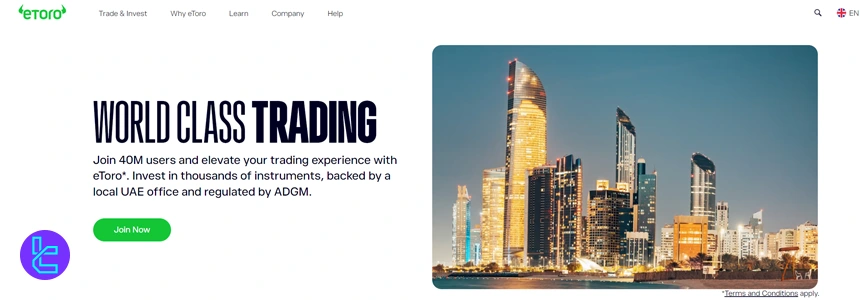
eToro operates through multiple regulated entities, including authorization by the Financial Conduct Authority (FCA), Cyprus Securities and Exchange Commission (CySEC), Australian Securities and Investments Commission (ASIC), and the Abu Dhabi Global Market (FSRA).
Client fund segregation is applied across all major entities, with compensation schemes such as FSCS (up to £85,000) and SIPC (up to $500,000) where applicable.
The broker offers four primary account types: Personal, Professional, Corporate, and Islamic. Retail leverage typically caps at 1:30 under FCA/CySEC rules, while eligible professional clients may access leverage up to 1:400. A minimum deposit from $10 and minimum copy-trade allocation of $1 make entry thresholds relatively accessible.
eToro provides access to 6,000+ stocks, 735 ETFs, 120+ cryptocurrencies, 62 currency pairs, and multiple indices and commodities. Investment services include CopyTrader, Smart Portfolios, and crypto staking for selected assets such as ETH, ADA, SOL, and TRX, all executed via its proprietary web and mobile platform.
If you are interested in this broker, check out our eToro registration guide. The table below outlines the broker’s specifics.
Account Types | Personal, Professional, Corporate, Islamic |
Regulating Authorities | FCA, CySEC, MFSA, FSRA, ASIC, FSA, Gibraltar FSC |
Minimum Deposit | $10 |
Deposit Methods | eToro Money, Credit/Debit Card, Bank Transfer, PayPal, Neteller, Skrill, Online Banking (Trustly), iDEAL, Sofort, Przelewy24 |
Withdrawal Methods | eToro Money, Credit/Debit Card, Bank Transfer, PayPal, Neteller, Skrill, Online Banking (Trustly), iDEAL, Sofort, Przelewy24 |
Maximum Leverage | 1:400 |
Trading Platforms & Apps | Proprietary App |
eToro Pros and Cons
When evaluating eToro for futures-style or leveraged CFD trading within a Forex broker comparison, its strengths lie in regulatory breadth, asset diversity, and social trading innovation, while limitations include the absence of MT4/MT5 and restricted direct futures exchange access. Below is a structured overview of key advantages and disadvantages.
Pros | Cons |
Regulated by FCA, ASIC, CySEC, FSRA, and others | No MT4 or MT5 platform support |
Advanced CopyTrader and social investing ecosystem | No direct phone support channel |
Access to 6,000+ stocks and 735 ETFs | CFD spreads can be relatively high |
Low minimum deposit starting from $10 | $5 withdrawal fee and inactivity charges |
Darwinex
Founded in March 2012, Darwinex operates as both a brokerage and asset management firm, combining trading infrastructure with capital allocation. The company offers access to 1,500+ instruments across Forex, CFDs, Futures, Stocks, Indices, and ETFs, processing nearly $15B in monthly trading volume from clients in 80+ countries.
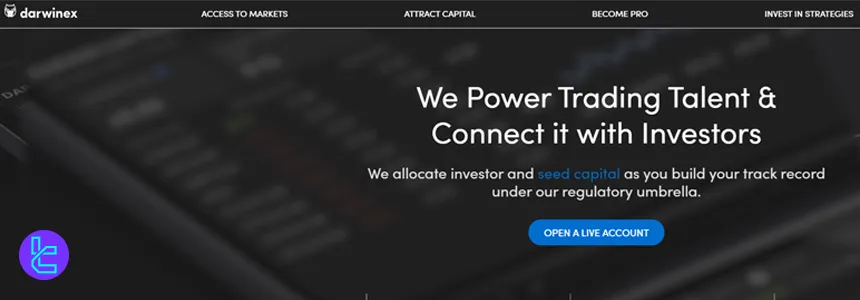
Regulated by the UK FCA, Spain’s CNMV, and the Seychelles FSA, Darwinex provides structured investor protection. Eligible clients benefit from FSCS coverage up to £85,000 in the UK and FOGAIN protection up to €100,000 in Spain, with segregated client funds held in major European banks.
Its core innovation is the DARWIN model; transforming verified trading strategies into investable assets. Through programs like DarwinIA, top-performing traders receive seed capital allocation, while investors gain exposure to risk-standardized, algorithmically scored strategies rather than copying raw trading signals.
Darwinex integrates with Interactive Brokers (IBKR), enabling access to global Futures, Options, and 800+ US Stocks. With leverage up to 1:200 (Professional), spreads from 0.0 pips, MT4/MT5 support, and advanced APIs, the broker targets systematic traders and asset managers.
Specifics and Features
Account Types | Live, Professional, Darwin IBKR, Classic IBKR |
Regulating Authorities | FCA, CNMV, FSA |
Minimum Deposit | $500 |
Deposit Methods | Credit/Debit Cards, Bank Transfer |
Withdrawal Methods | Credit/Debit Cards, Bank Transfer |
Maximum Leverage | 1:200 |
Trading Platforms & Apps | MT4, MT5, WebTrader, TradingView, NinjaTrader, TWS, MultiCharts, DARWIN API, FIX, ZORRO IB Bridge, IB Gateway |
Darwinex Pros & Cons
Darwinex stands out for merging regulated brokerage services with asset management technology. However, higher entry requirements and structural complexity may not suit beginners. Below is a balanced overview of its main advantages and limitations, which are essential to be aware of before Darwinex registration.
Pros | Cons |
Regulated by FCA & CNMV with compensation schemes | Relatively high minimum deposit ($500) |
Unique DARWIN asset model with DarwinIA seed capital | No Islamic (swap-free) accounts |
Integration with Interactive Brokers (IBKR) for global market access | Complex structure for inexperienced traders |
Spreads from 0.0 pips with institutional-style execution | Geographic restrictions (including US clients) |
Tickmill
Founded in 2014, Tickmill operates as a no-dealing-desk (NDD) multi-asset broker serving over 785,000 registered users across 180+ countries. With average monthly trading volumes exceeding $129 billion, the broker has positioned itself among competitive futures and CFD providers globally.
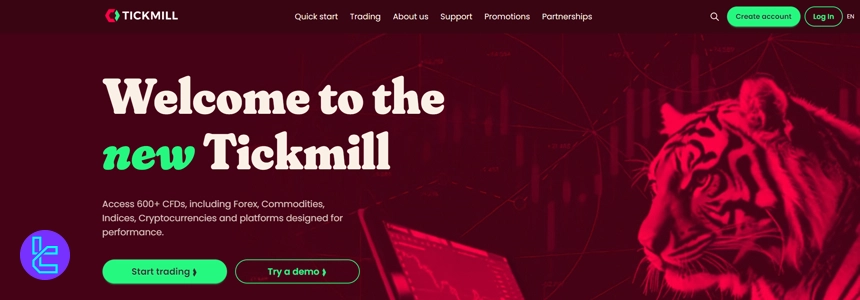
Tickmill offers spreads from 0.0 pips, leverage up to 1:1000 (jurisdiction-dependent), and access to six base currencies: USD, EUR, GBP, ZAR, PLN, and CHF. Its Classic and Raw accounts require a minimum deposit of $100, supporting both retail and professional trading profiles.
Regulation spans multiple entities, including the FCA (UK), CySEC (Cyprus), FSCA (South Africa), LFSA (Labuan), and FSA (Seychelles). Client protection mechanisms include segregated accounts, negative balance protection, FSCS coverage up to £85,000, and insurance via Lloyd’s up to $1,000,000.
Traders access global markets, including Forex, Stock Indices, Commodities, Cryptocurrencies, Stocks, and Bonds, through MetaTrader 4, MetaTrader 5, WebTrader, and mobile apps. Market execution, scalping and hedging permissions, VPS support, andintegrated social trading broaden the broker’s ecosystem.
Specifics and Parameters
Account Types | Classic, Raw |
Regulating Authorities | FSA, FCA, CySEC, LFSA, FSCA |
Minimum Deposit | $100 |
Deposit Methods | Crypto, Payment Systems, Credit/Debit Cards, Bank Transfers |
Withdrawal Methods | Crypto, Payment Systems, Credit/Debit Cards, Bank Transfers |
Maximum Leverage | 1:1000 |
Trading Platforms & Apps | Metatrader 4, Metatrader 5, Metatrader Web, Mobile App |
Tickmill Pros & Cons
Tickmill’s strengths lie in regulatory breadth, low spreads, and high-leverage flexibility under offshore entities, while limitations relate to account variety and slightly narrower product depth compared to industry leaders. Below is a balanced overview of its key advantages and drawbacks; check them out before Tickmill registration.
Pros | Cons |
Regulated by FCA, CySEC, FSCA, LFSA, and FSA | Limited account type diversity (Classic & Raw only) |
Spreads from 0.0 pips with competitive commissions | Fewer Forex pairs compared to top-tier brokers |
Segregated funds, negative balance protection, Lloyd’s insurance | Trustpilot score below 4.0 |
Supports MT4, MT5, VPS, and Social Trading | No PAMM account offering |
FxPro
Founded in 2006, FxPro has grown into a global multi-asset broker serving over 7.8 million client accounts. The company processes trades in under 12 milliseconds, positioning itself as a high-speed execution venue for forex, futures, and CFD traders seeking institutional-grade infrastructure.
FxPro offers access to more than 2,100 instruments across Forex, shares, indices, metals, energies, cryptocurrencies, and futures CFDs.
Traders can operate via MetaTrader 4, MetaTrader 5, cTrader, WebTrader, and a dedicated mobile app, with support for algorithmic trading and EAs. To learn about the broker’s personal cabinet, check out the FxPro dashboard article.
The broker operates under multiple regulatory entities, including the Financial Conduct Authority (FCA), Cyprus Securities and Exchange Commission (CySEC), Financial Sector Conduct Authority (FSCA), and the Securities Commission of The Bahamas (SCB). Investor protection schemes include FSCS coverage up to £85,000 and ICF protection up to €20,000.
Account types include Standard, Raw+, and Elite, with spreads from 0.0 pips on commission-based accounts and a minimum deposit starting at $100. Retail leverage reaches up to 1:30 under Tier-1 regulation, while professional accounts may access significantly higher ratios depending on eligibility.
It’s worth mentioning that a FxPro rebate program is available for discount on fees. Here’s a table of the broker’s specifics.
Account Types | Standard, Raw+, Elite |
Regulating Authorities | FCA, FSCA, CySEC, SCB |
Minimum Deposit | $100 |
Deposit Methods | Visa, Mastercard, Bank Wire Transfer, Broker to Broker Transfer, Skrill, Neteller, PayPal |
Withdrawal Methods | Visa, Mastercard, Bank Wire Transfer, Broker to Broker Transfer, Skrill, Neteller, PayPal |
Maximum Leverage | 1:500 |
Trading Platforms & Apps | MT4, MT5, cTrader, Web Trader, Mobile App |
FxPro Pros & Cons
FxPro’s strengths lie in regulation, execution speed, and platform diversity. However, limitations such as regional restrictions and the absence of ongoing bonus programs may influence broker selection criteria. The key advantages and drawbacks are summarized below.
Pros | Cons |
Regulated by FCA, CySEC, FSCA, and SCB | Not available in the US, Canada, Iran, and some sanctioned countries |
Access to 2,100+ instruments including futures CFDs | No consistent promotional or bonus programs |
Ultra-fast execution (under 12 ms) | No 24/7 customer support (24/5 only) |
Multiple advanced platforms (MT4, MT5, cTrader) with EA support | Elite account requires high minimum deposit ($15,000) |
What Parameters were Considered in Curating the Brokers?
Choosing the best Futures trading Forex brokers requires more than comparing spreads or leverage. At TradingFinder, our review methodology is built on 19 data-driven metrics designed to evaluate regulatory strength, trading conditions, operational transparency, and long-term reliability across global financial markets such as Forex, Futures, ETFs, Stocks, and CFDs.
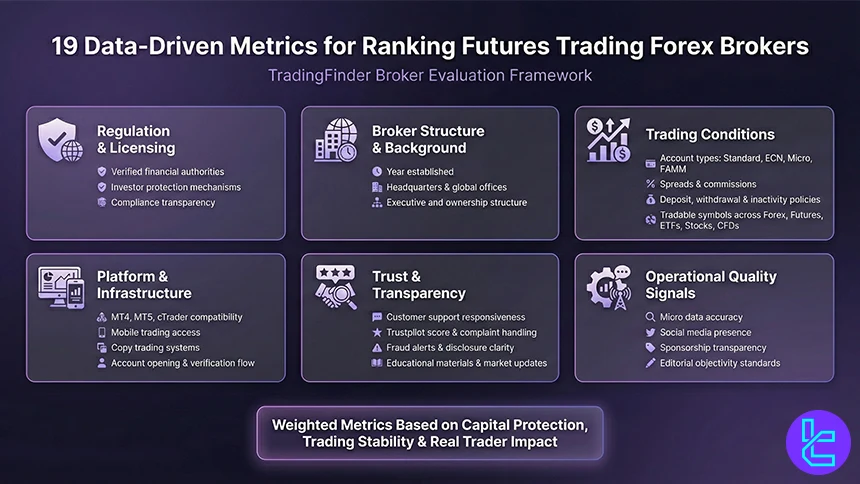
Regulation and licensing stand at the core of our framework. We verify each broker’s authorization under recognized financial authorities and assess investor protection mechanisms.
In parallel, we analyze broker background data, including year of establishment, headquarters, executive structure, and global office presence, ensuring structural credibility and operational transparency.
Trading conditions are assessed through account type diversity (Standard, ECN, Micro, PAMM), variety of tradable symbols, commission structure, spreads, deposit and withdrawal policies, and inactivity fees.
We also test platform compatibility across MetaTrader 4 (MT4), MetaTrader 5 (MT5), cTrader, and mobile apps, while reviewing account opening, verification processes, and copy trading infrastructure.
Beyond trading costs, we evaluate customer support responsiveness, Trustpilot score, fraud alerts, broker responses to complaints, educational materials, market news updates, and infographic clarity. Micro data accuracy, social media activity, sponsorship initiatives, and transparency in disclosures are also examined.
Our analysts, experienced in volatile markets like Forex, Crypto, and Futures trading, apply strict editorial guidelines to ensure objectivity. Each metric is weighted according to its real impact on trader experience, capital protection, and platform stability.
This structured methodology allows TradingFinder to provide transparent, unbiased, and SEO-driven broker rankings grounded in measurable performance criteria.
What is Futures Trading?
Futures trading refers to buying or selling standardized financial contracts that obligate parties to transact an underlying asset at a predetermined price on a specified future date.
These contracts are traded on regulated exchanges such as the Chicago Mercantile Exchange (CME) and the Intercontinental Exchange (ICE), ensuring transparency, liquidity, and centralized clearing.
A futures contract can be based on various asset classes, including commodities (Crude Oil, Gold, Wheat), financial instruments (U.S. Treasury Bonds), equity indices (S&P 500, Nasdaq 100), and currencies (EUR/USD, USD/JPY).
Unlike spot trading, futures contracts are standardized in terms of contract size, expiration date, and tick value, which enhances pricing efficiency and market depth.
One of the defining features of futures markets is the use of margin. Traders are not required to pay the full contract value upfront; instead, they deposit an initial margin, allowing for leveraged exposure. While leverage amplifies potential returns, it also increases risk, making risk management tools such as stop-loss orders essential.
Futures trading serves two primary purposes: hedging and speculation. Corporations and institutional investors often use futures to hedge against price volatility in commodities or currencies, while retail and professional traders seek to profit from short-term price movements.
Due to exchange regulation, centralized clearinghouses, and high liquidity, futures markets are considered among the most structured and transparent segments of global financial markets.
What are the Pros and Cons of Futures Trading in Forex?
Futures trading in Forex combines the structure of exchange-traded derivatives with the price dynamics of the global currency market. Unlike spot Forex, currency futures are standardized contracts traded on regulated exchanges such as the Chicago Mercantile Exchange.
While this structure increases transparency and central clearing, it also introduces contract specifications and expiration constraints that differ from decentralized OTC Forex markets.
Below is a data-driven comparison of the main advantages and disadvantages.
Pros | Cons |
Exchange-regulated environment with centralized clearing reduces counterparty risk | Fixed contract sizes may lack flexibility for smaller retail traders |
Transparent pricing and real-time order book data | Contracts have expiration dates, requiring rollovers |
High liquidity in major currency futures (e.g., EUR, JPY, GBP) | Margin requirements can fluctuate during high volatility |
Standardized contracts improve execution consistency | Lower leverage compared to some offshore Forex brokers |
How is Futures Trading in the US?
Futures trading in the United States operates within one of the most regulated and transparent derivatives frameworks globally. The market is primarily supervised by the Commodity Futures Trading Commission (CFTC) and enforced through self-regulatory organizations such as the National Futures Association (NFA).
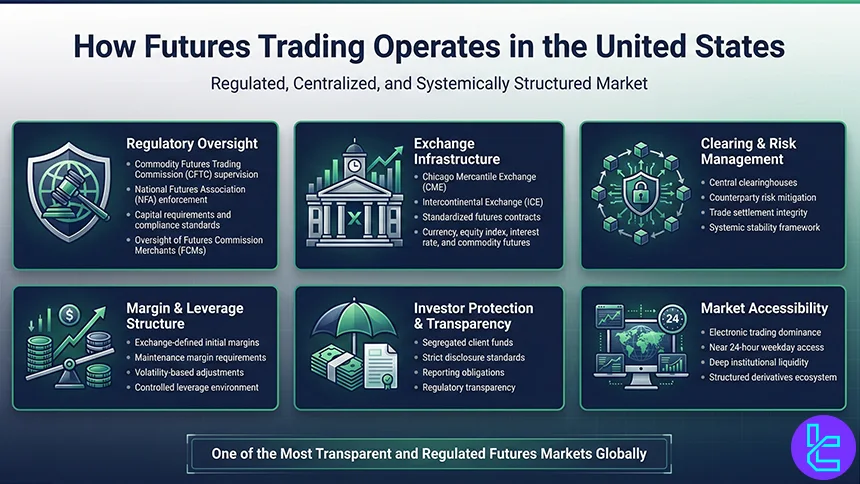
These entities establish capital requirements, reporting standards, and strict compliance rules for Futures Commission Merchants (FCMs) and brokers.
Most U.S. futures contracts are traded on centralized exchanges like the Chicago Mercantile Exchange (CME) and the Intercontinental Exchange (ICE). These exchanges provide standardized contracts across asset classes including currency futures, equity index futures, interest rate futures, and commodity futures.
Central clearinghouses mitigate counterparty risk, ensuring trade settlement integrity.
Margin requirements in the U.S. are set by exchanges and brokers, with initial and maintenance margins varying based on contract volatility. Unlike retail spot Forex in offshore jurisdictions, leverage is more controlled, prioritizing systemic stability. Additionally, U.S.-based brokers must segregate client funds, enhancing investor protection.
Electronic trading dominates the U.S. futures market, with nearly 24-hour access during the trading week. The combination of regulatory oversight, centralized clearing, deep liquidity, and strict disclosure standards makes the United States one of the most structured environments for futures trading globally.
Most Traded Instruments and Assets in the Futures Market
The global futures market covers multiple asset classes, with liquidity concentrated in contracts traded on major exchanges such as the Chicago Mercantile Exchange and the Intercontinental Exchange.
The most actively traded futures contracts typically fall into five primary categories: equity indices, commodities, currencies, interest rates, and energy products.
Equity Index Futures
Index futures are among the highest-volume derivatives globally. Contracts such as the E-mini S&P 500 and Nasdaq-100 futures allow traders to gain exposure to broad stock market performance without directly owning shares. These contracts are widely used by hedge funds, asset managers, and short-term traders for hedging and speculation.
Commodity Futures
Precious metals and agricultural products play a central role in the futures market. Gold and silver futures attract institutional hedging demand, while contracts on wheat, corn, and soybeans are critical for producers and exporters managing price risk.
Energy Futures
Crude oil futures, particularly WTI and Brent benchmarks, rank among the most liquid futures contracts worldwide. Natural gas futures also see significant trading volume due to supply-demand volatility and seasonal factors.
Currency Futures
Currency futures such as EUR/USD, JPY/USD, and GBP/USD provide standardized alternatives to OTC Forex trading, offering centralized clearing and regulated price discovery.
Interest Rate Futures
U.S. Treasury futures and Eurodollar contracts are heavily traded instruments used by financial institutions to manage exposure to interest rate fluctuations.
Are Futures Instruments Prices Affected the Same Way as Other Assets?
Futures prices are influenced by many of the same macroeconomic and fundamental factors that affect their underlying assets, but they also include additional components unique to derivative markets.
Since futures are standardized contracts traded on exchanges like the Chicago Mercantile Exchange and the Intercontinental Exchange, their pricing reflects both spot market dynamics and contract-specific variables.
First, supply and demand fundamentals remain central. For example, crude oil futures respond to OPEC production decisions, geopolitical tensions, and inventory reports, just as spot oil prices do. Equity index futures react to corporate earnings, macroeconomic data, and monetary policy decisions from institutions such as the Federal Reserve.
However, futures prices also incorporate the cost of carry, which includes interest rates, storage costs (for commodities), and expected dividends (for equity index futures). This relationship is often described by the futures pricing model:
Futures Price = Spot Price + Carrying Costs − Expected Income
Additionally, futures markets may experience contango (futures price above spot) or backwardation (futures price below spot), depending on supply expectations and storage economics. These structures do not typically apply to direct asset ownership in the same way.
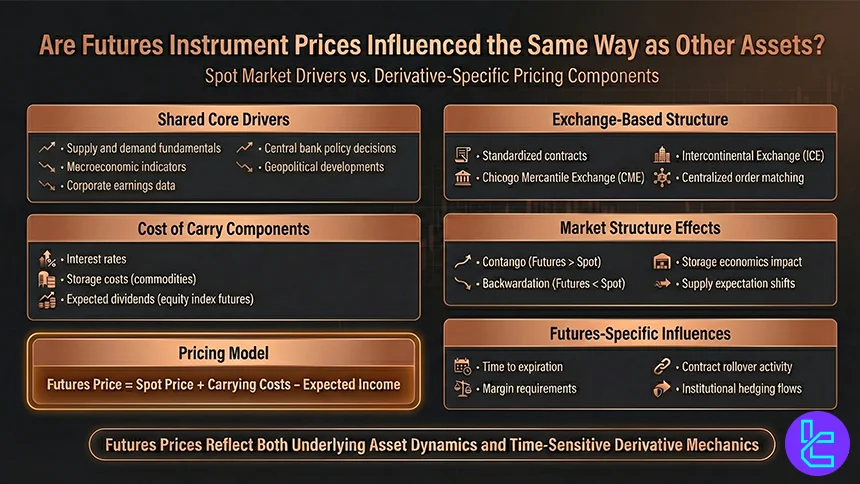
While the core drivers overlap with spot assets, futures instruments are uniquely shaped by time to expiration, margin requirements, rollover activity, and hedging flows from institutional participants. As a result, their price behavior can diverge temporarily from the underlying asset, especially during periods of high volatility or contract expiration cycles.
What Leverage is Available for Futures Trading in Forex Brokers?
Leverage in futures trading is determined primarily by exchange margin requirements rather than fixed broker ratios. Unlike retail spot Forex, where brokers may advertise leverage such as 1:100 or 1:500, futures leverage is implied through initial margin and maintenance margin levels set by exchanges like the CME.
In practice, this means traders only deposit a fraction of the total contract value. For example, if an equity index futures contract has a notional value of $200,000 and the required initial margin is $10,000, the effective leverage is approximately 1:20. However, this ratio fluctuates depending on volatility, asset class, and regulatory adjustments.
In the United States, brokers regulated by the Commodity Futures Trading Commission and the National Futures Association must follow strict margin rules. During periods of high market volatility, exchanges may raise margin requirements, effectively reducing available leverage to control systemic risk.
Outside the U.S., some Forex brokers offer futures-based CFDs, which may provide higher leverage compared to exchange-traded futures. However, these products operate under different regulatory frameworks and carry counterparty risk.
Generally, effective leverage in regulated futures markets ranges between 1:10 and 1:30 for major contracts, though it can vary significantly based on asset volatility. Because leverage amplifies both profits and losses, prudent risk management, such as position sizing and stop-loss strategies, is essential when trading futures through Forex brokers.
What Strategies and Approaches are Best for Trading Futures in Forex Brokers?
Trading futures through Forex brokers requires structured risk management and strategy alignment with contract specifications, margin requirements, and volatility conditions.
Since many futures contracts are traded on regulated exchanges such as the Chicago Mercantile Exchange, traders often combine technical analysis, macroeconomic evaluation, and volume-based tools to optimize performance.
Below are the most widely used and data-backed approaches:
Trend-Following Strategies:
- Identify directional momentum using Moving Averages, RSI, and MACD;
- Trade breakouts in equity index futures (e.g., S&P 500 futures);
- Use trailing stop-loss orders to manage leveraged exposure.
Trend-following is effective in highly liquid futures markets where institutional flows create sustained moves.
Breakout and Volatility Trading:
- Monitor economic releases (CPI, NFP, central bank decisions);
- Trade price expansion during high-impact news events;
- Use volatility indicators such as ATR.
Futures markets often experience sharp movements during macro announcements.
Spread Trading:
- Trade the price difference between related contracts (e.g., Brent vs. WTI crude);
- Calendar spreads: Buy one expiration month and sell another;
- Typically lower directional risk compared to outright positions.
Spread strategies are commonly used by professional traders to hedge exposure.
Hedging Strategies:
- Corporations hedge commodity price risk;
- Portfolio managers hedge equity exposure using index futures;
- Currency futures used to mitigate FX volatility.
Scalping and Intraday Trading:
- Utilize high liquidity and tight spreads;
- Focus on short-term price inefficiencies;
- Requires strict position sizing due to leverage.
Effective futures trading combines disciplined margin management, contract awareness, and structured risk control to navigate volatility within regulated and broker-facilitated environments.
Futures Assets vs. Other Common Instruments
Futures contracts are standardized derivatives traded on regulated exchanges such as CME Group and ICE, offering centralized clearing, transparent pricing, and defined expiration dates.
Compared to gold, oil, and ETFs, futures provide institutional-grade liquidity, margin-based leverage, and direct exposure to commodities, indices, rates, and currencies. However, contract specifications, rollover costs, and higher notional sizes differentiate them from CFD-based or exchange-traded alternatives commonly offered by retail Forex brokers.
Parameter | Futures (Exchange-Traded) | Gold (XAU/USD) | Oil (WTI/Brent) | ETFs (e.g., SPY, GLD, QQQ) |
Market Structure | Centralized exchanges (CME, ICE), standardized contracts, clearinghouse-guaranteed | OTC spot (CFDs), COMEX futures (CME), ETFs like GLD | Futures (CME/ICE), OTC CFDs | Listed on stock exchanges (NYSE, NASDAQ), physically or synthetically backed |
Trading Hours | Nearly 23-24 hours (Globex sessions, asset-dependent) | Nearly 24/5 (global sessions) | ~23 hours (futures-dependent) | Exchange hours (e.g., 9:30-16:00 ET, some pre/after-hours) |
Typical Volatility | Medium-High (macro & contract-specific) | Medium-High (USD, real yields sensitive) | High (inventory, OPEC, geopolitics) | Low-Medium (diversified exposure) |
Main Price Drivers | Supply/demand, macro data, interest rates, currency flows | USD (DXY), inflation, real yields, central bank demand | OPEC policy, inventories, global growth, geopolitics | Underlying index/sector performance, earnings, macro trends |
Leverage (Retail) | Margin-based (~5-15% initial margin typical) | Up to 1:20 (FCA/ASIC retail) | Often 1:10-1:20 (commodity CFDs) | Usually unleveraged (margin accounts ~1:2 typical) |
Expiration | Yes (fixed contract expiry, rollover required) | No (spot CFDs), futures expire | Yes (monthly futures contracts) | No expiration |
Settlement Type | Cash or physical (contract-dependent) | Cash-settled (CFDs) or physical (futures) | Mostly physical (futures) or cash (CFDs) | Cash equity settlement |
Safe-Haven Status | Asset-dependent (e.g., Treasury futures defensive) | Yes (historical store of value) | No (cyclical demand-driven) | No (risk-on, diversified exposure) |
Dividend / Yield | None (except rate/treasury price mechanics) | No yield | No dividend (cost embedded in curve) | Dividends distributed (if applicable) |
Short-Selling Access | Intrinsic two-sided market | Yes (via CFDs/futures) | Yes (via futures/CFDs) | Yes (via margin or inverse ETFs) |
Gap Risk Exposure | Moderate (session breaks & rollovers) | Moderate (weekend gaps) | High (inventory & geopolitical shocks) | Moderate (earnings & macro news) |
Conclusion
Forex brokers offer exchange-traded Futures assets to traders which enable them to trade at both directions of the market. It’s important to pick the best broker for trading futures so the results are optimal.
According to our examinations involving trading conditions and important parameters, AvaTrade, Moneta Markets, eToro, and Darwinex are some of the best choices for futures trading.
To learn about the details of our framework, check out the Forex methodology article.