









Standard accounts are the typical default account types that are available in almost every Forex broker. However, each of them provides them with unique spreads, leverage restrictions, instruments, etc.
The shortlist in this article mentions some of the best broker choices for those sticking to the standard trading settings and parameters.
 | AVATRADE | |||
 | pepperstone | |||
 | ERRANTE | |||
| 4 |  | XM | ||
| 5 |  | IC Markets | ||
| 6 |  | Exness | ||
| 7 |  | eightcap | ||
| 8 |  | FxPro |
Trustpilot Ratings for Broker Candidates
This part of the article demonstrates a ranking of mentioned brands based on Trustpilot user reviews and submitted scores.
Broker Name | Trustpilot Rating | Number of Reviews |
51,336 | ||
AvaTrade | 11,872 | |
Exness | 27,539 | |
Pepperstone | 3,205 | |
Eightcap | 3,467 | |
60 | ||
FxPro | 818 | |
XM | 3,025 |
Minimum Spreads in Standard Account Forex Brokers
Spreads range from 0 pips to 1 pip or higher amounts in various brokers. Here’s a list of minimum spread numbers in abovementioned brokerages.
Broker Name | Min. Spread |
0 Pips | |
Exness | 0 Pips |
FOREX.com | 0 Pips |
0 Pips | |
Eightcap | 0 Pips |
FxPro | 0 Pips |
IG | 0.3 Pips |
tastyfx | 0.8 Pips |
Account Types Other than Standard in Brokerages
The table below summarizes the account types along with their leverage availability for select brokers.
Broker Name | Account Types | Max. Leverage |
Exness | Standard, Standard Cent, pro, Raw Spread, Zero | Unlimited (Subject to account) |
AvaTrade | Retail, Professional, Islamic, Demo | 1:400 |
Standard, Raw, TradingView, Demo | 1:500 | |
FOREX.com | Standard, Raw Spread, MetaTrader | 1:50 |
Standard, Raw+, Elite | 1:500 | |
Pepperstone | Standard, Razor | Up to 1:500 |
Global Prime | Standard, Raw | 1:500 |
IG | CFD | 1:200 |
Tradable Assets in Standard Account Forex Brokers
Last but not least, the table in this section ranks brokers according to their respective number of available trading instruments.
Broker Name | Number of Instruments |
eToro | 17,000+ |
IG | 17,000+ |
FxPro | 2,100+ |
1,400+ | |
Pepperstone | 1,200+ |
Eightcap | 800+ |
200+ | |
tastyfx | 80+ |
Top 6 Standard Account Brokers in Detail
Next sections of this review will introduce six best brokers among mentioned brands in more detail with tables of pros and cons for each.
IC Markets
IC Markets is a multi-asset brokerage established in 2007, offering access to Forex and CFD markets under ASIC, CySEC, and FSA oversight. With a $200 minimum deposit and 10 base currencies, it supports both regional and global clients through distinct regulatory entities.
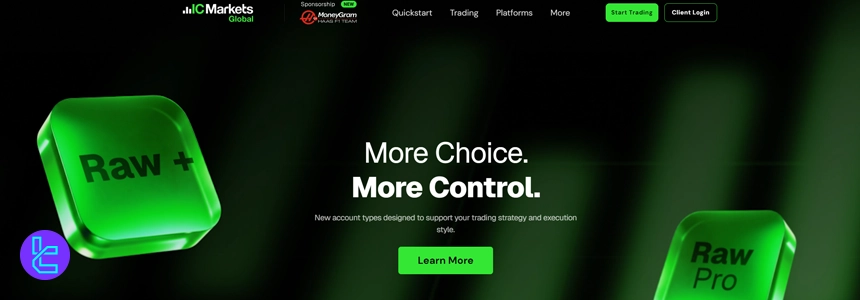
The Standard account is commission-free, with spreads starting from 0.8 pips and market execution. Traders can access over 60 currency pairs and more than 2,100 stock CFDs, alongside indices, commodities, bonds, and cryptocurrencies, positioning IC Markets among brokers with broad instrument depth.
It’s worth noting that an IC Markets rebate program is provided with discounts on trading costs.
Regulatory coverage includes ASIC (Australia), CySEC (EU), and the FSA (Seychelles). EU clients benefit from Investor Compensation Fund protection up to €20,000 and negative balance protection, while segregated client funds and AML procedures apply across entities, supported by periodic external audits.
Platform availability spans MetaTrader 4, MetaTrader 5, cTrader, cTrader Web, and proprietary mobile apps. Leverage reaches 1:500 under offshore regulation, with minimum order size of 0.01 lot. Average EUR/USD spreads can fall near 0.1 pips on Raw accounts, supporting algorithmic and high-frequency strategies. The table below summarizes specifics.
Account Types | Standard, Raw Spread, Islamic |
Regulating Authorities | FSA, CySEC, ASIC |
Minimum Deposit | $200 |
Deposit Methods | Bank Cards, Wire Transfers, Electronic payments, etc. |
Withdrawal Methods | Bank Cards, Wire Transfers, Electronic payments, etc. |
Maximum Leverage | 1:500 |
Trading Platforms & Apps | Metatrader 4, Metatrader 5, cTrader, cTrader Web, IC Markets Mobile |
IC Markets Pros and Cons
IC Markets’ advantages and limitations reflect its institutional pricing model, regulatory segmentation, and infrastructure depth. Below is a structured summary of its main strengths and constraints for Standard account traders.
Pros | Cons |
Regulated by ASIC, CySEC, and FSA | $200 minimum deposit may deter beginners |
Commission-free Standard account with spreads from 0.8 pips | Leverage limited to 1:30 under EU/ASIC regulation |
Access to 2,100+ stock CFDs and 60+ FX pairs | No PAMM account offering |
Multiple platforms (MT4, MT5, cTrader) with fast execution | Certain countries restricted from registration |
AvaTrade
Founded in 2006, AvaTrade operates under nine regulatory licenses, including the Central Bank of Ireland, Australian Securities and Investments Commission, Financial Sector Conduct Authority, and Cyprus Securities and Exchange Commission.

Its multi-jurisdiction structure supports cross-border client onboarding while maintaining segregated funds and negative balance protection under MiFID II compliance.
The Standard Account requires a $100 minimum deposit, with base currencies including USD, EUR, GBP, JPY, CHF, and AUD. Margin call and stop-out levels are set at 25% and 10%, respectively. Retail leverage varies by entity, reaching up to 1:30 in the EU and higher ratios under offshore frameworks.
AvaTrade provides access to 1,250+ tradable instruments, covering forex, indices, commodities, stocks, ETFs, bonds, options, and cryptocurrencies. Trading is available on MetaTrader 4, MetaTrader 5, WebTrader, AvaOptions, and mobile applications. Orders are executed instantly, and spreads are fixed or variable depending on asset class.
AvaTrade Deposit and withdrawal methods include bank wire, credit/debit cards, Skrill, Neteller, WebMoney, and PayPal, generally without broker-side fees. Inactivity fees apply after two months of dormancy. Copy trading is supported via DupliTrade and AvaSocial, expanding the broker’s appeal to both active and passive participants.
Specifics and Details
Account Types | Retail, Professional, Islamic, Demo |
Regulating Authorities | ASIC, CySEC, CBI, FSA, FSCA, MiFID, ADGM, PFSA, ISA |
Minimum Deposit | $100 |
Deposit Methods | Credit/Debit Cards, E-Wallets, Bank Wire Transfer, PayPal |
Withdrawal Methods | Credit/Debit Cards, E-Wallets, Bank Wire Transfer, PayPal |
Maximum Leverage | 1:400 |
Trading Platforms & Apps | MetaTrader 4, MetaTrader 5, Mobile App, WebTrader |
AvaTrade Pros & Cons
The broker combines extensive regulatory coverage, diversified instruments, and commission-free trading within its Standard Account structure. Before going through with AvaTrade registration, consider its primary advantages and operational considerations.
Pros | Cons |
Regulated by multiple Tier-1 and Tier-2 authorities | Inactivity fees after two months |
Wide range of 1,250+ tradable instruments | No PAMM account offering |
MT4, MT5, AvaOptions, and proprietary platforms | Support not available 24/7 |
Commission-free trading with competitive spreads | Regional restrictions (e.g., U.S. clients not accepted) |
Exness
Founded in 2008 by Petr Valov and Igor Lychagov, Exness has evolved into a global retail forex market maker processing over $4 trillion in monthly trading volume. With a team of 2,100+ professionals across nearly 100 countries, the group maintains a multi-entity structure serving diverse jurisdictions.

Exness operates through regulated entities including Exness (UK) Ltd under the Financial Conduct Authority (FCA), Exness (Cy) Ltd under CySEC, and additional licenses from FSCA, CMA, FSC BVI, CBCS, and FSA Seychelles. Investor protection schemes cover up to £85,000 under FSCS and €20,000 under ICF.
For Standard account traders, spreads start from 0.2 pips with zero commission, while Raw Spread and Zero accounts offer pricing from 0.0 pips with commissions between $0.2 and $3.5 per lot. Note that an Exness rebate program is provided for reduced costs.
The broker supports 96 forex pairs and over 200 total instruments. Trading infrastructure includes MetaTrader 4 (MT4), MetaTrader 5 (MT5), Exness Terminal, and Exness Trade mobile app.
Market and instant execution modes are available, with negative balance protection, segregated client funds, and unlimited leverage eligibility under specific equity and trading volume conditions. For Exness deposit and withdrawal options, go to the linked page.
The table below summarizes the broker’s specifics.
Account Types | Standard, Standard Cent, pro, Raw Spread, Zero |
Regulating Authorities | FSA, CySEC, FCA, FSCA, CBCS, FSC, CMA |
Minimum Deposit | $10 |
Deposit Methods | Neteller, Skrill, Perfect Money, Sticpay, Bank cards |
Withdrawal Methods | Neteller, Skrill, Perfect Money, Sticpay, Bank cards |
Maximum Leverage | Unlimited (Subject to account) |
Trading Platforms & Apps | Exness Trade (mobile), Exness Terminal (web), MT4, MT5 |
Exness Pros & Cons
When evaluating Exness among the best Standard Account forex brokers, its regulatory diversification, transparent cost structure, and deep liquidity access stand out. However, country restrictions and limited structured educational programs may influence suitability depending on trader profile.
Pros | Cons |
Multi-regulated under FCA, CySEC, FSCA, CMA, FSC, CBCS | Restricted in several jurisdictions including Canada and Australia |
Standard account from $10 minimum deposit | Limited structured beginner education programs |
Spreads from 0.2 pips with zero commission on Standard | Some instruments unavailable across all account types |
Fast crypto and e-wallet withdrawals with no fees | Reviews.io score lower compared to Trustpilot |
Errante
Errante began operations in 2018 as a multi-asset Forex and CFD broker serving both European and international traders. The company operates through regulated entities in Cyprus and Seychelles, positioning itself as a cross-border brokerage offering Standard accounts with competitive spreads and flexible leverage structures.

Regulatory oversight includes authorization by Cyprus Securities and Exchange Commission (CySEC) for EU operations and licensing by the Financial Services Authority (FSA) for international clients.
Under CySEC supervision, eligible clients benefit from Investor Compensation Fund (ICF) protection up to €20,000, alongside segregated accounts and negative balance protection.
Errante provides four account types, including Standard, Premium, VIP, and Tailor Made, with a $50 minimum deposit for the Standard account.
Spreads start from 0.8 pips on Standard accounts with zero commission, while leverage can reach up to 1:1000 depending on jurisdiction. The minimum trade size is 0.01 lots, supporting micro-position management.
Platform coverage includes MetaTrader 4, MetaTrader 5, cTrader, and TradingView integration (via cTrader accounts). With over 150 tradable instruments across Forex, metals, indices, energy, stocks, and crypto CFDs, Errante supports copy trading, PAMM, and MAM solutions for diversified strategy allocation.
Specifics and Details
Account Types | Standard, Premium, VIP, and Tailor Made |
Regulating Authorities | CySEC, FSA |
Minimum Deposit | $50 |
Deposit Methods | Bank Wire Transfer, VISA, MasterCard, Skrill, Neteller, Volet, SticPay, Bitcoin, Ethereum, Tether, Ripple |
Withdrawal Methods | Bank Wire Transfer, VISA, MasterCard, Skrill, Neteller, Volet, SticPay, Bitcoin, Ethereum, Tether, Ripple |
Maximum Leverage | 1:1000 |
Trading Platforms & Apps | MetaTrader 4, MetaTrader 5, cTrader, TradingView |
Errante Pros and Cons
Errante’s profile combines dual regulation, high leverage flexibility, and multiple platform integrations, though its relatively short operational history and limited swap-free duration may influence long-term strategy decisions. Below is a structured breakdown of its key advantages and drawbacks; check them out before Errante registration.
Pros | Cons |
CySEC-regulated EU entity with ICF protection up to €20,000 | Established in 2018 with shorter track record |
Zero-commission Standard account with 0.01 lot minimum trade | Limited number of swap-free nights before retroactive charges |
Multi-platform support (MT4, MT5, cTrader, TradingView integration) | No Cent account offering |
Copy trading, PAMM, and MAM investment solutions available | Trustpilot and REVIEWS.io ratings remain below industry average |
Pepperstone
Founded in 2010 in Melbourne, Pepperstone has grown into a globally recognized multi-asset broker processing approximately $9.2 billion in daily trading volume for over 400,000 clients. Its Standard and Razor accounts support flexible position sizing from 0.01 to 100 lots, catering to both retail and professional traders.

Pepperstone operates under a multi-jurisdictional regulatory framework, including oversight by the Australian Securities and Investments Commission (ASIC), Financial Conduct Authority (FCA), Cyprus Securities and Exchange Commission (CySEC), Dubai Financial Services Authority (DFSA), BaFin, and CMA Kenya.
Client funds are held in segregated accounts, with negative balance protection across regulated entities.
The broker supports 10 base currencies (AUD, USD, GBP, JPY, EUR, CAD, CHF, NZD, SGD, HKD) and offers leverage up to 1:500 in eligible jurisdictions. With spreads from 0.0 pips, no minimum deposit requirement, and commission-free Standard accounts, it provides structured pricing models for diverse trading strategies.
Note that a Pepperstone rebate offer is available for trading costs reduction.
Pepperstone delivers access to over 1,200 CFDs across Forex, indices, commodities, cryptocurrencies, shares, and ETFs. Traders can choose between MetaTrader 4, MetaTrader 5, cTrader, TradingView, and its proprietary platform. Scalping, hedging, Expert Advisors, and news trading are permitted across main account types.
Table of Features and Specifics
Account Types | Standard, Razor |
Regulating Authorities | ASIC, SCB, FCA, DFSA, CMA, BaFin, CySEC |
Minimum Deposit | $1 |
Deposit Methods | Apple Pay, Google Pay, Visa, Mastercard, Bank transfer, PayPal, Neteller, Skrill, Union Pay, USDT, ZotaPay |
Withdrawal Methods | Apple Pay, Google Pay, Visa, Mastercard, Bank transfer, PayPal, Neteller, Skrill, Union Pay, USDT, ZotaPay |
Maximum Leverage | Up to 1:500 |
Trading Platforms & Apps | Proprietary Platform, cTrader, Trading View, MetaTrader 4&5 |
Pepperstone Pros and Cons
Pepperstone combines high-tier regulatory coverage, competitive spreads, and multi-platform support, making it a strong candidate among Standard account brokers. However, leverage limits vary by jurisdiction, and passive investment tools remain limited compared to some competitors. Below is a balanced overview of its key advantages and drawbacks.
Pros | Cons |
Regulated by ASIC, FCA, CySEC, DFSA, BaFin, and CMA | Leverage capped at 1:30 in Tier-1 jurisdictions |
No minimum deposit requirement | No PAMM or managed account solutions |
Access to 1,200+ CFDs across 6 asset classes | Limited promotional programs |
Supports MT4, MT5, cTrader, TradingView, and proprietary platform | Demo account access may be limited in some regions |
Eightcap
Founded in 2009 in Melbourne, Eightcap operates as a multi-asset CFD broker serving global clients under a structured regulatory framework. The company is authorized by the Australian Securities and Investments Commission (ASIC), UK Financial Conduct Authority (FCA), Cyprus Securities and Exchange Commission (CySEC), and Securities Commission of The Bahamas (SCB).
Eightcap provides access to more than 800 tradable symbols across six markets, including Forex, commodities, metals, indices, shares, and cryptocurrencies (as CFDs). Its Standard account features spreads from 1.0 pip with zero commission, while Raw accounts offer spreads from 0.0 pips plus a fixed round-turn fee.
The broker supports MetaTrader 4 (MT4), MetaTrader 5 (MT5), and TradingView integration, enabling advanced charting, algorithmic trading, and direct market execution. Traders can access Capitalise.ai for no-code automation, FlashTrader for one-click execution, and an AI-powered economic calendar covering 1,000+ macro events.
With a $100 minimum deposit and base currencies including USD, EUR, GBP, AUD, and SGD, Eightcap combines structured risk controls, such as segregated funds and negative balance protection, with leverage up to 1:500 (jurisdiction-dependent).
Its margin call and stop-out levels are set at 80% and 50%, respectively. The table below demonstrates the broker’s specifics.
Account Types | Standard, Raw, TradingView, Demo |
Regulating Authorities | ASIC, FCA, CySEC, SCB |
Minimum Deposit | $100 |
Deposit Methods | Crypto, e-wallets, credit/debit card, bank transfer, Online Payment Systems |
Withdrawal Methods | Crypto, e-wallets, credit/debit card, bank transfer, Online Payment Systems |
Maximum Leverage | 1:500 |
Trading Platforms & Apps | MT4, MT5, TradingView |
Eightcap Pros and Cons
Before going through the Eightcap registration process, reviewing its strengths and operational limitations can help determine alignment with specific trading objectives, platform preferences, and cost structures.
Pros | Cons |
Multi-jurisdiction regulation (ASIC, FCA, CySEC, SCB) | No copy trading or PAMM accounts |
Access to 800+ CFD instruments | Crypto CFDs unavailable to UK retail clients |
Integration with MT4, MT5, and TradingView | Inactivity fee after 3 months |
Advanced trading tools (Capitalise.ai, FlashTrader, AI calendar) | Educational resources lack advanced filtering |
How Was Each Broker Chosen?
Choosing the Best standard account forex brokers requires more than comparing spreads or leverage. At TradingFinder, our evaluation is built on a structured, data-driven framework designed to protect traders’ capital and ensure objective analysis.
Our analysts apply 19 core metrics to examine each forex broker from regulatory strength to trading conditions and long-term credibility.
Regulation and licensing form the foundation of our review process. We verify broker authorizations with recognized financial authorities, assess client fund protection mechanisms, and examine transparency standards.
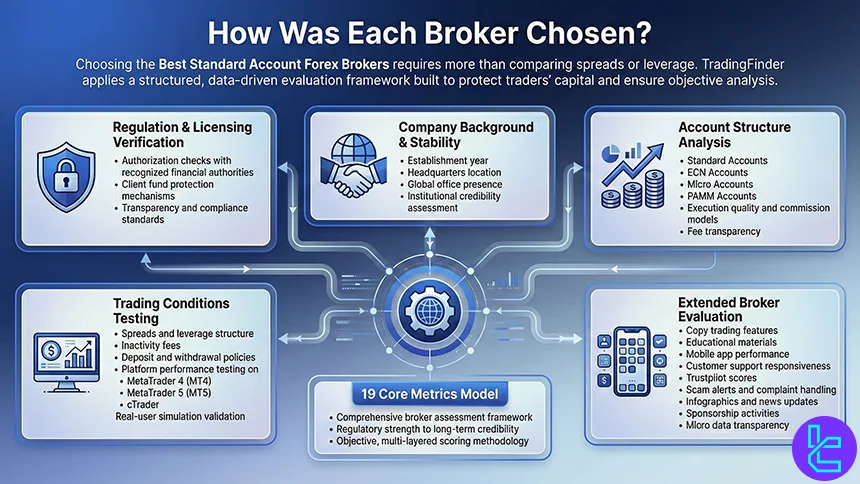
Company background data such as establishment year, headquarters, and global office presence are analyzed to measure operational stability and institutional credibility.
Account structure is another critical entity in our methodology. We compare Standard accounts, ECN accounts, Micro accounts, and PAMM accounts to determine execution quality, commission models, and fee transparency.
Trading conditions, including spreads, leverage, inactivity fees, deposit and withdrawal policies, and supported trading platforms like MetaTrader 4 (MT4), MetaTrader 5 (MT5), and cTrader, are tested directly through real-user simulations.
Beyond trading mechanics, TradingFinder evaluates copy trading features, educational materials, mobile apps, customer support responsiveness, Trustpilot scores, scam alerts, and broker responses to user complaints. We also review infographics, news updates, sponsorship activities, and micro data transparency.
What is a Standard Account?
A Standard Account is the most common retail trading account type offered by forex brokers. It typically allows traders to access the global Forex market with full lot sizing, where 1 standard lot equals 100,000 units of the base currency. Unlike Micro or Cent accounts, balances are denominated in real currency (USD, EUR, GBP, etc.), not in cents.
Standard accounts usually operate with spread-based pricing, meaning brokers generate revenue through the bid-ask spread rather than fixed commissions. Spreads often start from around 0.8 to 1.5 pips on major currency pairs like EUR/USD, depending on market liquidity and the broker’s execution model (Market Maker, STP, or ECN hybrid).
Leverage availability varies by jurisdiction and regulation. In regulated regions such as the EU under ESMA rules, retail leverage may be capped at 1:30 for major pairs, while offshore-regulated brokers may offer leverage up to 1:500 or higher. Minimum deposit requirements generally range between $50 and $200, though this differs by broker.
Most Standard Accounts support widely used trading platforms including MetaTrader 4 (MT4), MetaTrader 5 (MT5), and sometimes cTrader, enabling access to Expert Advisors (EAs), technical indicators, and automated trading tools.
A Standard Account is typically suited for traders who have moved beyond demo or micro trading and want direct exposure to market-sized positions with competitive spreads and full platform functionality.
Pros and Cons of Trading via a Standard Account in a Broker
A Standard account is widely used in the Forex market due to its straightforward pricing model and access to full lot sizes. It typically operates with spread-based execution on platforms like MetaTrader 4 (MT4) and MetaTrader 5 (MT5). While it offers competitive trading conditions for active traders, it may not suit beginners with very small capital.
Pros | Cons |
Access to full lot trading (1 lot = 100,000 units), enabling meaningful market exposure | Higher capital requirement compared to Cent or Micro accounts |
Usually commission-free with spread-based pricing | Spreads may be wider than ECN or Raw accounts |
Broad access to forex pairs, CFDs, indices, commodities, and sometimes crypto | Larger position sizes increase risk exposure per trade |
Full platform functionality including EAs, technical indicators, and automated trading | Less suitable for testing strategies with minimal risk capital |
How Can I Set Up a Standard Account?
Setting up a standard account with a forex broker involves a regulated onboarding process designed to comply with Know Your Customer (KYC) and Anti-Money Laundering (AML) requirements. The first step is selecting a broker that operates under a recognized financial authority and reviewing its license details for transparency and client fund protection.
After choosing the broker, traders complete an online registration form by submitting personal information such as full name, country of residence, contact details, and financial background.
Identity verification is then required, which typically involves uploading a government-issued ID (passport or national ID) and proof of address, such as a recent utility bill or bank statement.
Once verification is approved, the trader selects “Standard Account” as the preferred account type, chooses a base currency (for example USD or EUR), and determines the leverage level within regulatory limits. Before activation, the broker requires acceptance of risk disclosure statements and trading terms.
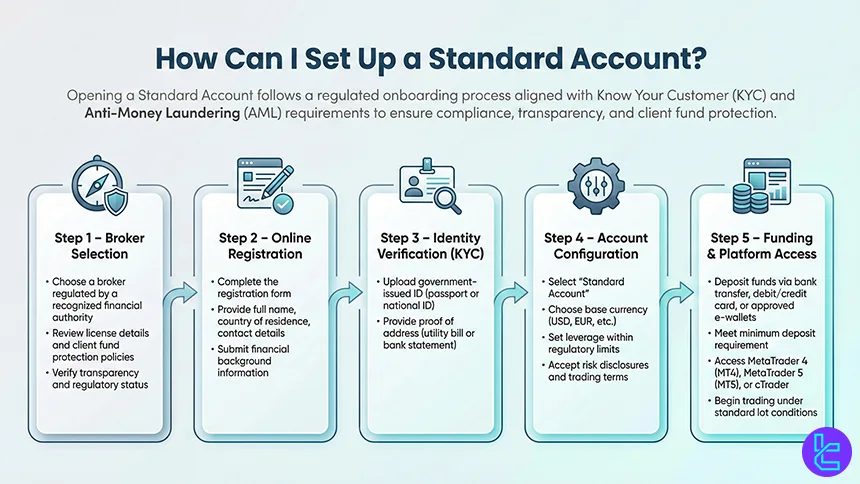
The final step is funding the account through supported payment methods such as bank transfer, debit or credit card, or approved electronic wallets. After depositing the minimum required amount, traders can log in to platforms like MetaTrader 4 (MT4), MetaTrader 5 (MT5), or cTrader and begin trading under standard lot conditions.
Do Standard Accounts Come with Wide Spreads?
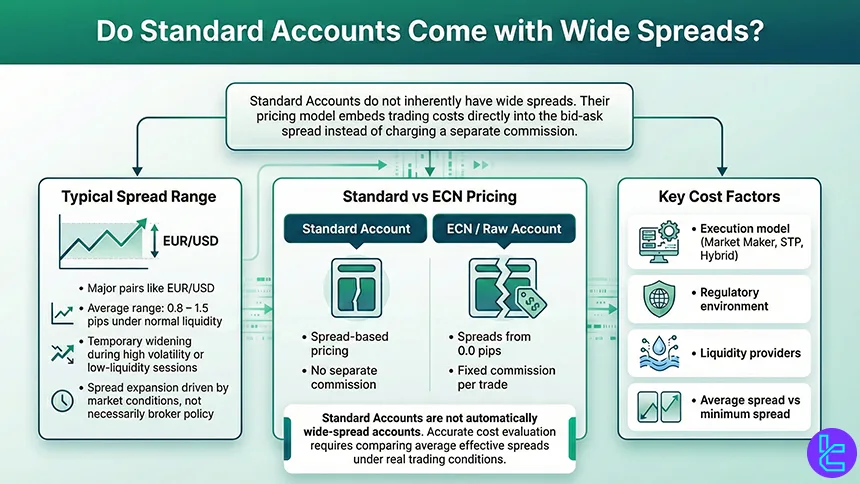
Standard Accounts do not inherently come with wide spreads, but their pricing structure differs from ECN or Raw accounts. Most brokers offer spread-based pricing on Standard Accounts, meaning the trading cost is embedded in the bid-ask spread rather than charged as a separate commission.
On major currency pairs such as EUR/USD, spreads on a Standard Account typically range from 0.8 to 1.5 pips under normal market liquidity. During periods of high volatility, such as major economic releases or low-liquidity sessions, spreads may widen temporarily due to market conditions rather than broker policy.
Compared to ECN accounts, which may offer raw spreads starting from 0.0 pips plus a fixed commission, Standard Accounts generally display slightly higher average spreads. However, when commissions are included in ECN pricing, the overall trading cost difference may be narrower than it appears.
Spread levels also depend on the broker’s execution model (Market Maker, STP, or hybrid), regulatory environment, and liquidity providers. Therefore, Standard Accounts are not necessarily “wide-spread” accounts, but traders should always compare average spreads, not just minimum advertised spreads, when evaluating trading costs.
Do Cent Accounts Include High Non-Trading Fees?
Cent Accounts generally do not include high non-trading fees compared to other retail forex account types. In most cases, the non-trading cost structure, such as deposit fees, withdrawal charges, and inactivity fees, depends on the broker’s overall pricing policy rather than the specific account type.
Many forex brokers offer free deposits through common payment methods like bank transfers, cards, or e-wallets, though third-party processing fees may still apply. Withdrawal fees can vary depending on the payment provider and currency conversion costs.
These charges are typically similar across Cent, Standard, and ECN accounts within the same brokerage.
Inactivity fees may apply if a trading account remains dormant for a defined period, often ranging from 3 to 12 months. This fee structure is not exclusive to Cent Accounts and is usually disclosed in the broker’s terms and conditions.
Since Cent Accounts are designed for low-capital traders, minimum deposit requirements are usually small, but this does not automatically imply higher non-trading fees. Traders should review the broker’s full fee schedule, including administrative charges and currency conversion costs, before opening a Cent Account.
Who Is a Standard Account For?
A Standard Account in a forex broker is primarily designed for traders who seek direct exposure to real market pricing with full lot sizing and competitive spread-based execution.
Since balances are denominated in standard currency (USD, EUR, GBP, etc.) and not cents, this account type is generally more suitable for traders with moderate capital and defined risk management strategies.
A standard account is typically appropriate for:
- Intermediate traders who have moved beyond demo, Cent, or Micro accounts and understand position sizing and leverage;
- Active forex traders trading major and minor currency pairs with average position sizes of 0.10 lots or higher;
- Traders using MetaTrader 4 (MT4), MetaTrader 5 (MT5), or cTrader who require full access to Expert Advisors (EAs) and advanced technical indicators;
- Swing traders and intraday traders who prefer spread-only pricing instead of commission-based ECN models;
- Market participants with $100–$500+ capital, depending on broker minimum deposit requirements and leverage conditions;
- Traders comfortable managing risk per trade, as 1 standard lot equals 100,000 units of the base currency, increasing exposure compared to micro accounts.
A standard account is generally less suitable for absolute beginners testing strategies with minimal capital. However, for traders seeking balanced trading conditions, platform flexibility, and transparent cost structures, it remains one of the most widely used account types in the global forex market.
What Tradable Instruments Are Offered with Standard Accounts?
A Standard Account typically provides access to a broad range of tradable instruments, depending on the broker’s regulatory framework and liquidity partnerships. Unlike Cent or limited-entry accounts, Standard Accounts usually grant full market access across multiple asset classes within the broker’s product offering.
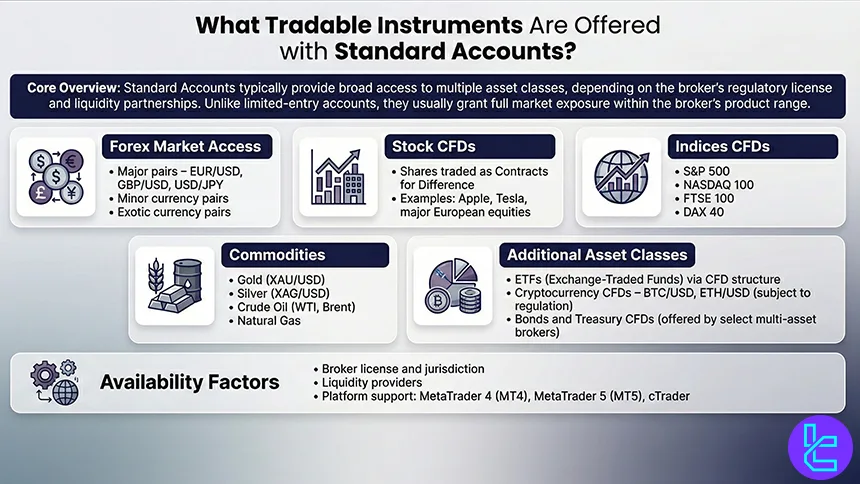
Common instruments available with Standard Accounts include:
- Forex currency pairs - Major (EUR/USD, GBP/USD, USD/JPY), minor, and exotic pairs
- Stock CFDs - Shares of publicly listed companies such as Apple, Tesla, or major European equities, traded as Contracts for Difference
- Indices CFDs - Global benchmarks like S&P 500, NASDAQ 100, FTSE 100, and DAX 40
- Commodities - Gold (XAU/USD), Silver (XAG/USD), Crude Oil (WTI, Brent), and Natural Gas
- ETFs (Exchange-Traded Funds) - Available via CFD structure with selected brokers.
- Cryptocurrency CFDs - Bitcoin (BTC/USD), Ethereum (ETH/USD), and other major digital assets, subject to regulatory restrictions
- Bonds and Treasury CFDs - Offered by some multi-asset brokers
The availability of these instruments depends on the broker’s license, jurisdiction, and trading platform support such as MetaTrader 4 (MT4), MetaTrader 5 (MT5), or cTrader.
Standard Accounts are structured to provide diversified exposure across global financial markets, allowing traders to implement multi-asset strategies under a single brokerage environment.
Standard Accounts vs. Other Common Account Types
Standard accounts represent the default retail trading structure in most forex brokers, offering full lot denomination, spread-based pricing, and broad instrument access on platforms such as MetaTrader 4 and MetaTrader 5.
Compared to Cent accounts (low-capital structure), ECN accounts (raw spreads with commission), and Pro accounts (tight spreads with higher entry thresholds), each account type targets a different trader profile based on capital size, execution preference, and cost sensitivity.
Parameters | Cent Account | Standard Account | ECN Account | Pro Account |
Balance Denomination | Cents (e.g., $10 = 1,000 cents) | Base currency (USD, EUR, etc.) | Base currency | Base currency |
Typical Minimum Deposit | $0 - $50 | $50 - $200 | $100 - $500 | $200 - $1,000+ |
Lot Size Structure | Micro lots (0.01) or smaller | Standard & mini lots (0.01-1.0) | Raw lot sizes with direct liquidity | Standard lots with optimized execution |
Spreads (Major Pairs) | 1.0 - 2.0+ pips (floating) | 0.8 - 1.5 pips (floating) | 0.0 - 0.3 pips (raw) | 0.1 - 0.8 pips |
Commission Model | Usually spread-only | Usually spread-only | Commission per lot ($3–$7 RT typical) | Low or zero commission (broker-dependent) |
Execution Model | Market Maker / Hybrid | Market Maker / STP | True ECN / NDD | STP / Hybrid |
Max Leverage (Offshore) | 1:500 - 1:2000+ | 1:500 - 1:1000 | 1:200 - 1:500 | 1:200 - 1:500 |
Max Leverage (Tier-1 Reg.) | 1:30 | 1:30 | 1:30 | 1:30 |
Instrument Availability | Limited to core FX & CFDs | Full retail offering | Full offering with deeper liquidity | Full offering |
Target Trader Profile | Beginners, low-capital traders, EA testing | Retail & intermediate traders | Scalpers, high-volume traders | Experienced discretionary traders |
Typical Stop-Out Level | 20% - 50% | 20% - 50% | 20% - 30% | 20% - 30% |
Slippage Sensitivity | Moderate | Moderate | Lower (direct liquidity access) | Lower |
Conclusion
Standard account type is the most common form of retail trading accounts found in almost every broker. Each brokerage offers these accounts with various parameters and conditions. Among many brokers examined and reviewed by our team, IC Markets, AvaTrade, Exness, and Eightcap are the best choices.
To learn about the way we curated the shortlist of brokers, check out our Forex methodology article.