






Free VPS service is one of the advantages and benefits some brokers offer. However, it’s not enough for a broker to only provide access to it; a reliable choice must have high execution speed, low spreads, and reputable regulatory licenses.
The shortlist below contains the brands with the best conditions for VPS trading. These are selected based on a structured methodology.
 | FUSION MARKETS | |||
 | HFM | |||
 | Vantage | |||
| 4 |  | alpari | ||
| 5 |  | vt markets | ||
| 6 |  | PUPRIME | ||
| 7 |  | NORD FX |
Trustpilot Ratings and Reviews
Trustpilot is a reputable source in the financial industry that publishes user reviews after verifying their authenticity. The table below ranks the introduced brokerages based on these ratings.
Broker Name | Trustpilot Rating | Number of Reviews |
7,034 | ||
NordFX | 72 | |
4.4/5 ⭐ | 2,921 | |
Vantage Markets | 12,308 | |
VT Markets | 2,613 | |
PU Prime | 3.5/5 ⭐ | 1,753 |
Alpari | 2.4/5 ⭐ | 282 |
Available Trading Platforms for VPS Brokers
MetaTrader 4, MetaTrader 5, and cTrader are the most popular platforms among brokers and traders. This section demonstrates the available options in the mentioned brokers.
Broker Name | Trading Platforms |
Metatrader 4, Metatrader 5, ProTrader, TradingView, proprietary application | |
LiteFinance | MT4, MT5, cTrader, Mobile App |
VT Markets | MetaTrader 4, MetaTrader 5, Webtrader+, VT Markets App |
PU Prime | MT4, MT5, PU Prime app |
MT4, MT5, WebTrader | |
FXGlory | Metatrader 4, Metatrader 5 |
NordFX | MT4 / MT5 |
Minimum Spreads in the Mentioned Brokers
Professional and experienced traders typically prefer to trade with lower spreads, even if it is in expense of trading commissions. Aside from that, low spread enables reduced overall fees. Here’s a comparison based on this parameter.
Broker Name | Min. Spreads |
Vantage Markets | 0 Pips |
Eightcap | 0 Pips |
0 Pips | |
PU Prime | 0 Pips |
Alpari | 0 Pips |
NordFX | 0 Pips |
FXGlory | 0.1 Pips |
Regulatory Licenses Acquired by the Brokers
Brokers indicate their reputation and trustworthiness with their supervising financial authorities. Top-tier regulators, such as the FCA, CySEC, and other organizations have stringent rules for brokerages. The table below ranks the mentioned brands based on this parameter.
Broker Name | Regulatory Licenses |
Pepperstone | ASIC, SCB, FCA, DFSA, CMA, BaFin, CySEC |
Vantage Markets | ASIC, FSCA, VFSC, FCA, CIMA |
SVG FSC, Mwali FSC, FSCA, ASIC | |
Eightcap | ASIC, FCA, CySEC, SCB |
VT Markets | FSCA, ASIC, FSC Mauritius |
Alpari | MISA |
Not regulated |
Top 6 Brokers in Detail
The following sections will dig into the details and briefly review six of the mentioned VPS brokers. Pros, cons, account types, trading fees, and other parameters will be examined.
Fusion Markets
Fusion Markets is an Australia-based Forex broker founded by Phil Horner and backed by Gleneagle Securities, which manages more than $400 million in client assets.
The broker operates under both the Australian Securities and Investments Commission and the Vanuatu Financial Services Commission, giving it broader international coverage.
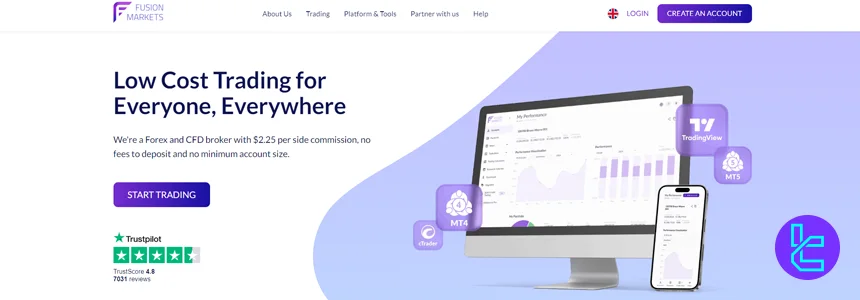
Fusion Markets is widely recognized for its low-cost trading model. Traders can open an account with no minimum deposit, access raw spreads from 0.0 pips on major pairs like EUR/USD, and pay commissions as low as $4.50 per lot on the Zero account.
For VPS trading, Fusion Markets stands out with ultra-fast execution speeds of around 0.02 milliseconds and support for MetaTrader 4, MetaTrader 5, cTrader, and TradingView. The broker also offers free VPS hosting for eligible traders who need uninterrupted automated trading.
Fusion Markets supports more than 250 instruments across Forex, indices, commodities, metals, cryptocurrencies, and US share CFDs. Additional features such as Fusion+, DupliTrade, MAM/PAMM accounts, copy trading, and 24/7 support make it suitable for both manual and algorithmic traders.
For more details on the broker’s features and personal cabinet, visit our Fusion Markets dashboard review.
Table of Specifics
Account Types | Zero, Classic, Swap-Free |
Regulating Authorities | ASIC, VFSC |
Minimum Deposit | $0 |
Deposit Methods | VISA, MasterCard, PayPal, Perfect Money, PayID, Bank Wire, Crypto, Skrill, Neteller, etc. |
Withdrawal Methods | PayPal, Perfect Money, Bank Wire, Crypto, Skrill, Neteller, etc. |
Maximum Leverage | 1:500 |
Trading Platforms & Apps | MetaTrader 4, MetaTrader 5, TradingView, cTrader |
Fusion Markets Pros and Cons
Fusion Markets combines low trading costs, fast execution, and VPS support with a flexible account structure. However, despite its strong pricing and platform offering, the broker still has a smaller product range than some larger competitors and limited educational resources for beginners.
Pros | Cons |
VPS hosting for eligible traders | No investor compensation scheme |
Raw spreads from 0.0 pips | Limited educational content |
No minimum deposit requirement | No proprietary trading platform |
Supports MT4, MT5, cTrader, and TradingView | Fewer instruments than larger multi-asset brokers |
HFM
HFM has operated in the online trading industry since 2010 and supports more than 2.5 million live accounts across 27+ languages. The broker is known for combining high leverage, diverse account types, and low entry barriers, making it suitable for both beginners and advanced VPS traders.
HF Markets is regulated by multiple authorities, including Financial Conduct Authority, Cyprus Securities and Exchange Commission, Dubai Financial Services Authority, and Financial Sector Conduct Authority. This multi-regulated structure improves client fund protection through segregated accounts and negative balance protection.
For VPS trading, the broker provides floating spreads from 0.0 pips, leverage up to 1:2000, and direct access to VPS hosting, Autochartist, SMS alerts, and HFM copy trading.
Traders can use automated strategies on both MetaTrader 4 and MetaTrader 5 across desktop and mobile devices.
HFM supports more than 1,000 instruments, including Forex, stocks, commodities, ETFs, indices, bonds, metals, and cryptocurrencies. The broker offers Cent, Zero, Premium, and Pro accounts with minimum deposits starting from $0, making it accessible for traders with different budgets and trading styles.
It’s worth noting that there is a HFM rebate program available for discounts on fees. The table below summarizes the broker’s specifics.
Account Types | Cent, Zero, Pro, Premium |
Regulating Authorities | CySEC, DFSA, FCA, FSCA, FSA |
Minimum Deposit | From $0.00 |
Deposit Methods | Wire transfer, E-payments, Credit/Debit cards, Crypto |
Withdrawal Methods | Wire transfer, E-payments, Credit/Debit cards, Crypto |
Maximum Leverage | 1:2000 |
Trading Platforms & Apps | MT4, MT5, Mobile App |
HFM Pros and Cons
HFM stands out for traders looking for free VPS services, automated trading tools, and high leverage. However, some users may find its platform range narrower than brokers offering cTrader or TradingView integration, and support quality can vary depending on region.
Pros | Cons |
Regulated by FCA, CySEC, DFSA, FSCA, and FSA | Geo-restrictions in several countries |
VPS hosting and Autochartist available | No cTrader or TradingView support |
Minimum deposit starts from $0 | Some reports of technical issues |
Supports copy trading, PAMM, and crypto payments | Customer support quality is inconsistent |
Vantage Markets
Founded in 2009 and headquartered in Sydney, Vantage Markets has expanded to more than 30 offices worldwide. The broker supports traders through multiple regulated entities and combines low-cost trading with infrastructure built for active and automated strategies.

Vantage Markets is particularly attractive for VPS-focused traders because it offers VPS hosting for stable Expert Advisor performance, lower latency, and uninterrupted execution. Combined with spreads from 0.0 pips and market execution, the broker is suitable for scalping, algorithmic trading, and high-frequency strategies.
The broker supports five trading platforms, including MetaTrader 4, MetaTrader 5, TradingView, ProTrader, and its own proprietary mobile app. Traders can also access social and copy trading through ZuluTrade, DupliTrade, and Myfxbook AutoTrade.
Vantage Markets is regulated by authorities such as ASIC, FCA, FSCA, VFSC, and CIMA. Depending on the branch, clients can benefit from segregated funds, negative balance protection, and compensation coverage of up to GBP 85,000 or additional Lloyd’s insurance.
Specifics and Details
Account Types | Standard STP, Standard Cent, Raw ECN, Pro ECN, Swap Free |
Regulating Authorities | ASIC, FSCA, VFSC, FCA, CIMA |
Minimum Deposit | $20 |
Deposit Methods | E-Wallets, bank transfer, credit/debit cards, Perfect Money, local payment options |
Withdrawal Methods | E-Wallets, bank transfer, credit/debit cards, Perfect Money, local payment options |
Maximum Leverage | Up to 1:1000 |
Trading Platforms & Apps | Metatrader 4, Metatrader 5, ProTrader, TradingView, proprietary application |
Vantage Markets Pros and Cons
Vantage Markets offers several strengths for traders who rely on VPS services, including fast execution, broad platform support, and ECN-style pricing. However, some account types require larger deposits, and certain countries remain restricted from opening accounts.
Check out the pros and cons before going through the Vantage Markets registration process.
Pros | Cons |
VPS hosting for automated and low-latency trading | High $10,000 minimum deposit for Pro ECN account |
Regulated by ASIC, FCA, and other global authorities | No proprietary desktop trading platform |
Spreads from 0.0 pips on Raw ECN and Pro ECN accounts | Restricted in countries such as the US and Canada |
Supports MT4, MT5, TradingView, ProTrader, and copy trading | Trustpilot score remains relatively average compared to competitors |
NordFX
NordFX has operated in the online trading industry since 2008 and now serves more than 1.7 million clients across 190 countries. The broker offers access to Forex, stocks, cryptocurrencies, indices, metals, and energy markets through MetaTrader 4 and MetaTrader 5 platforms.
One of NordFX’s strongest advantages for VPS-focused traders is its support for automated trading. Both MT4 and MT5 allow Expert Advisors, one-click execution, algorithmic strategies, copy trading, and MQL5 signal integration, making the broker suitable for scalpers and VPS users.
NordFX provides four account types, including MT4 Pro, MT4 Zero, MT5 Pro, and MT5 Zero. Traders can start with as little as $10, access spreads from 0.0 pips, and use leverage of up to 1:1000 depending on the account and jurisdiction.
The broker also supports VPS hosting, PAMM accounts, and copy trading services for traders who rely on uninterrupted execution. However, NordFX operates without strong top-tier regulation, which may concern traders seeking higher levels of investor protection and oversight.
Summary of Specifics
Account Types | MT4 Zero, MT4 Pro, MT5 Zero, MT5 Pro |
Regulating Authorities | Not regulated |
Minimum Deposit | $10 |
Deposit Methods | Bank wire transfer, Credit/debit cards, E-wallets, Cryptocurrencies |
Withdrawal Methods | Bank wire transfer, Credit/debit cards, E-wallets, Cryptocurrencies, Internal Transfer |
Maximum Leverage | 1:1000 |
Trading Platforms & Apps | MT4 / MT5 |
NordFX Pros and Cons
NordFX combines high leverage, low minimum deposits, VPS hosting, and support for automated trading strategies. At the same time, its limited regulation, lack of investor compensation schemes, and relatively narrow stock offering may be disadvantages for some traders.
We recommend you to check the upsides and downsides before NordFX registration.
Pros | Cons |
VPS hosting for automated trading and Expert Advisors | No strong top-tier regulation |
Spreads from 0.0 pips on Zero accounts | No investor compensation fund |
Minimum deposit starts from $10 | Limited educational and research resources |
Supports PAMM accounts and copy trading | Restricted access for traders from the US, Canada, and EU |
VT Markets
VT Markets is an Australia-based multi-asset broker that serves more than 400,000 active traders and processes over 30 million trades each month. The broker offers access to more than 1,000 instruments across Forex, indices, stocks, ETFs, commodities, and bonds, making it suitable for traders seeking broad market exposure.

VT Markets supports four live account types, including Standard STP, RAW ECN, Cent STP, and Cent ECN. Minimum deposits start from $50, spreads on ECN accounts can begin from 0.0 pips, and leverage reaches up to 1:500 for eligible clients outside ASIC-regulated jurisdictions.
For VPS-focused traders, VT Markets stands out with support for MetaTrader 4, MetaTrader 5, WebTrader+, and its proprietary mobile app. The broker also offers VPS refunds, algorithmic trading support, copy trading, PAMM services, and integrated tools such as Trading Central and Acuity sentiment analysis.
To learn more about the broker’s personal cabinet and features, visit our VT Markets dashboard article.
VT Markets is regulated by multiple authorities, including the Australian Securities and Investments Commission, the Financial Sector Conduct Authority of South Africa, and the Financial Services Commission of Mauritius.
While ASIC regulation adds credibility, most retail traders are onboarded under offshore entities, where investor protection is generally weaker.
Table of Details
Account Types | Standard STP, RAW ECN, Cent STP, Cent ECN, Demo |
Regulating Authorities | FSCA, ASIC, FSC Mauritius |
Minimum Deposit | $50 |
Deposit Methods | Neteller, Skrill, Credit/Debit Cards, Wire Transfer, UnionPay, Fasapay |
Withdrawal Methods | Neteller, Skrill, Credit/Debit Cards, Wire Transfer, UnionPay, Fasapay |
Maximum Leverage | 1:500 |
Trading Platforms & Apps | MetaTrader 4, MetaTrader 5, Webtrader+, VT Markets App |
VT Markets Pros and Cons
VT Markets combines low-cost trading conditions, flexible account options, and strong MetaTrader support, but traders should also consider its offshore onboarding structure, mixed review scores, and limited protection features before opening an account.
Pros | Cons |
Supports MT4, MT5, WebTrader+, and mobile trading | Most retail clients are onboarded through offshore entities |
VPS refund program available for active traders | No excess loss insurance or compensation fund for most users |
Raw ECN spreads from 0.0 pips with low minimum deposit | ForexPeaceArmy score remains very low |
Offers copy trading, PAMM, and multiple account types | Certain countries, including the U.S. and Iran, are restricted |
PU Prime
PU Prime has offered Forex and CFD trading since 2016, providing access to more than 800 instruments across 6 asset classes. Traders can choose between Standard, Prime, ECN, and Cent accounts, with spreads from 0.0 pips and a low minimum deposit of $20.
The broker is regulated by multiple authorities, including the Australian Securities and Investments Commission, the Financial Services Authority Seychelles, the Financial Services Commission Mauritius, and the Financial Sector Conduct Authority.
Client funds are held in segregated accounts, and negative balance protection is available across all entities.
PU Prime supports both MetaTrader platforms and its proprietary mobile app, giving traders access to copy trading, social trading, ECN execution, and market execution. The broker also supports automated trading strategies, VPS-friendly conditions, and leverage of up to 1:1000 for eligible clients.
With over 54 Forex pairs, 550+ stock CFDs, 150+ ETFs, and 59 cryptocurrency instruments, PU Prime appeals to traders seeking broad market coverage. Fee-free deposits, multiple payment methods, 24/7 customer support, and promotional programs further strengthen its appeal for active traders.
You can check out the PU Prime deposit and withdrawal methods article to learn about the broker’s funding options.
PU Prime Pros and Cons
PU Prime combines low entry requirements, flexible account options, and a wide selection of trading instruments. However, its offshore regulatory exposure, mixed user reviews, and country restrictions may be drawbacks for some traders.
Pros | Cons |
Minimum deposit starts from $20 | Mixed ratings on Trustpilot and ForexPeaceArmy |
Regulated by ASIC, FSCA, FSA, and FSC | Not available for U.S. traders |
Supports MT4, MT5, copy trading, and social trading | Offshore regulation may concern risk-averse traders |
Over 800 instruments across multiple markets | Higher minimum deposit for Prime and ECN accounts |
How was Each Broker Evaluated and Selected?
Selecting the best VPS Forex brokers requires more than comparing spreads or leverage. TradingFinder uses a detailed review methodology built around 19 evaluation metrics.
This process is to identify brokers that can support stable, low-latency, and uninterrupted trading conditions for strategies such as scalping, automated trading, Expert Advisors, and algorithmic systems on platforms like MetaTrader 4, MetaTrader 5, and cTrader.
Our analysts begin by reviewing each broker’s regulatory backgroundb licenses, company history, headquarters, and reputation.
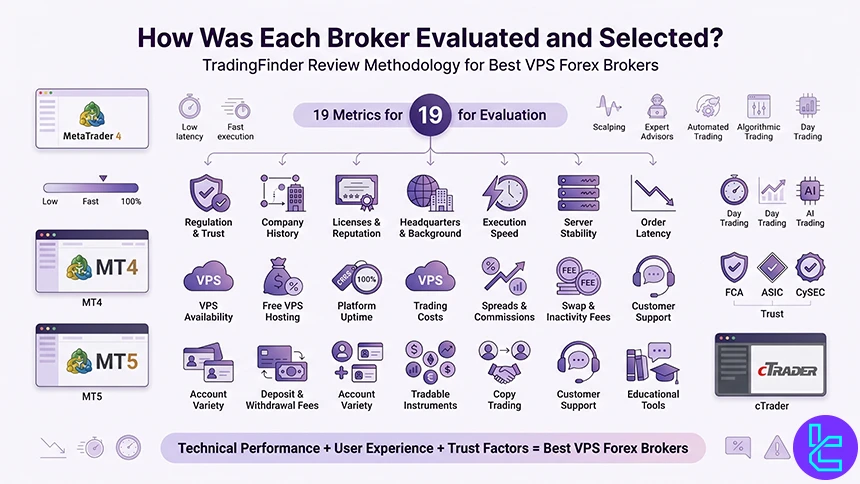
Brokers regulated by authorities such as Financial Conduct Authority, Australian Securities and Investments Commission, and Cyprus Securities and Exchange Commission generally receive stronger ratings due to stricter compliance standards and investor protection measures.
For VPS-focused trading, we pay special attention to execution speed, server stability, order latency, platform uptime, and the availability of dedicated VPS services. Brokers that provide free VPS hosting, low-latency infrastructure, and fast order execution are better suited for high-frequency trading, day trading, scalping, and AI-driven strategies.
We also review trading costs, including spreads, commissions, swap fees, deposit and withdrawal charges, and inactivity fees, since these directly affect long-term profitability.
TradingFinder also examines account variety, tradable instruments, copy trading options, customer support quality, educational tools, Trustpilot ratings, scam alerts, and broker responsiveness.
By combining technical performance with user experience and trust factors, our methodology helps traders identify the best VPS Forex brokers for their trading style and platform requirements.
What is a Forex VPS?
A Forex VPS (Virtual Private Server) is a remote cloud-based server that allows traders to run their trading platforms 24 hours a day without depending on their personal computer or local internet connection.
A VPS is commonly used for automated trading strategies, Expert Advisors (EAs), copy trading systems, and high-frequency trading because it keeps platforms such as MetaTrader 4, MetaTrader 5, and cTrader active even when the trader’s device is turned off.
Instead of installing trading software directly on a home computer, traders can install it on a VPS located in a professional data center. These servers are usually positioned close to a broker’s trading servers, reducing latency and improving execution speed.
Lower latency is especially important for scalpers, day traders, and algorithmic traders because even a small delay in order execution can affect entry prices, slippage, and overall profitability.
A Forex VPS also improves stability and security. Since the server operates continuously, trading systems remain active during power outages, internet failures, software crashes, or computer restarts. This is particularly important for automated strategies that need to monitor the market and execute trades around the clock.
Many brokers offer free VPS hosting to clients who meet certain trading volume or deposit requirements. Others partner with VPS providers so traders can access discounted hosting services. Popular VPS providers for Forex trading include Beeks Financial Cloud, ForexVPS.net, and New York City Servers.
Pros and Cons of Trading with a Forex VPS
A Forex VPS can improve execution quality, trading stability, and platform uptime, especially for traders using automated systems, scalping strategies, or Expert Advisors on MetaTrader 4 and MetaTrader 5.
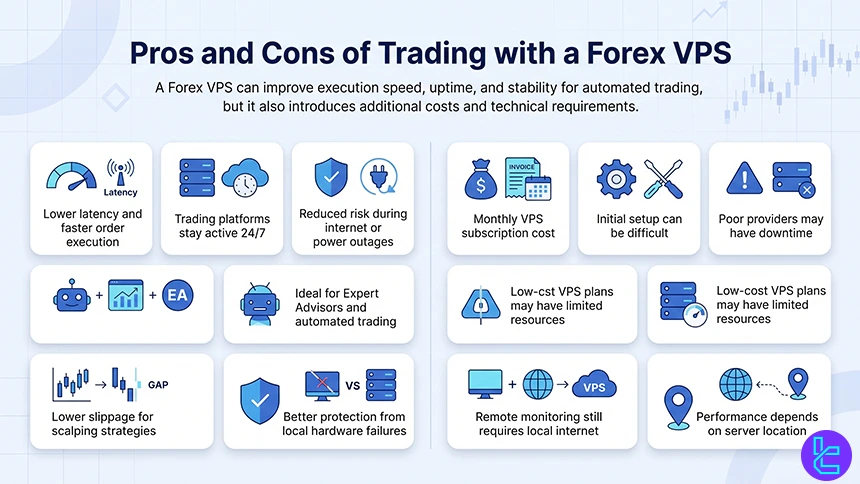
However, VPS hosting also introduces additional costs, technical setup requirements, and dependence on third-party server providers.
Pros | Cons |
Lower latency between the trading platform and broker server can improve order execution speed | VPS hosting usually adds a monthly cost unless it is offered free by the broker |
Trading platforms stay active 24/7 even if the trader’s computer is turned off | Initial setup can be difficult for beginners with limited technical knowledge |
Reduces the risk of missed trades during internet outages, power cuts, or device failures | Poor-quality VPS providers may still experience downtime or server instability |
Useful for running automated trading systems, Expert Advisors, and copy trading tools continuously | Some low-cost VPS services may have limited RAM, CPU power, or storage capacity |
Helps reduce slippage for scalping and high-frequency trading strategies | Traders still need a stable local internet connection to monitor or adjust trades remotely |
Professional data center security can protect trading platforms from local hardware failures | VPS performance depends heavily on server location and distance from the broker’s infrastructure |
Which Type of Traders Should Trade through a Forex VPS?
A Forex VPS is not essential for every trader, but it can be highly valuable for traders who rely on speed, continuous market access, or automated systems.
Traders who keep positions open for weeks or months may not benefit much from a VPS, while traders who depend on precise execution often see a clear advantage.
The following types of traders are the most likely to benefit from using a Forex VPS:
- Scalpers who target small price movements and need the fastest possible execution to reduce slippage and requotes
- Day traders who place multiple trades during a session and want stable platform performance during volatile periods
- Traders using Expert Advisors (EAs) on MetaTrader 4 and MetaTrader 5, since these systems often need to run continuously without interruption
- Algorithmic and AI traders running automated strategies that monitor markets 24/7 and react instantly to price changes
- High-frequency traders who depend on extremely low latency and rapid order execution
- Copy traders using services such as ZuluTrade or broker-integrated social trading systems, because a VPS can help ensure copied trades are executed more consistently
- News traders who trade around major events such as central bank announcements, inflation reports, or employment data releases, where price moves happen within seconds
- Traders living in regions with unstable internet connections, frequent power outages, or unreliable computer performance
- Traders managing multiple trading accounts or running several trading platforms at the same time
For long-term swing traders or position traders, a VPS may be less important because execution speed usually has less impact on overall results.
What Is Considered Good Latency for a Forex VPS?
Good latency for a Forex VPS is generally considered to be below 10 milliseconds (ms) between the VPS server and the broker’s trading server. Latency refers to the time it takes for an order to travel from the trading platform to the broker and back.
Lower latency can reduce slippage, improve order fill quality, and increase the accuracy of automated strategies.
For most retail traders, latency below 50 ms is usually acceptable. However, scalpers, high-frequency traders, and traders using Expert Advisors on MetaTrader 4 or MetaTrader 5 often aim for latency below 5 ms. In some premium VPS environments located in the same data center as the broker’s servers, latency can fall below 1 ms.
A VPS with latency between 10 ms and 30 ms is still considered good for swing trading, day trading, and most automated systems. Once latency rises above 100 ms, traders may begin to notice slower execution speeds, higher slippage, and less precise trade entries during volatile market conditions.
The best Forex VPS providers place their servers near major financial hubs such as London, New York City, and Tokyo because many broker trading servers are located in these regions. Choosing a VPS in the same city or data center as the broker’s infrastructure is one of the most effective ways to achieve low latency and improve execution quality.
How Significant is Server Location for a Forex VPS?
Server location is one of the most important factors in Forex VPS performance because physical distance directly affects latency. The closer the VPS server is to the broker’s trading servers, the faster trade orders can be transmitted and executed.
Lower latency is particularly important for scalping, news trading, arbitrage strategies, and automated systems that rely on fast execution.
For example, if a trader uses a VPS located in London while the broker’s trading servers are also based in London, latency may be below 5 ms. However, if the trader uses a VPS in Singapore while the broker’s servers are in London, latency can increase significantly, sometimes above 150 ms.
This difference may seem small, but in fast-moving Forex markets, even a delay of 50 to 100 milliseconds can affect fill prices, increase slippage, and reduce the performance of Expert Advisors running on MetaTrader 4 or MetaTrader 5.
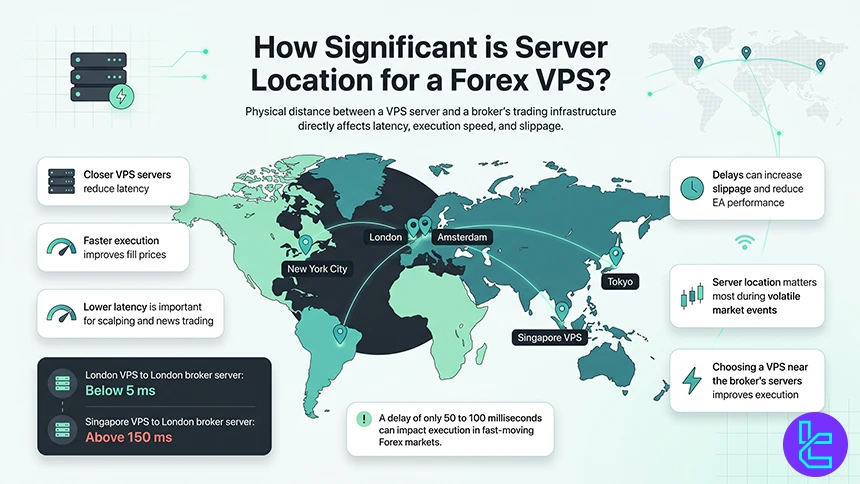
Server location becomes even more important during volatile market events such as central bank announcements, major economic releases, or sharp price spikes.
Many leading Forex brokers host their infrastructure in major financial data centers located in London, New York City, Tokyo, and Amsterdam. Choosing a VPS provider with servers near these locations is one of the simplest ways to improve execution speed and trading efficiency.
In What Way Does a VPS Improve Trade Execution Speed?
A VPS improves trade execution speed by reducing the physical distance between the trading platform and the broker’s servers.
When a trader places an order from a personal computer, the request must travel through the local internet connection, internet service provider, and several network points before reaching the broker. This process can increase latency and create delays.
With a Forex VPS, the trading platform is hosted inside a professional data center, often in the same city or near the same infrastructure as the broker’s trading servers. This shorter route allows orders to reach the broker more quickly, reducing execution time and improving pricing accuracy.
For traders using automated systems, even small differences in execution speed can affect performance. A delay of a few milliseconds may not matter for long-term trading, but it can be important for scalping, high-frequency trading, news trading, and Expert Advisors running on MetaTrader 4 or MetaTrader 5.
Faster execution can reduce slippage, minimize requotes, and improve the likelihood of entering or exiting a trade at the intended price.
A VPS also provides more stable performance because it is not affected by local internet interruptions, Wi-Fi instability, computer restarts, or power outages. This consistency helps trading platforms remain connected to the broker continuously, which is especially important during major market events or periods of high volatility.
In practice, many traders see the biggest execution benefits when their VPS is located near broker servers in major financial hubs such as London, New York City, or Tokyo.
Parameters and Considerations in Choosing the Best Forex Broker with VPS Services
Choosing the best Forex broker with VPS services involves more than checking whether free VPS hosting is available. Traders should evaluate the overall quality of the broker’s infrastructure, trading conditions, and server performance because these factors directly affect execution speed, platform stability, and long-term trading results.
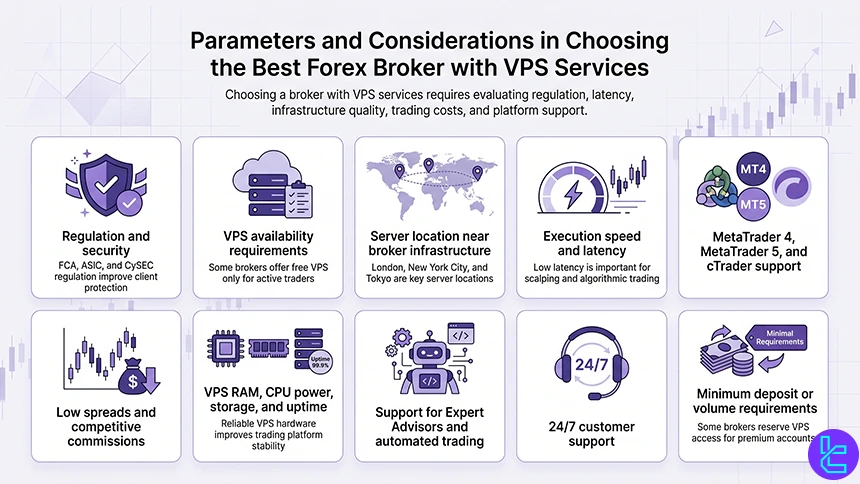
Important parameters to consider include:
- Regulation and security: Brokers regulated by authorities such as the FCA, ASIC, and CySEC generally provide stronger client protection and more transparent business practices;
- VPS availability: Some brokers provide free VPS hosting, while others require a minimum deposit, monthly trading volume, or account balance to qualify;
- Server location: The VPS server should be located near the broker’s trading infrastructure in financial hubs such as London, New York City, or Tokyo to reduce latency;
- Execution speed and latency: Brokers with low-latency connections, fast order routing, and minimal requotes are usually more suitable for scalping and automated trading;
- Platform compatibility: The broker should support major trading platforms such as MetaTrader 4, MetaTrader 5, and cTrader;
- Trading costs: Low spreads, competitive commissions, and reasonable swap fees are important because VPS users often place a high number of trades;
- VPS performance: RAM, CPU power, storage space, uptime guarantees, and operating system quality can all affect trading platform performance;
- Support for automation: Traders using Expert Advisors, algorithmic strategies, or copy trading systems need brokers that allow unrestricted automated trading;
- Customer support: Reliable 24/7 customer support is important if there are issues with VPS access, platform connectivity, or trade execution;
- Account requirements: Some brokers only provide VPS services to premium account holders or traders who reach a certain monthly trading volume.
Conclusion
A VPS allows traders to enable trading with less latency and more automation. Although it might not be essential for everyone, but it certainly improves the results. Reliable regulatory licenses and fair overall fees play a crucial role in making a broker recommendable.
According to our analysis and reviews, Fusion Markets, HFM, Vantage Markets, and NordFX are the best Forex VPS brokers for the financial market enthusiasts.
To learn about the way each broker was reviewed and chosen and the effective factors in the process, check out our Forex methodology.