









Social trading has transformed the way traders interact with financial markets by combining trading execution with community-driven insights. Instead of relying solely on individual analysis, users can observe, follow, and replicate the strategies of other traders in real time, creating a collaborative trading environment.
Through social trading platforms, investors gain access to leaderboards, performance statistics, risk scores, and public trade histories. This transparency allows users to evaluate strategy providers based on consistency, drawdown, and trading behavior rather than marketing claims alone.
The list below evaluate the best Forex brokers for social trading based on platform quality, transparency of performance data, fee structure, execution reliability, user experience, and regulatory coverage
 | FUSION MARKETS | |||
 | BlackBull | |||
 | LiteFinance | |||
| 4 |  | pepperstone | ||
| 5 |  | AVATRADE | ||
| 6 |  | ICMarkets | ||
| 7 |  | TICKMILL | ||
| 8 |  | fpmarkets |
Social Trading Brokers Ranked by Trustpilot
When evaluating Forex brokers that offer social trading, platform features and strategy availability are important, but real user feedback provides critical insight into day-to-day performance. Trustpilot ratings reflect actual client experiences related to trade copying accuracy, withdrawal reliability, platform stability, and overall transparency.
In social trading environments, execution quality and synchronization between strategy providers and followers are essential.
Issues such as slippage, delayed trade replication, or inconsistent performance tracking are often highlighted in user reviews before they become visible in official broker documentation. For this reason, Trustpilot scores serve as a practical benchmark for operational reliability.
Broker Name | Trustpilot Rating | Number of Reviews |
10,059 | ||
IC Markets | 52,983 | |
Fusion Markets | 6,951 | |
AvaTrade | 12,220 | |
BlackBull Markets | 2,968 | |
Pepperstone | 3,338 | |
LiteFinance | 3.2/5⭐ | 668 |
2.2/5⭐ | 350 |
Comparing Spreads in Social Trading Brokerages
Spread structure plays a critical role in social trading performance, as trading costs are directly transferred to followers copying a strategy. Unlike manual trading, where individuals can adjust entries and exits, social trading replicates trades automatically, meaning even small spread differences can significantly impact net returns over time.
When comparing brokers, traders should evaluate average spreads during active sessions, commission levels, and slippage impact. Since social trading performance depends on accurate replication, minimizing trading friction is essential for maintaining consistency between strategy providers and followers.
Broker Name | Min. Spread |
0.0 Pips | |
0.0 Pips | |
LiteFinance | 0.0 Pips |
Pepperstone | 0.0 Pips |
Global Prime | 0.0 Pips |
eToro | 0.0 Pips |
Vantage Markets | 0.0 Pips |
ActivTrades | 0.5 Pips |
Highest Leverage Provided by Social Trading Brokers
Leverage is a key variable in social trading because it directly affects both return potential and risk exposure for followers. Since trades are replicated automatically from strategy providers, the leverage used at the broker level can amplify gains, but also accelerate drawdowns if risk is not controlled properly.
Social trading brokers typically offer different leverage limits depending on regulatory jurisdiction and account classification. Under Tier-1 regulators such as FCA, CySEC, or ASIC, retail leverage is usually restricted, while offshore entities may provide significantly higher ratios.
Broker Name | Max. Leverage |
FXTM | 1:3000 |
PU Prime | 1:1000 |
Tickmill | 1:1000 |
OctaFX | 1:1000 |
FP Markets | 1:500 |
1:500 | |
1:400 | |
NAGA | 1:30 |
Deposit and Withdrawal Methods in Social Trading Brokers
Reliable deposit and withdrawal systems are essential in social trading environments, where capital is frequently allocated, reallocated, or withdrawn based on strategy performance. Since users may switch between strategy providers or adjust allocation levels, fast and transparent transaction processing plays a critical role in overall user experience.
For social trading participants, choosing a broker with efficient, low-cost, and transparent funding infrastructure is essential to maintain flexibility and control over capital allocation decisions.
Broker Name | Deposit Methods | Withdrawal Methods |
Credit/Debit Cards, Bank Wire, STICPAY, Perfect Money, Africa Mobile Money, Volet | Credit/Debit Cards, Bank Wire, STICPAY, Perfect Money, Africa Mobile Money, Volet | |
Apple Pay, Google Pay, Visa, Mastercard, Bank transfer, PayPal, Neteller, Skrill, Union Pay, USDT, ZotaPay | Apple Pay, Google Pay, Visa, Mastercard, Bank transfer, PayPal, Neteller, Skrill, Union Pay, USDT, ZotaPay | |
AvaTrade | Credit/Debit Cards, E-Wallets, Bank Wire Transfer, PayPal | Credit/Debit Cards, E-Wallets, Bank Wire Transfer, PayPal |
IC Markets | Bank Cards, Wire Transfers, Electronic payments, etc. | Bank Cards, Wire Transfers, Electronic payments, etc. |
Global Prime | Credit/Debit Cards, Crypto, PayPal, Neteller, Skrill, FasaPay, Perfect Money, Bank Wire, etc. | Credit/Debit Cards, Crypto, PayPal, Neteller, Skrill, AstroPay, Perfect Money, Bank Wire |
XM | Credit/Debit Cards, Bank Transfers, E-Wallet Payments | Credit/Debit Cards, Bank Transfers, E-Wallet Payments |
JustMarkets | Bank transfer, E-payments, Credit/Debit cards, Crypto, Local banks | Bank transfer, E-payments, Credit/Debit cards, Crypto, Local banks |
Headway | Credit/Debit Cards, Crypto | Credit/Debit Cards, Crypto |
Top 6 Social Trading Forex Brokers
Social trading brokers provide platforms where users can follow, analyze, and replicate the strategies of other traders in real time. The quality of these platforms depends on execution speed, transparency of performance data, flexibility in allocation settings, and overall user experience.
Below are six leading Forex brokers that offer robust social trading environments. These brokers were selected based on platform reliability, copy execution accuracy, fee transparency, asset availability, and overall trust metrics.
Fusion Markets
Fusion Markets is a low-cost Forex and CFD broker established in 2019, operating under ASIC and VFSC regulation. The broker is known for its ultra-competitive pricing model, offering spreads from 0.0 pips and positioning itself as one of the lowest-cost providers in the market. It also benefits from institutional backing and maintains client funds in segregated accounts with major banks.
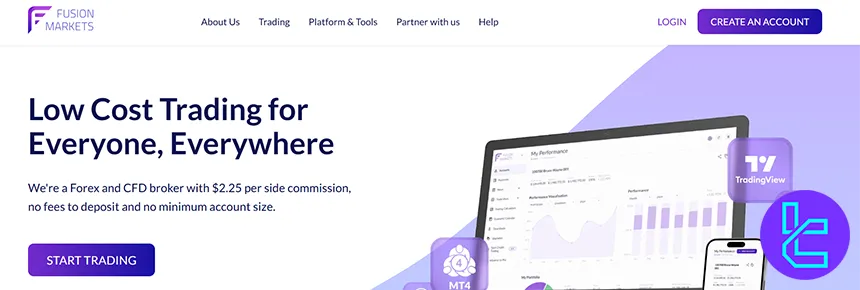
Fusion Markets dashboard provides three main account types including Zero, Classic, and Swap-Free, allowing traders to choose between raw spreads with commissions or commission-free pricing structures. Notably, Fusion Markets has no minimum deposit requirement, making it highly accessible for both beginner traders and professional investors. Leverage can reach up to 1:500 depending on the entity.
Fusion Markets supports a wide range of platforms including MetaTrader 4, MetaTrader 5, cTrader, and TradingView. This multi-platform offering ensures flexibility across manual trading, algorithmic strategies, and advanced charting environments. Execution speed is a key strength, supported by VPS services and low-latency infrastructure.
The broker offers over 250 tradable instruments across Forex, metals, indices, commodities, cryptocurrencies, and US share CFDs. Social trading is supported through Fusion+, DupliTrade, and MAM/PAMM solutions, enabling both passive and active investment approaches.
Funding options include bank transfers, cards, PayPal, Skrill, Neteller, and cryptocurrencies, with zero deposit and withdrawal fees.
Overall, Fusion Markets stands out for its cost efficiency, platform diversity, and strong execution environment, although limited educational resources and lack of investor compensation schemes may be considerations.
Account Types | Zero, Classic, Swap-Free |
Regulating Authorities | ASIC, VFSC |
Minimum Deposit | $0 |
Deposit Methods | VISA, MasterCard, PayPal, Skrill, Neteller, Bank Wire, Crypto, PayID, Perfect Money |
Withdrawal Methods | PayPal, Skrill, Neteller, Bank Wire, Crypto, Perfect Money |
Maximum Leverage | Up to 1:500 |
Trading Platforms & Apps | MetaTrader 4, MetaTrader 5, cTrader, TradingView |
Fusion Markets Pros and Cons
When evaluating the broker for social trading, notable strengths include robust regulatory coverage, easy Fusion Markets registration, competitive pricing, and diverse investment opportunities, although certain limitations may impact overall suitability.
Pros | Cons |
Ultra-low spreads from 0.0 pips | No investor compensation scheme |
No minimum deposit requirement | Limited educational resources |
Multiple platforms (MT4, MT5, cTrader, TradingView) | No proprietary platform |
Supports copy trading, PAMM, and MAM | Limited regulatory coverage (offshore entity) |
Zero deposit and withdrawal fees | Relatively new broker |
Fast execution and VPS support | Limited number of instruments compared to top brokers |
BlackBull Markets
BlackBull Markets is a multi-asset Forex and CFD broker established in 2014 and headquartered in New Zealand. BlackBull verification operates under FMA and FSA regulation, offering a combination of Tier-1 and offshore oversight.

It provides access to over 26,000 tradable instruments across Forex, equities, commodities, indices, and cryptocurrencies, positioning itself as a high-volume, institutional-grade broker.
The broker offers three ECN-based account types including Standard, Prime, and Institutional, all of them are designed for different trader profiles and are available through BlackBull registration.
Spreads start from 0.0 pips, with commission structures varying depending on account type. Notably, BlackBull Markets allows a minimum deposit of $0 for most accounts, while institutional services require significantly higher capital.
BlackBull supports a wide range of platforms including MetaTrader 4, MetaTrader 5, cTrader, TradingView, and its proprietary solutions such as BlackBull CopyTrader and BlackBull Invest. This ecosystem enables both active trading and social trading through copy-based strategies with real-time performance tracking.
Execution speed is a key strength, supported by Equinix servers and deep liquidity access. The broker also offers API trading, making it suitable for algorithmic traders and institutional clients.
Funding options include cards, bank transfers, e-wallets, and cryptocurrencies, with deposits generally free and a flat $5 withdrawal fee.
Overall, BlackBull Markets stands out for its extensive asset coverage, strong execution infrastructure, and advanced trading ecosystem, although complexity and regional restrictions may impact beginner accessibility.
Account Types | ECN Standard, ECN Prime, ECN Institutional |
Regulating Authorities | FMA, FSA |
Minimum Deposit | $0 |
Deposit Methods | Visa, MasterCard, Apple Pay, Google Pay, Bank Wire, Crypto, Skrill, Neteller, SEPA, FasaPay |
Withdrawal Methods | Visa, MasterCard, Apple Pay, Google Pay, Bank Wire, Crypto, Skrill, Neteller, SEPA, FasaPay |
Maximum Leverage | Up to 1:500 |
Trading Platforms & Apps | MetaTrader 4, MetaTrader 5, cTrader, TradingView, BlackBull CopyTrader, BlackBull Invest |
BlackBull Markets Pros and Cons
BlackBull Markets demonstrates key advantages in social trading, such as strong regulatory backing, tight spreads, and a wide range of investment options, though some constraints should also be considered.
Pros | Cons |
Access to 26,000+ instruments | Platform complexity for beginners |
Spreads from 0.0 pips (ECN accounts) | Withdrawal fee ($5 per transaction) |
Strong platform ecosystem (MT4, MT5, cTrader, TradingView) | Limited availability in some regions |
Advanced tools (API trading, CopyTrader, Invest) | Institutional account requires high capital |
Tier-1 + offshore regulation (FMA, FSA) | Some services restricted by jurisdiction |
No minimum deposit for standard accounts | - |
LiteFinance
LiteFinance is a long-standing Forex and CFD broker established in 2005, serving over 3 million clients globally with an average daily trading volume exceeding $24 billion.
The broker operates under the FSC (Mauritius) and also maintains a European entity regulated by CySEC, offering varying levels of investor protection depending on jurisdiction.
The broker offers two primary account types, Classic and ECN, designed to accommodate different trading preferences. The Classic account features commission-free trading with spreads starting from 1.8 points, while the ECN account provides raw spreads from 0.0 with commissions starting from $0.25 per lot.
LiteFinance dashboard supports multiple platforms including MetaTrader 4, MetaTrader 5, cTrader, and its proprietary mobile app. LiteFinance copy trading offers an integrated system, allowing users to replicate strategies from experienced traders with real-time monitoring and performance metrics.
The asset coverage includes Forex, commodities, indices, and stock CFDs, providing a balanced multi-asset environment. Execution is based on market execution, supported by ECN technology for faster order processing and reduced dealer intervention.
LiteFinance deposit and withdrawal options include bank transfers, cards, and various e-wallets, with most deposit methods offering zero commission. Withdrawals are generally processed within 24 hours depending on the method.
Overall, LiteFinance combines long operational history, high leverage, and social trading capabilities, although limited account variety and mixed regulatory strength may be factors to consider.
Account Types | Classic, ECN |
Regulating Authorities | FSC (Mauritius), CySEC (EU entity) |
Minimum Deposit | $50 |
Deposit Methods | Credit/Debit Cards, Bank Wire, STICPAY, Perfect Money, Volet, Africa Mobile Money |
Withdrawal Methods | Credit/Debit Cards, Bank Wire, STICPAY, Perfect Money, Volet, Africa Mobile Money, Crypto |
Maximum Leverage | Up to 1:1000 |
Trading Platforms & Apps | MetaTrader 4, MetaTrader 5, cTrader, Mobile App |
LiteFinance Pros and Cons
In assessing LiteFinance for social trading, its regulatory framework, cost-efficient spreads, and varied investment choices stand out, while a few limitations may influence user preference.
Pros | Cons |
Established since 2005 | Limited account types |
High leverage up to 1:1000 | No 24/7 customer support |
ECN accounts with raw spreads | Mixed regulatory strength |
Copy trading and social trading features | Inactivity fee after 3 months |
Multiple platforms (MT4, MT5, cTrader) | Limited asset coverage compared to top brokers |
Low minimum deposit ($50) | - |
Pepperstone
Pepperstone is a globally recognized Forex and CFD broker founded in 2010 in Australia, serving over 400,000 clients with an average daily trading volume exceeding $9.2 billion. The broker is regulated by multiple Tier-1 authorities including FCA, ASIC, CySEC, BaFin, DFSA, and CMA, providing a strong regulatory framework with segregated funds and negative balance protection across entities.

Pepperstone registration page offers two primary account types, Standard and Razor, catering to both beginner and professional traders. The Standard account provides commission-free trading with spreads starting around 1.0-1.2 pips, while the Razor account offers raw spreads from 0.0 pips with a commission of approximately $3.5 per side.
There is no strict minimum deposit requirement, making the broker accessible to a wide range of traders.
The broker supports a comprehensive suite of platforms including MetaTrader 4, MetaTrader 5, cTrader, TradingView, and its proprietary platform. This ecosystem allows for advanced charting, algorithmic trading, and integration with social trading features through MetaTrader Signals and third-party tools like DupliTrade.
Pepperstone provides access to over 1,200 instruments across Forex, commodities, indices, cryptocurrencies, shares, and ETFs, enabling strong portfolio diversification. Execution is supported by deep liquidity and low-latency infrastructure, making it suitable for scalping and high-frequency strategies.
Funding methods include cards, bank transfers, PayPal, Skrill, Neteller, and cryptocurrencies, with no deposit fees and fast processing times.
Overall, the broker combines strong regulation, advanced platforms, Pepperstone rebate and competitive pricing, although limited passive investment options and regional restrictions may be considerations.
Account Types | Standard, Razor |
Regulating Authorities | ASIC, FCA, CySEC, BaFin, DFSA, CMA, SCB |
Minimum Deposit | No minimum requirement |
Deposit Methods | Visa, MasterCard, Bank Transfer, PayPal, Skrill, Neteller, Apple Pay, Google Pay, USDT |
Withdrawal Methods | Visa, MasterCard, Bank Transfer, PayPal, Skrill, Neteller, Apple Pay, Google Pay, USDT |
Maximum Leverage | Up to 1:500 |
Trading Platforms & Apps | MetaTrader 4, MetaTrader 5, cTrader, TradingView, Proprietary Platform |
Pepperstone Pros and Cons
Pepperstone offers a solid social trading environment supported by regulation, competitive spreads, and diversified portfolios, although certain factors may limit its appeal for some traders.
Pros | Cons |
Regulated by multiple Tier-1 authorities | No PAMM account support |
Spreads from 0.0 pips (Razor account) | Limited passive investment options |
Wide platform support (MT4, MT5, cTrader, TradingView) | Some regional restrictions |
1,200+ tradable instruments | Limited bonus offerings |
No minimum deposit requirement | Demo access limitations |
Strong execution and liquidity | - |
AvaTrade
AvaTrade is a globally established Forex and CFD broker with a strong regulatory footprint, holding licenses from multiple authorities including the Central Bank of Ireland, ASIC, CySEC, FSCA, and ADGM.
This broad regulatory coverage enhances its credibility and ensures client fund protection through segregated accounts and compliance with MiFID II standards.

The broker offers a structured account system including Retail, Professional, Islamic, and Demo accounts (choosable in AvaTrade registration), catering to traders with varying levels of experience. A minimum deposit of $100 is required to start trading, while leverage can reach up to 1:400 depending on the jurisdiction. AvaTrade follows a spread-based pricing model, with no direct commissions on trades.
AvaTrade dashboard supports multiple platforms including MetaTrader 4, MetaTrader 5, WebTrader, and its proprietary mobile app. Additionally, it provides a dedicated options trading platform, AvaOptions, expanding its offering beyond standard CFD trading.
For social trading, users can access DupliTrade and AvaSocial, enabling real-time copy trading and interaction with strategy providers.
The broker offers over 1,250 instruments across Forex, stocks, commodities, indices, cryptocurrencies, bonds, and options. This wide asset coverage allows traders to diversify across multiple markets within a single account. Execution is instant, with margin call and stop-out levels set at 25% and 10%, respectively.
AvaTrade deposit and withdrawal methods include credit cards, bank transfers, Skrill, Neteller, WebMoney, and PayPal, with no deposit or withdrawal fees charged by the broker.
Overall, AvaTrade stands out for its strong regulation, diverse platforms, and integrated social trading features, although inactivity fees and limited account customization may be considerations.
Account Types | Retail, Professional, Islamic, Demo |
Regulating Authorities | ASIC, CySEC, CBI, FSA, FSCA, ADGM, ISA, MiFID |
Minimum Deposit | $100 |
Deposit Methods | Credit/Debit Cards, Bank Wire, Skrill, Neteller, WebMoney, PayPal |
Withdrawal Methods | Credit/Debit Cards, Bank Wire, Skrill, Neteller, WebMoney, PayPal |
Maximum Leverage | Up to 1:400 |
Trading Platforms & Apps | MetaTrader 4, MetaTrader 5, WebTrader, Mobile App, AvaOptions |
AvaTrade Pros and Cons
From a social trading perspective, AvaTrade benefits from strong regulatory oversight, efficient pricing, and multiple investment options, though potential drawbacks may affect overall evaluation.
Pros | Cons |
Regulated by multiple global authorities | Inactivity fee after 2 months |
Strong social trading (AvaSocial, DupliTrade) | Limited account customization |
Wide range of instruments (1250+) | No PAMM accounts |
Multiple platforms including AvaOptions | Spreads not as tight as ECN brokers |
No deposit/withdrawal fees | No 24/7 support |
Educational resources available | - |
IC Markets
IC Markets is a globally recognized Forex and CFD broker established in 2007, known for its institutional-grade trading conditions, deep liquidity, and ultra-low spreads. The broker operates under multiple regulatory authorities including ASIC, CySEC, and FSA, providing a combination of strong oversight and flexible global access.
The broker offers three main account types including Standard, Raw Spread, and Islamic accounts. The minimum deposit is $200, while leverage can reach up to 1:500 depending on the regulatory entity.
The Standard account features spreads from 0.8 pips with no commission, while Raw Spread accounts offer spreads from 0.0 pips with commissions starting around $3–$3.5 per lot.
IC Markets supports a wide range of platforms including MetaTrader 4, MetaTrader 5, cTrader, and its proprietary mobile app. These platforms are optimized for fast execution, algorithmic trading, and scalping strategies, supported by low-latency infrastructure and access to deep liquidity pools.
The broker provides IC Markets rebate access to over 2,200 tradable instruments across Forex, stocks, commodities, indices, bonds, and cryptocurrencies. Social trading is available through cTrader Copy, allowing users to replicate strategies with full transparency and customizable risk settings.
Funding methods include bank cards, wire transfers, PayPal, Skrill, Neteller, and other electronic payment systems, with no broker-side deposit or withdrawal fees.
Overall, IC Markets stands out for its low-cost trading environment, advanced platforms, and strong execution quality, although the higher minimum deposit and limited passive investment tools may be considerations for some users.
Account Types | Standard, Raw Spread, Islamic |
Regulating Authorities | ASIC, CySEC, FSA |
Minimum Deposit | $200 |
Deposit Methods | Visa, MasterCard, Bank Wire, PayPal, Skrill, Neteller, UnionPay, POLI, BPay |
Withdrawal Methods | Visa, MasterCard, Bank Wire, PayPal, Skrill, Neteller |
Maximum Leverage | Up to 1:500 |
Trading Platforms & Apps | MetaTrader 4, MetaTrader 5, cTrader, cTrader Web, Mobile App |
IC Markets Pros and Cons
IC Markets stands out in social trading due to its regulatory strength, competitive spreads, and flexible investment offerings, yet some limitations may still apply.
Pros | Cons |
Spreads from 0.0 pips (Raw accounts) | Minimum deposit $200 |
Regulated by ASIC, CySEC, FSA | Limited leverage under strict regulators |
2,200+ tradable instruments | No PAMM account support |
Advanced platforms (MT4, MT5, cTrader) | Can be complex for beginners |
Strong execution and low latency | Limited proprietary platform features |
No deposit/withdrawal fees | - |
What Factors Were Considered in Choosing Social Trading Brokers?
Selecting the best Forex brokers for social trading requires a multi-dimensional evaluation framework that goes beyond standard trading conditions.
Since users rely on copying strategies and interacting with other traders, both the broker’s infrastructure and the quality of its social trading ecosystem must be assessed.
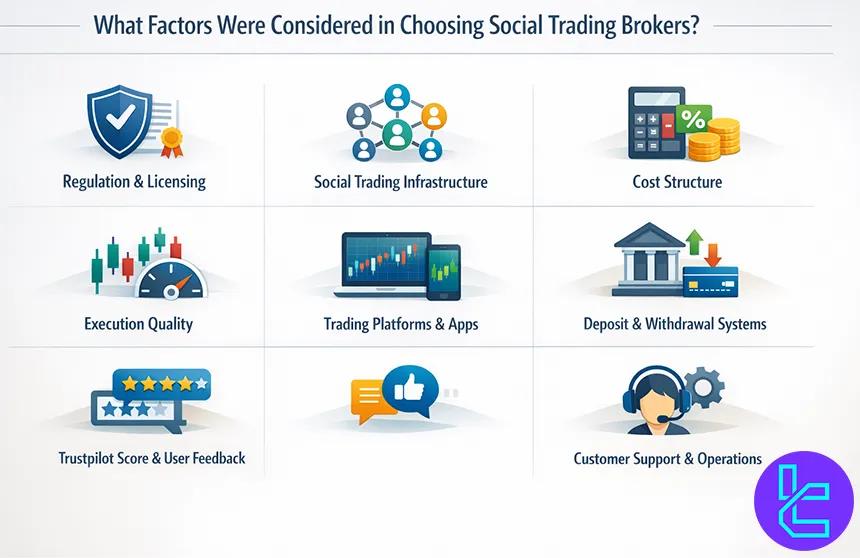
TradingFinder applies a structured methodology based on 19 data metrics to ensure objective, transparent, and data-driven broker selection.
The evaluation focuses on factors that directly influence copy trading accuracy, user experience, and capital safety. The most important criteria include:
- Regulation and Licensing: Verification of broker oversight, fund segregation policies, and investor protection mechanisms;
- Social Trading Infrastructure: Availability of copy trading platforms, performance dashboards, leaderboards, and risk scoring systems;
- Cost Structure: Analysis of spreads, commissions, copy trading fees, and non-trading charges affecting net returns;
- Execution Quality: Speed and accuracy of trade replication, slippage control, and liquidity access during volatile conditions;
- Trading Platforms and Apps: Support for MT4, MT5, cTrader, proprietary apps, and mobile trading environments;
- Deposit and Withdrawal Systems: Processing speed, fee transparency, and operational reliability;
- Trustpilot Score and User Feedback: Real user experience related to withdrawals, platform stability, and copy execution performance;
- Customer Support and Operations: Responsiveness of support teams, availability of help centers, and efficiency in resolving issues.
This comprehensive approach ensures that selected social trading brokers provide not only advanced copy trading tools, but also transparency, execution reliability, and user-focused infrastructure required for consistent long-term performance.
What is Social Trading?
Social trading is a modern trading approach that allows individuals to observe, interact with, and replicate the strategies of other traders within a shared platform. Instead of relying solely on personal analysis, users can follow experienced traders and automatically copy their positions in real time.
This model bridges the gap between independent trading and managed accounts. Unlike PAMM or MAM systems, capital remains fully controlled by the user, while trade execution is mirrored based on selected strategies. Social trading platforms typically provide access to detailed performance metrics, including return percentage, drawdown, win rate, and trade history.
The concept relies heavily on transparency and community-driven insights. Traders can evaluate strategy providers based on actual data rather than marketing claims, creating a more data-oriented decision-making process.
Social trading is widely used by beginners seeking guided market exposure and by experienced traders aiming to diversify strategies without increasing screen time. However, success depends on selecting reliable traders and understanding associated risks.
Pros and Cons of Social Trading
Social trading simplifies market entry but still requires careful evaluation of risk and strategy consistency.
Pros | Cons |
Access to experienced traders’ strategies | No guarantee of profitability |
Passive trading with minimal effort | Risk of following poor-performing traders |
Full control over funds | Exposure to market volatility |
Transparent performance metrics | Over-reliance on others’ decisions |
Easy diversification across strategies | Slippage in trade replication |
Flexible allocation and stop options | Fees may reduce net returns |
Key Features of Social Trading Platforms
Social trading platforms combine trading infrastructure with social interaction tools.
- Strategy provider profiles with performance statistics
- Leaderboards ranking traders by returns and risk
- Real-time trade replication systems
- Risk management tools (stop copy, allocation limits)
- Transparent historical data (drawdown, win rate, trade history)
- Community interaction (comments, signals, insights)
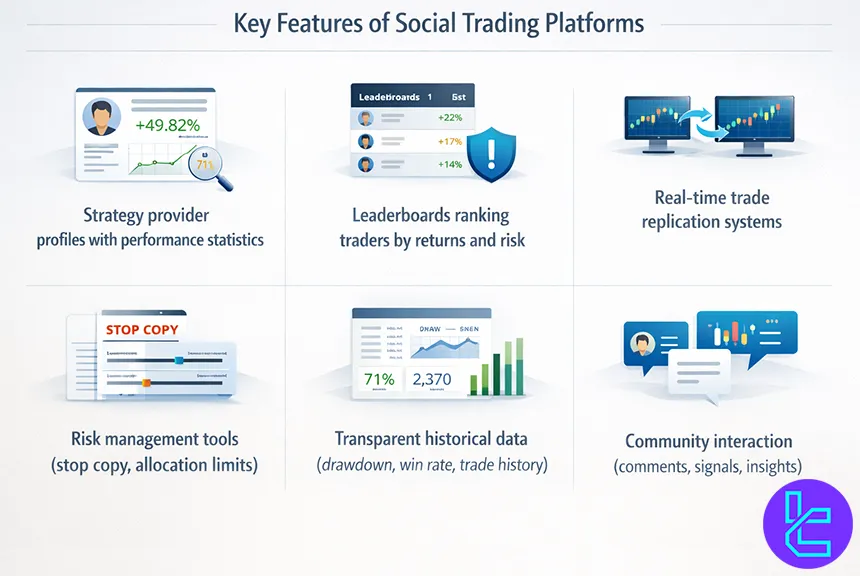
These features allow users to make data-driven decisions while maintaining flexibility and control over their investments.
How Do Social Trading Platforms Operate?
The operational process follows a structured workflow:
- User opens an account with a social trading broker
- Funds are deposited into the trading account
- User selects one or more strategy providers
- Capital allocation is defined (fixed or proportional)
- Trades are copied automatically in real time
- Performance is monitored through dashboards
- User can adjust or stop copying at any time
Execution is handled by the broker’s infrastructure, ensuring synchronization between the provider and followers. However, minor variations may occur due to latency or pricing differences.
Can All Traders Use Social Trading?
Social trading is accessible to a wide range of users, but suitability depends on experience and objectives.
- Beginners: Can gain exposure without deep technical knowledge
- Intermediate traders: Use it for diversification
- Professional traders: Act as strategy providers and earn fees
- Passive investors: Allocate capital without active involvement
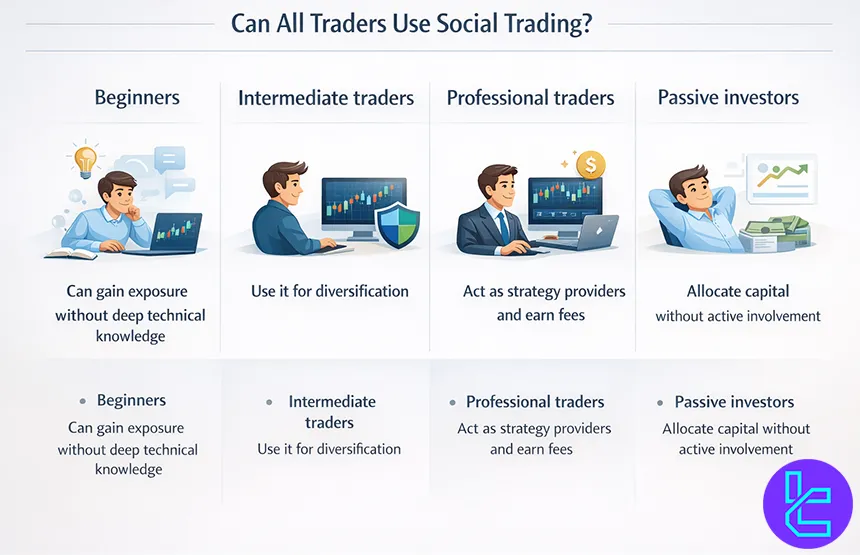
While entry barriers are low, users must still understand risk metrics such as drawdown and leverage. Social trading does not eliminate the need for basic financial awareness.
Legal Framework of Social Trading Platforms
The legal classification of social trading varies by jurisdiction, often falling under investment advisory or portfolio management regulations.
Key regulatory aspects include:
- Broker licensing under authorities like FCA, CySEC, or ASIC
- Transparency requirements for strategy performance
- Investor protection measures such as segregated funds
- Compliance with AML and KYC procedures
- Restrictions on marketing or performance claims
In regulated environments, stricter rules apply to ensure fairness and transparency. Offshore platforms may offer fewer protections but more flexibility.
What Methods Are Part of Social Trading?
Social trading includes several execution models:
- Copy Trading: Direct replication of trades into user accounts
- Mirror Trading: Automated strategy execution based on predefined systems
- Signal Trading: Manual execution based on alerts from providers
- Community Trading: Sharing ideas without automatic execution
Each method offers different levels of control and automation. Copy trading remains the most widely used due to its simplicity and real-time execution.
What Markets Are Available in Social Trading?
Social trading is not limited to Forex. Most brokers offer multi-asset access:
- Forex pairs (EUR/USD, GBP/USD, etc.)
- Cryptocurrencies (BTC, ETH, altcoins)
- Indices (S&P 500, NASDAQ, DAX)
- Commodities (gold, oil, silver)
- Stocks and ETFs
- Bonds and other CFDs
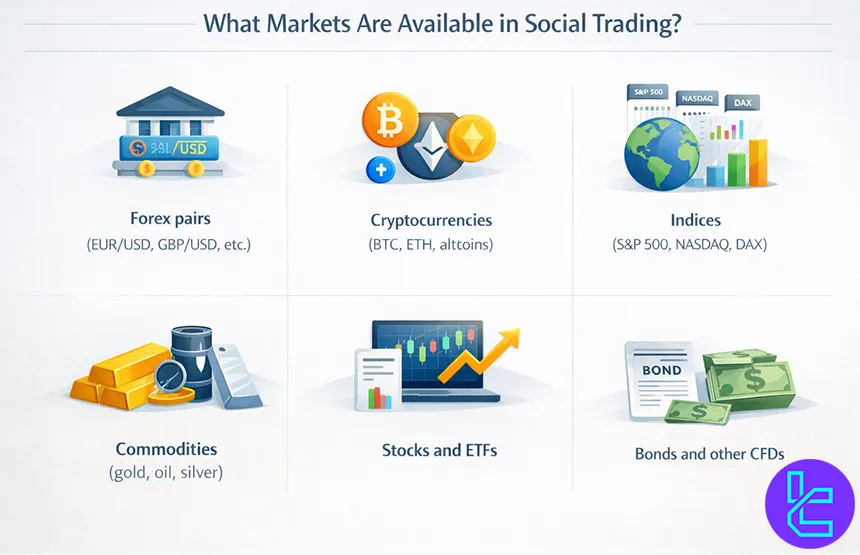
The availability of markets depends on the broker’s asset coverage. A broader selection allows for better diversification and strategy flexibility.
How Much Is Needed to Start Social Trading?
In addition to broker requirements, individual strategy providers may set minimum allocation thresholds. Table below provides a glance of typical minimum deposits for social trading:
Broker Type | TypicalMinimum Deposit |
Entry-Level Brokers | $10 - $100 |
Mid-Tier Brokers | $100 - $500 |
Advanced Platforms | $500 - $2,000+ |
What Charges Are Involved in Social Trading?
Understanding the full cost structure in social trading is essential because fees directly impact net profitability. Unlike traditional trading, where costs are limited to spreads and commissions, social trading introduces additional layers such as performance fees and copy-related charges.
The total cost of social trading typically includes the following components:
Cost Type | Description |
Spread | Difference between bid and ask price applied to each copied trade |
Commission | Charged per lot on ECN or raw spread accounts |
Performance Fee | Percentage of profits paid to the strategy provider |
Management Fee | Fixed fee charged periodically by some providers |
Copying Fee | Subscription or fixed fee for accessing a strategy |
Swap Fees | Overnight charges for holding positions |
Deposit/Withdrawal Fees | Payment processing or broker-side charges |
Performance fees are the most distinctive element in social trading. These are usually calculated based on a high-water mark model, meaning the strategy provider earns a percentage only on new profits above previous peaks. This aligns incentives between followers and traders.
In addition, some platforms charge subscription-based fees for accessing premium strategies or advanced analytics tools. These costs may be fixed monthly or dependent on account size.
Traders should also consider indirect costs such as slippage, which occurs when copied trades are executed at slightly different prices than the original position. This can accumulate over time, especially in high-frequency strategies.
Comparing Social Trading with Other Trading Models
Social Trading has introduced a more interactive and community-driven approach to financial markets, allowing traders to follow, analyze, and replicate the strategies of others. Unlike structured systems such as MAM or PAMM account, which rely on professional fund managers, social trading emphasizes transparency, peer interaction, and user-driven decision-making.
It bridges the gap between manual trading and full automation, offering flexibility while still exposing users to market risks. The table below compares Social Trading with other widely used trading models in Forex and CFD markets.
Parameter | Social Trading | Copy Trading | PAMM | MAM | Self-Directed Trading |
Core Concept | Community-based idea sharing and interaction | Automatic replication of trades | Pooled funds managed by a trader | Multi-account management by a professional | Individual manual trading decisions |
Trade Execution | Manual or semi-automated | Fully automated copying | Executed by fund manager | Executed by manager across accounts | Fully manual by trader |
User Control | High (choose, filter, decide) | Moderate (can start/stop copying) | Very low | Moderate to high | Full control |
Transparency | High (profiles, stats, history visible) | High (real-time trade tracking) | Medium (performance reports) | High (account-level reporting) | Depends on trader discipline |
Skill Requirement | Low to medium | Low | None required | Low | High |
Customization | High | Medium | Low | High | Very high |
Risk Exposure | Depends on chosen traders | Linked to copied strategy | Shared across pooled funds | Adjustable per account | Fully dependent on trader |
Minimum Investment | Low | Low to medium | Medium to high | Medium to high | Flexible |
Fees Structure | Platform-based or spread markup | Spread/commission or profit share | Performance fee (profit split) | Performance or management fee | Trading costs only (spread/commission) |
Best For | Traders seeking ideas and community insights | Beginners seeking automation | Passive investors | Professional capital managers | Experienced and independent traders |
Conclusion
Social trading has reshaped participation in Forex markets by combining real-time execution with transparent, community-driven decision-making. Instead of relying solely on personal analysis, traders can evaluate verified performance data, copy strategies, and diversify capital across multiple providers.
This model offers a flexible balance between control and automation, making it suitable for both beginners and experienced investors seeking efficiency and scalability.
To understand how we curated this list of brokers, please visit our Forex methodology page for full details.