








Some traders and investors work with larger numbers which might affect spreads and other trading fees. Certain brokers provide better conditions for this group of clients with specific accounts, such as pro, premium, etc., or other measurements.
The shortlist in this review contains some of the best brokerages for those with large investments.
 | fpmarkets | |||
 | FUSION MARKETS | |||
 | BlackBull | |||
| 4 |  | Libertex | ||
| 5 |  | JustMarkets | ||
| 6 |  | FBS | ||
| 7 |  | pepperstone | ||
| 8 |  | octa |
Submitted Trustpilot Ratings for Select Brokers
The table below demonstrates the user scores and reviews for introduced brokerages. The brands are ranked according to the rating.
Broker Name | Trustpilot Rating | Number of Reviews |
9,990 | ||
6,258 | ||
BlackBull Markets | 3,126 | |
JustMarkets | 4.4/5⭐ | 4,355 |
FBS | 8,634 | |
Pepperstone | 3,213 | |
OctaFX | 9,055 | |
Libertex | 4,260 |
Minimum Spreads in Mentioned Brokerages
Brokers put differences between bid and ask brokers as spreads. These costs vary based on the account type, market behaviors, etc.
Broker Name | Min. Spread |
FxPro | 0 Pips |
0 Pips | |
Global Prime | 0 Pips |
Pepperstone | 0 Pips |
0.1 Pip | |
IG | 0.3 Pips |
OctaFX | 0.6 Pips |
FBS | 0.7 Pips |
Account Types and Leverage Limitations Ranking
For high-volume investors and traders, choosing an account type is a crucial part of signing up for a broker. The table below provides account types and maximum leverage levels for each brokerage.
Broker Name | Account Types | Max. Leverage |
Libertex | Demo, Real, Invest, MT4, MT5 | Up To 1:30 For Retail Clients Up To 1:600 For Professional Accounts |
Standard Cent, Standard, Pro, Raw Spread | 1:3000 | |
Eightcap | Standard, Raw, TradingView, Demo | 1:500 |
FxPro | Standard, Raw+, Elite | 1:500 |
OctaFX | MT4, MT5, OctaTrader | 1:1000 |
Global Prime | Standard, Raw | 1:500 |
Pepperstone | Standard, Razor | Up to 1:500 |
Standard | 1:3000 |
Tradable Instruments in Large Account Brokers
Last but not least, here’s a table sorting the list of brokerages based on the number of the available instruments and asset classes.
Broker Name | Number of Instruments |
XTB | 36,400+ |
1,200+ | |
Eightcap | 800+ |
FBS | 550+ |
Libertex | 300+ |
270+ | |
Global Prime | 150+ |
JustMarkets | 90+ |
Top 6 Large Account Forex Brokers in Detail
The next sections will review six of the recommended brokerages covering important specifics and parameters.
FP Markets
FP Markets, founded in 2005 as First Prudential Markets, is a multi-regulated Australian brokerage serving global clients for nearly two decades. It operates under top-tier regulators such as Australian Securities and Investments Commission (ASIC) and Cyprus Securities and Exchange Commission (CySEC), reinforcing institutional-grade oversight.

The broker offers Standard and RAW accounts with floating spreads from 0.0 pips and a minimum deposit of $50. Under CySEC (license 371/18), eligible EU clients may access investor compensation up to €20,000, while segregated funds and negative balance protection apply across regulated entities.
FP Markets provides access to 10,000+ instruments across Forex, share CFDs, indices, commodities, ETFs, metals, and cryptocurrencies. Trading is supported via MetaTrader 4, MetaTrader 5, and cTrader, enabling manual, algorithmic, and ECN-style execution with minimum order sizes from 0.01 lots.
For large-account traders, the broker’s professional account offers leverage up to 1:500 (subject to eligibility), competitive RAW commissions from $3 per lot, and margin call/stop-out levels at 100%/50%. Leadership under Craig Allison, Head of EMEA, emphasizes regulatory compliance, digital expansion, and operational transparency.
You can open an account via our FP Markets registration tutorial. Here’s a table of specifics.
Account Types | Standard, RAW |
Regulating Authorities | ASIC, CySEC, FSC, FSCA, FSA |
Minimum Deposit | $50 |
Deposit Methods | Visa and Master card, Skrill, PayPal, Neteller, Bank Transfer |
Withdrawal Methods | Visa and Master card, Skrill, PayPal, Neteller, Bank Transfer |
Maximum Leverage | 1:500 |
Trading Platforms & Apps | MT4, MT5, cTrader |
FP Markets Pros and Cons
The broker combines multi-jurisdictional regulation, low entry barriers, and deep multi-asset access, making it relevant for both mid-sized and large trading accounts. Below is a structured overview of its primary strengths and operational limitations.
Pros | Cons |
Regulated by ASIC and CySEC (Tier-1 oversight) | Not available to U.S. residents |
RAW spreads from 0.0 pips with transparent commission | No proprietary trading platform |
Access to 10,000+ instruments across 7 asset classes | Investor protection varies by entity |
Supports MT4, MT5, and cTrader with algo & copy trading | Professional leverage requires eligibility criteria |
Fusion Markets
Founded in 2019 by Phil Horner, Fusion Markets operates under Gleneagle Securities Pty Limited (Company No. 40256) and is regulated by the Australian Securities and Investments Commission (ASIC) and the Vanuatu Financial Services Commission (VFSC). This dual-jurisdiction structure supports international client coverage with tiered leverage up to 1:500.
The broker is backed by Glen Eagle Securities, an Australian financial services firm managing over $400 million in client funds. All client balances are held in segregated accounts with HSBC and National Australia Bank (NAB), reinforcing operational transparency for large-account traders seeking institutional-grade fund handling.
Fusion Markets offers Zero, Classic, and Swap-Free accounts with no minimum deposit requirement. Spreads start from 0.0 pips (Zero) with a $4.5 commission per lot, while the Classic account provides spreads from 0.9 pips with $0 commission. Maximum leverage reaches 1:500 under VFSC and 1:30 under ASIC.
Traders gain access to 250+ instruments, including 55 forex pairs, 1,000+ US share CFDs, indices, metals, energy, and cryptocurrencies.
Platforms include MetaTrader 4, MetaTrader 5, TradingView, and cTrader, supported by ultra-fast execution (~0.02ms), VPS hosting, MAM/PAMM, and Fusion+ copy trading. To access all features, you should pass the Fusion Markets verification process. Here are the broker’s specifics.
Account Types | Zero, Classic, Swap-Free |
Regulating Authorities | ASIC, VFSC |
Minimum Deposit | $0 |
Deposit Methods | VISA, MasterCard, PayPal, Perfect Money, PayID, Bank Wire, Crypto, Skrill, Neteller, etc. |
Withdrawal Methods | PayPal, Perfect Money, Bank Wire, Crypto, Skrill, Neteller, etc. |
Maximum Leverage | 1:500 |
Trading Platforms & Apps | MetaTrader 4, MetaTrader 5, TradingView, cTrader |
Fusion Markets Pros and Cons
For high-volume and large-balance traders, Fusion Markets stands out for cost efficiency and execution speed. However, its limited proprietary tools and absence of an investor compensation scheme under some jurisdictions should be evaluated before capital allocation.
If you are willing to go through Fusion Markets registration, do not overlook this section.
Pros | Cons |
Ultra-low spreads from 0.0 pips | No investor compensation scheme |
No minimum deposit requirement | Limited proprietary research tools |
Regulated by ASIC and VFSC | Relatively new broker (est. 2019) |
1,000+ US share CFDs with $0 commission | Educational resources less comprehensive than top-tier competitors |
BlackBull Markets
Founded in 2014 by Michael Walker and Selwyn Loekman, Black Bull Group Limited is a New Zealand-based brokerage offering access to 26,000+ instruments across six asset classes. The broker has earned 7 industry awards and serves global traders through institutional-grade ECN infrastructure.
BlackBull Markets operates under the supervision of the Financial Markets Authority (FMA) in New Zealand and the Financial Services Authority (FSA) in Seychelles. Client funds are held in segregated accounts with tier-1 banking partners, and eligible New Zealand clients benefit from FSCL dispute resolution membership (5623).
For large-account traders, the broker provides ECN Standard, ECN Prime, and ECN Institutional accounts with spreads from 0.0 pips and commissions starting at $0. Institutional accounts require a $20,000 minimum deposit and offer customizable liquidity via Equinix NY4/LD5 servers.
BlackBull supports MT4, MT5, cTrader, TradingView, BlackBull Invest, and its proprietary CopyTrader platform. With leverage up to 1:500, API trading, PAMM solutions, and 24/7 multilingual support, it caters to active traders, money managers, and high-volume participants.
Table of Parameters and Details
Account Types | ECN Standard, ECN Prime, ECN Institutional |
Regulating Authorities | FSA, FMA |
Minimum Deposit | $0 |
Deposit Methods | Visa, MasterCard, Apple Pay, Google Pay, Bank Wire, Crypto, Neteller, Skrill, SEPA, FasaPay |
Withdrawal Methods | Visa, MasterCard, Apple Pay, Google Pay, Bank Wire, Crypto, Neteller, Skrill, SEPA, FasaPay |
Maximum Leverage | 1:500 |
Trading Platforms & Apps | MT4, MT5, TradingView, cTrader, BlackBull CopyTrader, BlackBull Invest |
BlackBull Markets Pros and Cons
For high-capital traders, BlackBull Markets combines raw-spread pricing, deep liquidity, and multi-asset coverage. However, leverage caps, regional restrictions, and withdrawal processing fees should be factored into the overall cost structure and regulatory scope. Check out these pros and cons before BlackBull Markets registration.
Pros | Cons |
26,000+ instruments including 23,000+ share CFDs | $5 withdrawal processing fee per transaction |
Tier-1 FMA regulation with segregated funds | Institutional account requires $20,000 minimum deposit |
Spreads from 0.0 pips with ECN pricing | Not available to U.S. and several restricted jurisdictions |
Multi-platform support (MT4, MT5, cTrader, TradingView) | Crypto leverage capped at 1:100 |
JustMarkets
Founded in 2012 and headquartered in Mahe, Seychelles, JustMarkets serves over 2 million traders across 160+ countries. The broker was named “Best CFD Broker” at the UF Awards MEA 2024, strengthening its positioning among large-account forex brokers with competitive trading conditions and scalable leverage.
JustMarkets operates through multiple regulated entities, including oversight from the Seychelles FSA, CySEC, FSCA, and FSC (Mauritius and BVI). The CySEC branch provides access to the Investor Compensation Fund (ICF) with protection up to €20,000, while all entities enforce segregated accounts and negative balance protection.
The broker offers four account types, including Standard Cent, Standard, Pro, and Raw Spread, with minimum deposits from $10 and leverage up to 1:3000 (jurisdiction-dependent). Floating spreads start from 0.0 pips, and Raw Spread accounts charge $3 per side per lot, supporting both retail and high-volume traders.
Clients can trade 90+ instruments across Forex, commodities, indices, cryptocurrencies, and stocks via MT4, MT5, and mobile apps. With 10+ base currencies, JustMarkets copy trading integration, VPS support, and up to 100 simultaneous positions, the broker accommodates diversified portfolio strategies.
Specifications and Features
Account Types | Standard Cent, Standard, Pro, Raw Spread |
Regulating Authorities | CySEC, FSA, FSCA, FSC |
Minimum Deposit | From $10 |
Deposit Methods | Bank transfer, E-payments, Credit/Debit cards, Crypto, Local banks |
Withdrawal Methods | Bank transfer, E-payments, Credit/Debit cards, Crypto, Local banks |
Maximum Leverage | 1:3000 |
Trading Platforms & Apps | MT4, MT5, Mobile App |
JustMarkets Pros & Cons
For large-account traders, this brokerage combines high leverage flexibility, fast withdrawals, and multi-jurisdiction regulation. However, asset depth and regional restrictions may influence suitability, as outlined below. Check out the table here before JustMarkets registration.
Pros | Cons |
Multi-regulated (CySEC, FSA, FSCA, FSC) | Limited total instrument count compared to top-tier brokers |
Leverage up to 1:3000 (non-EU entities) | Geo-restrictions (US, UK, EU, etc.) |
Spreads from 0.0 pips with Raw accounts | Inactivity fee after 150 days |
Wide crypto deposit/withdrawal options (TRC20, BTC, ETH, etc.) | Mixed third-party review ratings (e.g., ForexPeaceArmy) |
FBS
Founded in 2009, FBS has grown into a global brokerage serving over 27 million users. Operating through entities such as Cyprus Securities and Exchange Commission (License 331/17), Financial Services Commission of Belize, and ASIC-regulated branches, it maintains a multi-jurisdictional regulatory footprint.
FBS provides access to 550+ CFD instruments across Forex, indices, metals, shares, commodities, and cryptocurrencies. Traders can operate via MetaTrader 4, MetaTrader 5, and a proprietary mobile app featuring 90+ technical indicators and integrated account management tools.
The Standard account structure offers floating spreads from 0.7 pips with zero commission. Maximum leverage reaches 1:3000 (FSC entity), while EU clients under CySEC benefit from ICF coverage up to €20,000 and negative balance protection under stricter leverage limits.
For discount on fees and spreads, you may participate in the FBS rebate program.
With a minimum deposit starting from $5-$15 depending on region, order sizes from 0.01 lots, 500 maximum open positions, and 40%/20% margin call-stop out levels, FBS positions itself as a scalable broker for both entry-level and large-volume CFD traders. Here are the broker’s parameters.
Account Types | Standard |
Regulating Authorities | FSC, CySEC |
Minimum Deposit | $5 |
Deposit Methods | Bank Transfers, Payment Systems, Credit/Debit Cards |
Withdrawal Methods | Bank Transfers, Payment Systems, Credit/Debit Cards |
Maximum Leverage | 1:3000 |
Trading Platforms & Apps | MT4, MT5, Mobile App |
FBS Pros & Cons
Before going through with FBS registration, check out a concise breakdown of the broker’s core strengths and structural limitations for large account and high-leverage traders here.
Pros | Cons |
Multi-regulated (CySEC, ASIC, FSC) | Only one primary retail account type |
Spreads from 0.7 pips with $0 commission | No PAMM or copy trading service |
High leverage up to 1:3000 (offshore entity) | Restricted in US, UK, and EU (global branch) |
90+ indicators on proprietary mobile app | Index spreads slightly above industry average |
Pepperstone
Founded in 2010 in Melbourne, Pepperstone has evolved into a global forex and CFD broker serving over 400,000 clients. The company processes an average of $9.2 billion in daily trading volume, reflecting deep liquidity access and strong institutional-grade execution infrastructure.
Pepperstone operates under multiple regulators, including Australian Securities and Investments Commission (ASIC), Financial Conduct Authority (FCA), Cyprus Securities and Exchange Commission (CySEC), Dubai Financial Services Authority (DFSA), Federal Financial Supervisory Authority (BaFin), and Capital Markets Authority (CMA). Client funds are held in segregated accounts, with negative balance protection applied across regulated entities.
For large account traders, Pepperstone supports 10 base currencies (AUD, USD, GBP, JPY, EUR, CAD, CHF, NZD, SGD, HKD) and leverage up to 1:500 (jurisdiction-dependent). Order sizes range from 0.01 to 100 lots, accommodating both precision entries and high-volume execution.
The broker offers two primary accounts, including Standard (spread-only pricing) and Razor (raw spreads from 0.0 pips with commission). Platforms include MetaTrader 4, MetaTrader 5, cTrader, TradingView, and a proprietary web/mobile solution, supporting EAs, hedging, and scalping strategies.
Note that you can participate in the Pepperstone rebate program to reduce your trading costs. The table below summarizes the broker’s specifications.
Account Types | Standard, Razor |
Regulating Authorities | ASIC, SCB, FCA, DFSA, CMA, BaFin, CySEC |
Minimum Deposit | $1 |
Deposit Methods | Apple Pay, Google Pay, Visa, Mastercard, Bank transfer, PayPal, Neteller, Skrill, Union Pay, USDT, ZotaPay |
Withdrawal Methods | Apple Pay, Google Pay, Visa, Mastercard, Bank transfer, PayPal, Neteller, Skrill, Union Pay, USDT, ZotaPay |
Maximum Leverage | Up to 1:500 |
Trading Platforms & Apps | Proprietary Platform, cTrader, Trading View, MetaTrader 4&5 |
Pepperstone Pros & Cons
Pepperstone combines regulatory depth, platform diversity, and high liquidity access, but like any broker, it has operational trade-offs. Below is a balanced overview of its main advantages and limitations for large account traders.
Pros | Cons |
Regulated by multiple Tier-1 authorities (ASIC, FCA, BaFin, CySEC) | Leverage capped at 1:30 under EU/UK regulation |
Processes $9.2B average daily trading volume | No traditional bonuses or promotions |
Raw spreads from 0.0 pips on Razor account | No PAMM or structured asset management accounts |
Supports MT4, MT5, cTrader, TradingView & proprietary platform | Certain countries (e.g., US, Canada) are restricted |
What is the Framework for Choosing Each broker?
Choosing the best large account forex brokers requires more than reviewing spreads or leverage. At TradingFinder, our analysts apply a structured, data-driven framework built on 19 evaluation metrics to ensure transparency, objectivity, and capital protection for high-net-worth traders and professional investors.
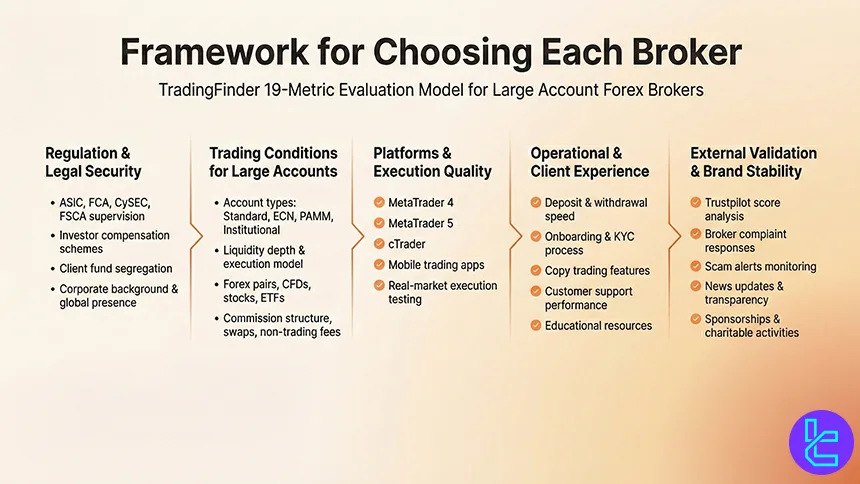
Our first layer of analysis focuses on Regulations and Licenses, verifying supervision by authorities such as ASIC, FCA, CySEC, and FSCA, alongside investor compensation schemes and asset segregation policies. We also examine the broker’s corporate background, including founding year, headquarters, operational history, and global office presence to assess institutional reliability.
Next, we evaluate trading conditions critical for large accounts: account type diversity (Standard, ECN, PAMM, Institutional), depth of liquidity, range of tradable symbols (Forex pairs, CFDs, stocks, ETFs), commission structures, swap policies, and non-trading fees.
Execution quality, access to MetaTrader 4, MetaTrader 5, cTrader, and mobile apps are tested directly to measure performance under real market conditions.
Operational efficiency is another core pillar. We review deposit and withdrawal speed, onboarding and KYC processes, copy trading features, customer support responsiveness, and educational resources.
External validation includes Trustpilot scores, broker responses to complaints, scam alerts, and ongoing news updates. Even sponsorships and charitable activities are considered as indicators of long-term brand stability.
By combining quantitative data, hands-on testing, and expert market insight, TradingFinder ensures that each broker listed in this article meets the standards required for managing substantial trading capital with confidence and security.
What is a Large Account?
In the forex market, a large account generally refers to a trading account funded with a substantial capital base, typically starting from $10,000 to $50,000 and often exceeding $100,000 or more, depending on broker classification.
Some institutions define large or professional accounts at even higher thresholds, particularly in prime brokerage environments.
Unlike micro or standard retail accounts, large accounts are often associated with professional traders, high-net-worth individuals (HNWIs), asset managers, and proprietary trading firms.
These accounts may qualify for enhanced trading conditions such as tighter spreads, lower commission tiers, priority liquidity routing, and higher execution quality due to larger order sizes and institutional-grade infrastructure.
From a regulatory standpoint, certain jurisdictions (e.g., under FCA, ASIC, or CySEC) distinguish between retail and professional clients. Traders operating large accounts may opt for professional classification, which can provide higher leverage but may reduce access to investor compensation schemes.
Capital size, trading experience, and portfolio value are typically part of eligibility criteria.
Risk exposure is significantly amplified in large accounts. A 1% move on a $100,000 account equals $1,000 in fluctuation, making risk management, position sizing, margin requirements, and liquidity depth critical factors.
For this reason, brokers serving large accounts must demonstrate strong financial stability, transparent pricing, fast execution, and reliable withdrawal systems.
In practical terms, a large account is defined not only by balance size but by the level of capital efficiency, execution precision, and regulatory safeguards required to manage substantial trading exposure.
Pros and Cons of Trading with Large Accounts
Trading with a large forex account provides capital flexibility, improved pricing tiers, and access to institutional-grade liquidity. However, higher exposure increases absolute risk and psychological pressure.
Larger balances may qualify for tighter spreads and VIP conditions, yet regulatory classifications and margin requirements can differ significantly from standard retail accounts.
Pros | Cons |
Access to tighter spreads and volume-based commission discounts | Larger absolute drawdowns during adverse market moves |
Higher capital efficiency with diversified position sizing | Increased psychological pressure due to capital size |
Eligibility for VIP, Pro, or Institutional account tiers | Potential reduction in investor protection under professional status |
Improved execution quality and deeper liquidity access | Slippage risk when placing very large orders in low-liquidity conditions |
How Can I Set Up a Large Account?
Setting up a large forex trading account involves more than depositing a high amount of capital. Brokers apply enhanced due diligence, regulatory classification checks, and risk disclosures, especially when balances exceed $10,000-$50,000 or when applying for Pro or Institutional accounts.
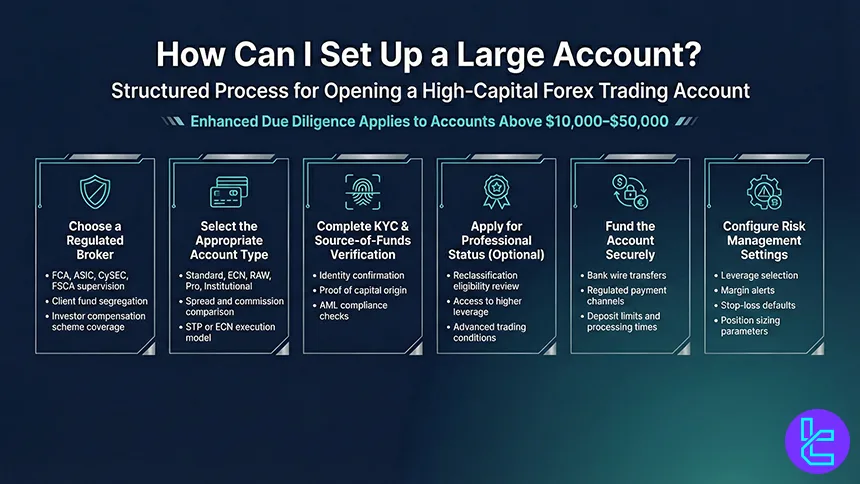
Follow these key steps:
- Choose a Regulated Broker: Verify licenses under authorities such as FCA, ASIC, CySEC, or FSCA, and confirm segregation of client funds and compensation scheme coverage;
- Select the Appropriate Account Type: Compare Standard, ECN, RAW, Pro, or Institutional accounts based on spreads, commissions, and execution model (STP/ECN);
- Complete KYC and Source-of-Funds Verification: Large deposits often require enhanced identity verification and proof of capital origin under AML regulations;
- Apply for Professional Status (Optional): If eligible, request reclassification to access higher leverage or advanced trading conditions;
- Fund the Account Securely: Use bank wire transfers or regulated payment channels; confirm deposit limits and processing times;
- Configure Risk Management Settings: Set leverage levels, margin alerts, stop-loss defaults, and position sizing parameters before trading.
Before activating large capital exposure, test execution quality, spreads, and withdrawal reliability under real market conditions. Large accounts demand robust liquidity access, transparent pricing, and strict risk management discipline to operate efficiently.
Do Large Accounts Have Wide Spreads?
In most cases, large forex accounts do not face wider spreads. In fact, traders with higher balances often receive tighter spreads and better pricing tiers, especially under ECN, RAW, or Institutional account structures. Brokers typically reward higher trading volumes and larger deposits with reduced markups.
Spread structure depends primarily on the broker’s execution model (Market Maker vs. STP/ECN) and underlying liquidity providers, not the account size alone.
For example, ECN accounts connected to deep liquidity pools may offer spreads from 0.0 pips on major pairs like EUR/USD, with commissions applied separately.
Large account holders frequently qualify for lower commission brackets based on monthly traded volume.
However, order size matters. When placing very large single-ticket trades, particularly during low-liquidity sessions or high-impact news events, temporary spread widening or slippage can occur. This is a function of market depth, not account balance.
In regulated environments under authorities such as FCA, ASIC, or CySEC, brokers must maintain transparent pricing policies. Professional or VIP clients may access institutional-grade liquidity, but they are still subject to real market conditions.
In summary, large accounts generally benefit from competitive spreads, provided the broker offers robust liquidity access and a transparent pricing model.
Do Large Accounts Affect Non-Trading Fees?
In most regulated forex brokerages, non-trading fees, such as deposit charges, withdrawal fees, inactivity fees, and currency conversion costs, are not directly determined by account balance size. However, traders with large accounts may qualify for preferential fee structures under VIP, Pro, or Institutional tiers.
For example, many brokers waive withdrawal fees for high-volume or high-balance clients, especially when using bank wire transfers. Similarly, inactivity fees may be reduced or removed for premium accounts. That said, third-party banking charges and currency conversion spreads still apply, regardless of capital size.
Large accounts may also benefit from dedicated account managers, faster withdrawal processing, and higher transaction limits.
However, these advantages depend on broker policy rather than regulation. Under high-tier authorities, brokers must disclose all non-trading costs transparently.
In short, while large accounts do not automatically eliminate non-trading fees, they often provide leverage in negotiating improved terms, particularly when trading volume and capital commitment are substantial.
Who Should Invest in Large Accounts?
Large forex accounts are generally suitable for traders with substantial capital, proven experience, and structured risk management strategies. Typically, these include professional traders, high-net-worth individuals (HNWIs), portfolio managers, and proprietary trading firms operating with balances above $10,000–$100,000 or more.
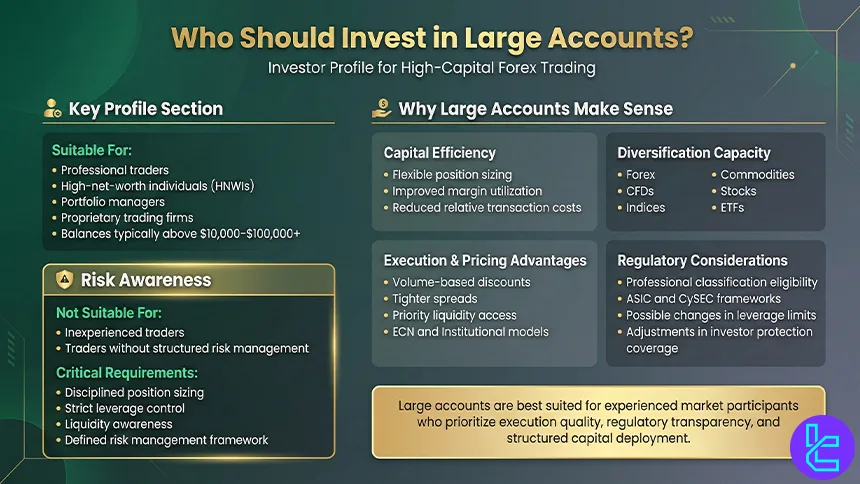
Investors who benefit most from large accounts are those who require capital efficiency, diversification across multiple asset classes (Forex, CFDs, indices, commodities, stocks, ETFs), and institutional-grade execution.
Larger balances allow more flexible position sizing, reduced relative transaction costs, and improved margin utilization.
Traders seeking volume-based discounts, tighter spreads, and priority liquidity access under ECN or Institutional account models may also consider large accounts. However, eligibility for professional classification under regulators such as ASIC or CySEC may alter leverage limits and investor protection coverage.
Large accounts are not ideal for inexperienced traders or those without a defined risk management framework. Because absolute drawdowns increase proportionally with capital size, disciplined position sizing, leverage control, and liquidity awareness are essential.
In summary, large accounts are best suited for experienced market participants who prioritize execution quality, regulatory transparency, and structured capital deployment in global financial markets.
Is Swap-Free Option Available in Large Accounts?
Yes, swap-free (Islamic) accounts are often available for large forex accounts, but availability depends on the broker’s policy and regulatory jurisdiction. Many regulated brokers offer swap-free structures designed to comply with Shariah principles, where overnight interest (swap) charges are removed.
For large accounts, swap-free conditions may still apply; however, brokers often introduce administrative fees or fixed holding charges after a specific number of days to offset liquidity costs. These fees are typically disclosed in advance and vary by instrument (Forex majors, metals, indices, etc.).
Institutional or ECN large accounts may also provide customized swap-free terms, especially for high-volume traders. That said, not all asset classes qualify; cryptocurrency CFDs, certain indices, or exotic pairs may have different rules.
Regulated brokers must clearly disclose whether swap-free status is permanent or subject to time limits. Some providers periodically review accounts to prevent misuse of swap-free features for arbitrage strategies.
In summary, swap-free options are commonly available in large accounts, but traders should carefully review the fee structure, holding conditions, and instrument eligibility before activating this feature.
What Should I Consider Before Choosing a Large Account Forex Broker?
Selecting a broker for a large forex account requires stricter due diligence than opening a standard retail account. When significant capital is involved, execution quality, regulatory protection, and operational transparency become critical risk factors.
Before choosing a broker, consider the following.
Regulatory Strength & Client Fund Protection:
- Verify licenses under top-tier regulators;
- Confirm segregation of client funds;
- Review eligibility for investor compensation schemes;
- Check financial transparency and corporate structure.
Liquidity & Execution Model:
- Determine whether the broker operates under ECN, STP, or Market Maker models;
- Assess depth of liquidity for large order sizes;
- Review slippage statistics and order execution speed;
- Confirm access to institutional liquidity providers.
Cost Structure & Pricing Transparency:
- Compare spreads on major pairs like EUR/USD;
- Analyze commission tiers for high-volume trading;
- Review swap rates, rollover policies, and administrative fees;
- Check for hidden non-trading fees (withdrawal, inactivity, conversion).
Withdrawal Reliability & Capital Safety:
- Test withdrawal processing times;
- Review transaction limits for large wire transfers;
- Confirm AML/KYC procedures for high-value deposits.
Platform Stability & Risk Tools:
- Ensure compatibility with MetaTrader 4, MetaTrader 5, or cTrader;
- Evaluate margin alerts, stop-out levels, and leverage controls;
- Check infrastructure uptime and mobile access.
When trading substantial capital, the broker’s financial stability, regulatory credibility, and liquidity access matter more than promotional bonuses or high leverage.
Large Accounts in Comparison to Other Common Account Types
Large trading accounts are typically designed for high-net-worth individuals, professional traders, and money managers who require deeper liquidity, priority execution, and tailored trading conditions.
Compared to Cent, Standard, and ECN accounts, Large Accounts often involve higher minimum deposits, personalized support, and institutional-style pricing structures.
While Cent accounts focus on capital protection and micro-sizing, and ECN accounts emphasize raw spreads and commission-based execution, Large Accounts combine capital scale with enhanced infrastructure, risk management flexibility, and premium service conditions.
Parameters | Large Account | Cent Account | Standard Account | ECN Account |
Balance Denomination | Base currency (often multi-currency options) | Cents (e.g., $10 = 1,000 cents) | Base currency (USD, EUR, etc.) | Base currency |
Typical Minimum Deposit | $10,000 - $100,000+ | $0 - $50 | $50 - $200 | $100 - $500 |
Lot Size Structure | Standard & large-volume lots with priority routing | Micro lots (0.01) or smaller | Mini & standard lots (0.01-1.0) | Raw lots with direct liquidity |
Spreads (Major Pairs) | 0.0 - 0.5 pips (institutional-tier, volume-based) | 1.0 - 2.0+ pips (floating) | 0.8 - 1.5 pips (floating) | 0.0 - 0.3 pips (raw) |
Commission Model | Negotiable / volume-based commission discounts | Usually spread-only | Usually spread-only | Commission per lot ($3–$7 RT typical) |
Execution Model | Direct Market Access (DMA) / Institutional ECN | Market Maker / Hybrid | Market Maker / STP | True ECN / NDD |
Max Leverage (Offshore) | 1:100 - 1:500 (risk-managed tiers) | 1:500 - 1:2000+ | 1:500 - 1:1000 | 1:200 - 1:500 |
Max Leverage (Tier-1 Reg.) | 1:30 (professional status may allow higher) | 1:30 | 1:30 | 1:30 |
Instrument Availability | Full multi-asset access incl. indices, commodities, shares, ETFs | Limited to core FX & CFDs | Full retail offering | Full offering with deeper liquidity |
Target Trader Profile | High-net-worth, institutional, fund managers | Beginners, low-capital traders, EA testing | Retail traders | Scalpers, high-volume traders |
Typical Stop-Out Level | 10% - 30% (risk-adjusted) | 20% - 50% | 20% - 50% | 20% - 30% |
Slippage Sensitivity | Lowest (priority execution & deeper liquidity pools) | Moderate | Moderate | Lower (direct liquidity access) |
Conclusion
Traders who invest large amounts often go with certain account types, such as Premium, Professional, etc. The title differs, but they usually share some common characteristics, including low non-trading fees, tighter spreads, and more.
You should choose a well-regulated broker, preferably supervised by a tier-1 authority, which is also desirable in terms of trading conditions for this purpose. FP Markets, Fusion Mrakets, FBS, and Pepperstone are some of the best choices all round.
To learn about the details of our approach towards curating brokers, check out our Forex methodology.