





Low cost Forex brokers offer foreign exchange trading services with spreads from 0.0 pips, low commissions on ECN and Zero accounts, and don’t impose internal fees on deposits and withdrawals.
The brokers listed bellow offer various benefits in addition to low trading fees, including quality customer support, leverage up to 1:unlimited, and support for MT4 and MT5 platforms.
 | FUSION MARKETS | |||
 | eightcap | |||
 | BlackBull Markets | |||
| 4 |  | IC Markets | ||
| 5 |  | pepperstone | ||
| 6 |  | vt markets | ||
| 7 |  | fxcm | ||
| 8 |  | D Prime | ||
| 9 |  | FXGIANTS | ||
| 10 |  | FXopen |
Trustpilot Ratings of Low-Cost Forex Brokers
The table below helps you understand and evaluate the trustworthiness of low-cost Forex brokers
Broker | Trustpilot Rating | Number of Reviews |
Fusion Markets | 6000+ | |
4.8/5 ⭐ | 51000+ | |
BlackBull Markets | 4.8/5 ⭐ | 3000+ |
4.6/5 ⭐ | 800+ | |
Pepperstone | 4.2/5 ⭐ | 3000+ |
VT Markets | 4.2/5 ⭐ | 2000+ |
Eightcap | 4.1/5 ⭐ | 3000+ |
FXOpen | 3.7/5 ⭐ | 400+ |
D Prime | 2.6/5 ⭐ | 400+ |
2.6/5 ⭐ | 100+ |
Minimum Spreads in Low Cost Forex Brokers
Traders must consider the minimum spreads as it is the most important trading fee when choosing a low-cost Forex brokerage.
Brokers | Minimum Spreads |
0.0 pips | |
0.0 pips | |
FXGiants | 0.0 pips |
Alpari | 0.0 pips |
Trive | 0.0 pips |
HFM | 0.0 pips |
ActivTrades | 0.5 Pips |
XM | 0.6 Pips |
AvaTrade | 0.6 Pips |
FBS | 0.7 Pips |
Account Types and Leverage in Low-cost Forex Brokers
Having access to a wide variety of account types and high leverage is an important factor when choosing a low-cost Forex brokers.
Broker | Account Types | Maximum Leverage |
Exness | Standard, Pro, Zero, and Raw Spread | 1:Unlimited |
FXTM | Advantage, Advantage Plus, Advantage Shares | 1:3000 |
FXGlory | Standard, Premium, VIP | 1:3000 |
TMGM | Classic, Edge | 1:1000 |
AMarkets | Fixed, Standard, ECN | 1:1000 |
Standard, Razor | 1:500 | |
Standard STP, RAW ECN, Swap Free, Cent, Demo | 1:500 | |
Eightcap | Raw, Standard, TradingView | 1:500 |
Litefinance | ECN, Classic, Cent | 1:500 |
FxPro | Standard MT4, Standard MT5, cTrader | 1:200 |
Number of Tradable Instruments in Low-cost Forex Brokers
Traders who choose low-cost Forex brokers must check the number of tradable assets to have access to a wide variety of markets and diversify their portfolio.
Broker | Number of Tradable Assets |
26000+ | |
FP Markets | 10000+ |
IC Markets | 2250+ |
Moneta Markets | 1000+ |
PU Prime | 1000+ |
800+ | |
FXGT | 500+ |
250+ | |
Errante | 120+ |
FXGrow | 160+ |
Top 8 Low-cost Forex Brokers
In the following paragraphs, you will learn about the most important features and trading costs in the low-cost Forex brokers allowing you to decide which one offers the best services based on your needs.
IC Markets
IC Markets operates as a multi-asset brokerage infrastructure offering retail access to leveraged Forex and CFD markets through a range of base currencies including USD, EUR, GBP, AUD, JPY, CHF, CAD, SGD, NZD, and HKD.
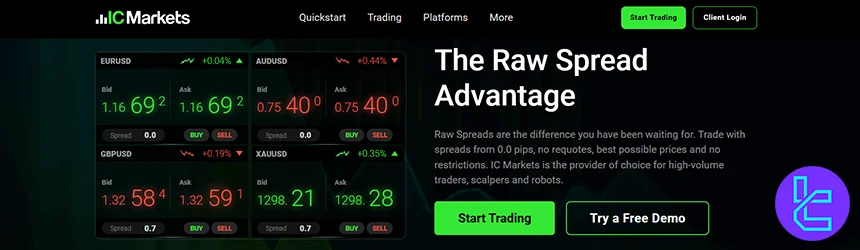
A minimum deposit requirement of $200 applies for activating live trading environments across supported account types. From a regulatory standpoint, the broker maintains operational entities under the supervision of ASIC in Australia, CySEC in Cyprus, and the FSA in Seychelles.
Client funds are held in segregated accounts within top-tier banking institutions, while EU-based accounts may qualify for coverage under the Investor Compensation Fund (ICF) up to €20,000.
IC Markets supports multiple execution pathways via Standard and Raw Spread accounts across MetaTrader 4 (MT4), MetaTrader 5 (MT5), and cTrader platforms.
Raw pricing structures typically offer spreads from 0.0 pips with commission-based execution, whereas Standard accounts integrate trading costs within floating spreads starting from approximately0.8 pips.
Trading costs can be lowered by using IC Markets rebate program. The broker facilitates market execution with leverage reaching up to 1:500 in eligible jurisdictions and a minimum trade size of 0.01 lot.
Tradable instruments include Forex pairs, stock CFDs (2,100+), indices, commodities, bonds, and cryptocurrencies. Scalping and automated strategies using Expert Advisors (EAs) are supported across MT4, MT5, and cTrader environments.
Swap-free (Islamic) configurations are available on all major platforms, excluding overnight interest charges on applicable asset classes.
In terms of infrastructure, IC Markets provides 24/7 live chat support and multiple funding channels such as bank transfer, credit/debit cards, Skrill, Neteller, and PayPal, without broker-side inactivity or deposit/withdrawal fees in standard conditions.
Account Types | Standard, Raw Spread, Islamic |
Regulating Authorities | ASIC, CySEC, FSA |
Minimum Deposit | $200 |
Deposit Methods | Bank Transfer, Credit/Debit Cards, Skrill, Neteller, PayPal, UnionPay, POLI |
Withdrawal Methods | Bank Transfer, Credit/Debit Cards, Skrill, Neteller, PayPal |
Maximum Leverage | Up to 1:500 |
Trading Platforms & Apps | MetaTrader 4 (MT4), MetaTrader 5 (MT5), cTrader, cTrader Web, IC Markets Mobile App |
IC Markets Pros and Cons
The table below showcases the benefits and drawbacks of trading with IC Markets.
Pros | Cons |
Raw Spread accounts with spreads from 0.0 pips | $200 minimum deposit may be relatively high for beginners |
Supports MetaTrader 4, MetaTrader 5, and cTrader platforms | Leverage limited to 1:30 under ASIC and CySEC regulation |
Access to 2,100+ tradable instruments across multiple asset classes | Investor protection schemes not available under offshore entity |
Suitable for algorithmic trading via Expert Advisors (EAs) | Swap-free accounts may include fixed administration fees |
BlackBull Markets
BlackBull Markets is a New Zealand brokerage (Black Bull Group Limited) founded in 2014 by Michael Walker and Selwyn Loekman.
The firm positions itself as a multi-asset venue, listing access to 26,000+ instruments across six asset classes, including Forex, indices, commodities, metals, energies, stocks, and cryptocurrencies.
Its account lineup after finalizing the BlackBull Markets registration is built around an ECN framework, offering ECN Standard, ECN Prime, and ECN Institutional structures.
Cost conditions differ by tier: ECN accounts can be presented with spreads down to 0.0 pips on certain configurations, while commission schedules vary by account type.
Order handling is described through market-based execution with common order types such as market, limit, stop, and trailing stop, alongside support for strategies like scalping, API trading, and copy trading.
Regulation is entity-dependent. One branch operates under the New Zealand FMA with dispute-resolution linkage through FSCLmembership (5623), while another branch is supervised by the Seychelles FSA.
Across these entities, the broker references operational controls such as segregated client funds, negative balance protection, and partnerships with tier-1 banking providers; also all entities require completing the BlackBull Markets verification.
Platform coverage spans MetaTrader 4 (MT4), MetaTrader 5 (MT5), cTrader, and TradingView, with proprietary services including BlackBull CopyTrader and BlackBull Invest.
Funding rails include bank wire, cards, Apple Pay/Google Pay, e-wallets (Neteller, Skrill), SEPA, and crypto, with withdrawals described as subject to a flat processing fee in some cases.
The broker also cites 24/7 support via live chat, email, phone, and WhatsApp, plus region-based access limitations.
Account Types | ECN Standard, ECN Prime, ECN Institutional |
Regulating Authorities | Financial Markets Authority (FMA), Financial Services Authority (FSA Seychelles) |
Minimum Deposit | $0 (ECN Standard), $0 (ECN Prime), $20,000 (ECN Institutional) |
Deposit Methods | Visa, MasterCard, Apple Pay, Google Pay, Bank Wire, Crypto, Neteller, Skrill, SEPA, FasaPay |
Withdrawal Methods | Visa, MasterCard, Apple Pay, Google Pay, Bank Wire, Crypto, Neteller, Skrill, SEPA, FasaPay |
Maximum Leverage | Up to 1:500 |
Trading Platforms & Apps | MetaTrader 4 (MT4), MetaTrader 5 (MT5), cTrader, TradingView, BlackBull CopyTrader, BlackBull Invest |
Pros and Cons of BlackBull Markets
The table below allows you to evaluate the benefits and drawbacks of trading with the BlackBull Markets broker.
Pros | Cons |
Access to 26,000+ tradable instruments | Limited service availability in certain regions |
ECN execution with spreads from 0.0 pips | Institutional account requires $20,000 deposit |
Integration with MT4, MT5, cTrader, TradingView | Some advanced features may be complex for beginners |
Supports Copy Trading and API Trading | Withdrawal processing fee of $5 per transaction |
FXOpen
FXOpen is an ECN/STP brokerage operating across multiple regulatory jurisdictions, including oversight from CySEC, FCA, and ASIC, with international clients supported through membership in The Financial Commission.
Originally launched in 2003 as an educational initiative, the firm transitioned into a live trading environment in 2005, offering multi-asset access under region-specific compliance frameworks.
Its infrastructure is built around an Electronic Communication Network (ECN) model, enabling direct connectivity to interbank liquidity providers.
This execution pathway supports low-latency order routing and floating spreads from 0.0 pips, particularly within ECN account structures.
Available account types include ECN, STP, and Micro, each designed with varying margin requirements and cost models for different trading profiles.
FXOpen provides platform access via MetaTrader 4 (MT4), MetaTrader 5 (MT5), TickTrader, and TradingView, allowing integration with algorithmic strategies through Expert Advisors (EAs) and advanced order types such as OCO and Iceberg.
PAMM-based copy trading is also supported, offering allocation-based portfolio management under segregated fund structures after completing the FXOpen registration.
From a pricing perspective, STP accounts embed execution costs within spread markups, while ECN accounts apply tiered commissions ranging from approximately $1.50 to $3.50 per lot depending on account equity.
Traders can lower trading costs by joining the FXOpen rebate program offered TradingFinder IB. Overnight positions may incur swap charges, and inactive accounts are subject to a $10 monthly fee after 90 days.
Tradable instruments span over 600 financial assets across Forex, Commodities, Indices, Cryptocurrencies, ETFs, and Shares, with leverage availability up to 1:500 depending on jurisdiction.
FXOpen also offers Islamic (swap-free) accounts and VPS hosting for qualifying ECN and Crypto trading environments. FXOpen deposit and withdrawal methods include Bank Cards and Wire transfers.
Account Types | ECN, STP, Micro |
Regulating Authorities | CySEC, FCA, ASIC, The Financial Commission |
Minimum Deposit | From $1 |
Deposit Methods | Bank Transfer, Visa/MasterCard, Instant Bank Transfer |
Withdrawal Methods | Bank Transfer, Visa/MasterCard, Wire Transfer |
Maximum Leverage | Up to 1:500 |
Trading Platforms & Apps | MetaTrader 4 (MT4), MetaTrader 5 (MT5), TickTrader, TradingView |
FXOpen Pros and Cons
Traders who want to open an account with FXOpen, must consider the following pros and cons.
Pros | Cons |
Regulated by CySEC, FCA, and ASIC | Inactivity fee after 90 days of dormancy |
ECN execution with floating spreads from 0.0 | Limited investor protection in offshore entity |
Minimum deposit from $1 (Micro account) | - |
Supports MT4, MT5, TickTrader, TradingView | - |
FXGiants
FXGiants, operating since 2015 under Notesco Int Limited, is a Bermuda-based Forex and CFD broker regulated by the Bermuda Monetary Authority (BMA).
The firm provides access to more than 300 financial instruments after completing FXGiants registration and access to various asset classes such as Forex, commodities, indices, stocks, and futures, serving traders in over 150 jurisdictions globally.
The broker supports multiple account configurations, including Live Floating Spread, Live Fixed Spread, Live Zero Fixed Spread, STP/ECN No Commission, STP/ECN Zero Spread, and STP/ECN Absolute Zero.
Traders must finalize FXGiants verification to cash out profits from these accounts. These structures accommodate varying pricing preferences, combining raw or fixed spreads with commission-based or commission-free execution models.
Trading is facilitated exclusively via MetaTrader 4 (MT4), which supports Expert Advisors (EAs), automated strategies, and custom technical indicators.
FXGiants offers leverage of up to 1:1000 depending on account type, with a minimum deposit requirement starting from $100 and a minimum trade size of 0.01 lots.
Execution is provided through Instant and Market order types, with margin call and stop-out levels set at 80% and 20%, respectively. Swap-free (Islamic) accounts and PAMM investment solutions are also available in the FXGiants dashboard.
From an operational standpoint, client funds are held in segregated accounts, and negative balance protection is implemented. However, the absence of Tier-1 regulatory oversight and reliance on a Tier-3 authority such as the BMA may influence perceived counterparty risk.
FXGiants provides 24/5 multilingual customer support via live chat and contact form, alongside infrastructure features such as VPS hosting and integrated copy trading functionality.
Account Types | Live Floating Spread, Live Fixed Spread, Live Zero Fixed Spread, STP/ECN No Commission, STP/ECN Zero Spread, STP/ECN Absolute Zero, Demo |
Regulating Authorities | Bermuda Monetary Authority (BMA) |
Minimum Deposit | From $100 |
Deposit Methods | Visa, MasterCard, Bank Wire Transfer, Crypto, UnionPay |
Withdrawal Methods | Visa, MasterCard, Bank Wire Transfer, Crypto, UnionPay |
Maximum Leverage | Up to 1:1000 |
Trading Platforms & Apps | MetaTrader 4 (MT4), Proprietary Mobile App |
FXGiants Pros and Cons
The table below helps you understand the benefits and drawbacks of trading with the FXGiants broker.
Pros | Cons |
Supports multiple account types including STP/ECN models | Limited regulatory oversight (BMA Tier-3) |
Spreads available from 0.0 pips on selected accounts | MT5 platform is not supported |
Maximum leverage up to 1:1000 | Commission-based pricing on Zero Spread accounts |
Access to MetaTrader 4 with EA support | Fewer advanced asset classes (e.g., ETFs, Bonds) |
Eightcap
Eightcap is a multi-asset CFD broker established in 2009 in Melbourne, providing leveraged access to six primary markets, including Forex, commodities, indices, cryptocurrencies, metals, and shares.
Clients can trade over 800 instruments through Standard, Raw, and TradingView account types, with leverage reaching up to 1:500 depending on jurisdiction and regulatory entity. The broker operates under several financial authorities, including ASIC, FCA, CySEC, and SCB, each enforcing distinct compliance frameworks
These include client fund segregation, Negative Balance Protection, and participation in compensation schemes like FSCS in the UK or ICF within the EU. These regulatory layers influence leverage limits, investor protection mechanisms, and regional client eligibility.
In terms of trading infrastructure, Eightcap supports MetaTrader 4 (MT4), MetaTrader 5 (MT5), and TradingView, enabling Market Execution across desktop, web-based WebTrader, and mobile environments.
These platforms allow automated trading through Expert Advisors (EAs), algorithmic scripting, and advanced charting modules compatible with custom technical indicators and strategy development workflows.
Additional functionality after finalizing the Eightcap registration is delivered through integrated tools such as Capitalise.ai for code-free automation, FlashTrader for rapid order management, and an AI-powered Economic Calendar to analyze macroeconomic events.
Trading costs vary by account structure, with Raw accounts offering spreads from 0.0 pips plus commission, while Standard and TradingView models incorporate pricing within wider spreads starting from 1.0 pip.
Traders can lower the trading costs by leveraging Eightcap rebate service offered by the TradingFinder IB.
Account Types | Standard, Raw, TradingView, Demo |
Regulating Authorities | ASIC, FCA, CySEC, SCB |
Minimum Deposit | $100 |
Deposit Methods | Credit/Debit Card, Bank Transfer, Skrill, Neteller, PayPal, Crypto |
Withdrawal Methods | Credit/Debit Card, Bank Transfer, Skrill, Neteller, PayPal, Crypto |
Maximum Leverage | Up to 1:500 |
Trading Platform& Apps | MetaTrader 4 (MT4), MetaTrader 5 (MT5), TradingView |
Eightcap Pros and Cons
Check the table below to know the advantages and disadvantages of choosing Eightcap as your Forex broker.
Pros | Cons |
Multi-jurisdictional regulation (ASIC, FCA, CySEC) | No Islamic (Swap-Free) Account Option |
Integration with TradingView Platform | No PAMM or Copy Trading Services |
Access to MT4 and MT5 Platforms | Limited Educational Depth for Advanced Users |
Competitive RAW Account Spreads from 0.0 Pips | Inactivity Fee After 3 Months |
FXCM
FXCM (Forex Capital Markets) has operated in online Forex and CFD trading since 1999 and currently serves clients through several regulated entities.
Its oversight includes the FCA in the UK, ASIC in Australia, CySEC in the EU (license 392/20), FSCA in South Africa (FSP 46534), and the Israel Securities Authority (ISA).
Across these jurisdictions, FXCM commonly applies safeguards such as segregated client accounts, Negative Balance Protection, and compensation coverage where mandated (e.g., FSCS protection up to £85,000 in the UK and ICF coverage up to €20,000 in the EU).
The broker’s structure reflects regional differences: leverage and eligibility depend on the operating entity, with stricter caps in the UK/EU and higher limits available under certain non-EU frameworks.
Based on the international AML and CFT laws, FXCM require all traders to complete the FXCM verification process.
FXCM’s core trading setup is built around MetaTrader 4 (MT4), TradingView integration, and TradeStation, targeting traders who prefer established charting ecosystems and multi-platform access.
Account lineups following the FXCM registration are typically positioned around CFD, Active Trader, and Corporate profiles, with the Active Trader tier oriented toward higher-volume activity and potential pricing benefits. FXCM’s corporate history includes notable regulatory and business events.
In 2017, the U.S. CFTC imposed a $7 million penalty related to misrepresentation, after which FXCM exited the U.S. market by withdrawing its CFTC registration; the same year, FXCM Group, Inc. filed for bankruptcy and the business was acquired by Jefferies Financial Group (formerly Leucadia).
These developments are relevant context alongside its long operating record and current multi-regulated footprint.
Account Types | CFD Account, Active Trader Account, Corporate Account, Demo |
Regulating Authorities | FCA, ASIC, CySEC, FSCA, ISA |
Minimum Deposit | $50 |
Deposit Methods | Visa/MasterCard, Bank Transfer, Skrill, Neteller |
Withdrawal Methods | Visa/MasterCard, Bank Transfer, Skrill, Neteller |
Maximum Leverage | Up to 1:1000 (varies by regulatory entity) |
Trading Platforms & Apps | MetaTrader 4 (MT4), TradingView, TradeStation |
FXCM Pros and Cons
The table below contains the benefits and limitations of choosing FXCM as your Forex broker.
Pros | Cons |
Regulated by FCA, ASIC, CySEC, FSCA, ISA | Bankruptcy history (2017) |
Access to MT4, TradingView, TradeStation | Bank wire withdrawal fee (~$40) |
Segregated client funds & negative balance protection | Annual inactivity fee (~$50) |
Multiple account types for different trader profiles | Leverage limits under Tier-1 regulation |
D Prime
Doo Prime, established in 2014 and operating under D Prime Limited, is a Hong Kong–based multi-asset brokerage providing access to leveraged trading across global financial markets.
The broker offers three primary account structures following the D Prime registration process, including Cent, STP, and ECN, with leverage availability reaching up to 1:1000 depending on the regulatory jurisdiction and account configuration.
From an infrastructure standpoint, Doo Prime supports widely used platforms such as MetaTrader 4 (MT4), MetaTrader 5 (MT5), and its proprietary Doo Prime InTrade terminal.
These environments enable algorithmic execution via Expert Advisors (EAs), real-time technical analysis, and compatibility with external integrations such as TradingView and FIX API for institutional-grade connectivity.
Regulatory supervision is conducted through offshore authorities including the VFSC (Vanuatu Financial Services Commission) and FSC (Financial Services Commission of Mauritius).
Both entities require traders to complete the D Prime verification process. Client fund segregation policies are implemented under specific entities, while Negative Balance Protection is selectively applied depending on jurisdictional coverage.
In terms of tradable instruments, the broker provides access to over 10,000 CFD-based products spanning Forex, Crypto, Metals, Commodities, Stock Indices, Futures, and Securities.
Market execution is applied across account types, with ECN accounts utilizing commission-based pricing models and STP environments typically offering spreads from 0.0 pips. Additional trading infrastructure includes VPS hosting, Trading Central analytics, and Economic Calendar integration.
Social and managed investment features such as PAMM, MAM, FOLLOWME, and Copy Trading are also supported in the D Prime dashboard, enabling automated portfolio allocation or signal-based trade replication within leveraged CFD environments.
Account Types | Cent, STP, ECN |
Regulating Authorities | VFSC (Vanuatu), FSC (Mauritius) |
Minimum Deposit | $0 (Cent), $100 (STP & ECN) |
Deposit Methods | Local Bank Transfer, E-wallets, International Wire Transfer, Credit/Debit Card |
Withdrawal Methods | Local Bank Transfer, E-wallets, International Wire Transfer, Credit/Debit Card |
Maximum Leverage | Up to 1:1000 |
Trading Platforms & Apps | MetaTrader 4 (MT4), MetaTrader 5 (MT5), Doo Prime InTrade |
Pros and Cons of D Prime
Traders must consider the following benefits and drawbakcs when choosing D Prime as their broker.
Pros | Cons |
Supports up to 1:1000 leverage across Cent, STP, and ECN accounts | Regulated only by Tier-3 authorities (VFSC, FSC) |
Access to 10,000+ instruments across Forex, Crypto, Futures, Indices | No Investor Compensation Scheme |
Integration with MT4, MT5, and Doo Prime InTrade platforms | Educational content limited to registered users |
Copy trading via PAMM, MAM, FOLLOWME, and Social Trading | Negative Balance Protection not available on all entities |
Pepperstone
Pepperstone is a multi-asset brokerage founded in 2010 in Melbourne, Australia, currently serving more than 400,000 clients with an average daily trading volume exceeding $9.2 billion.
The broker supports 10 base currencies, including AUD, USD, GBP, JPY, EUR, CAD, CHF, NZD, SGD, and HKD, while enabling position sizing from 0.01 to 100 lots and leverage of up to 1:500, depending on the regulatory entity.
From a regulatory standpoint, Pepperstone operates through multiple licensed entities supervised by financial authorities such as ASIC, FCA, CySEC, DFSA, CMA, and BaFin.
Client funds are typically maintained in segregated accounts, and Negative Balance Protection is available under several jurisdictions.
The broker offers two primary account structures (Standard and Razor) both accessible with no fixed minimum deposit requirement after finalizing the Pepperstone registration.
These accounts support trading via MetaTrader 4 (MT4), MetaTrader 5 (MT5), cTrader, TradingView, and Pepperstone’s proprietary web and mobile platforms.
Automated trading through Expert Advisors (EAs), hedging strategies, and news trading are permitted across supported environments.
Pepperstone provides access to over 1,200 CFD instruments spanning Forex, Commodities, Cryptocurrencies, Shares, Indices, and ETFs. Copy trading integrations are available through MetaTrader Signals, DupliTrade, and Signal Start.
While spreads on Razor accounts can start from 0.0 pips with commission-based pricing, the Standard account uses a spread-only structure. The trading fees can be lowered by earing Pepperstone rebates using the TradingFinder IB services.
Non-trading fees such as account maintenance or inactivity charges are generally not applied, though third-party processing costs may occur depending on the funding method.
Account Types | Standard, Razor |
Regulating Authorities | ASIC, FCA, CySEC, DFSA, CMA, BaFin, SCB |
Minimum Deposit | $1 |
Deposit Methods | Apple Pay, Google Pay, Visa, Mastercard, Bank Transfer, PayPal, Neteller, Skrill, UnionPay, USDT, ZotaPay |
Withdrawal Methods | Apple Pay, Google Pay, Visa, Mastercard, Bank Transfer, PayPal, Neteller, Skrill, UnionPay, USDT, ZotaPay |
Maximum Leverage | Up to 1:500 |
Trading Platforms & Apps | MetaTrader 4 (MT4), MetaTrader 5 (MT5), cTrader, TradingView, Pepperstone Proprietary Platform |
Pepperstone Pros and Cons
The following table allows you to compare the benefits and drawbacks of trading with the Pepperstone broker.
Pros | Cons |
Regulated by top-tier authorities including ASIC, FCA, and CySEC | Maximum leverage limited to 1:30 for retail clients under Tier-1 regulation |
Supports multiple advanced platforms such as MetaTrader 4, MetaTrader 5, cTrader, and TradingView | No PAMM or built-in asset management solutions |
Access to over 1,200 CFDs across Forex, Shares, Indices, Commodities, Crypto, and ETFs | Limited promotional programs due to regulatory restrictions |
Offers segregated client funds and Negative Balance Protection across regulated entities | Professional leverage access depends on jurisdiction and eligibility |
What Are the Main Costs of Trading with a Forex Broker?
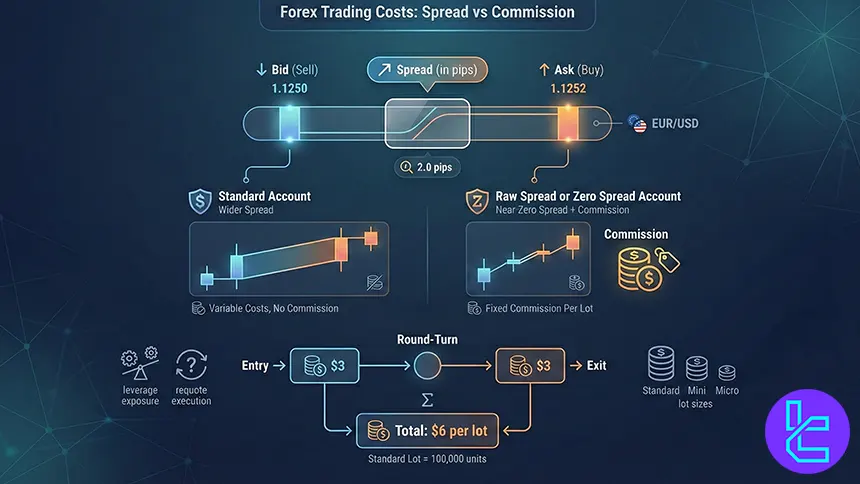
In the Forex market, trading expenses are primarily determined by two core pricing components: spread and commission.
Each currency pair is quoted with a Bid price (sell) and an Ask price (buy), and the numerical gap between these two values represents the spread an embedded transaction cost applied when opening a position.
Measured in Forex pips, this difference directly affects entry efficiency and overall execution pricing.
A narrower spread typically reflects reduced implicit costs per trade. However, ultra-tight spreads are often associated with specific account structures or higher leverage conditions, which may introduce additional exposure to market volatility.
Furthermore, execution models such as requotes can influence the final order price if market conditions shift between order placement and execution, potentially increasing the effective cost beyond the initially quoted rate.
In addition to spreads, many Forex brokers implement explicit commission-based pricing, particularly on Raw Spread or Zero Spread accounts.
Unlike Standard accounts, where trading fees are built into wider spreads, commission-based accounts offer near-zero spreads (sometimes from 0.0 pips) in exchange for a fixed charge per transaction.
This fee is commonly structured as a round-turn commission, applied per standard lot (100,000 units of the base currency).
For instance, a $6 round-turn fee may be divided into $3 at trade entry and $3 upon exit. Brokers supporting mini lots (10,000 units) or micro lots (1,000 units) proportionally adjust these commissions.
Evaluating how spreads and commissions interact across account types is essential for accurately assessing a broker’s total trading cost structure.
What are Non-Trading Fees in Online Forex Brokers?
Beyond spreads and trading commissions, Forex brokers may apply a range of non-trading fees that affect the total cost of maintaining a live account.
These charges are not directly tied to order execution but arise from account management, operational services, or specific trading conditions.
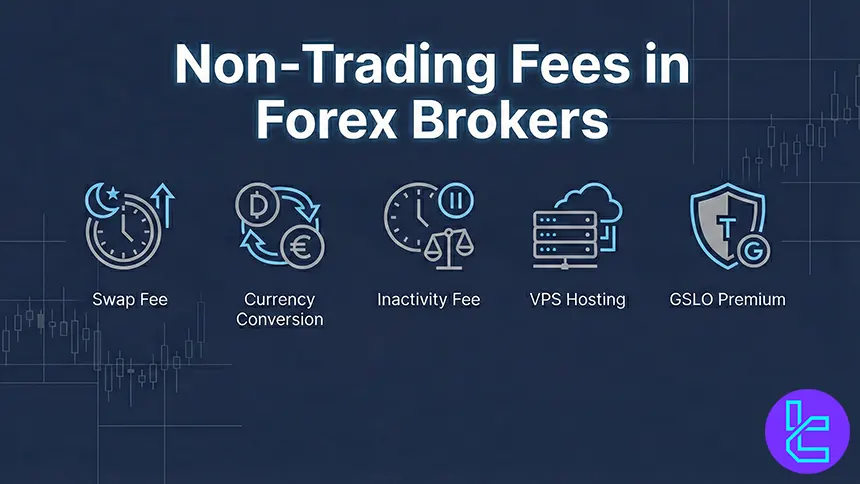
- Rollover (Swap) Fees: When a Forex position remains open beyond the daily market close, brokers may apply a swap fee based on the interest rate differential between the two currencies in the pair;
- Currency Conversion Fees: If profits, losses, or deposits are processed in a currency different from the account’s base currency, brokers may apply a conversion fee;
- Inactivity and Account Maintenance Fees: Some Forex brokers impose inactivity fees when no trades or account operations occur over a prolonged period, usually after 6 to 12 months;
- VPS Hosting Costs: Traders using automated trading systems such as Expert Advisors on MetaTrader 4 or MetaTrader 5 may require a Virtual Private Server to maintain continuous platform connectivity;
- Guaranteed Stop-Loss Order (GSLO) Premiums: Brokers that provide GSLO functionality may charge an additional premium for ensuring trade closure at the specified stop level during periods of volatility or price gaps.
Can I Trust Low Cost Forex Brokers?
Low-cost Forex brokers, including those offering zero spread or Raw Spread accounts, are not inherently less reliable than higher-cost providers. In many cases, these pricing models reflect a different commission structure rather than a reduction in service quality.
For instance, brokers may compensate for tighter spreads by applying a commission per lot, particularly within ECN or STP execution environments. As a result, evaluating total trading expenses requires assessing both the bid-ask spread and the associated transaction fees.
Trustworthiness in this context is more closely linked to the broker’s regulatory framework and execution model than to its pricing alone.
Brokers operating under the supervision of authorities such as FCA, ASIC, or CySEC are generally required to adhere to standards involving segregated client funds, negative balance protection, and transparent reporting practices.
These safeguards reduce the likelihood of operational misconduct, even when competitive pricing is offered.
It is also essential to examine whether the broker functions as a market maker or follows a No Dealing Desk (NDD) model, as execution structure may influence the presence of conflicts of interest.
Some brokers offering low spreads may internalize trades, potentially impacting order routing and requote frequency during volatile market conditions.
Ultimately, while reduced spreads can contribute to lower visible costs, a comprehensive assessment of commissions, execution policies, and regulatory oversight is necessary to determine whether a low-cost Forex broker operates within a secure environment.
Factors to Consider When Choosing a Low-Cost Forex Broker
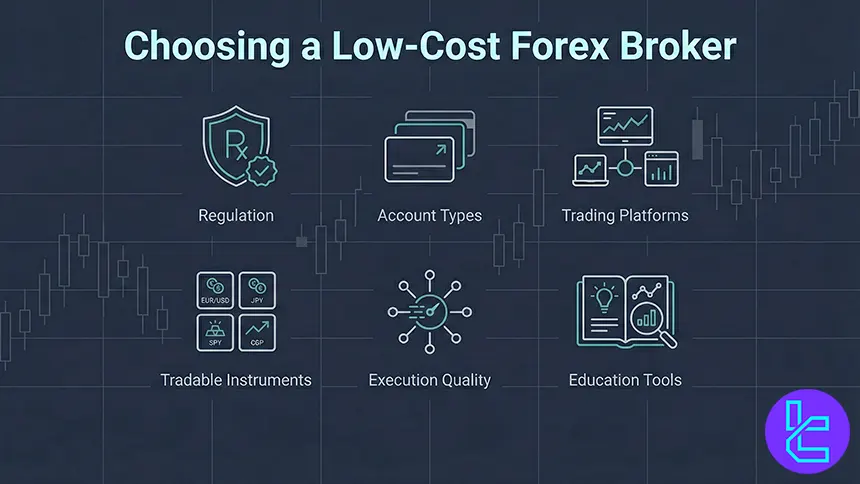
When selecting a low-cost Forex broker, evaluating trading fees alone may not provide a complete picture of the overall trading environment.
Regulatory oversight from authorities such as ASIC, FCA, CySEC, CIRO, or CFTC plays a critical role in ensuring operational transparency through mechanisms like segregated client funds, investor compensation schemes, negative balance protection, and AML compliance.
In addition, the availability of different account types such as Standard, ECN, or STP can significantly influence pricing structures, particularly in terms of spreads and commissions.
Access to a demo account on platforms like MetaTrader 4 or MetaTrader 5 also enables traders to assess execution conditions and cost dynamics without financial exposure.
Another important consideration involves the range of tradable Forex instruments offered by the broker.
Some platforms provide access only to major and minor currency pairs, while others include exotic pairs and cross-currency instruments, which may be restricted based on account tier or deposit size.
Platform infrastructure is equally relevant, as execution quality and latency across environments such as cTrader, TradingView, MT4, or MT5 can affect slippage and order fulfillment during periods of market volatility.
Compatibility with Expert Advisors and the presence of No Dealing Desk execution models may also contribute to cost variability.
Lastly, access to educational materials, analytical tools, and integrated economic calendars can support informed decision-making, helping traders manage indirect trading costs associated with strategy optimization and execution timing.
What Are Tradable Instruments in Low-Cost Forex Brokers?
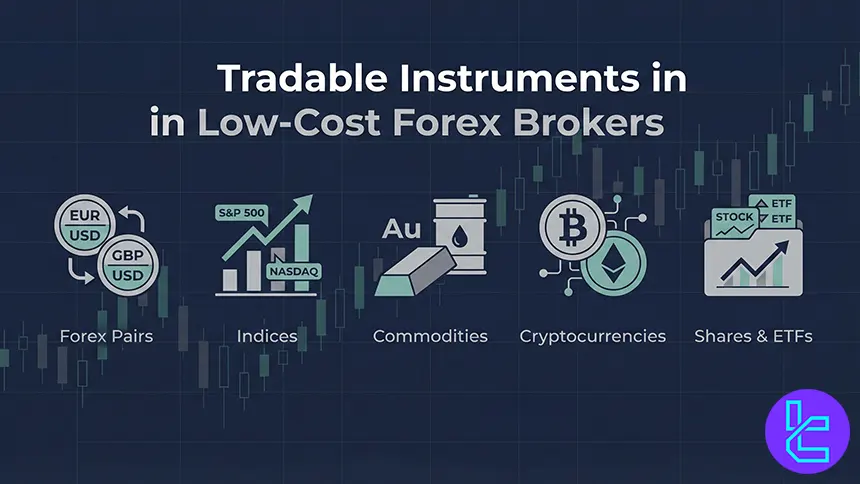
Low-cost Forex brokers typically provide access to a wide range of tradable instruments through Contracts for Difference (CFDs), enabling market participants to speculate on price fluctuations without taking ownership of the underlying asset.
These instruments extend beyond currency pairs to include multiple asset classes commonly traded within leveraged environments.
In the Forex market, brokers usually offer major pairs such as EUR/USD and GBP/USD, along with minor and exotic combinations like EUR/GBP or USD/TRY.
Due to their deep liquidity, major pairs often feature tighter bid-ask spreads, making them more cost-efficient for short-term strategies including scalping and intraday trading.
Beyond currencies, many low-cost brokers provide CFDs on global equity indices such as the S&P 500 (US500), NASDAQ 100, and FTSE 100.
These instruments allow traders to gain directional exposure to broader financial markets without directly purchasing stocks listed on traditional exchanges.
Commodity markets are also widely available, including precious metals like Gold and Silver, as well as energy products such as Crude Oil and Natural Gas.
These assets are frequently used in portfolio diversification or as hedging instruments during periods of macroeconomic uncertainty.
Additional offerings often include cryptocurrency CFDs, such as Bitcoin (BTC) and Ethereum (ETH), alongside equity-based products like individual company shares and sector-focused ETFs.
The availability of these instruments under low-spread account structures can significantly influence transaction efficiency, particularly in multi-asset trading strategies.
Do Low-Cost Forex Brokers Offer Swap-free or Islamic Accounts?
Many low-cost Forex brokers provide access to Islamic or swap-free accounts structured to comply with Sharia principles, allowing traders to participate in leveraged markets without incurring overnight interest (swap or rollover) charges.
These account types are commonly available across both Standard and Raw Spread models offered by regulated brokerage firms.
In swap-free environments, positions held beyond the daily market close are not subject to interest rate differentials between base and quote currencies, which would otherwise apply in conventional Forex trading.
Instead of swap fees, brokers may introduce alternative cost structures such as fixed administrative charges or adjusted spreads on specific instruments.
Islamic accounts are typically designed for traders seeking interest-free participation in markets such as Forex, Precious Metals, and Commodities.
Major currency pairs like EUR/USD or USD/JPY, along with instruments such as Gold and Silver, are often included under swap-free trading conditions depending on the broker’s internal policy.
Several established low-cost brokers, including Pepperstone, IC Markets Global, AvaTrade, Fusion Markets, and RoboForex, support Islamic account configurations across platforms such as MetaTrader 4 (MT4), MetaTrader 5 (MT5), and cTrader.
In many cases, these accounts are available upon request and may require verification to ensure alignment with religious compliance requirements.
While swap-free accounts eliminate financing costs tied to overnight exposure, traders should assess alternative fee mechanisms applied by brokers.
Trading Account Comparison in Low-Cost Forex Brokers
The table below allows you to compare trading costs in low-fee Forex brokers and choose the one that is the most suitable for you.
Parameters | Pro Account | Standard Account | ECN Account |
Average Spread (EUR/USD) | From 0.1 - 0.3 pips | From 0.8 - 1.5 pips | From 0.0 - 0.2 pips |
Commission per Lot (Round Turn) | Low or None | None | Fixed ($5 - $7 per lot) |
Execution Type | Market / Instant | Instant | Market (NDD / STP / ECN) |
Slippage Risk | Medium | Medium to High | Low |
Requote Possibility | Possible | Possible | Rare |
Minimum Deposit Requirement | Medium ($200 - $1,000) | Low ($0 - $100) | Medium to High ($100 - $500) |
Swap (Rollover) Fees | Applicable | Applicable | Applicable |
Swap-Free Option | Available | Available | Available |
Spread Markup | Low | High | None |
Trading Volume Requirement | Moderate | Low | High |
VPS Eligibility | Conditional | Rare | Often Available |
Conclusion
Based on our review of the best low-cost Forex brokers, IC Markets, FXGiants, FXOpen, BlackBull Markets, and FXCM offer the best services.
Now traders must compare the spread, commission, currency conversion, rollover, and inactivity fees of each broker and choose the one that is suitable for their needs.
All brokers have been assessed based on various factors mentioned in the TradingFinder Forex methodology.