








Spread is a key parameter in a trade's profit/loss outcome, directly affecting costs. Simply put, it is the difference between the buy and sell prices in a currency pair. Forex investors try to trade with the lowest spreads for maximized profits.
However, it is critical to consider every aspect of a broker before choosing it as a low-spread one. Here are some of the best options with the lowest spreads.
 | IC Markets | |||
 | fpmarkets | |||
 | FUSION MARKETS | |||
| 4 |  | ACTIVTRADES | ||
| 5 |  | BlackBull | ||
| 6 |  | FxPro | ||
| 7 |  | GLOBAL PRIME | ||
| 8 |  | MONETA MARKETS |
Trustpilot Ratings for Low Spread Forex Brokers
Trustpilot plays a vital role in determining a broker’s quality before getting started because it reflects user experiences. The table below ranks mentioned brands based on user reviews on the mentioned website.
Broker Name | Trustpilot Rating | Number of Reviews |
52,980 | ||
10,059 | ||
Fusion Markets | 6,951 | |
BlackBull Markets | 3,261 | |
Global Prime | 434 | |
ActivTrades | 4.4/5 ⭐ | 1,067 |
Moneta Markets | 496 | |
FxPro | 777 |
Minimum Spreads in Mentioned Brokers
Obviously, spreads are the most important parameter in this article when comparing broker candidates and picking from them. This section outlines the lowest spreads in the mentioned brands.
Broker Name | Min. Spread |
IC Markets | 0 Pips |
Moneta Markets | 0 Pips |
0 Pips | |
FxPro | 0 Pips |
0 Pips | |
FOREX.com | 0 Pips |
ActivTrades | 0.5 Pips |
Oanda | 2.0 Pips |
Non-Trading Fees Charged by Low Spread Brokers
Another parameter that heavily impacts a trade’s profit is the costs related to deposits/withdrawals and inactivity periods. For optimal outcomes, choose one with the minimum fees.
Broker Name | Deposit Fees | Withdrawal Fees | Inactivity Fees |
$0 | $0 | $0 | |
Moneta Markets | $0 | $0 | $0 |
Fusion Markets | $0 | $0 | $0 |
BlackBull Markets | $0 | $5 | $0 |
FOREX.com | $0 | $0 | €15 Monthly |
FxPro | $0 | $0 | $15 for Over Six Months, then $5 Monthly |
tastyfx | $0 | $15 for Each Bank Wire Transaction | $0 |
$0 | 9 GBP for Bank Transfers | €10 monthly |
Available Trading Platforms in Lowest Spread Brokerages
MetaTrader 4 and MetaTrader 5 are the two most popular trading platforms in the Forex market. However, there are other choices offered by some brokerages. The table below lists trading platforms employed by the introduced brokers.
Broker Name | Trading Platforms |
BlackBull Markets | MT4, MT5, TradingView, cTrader, BlackBull CopyTrader, BlackBull Invest |
MT4, MT5, cTrader, Web Trader, Mobile App | |
MT4, MT5, Pro Trader, App Trader | |
Fusion Markets | MetaTrader 4, MetaTrader 5, TradingView, cTrader |
Interactive Brokers | Trader Workstation, IBKR Mobile, Client Portal, IBKR APIs |
ActivTrades | MT4, MT5, ActivTrader, TradingView |
tastyfx | tastyfx Platform, TradingView, MetaTrader 4, ProRealTime |
Global Prime | MT4 |
Top 6 Low Spread Forex Brokers in Detail
In the following sections, six of the brokers mentioned above will be briefly reviewed and introduced with some important details pointed out.
IC Markets
IC Markets was founded in 2007 in Australia and has developed into a multi-asset broker serving clients across Europe, Asia, and other international markets.
The broker operates through entities regulated by Australian Securities and Investments Commission, Cyprus Securities and Exchange Commission, and the Financial Services Authority.

IC Markets is widely recognized for its low-cost pricing structure, offering spreads from 0.0 pips on Raw Spread accounts and from 0.8 pips on Standard accounts. The broker supports over 2,250 tradable instruments, including Forex CFDs, commodities, indices, bonds, cryptocurrencies, and more than 2,100 stock CFDs.
The broker provides access to multiple professional-grade platforms, including MetaTrader 4, MetaTrader 5, cTrader, cTrader Web, and its proprietary mobile application. Raw Spread accounts are especially popular among scalpers, algorithmic traders, and Expert Advisor users due to fast market execution and commissions starting from $3 per side.
IC Markets supports 10 base currencies, requires a minimum deposit of $200, and offers leverage up to 1:500 under its offshore entity. Traders can choose between Standard, Raw Spread, and Islamic accounts while funding accounts through cards, bank wires, PayPal, Skrill, Neteller, and other electronic payment methods.
For a reduction on trading commissions, check out the IC Markets rebate program. The table below summarizes the broker’s specifics.
Account Types | Standard, Raw Spread, Islamic |
Regulating Authorities | FSA, CySEC, ASIC |
Minimum Deposit | $200 |
Deposit Methods | Bank Cards, Wire Transfers, Electronic payments, etc. |
Withdrawal Methods | Bank Cards, Wire Transfers, Electronic payments, etc. |
Maximum Leverage | 1:500 |
Trading Platforms & Apps | Metatrader 4, Metatrader 5, cTrader, cTrader Web, IC Markets Mobile |
IC Markets Pros and Cons
IC Markets combines low spreads, advanced platforms, and a large product range, making it suitable for active traders, scalpers, and users of automated strategies.
However, some traders may find the $200 minimum deposit relatively high, while leverage restrictions under ASIC and CySEC entities may be limiting for certain strategies.
Pros | Cons |
Raw Spread accounts with spreads from 0.0 pips | $200 minimum deposit may be high for beginners |
Access to more than 2,250 tradable instruments | Lower leverage limits under ASIC and CySEC entities |
Supports MT4, MT5, cTrader, and mobile trading | No PAMM account offering |
Strong regulation through ASIC, CySEC, and FSA | Some bonus campaigns are unavailable in most regions |
FP Markets
FP Markets was founded in 2005 in Australia and has grown into a multi-asset broker regulated by several authorities, including Australian Securities and Investments Commission, Cyprus Securities and Exchange Commission, FSCA, FSC, and FSA entities in Seychelles and Saint Vincent and the Grenadines.
The broker is known for combining institutional-grade pricing with a low minimum deposit of just $50.
FP Markets offers two primary account types: Standard and RAW. The Standard account provides spreads from 1.0 pips with zero commission, while the RAW account features spreads from 0.0 pips with a $3 commission per lot. Both account types are available on MetaTrader 4, MetaTrader 5, and cTrader.
The broker supports more than 10,000 instruments across Forex, stocks, ETFs, indices, metals, commodities, and cryptocurrencies. FP Markets also offers additional investment solutions such as copy trading, PAMM, MAM, and algorithmic trading.
Traders can access over 60 Forex pairs, 650+ stock CFDs, 200+ ETFs, and a wide range of crypto CFDs from one account.
Client protection remains one of FP Markets’ strongest features. Under its CySEC-regulated entity, eligible traders can receive up to €20,000 through the Investor Compensation Fund.
Segregated client funds, negative balance protection, and multi-jurisdiction regulation strengthen the broker’s overall trust profile, particularly for traders seeking lower-spread accounts with strong regulatory oversight. Also, you can participate in the FP Markets rebate program to trade with lower commissions.
Table of Specifics
Account Types | Standard, RAW |
Regulating Authorities | ASIC, CySEC, FSC, FSCA, FSA |
Minimum Deposit | $50 |
Deposit Methods | Visa and Master card, Skrill, PayPal, Neteller, Bank Transfer |
Withdrawal Methods | Visa and Master card, Skrill, PayPal, Neteller, Bank Transfer |
Maximum Leverage | 1:500 |
Trading Platforms & Apps | MT4, MT5, cTrader |
FP Markets Pros and Cons
FP Markets stands out for its combination of low-cost pricing, multi-regulation, broad platform support, and extensive tradable markets. However, some limitations include the lack of a proprietary trading platform and restrictions for traders from jurisdictions such as the US.
Pros | Cons |
Regulated by ASIC, CySEC, FSCA, FSC, and FSA entities | Not available to US clients |
RAW account spreads from 0.0 pips | No proprietary trading platform |
Access to 10,000+ tradable instruments | Trust scores outside Trustpilot are mixed |
Supports MT4, MT5, cTrader, PAMM, and copy trading | Bank wire withdrawals can take up to 8 business days |
Fusion Markets
Founded by Phil Horner, Fusion Markets is a low-cost broker regulated by Australian Securities and Investments Commission and Vanuatu Financial Services Commission.
The broker is backed by Gleneagle Securities Pty Limited, which manages more than $400 million in client funds.
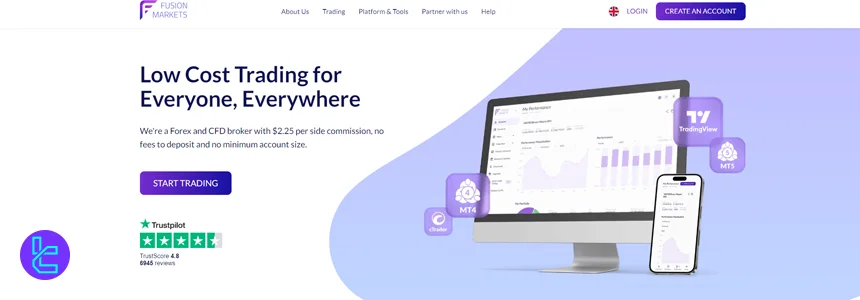
Fusion Markets is widely recognized for its pricing structure, offering RAW spreads from 0.0 pips on major Forex pairs such as EUR/USD. The Zero account charges $2.25 per side, while the Classic account provides spreads from 0.9 pips with no commission. There is also no minimum deposit requirement for opening an account.
The broker supports more than 250 instruments across Forex, indices, commodities, metals, energy products, cryptocurrencies, and US share CFDs. Traders can access platforms such as MetaTrader 4, MetaTrader 5, cTrader, and TradingView, with execution speeds reportedly averaging around 0.02 milliseconds.
Fusion Markets also provides copy trading through Fusion+, MAM, and PAMM accounts, making it suitable for both self-directed traders and money managers.
Client funds are held in segregated accounts with HSBC and National Australia Bank, while ASIC-regulated clients benefit from negative balance protection.
To learn about the features and options in the personal cabinet, visit our Fusion Markets dashboard review. Here’s a summary of the broker’s specifics.
Account Types | Zero, Classic, Swap-Free |
Regulating Authorities | ASIC, VFSC |
Minimum Deposit | $0 |
Deposit Methods | VISA, MasterCard, PayPal, Perfect Money, PayID, Bank Wire, Crypto, Skrill, Neteller, etc. |
Withdrawal Methods | PayPal, Perfect Money, Bank Wire, Crypto, Skrill, Neteller, etc. |
Maximum Leverage | 1:500 |
Trading Platforms & Apps | MetaTrader 4, MetaTrader 5, TradingView, cTrader |
Fusion Markets Pros and Cons
Fusion Markets stands out for its low-cost pricing model, broad platform selection, and support for copy trading. However, traders should also consider its limited educational resources, lack of a proprietary platform, and the absence of an investor compensation fund before opening an account.
Pros | Cons |
RAW spreads from 0.0 pips on major Forex pairs | No investor compensation fund |
No minimum deposit requirement | Limited educational materials |
Supports MT4, MT5, cTrader, and TradingView | No proprietary trading platform |
Copy trading, MAM, and PAMM solutions available | Fewer tradable instruments than some large multi-asset brokers |
BlackBull Markets
BlackBull Markets, founded in 2014 by Michael Walker and Selwyn Loekman, is a New Zealand-based broker regulated by the New Zealand FMA and Seychelles FSA.
The company supports trading across more than 26,000 instruments and six asset classes, making it one of the broadest multi-asset brokers in the low-spread category.
The broker offers three ECN account types: ECN Standard, ECN Prime, and ECN Institutional. Traders can access spreads from 0.0 pips, leverage up to 1:500, and minimum trade sizes of 0.01 lots. The ECN Standard account has no minimum deposit requirement and charges zero commission.
BlackBull Markets supports MT4, MT5, cTrader, TradingView, BlackBull CopyTrader, and BlackBull Invest. The broker also provides API trading, copy trading, stock investing, PAMM accounts, Islamic accounts, and access to 24/7 multilingual customer support through live chat, phone, email, and WhatsApp.
The broker maintains segregated client funds, negative balance protection, and partnerships with Tier-1 banking institutions. In addition to its trading services, BlackBull Markets has earned more than seven industry awards and offers over 3,000 educational videos, market analysis tools, and free TradingView Premium access for eligible traders.
If you are interested in the broker, you may go through our BlackBull Markets registration tutorial. The table below demonstrates the specifications.
Account Types | ECN Standard, ECN Prime, ECN Institutional |
Regulating Authorities | FSA, FMA |
Minimum Deposit | $0 |
Deposit Methods | Visa, MasterCard, Apple Pay, Google Pay, Bank Wire, Crypto, Neteller, Skrill, SEPA, FasaPay |
Withdrawal Methods | Visa, MasterCard, Apple Pay, Google Pay, Bank Wire, Crypto, Neteller, Skrill, SEPA, FasaPay |
Maximum Leverage | 1:500 |
Trading Platforms & Apps | MT4, MT5, TradingView, cTrader, BlackBull CopyTrader, BlackBull Invest |
BlackBull Markets Pros and Cons
BlackBull Markets combines institutional-grade trading conditions with a wide product range and advanced platform support. Its low spreads, no minimum deposit on standard accounts, and strong educational offering appeal to active traders, although the platform selection and broad range of services may feel overwhelming for complete beginners.
Pros | Cons |
Spreads from 0.0 pips on ECN accounts | ECN Institutional account requires a $20,000 deposit |
Access to 26,000+ tradable instruments | Services are unavailable in several countries, including the US |
No minimum deposit requirement for ECN Standard | Withdrawal requests incur a fixed $5 fee |
Supports MT4, MT5, cTrader, TradingView, and copy trading | Product range and platform options may be complex for beginners |
Global Prime
Global Prime was founded in 2010 in Australia and has grown into a multi-regulated broker with more than 150 tradable instruments. The company is regulated by the Australian Securities and Investments Commission (ASIC) and also operates under a VFSC license for international clients.
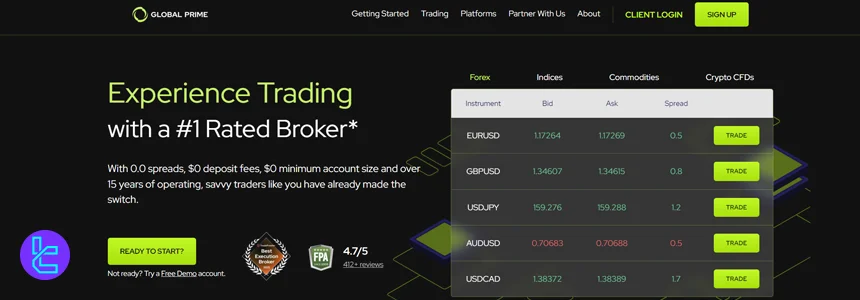
The broker offers Standard and Raw accounts with spreads starting from 0.9 pips on the Standard account and 0.0 pips on the Raw account. Global Prime supports trading on Forex, indices, commodities, cryptocurrencies, bonds, and US share CFDs.
Global Prime stands out for its fast execution speeds from 10 milliseconds, commission-free deposits and withdrawals, and access to more than 20 payment methods. Client funds are held in segregated accounts with major banking institutions such as HSBC and National Australia Bank.
The broker also provides several additional trading benefits, including TradingView Premium access, FT newspaper subscriptions, Autochartist signals, VPS services, and social trading through ZuluTrade. Traders can access leverage up to 1:500 under the VFSC entity, while ASIC-regulated accounts are capped at 1:30.
A Global Prime registration tutorial is available for those interested in the broker. Here’s a table of specifics.
Account Types | Standard, Raw |
Regulating Authorities | VFSC, ASIC |
Minimum Deposit | Unlimited |
Deposit Methods | Credit/Debit Cards, Crypto, PayPal, Neteller, Skrill, FasaPay, Perfect Money, Bank Wire, etc. |
Withdrawal Methods | Credit/Debit Cards, Crypto, PayPal, Neteller, Skrill, AstroPay, Perfect Money, Bank Wire |
Maximum Leverage | 1:500 |
Trading Platforms & Apps | MT4 |
Global Prime Pros and Cons
Global Prime combines competitive spreads, strong regulation, fast trade execution, and a broad range of payment methods. However, the broker still lacks platform diversity compared to competitors, since MT4 remains its primary trading platform.
Pros | Cons |
Regulated by ASIC and VFSC | MT4 is currently the main supported platform |
Raw spreads from 0.0 pips | No Islamic or swap-free account |
No minimum deposit requirement | Restricted access in several countries |
Fast execution from 10ms with segregated client funds | Limited promotions compared to some competitors |
ActivTrades
Founded in 2001 and headquartered in London, ActivTrades has grown into a global brokerage serving more than 100,000 clients across 170 countries. The broker has earned over 65 international awards and built a reputation around fast execution, platform variety, and strong client protection.
ActivTrades is regulated by several authorities, including the Financial Conduct Authority, SCB, CMVM, BACEN, and CVM. UK clients are protected by the FSCS up to £85,000, while the broker also provides additional insurance coverage of up to £1,000,000 per client.
The broker supports four account types, including Professional, Individual, Demo, and Islamic accounts. Traders can access spreads from 0.5 pips, leverage up to 1:400, and more than 1,000 CFD instruments across forex, shares, indices, commodities, ETFs, bonds, and cryptocurrencies.
One of the broker’s strongest advantages is its proprietary ActivTrader platform, alongside support for MetaTrader 4, MetaTrader 5, and TradingView. ActivTrades also uses a No Dealing Desk execution model with average execution speeds of around 4 milliseconds, making it suitable for scalpers, EA users, and active traders.
Check out our ActivTrades registration guide if you are not sure how to go through it. The table below summarizes the broker’s parameters and details.
Account Types | Professional, Individual, Demo, Islamic |
Regulating Authorities | FCA, SCB, CMVM, BACEN, CVM |
Minimum Deposit | $0 |
Deposit Methods | Bank Wire, Credit/Debit Cards (Visa, MasterCard), E-Wallets (Skrill, Neteller), Local Payment Methods |
Withdrawal Methods | Bank Wire, Credit/Debit Cards (Visa, MasterCard), E-Wallets (Skrill, Neteller), Local Payment Methods |
Maximum Leverage | 1:400 |
Trading Platforms & Apps | MT4, MT5, ActivTrader, TradingView |
ActivTrades Pros and Cons
ActivTrades combines strong regulation, solid investor protection, and a broad platform offering. While the broker does not provide copy trading or accept US clients, its fast execution, low minimum deposit, and wide instrument range make it a competitive choice for traders looking for a low spread forex broker.
Pros | Cons |
Regulated by FCA and several international authorities | No copy trading or social trading features |
Additional insurance coverage up to £1,000,000 per client | US clients are not accepted |
Access to MT4, MT5, TradingView, and ActivTrader | Promotions and bonuses are limited |
Over 1,000 CFD instruments with spreads from 0.5 pips | Some withdrawal methods may include external banking fees |
How Was Each Broker Selected?
Selecting the best lowest spread forex brokers requires more than comparing raw spreads or commission rates. At TradingFinder, our analysts review each broker through a 19-metric evaluation framework designed to identify platforms that combine competitive pricing with strong regulation, reliable execution, and a high-quality trading environment.
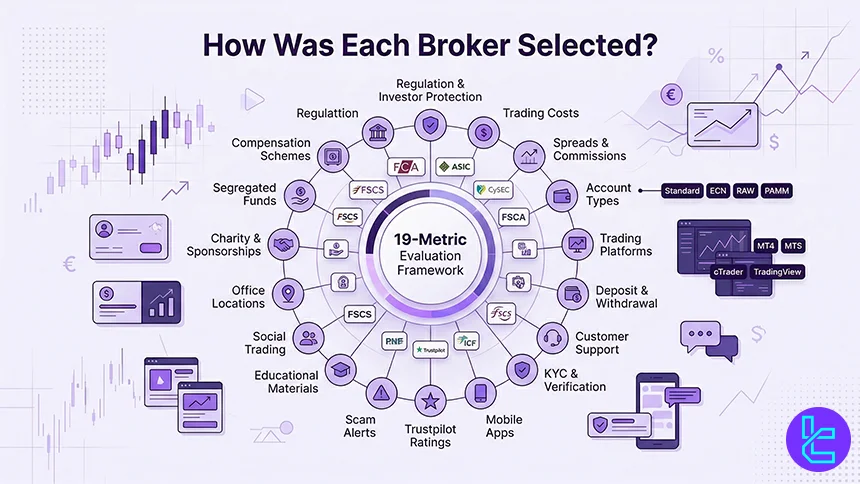
Regulation and investor protection are among the most important factors in our reviews. We prioritize brokers regulated by top-tier authorities such as the Financial Conduct Authority, Australian Securities and Investments Commission, Cyprus Securities and Exchange Commission, and Financial Sector Conduct Authority.
We also assess whether brokers provide negative balance protection, segregated client funds, and compensation schemes such as FSCS or ICF.
Our methodology goes beyond spreads by evaluating account diversity, trading conditions, and platform availability. We compare Standard, ECN, RAW, PAMM, and copy trading accounts while reviewing spreads, commissions, swap rates, leverage, minimum deposits, and non-trading fees.
Trading platforms such as MetaTrader 4, MetaTrader 5, cTrader, and TradingView are also examined to ensure brokers support different trading styles.
TradingFinder specialists also test the account opening process, KYC verification, deposit and withdrawal methods, customer support quality, and broker responsiveness. We review Trustpilot ratings, scam alerts, educational materials, market analysis tools, mobile apps, social media activity, office locations, and charity or sponsorship programs.
This approach helps us identify brokers that offer not only low spreads, but also transparency, security, and a strong overall trading experience.
What is Spread in a Forex Trade?
In forex trading, the spread is the difference between the bid price and the ask price of a currency pair. The bid price is the rate at which a trader can sell a currency pair, while the ask price is the rate at which the pair can be bought. This difference represents one of the main trading costs charged by forex brokers.
For example, if the EUR/USD pair is quoted at 1.1050 / 1.1052, the spread is 2 pips. In this case, a trader buying the pair enters the market 2 pips above the selling price. The trade initially starts with a small unrealized loss equal to the spread.
Low spread forex brokers are popular because tighter spreads reduce trading costs, especially for scalpers, day traders, and traders who open multiple positions per day. Major currency pairs such as EUR/USD, GBP/USD, and USD/JPY usually have the lowest spreads because they are highly liquid and heavily traded.
Spreads can be fixed or variable. Fixed spreads remain unchanged during most market conditions, while variable spreads fluctuate based on liquidity, volatility, and trading sessions. During major economic events, such as Non-Farm Payrolls, inflation data releases, or central bank announcements, spreads often widen because of increased market volatility.
How Can I Say if the Spread is Low?
A forex spread is generally considered low when it stays close to 0.0-1.0 pips on major currency pairs under normal market conditions. Pairs such as EUR/USD, USD/JPY, and GBP/USD usually offer the tightest spreads because they have the highest trading volume and liquidity.
For EUR/USD, a spread below 1 pip is often considered competitive for a Standard account, while RAW or ECN accounts may offer spreads between 0.0 and 0.3 pips plus a commission. On GBP/USD, spreads below 1.5 pips are typically viewed as low, while USD/JPY spreads under 1 pip are common among top brokers.
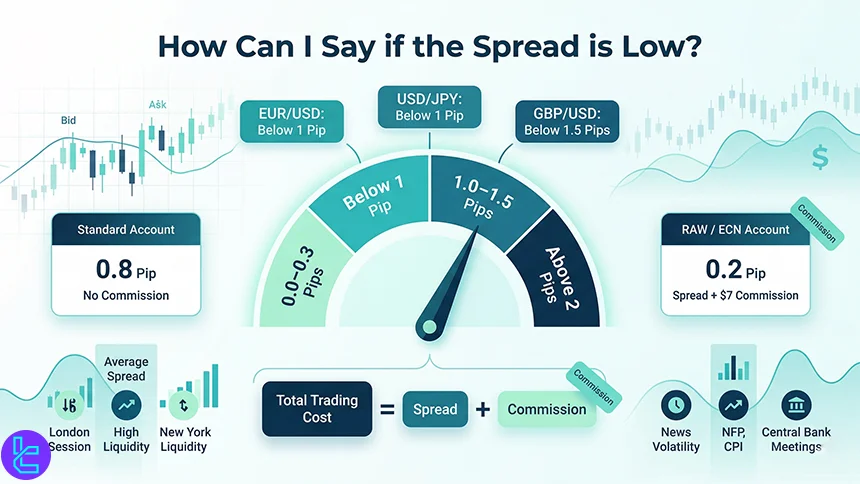
Traders should compare average spreads rather than minimum spreads. Many brokers advertise “spreads from 0.0 pips”, but those conditions may only occur during the most liquid trading hours. The average spread provides a more realistic picture of trading costs over time.
The lowest spreads are usually available during the overlap between the London and New York trading sessions, when market liquidity is highest. Spreads can widen significantly during periods of low activity, such as after the US market closes, or during major news releases like Non-Farm Payrolls, CPI data, or central bank meetings.
A spread may also appear low but become expensive when commissions are added. For example, a RAW account with a 0.2-pip spread and a $7 round-turn commission may cost more overall than a Standard account with a 0.8-pip spread and no commission. Traders should always evaluate the total trading cost rather than the spread alone.
Is Leverage Different in Low Spread Brokers?
Leverage is not directly determined by whether a broker offers low spreads. A broker can provide tight spreads and still offer either low or high leverage depending on its regulatory status, risk policy, and target market.
Most low spread brokers regulated by authorities such as the Financial Conduct Authority, Australian Securities and Investments Commission, and Cyprus Securities and Exchange Commission limit retail forex leverage to around 1:30 on major currency pairs. These restrictions are designed to reduce the risk of excessive losses for retail traders.
For example, a trader opening a $30,000 EUR/USD position with 1:30 leverage would need approximately $1,000 in margin.
Some offshore brokers that advertise ultra-low spreads may offer leverage as high as 1:500, 1:1000, or even higher. While this reduces the amount of capital needed to open a trade, it also increases the risk of rapid losses, margin calls, and stop-outs.
Professional traders who qualify for professional accounts with brokers under FCA, ASIC, or CySEC rules may access higher leverage than retail traders. However, they often lose certain protections such as negative balance protection or compensation scheme eligibility.
When comparing low spread brokers, traders should focus on the balance between spreads, commissions, leverage, and regulation rather than leverage alone. A broker with 0.1-pip spreads and 1:30 leverage under a top-tier regulator may be safer than an offshore broker offering 1:1000 leverage with weaker client protections.
Is Zero Spread Trading Always Favorable?
Zero spread trading is not always the cheapest or most favorable option. Many brokers advertise spreads from 0.0 pips, but these accounts usually charge a separate commission on each trade. In some cases, the combined cost of the spread and commission may be higher than a Standard account with a slightly wider spread and no commission.
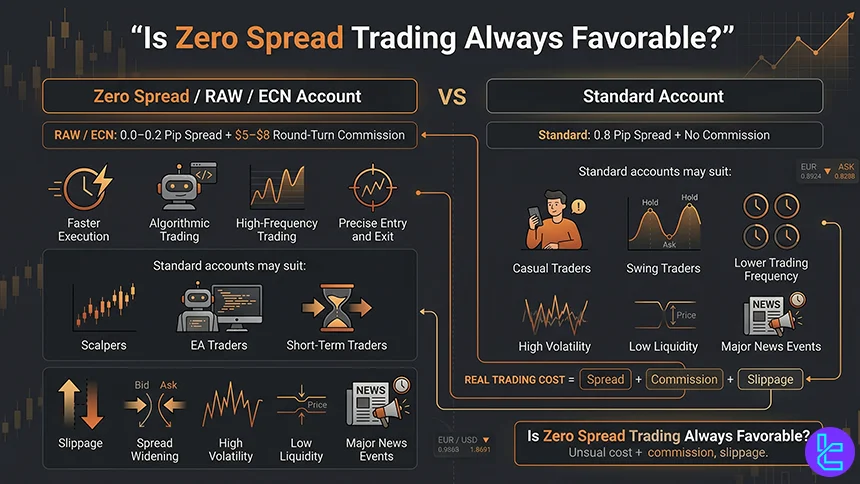
For example, a RAW or ECN account may offer EUR/USD spreads starting from 0.0–0.2 pips with a commission of $5 to $8 per round turn per lot. A Standard account may charge a spread of 0.8 pips without commission. Depending on position size and trading frequency, the total cost can be similar or even lower on the Standard account.
Zero spread accounts are often more suitable for scalpers, algorithmic traders, and high-frequency traders who need precise entry and exit points. Small differences in spread can have a major effect on strategies that target only a few pips of profit.
However, traders should also consider slippage, execution speed, and spread widening during volatile conditions. A broker may advertise zero spreads during liquid market hours, but spreads can widen significantly during major news events, low-liquidity periods, or market opens.
The best approach is to compare the average spread, commission structure, and execution quality together. A broker with slightly higher spreads but faster execution and lower commissions may offer better overall trading conditions than a broker that only promotes zero spreads.
What Other Fees Do Zero-Spread Forex Brokers Charge?
Zero-spread forex brokers often compensate for the lack of spread by charging other fees. Traders should always evaluate the total cost of trading rather than focusing only on the advertised spread.
The most common extra costs include:
- Commission Fees: Most zero-spread accounts charge a commission per trade, usually between $5 and $8 per round turn for one standard lot. This is the primary source of revenue for many ECN and RAW account brokers;
- Swap or Overnight Fees: Holding a leveraged forex position overnight usually results in a swap charge or credit, depending on the interest rate difference between the two currencies in the pair;
- Deposit and Withdrawal Fees: Some brokers charge fees for bank wire withdrawals, credit card deposits, or specific e-wallet methods, especially for international transactions;
- Currency Conversion Fees: If the trading account base currency differs from the deposited currency or traded asset, brokers may apply a conversion fee;
- Inactivity Fees: Certain brokers charge a monthly inactivity fee if the account remains unused for several months;
- VPS Fees: Traders using automated strategies or Expert Advisors may need a Virtual Private Server, which can cost between $10 and $50 per month unless the broker provides it for free;
- Market Data or Platform Fees: While platforms such as MetaTrader 4 and MetaTrader 5 are often free, some brokers charge for premium market data, advanced charting, or third-party platforms like TradingView and cTrader.
Total Broker Cost = Commission + Swap Fees + Non-Trading Fees
For active traders, these additional charges can become more important than the spread itself.
How to Calculate the Spread in a Trading Pair
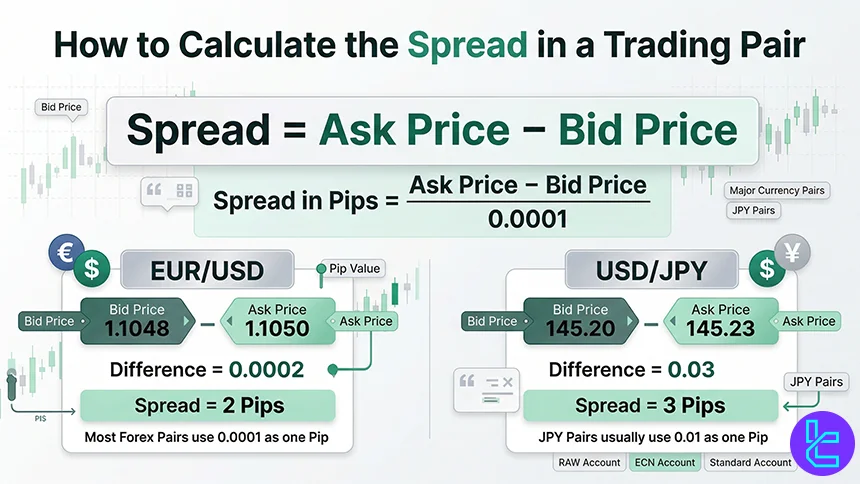
The spread in a trading pair is calculated by subtracting the bid price from the ask price. The result shows the difference between the buying price and the selling price quoted by the broker.
For example, if EUR/USD is quoted at 1.1048 / 1.1050:
- Bid Price = 1.1048
- Ask Price = 1.1050
- Spread = 0.0002
In most forex pairs, one pip equals 0.0001. Therefore, a spread of 0.0002 is equal to 2 pips.
Spread in Pips = (Ask Price − Bid Price) / 0.0001
For pairs involving the Japanese yen, such as USD/JPY, one pip is usually 0.01 instead of 0.0001. If USD/JPY is quoted at 145.20 / 145.23, the spread is 0.03, which equals 3 pips.
Understanding how to calculate the spread helps traders compare broker pricing more accurately, especially when evaluating RAW, ECN, or Standard accounts.
What Factors and Parameters Should I Consider in Choosing the Lowest Spread Forex Broker?
Choosing the lowest spread forex broker involves more than finding the smallest advertised spread. Traders should compare the full trading environment, including commissions, execution quality, regulation, and platform support.
Important factors to consider include:
- Regulation and Safety: Choose brokers regulated by authorities such as the FCA, ASIC, CySEC, or Financial Sector Conduct Authority. Strong regulation can provide client fund segregation, compensation schemes, and negative balance protection;
- Average Spread Instead of Minimum Spread: Many brokers advertise spreads “from 0.0 pips,” but traders should compare average spreads during normal market conditions;
- Commission Structure: A lower spread account may charge higher commissions. Always compare the total trading cost rather than spreads alone;
- Execution Speed and Slippage: Fast order execution and low slippage are especially important for scalpers, algorithmic traders, and traders using Expert Advisors;
- Trading Platforms: Support for MetaTrader 4, MetaTrader 5, cTrader, and TradingView can affect the overall trading experience;
- Account Types: Brokers offering Standard, RAW, ECN, and Islamic accounts provide more flexibility for different trading styles;
- Deposit, Withdrawal, and Inactivity Fees: Low spreads may be offset by expensive non-trading fees;
- Tradable Instruments: Brokers with access to forex, commodities, indices, stocks, ETFs, and crypto CFDs may provide better diversification opportunities;
- Customer Support and Reputation: Reviews on Trustpilot, support response speed, and the broker’s history can provide useful insight into reliability.
Conclusion
Spread is the difference between the bid and ask prices in a trading pair that makes up part of a broker’s costs for a client. It’s worth noting that in low-spread brokers, other fees might be higher; therefore, careful consideration is required.
Based on our investigations, IC Markets, FP Markets, Fusion Markets, and Global Prime are some of the best brokers for those with an intention of low spread trading.
To learn about the details and our approach in evaluating these brands, check out our Forex methodology.