









Zero spread Forex brokers attract traders who prioritize cost efficiency and precise trade execution, especially in strategies such as scalping and day trading. In these accounts, the spread on major currency pairs can drop to 0.0 pips, allowing traders to enter and exit positions without the typical bid ask difference found in standard accounts.
However, zero spread does not mean zero cost. Brokers usually apply a fixed commission per lot, which replaces the spread as the primary trading expense. This pricing model is commonly associated with ECN or RAW accounts, where prices are sourced directly from liquidity providers, ensuring tighter spreads and more transparent execution.
The guide below analyzes the best zero spread Forex brokers based on commission structure, execution speed, trading platforms, regulatory status, and overall trading conditions, helping traders identify cost-efficient and high-performance environments for active trading strategies.
 | LiteFinance | |||
 | FxPro | |||
 | Vantage | |||
| 4 |  | IC Markets | ||
| 5 |  | Exness | ||
| 6 |  | HFM | ||
| 7 |  | eightcap | ||
| 8 |  | AMARKETS |
Zero Spread Brokers Ranked by Trustpilot Scores
Trustpilot ratings provide valuable insight into real trader experiences with zero spread Forex brokers, particularly in areas such as execution quality, withdrawal reliability, and pricing transparency. Since zero spread accounts rely on commission-based pricing, user feedback often highlights whether brokers deliver fair conditions without hidden costs.
Unlike standard accounts, where spreads are visible, zero spread trading shifts the focus toward execution accuracy and commission consistency. As a result, Trustpilot reviews frequently emphasize slippage, order speed, and how closely real trading conditions match advertised specifications.
Broker Name | Trustpilot Rating | Number of Reviews |
IC Markets | 53,139 | |
AMarkets | 3,568 | |
Exness | 28,678 | |
HFM | 4.4/5⭐ | 2,923 |
Vantage Markets | 12,305 | |
Eightcap | 3,639 | |
4.1/5⭐ | 661 | |
777 |
Commission Per Lot Analysis in Zero Spread Brokers
In zero spread Forex accounts, the primary trading cost shifts from spreads to commissions. Instead of paying the bid ask difference, traders are charged a fixed fee per lot traded. This makes commission analysis essential, especially for scalpers and high-frequency traders who execute multiple positions daily.
For zero spread traders, selecting a broker with competitive and transparent commission pricing is critical, as it directly determines cost efficiency and overall trading performance.
Broker Name | Commission Per Lot |
$0.0 | |
AvaTrade | $0.0 |
LiteFinance | $0.25 |
FxPro | $3.5 |
$3.5 Average | |
FXTM | $3.5 |
TMGM | $3.5 |
Fusion Markets | $4.5 |
Execution Model of Zero Spread Forex Platforms
The execution model is a defining factor in zero spread Forex trading, as it determines how orders are processed, priced, and filled. Since zero spread accounts rely on raw pricing from liquidity providers, the execution environment must support fast, transparent, and interference-free order routing.
Zero spread conditions are most commonly associated with ECN and, in some cases, STP models, where brokers aggregate quotes from banks and liquidity providers to offer near-zero spreads.
Broker Name | Execution Model |
Exness | Market Execution, Instant Execution |
HFM | Market, Buy Stop, Stop Loss, Limit, Take Profit |
Market Execution | |
Instant, Market | |
Errante | Market, ECN |
Tickmill | Market |
Pepperstone | Instant |
Alpari | Market |
Additional Charges (Hidden Fees) in Zero Spread Brokers
Zero spread accounts often appear cost-free at first glance, but the absence of spreads does not eliminate all trading expenses. Brokers typically apply additional charges that can impact overall profitability, especially for active traders.
A zero spread broker should not be judged solely on spreads. Understanding the complete cost structure ensures more accurate evaluation and helps traders select platforms that truly offer cost-efficient trading conditions.
Broker Name | Deposit/Withdrawal Fee | Inactivity Fee |
Vantage Markets | $0 | $0 |
IC Markets | $0 | $0 |
$0 | $0 | |
Moneta Markets | $0 | $0 |
FP Markets | $0 | $0 |
$0 | $10 Inactivity Fee Per Month | |
FXGT | $0 | $10 Inactivity Fee Per Month |
PU Prime | 20 USD/JPY/HKD | $0 |
Top 6 Zero Spread Forex Brokers
Selecting a zero spread Forex broker requires a detailed evaluation of pricing transparency, execution quality, and overall trading conditions. Since these accounts rely on commission-based models, the best brokers are those that combine tight raw spreads with low commissions and fast execution.
Top zero spread brokers typically operate using ECN or STP execution, ensuring direct access to liquidity providers and minimal dealing desk intervention. This setup is especially important for scalpers and day traders who depend on precision and speed.
LiteFinance
LiteFinance is a long-established Forex and CFD broker founded in 2005, offering trading services across global markets including Forex, commodities, indices, and stocks. With over 3.01 million clients and an average daily trading volume of $24B, the broker has positioned itself as a competitive player in the industry, particularly in ECN trading environments.

The broker is regulated by the Financial Services Commission (FSC) of Mauritius, while its European entity operates under CySEC, providing an additional layer of credibility for EU clients. LiteFinance also implements features such as segregated funds and negative balance protection, enhancing account safety for traders.
LiteFinance dashboard offers two main account types: Classic and ECN. The ECN account provides zero spread trading with commissions starting from $5 per lot on major Forex pairs, making it suitable for scalpers and high-frequency traders. In contrast, the Classic account features spreads starting from 1.8 points with no commission. The minimum deposit is set at $50 for both account types.
The broker supports multiple trading platforms including MetaTrader 4, MetaTrader 5, and cTrader, along with a proprietary mobile app. These platforms enable both manual and algorithmic trading with fast execution and deep liquidity access.
LiteFinance deposit and withdrawal options include credit/debit cards, bank transfers, STICPAY, Perfect Money, Volet, and regional payment systems, with most withdrawals processed within 24 hours. However, an inactivity fee of $10 applies after 3 months of no trading activity.
Overall, the broker stands out for its ECN zero spread offering, LiteFinance copy trade, platform diversity, and long operational history, although its offshore regulation and limited account variety may be considerations.
Account Types | Classic, ECN |
Regulating Authorities | FSC (Mauritius), CySEC (EU entity) |
Minimum Deposit | $50 |
Deposit Methods | Credit/Debit Cards, Bank Wire, STICPAY, Perfect Money, Volet, Africa Mobile Money |
Withdrawal Methods | Credit/Debit Cards, Bank Wire, STICPAY, Perfect Money, Volet, Africa Mobile Money, Crypto |
Maximum Leverage | Up to 1:1000 |
Trading Platforms & Apps | MetaTrader 4, MetaTrader 5, cTrader, Mobile App |
LiteFinance Pros and Cons
When evaluating LiteFinance as a zero spread broker, its strengths include solid regulatory oversight, efficient execution, and a wide selection of instruments, although certain limitations may affect its overall suitability.
Pros | Cons |
Zero spread ECN account available | Offshore regulation (FSC) |
Established broker (since 2005) | Limited account types |
Supports MT4, MT5, cTrader | Inactivity fee after 3 months |
Copy trading available | No 24/7 support |
Wide range of payment methods | Mixed external review scores |
Fast execution and deep liquidity | - |
FxPro
FxPro is a globally recognized Forex and CFD broker established in 2006, known for its strong regulatory framework and advanced trading infrastructure. With over 15 years of experience and more than 125 industry awards, the broker has built a solid reputation among both retail and professional traders.

The company operates under multiple top-tier regulators, including the FCA in the UK, CySEC in Europe, FSCA in South Africa, and SCB in the Bahamas. This multi-jurisdictional regulation enhances client protection through mechanisms such as segregated funds and negative balance protection. In the UK, traders are covered by the FSCS scheme up to £85,000, adding an extra layer of security.
FxPro offers three main account types: Standard, Raw+, and Elite. The Raw+ account provides zero spread trading with commissions starting from $3.5 per side, making it suitable for scalpers and active traders. The Standard account, on the other hand, includes spreads from around 1.2 pips with no commission. The minimum deposit is $100, although higher-tier accounts require larger capital.
FxPro dashboard supports a wide range of platforms including MetaTrader 4, MetaTrader 5, cTrader, WebTrader, and a proprietary mobile app. Execution speed is a key strength, with average order execution times below 12 milliseconds, ensuring minimal latency in fast-moving markets.
FxPro provides access to over 2,100 tradable instruments across Forex, stocks, indices, commodities, cryptocurrencies, and futures. Funding methods include cards, bank transfers, Skrill, Neteller, and PayPal, depends on FxPro verification entity.
Overall, FxPro stands out for its strong regulation, fast execution, and zero spread account options, although higher deposit requirements and inactivity fees may be considerations.
Account Types | Standard, Raw+, Elite |
Regulating Authorities | FCA, CySEC, FSCA, SCB |
Minimum Deposit | $100 |
Deposit Methods | Visa, MasterCard, Bank Wire, Skrill, Neteller, PayPal, Broker Transfer |
Withdrawal Methods | Visa, MasterCard, Bank Wire, Skrill, Neteller, PayPal |
Maximum Leverage | Up to 1:500 |
Trading Platforms & Apps | MetaTrader 4, MetaTrader 5, cTrader, WebTrader, Mobile App |
FxPro Pros and Cons
The broker presents key advantages as a zero spread broker, including FxPro rebate, a dependable execution model, and broad market access, though some constraints may influence trader decisions.
Pros | Cons |
Strong multi-regulation (FCA, CySEC, FSCA) | Higher minimum deposit ($100) |
Zero spread accounts available (Raw+) | Inactivity fees apply |
Fast execution (under 12 ms) | No 24/7 support |
2100+ tradable instruments | Limited bonus offerings |
Multiple platforms (MT4, MT5, cTrader) | Restrictions in some countries |
Free deposits and withdrawals (most cases) | - |
Vantage Markets
Vantage Markets is a globally recognized Forex and CFD broker founded in 2009 and headquartered in Sydney, Australia. With a strong international presence across more than 30 offices, the broker has positioned itself as a competitive choice for both retail and professional traders.
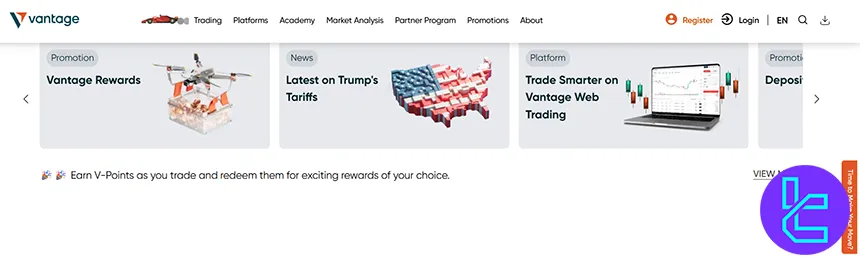
The broker operates under a multi-regulated framework, including top-tier authorities such as ASIC and FCA, along with FSCA, VFSC, and CIMA. This regulatory diversity enhances credibility and provides varying levels of investor protection, including compensation schemes and Lloyd’s insurance coverage in some jurisdictions.
After going through Vantage Markets registration, the broker offers a wide range of account types, including Standard STP, Standard Cent, Raw ECN, Pro ECN, and Swap-Free accounts. The Raw ECN and Pro ECN accounts are particularly relevant for zero spread trading, offering spreads from 0.0 pips with commissions starting from $6 per lot and as low as $1.5 per side in professional tiers. The minimum deposit starts from just $20, making the forex broker accessible to a wide range of traders.
The platform ecosystem is one of Vantage’s strongest features, supporting MetaTrader 4, MetaTrader 5, ProTrader, TradingView, and a proprietary mobile app. These platforms cater to both manual and algorithmic trading, with fast execution and advanced charting tools.
Vantage also provides copy trading solutions through ZuluTrade, DupliTrade, and Myfxbook AutoTrade, allowing users to replicate professional strategies. Funding options include cards, bank transfers, e-wallets, and local payment systems, with no deposit or withdrawal fees in most cases.
Overall, Vantage Markets stands out for its low entry barrier, strong platform offering, and flexible ECN pricing, although higher-tier accounts may require larger deposits.
Account Types | Standard STP, Standard Cent, Raw ECN, Pro ECN, Swap-Free |
Regulating Authorities | ASIC, FCA, FSCA, VFSC, CIMA |
Minimum Deposit | $20 |
Deposit Methods | Bank Transfer, Credit/Debit Cards, Skrill, Neteller, FasaPay, Perfect Money, Local Payments |
Withdrawal Methods | Bank Transfer, Credit/Debit Cards, Skrill, Neteller, FasaPay, Perfect Money, Local Payments |
Maximum Leverage | Up to 1:1000 |
Trading Platforms & Apps | MetaTrader 4, MetaTrader 5, ProTrader, TradingView, Proprietary App |
Vantage Markets Pros and Cons
In assessing Vantage Markets for zero spread trading, its regulatory framework, execution reliability, and diverse instrument offering stand out, while a few limitations may impact its appeal.
Pros | Cons |
Strong regulation (ASIC, FCA, FSCA) | High deposit for Pro ECN account |
Zero spread ECN accounts available | Some countries restricted |
Low minimum deposit ($20) | No dedicated desktop proprietary platform |
Multiple platforms (MT4, MT5, TradingView) | - |
Copy trading options (ZuluTrade, DupliTrade) | - |
No inactivity fees | - |
IC Markets
IC Markets is a globally recognized Forex and CFD broker established in 2007, offering institutional-grade trading conditions with a strong focus on low spreads and high-speed execution. The broker is regulated by multiple authorities, including ASIC, CySEC, and FSA, ensuring a secure and compliant trading environment for both retail and professional clients.

One of IC Markets’ key strengths lies in its pricing model. The broker offers Raw Spread accounts with spreads starting from 0.0 pips and commissions around $3 to $3.5 per side, making it a preferred choice for scalpers and algorithmic traders.
The Standard account, on the other hand, provides spreads from 0.8 pips with no commission. The minimum deposit is set at $200, which is slightly higher than some competitors but aligns with its professional-grade infrastructure.
IC Markets supports a wide range of platforms, including MetaTrader 4, MetaTrader 5, cTrader, and its proprietary mobile app. These platforms are optimized for fast execution, one-click trading, and automated strategies using Expert Advisors. The broker’s infrastructure supports market execution with deep liquidity, ensuring minimal slippage and consistent order fills.
The broker provides access to over 2,200 tradable instruments, including Forex pairs, stocks, indices, commodities, bonds, and cryptocurrencies. Funding options include bank transfers, credit/debit cards, PayPal, Skrill, Neteller, and regional payment systems, with no deposit or withdrawal fees in most cases.
Overall, the broker stands out for its ultra-tight spreads, IC Markets rebate, advanced platforms, and strong execution environment, although the higher minimum deposit may be a consideration for beginners.
Account Types | Standard, Raw Spread, Islamic |
Regulating Authorities | ASIC, CySEC, FSA |
Minimum Deposit | $200 |
Deposit Methods | Bank Cards, Wire Transfer, PayPal, Skrill, Neteller, UnionPay, POLI |
Withdrawal Methods | Bank Cards, Wire Transfer, PayPal, Skrill, Neteller |
Maximum Leverage | Up to 1:500 |
Trading Platforms & Apps | MetaTrader 4, MetaTrader 5, cTrader, cTrader Web, Mobile App |
IC Markets Pros and Cons
IC Markets delivers a competitive zero spread environment supported by robust regulation, stable execution, and extensive instrument coverage, although certain factors may limit its suitability.
Pros | Cons |
Ultra-low spreads (from 0.0 pips) | High minimum deposit ($200) |
Strong regulation (ASIC, CySEC) | Limited leverage in EU regions |
Multiple advanced platforms (MT4, MT5, cTrader) | No PAMM accounts |
2200+ tradable instruments | - |
Fast execution and deep liquidity | - |
No inactivity or funding fees | - |
Exness
Exness is a globally established Forex and CFD broker founded in 2008, known for its high trading volumes exceeding $4 trillion per month and a strong presence across multiple regulated jurisdictions.

The broker operates under several reputable authorities, including FCA, CySEC, FSCA, CMA, and FSA, providing a layered regulatory framework and enhanced client protection through segregated funds and compensation schemes.
One of Exness’s standout features is its flexible pricing structure. The broker offers spreads starting from 0.0 pips on Zero and Raw Spread accounts, with commissions ranging from $0.2 to $3.5 per lot depending on the account type.
The Zero account is available in Exness dashboard and provides zero spreads for most of the trading day, making it highly attractive for scalpers and high-frequency traders. Meanwhile, Standard accounts offer commission-free trading with slightly wider spreads.
Exness provides a diverse range of account types, including Standard, Standard Cent, Pro, Raw Spread, and Zero accounts, catering to both beginners and professional traders. The minimum deposit starts from just $10, making it one of the most accessible brokers in the market. Additionally, the broker offers unlimited leverage under specific conditions, which can significantly enhance trading flexibility.
The platform ecosystem includes MetaTrader 4, MetaTrader 5, Exness Terminal (web), and the Exness Trade mobile app. These platforms support both manual and algorithmic trading, along with social trading features that allow users to copy strategies from experienced traders.
Exness deposit and withdrawal supports a wide variety of payment methods, including bank cards, e-wallets, and cryptocurrencies, with instant deposits and fast withdrawals, often processed within minutes to a few hours. Notably, the broker does not charge deposit, withdrawal, or inactivity fees.
Overall, the broker stands out for its ultra-low entry barrier, Exness bonus, flexible leverage, and strong execution environment, although educational resources may be less extensive compared to some competitors.
Exness Pros and Cons
From a zero spread trading perspective, Exness benefits from strong regulatory backing, consistent execution quality, and a wide range of tradable assets, though some drawbacks should be considered.
Pros | Cons |
Very low minimum deposit ($10) | Limited educational content |
Zero spread accounts available | Some restrictions by region |
Multiple top-tier regulations (FCA, CySEC) | Not all instruments available on all accounts |
Unlimited leverage (conditions apply) | - |
No deposit, withdrawal, or inactivity fees | - |
Fast execution and instant withdrawals | - |
HFM
HFM, also known as HF Markets, is a globally established Forex and CFD broker founded in 2010, serving over 2.5 million trading accounts across more than 27 languages. The broker operates under multiple regulatory authorities, including FCA, CySEC, DFSA, and FSCA, which enhances its credibility and ensures compliance with international financial standards.
One of HFM’s core strengths is its flexible pricing structure. The broker offers spreads starting from 0.0 pips on Zero accounts, while most other account types provide commission-free trading on Forex pairs. This makes HFM suitable for both cost-sensitive traders and those seeking raw spread environments.
HFM provides a diverse range of account types, including Cent, Premium, Pro, and Zero accounts, allowing traders to choose based on their experience level and trading strategy. The minimum deposit starts from $0, which significantly lowers the entry barrier for beginners. Additionally, the broker offers leverage up to 1:2000, depending on the regulatory entity.
HFM dashboard provides access MetaTrader 4, MetaTrader 5, and a proprietary mobile trading app, supporting both manual and automated trading strategies. The broker also offers HFM copy trading and PAMM account services, enabling users to follow experienced traders or manage investor funds.
In terms of assets, HFM provides access to over 1,000 trading instruments across Forex, stocks, indices, commodities, cryptocurrencies, ETFs, and bonds. Funding options include bank transfers, cards, e-wallets, and crypto payments, with most transactions processed quickly and without deposit or withdrawal fees.
Overall, The broker stands out for its wide asset coverage, easy HFM registration, flexible account options, and strong regulatory backing, although some users report occasional technical issues and mixed customer support experiences.
Account Types | Cent, Premium, Pro, Zero |
Regulating Authorities | FCA, CySEC, DFSA, FSCA, FSA |
Minimum Deposit | From $0 |
Deposit Methods | Bank Transfer, Credit/Debit Cards, Skrill, Neteller, Perfect Money, Crypto |
Withdrawal Methods | Bank Transfer, Credit/Debit Cards, Skrill, Neteller, Perfect Money, Crypto |
Maximum Leverage | Up to 1:2000 |
Trading Platforms & Apps | MetaTrader 4, MetaTrader 5, Mobile App |
HFM Pros and Cons
HFM stands out among zero spread brokers due to its regulatory strength, execution efficiency, and diversified product range, though certain limitations may still apply.
Pros | Cons |
Multi-regulated (FCA, CySEC, DFSA, FSCA) | Reports of technical issues |
Zero spread account available | Mixed customer support reviews |
No minimum deposit requirement | Geo-restrictions in some countries |
1000+ tradable instruments | Limited proprietary platforms |
Copy trading and PAMM services | - |
Criteria to Choose the Best Zero Spread Forex Broker
Choosing a zero spread Forex broker requires a deeper level of evaluation compared to standard accounts, as trading costs shift from spreads to commissions and execution quality.
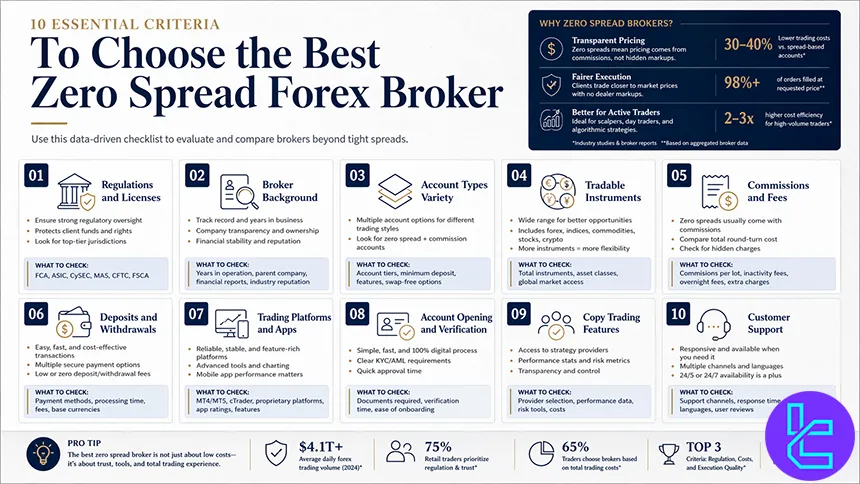
Traders rely on these brokers for precise order execution and transparent pricing, making it essential to assess every aspect of their infrastructure and services. TradingFinder applies a comprehensive methodology built on 19 data-driven metrics, ensuring that each broker is analyzed with a focus on cost efficiency, execution reliability, and overall trading experience.
Zero spread environments demand high-performance systems, as even minor delays or inconsistencies can impact profitability. For this reason, the evaluation process goes beyond pricing and includes platform stability, liquidity access, and operational transparency.
The goal is to identify brokers that consistently deliver true 0.0 pip conditions without compromising execution speed or introducing hidden costs. Core evaluation criteria:
- Regulations and Licenses: Verification of broker legitimacy and compliance with international financial authorities;
- Broker Background: Assessment of company history, reputation, and operational track record;
- Account Types Variety: Availability of RAW, ECN, and zero spread accounts for different strategies;
- Tradable Instruments: Diversity across Forex, indices, commodities, stocks, and cryptocurrency CFDs;
- Commissions and Fees: Detailed analysis of per-lot commissions and non-trading costs;
- Deposits and Withdrawals: Speed, reliability, and variety of funding methods;
- Trading Platforms and Apps: Support for MT4, MT5, cTrader, and mobile trading environments;
- Account Opening and Verification: Simplicity and efficiency of onboarding process;
- Copy Trading Features: Availability and quality of social and automated trading tools;
- Customer Support: Responsiveness and effectiveness across multiple communication channels;
- Micro Data Accuracy: Precision and usability of trading data provided by the broker;
- Global Presence: Availability of offices and services across multiple regions;
- Educational Resources: Access to tutorials, webinars, and analytical tools;
- Trustpilot Score: Real user feedback on execution, withdrawals, and pricing transparency;
- Platform Updates and Innovation: Frequency of improvements and feature enhancements;
- Infographic and Data Presentation: Clarity of complex trading information;
- Broker Responsiveness: Efficiency in resolving issues and handling user requests;
- Scam Alerts and Risk Signals: Monitoring of fraud reports and operational warnings;
- Sponsorship and Brand Presence: Market reputation and industry involvement.
By combining these criteria, TradingFinder ensures a balanced and transparent evaluation framework, helping traders identify zero spread brokers that deliver consistent pricing, fast execution, and a reliable trading environment for high-frequency and cost-sensitive strategies.
What Does Zero Spread Actually Mean in Forex Trading?
Zero spread in Forex trading refers to a pricing model where the difference between the bid and ask price is reduced to 0.0 pips, meaning traders can enter and exit positions at the same price under normal market conditions. This model is typically offered on ECN or RAW accounts, where brokers stream prices directly from liquidity providers.
However, zero spread does not mean zero cost. Instead of earning through spreads, brokers charge a fixed commission per trade, which becomes the primary cost component. Key characteristics of zero spread:
- Bid and ask prices are equal during high liquidity periods
- Pricing is sourced directly from liquidity providers
- Most common on major currency pairs like EURUSD
- Requires commission payment per lot
Zero spread conditions are most stable during peak trading sessions such as the London and New York overlap. During low liquidity or high volatility, spreads may temporarily widen.
For traders, zero spread provides pricing clarity and eliminates hidden markups, making it particularly useful for short-term strategies where entry precision is critical.
How Do Zero Spread Brokers Make Money?
Zero spread brokers operate on a commission-based model rather than earning from the bid-ask spread. This approach creates a more transparent pricing structure, but understanding how brokers generate revenue is essential. Main revenue sources:
- Commission per lot traded (primary income source)
- Swap or overnight fees on open positions
- Currency conversion charges
- Fees on withdrawals or inactive accounts
- Markups on certain instruments outside major pairs
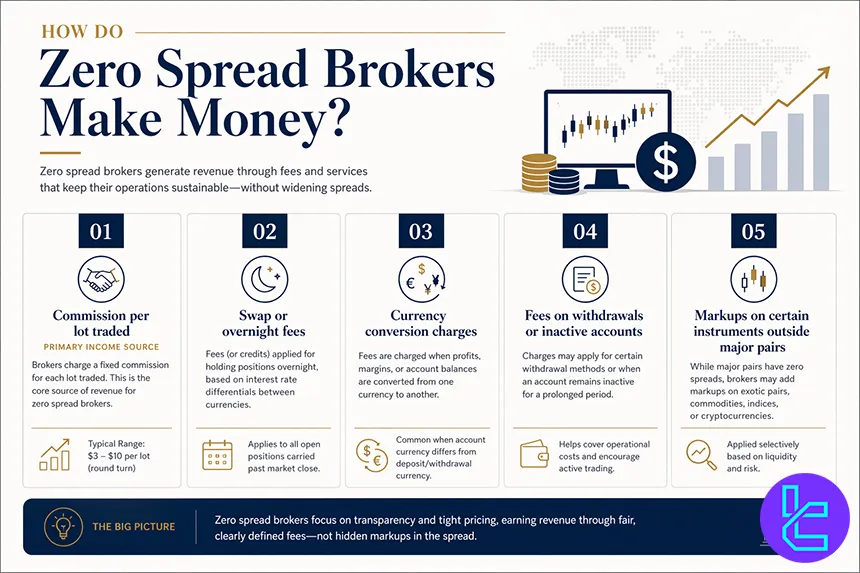
In ECN environments, brokers may also earn from liquidity provider rebates based on trading volume. Understanding how brokers generate income helps traders evaluate whether pricing conditions are fair and sustainable over time.
Are Zero Spread Accounts Truly Cost-Effective?
Zero spread accounts are often marketed as the most cost-efficient trading option, but their real effectiveness depends on how total trading costs are calculated. Unlike standard accounts where the cost is embedded in the spread, zero spread models shift the expense entirely to commissions, making cost evaluation more nuanced.
At first glance, entering trades at 0.0 pips seems like a clear advantage, especially for strategies that rely on tight entry points such as scalping. However, the real question is whether the commission replaces the spread at a lower overall cost or simply redistributes it.
In high-frequency environments, zero spread accounts often become more cost-efficient because the absence of spread reduces entry friction. This is particularly relevant for traders who open and close multiple positions within short timeframes.
However, for low-frequency or swing trading, commissions can accumulate without delivering meaningful benefits, especially when trades are held longer and influenced by swap fees. When zero spread accounts deliver value:
- Scalping and day trading strategies with high trade volume
- Trading during peak liquidity sessions with stable spreads
- Precision-based strategies requiring exact entry levels
How Do Commissions Impact Zero Spread Trading?
In zero spread Forex accounts, commissions replace spreads as the primary trading cost, making them a critical factor in overall profitability. While traders benefit from entering positions at 0.0 pips, every trade incurs a fixed fee, which directly affects the break-even point and net returns.
Unlike standard accounts where costs are embedded in price, zero spread models offer greater transparency. However, this also means traders must actively calculate total costs per trade, especially in high-frequency environments. Commission structures in zero spread brokers:
Model | Description | Impact |
Per Side | Charged on entry and exit separately | Higher visibility of cost |
Round Turn | Combined cost for full trade | Easier cost calculation |
Tiered | Lower fees for higher volume | Suitable for active traders |
For traders, choosing a broker with competitive commission rates is essential, as it directly defines the efficiency of zero spread trading.
Is Slippage Higher in Zero Spread Brokers?
Slippage is a natural part of market execution and refers to the difference between the expected price and the actual execution price. In zero spread brokers, slippage is not necessarily higher, but it is more transparent because prices reflect real market conditions.
Unlike market maker models, where execution may be controlled internally, zero spread brokers (typically ECN) pass orders directly to liquidity providers. This results in both positive and negative slippage.
Factor | ECN (Zero Spread) | Market Maker |
Price Source | Real market liquidity | Broker-controlled |
Slippage Type | Positive & Negative | Often limited visibility |
Transparency | High | Moderate |
During the times below, slippage increases:
- During major economic news releases
- In low liquidity market sessions
- When trading large position sizes
- Under high market volatility
Zero spread brokers do not create slippage but expose real market movement. This means traders may sometimes receive better prices, which is not always possible in fixed-spread environments.
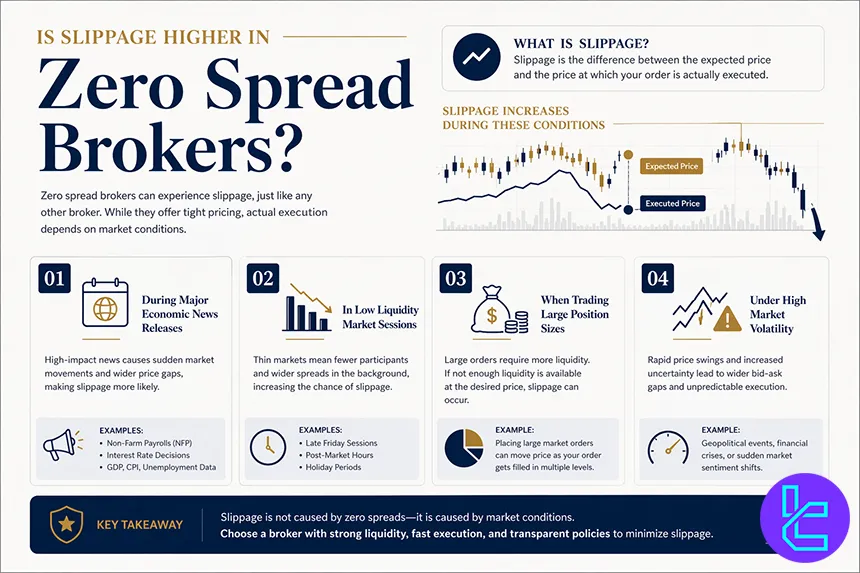
Selecting brokers with deep liquidity and fast execution infrastructure reduces slippage risk and improves trade consistency.
What Instruments Offer Zero Spread Conditions?
Zero spread conditions are typically limited to highly liquid instruments where tight pricing is sustainable. Brokers prioritize major markets where bid and ask prices naturally converge due to high trading volume. Common instruments with zero spread:
Asset Class | Examples | Availability |
Major Forex Pairs | EURUSD, GBPUSD, USDJPY | High |
Minor Forex Pairs | EURGBP, AUDUSD | Moderate |
Metals | Gold (XAUUSD) | Moderate |
Indices | US30, NASDAQ | Limited |
Cryptocurrencies | BTCUSD, ETHUSD | Rare |
For traders, focusing on major currency pairs ensures consistent access to zero spread pricing and optimal execution conditions.
How Do Zero Spread Brokers Perform During High Volatility?
Market volatility significantly impacts the performance of zero spread brokers, particularly during major news events or sudden liquidity shifts. While these brokers aim to maintain tight pricing, real market conditions can temporarily override zero spread advantages. Typical behavior during volatile conditions:
Factor | Normal Market | High Volatility |
Spread | 0.0 pips | May widen temporarily |
Execution Speed | Stable | Can fluctuate |
Slippage | Minimal | Increased likelihood |
Liquidity | Deep | Reduced |
During events such as interest rate decisions or economic data releases, liquidity providers may widen spreads to manage risk, which directly affects zero spread accounts.
Zero spread brokers generally maintain transparency during volatility, but traders must adapt to dynamic market conditions to protect capital.
How to Verify the Authenticity of Zero Spread Claims
Not all brokers advertising zero spread accounts consistently deliver true 0.0 pip conditions. Verifying these claims is essential to avoid hidden costs and misleading pricing structures. Step-by-Step verification process:
- Monitor live spreads on MT4 or MT5 during peak sessions
- Compare broker pricing with external data sources like TradingView
- Check commission details and hidden fee structures
- Analyze Trustpilot reviews focusing on execution and pricing
- Test the broker with a small live account
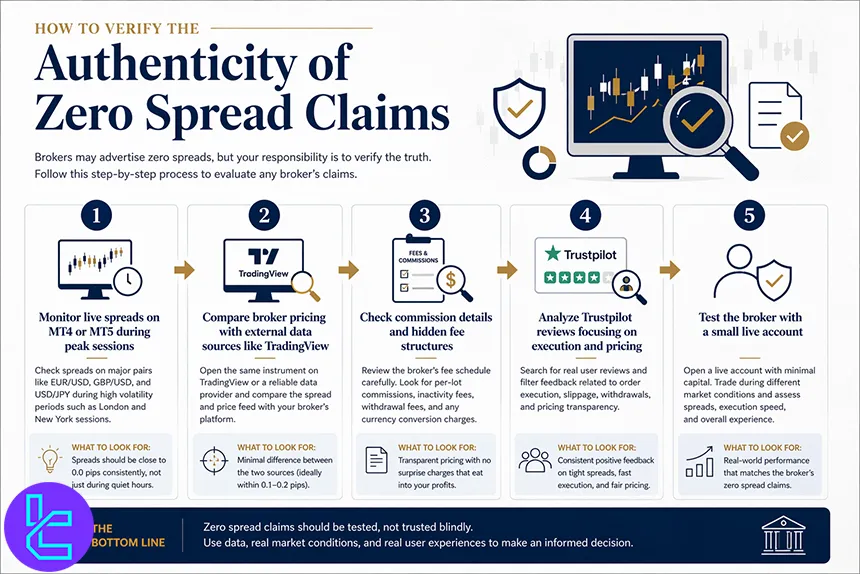
Verifying zero spread conditions ensures traders operate in a transparent environment, allowing them to fully benefit from cost-efficient trading without unexpected expenses.
Comparing Zero Spread Accounts with Raw Spread and Standard Accounts in Forex Brokers
Forex brokers offer multiple pricing models that directly impact trading costs, execution quality, and trading strategy performance. Zero spread accounts eliminate the bid ask difference on selected instruments but usually apply fixed commissions, while raw spread accounts provide direct market pricing with ultra low spreads and transparent commission structures.
Standard accounts, on the other hand, include the broker markup within the spread and typically charge no separate commission. Each model suits different trading styles, particularly when considering frequency, execution sensitivity, and cost predictability. The table below compares these three account types based on their core trading conditions.
Parameter | Zero Spread Accounts | Raw Spread Accounts (ECN/RAW) | Standard Accounts |
Spread Type | 0.0 pips on selected instruments (often variable conditions) | Interbank/raw spreads (from 0.0 pips) | Marked-up spreads (no raw pricing) |
Commission Structure | Fixed commission per trade or per lot | Commission per lot (transparent ECN model) | No commission (cost included in spread) |
Pricing Model | Commission-based zero spread | True market spread + commission | All-in-one spread pricing |
Execution Model | ECN/STP or hybrid | ECN/STP (direct liquidity access) | Market maker or hybrid |
Cost Transparency | High (separate commission) | Very high (raw pricing + clear fees) | Medium (cost embedded in spread) |
Suitability | Scalping, news trading, high-frequency strategies | Scalping, algorithmic trading, precision entries | Beginners, swing trading, low-frequency trading |
Spread Stability | May widen during volatility despite “zero” claim | Variable but reflects real market conditions | More stable but generally wider |
Slippage Sensitivity | Medium to high | High (market execution dependent) | Lower (broker-managed execution) |
Minimum Deposit | Medium | Medium to high | Low |
Best Use Case | Traders needing tight entry pricing with predictable commission | Professional traders needing lowest possible spreads | Traders preferring simplicity and fixed cost structure |
Conclusion
Zero spread Forex brokers offer a compelling pricing model for traders who prioritize execution precision and cost transparency, especially in high-frequency strategies such as scalping and day trading. However, the real advantage of these accounts depends on a balanced evaluation of commissions, execution quality, and hidden fees rather than spreads alone.
As shown throughout this guide, brokers that combine low commissions, fast execution, deep liquidity, and strong regulatory backing provide the most reliable environment for consistent performance.
Traders who align zero spread conditions with their trading style can significantly improve cost efficiency, while ignoring these factors may lead to misleading expectations and higher real trading costs
For a deeper understanding of our evaluation and selection process, please refer to TradingFinder’s Forex methodology page.