









The AUDUSD symbol is one of the most popular currency pairs found in many Forex brokers. Because of the high number of brokerages, it might be difficult to choose the best. Therefore, a shortlist is made up to narrow down the selection.
Trading fees, spreads, platforms, leverage, and other important parameters were considered in choosing these brands.
 | fpmarkets | |||
 | eightcap | |||
 | GLOBAL PRIME | |||
| 4 |  | eToro | ||
| 5 |  | Pepperstone | ||
| 6 |  | ACTIVTRADES | ||
| 7 |  | FUSION MARKETS |
Trustpilot Ratings in Mentioned Brokers
“Trustpilot” can be a very helpful source for those who take user experiences seriously since it is a platform for reviews and scores submitted by traders.
Broker Name | Trustpilot Score | Number of Reviews |
Fusion Markets | 6,369 | |
10,020 | ||
Global Prime | 422 | |
eToro | 30,702 | |
Pepperstone | 3,235 | |
3,503 | ||
ActivTrades | 1,051 |
Minimum Spread in Trading Pairs
Spreads are part of the expenses a trader pays for buying/selling an asset in a Forex broker. The table below ranks mentioned brands based on this parameter.
Broker Name | Min. Spread |
Fusion Markets | 0 Pips |
0 Pips | |
0 Pips | |
Pepperstone | 0 Pips |
Libertex | 0.1 Pip |
IG | 0.3 Pips |
Plus500 | 0.5 Pips |
Non-Trading Costs and Fees in Forex Brokers
Beside spreads, non-trading fees such as deposit/withdrawal commissions and inactivity fees are also applied in some brokerages. The table in this section ranks mentioned brands based on this parameter.
Broker Name | Deposit Fee | Withdrawal Fee | Inactivity Fee |
Fusion Markets | $0 | $0 | $0 |
Global Prime | $0 | $0 | $0 |
$0 | $0 | $0 | |
Plus500 | $0 | $0 | $10 Monthly |
eToro | $0 | $5 | $10 Monthly |
Libertex | $0 | €1 via Bank Cards | 10 EUR Monthly |
IG | $0 via Debit Cards and Bank Transfers | $0 | $18 Monthly |
Available Trading Platforms at AUD/USD Brokers
Brokers offer various terminals and platforms to traders, including MetaTrader 4/5, cTrader, etc. This section outlines the platforms for AUD/USD brokerages.
Broker Name | Trading Platforms |
IG | MT4, TradingView, L2 Dealer, ProRealTime, Proprietary Platform |
Fusion Markets | MetaTrader 4, MetaTrader 5, TradingView, cTrader |
MT4, MT5, ActivTrader, TradingView | |
Libertex | MT4, MT5, Proprietary Platform |
Plus500 | Own platform |
eToro | Proprietary App |
Global Prime | MT4 |
Top 6 Forex Brokers for AUD/USD Trading in Detail
Six of the introduced brokers will be reviewed and explained in more details, separately, in the rest of this article.
Fusion Markets
Founded by Phil Horner, Fusion Markets is an Australia-linked forex and CFD broker operating under Gleneagle Securities Pty Limited (Company No. 40256).
It is regulated by the Australian Securities and Investments Commission (ASIC) and the Vanuatu Financial Services Commission (VFSC), supporting multi-jurisdictional compliance.
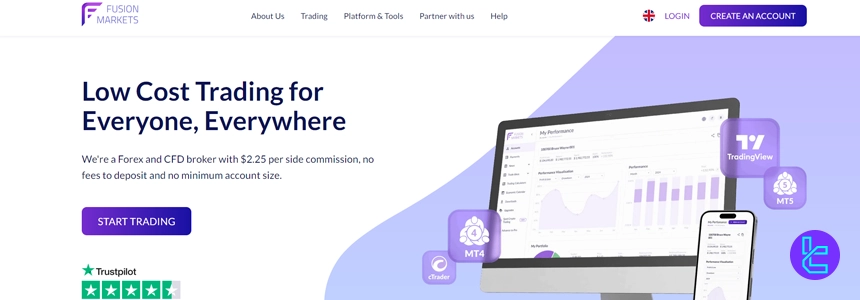
Fusion Markets provides access to 250+ instruments across seven markets, including forex, indices, metals, commodities, US share CFDs, and cryptocurrencies. Traders can access 55 currency pairs, making it suitable for active AUD/USD strategies, especially with leverage up to 1:500 (VFSC entity).
The broker is recognized for ultra-low trading costs, offering Zero accounts with spreads from 0.0 pips and $4.5 commission per lot, and Classic accounts from 0.9 pips with $0 commission. It claims costs up to 36% lower than many competitors.
Client funds are held in segregated accounts with HSBC and National Australia Bank (NAB). With no minimum deposit requirement, 30+ funding methods, and platforms including MetaTrader 4, MetaTrader 5, cTrader, and TradingView, Fusion Markets supports diverse trading approaches.
Check out our Fusion Markets dashboard review to learn about the broker’s personal cabinet. Here’s a table of specifics.
Account Types | Zero, Classic, Swap-Free |
Regulating Authorities | ASIC, VFSC |
Minimum Deposit | $0 |
Deposit Methods | VISA, MasterCard, PayPal, Perfect Money, PayID, Bank Wire, Crypto, Skrill, Neteller, etc. |
Withdrawal Methods | PayPal, Perfect Money, Bank Wire, Crypto, Skrill, Neteller, etc. |
Maximum Leverage | 1:500 |
Trading Platforms & Apps | MetaTrader 4, MetaTrader 5, TradingView, cTrader |
Fusion Markets Pros and Cons
Before choosing this broker for AUD/USD trading, it is important to weigh its cost efficiency, execution model, andregulatory structure against its educational depth and product limitations.
Below is a structured overview of its core advantages and drawbacks; these are critical before going through Fusion Markets registration.
Pros | Cons |
Ultra-low spreads from 0.0 pips (Zero account) | No investor compensation scheme |
No minimum deposit requirement | Limited proprietary research tools |
Regulated by ASIC (Tier-1) and VFSC | Fewer educational resources compared to large brokers |
Wide platform support (MT4, MT5, cTrader, TradingView) | No proprietary trading platform |
FP Markets
Founded in 2005, FP Markets (First Prudential Markets) is a multi-regulated Australian brokerage delivering institutional-grade trading conditions.
Headquartered in Sydney, it serves global clients with Forex, CFDs, ETFs, indices, commodities, metals, cryptocurrencies, and stocks, making it a strong contender for trading AUD/USD.

FP Markets operates under top-tier regulators including Australian Securities and Investments Commission (ASIC) and Cyprus Securities and Exchange Commission (CySEC - License 371/18), alongside FSCA and FSC entities.
Client funds are segregated, negative balance protection is provided, and EU clients may benefit from up to €20,000 under the ICF scheme.
The broker offers two primary accounts, Standard and RAW, with spreads from 1.0 pips and 0.0 pips respectively. Both require a $50 minimum deposit.
Professional clients can access leverage up to 1:500 (subject to jurisdiction), while retail leverage under ASIC and CySEC is capped at 1:30. Sign up in the FP Markets rebate program for reduced trading fees.
FP Markets supports MetaTrader 4, MetaTrader 5, and cTrader, enabling advanced charting,algorithmic trading via EAs, and ECN-style execution. With over 60+ Forex pairs and 10,000+ total instruments, it provides competitive liquidity and fast order execution for active AUD/USD traders.
Table of Specifics and Parameters
Account Types | Standard, RAW |
Regulating Authorities | ASIC, CySEC, FSC, FSCA, FSA |
Minimum Deposit | $50 |
Deposit Methods | Visa and Master card, Skrill, PayPal, Neteller, Bank Transfer |
Withdrawal Methods | Visa and Master card, Skrill, PayPal, Neteller, Bank Transfer |
Maximum Leverage | 1:500 |
Trading Platforms & Apps | MT4, MT5, cTrader |
FP Markets Pros and Cons
Below is a structured breakdown of its key advantages and limitations. Pay undivided attention to this part if you are considering going through FP Markets registration.
Pros | Cons |
Regulated by ASIC & CySEC (Tier-1 oversight) | Not available to US clients |
RAW spreads from 0.0 pips | No proprietary trading platform |
10,000+ tradable instruments | Retail leverage capped at 1:30 in Tier-1 regions |
Multiple platforms (MT4, MT5, cTrader) | Educational content less comprehensive than some competitors |
Global Prime
Founded in 2010 in Australia by Jeremy Kinstlinger, Global Prime is a multi-asset Forex and CFD broker with over 13 years of market presence. The company operates under ASIC (tier-1) and VFSC regulation, offering structured access to global markets with strict compliance standards.
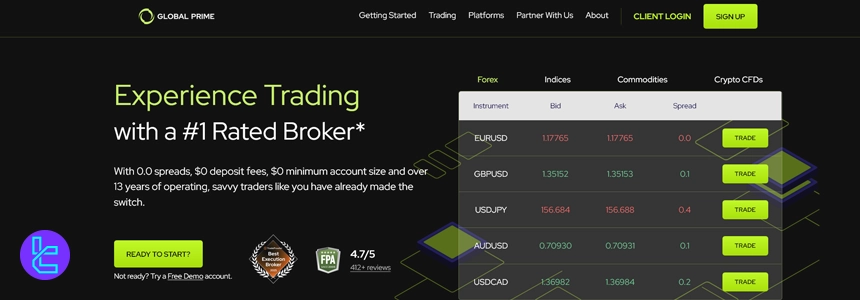
Global Prime provides trading on150+ instruments, including 56 Forex pairs, indices, commodities, crypto CFDs, and US share CFDs. For AUD/USD traders, spreads start from 0.0 pips on the Raw account, with average EUR/USD spreads around 0.06 pips plus a $7 round-lot commission. A Global Prime rebate program is available for discount on fees.
Client funds are held in segregated accounts with HSBC and National Australia Bank (NAB), reinforcing capital protection. ASIC-regulated accounts offer leverage up to 1:30, while international clients under VFSC can access leverage up to 1:500, depending on eligibility.
The broker supports MT4 across desktop, web, Android, and iOS, with execution speeds from 10 milliseconds. Traders also benefit from integrations such as Autochartist signals and ZuluTrade, alongside promotions including TradingView Premium and Financial Times subscriptions. The table below summarizes the broker’s features.
Account Types | Standard, Raw |
Regulating Authorities | VFSC, ASIC |
Minimum Deposit | Unlimited |
Deposit Methods | Credit/Debit Cards, Crypto, PayPal, Neteller, Skrill, FasaPay, Perfect Money, Bank Wire, etc. |
Withdrawal Methods | Credit/Debit Cards, Crypto, PayPal, Neteller, Skrill, AstroPay, Perfect Money, Bank Wire |
Maximum Leverage | 1:500 |
Trading Platforms & Apps | MT4 |
Global Prime Pros & Cons
Global Prime combines regulatory credibility, competitive pricing, and fast execution for AUD/USD trading. However, platform limitations and regional restrictions may influence suitability depending on the trader’s location and strategy.
Pros | Cons |
Regulated by ASIC (Tier-1) with segregated client funds | Only MT4 platform currently available |
Raw spreads from 0.0 pips with competitive commission structure | No Islamic (swap-free) account option |
Fast execution (from 10ms) and strong liquidity access | Geo-restrictions including the US and Japan |
20+ payment methods with zero deposit/withdrawal fees | Higher leverage (1:500) only under VFSC entity |
eToro
eToro is a multi-asset broker founded in January 2007 by David Ring, Ronen Assia, and Yoni Assia, operating as eToro Ltd from Tel Aviv. For traders focused on AUD/USD, its appeal is the broker’s unified access to FX, indices, commodities, ETFs, stocks, and crypto through one proprietary ecosystem.

From a regulation standpoint, eToro operates through multiple entities across key jurisdictions, including the FCA (UK), CySEC (EU), ASIC (Australia), ADGM FSRA (UAE), and additional registrations such as FSA Seychelles and Gibraltar’s GFSC framework for crypto-related services. Entity-level protections vary by region.
Account coverage is segmented into Personal, Professional, Corporate, and Islamic profiles, which matters for AUD/USD traders because leverage eligibility and protections can differ by classification. The Personal account is positioned for retail access, while the Professional account targets experienced traders who meet eligibility criteria.
Execution is delivered via eToro’s proprietary web and mobile platform (no MT4/MT5), alongside investment-oriented features such as CopyTrader, Smart Portfolios, and crypto staking. With a stated $10 minimum deposit and a low $1 minimum order for copy trading, eToro leans toward accessibility and portfolio-style participation.
There is an eToro registration guide available if you are interested in opening an account. Here’s a summary of the broker’s details.
Account Types | Personal, Professional, Corporate, Islamic |
Regulating Authorities | FCA, CySEC, MFSA, FSRA, ASIC, FSA, Gibraltar FSC |
Minimum Deposit | $10 |
Deposit Methods | eToro Money, Credit/Debit Card, Bank Transfer, PayPal, Neteller, Skrill, Online Banking (Trustly), iDEAL, Sofort, Przelewy24 |
Withdrawal Methods | eToro Money, Credit/Debit Card, Bank Transfer, PayPal, Neteller, Skrill, Online Banking (Trustly), iDEAL, Sofort, Przelewy24 |
Maximum Leverage | 1:400 |
Trading Platforms & Apps | Proprietary App |
eToro Pros and Cons
The following pros and cons summarize how eToro typically fits into a “Best AUD/USD Trading Forex Brokers” shortlist-especially for those prioritizing regulated access and platform simplicity versus MetaTrader-based workflows.
Pros | Cons |
Strong multi-jurisdiction footprint (e.g., FCA, ASIC, CySEC, ADGM FSRA) supporting regional compliance | No MT4/MT5 support (workflow limitations for EA-heavy FX traders) |
CopyTrader and Smart Portfolios can complement directional AUD/USD views with strategy replication | Customer support lacks phone-call handling (primarily ticket/email/live chat) |
Broad multi-asset coverage enables correlation and risk-hedging around AUD drivers (commodities, indices, USD assets) | Conditions and protections vary by entity (e.g., compensation funds and NBP differ by region) |
Low entry points stated ($10 minimum deposit; $1 minimum copy-trade order) for incremental allocation | Fee structure can be complex across asset classes (spreads/commissions/conversion/inactivity considerations) |
Pepperstone
Founded in 2010 in Melbourne, Pepperstone has grown into a global CFD and Forex provider processing an average of $9.2 billion in daily trading volume for over 400,000 clients. Its strong liquidity network and institutional-grade infrastructure make it a competitive choice for AUD/USD traders.

The broker is regulated by top-tier authorities, including Australian Securities and Investments Commission (ASIC), Financial Conduct Authority (FCA), Cyprus Securities and Exchange Commission (CySEC), and Dubai Financial Services Authority (DFSA).
Client funds are held in segregated accounts, with negative balance protection across regulated entities.
Pepperstone offers two core accounts, including Standard and Razor, with spreads from 0.0 pips and commissions from $3.5 per side on Razor. Supported base currencies include AUD, USD, GBP, JPY, EUR, CAD, CHF, NZD, SGD, and HKD, with order sizes ranging from 0.01 to 100 lots. The Pepperstone rebate program enables discount on spreads.
Traders gain access to MetaTrader 4, MetaTrader 5, cTrader, TradingView, and Pepperstone’s proprietary platform. With leverage up to 1:500 (jurisdiction-dependent), instant execution, and over 1,200 instruments, the broker supports diversified strategies across Forex, indices, shares, ETFs, commodities, and crypto CFDs.
Features and Parameters
Account Types | Personal, Professional, Corporate, Islamic |
Regulating Authorities | FCA, CySEC, MFSA, FSRA, ASIC, FSA, Gibraltar FSC |
Minimum Deposit | $10 |
Deposit Methods | eToro Money, Credit/Debit Card, Bank Transfer, PayPal, Neteller, Skrill, Online Banking (Trustly), iDEAL, Sofort, Przelewy24 |
Withdrawal Methods | eToro Money, Credit/Debit Card, Bank Transfer, PayPal, Neteller, Skrill, Online Banking (Trustly), iDEAL, Sofort, Przelewy24 |
Maximum Leverage | 1:400 |
Trading Platforms & Apps | Proprietary App |
Pepperstone Pros and Cons
As outlined below, Pepperstone combines regulatory strength, deep liquidity, and platform diversity, while limitations such as restricted regions and the absence of bonuses may affect some traders.
Pros | Cons |
Regulated by multiple Tier-1 authorities (ASIC, FCA, CySEC) | No bonus or promotional programs |
Raw spreads from 0.0 pips on Razor account | Not available to US clients |
Supports MT4, MT5, cTrader, and TradingView | No PAMM account offering |
High leverage up to 1:500 (offshore entities) | Investor compensation not available under all entities |
Eightcap
Founded in 2009 in Melbourne, Eightcap has evolved into a multi-regulated CFD broker serving global traders. It offers access to over 800 instruments across Forex, commodities, metals, crypto CFDs, indices, and shares, making it a competitive choice for trading major pairs like AUD/USD.
Eightcap operates under top-tier regulators including Australian Securities and Investments Commission (ASIC), Financial Conduct Authority (FCA), and Cyprus Securities and Exchange Commission (CySEC), alongside SCB in the Bahamas. Client funds are segregated, and negative balance protection is available across regulated entities.
Traders can choose between three live accounts, including Standard, Raw, and TradingView, with spreads from 1.0 pip (Standard) and from 0.0 pips (Raw). The maximum leverage reaches 1:500 (offshore entity), while the minimum deposit starts at $100, supporting flexible AUD-based funding options.
Platform access includes MetaTrader 4, MetaTrader 5, and TradingView integration. Advanced tools such as Capitalise.ai automation, FlashTrader order management, and an AI-powered economic calendar enhance execution and macro-driven AUD/USD strategy development.
Eightcap Pros and Cons
The broker’s strengths lie in its strong regulation, competitive spreads, and third-party platform integration. However, it lacks passive investment features such as copy trading or PAMM accounts. Below is a balanced overview of its key advantages and limitations, which must be considered before Eightcap registration.
Pros | Cons |
Regulated by ASIC, FCA, CySEC | No copy trading or PAMM solutions |
Spreads from 0.0 pips (Raw account) | Crypto available only as CFDs |
TradingView direct integration | Educational filtering is limited |
800+ tradable instruments | No Islamic (swap-free) account |
What is the Framework for Choosing Forex Brokers?
Selecting the Best AUD/USD trading Forex brokers requires more than comparing spreads. At TradingFinder, our review process is built on a structured 19-metric evaluation framework designed to assess regulation strength, trading conditions, execution quality, and overall reliability for AUD/USD traders.
We begin with Regulations and Licenses, verifying oversight from authorities such as the ASIC (Australian Securities and Investments Commission), FCA, and CySEC. Since AUD/USD is closely tied to the Australian financial system and global risk sentiment, regulatory protection and fund segregation policies are critical evaluation factors.
Next, we analyze Account Types Variety, including Standard, ECN, Micro, and PAMM accounts, alongside the Variety of Tradable Symbols. Brokers offering deep liquidity in major pairs like AUD/USD, competitive spreads, and institutional-grade execution receive higher scores.
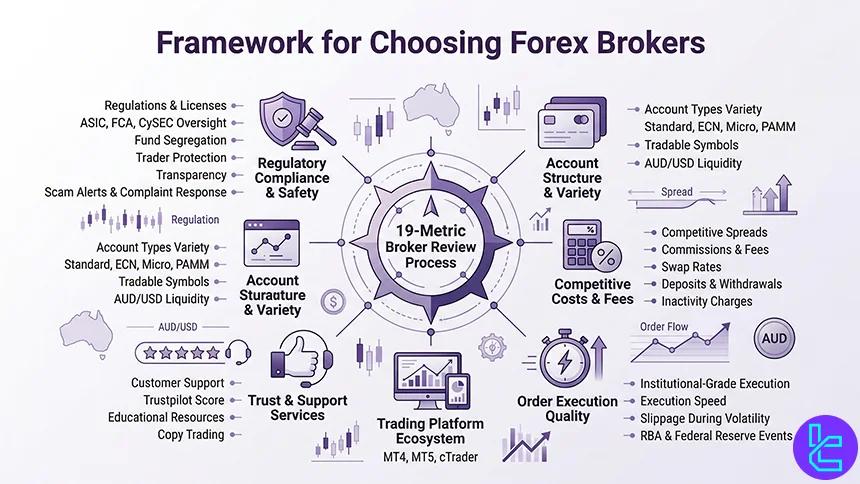
We also test Commissions and Fees, swap rates, deposit/withdrawal efficiency, and inactivity charges through real platform usage.
Platform performance is another decisive factor. We review broker compatibility with MetaTrader 4 (MT4), MetaTrader 5 (MT5), and cTrader, measuring order execution speed and slippage under volatile conditions influenced by events such as RBA and Federal Reserve announcements.
Additional metrics include Customer Support responsiveness, Trustpilot Score, educational resources, micro-data transparency, copy trading features, and broker response to complaints or scam alerts. Our analysts, experienced in volatile forex markets, apply objective scoring to ensure accuracy and neutrality.
This comprehensive methodology ensures that every broker listed for AUD/USD trading meets high standards in transparency, performance, and trader protection.
Why is AUDUSD a Highly Traded Currency Pair?
The AUD/USD pair, often called the “Aussie”, is one of the most liquid and actively traded currency pairs in the global forex market. As a major pair, it represents the exchange rate between the Australian Dollar and the United States Dollar, two currencies backed by stable, developed economies.
One key reason for its popularity is Australia’s strong connection to global commodity markets.
The Australian economy is a leading exporter of iron ore, coal, and gold, making AUD highly sensitive to commodity prices and Chinese demand. This commodity linkage creates clear macro-driven trends that traders can analyze using fundamental and technical strategies.
Monetary policy divergence also drives high trading volumes. Decisions from the Reserve Bank of Australia and the Federal Reserve directly impact interest rate differentials, capital flows, and short-term volatility. AUD/USD frequently reacts to inflation data, employment reports, and rate statements from both economies.
Additionally, AUD/USD offers tight spreads, deep liquidity, and strong price movements during both Asian and US trading sessions. Its volatility profile, typically moderate but responsive to risk sentiment, makes it suitable for scalpers, day traders, and swing traders alike.
Combined with transparent economic drivers and high institutional participation, these factors explain why AUD/USD consistently ranks among the most traded forex pairs worldwide.
What are the Pros and Cons of Trading AUD/USD?
AUD/USD is considered one of the most accessible major currency pairs due to its strong liquidity, transparent macroeconomic drivers, and relatively tight spreads. It is heavily influenced by commodity prices, interest rate expectations, and economic data from both Australia and the United States, giving traders multiple catalysts for analysis.
However, the pair can also become highly volatile during central bank meetings, Chinese economic releases, and changes in global risk sentiment.
Pros | Cons |
High liquidity results in tight spreads and lower transaction costs | Can become highly volatile during RBA, Federal Reserve, and major employment reports |
Strong correlation with commodities such as gold and iron ore creates clear trading narratives | Sensitive to Chinese economic data, which can trigger unexpected price swings |
Active during both Asian and US sessions, offering more trading opportunities | Can experience reduced momentum during quiet market periods between sessions |
Widely supported across MT4, MT5, cTrader, and proprietary broker platforms | Overnight swap fees may become expensive for long-term leveraged positions |
Suitable for scalping, day trading, and swing trading due to stable liquidity | Commodity-driven trends can reverse quickly when risk sentiment changes |
Economic drivers are transparent, including inflation, employment, GDP, and interest rates | News-based volatility can increase slippage during major events |
Usually provides more predictable behavior than exotic currency pairs | Strong US Dollar trends can sometimes overshadow Australian economic factors |
Frequently covered by analysts and media, making research and forecasts easier | Requires monitoring multiple markets, including commodities, equities, and Chinese data |
How is AUDUSD Trading in the US?
In the United States, AUD/USD trading is legal and widely available through brokers regulated by the Commodity Futures Trading Commission and the National Futures Association.
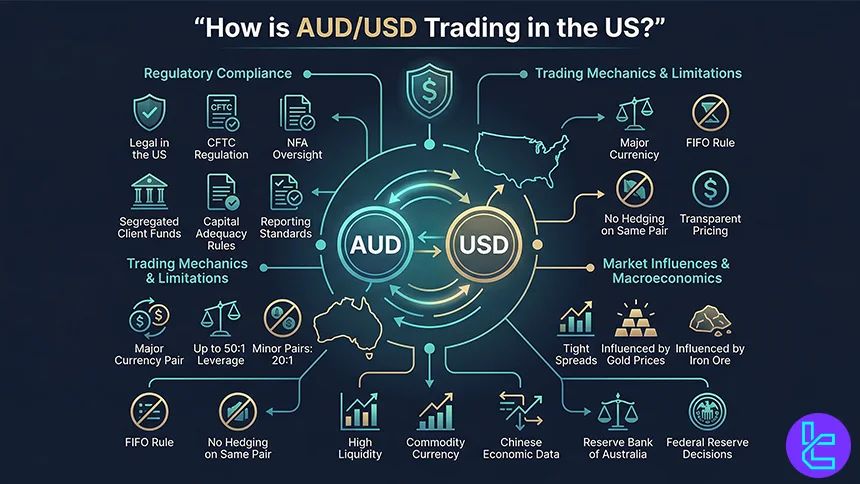
Since AUD/USD is classified as a major currency pair, it benefits from relatively favorable trading conditions compared to minor and exotic pairs.
US retail traders can typically access leverage of up to 50:1 on AUD/USD, which is the maximum allowed for major forex pairs under CFTC and NFA regulations.
By comparison, minor currency pairs are generally limited to 20:1 leverage. These leverage caps are designed to reduce excessive risk and protect retail investors from rapid account losses.
Another important feature of US forex trading is the strict regulatory environment. Brokers must maintain transparent pricing, segregate client funds, follow capital adequacy rules, and comply with reporting standards. US traders are also subject to FIFO (First In, First Out) rules and cannot hedge the same currency pair in opposite directions within one account.
AUD/USD remains attractive in the US because it combines high liquidity, relatively tight spreads, and strong price reactions to commodity prices, Chinese economic data, and interest rate decisions from the Reserve Bank of Australia and the Federal Reserve.
Its strong connection to commodities such as iron ore and gold also makes it one of the most closely watched “commodity currency” pairs among American traders.
What Factors Affect the AUD/USD Price?
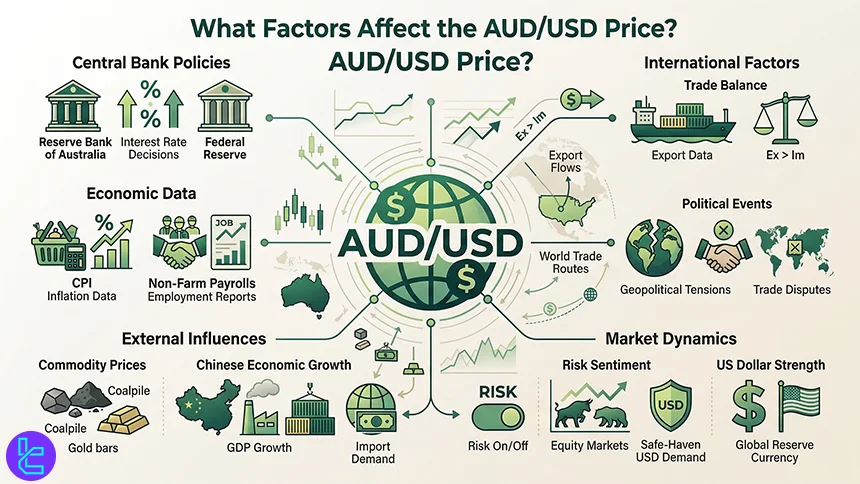
AUD/USD is influenced by a combination of economic, monetary, commodity, and geopolitical factors. Because the pair connects the Australian and US economies, price movements often reflect changing expectations about growth, inflation, and interest rates in both countries.
Key factors affecting AUD/USD include:
- Interest Rate Decisions: Policy changes from the Reserve Bank of Australia and the Federal Reserve are among the biggest drivers of AUD/USD. Higher interest rates in Australia can strengthen AUD, while higher US rates often support USD;
- Inflation and Employment Data: Reports such as CPI, unemployment, and Non-Farm Payrolls can significantly impact the pair. Strong Australian employment or inflation data may boost AUD, while stronger US data may increase demand for USD;
- Commodity Prices: Australia is one of the world’s largest exporters of iron ore, coal, and gold. Rising commodity prices often strengthen the Australian Dollar because they improve Australia’s export revenues and trade balance;
- Chinese Economic Growth: China is Australia’s largest trading partner. Strong Chinese industrial production, GDP growth, and import demand can support AUD, while weaker Chinese data often pressures the currency;
- Risk Sentiment: AUD is generally considered a risk-sensitive currency. During periods of strong global growth and rising equity markets, AUD tends to appreciate. In times of market stress, recession fears, or geopolitical uncertainty, traders often move into the safer United States Dollar;
- Trade Balance and Export Data: Australia’s trade surplus or deficit can influence investor confidence in the Australian economy. Strong export numbers usually support AUD;
- Political and Geopolitical Events: Elections, trade disputes, sanctions, and tensions in major economies can create volatility in AUD/USD, especially when they affect commodity markets or global trade flows;
- US Dollar Strength: Since USD is the world’s reserve currency, broad US Dollar trends can heavily influence AUD/USD, even when Australian economic data remains stable.
Available Leverage for Trading AUD/USD Pair
Because AUD/USD is classified as a major currency pair, it usually receives the highest leverage allowances available to retail forex traders. However, the exact leverage depends on the broker’s regulatory jurisdiction and whether the account is categorized as retail or professional.
Jurisdiction / Regulator | Maximum Retail Leverage on AUD/USD |
FCA (United Kingdom) | 1:30 |
ASIC (Australia) | 1:30 |
ESMA / CySEC (European Union) | 1:30 |
CFTC / NFA (United States) | 1:50 |
CIRO (Canada) | 1:50 |
MAS (Singapore) | Around 1:20 |
Offshore Brokers | 1:100 to 1:1000+ |
Retail leverage on major currency pairs such as AUD/USD is commonly capped at 1:30 in the UK, Europe, and Australia due to consumer protection rules introduced by regulators such as the FCA, ASIC, and ESMA. These restrictions are designed to reduce the risk of excessive losses for retail traders.
In the United States, retail traders can access leverage of up to 1:50 on major currency pairs, including AUD/USD, under CFTC and NFA rules. Minor and exotic currency pairs are usually limited to 1:20.
Professional clients may qualify for significantly higher leverage, sometimes reaching 1:100, 1:200, or more depending on the broker.
Offshore-regulated brokers can also offer leverage of 1:500 or even 1:1000+, although these higher ratios generally come with fewer investor protections, weaker negative balance protection policies, and greater risk exposure.
What Trading Strategies are Mostly Recommended for AUD/USD?
AUD/USD is suitable for several trading styles because it combines strong liquidity, moderate volatility, and clear reactions to macroeconomic events. The pair is active during both the Asian and US sessions, making it attractive for short-term traders as well as swing traders.
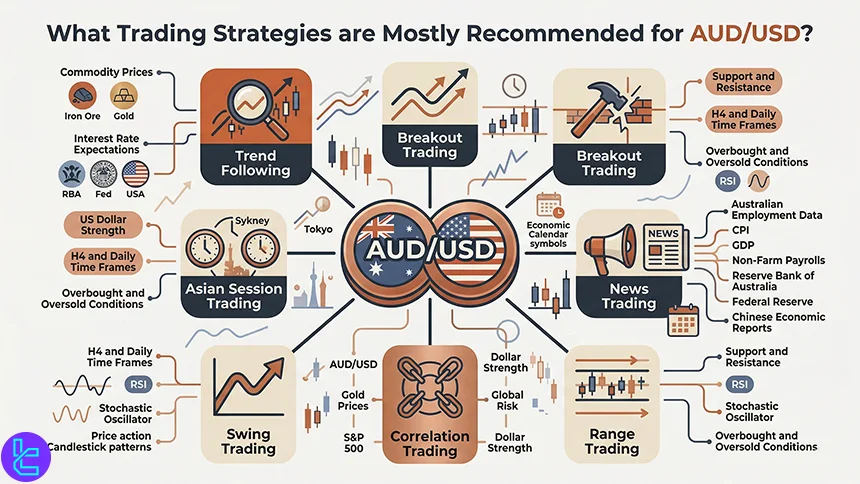
Commonly recommended strategies for AUD/USD include:
- Trend Following: AUD/USD often develops sustained directional moves when commodity prices, interest rate expectations, or US Dollar strength remain aligned;
- Breakout Trading: The pair frequently reacts strongly to major data releases such as Australian employment reports, US Non-Farm Payrolls, CPI, GDP, and central bank decisions;
- Asian Session Trading: Since Australia is part of the Asia-Pacific region, AUD/USD can experience increased activity during the Asian session, especially around Australian economic releases, Chinese data, and movements in regional equity markets;
- News Trading: AUD/USD is heavily influenced by Reserve Bank of Australia meetings, Federal Reserve announcements, commodity price changes, and Chinese economic reports;
- Swing Trading: Because AUD/USD often respects key support and resistance zones, swing traders can use higher time frames such as H4 and Daily to capture multi-day trends;
- Correlation Trading: AUD/USD is closely linked to gold prices, iron ore, commodity demand, and broader risk sentiment. Some traders combine AUD/USD analysis with movements in gold, the S&P 500, or Chinese economic data to confirm trade direction;
- Range Trading: During periods of low volatility or between major economic events, AUD/USD can remain inside defined support and resistance zones. Traders may use oscillators such as RSI or Stochastic to identify overbought and oversold conditions within the range.
What is the Minimum Trade Amount for AUD/USD?
The minimum trade amount for AUD/USD depends on the broker, account type, and platform. Most forex brokers allow trading from 0.01 lots, also known as a micro lot. In AUD/USD, a standard lot equals 100,000 units of the base currency, meaning:
- 1 standard lot = 100,000 AUD
- lot = 10,000 AUD
- lot = 1,000 AUD
Because many brokers support micro-lot trading, traders can start with relatively small positions and lower risk exposure. For example, opening a 0.01-lot AUD/USD position means controlling around 1,000 AUD in the market.
The margin required depends on the leverage used. With 1:30 leverage, a 0.01-lot AUD/USD trade mayrequire around 33 AUD in margin. With 1:100 leverage, the same position may require only around 10 AUD in margin, although the actual requirement varies slightly depending on the current exchange rate and broker conditions.
Some brokers also offer nano lots or cent accounts, allowing traders to place even smaller positions than 0.01 lots. These account types are often used for testing strategies, practicing on live markets, or reducing risk while trading volatile conditions.
AUD/USD in Comparison to Other Tradable Symbols
AUD/USD differs from stocks, commodities, and ETFs because it trades in the decentralized Forex market with nearly 24-hour liquidity, tight spreads, and strong sensitivity to interest rates, commodity prices, and global risk sentiment.
Stocks and ETFs are exchange-listed instruments with more limited trading hours, while commodities often react more aggressively to supply-demand shocks and geopolitical events. Compared with these markets, AUD/USD offers relatively high leverage, strong liquidity, and broad accessibility across most Forex brokers.
Parameter | AUD/USD | Stocks (Equities) | Commodities (Oil, Silver, etc.) | ETFs |
Market Structure | Decentralized interbank OTC Forex market | Centralized stock exchanges (NYSE, NASDAQ, LSE) | Futures exchanges (CME, ICE), OTC CFDs | Listed on centralized exchanges (NYSE, Nasdaq); also offered as ETF CFDs |
Trading Hours | 24/5 global market | Exchange-specific hours (limited daily sessions) | Mostly 23–24 hours depending on futures contract | Exchange hours; extended hours possible; 24/5 via CFDs |
Typical Volatility | Medium (macro-driven, risk-sensitive) | Varies by company, sector, and earnings cycle | Medium–High (supply/demand shocks, geopolitics) | Low–Medium for broad ETFs; Medium–High for sector/thematic ETFs |
Main Price Drivers | Interest rates, commodity prices, Chinese demand, RBA/Fed policy, USD strength | Earnings reports, sector performance, economic data | Supply/demand, OPEC decisions, weather, inventories | Underlying asset performance, NAV, sector rotation, interest rates |
Leverage (Retail, Tier-1 Reg.) | Up to 1:30 in FCA/ASIC regions; 1:50 in the US | Often 1:5 or lower for stock CFDs; margin-regulated | Often 1:10–1:20 for commodity CFDs | Typically up to 1:5 for ETF CFDs |
Safe-Haven Status | Limited; AUD is considered risk-sensitive while USD can be defensive | No; generally risk-on asset class | Depends on asset; gold can be defensive, oil is cyclical | Broad index ETFs: No; bond and gold ETFs may be defensive |
Dividend / Yield | Interest rate differentials through swap | Dividends possible | No dividend; futures may have carry costs | Dividends possible if underlying holdings pay |
Correlation Profile | Linked to commodity prices, Chinese growth, and global risk sentiment | Correlated with economic cycles and sector trends | Correlated with global growth, inflation, and supply conditions | Correlated with underlying index, sector, or asset basket |
Short-Selling Access | Yes (intrinsic two-sided market) | Yes (via margin accounts or CFDs) | Yes (via CFDs and futures) | Yes (via margin accounts or ETF CFDs) |
Gap Risk Exposure | Lower than stocks; moderate around major news releases and weekends | High due to earnings gaps and exchange closures | High due to inventory reports and geopolitical shocks | Moderate due to earnings seasons, macro news, and market open gaps |
Conclusion
AUD/USD is a highly-traded trading pair in the Forex market that is available in many brokers and exchanges around the world. However, not every brokerage is worth investing in.
To choose a decent broker, you should consider its regulatory licenses, trading fees, account types, user reviews, and more. Fusion Markets, FP Markets, Global Prime, and eToro are recommended if you want a quick answer.
To find out how these brokers were evaluated and suggested, check out our Forex methodology article.