South Africa stands among Africa’s most active retail forex hubs, supported by strong digital adoption and a fast-growing trader base. Oversight by the Financial Sector Conduct Authority (FSCA), established in 2018, sets clear standards for capital adequacy, transparency, and client-fund protection.
The best forex brokers in South Africa typically operate under FSCA licenses or recognized offshore frameworks while serving local traders. These brokers compete on tight spreads, robust trading platforms, advanced research tools, and comprehensive education.
Broker credibility increasingly depends on independent trust metrics. Trustpilot scores reflect real user experiences with execution quality, withdrawals, support, and transparency.
The best South Africa forex brokers in spreads include FP Markets, IC Markets, Exness, and JustMarkets, offering raw pricing from 0.0 pips with no broker mark-ups. These minimum spreads reflect pure market pricing, vary by account type, and instrument.
ZA forex brokers with the lowest non-trading fees typically offer zero charges on deposits and withdrawals, with no inactivity penalties. Some platforms only apply limited exceptions, such as small fees on specific payment methods or a fixed monthly inactivity charge after prolonged account dormancy.
Trading Instruments in the Best South Africa Forex Brokers
The best South African forex brokers provide access to thousands of tradable instruments across forex pairs, CFDs, indices, commodities, shares, and cryptocurrencies.
Leading platforms support between 100 and over 17,000 instruments, enabling diversified strategies, multi-asset exposure, and flexible portfolio construction for retail and advanced traders.
South Africa hosts a mature and highly regulated forex trading environment, where licensed international brokers compete on pricing, execution quality, and platform technology.
The top South African brokers listed below represent providers that meet key requirements for ZA traders, including regulatory oversight, fund protection standards, platform reliability, and broad market access across forex and CFD instruments.
FP Markets
First Prudential Markets, widely known as FP Markets, is a global forex and CFD broker established in 2005 and headquartered in Australia. The broker operates under multiple regulatory authorities, including ASIC, CySEC, FSCA, FSC, and FSA, ensuring strong compliance, client protection standards, and a secure FP Markets registration process.
FP Markets is a regulated broker in South Africa, providing access to MetaTrader platforms
FP Markets offers two core account types, Standard and RAW, designed for different trading styles, available after bypassing the mandatory FP Markets verification process.
Traders benefit from floating spreads starting from 0.0 pips, a low minimum deposit of $50, and access to institutional-grade liquidity with fast order execution.
The broker supports major trading platforms such as MetaTrader 4, MetaTrader 5, and cTrader, enabling manual, algorithmic, and copy trading strategies. It provides access to over 10,000 instruments across forex, indices, commodities, shares, ETFs, and cryptocurrencies. FP Markets deposit and withdrawal options include Skrill, PayPal, Credit card, etc.
FP Markets places strong emphasis on transparency and safety through segregated client funds, negative balance protection, and regular audits. The broker provides services in regions like South Africa, Europe, and offshore markets through its global entities.
Account Types
Standard, Raw
Regulating Authorities
ASIC, CySEC, FSC, FSCA, FSA
Minimum Deposit
$50
Deposit Methods
Visa and Master card, Skrill, PayPal, Neteller, Bank Transfer
Withdrawal Methods
Visa and Master card, Skrill, PayPal, Neteller, Bank Transfer
Maximum Leverage
1:500
Trading Platforms & Apps
MT4, MT5, cTrader
FP Markets Pros and Cons
Let’s weigh the broker’s advantages against its disadvantages:
Pros
Cons
Regulated by the FSCA for South African residents
No ZAR base currency account available
High leverage options available compared to EU brokers
Offshore leverage may increase risk for inexperienced traders
Tight Raw spreads suitable for scalping and algorithmic trading
$50 minimum deposit may still be high for micro traders
Supports international payment methods accessible from South Africa
-
AvaTrade
AvaTrade is a global brokerage holding 9 regulatory licenses across major jurisdictions, including CBI, MiFID II, ASIC, FSCA, CySEC, and ADGM. This multi-license structure strengthens compliance standards and reinforces client protection features such as segregated funds and negative balance protection; however, it mandates a comprehensive process for AvaTrade registration.
AvaTrade is one of the best brokers in South Africa, regulated by FSCA, with a $100 minimum deposit
The broker supports Retail, Professional, Islamic, and Demo accounts with a $100 minimum deposit and 0.01 lot minimum order size. Traders can fund accounts using 6 AvaTrade deposit and withdrawal methods, including cards, bank wires, Skrill, Neteller, WebMoney, and PayPal, with region-based availability.
AvaTrade provides access to forex and CFD markets across metals, stocks, commodities, indices, and crypto, offering more than 1,250 instruments.
Trading is available on MetaTrader 4, MetaTrader 5, WebTrader, mobile apps, and AvaOptions, combining classic execution with options-focused risk controls.
Risk management is built into the trading conditions, with margin call and stop out levels set at 25% and 10%. AvaTrade dashboard also offers copy trading through DupliTrade and AvaSocial, while customer support operates 24/5 and is available in 14 languages for global client coverage.
Account Types
Retail, Professional, Islamic, Demo
Regulating Authorities
ASIC, CySEC, CBI, FSA, FSCA, MiFID, ADGM, PFSA, ISA
Minimum Deposit
$100
Deposit Methods
Credit/Debit Cards, E-Wallets, Bank Wire Transfer, PayPal
Withdrawal Methods
Credit/Debit Cards, E-Wallets, Bank Wire Transfer, PayPal
Maximum Leverage
1:400
Trading Platforms & Apps
MetaTrader 4, MetaTrader 5, Mobile App, WebTrader
AvaTrade Pros and Cons
The pros and cons below summarize AvaTrade’s strengths and limitations, giving traders a clearer snapshot before comparing costs, platforms, and trust signals:
Pros
Cons
Strong regulatory coverage with 9 licenses across top jurisdictions
Inactivity fees apply after 2 months of no trading activity
1,250+ instruments across forex and key CFD markets
Spreads are typically fixed, which may be less competitive in fast markets
Multiple platforms including MT4, MT5, WebTrader, mobile, and AvaOptions
24/5 support, not 24/7
Copy trading access via DupliTrade and AvaSocial
-
IC Markets
IC Markets is a global multi-asset broker founded in Australia in 2007, offering forex and CFD trading with institutional-style execution. Traders can choose from 10 base currencies, including USD, EUR, GBP, AUD, and CAD, with a minimum deposit of $200 to start.
IC Markets provides Forex/CFD trading for ZA traders, while not regulated by FSCA
The broker operates under the oversight of multiple regulatory bodies, including ASIC in Australia and CySEC in Cyprus, plus FSA in Seychelles. EU clients receive Investor Compensation Fund coverage up to €20,000 by completing IC Markets EU registration process, while operational controls include external audits and client fund segregation.
IC Markets supports Standard, Raw Spread, and Islamic accounts, with a 0.01 lot minimum order size and leverage up to 1:500 for eligible clients.
Standard accounts offer spreads from 0.8 pips with no commission, while Raw Spread pricing can begin from 0.0 pips with per-lot commissions. Traders can receive up to 21.5% of their commissions via the IC Markets rebate program.
Platform coverage includes MetaTrader 4, MT5, cTrader, cTrader Web, and mobile apps, making it suitable for scalping, expert advisors, and algorithmic workflows. The product list covers forex pairs, indices, commodities, bonds, crypto CFDs, and over 2,100 stock CFDs across global markets.
Account Types
Standard, Raw Spread, Islamic
Regulating Authorities
FSA, CySEC, ASIC
Minimum Deposit
$200
Deposit Methods
Bank Cards, Wire Transfers, Electronic payments, etc.
Withdrawal Methods
Bank Cards, Wire Transfers, Electronic payments, etc.
Maximum Leverage
1:500
Trading Platforms & Apps
Metatrader 4, Metatrader 5, cTrader, IC Markets Mobile
IC Markets Pros and Cons
The pros and cons below summarize IC Markets' strengths and limitations:
Pros
Cons
Accepts South African traders under regulated international entities
No locally licensed FSCA entity for South Africa
Access to high leverage options up to 1:500 for eligible accounts
Higher leverage increases risk if not managed properly
Supports ZAR-compatible funding via cards and international payment methods
No ZAR base currency account, currency conversion may apply
Very tight spreads and Raw pricing suitable for scalping and EAs
$200 minimum deposit may be high for some beginners
JustMarkets
JustMarkets is a multi-regulated forex and CFD broker founded in 2012, serving over 2 million traders across 160+ countries. It earned the Best CFD Broker title at the UF Awards MEA 2024 and supports trading on MT4, MT5, and mobile apps with a 0.01 lot minimum order size. JustMarkets registration process requires only email verification.
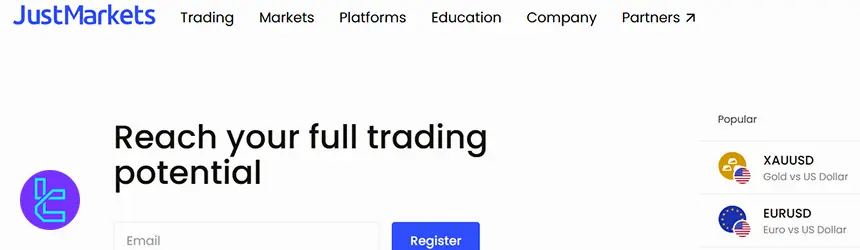
JustMarkets is a FSCA-regulated broker providing access to gold CFD and EUR/USD
The broker operates through several regulated entities, including an FSCA-regulated South African branch and a CySEC-regulated EU entity. Its framework also includes oversight in jurisdictions such as Seychelles, Mauritius, and the British Virgin Islands, with negative balance protection and segregated funds applied across entities.
JustMarkets offers 4 account types, including a Cent account with a $10 minimum deposit and leverage options reaching 1:3000 under eligible entities. Traders can access 5 major asset classes with 90+ instruments, 10+ base currencies including ZAR, and floating spreads that can start from 0.00 pips on Raw pricing. JustMarkets deposit and withdrawal methods include bank transfers and cryptocurrencies.
JustMarkets emphasizes security controls such as SSL encryption, PCI DSS data safeguards, and segregation of client funds in reputable banks.
Traders can access services like JustMarkets copy trading, VPS access, swap-free options, and 24/7 support via live chat, email, phone, and callback requests.
Account Types
Standard Cent, Standard, Pro, Raw Spread
Regulating Authorities
CySEC, FSA, FSCA, FSC
Minimum Deposit
$10
Deposit Methods
Bank transfer, E-payments, Credit/Debit cards, Crypto, Local banks
Withdrawal Methods
Bank transfer, E-payments, Credit/Debit cards, Crypto, Local banks
Maximum Leverage
1:3000
Trading Platforms & Apps
MT4, MT5, Mobile App
JustMarkets Pros and Cons
The pros and cons below summarize how JustMarkets' pricing flexibility, leverage range, and payment accessibility compare with its instrument scope and operational trade-offs.
Pros
Cons
FSCA-regulated entity available for South African traders
Instrument count is lower than multi-asset brokers offering thousands of CFDs
$10 minimum deposit and the Cent account suits small balance strategies
Very high leverage up to 1:3000 can amplify risk if mismanaged
Segregated funds, negative balance protection, SSL, and PCI DSS security
Some users report technical glitches or occasional platform instability
Wide funding options, including cards, e-payments, crypto, and local methods
Inactivity fee can apply after 150 days with a positive balance
Plus500
Plus500 is a globally recognized CFD broker founded in 2008, offering access to forex, stocks, indices, commodities, ETFs, options, and cryptocurrencies. Headquartered in London and listed on the London Stock Exchange under LSE PLUS, it operates across more than 50 countries through multiple regulated entities.
Homepage of the Plus500 Forex/CFD broker
The broker is supervised by top-tier authorities such as the FCA, CySEC, ASIC, FSCA, DFSA, MAS, and EFSA. This multi-jurisdictional regulation framework ensures strong compliance, fund segregation, negative balance protection, strong Plus500 registration procedure, and transparent operating standards for retail and professional traders.
Plus500 provides Retail and Professional accounts with a minimum deposit of $100 and maximum leverage reaching 1:300 for eligible professionals.
Traders access over 2800 CFD instruments through the proprietary Plus500 WebTrader and fully featured mobile applications on iOS and Android.
Designed for self-directed traders, Plus500 broker emphasizes simplicity, fast onboarding, and a clean trading interface. The platform supports advanced risk management tools, real-time alerts, and commission-free trading via variable spreads, making it suitable for beginners and intermediate CFD traders.
Visa/MasterCard, PayPal, Bank Wire, GooglePay, ApplePay, Skrill
Withdrawal Methods
Visa/MasterCard, PayPal, Bank Wire, GooglePay, ApplePay, Skrill
Maximum Leverage
1:300
Trading Platforms & Apps
Proprietary platform
Plus500 Pros and Cons
The following pros and cons summarize Plus500’s key strengths and limitations:
Pros
Cons
FSCA regulated entity available for South African traders
No MT4 or MT5 platform support
Over 2800 tradable CFD instruments across global markets
No copy trading or social trading features
User friendly proprietary WebTrader and mobile apps
Inactivity fee charged after prolonged account dormancy
Commission free trading with transparent cost structure
Limited appeal for advanced algorithmic traders
Exness
Exness is a global forex broker founded in 2008 by Petr Valov and Igor Lychagov, operating under the EXNESS Group. The company employs over 2,100 professionals from nearly 100 countries, with Valov serving as Chief Executive Officer and guiding its multi-region expansion.
The broker reports monthly trading volumes above $4 trillion, positioning itself as a major retail market maker with professional liquidity access. Exness registration allows access to forex and CFD trading with spreads ranging from 0.0 to 0.8 pips and commissions from $0.2 up to $3.5, depending on account type.
Exness runs a multi-entity regulatory structure, including FCA and CySEC as tier 1 authorities, plus FSCA in South Africa and CMA in Kenya.
Across its entities, the broker applies segregated funds, negative balance protection, and compensation coverage such as up to £85,000 under FSCS and up to €20,000 under ICF. Exness deposit and withdrawal methods include Perfect Money, Skrill, and Neteller.
Account selection includes Standard, Standard Cent, Pro, Raw Spread, and Zero, with minimum deposits from $10 and order sizes from 0.01 lot.
Traders can use the Exness dashboard to access MT4, MT5, Exness Terminal, and the Trade app, with options for VPS access, copy trading, and swap-free conditions on selected instruments.
Account Types
Standard, Standard Cent, pro, Raw Spread, Zero
Regulating Authorities
FSA, CySEC, FCA, FSCA, CBCS, FSC, CMA
Minimum Deposit
$10
Deposit Methods
Neteller, Skrill, Perfect Money, Sticpay, Bank cards
Withdrawal Methods
Neteller, Skrill, Perfect Money, Sticpay, Bank cards
The pros and cons below summarize Exness' strengths and trade-offs:
Pros
Cons
Strong multi-jurisdiction regulation, including FCA, CySEC, and FSCA
Educational content can feel limited for complete beginners
Low entry cost with $10 minimum deposit and a 0.01 lot minimum order
Instrument availability varies by account type and region
Instant withdrawals and strong local payment accessibility
Very high leverage options can increase risk if mismanaged
Supports ZAR trading and popular platforms like MT4/MT5
-
XM Group
XM Group is a global forex and CFD broker founded in 2009, serving over 15 million clients and processing nearly 14 million trades daily. It offers 55+ currency pairs, over 1,400 CFDs, and more than 1,200 stock CFDs, with a low $5 minimum deposit. XM Group registration requires only email verification.
XM Group operates under the supervision of multiple regulatory bodies, including CySEC in Cyprus, FSCA in South Africa, DFSA in Dubai, and FSC oversight in jurisdictions such as Belize and Mauritius. Its South Africa entity is registered with the FSCA under license number 49976.
XM runs a MetaTrader-focused setup with MT4, MetaTrader 5, and a mobile app, supporting 0.01 lot minimum orders and leverage up to 1:1000. Trading spreads start from 0.6 pips on Ultra Low accounts, while commissions generally apply only on Shares accounts. XM Group deposit and withdrawal methods include e-wallets and credit cards.
Trust signals are mixed across review platforms, with a Trustpilot score of 3.5 out of 5 from 2,750 plus reviews and a ForexPeaceArmy average of 3.1 out of 5. Traders also get access to XM Group copy trading, negative balance protection, Islamic account options, and 24/7 support via live chat, phone, and email.
Account Types
Standard, Ultra Low, Shares
Regulating Authorities
FSC Belize, CySEC, FSCA, DFSA, FSC, FSA
Minimum Deposit
$5
Deposit Methods
Credit/Debit Cards, Bank Transfers, E-Wallet Payments
Withdrawal Methods
Credit/Debit Cards, Bank Transfers, E-Wallet Payments
Maximum Leverage
1:1000
Trading Platforms & Apps
MT4, MT5, Mobile App
XM Group Pros and Cons
The pros and cons below summarize how XM’s low entry barrier, platform reliability, and regulation compare against its fee policies and platform limitations.
Pros
Cons
$5 minimum deposit suits budget-focused South African starters
A monthly inactivity fee can apply to dormant accounts
FSCA-regulated entity available for South African residents
No cTrader or TradingView integration, MetaTrader only
1,400+ CFDs with 55+ forex pairs and 1,200+ stock CFDs
Trust scores are mid-range compared with top top-rated competitors
Negative balance protection and swap-free options on selected accounts
Shares account requires a much higher entry level deposit
HFM (HF Markets)
HFM, also known as Hot Forex Markets, has served global traders since 2010 and supports 2,500,000+ live accounts in 27+ languages. It provides access to Forex and CFDs with floating spreads from 0.00 pips and mostly commission-free pricing, except on the Zero account. Traders only need to verify their email addresses for HFM registration.
For South African residents, HFM operates through an FSCA-regulated entity under license number 46632. The broker also maintains additional oversight via CySEC, FCA, and DFSA across other entities.
HFM applies various client protection protocols like segregated funds and negative balance protection to strengthen client safety and risk controls.
HFM dashboard offers multiple account types, including Cent, Pro, Premium, and Zero, with minimum deposits starting from $0. It supports 0.01 lot order sizes, leverage that can reach 1:500 under the South Africa entity, and trading on MT4, MT5, and mobile apps for flexible execution.
Beyond core trading, HFM supports crypto funding, provides Autochartist market scanning, and offers SMS market notifications. Traders can also access HFM copy trading and PAMM-style solutions, plus an affiliate program that can pay commissions up to $650, depending on region and partner terms.
The pros and cons below summarize HFM’s key strengths and trade-offs for South African traders, focusing on regulation, leverage conditions, funding convenience, and platform depth before comparing costs, trust signals, and long-term account management.
Pros
Cons
FSCA-regulated entity for South African residents with license 46632
Support operates 24/5, which may not suit weekend active traders
Commission-free Forex pricing on most accounts and spreads from 0.00 pips
Zero account adds commission, which can raise the total cost for small volumes
Flexible funding options, including cards, e-payments, and crypto deposits
Mixed feedback mentions occasional technical issues and support consistency
Autochartist plus SMS alerts and multi-language coverage for 27+ languages
-
Is Forex Trading Legal in South Africa?
Forex trading is fully legal in South Africa and permitted for both retail and professional traders under national financial legislation. Residents can trade forex and CFDs through authorized financial service providers, provided that brokers comply with disclosure, licensing, and conduct requirements defined by South African financial laws.
South African traders are legally allowed to access international forex markets, including leveraged products, as long as capital movement rules and financial surveillance regulations are respected. Trading legality is not restricted to local brokers, but compliance and transparency remain essential for lawful participation.
Introduction to the FSCA Regulatory Framework and Its Conditions for Forex Trading
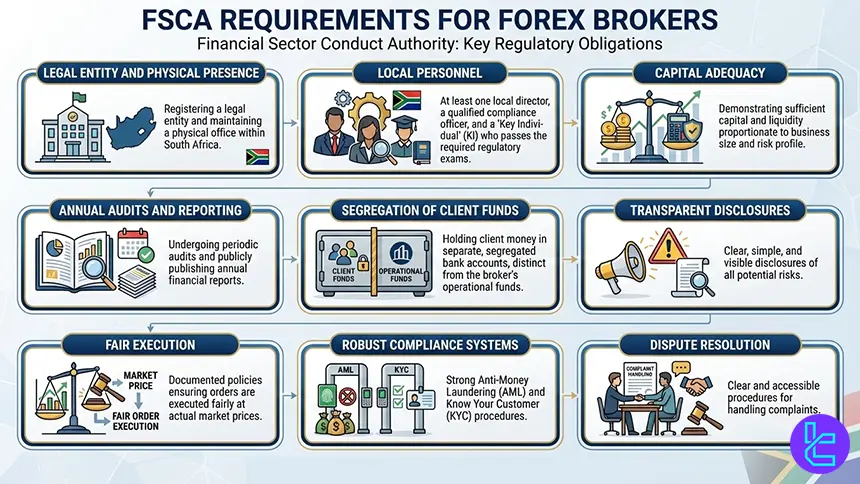
The Financial Sector Conduct Authority (FSCA) is the primary regulator overseeing forex brokers operating in South Africa. Established in 2018 under the Twin Peaks model, the FSCA focuses on market conduct, consumer protection, and fair treatment of clients rather than monetary or interest rate policy.
FSCA-regulated brokers must meet strict requirements, including capital adequacy, segregation of client funds, transparent risk disclosures, and ongoing compliance reporting. These conditions aim to reduce fraud, improve broker accountability, and enhance confidence among South African retail and professional forex traders.
FSCA sets conduct standards for forex brokers in South Africa
FSCA’s Warning Lists for Online Traders
The FSCA publishes official warning notices identifying unlicensed financial service providers and suspicious entities targeting South African traders. These warnings commonly involve clone firms, false FSCA license claims, and offshore platforms marketing illegal investment services to local residents.
Reviewing the FSCA warning list before opening a trading account is a critical safety step. Many reported cases involve aggressive marketing tactics and misleading regulatory representations, making official verification essential for avoiding financial loss and fraud.
How to Start Forex Trading in South Africa
To start forex trading in South Africa, traders must select a regulated broker, complete identity verification, fund their trading account, and choose a suitable trading platform. Most brokers offer MetaTrader or proprietary platforms with demo account access.
Beginners are encouraged to start with demo trading, understand leverage mechanics, and apply strict risk management. FSCA consumer guidance emphasizes informed decision-making and awareness of potential losses in leveraged trading.
What Factors Are Important in Selecting the Best Forex Broker in South Africa?
Selecting the best forex broker in South Africa depends on several factors, including FSCA regulation, trading costs, execution quality, platform stability, leverage policies, and customer support availability. Regulation remains the most important factor for long-term trading safety.
Additional considerations include deposit and withdrawal methods, negative balance protection, educational resources, and transparency of fees. Evaluating these elements together helps traders choose brokers aligned with their experience level and risk tolerance.
Regulation: Broker authorization under recognized financial regulators, ensuring compliance, transparency, and trader protection
Reputation and Trust: Strong user reviews, transparent operations, and consistent regulatory history
Safety of Funds: Segregation of client funds from company capital to reduce insolvency and misuse risks
Trading Costs: Competitive spreads, low commissions, and transparent fee structures for cost-efficient trading
Execution Quality: Fast order execution with minimal slippage during normal and volatile market conditions
Trading Platforms: Availability of reliable platforms like MT4, MT5, cTrader, or stable proprietary solutions
Leverage Conditions: Reasonable leverage options with clear margin and risk management rules
Account Types: Variety of accounts suitable for beginners, professionals, and different trading strategies
Payment Methods: Fast, low-cost deposit and withdrawal options accessible to local traders
Customer Support: Responsive and knowledgeable support available during active trading hours
Key factors for selecting the best Forex broker in South Africa
Negative Balance Protection in South African Brokers
Negative balance protection ensures that traders cannot lose more than their deposited funds during extreme market volatility. Many brokers offering services to South African residents apply this protection, particularly under FSCA-aligned or comparable regulatory frameworks.
Negative Balance Protection (NBP) is especially important during sudden market gaps, news events, or liquidity shortages. Traders should confirm whether it applies under the specific entity serving South African clients.
How to Check an Entity’s FSCA License?
South African traders can verify a broker’s authorization by searching the official FSCA Financial Service Provider register. Each licensed broker has a unique FSP number linked to its legal entity name, approved services, and current regulatory status.
This verification process helps traders detect clone firms that misuse legitimate license numbers. Matching the broker’s legal name, FSP number, and approved activities is essential before depositing funds or sharing personal information. Here’s a step-by-step guide to verify FSCA authorization:
Open the official FSCA Financial Service Provider register page;
Enter the broker’s legal company name in the search field;
Search the broker’s FSP number if it appears on the broker's website;
Confirm the entity status shows authorized and active on the register;
Match the registered legal name with the name shown on the broker legal documents;
Review the approved financial services and ensure forex or CFDs are included;
Check the registered contact details and compare them with the broker contact page;
Confirm the physical address and country match the entity serving South African residents;
Search the FSCA warnings page for the broker name and related brand variations;
Save screenshots or export the register result for future reference and dispute evidence.
What Safety Protocols Do South Africa Brokers Offer for ZA Residents?
Fund safety protocols are critical for South African forex traders. FSCA-regulated brokers must segregate client funds from company operating capital, ensuring that trader money is protected in the event of broker insolvency or financial distress.
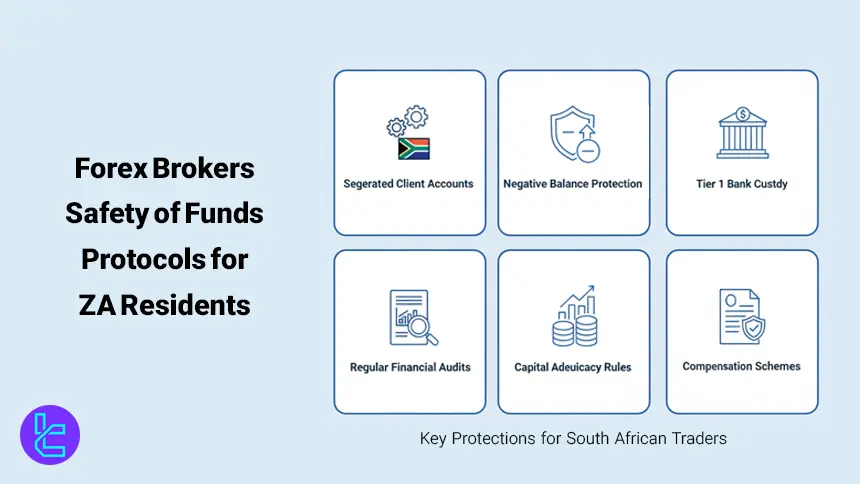
Many brokers also apply internal controls, external audits, and secure payment infrastructures. These measures reduce misuse of client funds and improve transparency, especially for traders using offshore entities linked to FSCA-compliant groups. Here’s a list of protocols for safekeeping South African traders’ funds:
Segregated Client Accounts: Holding client funds separately from operational capital at top-tier banking institutions
Negative Balance Protection: Preventing accounts from falling below zero during high volatility or extreme market conditions
Tier 1 Bank Custody: Using reputable international or local banks for safeguarding client deposits
Regular Financial Audits: Undergoing independent audits to verify solvency and compliance with regulatory requirements
Capital Adequacy Rules: Maintaining sufficient operational capital to withstand market shocks and liquidity stress
Compensation Schemes: Providing investor protection coverage through regional or international compensation funds where applicable
Client fund protection protocols in South Africa
Tax on Forex Trading in South Africa
Forex trading profits are taxable in South Africa under SARS regulations. Depending on trading frequency, intent, and holding period, profits may be classified as normal income tax or capital gains tax.
Traders must declare forex income annually and may be required to register as provisional taxpayers. Maintaining accurate trade records is essential to ensure correct tax reporting and compliance with SARS requirements.
Tax Item
Rate / Percentage
How It Applies to Traders
Personal income tax brackets
18% to 45%
Applied when trading profits are classified as income
Maximum marginal income tax rate
45%
Applies to high-income active traders
Capital gains inclusion rate (individuals)
40%
Portion of capital gains added to taxable income
Effective capital gains tax rate
Up to 18%
45% × 40% inclusion rate
Capital gains annual exclusion
R40,000
First R40,000 of gains exempt each tax year
Interest on overdue tax
Repo rate + margin
Calculated monthly by SARS
VAT on forex and CFDs
0%
Forex and CFD trading is VAT exempt
What Are Leverage Caps in South Africa?
The maximum leverage available to South African traders depends on the broker’s regulatory entity. FSCA doesn’t impose specific restrictions on leverage options, and FSCA-aligned entities often offer higher leverage compared to European regulators, sometimes exceeding 1:100 or more under specific conditions.
While higher leverage increases market exposure and potential returns, it also significantly amplifies risk. Traders should combine leverage usage with strict position and risk management strategies.
What Platforms Are Most Popular Among South African Traders?
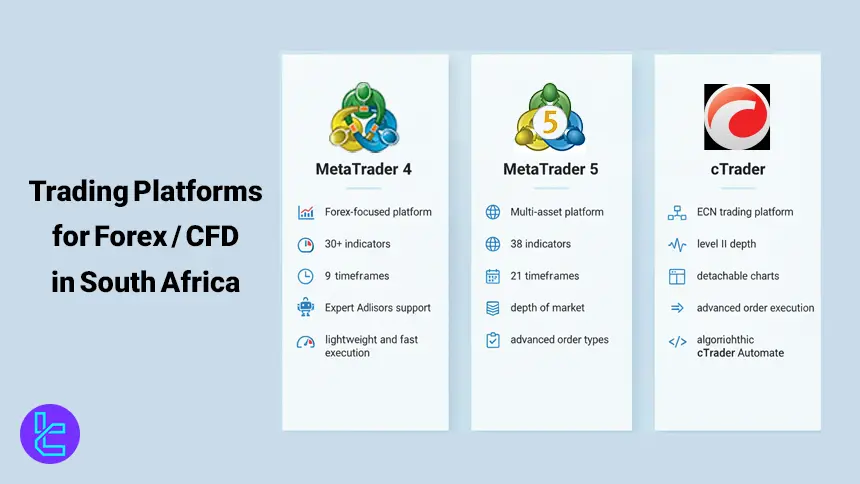
South African traders have access to widely used platforms such as MetaTrader 4, MetaTrader 5, cTrader, and various proprietary trading platforms. Platform selection affects execution speed, automation capability, charting depth, and strategy flexibility.
Most brokers support desktop, web, and mobile versions, allowing traders to manage positions across devices. Platform stability during volatile market conditions remains a key consideration.
Popular trading platforms used by ZA traders
What Fees Should ZA Traders Expect?
Forex trading fees include spreads, commissions, overnight swap charges, and inactivity fees. Many brokers serving South African traders offer raw spread accounts with low commissions and no deposit or withdrawal fees.
Understanding total trading costs is essential for long-term profitability, especially for scalpers and active traders. Fee transparency should always be evaluated alongside execution quality and platform performance.
What Are Professional Forex Account’s Criteria for South African Traders?
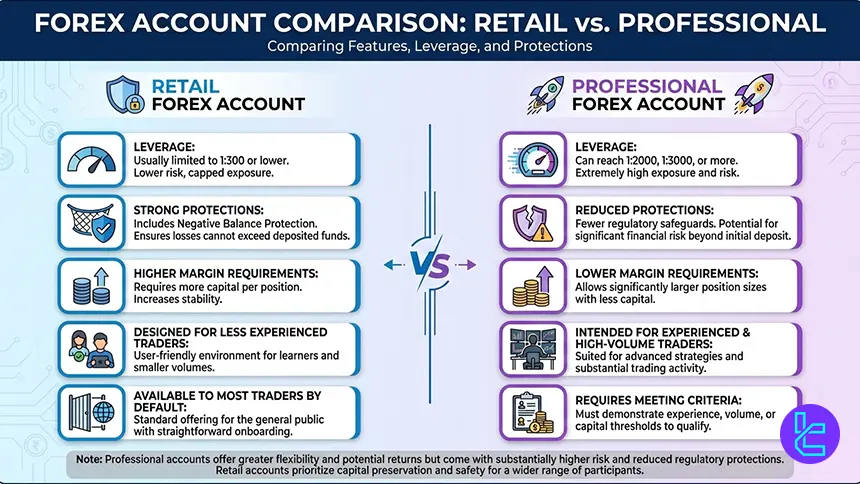
Professional forex accounts provide higher leverage and fewer regulatory restrictions but require traders to meet eligibility criteria. These may include trading experience, portfolio size, or transaction volume thresholds.
Professional status reduces regulatory protections, such as leverage caps and risk warnings. Such accounts are suitable only for experienced traders who fully understand leverage, margin requirements, and potential losses.
Higher leverage access
Experience and capital required
Reduced regulatory protection
Advanced risk exposure
A comprehensive comparison between Forex professional and retail accounts
Helpful Links for South African Traders
Official regulatory and tax resources are essential for South African forex traders to remain compliant. These platforms provide access to licensing verification, tax filing, regulatory updates, and online payment services required for lawful trading activity.
Using verified government sources reduces compliance risk and ensures traders stay informed about regulatory changes affecting forex trading and financial reporting obligations.
FSCA Register: Official FSCA database for verifying licensed financial service providers, including forex and CFD brokers authorized to operate in South Africa
FSCA Warnings: FSCA alerts listing unlicensed, suspicious, or fraudulent entities targeting South African traders and investors
SARS eFiling: Official online platform for submitting tax returns, making payments, and managing tax obligations with the South African Revenue Service
Forex Trading in South Africa Compared to Other Countries
Forex trading in South Africa is regulated by the FSCA and stands out for high retail leverage up to 1:500, mandatory negative balance protection, and access to global brokers.
Compared with Kenya, Australia, and the UK, South Africa offers greater leverage but lower investor protection than the FCA or ASIC frameworks.
Australian Securities and Investments Commission (ASIC)
Financial Conduct Authority (FCA)
Regulatory Framework
National FSCA regulations
National regulation under CMA
National framework under ASIC
National FCA framework post Brexit
Retail Leverage Cap Forex Majors
Up to 1:500
Up to 1:400
1:30
1:30
Investor Protection Level
Medium
Medium
High
Very high
Negative Balance Protection
Mandatory
Mandatory
Mandatory
Mandatory
Client Fund Segregation
Mandatory under FSCA rules
Required under CMA rules
Required under ASIC rules
Mandatory
Broker Transparency Requirements
Transparent risk disclosures under FSCA oversight
Not Strict
Licensing and conduct rules under ASIC
Very strict conduct and disclosure standards
Broker Availability
Local and international
CMA-regulated local and international brokers
ASIC-licensed brokers
FCA licensed local and international brokers
Access to International Brokers
Yes
Yes
Yes
High global broker access
Typical Trading Platforms
MT4, MT5, cTrader
MT4, MT5, cTrader
MT4, MT5, cTrader, TradingView, NinjaTrader
MT4, MT5, cTrader, TradingView
Maximum Loss Protection
Cannot lose more than deposit
Cannot lose more than deposit
Cannot lose more than deposit
Cannot lose more than deposit
Tax Treatment of Forex Profits
Up to 45% as normal income tax or capital gains tax
Taxable income by Kenya Revenue Authority
Treated as assessable income
Capital gains tax or income tax depending on activity
Conclusion and Expert Suggestions
South Africa remains one of Africa’s most active retail FX markets, supported by 200,000+ traders and clear conduct oversight from the Financial Sector Conduct Authority (FSCA), created in 2018. Choosing FSCA-licensed entities, verifying FSP details, and checking FSCA warning notices directly reduces clone-firm risk and strengthens client fund safety.
For cost and performance, top brokers compete on raw spreads from 0.0 pips, platform depth across MetaTrader, cTrader, and proprietary terminals, plus multi-asset coverage that can exceed 17,000 instruments. Trustpilot ratings also matter, with FP Markets, IC Markets, and Exness at 4.8 out of 5, helping ZA traders balance pricing, execution, and reliability.
Our ranking system applies a structured weighting approach that assesses brokers across key areas, including pricing competitiveness, regulatory coverage, and the range of account options, in alignment with the principles defined in the Forex methodology framework.
FAQs
What is the best forex broker in South Africa?
There is no single best forex broker for all South African traders, as suitability depends on regulation, costs, platforms, leverage, and individual risk preferences. The brokers below are widely used in South Africa and meet key criteria such as regulatory oversight, pricing transparency, execution quality, and platform reliability.
FP Markets: Competitive raw spreads, strong multi regulation, advanced platforms, and deep liquidity for active traders
Exness: Low entry requirements, flexible leverage, instant withdrawals, and strong accessibility for South African clients
IC Markets: Institutional grade execution, ultra tight spreads, and excellent support for scalping and algorithmic trading
Ava Trade: Multi regulated broker with solid risk management tools, multiple platforms, and copy trading options
Plus500: User friendly proprietary platform, broad CFD coverage, and strong regulatory framework for retail traders
Pepperstone: High speed execution, low latency infrastructure, and professional grade trading platforms
Tickmill: Cost efficient trading, low commissions, and reliable execution for short term and swing traders
Is forex trading legal in South Africa?
Yes, forex trading is fully legal in South Africa for both retail and professional traders. South African residents are allowed to trade forex and CFDs through locally regulated or internationally licensed brokers, provided financial laws and exchange control rules are respected.
The Financial Sector Conduct Authority FSCA oversees market conduct and broker behavior, ensuring transparency, fair treatment of clients, and proper risk disclosures. Traders are responsible for choosing compliant brokers and understanding leveraged trading risks.
Who regulates forex brokers in South Africa?
Forex brokers operating locally are regulated by the Financial Sector Conduct Authority FSCA. This regulator was established in 2018 as part of South Africa’s Twin Peaks financial regulation model.
The FSCA focuses on consumer protection, broker conduct, disclosure standards, and operational integrity. It does not control prices or profits but ensures brokers act fairly, manage risks responsibly, and protect retail traders from misconduct.
Do brokers need an FSCA license to serve South Africans?
Brokers can legally serve South African traders either through an FSCA license or via recognized offshore entities. FSCA authorization offers stronger local oversight and clearer complaint resolution mechanisms.
Offshore brokers may still operate legally, but traders must carefully verify regulation, fund protection policies, and transparency. FSCA-regulated brokers generally provide higher confidence for retail traders seeking local compliance.
How many active forex traders are in South Africa?
South Africa has an estimated 190,000 to over 200,000 active retail forex traders. This makes it one of the largest and most developed forex markets on the African continent.
Growth is driven by mobile trading adoption, global market access, and increasing financial education. South African traders actively participate in forex, indices, commodities, and CFD markets through international platforms.
What markets can South African traders access?
South African traders can access forex pairs, stock indices, commodities, metals, shares, ETFs, and cryptocurrency CFDs. Market availability depends on the broker and account type.
Leading brokers offer anywhere from several hundred to over 10,000 instruments. This wide selection allows traders to diversify strategies, hedge positions, and trade global markets from a single account.
Are offshore forex brokers allowed in South Africa?
Yes, South Africans are allowed to trade with offshore brokers as long as tax obligations and exchange control rules are respected. There is no law restricting residents to local brokers only.
However, offshore regulation varies significantly. Traders should verify licensing, fund segregation, and dispute resolution options carefully before opening accounts with non-FSCA-regulated entities.
What trading platforms are popular in South Africa?
MetaTrader 4 and MetaTrader 5 are the most widely used platforms among South African traders. cTrader and proprietary web platforms are also increasingly popular.
These platforms support advanced charting, automated trading, mobile access, and fast execution. Platform stability and execution quality are especially important during high volatility market conditions.
Do South African brokers offer negative balance protection?
Many brokers serving South African traders provide negative balance protection, especially for retail accounts. This feature prevents traders from losing more than their deposited funds.
Negative balance protection is particularly important during extreme volatility or sudden market gaps. Availability depends on the broker’s regulatory entity and account classification, so traders should confirm coverage before trading.
What is the minimum deposit for South African traders?
Minimum deposits typically range from $10 to $200, depending on the broker and account type. Some brokers allow very low entry points for beginners.
Higher minimum deposits often unlock advanced features such as raw spreads, professional leverage, or premium execution. Traders should choose deposit levels aligned with risk tolerance and experience.
Are forex profits taxable in South Africa?
Yes, all forex and CFD trading profits are taxable in South Africa. Profits are classified either as income tax or capital gains tax, depending on trading frequency and intent.
Active traders are usually taxed under income tax rules, while long-term or occasional traders may fall under capital gains tax. Accurate record keeping is essential for tax compliance.
Do South African traders pay VAT on forex trading?
Forex and CFD trading is VAT exempt in South Africa. Traders do not pay VAT on spreads, commissions, or trading profits.
However, VAT exemption does not remove income tax or capital gains tax obligations. Traders must still declare profits annually and comply with South African Revenue Service requirements.
What leverage is available to South African traders?
Leverage available to South African traders depends on the broker’s regulatory structure. While FSCA doesn’t impose restrictions on leverage options, some brokers offer leverage exceeding 1:100.
Higher leverage increases both profit potential and risk exposure. Traders should use leverage carefully and combine it with strong risk management and position sizing rules.
How can traders verify an FSCA license?
Traders can verify a broker’s license by searching the FSCA Financial Service Provider register using the broker’s legal name or FSP number.
This process helps identify unauthorized brokers or clone firms using false license claims. Verification should always be completed before depositing funds or sharing personal information.
What are FSCA warning lists?
FSCA warning lists identify unlicensed or suspicious financial entities targeting South African traders. These warnings often involve clone firms or fraudulent investment schemes.
Checking warning lists is a critical safety step. Many scams operate through aggressive marketing and misleading regulatory claims, making verification essential.
Do South African brokers segregate client funds?
Reputable brokers segregate client funds from operational capital. This means trader deposits are held in separate bank accounts.
Fund segregation protects clients if a broker faces financial difficulties. It is a core safety requirement under FSCA-aligned and reputable international regulatory frameworks.
Are ZAR accounts available with forex brokers?
Some brokers support ZAR deposits and withdrawals, but ZAR base currency accounts are not always available. Most trading accounts are denominated in USD or EUR.
When ZAR accounts are unavailable, currency conversion fees may apply. Traders should factor these costs into overall trading expenses.
Do brokers charge deposit or withdrawal fees from ZA residents?
Many top brokers offer fee-free deposits and withdrawals for South African traders. However, third-party payment providers may apply their own charges.
Inactivity fees may also apply if accounts remain unused for extended periods. Traders should always review the broker’s non-trading fee structure.
Is copy trading available in South Africa?
Yes, copy trading and social trading services are available to South African traders through selected brokers. These services allow users to follow experienced traders automatically.
Copy trading can help beginners learn market behavior, but it still involves risk. Performance varies, and proper risk allocation remains essential.
What makes a broker reliable for South Africans?
A reliable broker combines strong regulation, transparent pricing, secure fund handling, and stable trading platforms. Execution quality and customer support are also critical factors.
Long operating history, positive user reviews, and clear legal documentation further indicate broker reliability for South African traders.
Can beginners trade forex safely in South Africa?
Beginners can trade safely by choosing regulated brokers, starting with demo accounts, and using conservative leverage. Education and discipline are key to long-term success.
Understanding risk, avoiding overtrading, and setting realistic expectations help beginners navigate the forex market responsibly.