






Stock trading through forex brokers has become increasingly accessible, with platforms like Fusion Markets, Pepperstone, and BlackBull Markets serving thousands of traders globally. Leading brokers offer minimum deposits from $0 to $100 and leverage ranging from 1:5 up to 1:500 for professional accounts. Trustpilot ratings highlight broker reliability, with Fusion Markets and BlackBull Markets earning 4.8/5 from over 3,000 reviews each.
Here are the top stock trading brokers currently available:
 | FUSION MARKETS | |||
 | pepperstone | |||
 | eightcap | |||
| 4 |  | Blackbull | ||
| 5 |  | XM | ||
| 6 |  | ACTIVTRADES | ||
| 7 |  | eToro |
Trustpilot Ratings for Stock Trading Forex Brokers
Customer feedback can reveal a lot about a broker’s reliability and service quality. Trustpilot ratings give traders a snapshot of overall satisfaction, helping you identify brokers with strong reputations and a history of positive user experiences:
Broker | Trustpilot | Number of Reviews |
Fusion Markets | 6,330 | |
BlackBull Markets | 3,128 | |
eToro | 30,657 | |
Pepperstone | 3,226 | |
3,498 | ||
ActivTrades | 1,050 | |
2,708 |
Minimum Spreads in Stock Trading Brokers
Tighter spreads can make a big difference in trading costs, especially for active traders. Comparing minimum spreads across brokers shows where you can trade stocks with lower transaction costs and better price efficiency:
Brokers | Minimum Spreads |
eToro | 0.0 Pips |
0.0 Pips | |
AvaTrade | 0.0 Pips |
Pepperstone | 0.0 Pips |
Eightcap | 0.0 Pips |
0.5 Pips | |
IQ Option | 1.7 Pips |
Non-Trading Fees Charged by Forex Stock Brokers
Beyond spreads and commissions, brokers may charge fees for deposits, withdrawals, or inactivity. Understanding these non-trading costs ensures there are no hidden surprises that could eat into your profits
Broker Name | Deposit Fee | Withdrawal Fee | Inactivity Fee |
Pepperstone | $0 | $0 | $0 |
FP Markets | $0 | $0 | $0 |
$0 | $0 | $0 | |
Global Prime | $0 | $0 | $0 |
BlackBull Markets | $0 | $5 | $0 |
XM Group | $0 | $0 | $10 Monthly |
Eightcap | $0 | $0 | $10 Monthly |
Trading Platforms Available for Stock Trading
The right trading platform affects both your strategy execution and overall trading experience. Some brokers offer proprietary apps, while others support MetaTrader, TradingView, or multiple platforms, giving you flexibility and advanced tools for trading:
Broker Name | Trading Platforms |
Proprietary App | |
Axi | MetaTrader 4, Axi Copy Trade |
IFC Markets | MetaTrader 4, MetaTrader 5, NetTradeX |
Fusion Markets | MetaTrader 4, MetaTrader 5, TradingView, cTrader |
ActivTrades | MetaTrader 4, MetaTrader 5, ActivTrader, TradingView |
Proprietary Platform, cTrader, Trading View, MetaTrader 4&5 | |
Blackbull Markets | MetaTrader 4, MetaTrader 5, TradingView, cTrader, BlackBull CopyTrader, BlackBull Invest |
Details of the Top 6 Forex Brokers for Stock Trading
This section provides a detailed overview of six top-rated brokers, Fusion Markets, Pepperstone, Eightcap, BlackBull Markets, XM Group, and ActivTrades, highlighting their key features, trading conditions, regulatory credentials, and platform offerings.
Fusion Markets
Founded in 2019 by Phil Horner, Fusion Markets is a low-cost, multi-asset forex and CFD broker designed for traders seeking ultra-tight spreads and transparent pricing. The company operates under the legal entity Gleneagle Securities Pty Limited (Company No. 40256) and offers access to 250+ tradable instruments across seven markets, including Forex, indices, commodities, metals, cryptocurrencies, and US share CFDs.
Regulated by the Australian Securities and Investments Commission (ASIC) and the Vanuatu Financial Services Commission (VFSC), the broker follows a multi-jurisdictional compliance model. Client funds are held in segregated accounts with top-tier banks such as HSBC and National Australia Bank, reinforcing operational transparency. ASIC-regulated clients benefit from negative balance protection and leverage up to 1:30, while VFSC clients can access leverage up to 1:500.
Upon completing Fusion Markets registration steps, the broker offers three main account types: Zero, Classic, and Swap-Free (Islamic). The Zero account provides spreads from 0.0 pips with a $4.5 commission per lot, while the Classic account features spreads from 0.9 pips with $0 commission. There is no minimum deposit requirement, and traders can open accounts in multiple base currencies, including USD, EUR, GBP, AUD, JPY, SGD, THB, and CAD.
The broker supports leading platforms such as MetaTrader 4, MetaTrader 5, cTrader, and TradingView across desktop, web, and mobile. With execution speeds around 0.02ms, VPS hosting, copy trading via Fusion+ accessible through the Fusion Markets dashboard, and MAM/PAMM solutions, Fusion Markets caters to scalpers, algorithmic traders, and money managers alike.
The broker has also received industry recognition from BrokerChooser and Compare Forex Brokers for its low-spread and low-commission structure.
Account Types | Zero, Classic, Swap-Free |
Regulating Authorities | ASIC, VFSC |
Minimum Deposit | $0 |
Deposit Methods | Bank Wire, VISA/MasterCard, PayPal, Skrill, Neteller, PayID, Crypto, Interac, BinancePay |
Withdrawal Methods | Bank Transfer, PayPal, Skrill, Neteller, Crypto, Interac, Jetonbank, DragonPay |
Maximum Leverage | 1:500 (VFSC) / 1:30 (ASIC Retail) |
Trading Platforms & Apps | MetaTrader 4 (MT4), MetaTrader 5 (MT5), cTrader, TradingView |
Fusion Markets Pros and Cons
Overall, Fusion Markets stands out for its ultra-low trading costs, flexible account structure, and strong platform selection. However, it has limitations in educational depth and asset diversity compared to larger global brokers. Below is a quick overview of its key advantages and disadvantages:
Pros | Cons |
Ultra-low spreads from 0.0 pips | No investor compensation scheme |
$0 minimum deposit requirement | Limited educational resources |
Regulated by ASIC & VFSC | No proprietary trading platform |
Wide platform support (MT4, MT5, cTrader, TradingView) | Fewer tradable assets than major multi-asset brokers |
Pepperstone
Founded in 2010 in Melbourne, Australia, Pepperstone has grown into a global forex and CFD broker serving over 400,000 clients worldwide. The company processes an average of $9.2 billion in daily trading volume and provides access to 1,200+ instruments across Forex, commodities, indices, shares, cryptocurrencies, and ETFs.
Pepperstone stands out for its strong regulatory framework. The broker is supervised by top-tier authorities, including the Australian Securities and Investments Commission (ASIC), Financial Conduct Authority (FCA), Cyprus Securities and Exchange Commission (CySEC), Dubai Financial Services Authority (DFSA), Federal Financial Supervisory Authority (BaFin), and Kenya’s CMA.
After the Pepperstone registration process, the broker offers two primary account types: Standard and Razor. The Standard account features spread-only pricing (EUR/USD averages around 1.0–1.2 pips), while the Razor account provides raw spreads from 0.0 pips with a $3.5 commission per side. There is no fixed minimum deposit (from $1), and traders can choose from 10 base currencies, including USD, EUR, GBP, AUD, JPY, and SGD.
Pepperstone supports multiple advanced trading platforms, including MetaTrader 4, MetaTrader 5, cTrader, and TradingView, alongside its proprietary web and mobile platform. With deep liquidity, instant execution, copy trading integrations (e.g., DupliTrade and MetaTrader Signals), Pepperstone rebate program, and 24/7 multilingual support, Pepperstone delivers a comprehensive trading environment for global investors.
Account Types | Cent, STP, ECN |
Regulating Authorities | VFSC, FSC |
Minimum Deposit | $0 |
Deposit Methods | Local Bank Transfers, E-wallets, International Wire Transfers, Credit/Debit Card |
Withdrawal Methods | Local Bank Transfers, E-wallets, International Wire Transfers, Credit/Debit Card |
Maximum Leverage | 1:500 |
Trading Platforms & Apps | MetaTrader 4, MetaTrader 5, Doo Prime InTrade |
Pepperstone Pros and Cons
Overall, Pepperstone combines regulatory strength, competitive pricing, and platform diversity. However, certain limitations, such as restricted leverage in Tier-1 regions and the absence of PAMM accounts, may impact some traders. Below is a summary of its main advantages and disadvantages:
Pros | Cons |
Regulated by multiple Tier-1 authorities (ASIC, FCA, CySEC, BaFin) | No PAMM account offering |
Processes $9.2B average daily trading volume | Leverage capped at 1:30 in Tier-1 regions |
1,200+ tradable instruments across 6 asset classes | Limited bonus/promotional programs |
Advanced platform range (MT4, MT5, cTrader, TradingView + proprietary) | Demo account access may be limited in some jurisdictions |
Eightcap
Founded in 2009 in Melbourne, Australia, Eightcap has grown into a globally recognized CFD and forex broker offering access to over 800 tradable instruments across six markets: Forex, commodities, metals, indices, shares, and cryptocurrencies. Traders can access leverage up to 1:500 (jurisdiction-dependent) and trade micro-lots starting from 0.01.
Eightcap operates under strong regulatory oversight from the Australian Securities and Investments Commission (ASIC), Financial Conduct Authority (FCA), Cyprus Securities and Exchange Commission (CySEC), and the Securities Commission of The Bahamas (SCB). Client funds are held in segregated accounts, and eligible UK/EU traders benefit from compensation schemes such as FSCS (£85,000) and ICF (€20,000).
In terms of pricing, the Standard and TradingView accounts offer spreads from 1.0 pip with zero commission (except shares), while the Raw account provides spreads from 0.0 pips with a $7 round-turn commission per lot. The minimum deposit is $100, margin call/stop-out levels are set at 80%/50%, and scalping is allowed. Eightcap also supports seven base currencies, including USD, EUR, GBP, AUD, and SGD, available after going through the Eightcap registration steps.
Eightcap integrates seamlessly with MetaTrader 4, MetaTrader 5, and TradingView, combining advanced charting with market execution. Additional tools such as Capitalise.ai (no-code automation), FlashTrader (one-click risk management), and an AI-powered economic calendar enhance strategy development. The broker also offers an Eightcap rebate program.
The broker was named “Global Broker of the Year 2023” at the Global Forex Awards, further strengthening its industry credibility.
Account Types | Standard, STP, ECN |
Regulating Authorities | ASIC (Australia), VFSC (Vanuatu), FSC (Mauritius) |
Minimum Deposit | $0 (varies by account type) |
Deposit Methods | Credit/Debit Card, Bank Transfers, E-wallets (Neteller, Skrill, etc.) |
Withdrawal Methods | Credit/Debit Card, Bank Transfers, E-wallets (Neteller, Skrill, etc.) |
Maximum Leverage | Up to 1:500 |
Trading Platforms & Apps | MetaTrader 4 (MT4), MetaTrader 5 (MT5), WebTrader (for non-MT4/MT5 users) |
Eightcap Pros and Cons
Overall, Eightcap delivers competitive spreads, strong regulation, and powerful third-party platform integration. However, the absence of passive investment tools and limited weekend support may be drawbacks for some traders. Below is a clear summary of its advantages and disadvantages:
Pros | Cons |
Regulated by ASIC, FCA, CySEC & SCB | No copy trading or PAMM accounts |
Raw spreads from 0.0 pips | $100 minimum deposit |
Strong TradingView integration | No Islamic (swap-free) account |
200+ cryptocurrency CFDs (outside UK retail) | 24/5 support only (no weekend service) |
BlackBull Markets
Founded in 2014 by Michael Walker and Selwyn Loekman, BlackBull Markets (officially Black Bull Group Limited) is a New Zealand-based multi-asset broker offering access to 26,000+ instruments across six asset classes. The company operates under regulation from the Financial Markets Authority (FMA) and the Seychelles Financial Services Authority (FSA), providing segregated client accounts, negative balance protection, and leverage up to 1:500.
Upon creating an account and finishing BlackBull Markets registration process, the broker delivers true ECN trading through three account types, ECN Standard, ECN Prime, and ECN Institutional, with spreads starting from 0.0 pips and commissions from $0. The broker supports nine base currencies and micro-lot trading from 0.01 lots, making it accessible to both beginners and institutional clients.
Traders gain access to powerful platforms, including MetaTrader 4, MetaTrader 5, cTrader, TradingView, as well as proprietary solutions like BlackBull CopyTrader and BlackBull Invest. The broker also provides API trading, 70+ order types for equities, and integration with 66+ third-party data providers. Investors can trade forex, commodities, indices, 23,000+ share CFDs, and 22 cryptocurrency pairs.
In addition to trading infrastructure, BlackBull Markets offers 24/7 multilingual support via email, live chat, phone, and WhatsApp. The broker partners with the Starship Foundation in New Zealand and maintains strong educational resources, including 3,000+ trading videos, webinars, podcasts, and market analysis tools. Completing BlackBull Markets verification steps is necessary to access features.
Account Types | ECN Standard, ECN Prime, ECN Institutional |
Regulating Authorities | FMA (New Zealand), FSA (Seychelles) |
Minimum Deposit | $0 (Standard & Prime), $20,000 (Institutional) |
Deposit Methods | Visa, MasterCard, Apple Pay, Google Pay, Bank Wire, SEPA, Crypto, Neteller, Skrill, FasaPay |
Withdrawal Methods | Visa, MasterCard, Apple Pay, Google Pay, Bank Wire, SEPA, Crypto, Neteller, Skrill, FasaPay |
Maximum Leverage | Up to 1:500 |
Trading Platforms & Apps | MetaTrader 4, MetaTrader 5, cTrader, TradingView, BlackBull CopyTrader, BlackBull Invest |
BlackBull Markets Pros and Cons
BlackBull Markets combines deep liquidity, competitive ECN pricing, and extensive platform support. However, regional restrictions and higher-tier account requirements may affect some traders. Below is a balanced overview of its key strengths and limitations:
Pros | Cons |
26,000+ tradable instruments across global markets | Services restricted in several countries (including the U.S.) |
True ECN accounts with spreads from 0.0 pips | $20,000 minimum deposit for Institutional account |
Multi-platform support (MT4, MT5, cTrader, TradingView) | $5 withdrawal fee per transaction |
Tier-1 regulation under New Zealand FMA | Higher complexity for beginner traders due to wide product range |
XM Group
Founded in 2009, XM Group has evolved into a global multi-asset broker serving over 15 million clients and processing nearly 14 million trades daily. With offices in Cyprus, Dubai, South Africa, and Belize, the broker delivers access to 1,400+ CFD instruments, including 55+ forex pairs and more than 1,200 stock CFDs. Its low $5 minimum deposit and leverage up to 1:1000 make XM accessible to both beginners and high-volume traders seeking flexible market exposure.
XM operates under multiple regulatory entities, including the Cyprus Securities and Exchange Commission (CySEC), Financial Sector Conduct Authority (FSCA), Dubai Financial Services Authority (DFSA), Financial Services Commission (FSC Belize), Financial Services Commission (FSC Mauritius), and Financial Services Authority (FSA Seychelles). In the UAE, XM Financial Products Promotion L.L.C. operates under SCA Category 5 licence No. 20200000322.
As a MetaTrader-focused broker, XM provides seamless trading via MetaTrader 4 and MetaTrader 5, plus a proprietary mobile app for iOS and Android. Traders benefit from spreads starting at 0.6 pips (Ultra Low account), a user-friendly XM Group dashboard, zero commissions on most accounts, hedging support, and guaranteed execution for orders up to 50 lots. With micro-lot trading from 0.01 lots and swap-free Islamic accounts, XM accommodates diverse strategies and risk profiles.
Beyond trading conditions, XM enhances user experience with 24/7 multilingual customer support, varied XM Group deposit and withdrawal methods, and a loyalty rewards program. The broker also integrates MQL5 Signal Service and XM Group copy trading, offering access to 9,000+ verified strategies and a community exceeding 100,000 active investors. Educational webinars, daily market analysis, and research tools further position XM as a comprehensive solution for retail and intermediate traders.
Account Types | Micro, Standard, Ultra Low Standard, Shares |
Regulating Authorities | FSC Belize, CySEC Cyprus, FSCA South Africa, DFSA Dubai, FSC Mauritius, FSA Seychelles |
Minimum Deposit | $5 (Micro, Standard, Ultra Low), $10,000 (Shares) |
Deposit Methods | Credit/Debit Cards (Visa, MasterCard), Bank Transfers, E-Wallets (Skrill, Neteller, Perfect Money), Mobile Payments (Apple Pay, Google Pay), Local Options (varies by country) |
Withdrawal Methods | Credit/Debit Cards (Visa, MasterCard), Bank Transfers, E-Wallets (Skrill, Neteller, Perfect Money), Mobile Payments (Apple Pay, Google Pay), Local Options |
Maximum Leverage | Up to 1:1000 (varies by account type and instrument) |
Trading Platforms & Apps | MetaTrader 4 (MT4), MetaTrader 5 (MT5), XM Mobile App (iOS & Android) |
XM Group Pros and Cons
Overall, XM Group combines strong regulation, competitive entry requirements, and broad instrument coverage. However, factors such as inactivity fees and regional restrictions may influence trader suitability. Below is a balanced overview of XM’s main advantages and disadvantages:
Pros | Cons |
Low $5 minimum deposit | $10 monthly inactivity fee |
1,400+ CFDs including 1,200+ stocks | Not available in the U.S., Canada, and some regions |
Multiple regulatory licenses (CySEC, FSCA, DFSA, FSC) | No proprietary web trading platform |
Negative balance protection & swap-free accounts | Mixed third-party review scores (Trustpilot 3.7/5) |
ActivTrades
Founded in 2001 and headquartered in London, ActivTrades is a globally recognized forex and CFD broker serving over 100,000 clients across 170+ countries. With more than two decades of market experience and 65+ international awards, the company has built a reputation for transparent pricing, ultra-fast execution, and client-focused innovation.
ActivTrades operates under strong multi-jurisdictional regulation, including the Financial Conduct Authority (FCA), Comissao do Mercado de Valores Mobiliarios (CMVM), Securities Commission of The Bahamas (SCB), and Brazilian authorities BACEN/CVM. UK clients benefit from FSCS protection up to £85,000, while additional private insurance covers up to £1,000,000 per client. Segregated funds and negative balance protection further enhance capital security across all account types.
The broker offers four account types, Professional, Individual, Demo account, and Islamic after completing ActivTrades registration steps,with no mandatory minimum deposit (except in select regions). Retail leverage reaches 1:30, while professional traders can access up to 1:400. ActivTrades supports multiple advanced platforms, including MetaTrader 4, MetaTrader 5, TradingView, and its proprietary ActivTrader platform featuring Progressive Trailing Stops and TradingView-powered charts.
Execution is handled through a No Dealing Desk (NDD) model with average speeds of around 4 milliseconds, supporting scalping, hedging, and algorithmic trading via Expert Advisors. Deposits are fee-free, withdrawals are processed promptly, and most payment methods, including cards, bank transfers, Skrill, Neteller, and crypto (region-dependent), are supported.
Account Types | Professional, Individual, Demo, Islamic |
Regulating Authorities | FCA UK, SCB, CMVM Portugal, BACEN Brazil, CVM Brazil |
Minimum Deposit | $0 (varies by country; $500 in Brazil & China) |
Deposit Methods | Credit/Debit Cards (Visa, MasterCard), Bank Transfers, E-Wallets (Skrill, Neteller, PayPal), Crypto via BitPay (not available for UK/EU), Local Payment Methods (Sofort, iDeal, Trustly, Przelewy24, Multibanco, PIX, Boleto Bancário) |
Withdrawal Methods | Credit/Debit Cards (Visa, MasterCard), Bank Transfers, E-Wallets (Skrill, Neteller, PayPal), Crypto (BitPay), Local Payment Methods |
Maximum Leverage | Up to 1:400 (1:30 for retail clients in most regions) |
Trading Platforms & Apps | ActivTrader, MetaTrader 4 (MT4), MetaTrader 5 (MT5), TradingView |
ActivTrades Pros and Cons
Overall, ActivTrades stands out for regulatory strength, risk protection, and professional-grade execution. However, limited promotional offers and the absence of social or copy trading may not suit every investor. Below is a concise breakdown of its key advantages and disadvantages:
Pros | Cons |
FCA-regulated with £85,000 FSCS + £1M additional insurance | No copy trading or PAMM accounts |
Spreads from 0.5 pips with fast 4ms execution | Retail leverage limited to 1:30 in UK/EU |
No minimum deposit requirement (most regions) | Limited bonus or promotional campaigns |
1,000+ CFDs across 7 asset classes | Not available to U.S. and certain restricted countries |
How Do We Evaluate Brokers for Stock Trading?
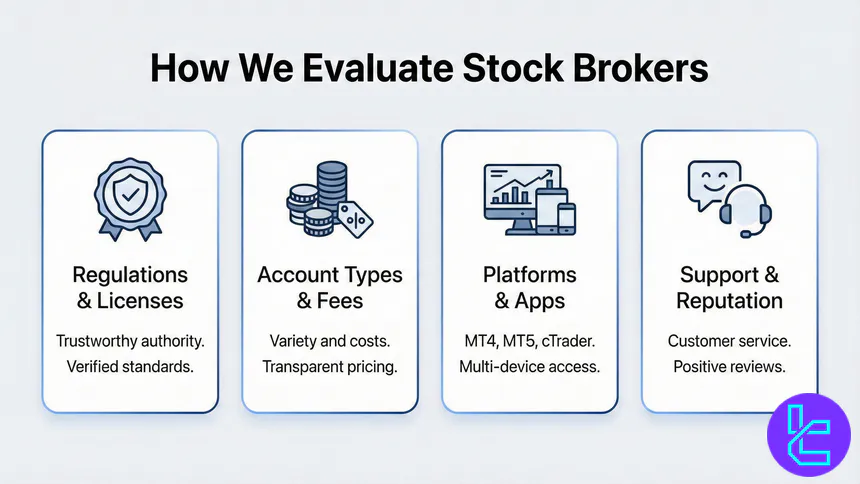
Reviewing stock brokers is a critical task since traders are entrusting their capital to these platforms. At Trading Finder, we provide a trusted evaluation framework, meticulously analyzing brokers to empower traders with informed decisions. Our methodology blends transparency, objectivity, and expert insight, guiding our team of seasoned market specialists to examine every key aspect of a broker’s offerings.
Our evaluation focuses on 19 core metrics, covering everything from regulations and licenses to customer support and educational resources. We assess account variety, commissions, deposits, withdrawals, and trading platforms like MetaTrader 4 & 5 and cTrader. Other factors include copy trading, broker offices, news updates, Trustpilot scores, and even philanthropic activities.
Key Evaluation Metrics:
- Regulations & Licenses: Verification under top-tier authorities
- Account Types & Tradable Symbols: Diversity and suitability for different traders
- Commissions & Fees: Trading, deposit, withdrawal, and inactivity costs
- Platforms & Apps: MT4, MT5, cTrader, mobile apps
- Customer Support & Social Media: Responsiveness and quality of service
- Education & Infographics: Resources to improve trader knowledge
- Trustpilot Score & Scam Reports: Reputation and reliability
- Investment & Copytrade Options: Access to professional trading strategies
This structured methodology ensures that Trading Finder provides objective, accurate, and practical insights, helping traders select brokers that meet both their strategic goals and operational needs in global stock markets.
Why Are Stocks a Popular Trading and Investment Asset?
Stocks remain one of the most widely traded and invested assets globally due to their potential for long-term growth and wealth creation. Companies listed on major exchanges such as the NYSE or NASDAQ allow traders to own fractional stakes in profitable businesses.
Globally, the total market capitalization of stock markets exceeded $120 trillion in 2025, highlighting their economic significance and attractiveness to investors seeking portfolio diversification.
Investing in stocks through forex brokers has grown in popularity because these platforms allow access to global equities without requiring direct exchange membership. Online brokers often provide access to hundreds of stock CFDs, enabling trading on price movements without owning the underlying asset. With advanced platforms like MT4, MT5, and TradingView integration, traders can combine forex and stock strategies efficiently.
Key Points:
- Global stock market capitalization: $120+ trillion (2025)
- Offers dividends, liquidity, and transparency
- Accessible via CFDs and online trading platforms
- Combines short-term trading and long-term investing
What Are the Pros and Cons of Trading Stocks Through Forex Brokers?
Trading stocks through forex brokers allows investors to access multiple markets without opening separate exchange accounts. Brokers often provide leverage, advanced charting tools, and fractional stock trading, making it easier for traders to diversify portfolios. For example, platforms like ActivTrades or XM offer leverage up to 1:20 for retail stock trading, enabling greater market exposure with smaller capital.
However, stock trading via forex brokers has drawbacks. Leverage magnifies losses alongside gains, and retail traders may face lower regulatory protection in non-major jurisdictions. Some brokers impose inactivity or withdrawal fees, and not all stock CFDs include voting rights or dividends. Trading on CFDs also means traders do not own the underlying stock, limiting some investment benefits.
Pros | Cons |
Access multiple markets without opening separate accounts | Leverage magnifies losses along with gains |
Leverage for retail stock trading (up to 1:20 on platforms like ActivTrades or XM) | Limited regulatory protection in non-major jurisdictions |
Advanced charting and trading platforms | Some stock CFDs do not include voting rights or dividends |
Fractional stock trading for easier portfolio diversification | Potential inactivity, withdrawal, or other broker fees |
Ability to diversify portfolios with smaller capital | CFDs mean traders do not own the underlying stock, limiting some investment benefits |
How Does Stock Trading Work in the United States?
In the U.S., stock trading is conducted primarily through regulated exchanges such as the NYSE and NASDAQ. Investors can buy and sell shares of publicly listed companies via brokerage accounts, either directly or through stock CFDs offered by forex brokers. Stock prices are determined by supply and demand dynamics, and U.S. trading hours are 9:30 AM to 4:00 PM EST, with pre-market and after-hours trading allowing extended opportunities.
Forex brokers operating in the U.S. must adhere to strict rules, including registration with the Commodity Futures Trading Commission (CFTC) and membership in the National Futures Association (NFA). Trading stocks via brokers outside the U.S. typically occurs through CFDs, which mirror the price of underlying U.S. equities without granting ownership.
Key Points:
- U.S. exchanges: NYSE, NASDAQ
- Trading hours: 9:30 AM - 4:00 PM EST
- Regulatory bodies: SEC, CFTC, NFA
- Global traders can access U.S. stocks via CFDs
Are Non-Trading Fees High for Stock Trading with Forex Brokers?
Non-trading fees vary widely among brokers, but most leading forex brokers maintain low costs for stock trading. Common fees include inactivity charges, account maintenance, currency conversion, and occasional withdrawal costs. For instance, ActivTrades does not charge deposit fees, but withdrawals in non-base currencies may carry a 0.5% conversion fee.
Some brokers offer free funding and withdrawals, while others may have tiered pricing depending on account type or region. E-wallets and local payment methods often bypass bank transfer fees, making deposits and withdrawals faster and cheaper. Traders should always verify the broker’s fee structure to avoid unexpected charges, especially when trading small accounts or using international currencies.
Non-Trading Fees:
- Common fees: inactivity, currency conversion, account maintenance
- Average inactivity fee: $10/month after 12 months
- Deposits often free; withdrawals may incur conversion charges
The Most Commonly Traded Stock Instruments in Forex Brokers
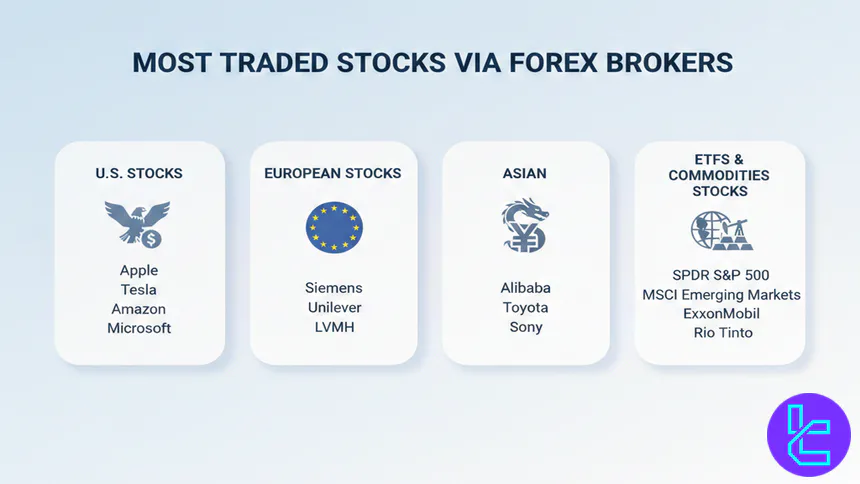
Forex brokers provide access to a wide range of stock instruments, often via CFDs. These typically include:
- U.S. equities: Apple (AAPL), Tesla (TSLA), Amazon (AMZN), Microsoft (MSFT)
- European stocks: Siemens (SIE.DE), Unilever (ULVR.L), LVMH (MC.PA)
- Asian markets: Alibaba (BABA), Toyota (7203.T), Sony (6758.T)
- Sector ETFs: SPDR S&P 500 (SPY), iShares MSCI Emerging Markets (EEM)
- Commodities-related equities: ExxonMobil (XOM), Rio Tinto (RIO)
These instruments allow traders to diversify across regions, sectors, and asset types. Some brokers also provide fractional shares, enabling investments in high-value stocks with minimal capital. Trading CFDs mirrors price movements without owning shares, making it simpler to go long or short.
Factors Influencing Stock Prices
Stock prices fluctuate due to a combination of microeconomic and macroeconomic factors. Company fundamentals, including earnings reports, revenue growth, and management decisions, directly impact investor perception. Broader market influences such as interest rates, inflation, and geopolitical events also play a crucial role. For example, Federal Reserve interest rate announcements often cause rapid price adjustments in tech and financial stocks.
Investor sentiment, supply and demand, andmarket liquidity also affect stock valuations. Unexpected news, mergers, or scandals can trigger sharp short-term movements. Forex brokers often provide access to economic calendars, real-time news feeds, and analytics tools to help traders anticipate such events. Using these insights, traders can develop strategies to mitigate risk or capitalize on market volatility.
Key Points:
- Drivers: earnings, revenue, interest rates, inflation, geopolitical events
- Influenced by supply-demand and market sentiment
- Brokers provide economic calendars and analytics tools
- News and events can create rapid price movements
What Leverage Do Forex Brokers Offer for Stock Trading?
Leverage allows traders to control larger positions with smaller capital, but it also magnifies risk. Retail stock traders usually receive leverage of 1:5 to 1:20, depending on regulations. Professional accounts or certain offshore brokers may offer higher leverage, sometimes up to 1:400 for CFDs. The leverage ratio directly affects margin requirements and potential gains or losses, making risk management crucial.
European brokers, governed by ESMA rules, cap leverage for retail stock trading at 1:5. In contrast, brokers outside strict regulatory jurisdictions may offer more aggressive leverage options. Traders must balance potential returns against risk exposure, especially during volatile market periods. Using stop-loss and position-sizing strategies is recommended to manage leveraged stock trades effectively.
Leverage in stock trading:
- Retail leverage: 1:5 to 1:20
- Professional/offshore leverage: up to 1:400
- Margin requirements vary by broker and account type
- Use risk management to mitigate losses
What Are the Minimum Spreads for Trading Stocks?
Spreads for stock CFDs represent the difference between buy and sell prices and vary by broker, stock, and market conditions. Leading brokers offer tight spreads from 0.5-1.0 pips for liquid U.S. and European stocks. Less liquid equities may have wider spreads, particularly during high volatility or after-hours trading. Tight spreads reduce trading costs and improve potential profitability for active traders.
Some brokers may also charge commissions on certain stocks or account types, but many offer zero-commission trading for major indices and shares. Spreads may widen during market news or low-liquidity periods. Forex platforms like MT4, MT5, and ActivTrader provide real-time spread monitoring to help traders optimize entry and exit points.
Spreads in stock trading:
- Typical minimum spreads: 0.5-1.0 pips
- Wider spreads for low-liquidity or volatile stocks
- Commissions may apply depending on broker
- Real-time monitoring tools aid cost management
What Is the Minimum Investment Required to Trade Stocks?
The minimum investment for stock trading varies by broker and instrument. Many forex brokers allow deposits as low as $0-$100, with fractional shares enabling trading of expensive stocks with minimal capital. Some U.S. or European brokers may require slightly higher initial deposits, usually $500-$1,000. This accessibility allows beginner traders to enter global stock markets without large upfront capital.
Investment size also depends on lot size and leverage. For instance, with a 0.01 lot CFD and leverage, traders can control larger positions while maintaining low margin requirements. Brokers often provide demo accounts to practice with virtual capital, allowing investors to test strategies before committing real money.
Key Points:
- Minimum deposit: $0–$100 (varies by broker and region)
- Fractional shares enable low-capital trading
- Lot size and leverage affect investment requirements
- Demo accounts available for risk-free practice
Which Regulatory Authorities Oversee Stock Trading Brokers?
Reliable stock brokers are regulated by top-tier authorities to ensure client protection and market integrity. Major regulatory bodies include:
- FCA (UK) - Oversees financial services and ensures FSCS protection up to £85,000
- SEC (U.S.) & CFTC - Regulate stock exchanges and derivatives
- CySEC (Cyprus) - Supervises brokers in EU under MiFID II
- ASIC (Australia) - Ensures broker compliance with investor safety rules
- FSCA (South Africa) - Monitors local brokers and trading platforms
Regulation guarantees segregated client funds, transparency, and adherence to strict operational standards. Traders should always verify broker licensing to reduce fraud risk.
The Best Account Types for Trading Stocks
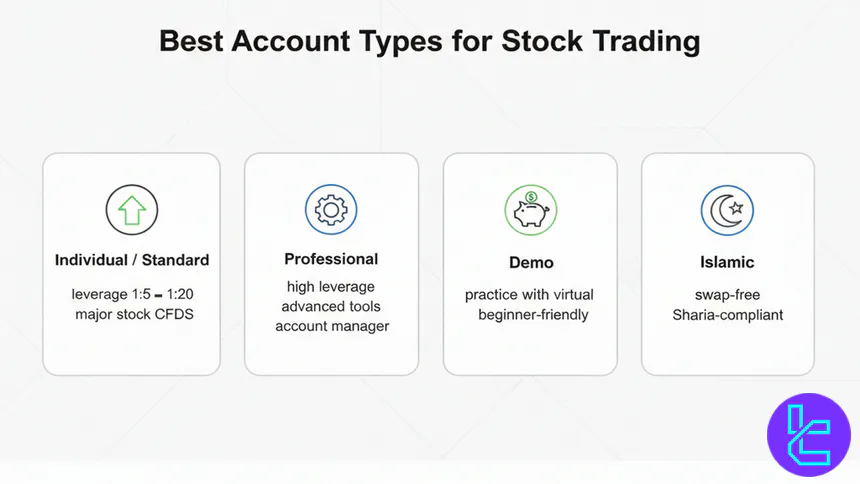
Forex brokers offer multiple account types tailored to different trading needs:
- Individual/Standard Accounsts: Suitable for most retail traders, offering leverage 1:5–1:20 and access to major stock CFDs;
- Professional Accounts: Higher leverage (up to 1:400), advanced risk management tools, and dedicated account managers;
- Demo Accounts: Risk-free practice with virtual funds, ideal for beginners;
- Islamic Accounts: Swap-free trading options for traders observing Sharia law.
Selecting the right account ensures optimal leverage, spreads, and trading flexibility.
What Strategies and Approaches Work Best for Stock Trading?
Successful stock trading combines technical, fundamental, and sentiment analysis. Short-term traders often use scalping, momentum, and day trading strategies, leveraging charts and indicators. Long-term investors focus on fundamental analysis, evaluating earnings, P/E ratios, and macroeconomic conditions. Combining stop-loss orders, trailing stops, and proper position sizing helps manage risk in volatile markets.
Algorithmic trading and automated EAs are increasingly popular, especially via MT4/MT5 platforms. Seasonal trends, sector rotation, and news-based strategies are also effective. Traders must align strategies with account type, leverage, and risk tolerance, ensuring consistent and disciplined execution.
Strategies for stock trading:
- Short-term: scalping, momentum, day trading
- Long-term: fundamental analysis and earnings evaluation
- Tools: EAs, indicators, stop-loss, trailing stops
- The Trading strategy must align with risk tolerance
How Do Stocks Compare to Other Popular Trading Instruments?
Stocks differ from forex, commodities, and crypto in volatility, liquidity, and income potential. Forex markets offer high leverage and 24-hour trading but lack dividend income. Commodities fluctuate with supply-demand and geopolitical factors. Cryptocurrencies are highly volatile and unregulated in many regions. Stocks provide balance, offering long-term growth, dividends, and moderate volatility.
CFDs enable traders to combine stock trading with other instruments in a single account. By analyzing spreads, leverage, and market hours, investors can diversify portfolios, hedge risks, and balance exposure across multiple asset classes efficiently.
Conclusion
Top brokers like Eightcap, XM Group, and ActivTrades provide access to over 1,400 stock CFDs, with spreads starting as low as 0.5 pips and leverage up to 1:400 for professional accounts. Many platforms support 7–10 base currencies, allowing global traders to diversify portfolios with minimal capital, sometimes from as little as $5.
Customer satisfaction remains strong, with several brokers maintaining Trustpilot scores above 4.0 and tens of thousands of verified reviews. By considering fees, platform features, account types, and regulatory oversight, traders can confidently select brokers that match their trading goals and risk tolerance.
For a deeper look into how we evaluate brokers, explore our detailed Forex methodology article.