








The Vanuatu Financial Services Commission (VFSC) oversees financial entities operating in Vanuatu, including forex and CFD brokers that serve international clients. Over the years, VFSC-regulated brokers have attracted global traders due to flexible leverage policies, streamlined onboarding processes, and competitive trading conditions.
Below, you’ll find a curated list of some of the best forex brokerages operating under VFSC oversight, evaluated based on trading conditions, reliability, and overall service quality.
 | Decode Global | |||
 | GTCFX | |||
 | Global Prime | |||
| 4 |  | ACY Securities | ||
| 5 |  | Blueberry Markets | ||
| 6 |  | OneRoyal | ||
| 7 |  | FXPrimus | ||
| 8 |  | D Prime | ||
| 9 |  | Deriv | ||
| 10 |  | FXGT |
Trustpilot Rankings of VFSC-Licensed Brokers
Trustpilot scores provide an additional layer of insight when evaluating VFSC-licensed brokers. While regulation focuses on compliance and operational standards, Trustpilot reflects real user experiences related to execution speed, withdrawals, spreads, platform stability, and customer support responsiveness.
Broker Name | Trustpilot Rating | Number of Reviews |
Global Prime | 413 | |
ACY Securities | 756 | |
Blueberry Markets | 3,151 | |
70,564 | ||
FXGT | 1488 | |
367 | ||
TMGM | 836 | |
FXPrimus | 97 | |
D Prime | 453 | |
21 |
Spread Rates Among VFSC-Regulated Forex Brokers
Spread rates among brokers licensed by the Vanuatu Financial Services Commission vary depending on account type, execution model, and liquidity providers. Since VFSC does not impose strict spread caps like some Tier-1 regulators, brokers under this framework often compete through flexible pricing structures and higher leverage offerings.
Broker Name | Min. Spread |
GTCFX | 0.0 Pips |
0.0 Pips | |
0.0 Pips | |
Blueberry Markets | 0.0 Pips |
OneRoyal | 0.0 Pips |
FXPrimus | 0.0 Pips |
D Prime | 0.0 Pips |
0.0 Pips | |
Fusion Markets | 0.0 Pips |
Deriv | 0.24 Pips |
Hidden and Non-Trading Fees in VFSC-Regulated Brokers
When evaluating VFSC-regulated Forex brokers, traders should look beyond spreads and commissions. Non-trading and hidden fees can significantly affect long-term profitability, especially for swing traders or inactive accounts.
Unlike Tier-1 regulators that impose stricter disclosure frameworks, VFSC-licensed brokers may have more flexible fee structures. This makes it essential to review the broker’s Terms and Conditions carefully.
Broker Name | Deposit Fee | Withdrawal Fee | Inactivity Fee |
Decode Global | $0 | $10 | $0 |
Global Prime | $0 | $0 | $0 |
D Prime | $0 | $0 | $0 |
$0 | $0 | $0 | |
$0 | $0 | $0 | |
ACY Securities | $0 | First 5 withdrawals per month free, then $25 | $0 |
FXPrimus | $0 | $0 | Yes (Unknown number) |
FXGT | $0 | $0 | $10 Monthly |
TMGM | $0 | $0 | $10 Monthly |
Deriv | $0 | $0 | 25 USD, EUR, or GBP |
Markets and Tradable Assets in VFSC Forex Brokerages
Forex brokers regulated by the Vanuatu Financial Services Commission typically operate through offshore entities that allow flexible leverage structures and broad product offerings. As a result, many VFSC-licensed brokers provide access to a wide spectrum of CFD instruments across global markets.
Broker Name | Number of Instruments |
GTCFX | 27,000+ |
10,000+ | |
FXGT | 2,800+ |
OneRoyal | 2,000+ |
1000+ | |
Blueberry Markets | 300+ |
Fusion Markets | 250+ |
Deriv | 200+ |
Global Prime | 150+ |
Decode Global | 100+ |
Top 7 Forex Brokers Regulated by VFSC
Below are seven well-known Forex brokers operating under the supervision of the Vanuatu Financial Services Commission (VFSC). These brokers are selected based on trading conditions, leverage flexibility, platform availability, and overall market presence.
Decode Global
Decode Global is a Vanuatu-based Forex and CFD broker established in 2004 and regulated by the Vanuatu Financial Services Commission under license number 303250. The broker offers trading through MetaTrader 4 and MetaTrader 5, providing access to Forex, indices, and commodities with leverage up to 1:500.

Decode Global registration keeps its account opening structure simple with two main live accounts, STD and Pro, both requiring a minimum deposit of $100. The STD account features spreads from 1.0 pips with zero commission, while the Pro account offers spreads from 0.0 pips with a $7 commission per lot. A demo account is also available with no time limit.
Funding options include USDT, wire transfer, and UnionPay, with no deposit fees charged by the broker. Withdrawals typically take 1–3 business days and may incur a $10 fee depending on the method.
Regulation is limited to VFSC Tier-3 oversight, and Trustpilot reviews are minimal. Traders should carefully evaluate risk exposure before opening an account.
Account Types | STD, Pro, Demo |
Regulating Authorities | VFSC (License 303250) |
Minimum Deposit | $100 |
Deposit Methods | USDT, Wire Transfer, UnionPay |
Withdrawal Methods | USDT, Wire Transfer, UnionPay |
Maximum Leverage | 1:500 |
Trading Platforms & Apps | MetaTrader 4, MetaTrader 5 |
Decode Global Pros and Cons
The broker provides a comprehensive trading experience with access to multiple asset classes (after completing Decode Global verification), competitive trading costs, and a broad product range. Below is a concise overview of its key strengths and limitations.
Pros | Cons |
Regulated by VFSC | No negative balance protection |
MT4 and MT5 support | No investor compensation scheme |
Spreads from 0.0 pips (Pro) | Limited tradable instruments |
Leverage up to 1:500 | No Islamic or Cent accounts |
Copy trading via DecodeEX | Limited funding methods |
No deposit fees | Weak Trustpilot presence |
GTCFX
GTCFX is a multi-regulated Forex and CFD broker founded in 2012, serving more than 985,000 clients across 100+ countries. The company operates under reputable authorities such as ASIC, FCA, FSCA, SCA, VFSC, and FSC, offering segregated funds and negative balance protection across its regulated entities.
The broker provides three main account types after GTCFX registration including Standard, Pro, and ECN.
Traders can start with a $0 minimum deposit on Standard accounts, while the ECN account requires $3,000 and delivers raw spreads from 0.0 pips with a $5 commission per lot. Maximum leverage reaches up to 1:2000, depending on jurisdiction.
GTCFX supports MetaTrader 4 and MetaTrader 5 and integrates advanced tools like Signal Center, Autochartist, VPS services, and market analysis.
Deposits and withdrawals are generally free, although wire withdrawals may incur a $25 fee. A $5 monthly inactivity fee applies after six months. With over 27,000 tradable instruments and strong liquidity infrastructure, GTCFX positions itself as a high-leverage, execution-focused broker with global reach.
Account Types | Standard, Pro, ECN |
Regulating Authorities | ASIC, FCA, SCA, FSCM, VFSC, FSC, FSCA |
Minimum Deposit | $0 (Standard), $3,000 (ECN) |
Deposit Methods | Bank Wire, VISA, MasterCard, GTCPay, Perfect Money, TCPay, My Fatoorah, USDT |
Withdrawal Methods | Bank Wire, VISA, MasterCard, GTCPay, Perfect Money, TCPay, My Fatoorah, USDT |
Maximum Leverage | Up to 1:2000 |
Trading Platforms & Apps | MetaTrader 4, MetaTrader 5 |
GTCFX Pros and Cons
The broker offers a balanced trading environment after registration and GTCFX verification featuring diverse instruments, low fees, and an extensive selection of products. Here is a summary of its main advantages and potential drawbacks.
Pros | Cons |
Regulated by ASIC and FCA | Complex fee structure for some accounts |
Leverage up to 1:2000 | Limited beginner education |
Raw spreads from 0.0 pips | Geo-restrictions in several countries |
27,000+ tradable instruments | Crypto coverage not deeply emphasized |
Copy trading, PAMM, MAM available | $5 inactivity fee after 6 months |
Advanced tools like Autochartist & VPS | - |
Global Prime
Global Prime is an Australia-founded broker (2010) that offers access to 150+ instruments across Forex, indices, commodities, crypto CFDs, and bonds. It operates a dual-entity structure, with tier-1 regulation via ASIC for Australian clients and a VFSC license for international coverage, where leverage can reach 1:500.
The broker provides two account types: Standard and Raw. Standard pricing starts from 0.9 pips with $0 commission, while the Raw account delivers spreads from 0.0 pips with a $3.5 commission per side (commonly shown as $7 per round lot on FX and metals).
Trading is primarily supported through MetaTrader 4, with execution reported around 10ms and “Pro Trading” mode available for eligible Australian clients to access higher leverage, but with a lower stop-out level.
Global Prime emphasizes cost transparency, stating $0 broker fees for deposits and withdrawals, with Global Prime rebate available to reduce trading costs. Funding options are broad, including cards, PayPal, Neteller, Skrill, bank wire, and crypto.
Account Types | Standard, Raw |
Regulating Authorities | ASIC, VFSC |
Minimum Deposit | No set minimum (varies by method; commonly $10) |
Deposit Methods | Credit and Debit Cards, Crypto, PayPal, Neteller, Skrill, FasaPay, Perfect Money, Bank Wire, plus regional gateways |
Withdrawal Methods | Credit and Debit Cards, Crypto, PayPal, Neteller, Skrill, AstroPay, Perfect Money, Bank Wire, plus regional options |
Maximum Leverage | Up to 1:500 (1:30 under ASIC by default) |
Global Prime Pros and Cons
The broker delivers a suitable experience with easy Global Prime registration supported by varied assets, cost-efficient pricing, and a wide product offering. The following section outlines its primary strengths and weaknesses.
Pros | Cons |
ASIC regulation for Australian clients | MT4 only (no MT5 or cTrader yet) |
Raw spreads from 0.0 pips | Restricted countries apply |
150+ tradable instruments | Leverage cap is 1:500 (not extreme) |
24/7 support via multiple channels | Promotions are not frequent or universal |
Wide range of payment methods | No Islamic account option |
Segregated funds under both entities | - |
ACY Securities
ACY Securities is an Australia-based broker (founded 2011) offering 2,200+ instruments across Forex, indices, commodities, stocks, ETFs, futures CFDs, and crypto CFDs. It runs a multi-entity structure, with ASIC regulation (AFSL 403863) for Australian residents, FSCA regulation in South Africa (license 51008), and an offshore SVG entity that enables the highest leverage options.
Account choices after ACY Securities registration include Standard, ProZero, and Bespoke. Standard typically uses wider spreads with $0 commission, while ProZero and Bespoke target lower all-in costs with spreads from 0.0 pips and commissions that scale by account.
Execution is STP-based, with an average execution time reported under 30ms, and trading is available on MetaTrader 4, MetaTrader 5, and LogixTrader.
ACY supports a wide set of funding methods including cards, bank wires, e-wallets, China UnionPay, and crypto options like BTC and USDT, plus local payment rails depending on region. The broker also offers an Islamic option, copy trading access, and periodic credit promotions.
Account Types | Standard, ProZero, Bespoke |
Regulating Authorities | ASIC (AFSL 403863), FSCA (51008), SVG entity listed by broker |
Minimum Deposit | $50 (Standard), $200 (ProZero), $10,000 (Bespoke) |
Deposit Methods | Credit and Debit Cards, E-wallets, Bank Wire, China UnionPay, BTC, USDT, local methods by region |
Withdrawal Methods | Credit and Debit Cards, E-wallets, Bank Wire, China UnionPay, BTC, USDT, local methods by region |
Maximum Leverage | Up to 1:5000 |
Trading Platforms & Apps | MetaTrader 4, MetaTrader 5, LogixTrader |
ACY Securities Pros and Cons
The broker presents a well-structured trading ecosystem with multiple tradable assets, easy ACY Securities verification, competitive costs, and diverse products. Below is a brief evaluation of its core pros and cons.
Pros | Cons |
2,200+ instruments across 6 markets | Advanced accounts require higher deposits |
ASIC and FSCA regulated entities | 24/5 support only |
Leverage up to 1:5000 via offshore entity | Offshore arm is not a top-tier license |
Spreads from 0.0 pips on ProZero and Bespoke | Promotions vary by region and terms |
MT4, MT5, and LogixTrader supported | No PAMM account option |
Segregated funds and negative balance protection | Restricted countries apply |
Blueberry Markets
Blueberry Markets is an Australian Forex and CFD broker founded in 2016, offering trading on 300+ instruments across Forex, indices, commodities, metals, shares, and crypto CFDs.

The broker operates under multi-jurisdiction oversight, with ASIC regulation for Blueberry Markets Pty Ltd (license 535887) and a VFSC regulated entity (company no. 700697), plus additional offshore structures listed under Tier 3 regulators.
In Blueberry Markets registration, the broker provides 2 main account types, Standard and Direct, both starting from a $100 minimum deposit and 0.01 lot minimum order size.
Standard pricing typically starts from 1.0 pips with no commission, while Direct targets raw spreads from 0.0 pips with a $7 round turn commission per lot. Leverage can reach up to 1:500 depending on the entity and client eligibility.
Platform access centers on MT4, MT5, and WebTrader, while the broker also markets expanded platform coverage including cTrader, TradingView, and Blueberry X in its broader offering.
Funding and withdrawals are described as fee-free on the broker side, but payment variety can be limited by Blueberry Markets verification and method. Support is positioned as responsive via email, live chat, and phone, and Trustpilot feedback trends positive with a 4.6 out of 5 score.
Account Types | Standard, Direct |
Regulating Authorities | ASIC (535887), VFSC (700697) |
Minimum Deposit | $100 |
Deposit Methods | Visa, MasterCard, Bank Wire Transfer (region dependent options may apply) |
Withdrawal Methods | Visa, MasterCard, Bank Wire Transfer (region dependent options may apply) |
Maximum Leverage | Up to 1:500 |
Trading Platforms & Apps | MT4, MT5, WebTrader (broker also references cTrader, TradingView, Blueberry X in broader offering) |
Blueberry Markets Pros and Cons
Blueberry Markets combines broad market access, low trading expenses, and a versatile product lineup to create a strong trading environment. Here is a summary of its key benefits and limitations.
Pros | Cons |
ASIC and VFSC regulated entities | Not available to US clients |
300+ tradable instruments | Minimum deposit can feel high versus $0 brokers |
Direct account offers spreads from 0.0 pips | Payment options vary and can be limited by region |
MT4, MT5, and WebTrader access | No Islamic account option |
Copy trading supported | No PAMM account |
Positive Trustpilot profile | Restricted countries list is broad |
OneRoyal
OneRoyal is a multi licensed CFD and Forex broker founded in 2006 under the Royal Group, offering access to FX pairs, metals, oil, indices, ETFs, stocks, and cryptocurrencies.
The broker operates through several entities, including an ASIC regulated branch in Australia (AFSL 420268), a VFSC licensed entity in Vanuatu (license 700284), and an SVGFSA registered entity in St. Vincent and the Grenadines (149LLC2019).
This structure allows OneRoyal to serve traders globally, while the ASIC entity delivers the strongest compliance framework. Protections differ by branch, with segregated funds and negative balance protection available under ASIC, and higher leverage caps up to 1:1000 typically linked to offshore entities.
OneRoyal supports multiple account types, including Classic, ECN, VIP, ECN Elite, Cent, and Demo, with deposits starting from $10 on Cent and reaching $10,000 for VIP and ECN Elite.
Pricing varies by account, with Classic and Cent using spread only, ECN accounts combining raw spreads from 0.0 with commissions, and VIP focusing on lower spreads without commission.
Trading runs on MT4, MT5, and MT4 Accelerator, with tools for automation, one click execution, and analysis. Extra services include copy trading via HokoCloud, PAMM, VPS hosting, AI trading tools, and an Islamic option (choosable during OneRoyal registration process). Support is offered 24/5 through live chat and multiple messaging channels.
Account Types | Classic, ECN, VIP, ECN Elite, Cent, Demo |
Regulating Authorities | ASIC (AFSL 420268), VFSC (700284), SVGFSA (149LLC2019) |
Minimum Deposit | $10 |
Deposit Methods | Visa, Mastercard, Bank Wire Transfer, Skrill, Neteller, Cryptocurrencies |
Withdrawal Methods | Visa, Mastercard, Bank Wire Transfer, Skrill, Neteller, Cryptocurrencies |
Maximum Leverage | Up to 1:1000 |
Trading Platforms & Apps | MT4, MT5, MT4 Accelerator |
OneRoyal Pros and Cons
OneRoyal provides traders with diversified instruments, affordable pricing, and an extensive range of products. The following overview highlights its main strengths and areas of consideration.
Pros | Cons |
Multi licensed structure (ASIC, VFSC, SVGFSA) | VIP and ECN Elite require $10,000 deposit |
Wide range of account types including Cent and Demo | Tradable assets can feel limited versus multi asset giants |
Spreads from 0.0 on ECN tiers | No US clients accepted |
MT4, MT5, and MT4 Accelerator available | Investor compensation is listed as none across entities |
Copy trading and PAMM supported | Protections vary by entity, especially offshore branches |
Islamic account option available | Segregated funds and balance protection are not uniform |
FXPrimus
FXPrimus is a multi regulated Forex and CFD broker with offices in Limassol and Vanuatu, serving traders through CySEC and VFSC entities. The CySEC branch targets EU and EEA residents and offers higher protection standards, including segregated client funds, negative balance protection, and access to the Investor Compensation Fund up to €20,000.
The VFSC entity serves global clients with higher leverage settings, reaching up to 1:1000, but it does not provide a compensation scheme and lists no negative balance protection.
This structure makes the chosen entity a key factor in how trading conditions and safeguards apply.
The broker supports Classic, Pro, and Zero accounts, letting traders align costs with deposit size. Classic starts from $15 with wider spreads and no commission, Pro requires $500 with tighter spreads and platform based commissions, and Zero requires $1000 with spreads from 0.0 pips and a per lot fee.
FXPrimus supports MT4, MT5, cTrader, and WebTrader, covers multiple base currencies like USD, EUR, GBP, SGD, and PLN, and offers extra features including FXPrimus rebate, copy trading, demo accounts, PAMM, and Islamic accounts.
Deposit and withdrawal options include bank wire, local bank payments, e wallets like Neteller, Skrill, and cryptocurrencies, with processing that the broker states as fast for most methods.
Account Types | Classic, Pro, Zero |
Regulating Authorities | CySEC (HE 337614), VFSC (14595) |
Minimum Deposit | $15 |
Deposit Methods | Bank Wire Transfer, Local Bank Payment, E wallets (Neteller, Skrill, etc.), Cryptocurrencies |
Withdrawal Methods | Bank Wire Transfer, Local Bank Payment, E wallets (Neteller, Skrill, etc.), Cryptocurrencies |
Maximum Leverage | Up to 1:1000 |
Trading Platforms & Apps | MT4, MT5, cTrader, WebTrader |
FXPrimus Pros and Cons
FXPrimus offers a comprehensive mix of trading assets, cost-effective spreads, and straightforward FXPrimus registration. Below is a structured look at its primary advantages and disadvantages.
Pros | Cons |
Dual regulation under CySEC and VFSC | Higher deposits for Pro ($500) and Zero ($1000) |
Multiple platforms: MT4, MT5, cTrader, WebTrader | Entry level Classic has higher spreads |
Tight pricing on Zero and Pro tiers | Protection differs by entity, especially offshore |
Copy trading, PAMM, and demo available | Inactivity fee is mentioned without clear details |
Islamic account option | Restricted countries include USA, Australia, Iran, N. Korea, Belgium |
Multiple base currencies supported | Leverage under CySEC is capped at 1:30 |
What is VFSC?
The Vanuatu Financial Services Commission (VFSC) is the main financial regulator of Vanuatu, established under the VFSC Act to supervise non-bank financial institutions, including Forex and CFD brokers.
It oversees company registration, licensing of financial dealers, trust services, and certain investment activities conducted from or within Vanuatu.
In the Forex industry, a VFSC license is typically issued under a “Financial Dealer License” framework. This allows brokers to offer margin trading, CFDs, and related investment services to international clients, subject to local compliance rules.
Unlike Tier-1 regulators such as ASIC or FCA, VFSC is generally considered an offshore regulator. While it requires registration, corporate presence, and certain compliance standards, it does not impose the same strict capital requirements, compensation schemes, or leverage caps seen in top-tier jurisdictions.
Many global brokers operate through a VFSC entity to provide higher leverage and flexible trading conditions to non-EU and non-Australian clients. However, traders should understand the regulatory tier and investor protection differences before opening an account under a VFSC-licensed entity.
Pros and Cons of VFSC License for Forex Brokers
When traders search about VFSC, they usually want a clear comparison. Below is a structured overview.
Advantages | Disadvantages |
Higher leverage flexibility compared to EU and Australia | No investor compensation scheme |
Faster licensing process than Tier-1 regulators | No strict leverage caps for retail protection |
Faster licensing process than Tier-1 regulators | Lower capital adequacy requirements compared to Tier-1 regulators |
Suitable for international client onboarding | Limited enforcement visibility internationally |
Allows broader product offerings including CFDs and crypto derivatives | Dispute resolution mechanisms are less robust than EU frameworks |
What Key Factors Were Considered in Ranking VFSC Brokers?
Selecting the best VFSC-regulated brokers requires a structured and data-driven evaluation process. Since regulatory standards under the Vanuatu Financial Services Commission differ from Tier-1 jurisdictions, a deeper review of operational transparency, trading conditions, and reputation becomes essential.
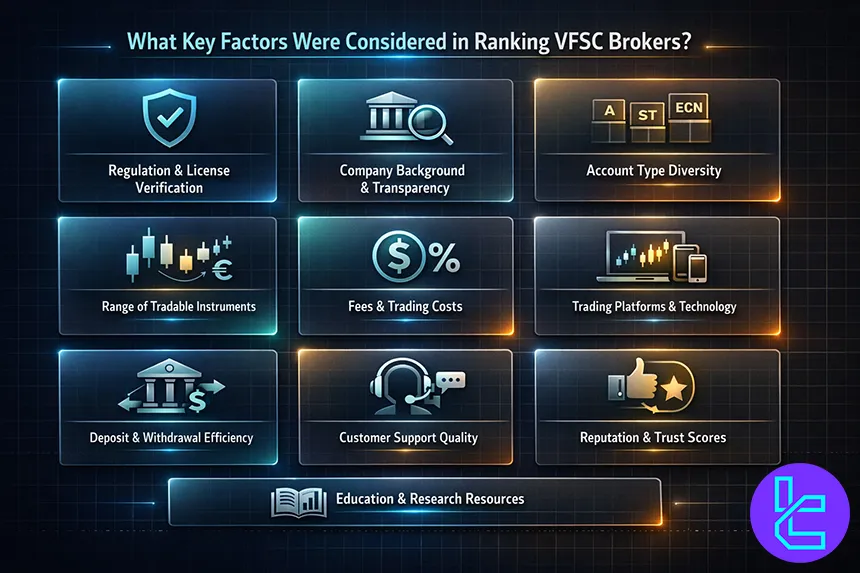
TradingFinder applies a comprehensive methodology built on 19 core data metrics to ensure objective and unbiased broker rankings. The most important evaluation factors include are the list below.
- Regulation and License Verification: We confirm the broker’s active VFSC Financial Dealer License, legal entity structure, and compliance disclosures to ensure operational legitimacy;
- Company Background and Transparency: Establishment year, executive leadership, headquarters location, and corporate structure are reviewed to assess stability and credibility;
- Account Type Diversity: We evaluate the availability of Standard, ECN, Cent, Islamic, PAMM, and other account types to ensure suitability for different trading strategies;
- Range of Tradable Instruments: Brokers are ranked based on the diversity of Forex pairs, indices, commodities, stocks, ETFs, and crypto CFDs;
- Fees and Trading Costs: Spreads, commissions, swap rates, deposit/withdrawal fees, and inactivity charges are carefully analyzed for competitiveness and transparency;
- Trading Platforms and Technology: Availability of MT4, MT5, cTrader, proprietary platforms, execution speed, and automation capabilities are assessed;
- Deposit and Withdrawal Efficiency: Funding speed, payment method diversity, processing times, and fee transparency are evaluated;
- Customer Support Quality: Responsiveness, multilingual support, communication channels, and complaint handling are tested directly;
- Reputation and Trust Scores: Reviews from Trustpilot and other monitoring platforms, alongside scam alerts and regulatory warnings, are incorporated into the final rating;
- Education and Research Resources: Webinars, analysis tools, market updates, and trader education materials contribute to the overall ranking.
By integrating these structured metrics, TradingFinder ranks VFSC brokers based on real performance indicators, ensuring traders receive transparent, data-backed guidance when selecting a broker.
Is Leverage Capped for VFSC-Regulated Forex Brokers?
Unlike regulators such as CySEC or ASIC that cap retail leverage at 1:30, VFSC does not impose strict leverage limits on Forex brokers. As a result, many VFSC-regulated brokers offer leverage ranging from 1:500 up to 1:1000 or even higher.
Asset Type | Maximum Leverage |
Forex Majors | 1:500 - 1:1000 |
Indices | 1:200 - 1:500 |
Commodities | 1:200 - 1:500 |
Crypto CFDs | 1:5 - 1:100 |
However, leverage policies are determined by the broker, not capped by VFSC itself. This means risk exposure can be significantly higher compared to Tier-1 regulated accounts.
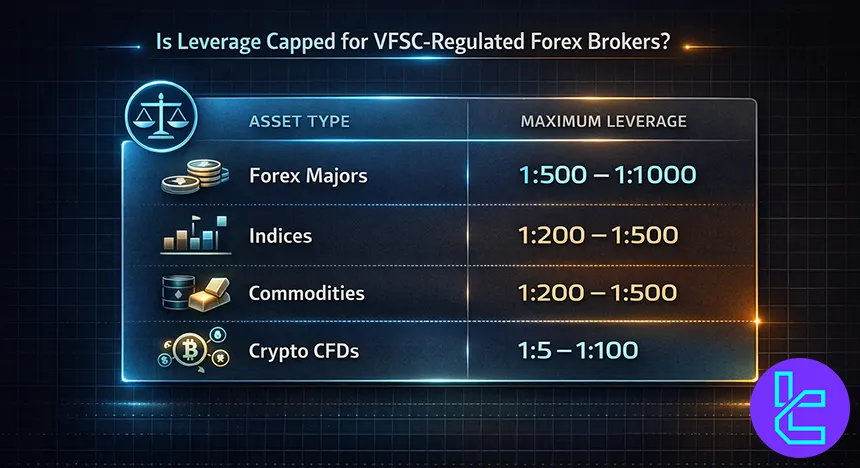
Traders using high leverage under VFSC entities must carefully monitor margin levels, stop-out thresholds, and negative balance protection policies, as regulatory safeguards may be limited compared to stricter jurisdictions.
What Are the Key Investor Protection Measures Enforced by VFSC?
VFSC provides a regulatory framework, but investor protection mechanisms are lighter compared to major regulators. The most common protection elements include:
- Company registration and licensing requirements
- Fit and proper checks for directors
- Basic AML and KYC compliance
- Requirement for maintaining proper accounting records
- Obligation to keep client funds segregated (as declared by broker policy)
However, VFSC does not provide the list below.
- A statutory investor compensation fund
- Guaranteed negative balance protection across all entities
- Strict product intervention measures
Protection ultimately depends on the broker’s internal policies rather than regulatory enforcement strength alone.
Traders should verify whether the broker offers segregated accounts, independent audits, and transparent risk disclosures before relying solely on the VFSC license as a trust indicator.
What Rules Must VFSC -Regulated Forex Brokers Comply With?
Brokers operating under a VFSC Financial Dealer License must comply with several structural and operational rules.
Core Compliance Requirements
- Maintain a registered local company in Vanuatu
- Appoint qualified directors and compliance officers
- Implement Anti-Money Laundering (AML) and Counter-Terrorism Financing policies
- Conduct proper client identification through KYC procedures
- Keep accounting records and submit reports when required
Operational Expectations
- Provide clear risk disclosures
- Avoid misleading marketing
- Maintain business continuity policies
- Ensure internal controls over client transactions
While these requirements establish a legal structure, enforcement intensity and supervisory frequency are generally lower than those seen under FCA, ASIC, or CySEC supervision. Traders should assess both regulatory status and broker transparency.
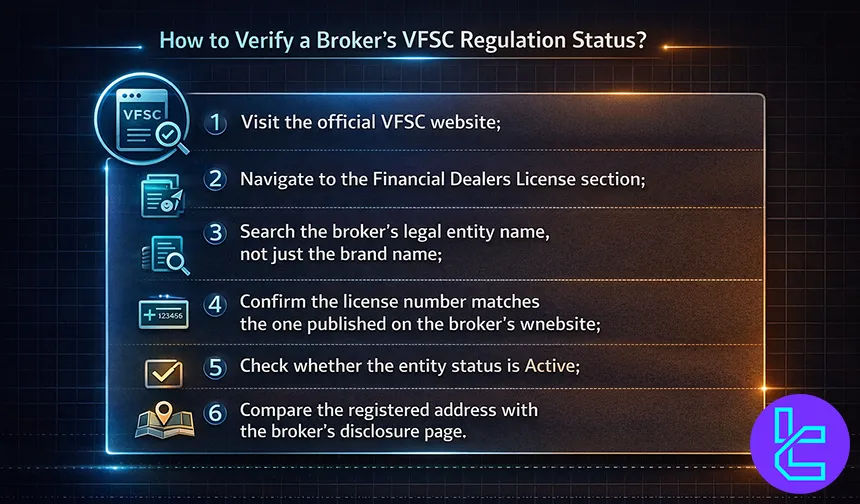
How to Verify a Broker’s VFSC Regulation Status?
Users searching this topic typically want a step-by-step process. Follow these actions:
- Visit the official VFSC website;
- Navigate to the Financial Dealers License section;
- Search the broker’s legal entity name, not just the brand name;
- Confirm the license number matches the one published on the broker’s website;
- Check whether the entity status is Active;
- Compare the registered address with the broker’s disclosure page.
Important checks beyond registry:
- Ensure the website domain matches the licensed entity;
- Verify that client agreements reference the same legal company;
- Confirm which entity your account is opened under.
Some brokers operate multiple entities, so always confirm whether you are registering under the VFSC branch or another jurisdiction.
Review of Crypto Trading Permission Under VFSC -Regulated Forex Brokers
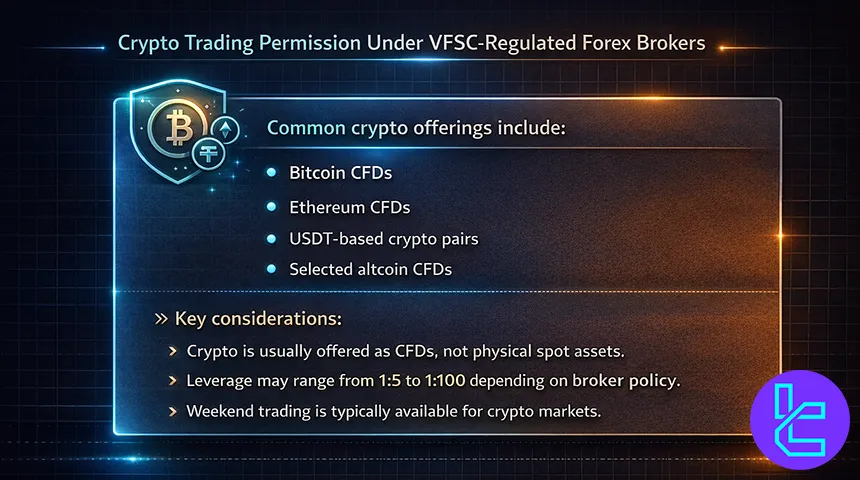
VFSC-regulated brokers often provide access to cryptocurrency CFDs. Since VFSC does not impose strict product bans, brokers may offer crypto derivatives alongside Forex, indices, and commodities.
Common crypto offerings include:
- Bitcoin CFDs
- Ethereum CFDs
- USDT-based crypto pairs
- Selected altcoin CFDs
Key considerations:
- Crypto is usually offered as CFDs, not physical spot assets;
- Leverage may range from 1:5 to 1:100 depending on broker policy;
- Weekend trading is typically available for crypto markets.
VFSC itself does not act as a crypto-asset supervisory authority in the same way EU regulators do. Therefore, product risk management, margin rules, and liquidity conditions are primarily broker-driven.
Traders interested in crypto under VFSC entities should review contract specifications, funding methods, swap policies, and volatility protections before trading.
VFSC vs Other Regulatory Authorities
When comparing the Vanuatu Financial Services Commission with other global regulators, it becomes clear that not all licenses offer the same level of oversight, investor protection, and enforcement strength.
While VFSC provides a recognized offshore licensing framework with flexible leverage and faster setup procedures, Tier-1 regulators such as BaFin and ASIC impose stricter compliance requirements, leverage caps, and stronger investor compensation schemes.
Understanding these structural differences helps traders assess risk exposure and choose brokers aligned with their protection expectations.
Below is a structured comparison of VFSC and other major regulatory authorities.
Parameter | VFSC (Vanuatu) | FSA (Seychelles) | BaFin (Germany) | ASIC (Australia) |
Regulatory Tier | Tier-3 Offshore | Tier-3 Offshore | Tier-1 | Tier-1 |
Year Established | 1993 | 2013 | 2002 | 1998 |
Legal Framework | Financial Dealers Licensing Act | Securities Act 2007 | German Banking Act (KWG), EU MiFID II | Corporations Act 2001 |
Client Fund Segregation | Required | Required | Strictly Required | Strictly Required |
Negative Balance Protection | Not Mandatory | Not Mandatory | Mandatory (Retail) | Mandatory (Retail) |
Retail Leverage Cap | No strict cap (often up to 1:500 or higher) | No strict cap (often up to 1:500 or higher) | 1:30 (ESMA rules) | 1:30 (Retail) |
Investor Compensation Scheme | No | No | Yes (up to €20,000+) | No formal compensation fund (AFCA dispute resolution) |
Enforcement & Supervision | Moderate | Moderate | Very Strict | Strict |
EU Passporting | No | No | Yes | No |
This comparison highlights that VFSC and FSA Seychelles offer greater flexibility in leverage and operational setup, but with lower investor protection mechanisms compared to BaFin and ASIC.
Traders seeking maximum capital protection typically prefer Tier-1 jurisdictions, while those prioritizing higher leverage and fewer trading restrictions may consider offshore-regulated brokers under careful due diligence.
Conclusion
VFSC-regulated Forex brokers offer a distinctive balance between flexibility and regulatory structure. Under the supervision of the Vanuatu Financial Services Commission, brokers such as Decode Global, GTCFX, Global Prime, ACY Securities, Blueberry Markets, OneRoyal, FXPrimus, D Prime, Deriv, and FXGT provide higher leverage options, competitive spreads from 0.0 pips, and broad CFD product ranges that often exceed 1,000 instruments.
However, compared to Tier-1 regulators like BaFin or ASIC, VFSC operates as a Tier-3 offshore authority with lighter investor protection mechanisms. There is no statutory compensation fund, leverage is not capped at conservative retail levels, and negative balance protection is not universally mandatory.
Ultimately, selecting the best VFSC broker requires evaluating regulation, trading costs, leverage structure, platform quality, reputation metrics such as Trustpilot scores, and operational transparency. A structured, data-driven comparison remains essential before committing capital under any offshore-regulated entity.
To gain a deeper understanding of the evaluation steps and ranking criteria used in compiling our broker list, please refer to the TradingFinder forex methodology page for a comprehensive breakdown.