



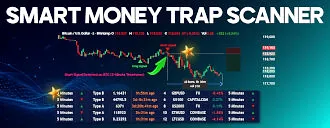




Forex brokers now provide access to Bitcoin primarily through CFD (Contract for Difference) instruments, enabling traders to speculate on price movements without owning the underlying asset. This structure allows for the use of leverage, short-selling opportunities, and integration with advanced trading platforms such as MetaTrader and cTrader.
The guide below evaluates the best Bitcoin trading brokers based on pricing efficiency, platform performance, risk management tools, funding options, and overall reliability. Whether you aim to trade short-term price swings or integrate Bitcoin into a diversified portfolio, selecting the right broker is essential for consistent performance and capital protection.
 | AMARKETS | |||
 | FXTM | |||
 | TMGM | |||
| 4 |  | FxGrow | ||
| 5 |  | MONETA MARKETS | ||
| 6 |  | octa | ||
| 7 |  | FXCM | ||
| 8 |  | TeleTrade |
Bitcoin Trading Brokers Ranked by Trustpilot
When evaluating brokers for Bitcoin trading, technical factors such as spreads, leverage, and platform performance are essential, but real user feedback provides a deeper understanding of operational reliability. Trustpilot ratings reflect actual client experiences related to execution during volatility, withdrawal efficiency, platform stability, and overall transparency.
Bitcoin markets are highly volatile and operate 24/7, meaning brokers must maintain stable infrastructure under constant pressure. During sharp price movements, issues such as slippage, order rejection, or platform downtime can significantly impact trading outcomes. These factors are often highlighted in user reviews, making Trustpilot scores a valuable reference point.
Broker Name | Trustpilot Rating | Number of Reviews |
AMarkets | 3,553 | |
893 | ||
Moneta Markets | 496 | |
TMGM | 876 | |
OctaFX | 9,257 | |
FxGrow | 4 | |
103 | ||
FXTM | 1,076 |
Cost Structure of Bitcoin Trading in Forex Brokers
Understanding the cost structure of Bitcoin trading through Forex brokers is essential, as multiple fee layers can significantly affect net profitability. Unlike spot crypto exchanges, Forex brokers typically offer Bitcoin via CFDs, where costs are embedded in spreads, commissions, and financing charges rather than direct ownership fees.
The total cost of trading Bitcoin with Forex brokers generally includes the following components.
Broker Name | Min. Spread | Commission |
From 1.3 pips | $0 | |
From 0.0 Pips | $0 | |
TMGM | From 0.0 Pips | $3.5 |
FxGrow | From0.00001 pips | $8 |
IFC Markets | From 0.4 pips | 0.005% |
FXCC | From 0.0 Pips | $0 |
FXPrimus | Floating from 1.5 pips | $0 |
Grand Capital | From 0.4 pips | 0.5% |
Deposit and Withdrawal Channels in BTC Forex Brokers
Efficient deposit and withdrawal systems are a critical component of Bitcoin trading through Forex brokers, as capital needs to move quickly in response to market volatility. Since Bitcoin markets operate 24/7, delays in funding or withdrawals can directly impact trading opportunities and risk management decisions.
Most BTC Forex brokers support a mix of traditional and crypto-native payment methods to accommodate global users.
Broker Name | Deposit Methods | Withdrawal Methods |
Wire transfer, Visa/MasterCard, Fasapay, Stickpay, JCB | Wire transfer, Visa/MasterCard, Fasapay, Stickpay, JCB | |
E-wallets, credit/debit cards, bank transfer, crypto | E-wallets, credit/debit cards, bank transfer, crypto | |
FXCM | Visa/MasterCard, Bank wired, Neteller, Skrill | Visa/MasterCard, Bank wired, Neteller, Skrill |
TeleTrade | Bank Transfers, Credit/Debit Cards, E-Payment Systems, Local Payment Options | Bank Transfers, Credit/Debit Cards, E-Payment Systems, Local Payment Options |
InstaForex | Crypto, Bank Transfer, E-payment Systems, Credit/Debit Cards | Crypto, Bank Transfer, Skrill, Neteller, Webmoney, Credit/Debit Cards |
Markets4you | Credit/Debit Cards, E-Wallets, Bank Transfer | Credit/Debit Cards, E-Wallets, Bank Transfer |
MTrading | Bank transfer, Neteller, Skrill, USDT | Bank transfer, Neteller, Skrill, USDT |
ETO Markets | UnionPay, Bank Transfer, USDT (ERC20, TRC20), SEPA Instant Transfer, SEPA Instant Banking | UnionPay, USDT (ERC20, TRC20), SEPA Instant Transfer, SEPA Instant Banking |
Founding Year and Regulatory Status of Bitcoin Trading Brokers
The founding year and regulatory status of a broker are critical indicators of reliability when trading Bitcoin through Forex platforms. Given the high volatility and continuous trading nature of Bitcoin markets, traders rely heavily on brokers with proven operational history and strong regulatory oversight.
A broker’s founding year reflects its experience in handling different market cycles, including periods of extreme volatility such as crypto bull runs and market crashes. Brokers with longer track records have typically developed more stable infrastructure, refined execution systems, and stronger risk management protocols.
Broker Name | Founding Year | Regulation |
2024 | ASIC - Australia, VFSC - Vanuatu, CMA -Kenya, FSC-Mauritius, FSA - | |
2008 | CySec, CNMV, MNB, FINANSTILSYNET, ACPR, KNF, BaFin, FI, HCMC | |
Moneta Markets | 2025 | FSCA, FSRA |
OctaFX | 2025 | FSCA, MISA |
TrioMarkets | 2019 | CySEC, DFSA, FSC |
xChief | 2014 | MISA, FSCA |
CapitalXtend | 2005 | FSC, SVG |
eToro | 2007 | FCA, CySEC, MFSA, FSRA, ASIC, FSA, Gibraltar FSC |
Top 6 Bitcoin Trading Brokers
Bitcoin trading through Forex brokers requires a combination of low-cost execution, platform stability, and reliable liquidity access. Since BTC markets are highly volatile and operate continuously, brokers must deliver consistent performance during both normal conditions and extreme price movements.
The top Bitcoin trading brokers typically provide access through CFD instruments, allowing traders to go long or short, apply leverage, and integrate Bitcoin into multi-asset portfolios. In addition, advanced charting tools, fast execution speeds, and risk management features are essential for handling rapid intraday price fluctuations.
AMarkets
AMarkets is an established Forex and CFD broker founded in 2007, serving over 2 million clients globally with a focus on high-leverage trading and flexible account structures. The broker operates under offshore regulatory frameworks including FSA, FSC, and MISA, while also being a member of the Financial Commission, offering compensation coverage up to €20,000 and maintaining segregated client funds.
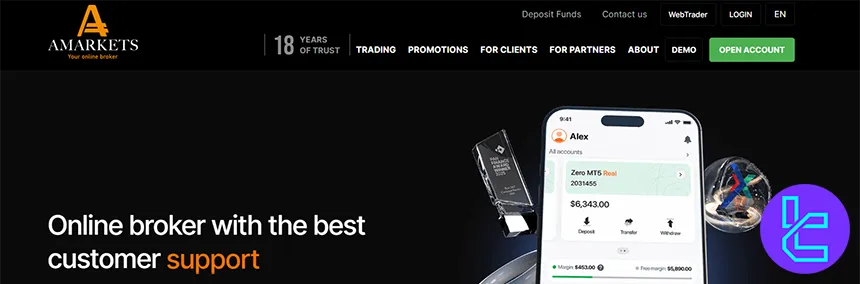
AMarkets dashboard provides a diverse range of account types including Standard, ECN, Fixed, and Crypto accounts, allowing traders to choose between variable spreads, fixed pricing, or Bitcoin-denominated balances. The minimum deposit starts at $100, while leverage can reach up to 1:3000, making AMarkets particularly attractive for high-risk, high-reward strategies.
AMarkets supports MetaTrader 4, MetaTrader 5, and its proprietary mobile application, enabling trading across desktop and mobile environments. Execution types include both instant and market execution, supported by regular audits through Verify My Trade to ensure execution quality.
The broker offers over 500 tradable instruments across Forex, cryptocurrencies, stocks, indices, commodities, ETFs, and bonds. Social trading is integrated through its copy trading platform, allowing users to follow experienced traders with transparent performance metrics and risk management tools.
AMarkets deposit and withdrawal methods include credit cards, bank transfers, cryptocurrencies, and e-wallets, with zero deposit fees and withdrawals typically processed within 24 hours.
Overall, the broker stands out for its high leverage, AMarkets copy trading broad asset coverage, and flexible account options, although its offshore regulation and withdrawal fees may be considerations for some traders.
Account Types | Standard, ECN, Fixed, Crypto, Demo |
Regulating Authorities | FSA, FSC, MISA, Financial Commission |
Minimum Deposit | $100 |
Deposit Methods | Credit/Debit Cards, Bank Transfer, Crypto, Volet, Perfect Money |
Withdrawal Methods | Credit/Debit Cards, Bank Transfer, Crypto, Volet, TC Pay |
Maximum Leverage | Up to 1:3000 |
Trading Platforms & Apps | MetaTrader 4, MetaTrader 5, Mobile App |
AMarkets Pros and Cons
When evaluating AMarkets for Bitcoin trading, its strengths include solid regulatory coverage, competitive spreads, and a wide range of investment options, although certain limitations may affect overall suitability.
Pros | Cons |
High leverage up to 1:3000 | Offshore regulation (no Tier-1 licenses) |
Multiple account types including Crypto account | Withdrawal fees (0.5%–1.8%) |
Copy trading and investment features | Not available in several countries |
Zero deposit fees | ECN account requires higher deposit ($200) |
Wide range of instruments (500+) | Limited investor protection compared to Tier-1 brokers |
MT4, MT5 and proprietary mobile app | - |
FXTM
FXTM (ForexTime) is a global Forex and CFD broker established in 2011, serving over 1 million traders across more than 150 countries. The broker offers access to multiple asset classes including Forex, stocks, indices, commodities, cryptocurrencies, and metals, with over 1000 tradable instruments available.
FXTM operates under a single offshore regulatory authority, the Financial Services Commission (FSC) of Mauritius. While it previously held licenses from major regulators such as FCA and CySEC, these are no longer active, which may impact its regulatory strength. Despite this, the broker maintains segregated client funds and continues to expand its global presence.
The broker provides three main account types including Advantage, Advantage Plus, and Advantage Stocks. The minimum deposit is set at $200, and leverage can reach up to 1:3000, making FXTM suitable for traders seeking high capital efficiency. Spreads start from 0.0 pips on the Advantage account, with commissions varying depending on the asset class.
FXTM dashboard supports MetaTrader 4, MetaTrader 5, and its proprietary FXTM Trader App, offering flexibility for both desktop and mobile trading. Social trading is available through FXTM Invest, allowing users to copy strategy managers with performance tracking and flexible allocation systems.
FXTM deposit and withdrawal options include cards, bank transfers, e-wallets, and cryptocurrencies, with most deposits processed quickly and without broker-side fees. Withdrawals vary by method, with some fees applied depending on the channel.
Overall, the broker offers strong trading conditions, high leverage, FXTM rebate and a solid copy trading system, although its offshore regulation and relatively high minimum deposit may be key considerations.
Account Types | Advantage, Advantage Plus, Advantage Stocks |
Regulating Authorities | FSC (Mauritius) |
Minimum Deposit | $200 |
Deposit Methods | Visa, MasterCard, Skrill, Neteller, Perfect Money, Bank Transfer, Crypto, FasaPay, TC Pay, M-Pesa |
Withdrawal Methods | Visa, MasterCard, Skrill, Neteller, Perfect Money, Bank Transfer, Crypto, FasaPay, TC Pay, M-Pesa |
Maximum Leverage | Up to 1:3000 |
Trading Platforms & Apps | MetaTrader 4, MetaTrader 5, FXTM Trader App |
FXTM Pros and Cons
FXTM offers notable advantages for Bitcoin trading, including strong regulation, tight spreads, and diverse trading opportunities, though some constraints may influence trader decisions.
Pros | Cons |
High leverage up to 1:3000 | Weak regulatory coverage (only FSC) |
Spreads from 0.0 pips | Minimum deposit $200 |
Copy trading via FXTM Invest | Limited cryptocurrency offerings |
1000+ tradable instruments | No Tier-1 regulatory oversight |
Multiple platforms (MT4, MT5, FXTM App) | Not available in several countries |
Strong educational resources | - |
TMGM
TMGM (TradeMax Global Markets) is an Australian Forex and CFD broker established in 2013, offering access to over 12,000 tradable instruments across Forex, stocks, indices, commodities, energies, and cryptocurrencies. The broker has built a strong global presence by combining deep liquidity, fast execution, and a wide asset offering suitable for both retail and institutional traders.

TMGM operates under a multi-regulatory framework led by ASIC (Tier-1), along with offshore regulators such as VFSC, FSC, and CMA. This structure allows the broker to provide both strong investor protection under ASIC and higher leverage options through offshore entities. Additionally, TMGM offers up to AUD 10 million in professional indemnity insurance and compensation coverage via The Financial Commission.
TMGM dashboard provides two main account types, ECN (Edge) and Classic, with spreads starting from 0.0 pips on ECN accounts and commission-free trading on Classic accounts. The minimum deposit is $100, while leverage can reach up to 1:1000 depending on the jurisdiction.
TMGM supports MetaTrader 4, MetaTrader 5, IRESS, and its proprietary mobile app, offering a flexible environment for manual, algorithmic, and institutional trading. Social trading is available through HUBx and ZuluTrade integration, enabling users to copy strategies and diversify their trading approach.
TMGM deposit and withdrawal options include cards, bank transfers, e-wallets, and cryptocurrencies such as USDT and USDC, with most deposits processed instantly and without fees.
Overall, the broker stands out for its strong regulatory backing, extensive asset coverage, and easy TMGM registration, although limited account variety and inactivity fees may be considerations.
Account Types | Edge (ECN), Classic, IRESS (Institutional) |
Regulating Authorities | ASIC, VFSC, FSC, CMA, FSA |
Minimum Deposit | $100 |
Deposit Methods | Visa, MasterCard, Bank Transfer, Neteller, Skrill, Revolut, WISE, UnionPay, Fasapay, Crypto (USDT, USDC) |
Withdrawal Methods | Bank Transfer, Neteller, Skrill, Revolut, WISE, Crypto (USDT, USDC) |
Maximum Leverage | Up to 1:1000 |
Trading Platforms & Apps | MetaTrader 4, MetaTrader 5, IRESS, TMGM Mobile App |
TMGM Pros and Cons
In assessing TMGM for BTC trading, its regulatory backing, cost-efficient pricing, and varied investment choices stand out, while a few limitations may impact its appeal.
Pros | Cons |
Regulated by ASIC (Tier-1) | Inactivity fee after 12 months |
Access to 12,000+ instruments | Limited account types |
Spreads from 0.0 pips (ECN) | Limited educational depth |
Copy trading via HUBx and ZuluTrade | Some offshore entities with lower protection |
Multiple platforms (MT4, MT5, IRESS) | - |
Fast execution and deep liquidity | - |
FxGrow
FxGrow is a Cyprus-based Forex and CFD broker established in 2008, operating under CySEC regulation and MiFID compliance across multiple European jurisdictions. The broker provides a regulated trading environment with investor protection schemes such as the ICF, offering coverage up to €20,000 along with segregated client funds and negative balance protection.
The broker offers a structured ECN-based account system including ECN, ECN Plus, and ECN Elite accounts, designed for different trading levels. The minimum deposit after FxGrow registration starts at $100, while leverage can reach up to 1:300 for non-retail clients, with retail leverage capped at 1:30 under EU regulations. Spreads vary by account type, starting from 0.1 pips, with commissions applied on higher-tier accounts.
FxGrow dashboard supports MetaTrader 5 as its primary platform, available on desktop, web, and mobile. The platform is optimized for advanced charting, algorithmic trading, and fast execution. Additionally, the broker provides copy trading functionality, allowing users to replicate strategies from experienced traders without active market participation.
The broker offers access to over 600 tradable instruments across Forex, indices, commodities, metals, energies, futures CFDs, and cryptocurrencies. While the asset range is sufficient for most retail strategies, it is narrower compared to leading multi-asset brokers.
Funding options include bank transfers, Skrill, and Neteller, with no deposit or withdrawal fees charged by the broker (this may vary based on FxGrow verification region). Processing times vary depending on the method, with e-wallets offering faster transactions.
Overall, FxGrow combines strong European regulation, ECN execution, and transparent pricing, although limited payment methods and a single trading platform may be considerations.
Account Types | ECN, ECN Plus, ECN Elite, Demo |
Regulating Authorities | CySEC, CNMV, MNB, FINANSTILSYNET, ACPR, KNF, BaFin, FI, HCMC |
Minimum Deposit | $100 |
Deposit Methods | Bank Transfer, Skrill, Neteller |
Withdrawal Methods | Bank Transfer, Skrill, Neteller |
Maximum Leverage | Up to 1:300 |
Trading Platforms & Apps | MetaTrader 5 (Desktop, Web, Mobile) |
FxGrow Pros and Cons
FxGrow provides a competitive environment for Bitcoin trading with robust regulation, attractive spreads, and multiple investment options, although certain factors may limit its suitability.
Pros | Cons |
Regulated by CySEC (EU Tier-1) | Limited payment methods |
ECN account structure | Only MetaTrader 5 platform |
Copy trading available | No PAMM accounts |
No deposit/withdrawal fees | Limited asset range (600+) |
Segregated funds and ICF protection | Mixed user reviews |
Fast execution and transparency | - |
Moneta Markets
Moneta Markets is a modern Forex and CFD broker established in 2020 and based in South Africa, offering a flexible trading environment with access to over 1,000 financial instruments.
Moneta Markets verification process operates under FSCA regulation and offshore registration, providing segregated client funds and negative balance protection while maintaining a focus on accessibility and user-friendly trading conditions.
The broker offers three main account types including Direct, Prime, and Ultra, designed for different trading styles. The Direct account is commission-free with spreads starting from 1.2 pips, while Prime and Ultra accounts provide raw spreads from 0.0 pips with low commissions starting from $3 and $1 per lot, respectively. The minimum deposit starts at $50, making it accessible to beginner traders, while leverage can reach up to 1:1000.
Moneta Markets supports multiple trading platforms including MetaTrader 4, MetaTrader 5, Pro Trader, and App Trader. The Pro Trader platform integrates with TradingView, offering advanced charting tools and a web-based trading experience.
The broker also provides strong social trading and investment features, including Moneta CopyTrader and PAMM accounts, enabling users to follow experienced traders or allocate funds to managed strategies.
Moneta Markets deposit and withdrawal options include bank transfers, credit/debit cards, e-wallets, and cryptocurrencies such as BTC, USDT, ETH, and USDC, with no deposit or withdrawal fees and fast processing times.
Overall, the broker stands out for its low entry requirements, straightforward Moneta Markets registration platform diversity, and strong copy trading ecosystem, although its relatively recent establishment and limited Tier-1 regulation may be considerations.
Account Types | Direct, Prime, Ultra |
Regulating Authorities | FSCA, FSRA |
Minimum Deposit | $50 |
Deposit Methods | Bank Transfer, Visa, MasterCard, Fasapay, SticPay, JCB, Crypto (BTC, USDT, ETH, USDC) |
Withdrawal Methods | Bank Transfer, Visa, MasterCard, Fasapay, SticPay, JCB, Crypto |
Maximum Leverage | Up to 1:1000 |
Trading Platforms & Apps | MetaTrader 4, MetaTrader 5, Pro Trader, App Trader |
Moneta Markets Pros and Cons
From a Bitcoin trading perspective, Moneta Markets benefits from strong regulatory oversight, efficient spreads, and diverse market access, though potential drawbacks should be considered.
Pros | Cons |
Low minimum deposit ($50) | Limited Tier-1 regulatory coverage |
Spreads from 0.0 pips (Prime/Ultra) | Relatively new broker (est. 2020) |
Supports copy trading and PAMM | Not available in some countries |
Multiple platforms (MT4, MT5, Pro Trader, App Trader) | Some withdrawal complaints reported |
1,000+ tradable instruments | - |
No deposit/withdrawal fees | - |
OctaFX
OctaFX is a globally recognized Forex and CFD broker established in 2011, serving over 12 million traders across more than 180 countries. The broker has built a strong reputation through its low-cost trading environment, user-friendly platforms, and extensive copy trading ecosystem, making it suitable for both beginners and experienced traders.
OctaFX operates under multiple regulatory entities, including FSCA, MISA, and CySEC for its European branch, offering a mix of offshore flexibility and regional investor protection. The broker follows an ECN/STP execution model and provides negative balance protection across all accounts.
The broker offers three main account types based on platforms: MT4, MT5, and OctaTrader. All accounts feature commission-free trading with spreads starting from 0.6 pips and no swap fees, making it particularly attractive for cost-conscious traders and those seeking Islamic trading conditions. The minimum deposit after OctaFX registration starts at just $25, one of the lowest among major brokers, while leverage can reach up to 1:1000.
OctaFX dashboard supports multiple platforms including MetaTrader 4, MetaTrader 5, its proprietary OctaTrader, and the Octa Copy app (for OctaFX copy trading). The proprietary platform integrates TradingView-powered charting and AI-driven analytics tools such as OctaVision.
OctaFX deposit and withdrawal options include bank transfers, cards, e-wallets, and cryptocurrencies like BTC, ETH, LTC, DOGE, and USDT, with zero deposit and withdrawal fees and fast processing times.
Overall, OctaFX stands out for its low entry barrier, zero-commission structure, and strong copy trading features, although its regulatory coverage may not match top-tier global brokers.
OctaFX Pros and Cons
OctaFX demonstrates key strengths in Bitcoin trading through its regulatory framework, competitive costs, and broad investment offerings, while some limitations may still apply.
Pros | Cons |
Very low minimum deposit ($25) | Limited Tier-1 regulation |
Commission-free trading | Limited asset range compared to top brokers |
No swap fees (Islamic-friendly) | Payment methods may vary by region |
Copy trading via Octa Copy | No PAMM accounts |
Multiple platforms including OctaTrader | - |
High leverage up to 1:1000 | - |
Key Factors for Selecting the Best Bitcoin Trading Brokers
Choosing the best brokers for Bitcoin trading requires a structured and data-driven evaluation approach, as traders are exposed to high volatility, rapid price movements, and 24/7 market conditions. Trading Finder applies a comprehensive methodology based on 19 core data metrics to ensure objective broker selection, focusing on transparency, execution quality, and overall trading efficiency.
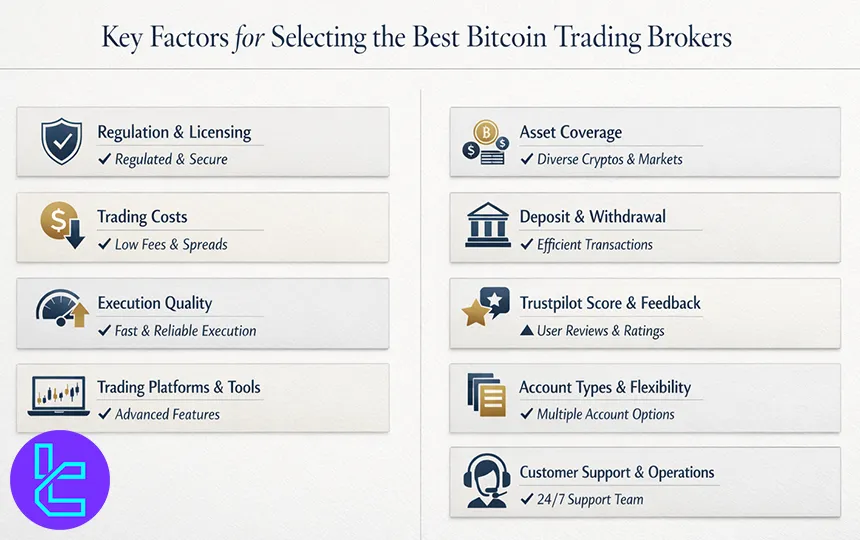
Since Bitcoin trading is typically offered via CFD contracts, additional factors such as swap costs, leverage conditions, and platform stability become critical. The evaluation framework is designed to assess both trading performance and operational reliability.
The most important factors considered include:
- Regulation and Licensing: Verification of broker credibility, oversight by financial authorities, and availability of fund protection mechanisms;
- Trading Costs: Analysis of spreads, commissions, overnight fees, and hidden charges affecting Bitcoin CFD profitability;
- Execution Quality: Speed, slippage control, and order reliability during high-volatility Bitcoin movements;
- Trading Platforms and Tools: Availability of MT4, MT5, cTrader, TradingView integration, and mobile trading apps;
- Asset Coverage: Access to Bitcoin alongside other cryptocurrencies and diversified trading instruments;
- Deposit and Withdrawal Systems: Speed, flexibility, and transparency of funding methods including crypto payments;
- Trustpilot Score and User Feedback: Real user insights on withdrawals, execution stability, and platform performance;
- Account Types and Flexibility: Availability of standard, ECN, and crypto-focused accounts tailored to different strategies;
- Customer Support and Operations: Responsiveness of support teams and efficiency in handling user issues.
This multi-layered evaluation ensures that selected Bitcoin trading brokers provide not only competitive pricing but also stable infrastructure, secure fund handling, and reliable execution, all of which are essential for navigating the fast-paced crypto market.
What is the Process of Trading BTC via Brokers?
Trading Bitcoin through Forex brokers follows a structured workflow, especially when using CFD instruments instead of direct ownership. This process allows traders to speculate on price movements without holding the actual asset, enabling both long and short positions. step-by-step BTC trading process:
- Account Registration and Verification: Create an account, complete KYC verification, and choose the appropriate trading platform such as MT4, MT5, or cTrader;
- Deposit Funds: Fund the account using cards, bank transfers, e-wallets, or cryptocurrency pairs depending on broker support;
- Select BTC Instrument: Choose BTC/USD or other crypto pairs offered as CFDs within the trading platform;
- Analyze the Market: Use technical indicators, price action, or fundamental factors such as macro news and Bitcoin dominance;
- Open a Position: Enter buy or sell trades based on market direction, applying leverage if needed;
- Manage Risk: Set stop-loss and take-profit levels to control downside exposure;
- Close the Trade: Exit manually or allow predefined levels to close the position automatically.
This process highlights the flexibility of broker-based Bitcoin trading, where execution speed and platform stability play a critical role in performance.
Pros and Cons of Bitcoin Brokers
Bitcoin brokers offer structured access to crypto markets, but they come with both advantages and limitations depending on trading goals and experience level.
Advantages | Disadvantages |
Ability to trade long and short positions | No ownership of the underlying Bitcoin (CFD model) |
Access to leverage for capital efficiency | Overnight fees for holding positions |
Integration with professional trading platforms | Potential slippage during high volatility |
No need for crypto wallet management | Regulatory differences across jurisdictions |
Multi-asset diversification within one account | Dependence on broker execution quality |
Evaluating these pros and cons helps traders align broker-based trading with their strategy and risk tolerance.
Why Use a Broker for Bitcoin Trading?
Using a Forex broker for Bitcoin trading provides a structured and regulated environment compared to direct crypto exchanges. Brokers integrate crypto trading into a broader financial ecosystem, allowing traders to manage multiple asset classes from a single account.
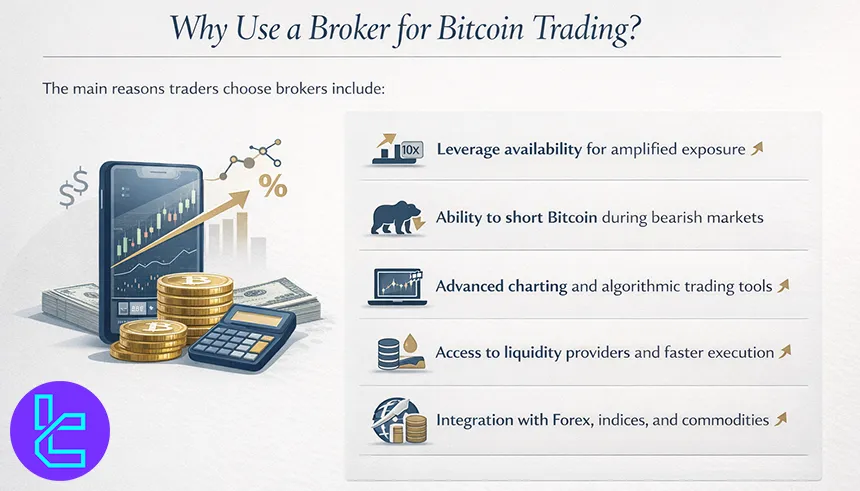
The main reasons traders choose brokers include:
- Leverage availability for amplified exposure
- Ability to short Bitcoin during bearish markets
- Advanced charting and algorithmic trading tools
- Access to liquidity providers and faster execution
- Integration with Forex, indices, and commodities
Additionally, brokers simplify the trading process by eliminating the need for private keys or wallet security management. This makes them particularly attractive for traders focused on price speculation rather than long-term asset holding.
However, this convenience comes with trade-offs such as swap fees and lack of direct ownership, making it essential to choose brokers with competitive pricing and reliable infrastructure.
How Bitcoin Brokers Operate in Financial Markets?
Crypto brokers act as intermediaries between traders and liquidity providers, offering Bitcoin trading primarily through CFD contracts. Instead of facilitating direct blockchain transactions, brokers replicate price movements based on underlying market data. Core Operational model:
Component | Function |
Liquidity Providers | Supply real-time Bitcoin pricing and market depth |
Broker Platform | Executes trades and manages client positions |
Pricing Engine | Aggregates quotes and determines spreads |
Risk Management System | Handles margin, leverage, and exposure |
Order Execution | Processes trades via market or instant execution |
Brokers may operate under STP, ECN, or market maker models, each affecting execution speed and spread structure. In volatile Bitcoin markets, execution quality becomes a key differentiator, especially for short-term traders.
This structure allows traders to access Bitcoin markets without interacting directly with blockchain networks.
Is it legal to trade BTC in a Forex Broker?
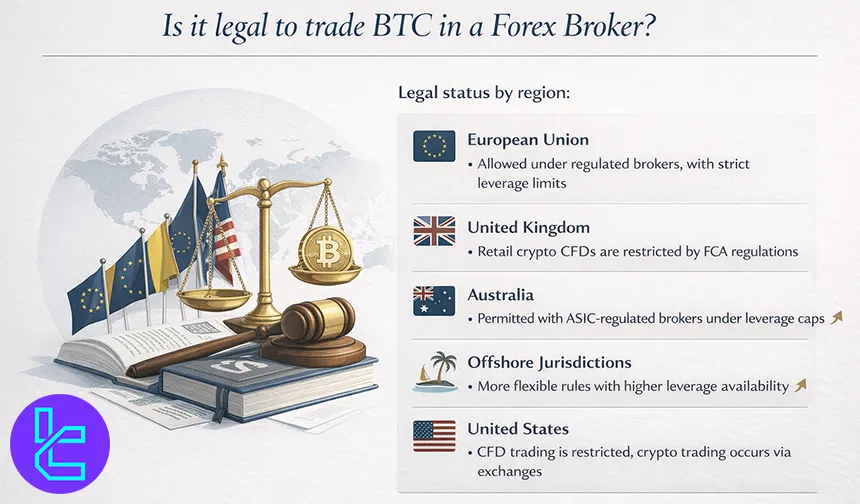
The legality of trading Bitcoin through Forex brokers depends on the trader’s jurisdiction and the regulatory framework governing CFDs and crypto assets. In many regions, Bitcoin trading via regulated brokers is permitted under financial market laws. Legal status by region:
- European Union: Allowed under regulated brokers, with strict leverage limits
- United Kingdom: Retail crypto CFDs are restricted by FCA regulations
- Australia: Permitted with ASIC-regulated brokers under leverage caps
- Offshore Jurisdictions: More flexible rules with higher leverage availability
- United States: CFD trading is restricted, crypto trading occurs via exchanges
Traders must verify local regulations before opening an account, as compliance requirements and restrictions vary significantly.
Regulated brokers typically provide investor protection measures such as segregated funds and negative balance protection, enhancing legal security for traders.
How to Verify a Bitcoin Broker’s Regulation?
Verifying broker regulation is a critical step in protecting capital and avoiding fraudulent platforms. Traders should not rely solely on broker claims and must independently confirm licensing details. Verification checklist:
- Check the broker’s license number on official regulator websites;
- Confirm the regulatory authority such as FCA, ASIC, or CySEC;
- Review whether client funds are held in segregated accounts;
- Verify the presence of investor compensation schemes;
- Assess negative balance protection policies;
- Analyze Trustpilot reviews for withdrawal-related issues.
Regulated brokers provide transparency regarding their legal entities and operational structure. In contrast, unregulated brokers often lack verifiable credentials or provide misleading information.
A thorough verification process reduces counterparty risk and ensures safer trading conditions.
Are All Forex Brokers Suitable for Bitcoin Trading?
Not all Forex brokers are equally equipped for Bitcoin trading. Differences in liquidity access, pricing models, and platform infrastructure can significantly affect trading performance. Key differences between brokers:
- Spread size and pricing transparency
- Availability of crypto pairs beyond BTC/USD
- Execution speed during volatile conditions
- Swap fees and overnight cost structure
- Platform stability and uptime
Some brokers specialize in Forex and offer limited crypto exposure, while others provide a more developed crypto trading environment with better liquidity and tighter spreads.
Choosing a broker specifically optimized for crypto trading ensures more consistent execution and cost efficiency.
What Beginners Should Know Before Trading BTC?
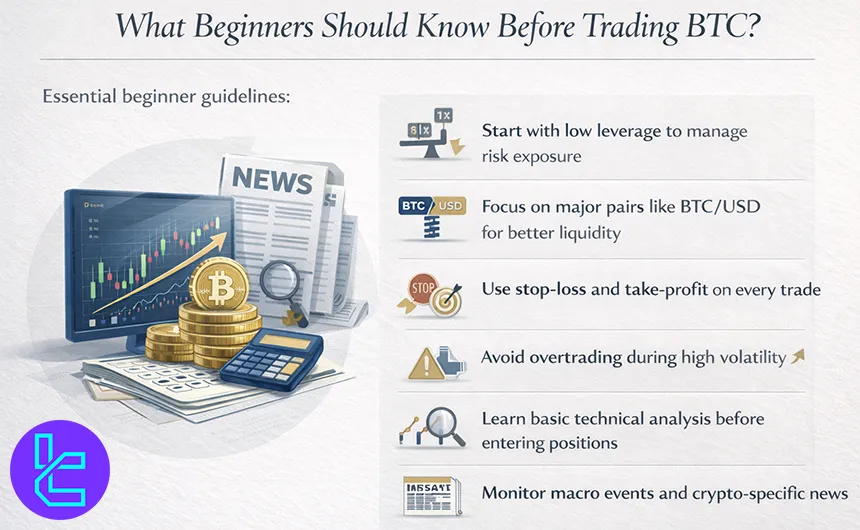
Bitcoin trading requires a strong understanding of volatility, risk management, and market behavior. Beginners often underestimate the speed and magnitude of price movements in crypto markets. Essential beginner guidelines:
- Start with low leverage to manage risk exposure
- Focus on major pairs like BTC/USD for better liquidity
- Use stop-loss and take-profit on every trade
- Avoid overtrading during high volatility
- Learn basic technical analysis before entering positions
- Monitor macro events and crypto-specific news
Bitcoin markets operate continuously, which can lead to emotional decision-making and overexposure. Developing a structured trading plan and maintaining discipline is essential for long-term success.
A gradual learning approach, combined with proper risk management, allows beginners to navigate Bitcoin trading more effectively.
Bitcoin vs. Top Class Assets; Reviewing the Trading Status of Each at Brokers
Bitcoin trading through Forex brokers is typically offered via CFDs, positioning it alongside traditional asset classes such as Forex, stocks, commodities, and indices. However, each asset differs significantly in terms of trading conditions, leverage restrictions, liquidity access, and regulatory treatment.
While Bitcoin stands out for its high volatility and 24/7 market structure, traditional assets benefit from deeper institutional frameworks and more stable pricing mechanisms. The table below compares Bitcoin with major asset classes based on how they are commonly offered and traded through brokers.
Parameter | Bitcoin (BTC CFDs) | Forex (Currency Pairs) | Stocks (Equities CFDs) | Commodities (Gold, Oil) | Indices (S&P 500, NASDAQ) |
Trading Format | CFD (no ownership), sometimes futures-based | Spot Forex (CFDs) | Share CFDs or direct shares | CFDs or futures-linked | Index CFDs |
Market Structure | Decentralized underlying market | Decentralized OTC interbank market | Centralized exchanges | Futures exchanges + OTC CFDs | Derived from stock exchanges |
Trading Hours | 24/7 underlying (broker-dependent) | 24/5 global sessions | Exchange hours (with limited extended sessions) | 23–24 hours (futures dependent) | 23–24 hours (CFDs) |
Volatility Level | Very high | Low–Medium (majors) | Moderate | Medium–High | Moderate |
Liquidity Depth | High in BTC, lower than Forex | Extremely deep | High in large-cap stocks | High in major commodities | High in major indices |
Leverage (Retail, Tier-1 Reg.) | Often limited to 1:2 | Up to 1:30 (majors) | Often 1:5 or lower | Typically 1:10–1:20 | Typically 1:10–1:20 |
Regulatory Treatment | Evolving, strict in Tier-1 regions | Well-established global regulation | Strict securities regulation | Exchange-regulated futures markets | Regulated derivative markets |
Main Price Drivers | Market sentiment, ETF flows, macro liquidity | Interest rates, central banks, macro data | Earnings, sector growth | Supply-demand, geopolitics | Economic outlook, corporate performance |
Gap Risk Exposure | Lower (continuous trading) | Moderate (weekend gaps) | High (earnings/news gaps) | High (macro & inventory shocks) | Moderate–High |
Risk Classification | Highly speculative | Macro-driven relative value | Growth/risk asset | Cyclical macro asset | Broad market risk benchmark |
Conclusion
Bitcoin trading through Forex brokers offers a flexible and efficient way to access one of the most volatile financial markets without direct asset ownership. By using CFD instruments, traders can benefit from both rising and falling markets, apply leverage, and integrate Bitcoin into a diversified multi-asset portfolio. However, this structure also introduces additional costs such as spreads and overnight fees, making broker selection a critical factor in long-term performance.
A well-informed approach to Bitcoin trading requires evaluating regulation, execution quality, cost structure, and platform reliability. Traders who focus on risk management, realistic expectations, and consistent strategy selection are better positioned to navigate market volatility. Whether beginner or experienced, choosing a broker with transparent conditions and strong infrastructure plays a key role in achieving sustainable trading outcomes.
For deeper insight into how we evaluated and shortlisted these brokers, please consult TradingFinder’s Forex methodology page.