





Traders who want to trade EURGBP Forex pair should choose a broker with low minimum spreads from 0.0 pips, high leverage options up to 1:1000, and various deposit and withdrawal options.
Users should consider ECB and BoE inflation rate decisions, macro economic changes, and inflation rates to gain profits from price changes.
 | BlackBull Markets | |||
 | Go MARKETS | |||
 | XM Group | |||
| 4 |  | TMGM | ||
| 5 |  | FXGLORY | ||
| 6 |  | Grand Capital | ||
| 7 |  | FXCC | ||
| 8 |  | Ultima Markets | ||
| 9 |  | ETO Markets | ||
| 10 |  | IC Markets |
Trustpilot Score Comparison of EUR/GBP Brokers
Traders must evaluate the trustworthiness of the EUR/GBP Forex brokers by checking their Trustpilot scores.
Broker Name | Trustpilot Rating | Number of Reviews |
IC Markets | 51500+ | |
BlackBull Markets | 3000+ | |
FXCC | 100+ | |
700+ | ||
60+ | ||
Ultima Markets | 400+ | |
TMGM | 800+ | |
ETO Markets | 20+ | |
XM Group | 2500+ | |
Grand Capital | 80+ |
Minimum Trading Spreads Across EURGBP Brokers
Low minimum spreads is one of the most important aspects of choosing the best EURGBP brokers. Here’s a list pf the best available options.
Broker Name | Minimum Spread |
Go Markets | 0.0 pips |
0.0 pips | |
Eightcap | 0.0 pips |
FXPro | 0.0 pips |
Pepperstone | 0.0 pips |
0.6 pips | |
AvaTrade | 0.8 pips |
0.8 pips | |
Plus500 | 0.9 pips |
eToro | 1.0 pips |
Non-Trading Costs in EUR/GBP Forex Brokers
Besides spreads and commissions, traders must check the non-trading fees in EUR/GBP Forex brokers such as deposit, withdrawal, and inactivity costs before opening an account.
Broker Name | Deposit Fee | Withdrawal Fee | Inactivity Fee |
Vantage | $0 | $0 | $0 |
FXGlory | $0 | $0 | $0 |
Fusion Markets | $0 | $0 | $0 |
Ultima Markets | $0 | $0 | $0 |
Varies | Varies | $0 | |
$0 | $0 | $5 | |
Axi | No fees for the first $50000 | Free for cashouts above $50 | $10 |
Admirals | $0 | 2 Free withdrawals per month | $10 |
CMC Markets | $0 | $0 | $15 |
OANDA | $0 | $20 | $10 |
Available Platforms in EURGBP Forex Brokers
Having access to various platforms helps traders trade EUR/GBP on their preferred interface.
Broker Name | Trading Platforms |
IG | WebTrader, MT4, ProRealTime, TradingView, IG tastytrade, L2 Dealer, Mobile app |
MT4, MT5, cTrader, TradingView, IC Social | |
MT4, MT5, Mobile app, WebTrader | |
Trade Nation | TN Trader, TradingView, MT4 |
HFM | MT4, MT5, HFM Platform |
MT4, MT5 | |
Global Prime | MT4, MT5 |
Eightcap | MT4, MT5 |
eToro | Own platform |
Top 8 Forex Brokers for Trading EURGBP
The brokers listed below offer the best trading conditions, including low spreads and commissions, high quality customer support, various trading platforms, and multiple payment options for trading EUR/GBP in a Forex broker.
XM Group
XM Group is a multi-asset financial brokerage established in 2009, offering access to more than 55 Forex pairs and over 1,400 CFD instruments across asset classes such as equities, commodities, indices, cryptocurrencies, and precious metals.
The broker reports a global client base exceeding 15 million users and processes approximately 14 million trades per day through its international infrastructure.
Operating via multiple legal entities including XM Global Limited and Trading Point MENA Limited, the brokerage is supervised by regulatory bodies such as CySEC, DFSA, FSCA, FSC Belize, FSC Mauritius, and FSA Seychelles.
Additionally, XM Financial Products Promotion L.L.C is authorized by the Securities and Commodities Authority (SCA) in the UAE under a Category 5 promotional license.
After completing XM Group registration, this brokerprovides trading through MetaTrader 4 and MetaTrader 5 platforms, supporting discretionary and automated workflows via Expert Advisors and MQL5 integration.
Account structures in the XM dashboard include Standard, Ultra Low, and Shares allowing participation with a minimum deposit from $5, while leverage may reach up to 1:1000 depending on jurisdiction and regulatory classification.
Execution models include both market and instant execution, with spreads typically starting from 0.6 pips and commission-free conditions applied to most account types except Shares.
Client protections such as negative balance protection, segregated accounts, and margin thresholds of 50% margin call and 20% stop-out are incorporated across supported entities.
Traders must provide the necessary documents during XM Group verification to ensure their funds are safe with the broker.
Account Types | Micro, Standard, Ultra Low, Shares, Demo |
Regulating Authorities | FSC Belize, CySEC Cyprus, FSCA South Africa, DFSA Dubai, FSC Mauritius, FSA Seychelles |
Minimum Deposit | From $5 (Shares Account: $10,000) |
Deposit Methods | Credit/Debit Cards, Bank Transfers, E-wallets (Skrill, Neteller, Perfect Money), Mobile Payments |
Withdrawal Methods | Credit/Debit Cards, Bank Transfers, E-wallets |
Maximum Leverage | Up to 1:1000 (Entity-Based) |
Trading Platforms & Apps | MetaTrader 4 (MT4), MetaTrader 5 (MT5), XM Mobile App |
XM Group Pros and Cons
The following table contains the advantages and disadvantages of trading with the XM Group broker.
Pros | Cons |
Access to 55+ Forex Pairs and 1,400+ CFDs | Monthly $10 Inactivity Fee |
Low Minimum Deposit Requirement ($5) | Not Available in US and Canada |
Multiple Regulatory Licenses (CySEC, DFSA, FSCA, FSC) | No PAMM Investment Option |
Negative Balance Protection Across Retail Accounts | - |
IC Markets
IC Markets is a multi-asset Forex and CFD brokerage established in Australia in 2007, offering trading access across global markets including Forex CFDs, commodities, indices, bonds, cryptocurrencies, and more than 2,100 stock CFDs.
The broker supports 10 base currencies such as USD, EUR, GBP, AUD, SGD, JPY, CHF, NZD, CAD, and HKD.
The company operates under multiple regulatory entities including CySEC (Cyprus), ASIC (Australia), and the FSA (Seychelles), applying jurisdiction-specific safeguards such as segregated client accounts, AML compliance frameworks, and external operational audits.
Under the CySEC entity, eligible EU clients are covered by the Investor Compensation Fund up to €20,000. IC Markets provides Standard, Raw Spread, and Islamic account types with a minimum deposit requirement of $200 and trade sizing from 0.01 lot.
Raw Spread environments offer pricing from 0.0 pips with commissions applied per standard lot, while Standard accounts apply spread-only execution from approximately 0.8 pips.
Traders can lower trading costs of this broker by using IC Markets rebate program.
Trading infrastructure includes MetaTrader 4 (MT4), MetaTrader 5 (MT5), and cTrader platforms, supporting algorithmic strategies through Expert Advisors (EAs), scalping models, and low-latency market execution.
Maximum leverage may reach up to 1:500 depending on regulatory jurisdiction and client classification.
Account Types | Standard, Raw Spread, Islamic |
Regulating Authorities | ASIC (Australia), CySEC (Cyprus), FSA (Seychelles) |
Minimum Deposit | $200 |
Deposit Methods | Bank Cards, Wire Transfer, E-wallets (Skrill, Neteller, PayPal) |
Withdrawal Methods | Bank Cards, Wire Transfer, Electronic Payment Systems |
Maximum Leverage | Up to 1:500 (Entity-Based) |
Trading Platforms & Apps | MetaTrader 4 (MT4), MetaTrader 5 (MT5), cTrader, IC Markets Mobile |
IC Markets Pros and Cons
Traders must consider the following benefits and drawbacks of trading with IC Markets before opening an account.
Pros | Cons |
Spreads from 0.0 pips on Raw Spread Accounts | $200 Minimum Deposit Requirement |
Multi-Platform Access (MT4, MT5, cTrader) | Lower Leverage in ASIC / CySEC Regions |
Segregated Client Funds Across Entities | No PAMM Account Support |
Supports Expert Advisors (EAs) & Scalping | - |
Grand Capital
Grand Capital is an online Forex and CFD broker established in 2006 with a reported client base of over 1,500,000 and partner network spanning 144 countries.
The broker is registered in Seychelles under IBC number 036046 and works with MetaQuotes and UpTrader to deliver account access through MT4, MT5, and WebTrader.
Its product coverage is described as 500+ tradable assets across multiple markets, including Forex, stocks, ETFs, indices, energy, metals, commodities, crypto, and bonds.
From a client-protection standpoint, Grand Capital is not presented as being supervised by a national financial regulator;
Instead, it became a member of The Financial Commission (FinaCom) in 2016 and is listed as a Category A broker, with an insurance/compensation framework referenced up to €20,000 per client under Financial Commission rules.
The broker promotes high leverage conditions up to 1:1000 (account/entity dependent) with entry access starting from a $10 minimum deposit and trade sizing from 0.01 lots.
Cost structure varies by account type and instrument, using spread-and-commission schedules across Standard, MT5, Micro, ECN Prime, and Islamic account options.
Non-trading costs can include a monthly inactivity fee of $15 after 90 days without trading activity, while deposit and withdrawal fees depend on the payment channel (bank cards, bank transfer, e-payments, crypto, and local exchange methods).
Additional services include Copy Trading and an Investment Portfolio product, alongside an affiliate program and periodic promotions.
Account Types | Standard, MT5, Micro, ECN Prime, Swap Free |
Regulating Authorities | None (Member of The Financial Commission – FinaCom) |
Minimum Deposit | $10 |
Deposit Methods | Bank Cards, Bank Transfer, E-payments, Crypto, Local Exchange |
Withdrawal Methods | Bank Cards, Bank Transfer, E-payments, Crypto, Local Exchange |
Maximum Leverage | Up to 1:1000 |
Trading Platforms & Apps | MT4, MT5, WebTrader |
Grand Capital Pros and Cons
Check the table below to learn benefits and drawbacks of trading with the Grand Capital broker.
Pros | Cons |
500+ tradable assets across multiple markets | No national financial regulator listed |
Multiple account types including Micro and Swap Free | ECN Prime minimum deposit is $500 |
Copy Trading and Investment Portfolio options | Geo-restrictions apply in several regions |
Supports MT4, MT5, and WebTrader | Limited platform variety beyond MetaTrader + WebTrader |
Ultima Markets
Ultima Markets is a multi-asset brokerage founded in 2016 and registered in Mauritius at 2nd Floor, The Catalyst, 40 Silicon Avenue, Ebene Cybercity, 72201.

It provides access to 250+ tradable instruments across four asset classes, including Forex, Stocks, Commodities, and Indices while offering both live and Demo environments.
The account lineup after finalizing Ultima Market registration is structured around Standard and ECN pricing, with normal and Cent variants, plus an Islamic (swap-free) option.
Entry requirements are positioned at a $50 minimum deposit and a 0.01 minimum order size, while leverage is stated up to 1:2000 (jurisdiction and account conditions can affect availability).
From a compliance and client-money standpoint, Ultima Markets cites dual oversight: CySEC (CIF license 426/23) and the FSC of Mauritius (license GB 23201593).
The broker also references segregated bank accounts to separate client funds from operational capital.
Execution is described as Market execution, and pricing differs by account type: Standard accounts are presented as commission-free with wider spreads, while ECN accounts typically tighten spreads (from 0.0 pips) and apply a commission schedule.
Traders can earn cashbacks and reduce trading costs via Ultima Markets rebate program offered by TradingFinder.
Platform access includes MetaTrader 4 (MT4), MetaTrader 5 (MT5), and a proprietary trading app, alongside tools such as an economic calendar and Trading Central.
For funding, Ultima Markets lists Credit/Debit Cards, E-Payment Systems, Crypto, and Bank Transfer for both deposits and withdrawals, with a stated $20 fee on bank-transfer withdrawals per request (except the first transaction).
Support channels include Email, Ticket, and Live Chat, with 24/7 availability.
Account Types | Demo, Standard, ECN, Standard Cent, ECN Cent |
Regulating Authorities | CySEC (CIF 426/23), FSC Mauritius (GB 23201593) |
Minimum Deposit | $50 |
Deposit Methods | Credit/Debit Cards, E-Payment Systems, Crypto, Bank Transfer |
Withdrawal Methods | Credit/Debit Cards, E-Payment Systems, Crypto, Bank Transfer |
Maximum Leverage | Up to 1:2000 |
Trading Platforms & Apps | MT4, MT5, Proprietary Platform |
Ultima Markets Pros and Cons
The table below helps you understand the benefits and drawbacks of trading with the Ultima Markets broker.
Pros | Cons |
Dual regulation via CySEC and FSC Mauritius | Cent accounts are more limited in instrument scope (Forex & Gold / 60+ symbols cited) |
Account variety including ECN and Cent structures | Bank-transfer withdrawals may incur a $20 fee per request (except the first) |
Tools include Trading Central and an economic calendar | Bonus terms can be region/time-limited and may change |
MT4, MT5, plus a proprietary platform | Restricted-country list is not fully detailed (US and North Korea explicitly referenced) |
Go Markets
Established in 2006 and headquartered in Melbourne, GO Markets operates as a multi-asset CFD brokerage regulated by financial authorities including ASIC, CySEC, FSC, and FSA across multiple jurisdictions.

The platform facilitates trading across diverse asset classes such as Forex, Shares, Indices, Commodities, Metals, Cryptocurrencies, ETFs, and Treasury CFDs, with leverage parameters extending up to 1:500 depending on the regulatory entity.
Trading infrastructure is supported through widely adopted platforms including MetaTrader 4 (MT4), MetaTrader 5 (MT5), and cTrader, enabling compatibility with automated strategies such as Expert Advisors (EAs) and scalping methodologies.
The brokerage offers two primary account structures (Standard and GO Plus+) after finalizing Go Markets registration alongside investment modules such as PAMM and Copy Trading, allowing allocation-based strategy replication.
The GO Plus+ account operates on a raw spread environment starting from 0.0 pips, with a commission model of $5 per round lot, while the Standard account incorporates spread-based pricing without direct commission.
Traders can lower trading commissions in this broker by joining the Go Markets rebate program. Margin call and stop-out thresholds are set at 80% and 50%, respectively, under an instant execution framework.
Funding mechanisms include Credit/Debit Cards, Bank Transfers, and selected E-wallets, with micro-lot trading from 0.01 lots supported across account types.
Account Types | Standard, GO Plus+ |
Regulating Authorities | ASIC, CySEC, FSC, FSA |
Minimum Deposit | 100 EUR |
Deposit Methods | Credit/Debit Cards, Bank Transfer, E-wallets |
Withdrawal Methods | Credit/Debit Cards, Bank Transfer, E-wallets |
Maximum Leverage | Up to 1:500 |
Trading Platforms & Apps | MetaTrader 4 (MT4), MetaTrader 5 (MT5), cTrader |
Go Markets Pros and Cons
The table below helps traders understand the benefits and drawbacks of trading with the Go Markets broker.
Pros | Cons |
MT4, MT5, and cTrader support | Higher minimum deposit than some peers |
PAMM and Copy Trading modules | Limited standalone investment tools |
Raw spreads from 0.0 pips | - |
Negative Balance Protection | - |
TMGM
TMGM (TradeMax Global Markets) is an Australia-origin Forex and CFD brokerage that has operated under the TradeMax brand since 2013.
TMGM registration provides access to 12,000+ tradable instruments across major markets such as Forex, Stocks, Indices, Commodities, Energies, and Cryptocurrency, with execution built around Market Execution and ECN-style routing on eligible accounts.
Pricing is structured through two core retail accounts: EDGE/ECN and CLASSIC. EDGE is positioned for tighter spreads (from 0.0 pips) with a per-lot commission, while CLASSIC applies wider spreads (from 1.0 pips) with zero commission.
Minimum deposit is stated as $100, minimum order size starts from 0.01 lots, and leverage is advertised up to 1:1000 (varies by entity).
TMGM’s regulatory footprint is split across multiple entities. Trademax Australia Limited is licensed by ASIC (Tier-1) and cites segregated client funds plus negative balance protection.
Additional entities are regulated offshore by VFSC (Vanuatu), FSC (Mauritius), and CMA (Kenya), where higher leverage is typically offered with different investor-protection standards.
Both entities require traders to provide identification documents and complete TMGM verification process.
The broker also references Professional Indemnity insurance coverage up to AUD 10 million across jurisdictions, and its Vanuatu arm’s membership in The Financial Commission with dispute resolution and potential compensation up to EUR 20,000.
Platform access via TMGM dashboard includes MetaTrader 4 (MT4), MetaTrader 5 (MT5), IRESS, and the TMGM Mobile App.
Copy trading and social trading are available via HUBx (ZuluTrade integration), alongside a Rewards Program that converts trading activity into redeemable points.
Reported restrictions include regions such as the USA, Japan, North Korea, Iran, Syria, Cuba, Sudan, Belarus, and Crimea.
Account Types | EDGE/ECN, CLASSIC |
Regulating Authorities | ASIC (Australia), VFSC (Vanuatu), FSC (Mauritius), CMA (Kenya) |
Minimum Deposit | $100 |
Deposit Methods | VISA, MasterCard, Bank Transfer, RMB Instant, Revolut, WISE, Neteller, Skrill, UnionPay, Fasapay, Crypto (USDT, USDC) |
Withdrawal Methods | Bank Transfer, RMB Instant, Revolut, WISE, Neteller, Skrill, Crypto (USDT, USDC) |
Maximum Leverage | Up to 1:1000 |
Trading Platforms & Apps | MT4, MT5, IRESS, TMGM Mobile App |
TMGM Pros and Cons
The table below helps you evaluate the quality of trading services in TMGM broker.
Pros | Cons |
Multi-entity regulatory setup including ASIC oversight | Inactivity fee policy applies after extended non-use (timeline varies by policy section) |
12,000+ instruments across multiple asset classes | Limited retail account variety (two main account types) |
Copy trading/social trading via HUBx (ZuluTrade) plus Rewards Program | Offshore entities (VFSC/FSC/CMA) have different investor-protection standards than Tier-1 regimes |
Broad funding options including e-wallets and stablecoins (USDT/USDC) | Restricted-country list includes several major jurisdictions (e.g., USA, Japan) |
FXCC
FXCC is a multi-asset Forex and CFD broker active since 2010, with operations linked to Cyprus and service delivery attributed to Central Clearing Ltd.
The product list is concentrated on five markets, including Forex, Crypto, Indices, Metals, and Energies, with leverage reaching 1:500 for non-EU clients and 1:30 under the CySEC regime.
Instead of multiple retail plans after FXCC registration, this broker focuses on a single live account, ECN XL, alongside a Demo account.
The ECN XL structure highlights raw, floating spreads from 0.0 pips with zero commission, while trading conditions include Market execution and a 50% stop-out level (margin call/stop out shown as 100%/50%).
A swap-free (Islamic) variant is available for the same live environment, and minimum order size starts from 0.01 lot.
Funding is presented as flexible, with a $0 minimum deposit and support for cards, e-wallets, and cryptocurrency rails (including USDT on multiple networks), although withdrawal fees can apply depending on the method.
Traders must also complete FXCC verification to become eligible for withdrawals.
From a compliance angle, the broker reports a dual regulatory setup: CySEC (license 121/10) for the Cyprus entity, and Mwali International Services Authority (MISA) (license BFX2024085) for the Comoros Union entity.
The Cyprus framework references Investor Compensation Fund coverage up to EUR 20,000, while both entities cite segregated funds and negative balance protection.
Platform support is limited to MetaTrader 4 (MT4), with extras such as Free VPS and a 100% deposit bonus (up to $2,000).
The support schedule is described as 24/5 via email, phone, live chat, and tickets, which may matter for weekend assistance expectations.
Account Types | ECN XL, Demo |
Regulating Authorities | CySEC, MISA |
Minimum Deposit | $0 |
Deposit Methods | Credit/Debit Cards, Bank Transfer, E-Wallets, Crypto |
Withdrawal Methods | Credit/Debit Cards, Bank Transfer, E-Wallets, Crypto |
Maximum Leverage | Up to 1:500 |
Trading Platforms & Apps | MetaTrader 4 (MT4) |
FXCC Pros and Cons
Traders must check the table below to learn about the benefits and limitations of trading with FXCC.
Pros | Cons |
CySEC oversight plus ICF coverage up to EUR 20,000 for Cyprus clients | Only MetaTrader 4 (no MT5/cTrader/TradingView) |
ECN XL model: floating spreads from 0.0 pips with $0 commission | No variety in live account types (single ECN XL) |
$0 minimum deposit and multiple funding rails including crypto | Support is 24/5, not 24/7 |
Swap-free (Islamic) option and Free VPS for eligible setups | No Stocks/ETFs market access, limiting diversification |
ETO Markets
Founded in 2013 under the ETO Group, ETO Markets operates as a Seychelles-registered brokerage regulated by the Financial Services Authority (FSA).
The platform provides access to more than 89 tradable instruments across key CFD asset classes including Forex, Indices, Metals, Energies, Cryptocurrencies, and Stock CFDs after completing ETO Markets registration.
Trading infrastructure is built around MetaTrader 4 (MT4) and MetaTrader 5 (MT5), enabling compatibility with automated systems such as Expert Advisors (EAs) and micro-lot execution from 0.01 lots.
Account segmentation includes PRO, BASIC, PRIME, and STD models, each offering distinct pricing configurations. Raw pricing environments start from 0.0 pips, while commission structures vary depending on account type (e.g., PRO accounts incur a $3.5 per-side fee).
The brokerage supports leverage levels of up to 1:500, and integrates investment modules such as PAMM and proprietary social trading via ETO Plus, allowing signal replication across MT4/MT5 environments.
Payment channels include UnionPay, SEPA Instant Transfer, and USDT (ERC20/TRC20), supporting fiat-to-crypto funding routes. Market execution is applied across all accounts with a standardized 100% Margin Call and 50% Stop Out framework.
Account Types | PRO, BASIC, PRIME, STD |
Regulating Authorities | FSA (Seychelles) |
Minimum Deposit | $100 |
Deposit Methods | UnionPay, Bank Transfer, USDT (ERC20/TRC20), SEPA Instant |
Withdrawal Methods | UnionPay, USDT (ERC20/TRC20), SEPA Instant |
Maximum Leverage | Up to 1:500 |
Trading Platforms & Apps | MetaTrader 4 (MT4), MetaTrader 5 (MT5) |
ETO Markets Pros and Cons
The table below helps you understand the benefits and drawbacks of trading with the ETO Markets broker.
Pros | Cons |
MT4 & MT5 platform support | No Tier-1 regulatory license |
Raw spreads from 0.0 pips | Limited support channels |
PAMM & ETO Plus Social Trading | No Islamic (Swap-Free) Account |
Multi-asset CFD coverage | $100 minimum withdrawal threshold |
What is EUR/GBP Trading Pair in Forex?
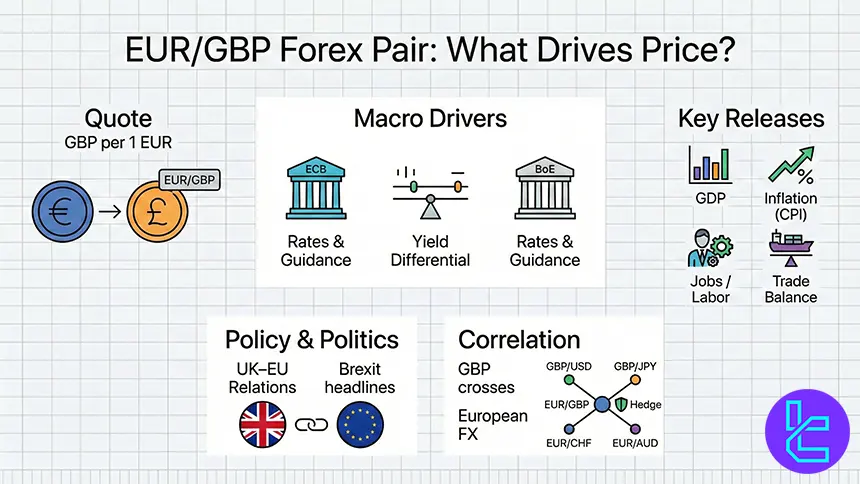
EUR/GBP is a major Forex cross that quotes how many British pounds (GBP) are required to buy one euro (EUR). Because it tracks two highly developed economies (the Eurozone and the United Kingdom) its pricing often reflects relative growth, inflation dynamics, and capital flows between the regions.
Two institutions tend to sit at the center of EUR/GBP’s macro drivers: the European Central Bank (ECB) and the Bank of England (BoE).
Shifts in interest-rate expectations, policy statements, and forward guidance can change the pair’s yield differential and, in turn, its direction.
Beyond monetary policy, traders watch releases such as GDP, inflation (CPI), labor-market figures, and trade data, since these inputs shape the probability of future ECB/BoE decisions.
Political risk can matter as well. Events tied to UK–EU relations, including Brexit-related developments, have historically influenced sentiment and repricing in EUR/GBP.
The pair is also monitored for its relationships with other European currencies and GBP-based crosses, which can be relevant for correlation analysis, hedging, and portfolio construction.
What Are the Pros and Cons of Trading EUR/GBP?
The EUR/GBP currency pair reflects the valuation between the Eurozone and the United Kingdom, making it a commonly monitored cross in the Forex market, particularly during the London session.
Its price dynamics are closely linked to macroeconomic alignment and interest rate differentials set by the European Central Bank (ECB) and the Bank of England (BoE).
Compared to USD-based majors such as GBP/USD or EUR/USD, EUR/GBP often exhibits more range-bound behavior shaped by regional capital flows.
Pros | Cons |
High liquidity typically results in tighter bid-ask spreads and reduced transaction costs | Susceptible to geopolitical developments such as Brexit negotiations or UK–EU policy disputes |
Often demonstrates relatively lower volatility due to economic integration between the UK and Eurozone | May present fewer high-momentum breakout opportunities compared to GBP/JPY or GBP/USD |
Can be used as a hedging instrument due to correlations with GBPCHF, GBPJPY, and EURMXN | Liquidity tends to decline outside European market hours, especially in the Asian session |
Overnight swap costs may remain limited depending on ECB–BoE interest rate differentials | Weekend macroeconomic or political news may trigger opening price gaps |
What are the Trading Costs of EUR/GBP in Forex Brokers?
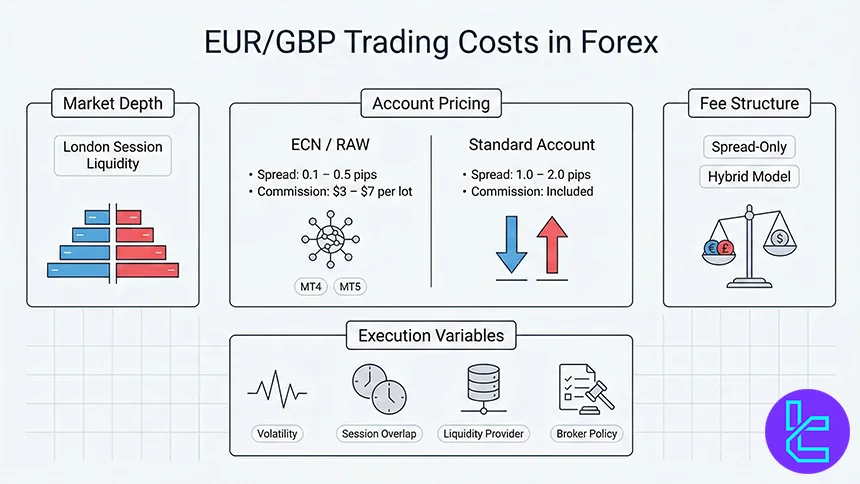
In the Forex market, trading the EUR/GBP currency pair generally involves relatively low transactional expenses due to its strong market depth and consistent liquidity during the London session.
Cost structures are typically defined by the pricing model applied in different account types such as ECN, RAW, or commission-free Standard accounts.
In commission-based environments, spreads on EUR/GBP may narrow to approximately 0.1-0.5 pips, with an added execution fee commonly ranging between $3 and $7 per round turn per lot.
This model is frequently used in institutional-style trading conditions where raw interbank pricing is provided through platforms like MetaTrader 4 (MT4) or MetaTrader 5 (MT5).
Alternatively, commission-free accounts usually integrate trading costs into wider bid-ask spreads, which may extend from around 1.0 to 2.0 pips depending on execution conditions, liquidity providers, and volatility levels. These pricing differences reflect how trading fees are redistributed across spread-only or hybrid models.
Because of the euro–pound correlation and consistent order flow between the Eurozone and the United Kingdom, EUR/GBP is often considered a cost-efficient cross pair.
However, spreads and commissions can still fluctuate based on market conditions, session overlaps, and broker-specific execution policies.
EUR/GBP Trading Time
The EUR/GBP currency pair operates within the decentralized structure of the global Forex market, allowing continuous trading access from Monday through Friday.
As part of the European cross-currency segment, its activity cycle is closely aligned with regional financial hubs, particularly those in the Eurozone and the United Kingdom.
Market participation tends to intensify when both the London and major European trading sessions are active simultaneously.
This overlap typically results in improved liquidity conditions, more competitive bid-ask spreads, and enhanced order execution efficiency.
During periods outside of peak European Forex market hours, EUR/GBP remains tradable; however, reduced institutional activity may influence execution quality and short-term volatility dynamics.
Key session-related characteristics of EUR/GBP trading include:
- Continuous availability within the 24-hour Forex trading cycle from Monday to Friday
- Increased liquidity during the London session, commonly between 08:00 and 16:00 GMT
- Tighter spreads due to overlapping activity between Eurozone and UK financial markets
- Lower volatility during off-peak sessions with reduced trading volume
- Potential variation in execution speed depending on session-based market depth
Understanding session-driven liquidity fluctuations can provide additional context when assessing execution conditions and short-term price behavior in EUR/GBP trading environments.
What is the Maximum Leverage for Trading EURGBP Pair?
The maximum leverage for trading the EUR/GBP pair is primarily determined by the broker’s regulatory jurisdiction and client classification.
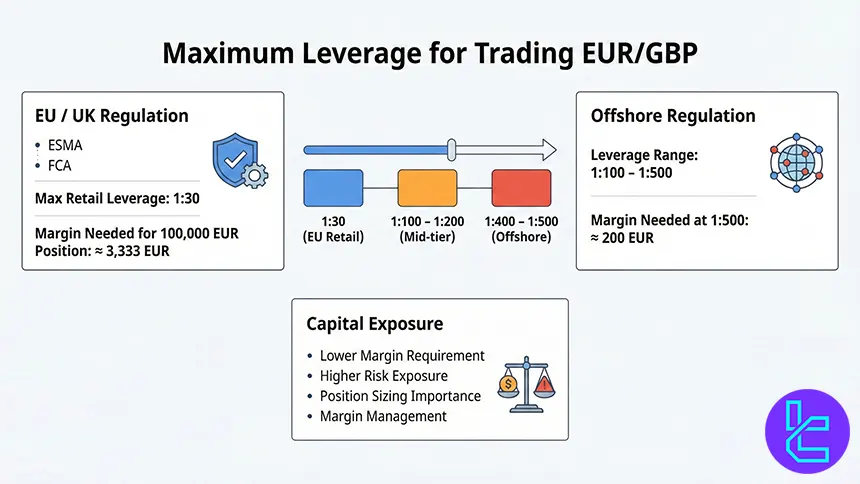
Under European regulatory frameworks such as ESMA in the EU and FCA in the UK, retail traders are typically limited to a maximum leverage of 1:30 when trading major Forex pairs, including EUR/GBP.
In these regulated environments, a trader controlling a 100,000-unit standard lot would need approximately 3,333 EUR in margin at 1:30 leverage.
This margin requirement is intended to reduce exposure to sudden price movements in highly liquid instruments such as EUR/GBP.
Outside of EU-regulated jurisdictions, brokers operating under offshore licenses may offer significantly higher leverage levels, often ranging between 1:100 and 1:500.
For example, at 1:500 leverage, the same 100,000-unit position may require as little as 200 EUR in initial margin, substantially increasing capital efficiency.
Typical leverage ranges available for EUR/GBP trading include:
- 1:30 under ESMA or FCA retail trading rules
- 1:100 to 1:200 in mid-tier regulated environments
- Up to 1:400 or 1:500 under offshore regulatory frameworks
Although higher leverage reduces the capital required per trade, it proportionally increases exposure to both gains and losses, making margin management and position sizing critical when trading EUR/GBP in leveraged Forex markets.
How to Choose the Best Broker for Trading EUR/GBP
Selecting a suitable Forex broker for trading the EUR/GBP pair requires evaluating operational factors that directly influence execution quality and transaction costs.
Since EUR/GBP is typically characterized by moderate volatility and tight price ranges, broker-side variables such as spread structure, platform latency, and regulatory oversight can materially impact strategy performance.
When comparing brokers the following technical criteria should be considered:
- Regulatory Authorization: Brokers supervised by institutions such as FCA, ASIC, or CySEC are subject to capital adequacy rules and client fund segregation policies;
- EUR/GBP Spread Levels: Commission-based accounts may offer spreads between 0.1–0.3 pips, while standard accounts typically range from 1.0 to 1.5 pips;
- Commission Structure: RAW or ECN accounts often charge between $3 to $7 per round-turn lot in addition to the spread;
- Trading Platform Support: Availability of MetaTrader 4, MetaTrader 5, or TradingView allows integration of Expert Advisors (EAs) and algorithmic strategies;
- Order Execution Speed: Low-latency infrastructure is critical for strategies that rely on rapid entry during London session volatility;
- Account Configuration: Raw spread accounts provide direct market pricing, whereas standard accounts simplify cost structures through spread-only pricing.
These parameters collectively determine execution efficiency when trading EUR/GBP in regulated Forex environments.
What Are the Non-Trading Fees in EUR/GBP Forex Brokers?
In EUR/GBP trading, total brokerage costs are not limited to spreads and commissions.
Many Forex brokers apply operational or administrative charges that are independent of trade execution but still influence the overall profitability of maintaining an active trading account over time.
- Inactivity Fees: Applied when no trading activity occurs for a defined period, often ranging from 3 to 12 months depending on broker policy;
- Deposit or Withdrawal Charges: Although many brokers support free funding via cards or e-wallets, international bank wire transfers may incur processing costs between 7.5 EUR and 15 GBP;
- Currency Conversion Fees: Triggered when deposits or withdrawals are processed in a base currency different from the trading account denomination;
- Account Maintenance Fees: Some providers may impose periodic service charges for maintaining an open account, particularly under specific account tiers.
Regulatory Authorities that Supervise EUR/GBP Trading in Forex Brokers
Forex brokers that provide access to EUR/GBP trading operate under the oversight of multiple financial supervisory bodies across different jurisdictions.
In the UK, the Financial Conduct Authority (FCA) plays a central role in supervising Forex brokers that offer EUR/GBP, enforcing requirements such as client fund segregation, risk disclosures, and negative balance protection for retail traders.
Within the EU, brokers are often authorized by the Cyprus Securities and Exchange Commission (CySEC), which operates under the broader regulatory framework defined by the European Securities and Markets Authority (ESMA).
Through MiFID II guidelines, ESMA standardizes investor protection measures across member states, including leverage restrictions of up to 1:30 for major pairs such as EUR/GBP.
Additional regulatory oversight may come from institutions such as BaFin in Germany, ASIC in Australia, and FINMA in Switzerland, each of which enforces capital adequacy rules and operational transparency.
Outside Europe, brokers serving international clients may also be licensed by authorities such as the DFSA in the UAE, FSCA in South Africa, or offshore bodies like the FSC in Mauritius, Seychelles, or the British Virgin Islands.
What Factors Effect EUR/GBP Price?
Movements in the GBP/EUR exchange rate are shaped by a combination of macroeconomic policy decisions, geopolitical developments, and intermarket relationships within the global Forex ecosystem.
Although this cross pair often demonstrates relatively moderate price fluctuations compared to USD-based majors, its valuation remains highly responsive to structural shifts in the United Kingdom and the Eurozone.
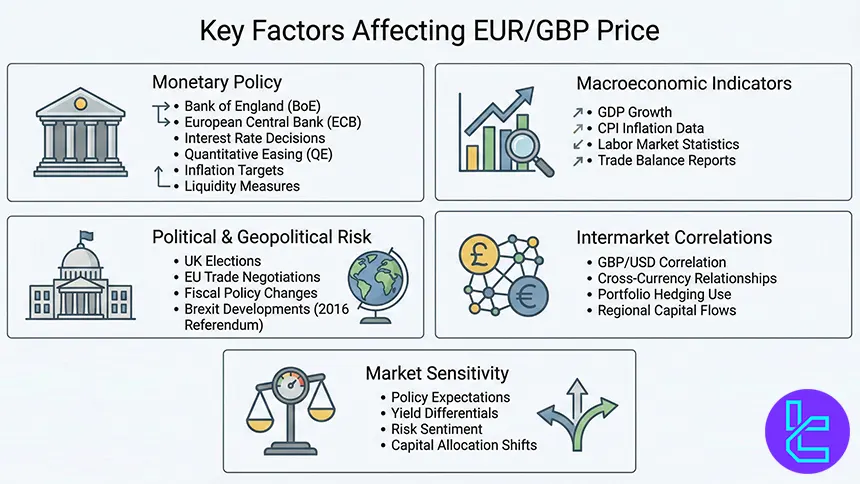
Monetary policy actions implemented by the Bank of England (BoE) and the European Central Bank (ECB) are among the most influential drivers of GBP/EUR pricing.
Adjustments to benchmark interest rates, quantitative easing programs, inflation targets, and liquidity measures can immediately impact capital flows between the two economies, thereby altering demand for the British Pound or the Euro in the Forex market.
Political uncertainty also plays a measurable role in volatility expansion. Events such as national elections, fiscal policy changes, or trade negotiations between the UK and the European Union can trigger repricing in GBP/EUR due to evolving economic expectations.
Historical developments, including the 2016 Brexit referendum and subsequent trade framework discussions, have demonstrated the sensitivity of this pair to policy-driven risk sentiment.
In addition, GBP/EUR tends to maintain statistical correlations with other major currency pairs such as GBP/USD. Monitoring these relationships allows market participants to assess directional bias or construct hedging strategies.
Full Comparison of EUR/GBP Symbol to Other Popular Instruments in Forex
The table below helps you understand the differences in various major trading pairs.
Parameter | EUR/GBP | GBP/USD | USD/JPY | USD/CAD |
Market Type | Major Currency Pair | Major Currency Pair | Major Currency Pair | Major Currency Pair |
Base Currency | Euro (EUR) | British Pound (GBP) | US Dollar (USD) | US Dollar (USD) |
Quote Currency | British Pound (GBP) | US Dollar (USD) | Japanese Yen (JPY) | Canadian Dollar (CAD) |
Average Daily Volatility | Low to Medium | High | Medium | Medium |
Liquidity Level | High | High | Very High | High |
Typical Spread (Raw) | 0.2 - 0.5 pips | 0.2 - 0.4 pips | 0.1 - 0.3 pips | 0.2 - 0.5 pips |
Correlation with USD Index | Low Direct | Moderate Inverse | Moderate Direct | Moderate Direct |
Influencing Central Banks | European Central Bank / Bank of England | Bank of England / Fed | Bank of Japan / Fed | Bank of Canada / Fed |
Best Trading Sessions | London | London / New York | Tokyo / New York | New York |
Conclusion
Based on TradingFinder’s expert review on the best EURGBP brokers, XM Group, IC Markets, Go Markets, FXCC, and Grand Capital are the best available options.
Now traders must check the minimum deposit requirements, account types, leverage limites, etc. to choose the best possible options.
To understand the criteria and key factors behind our broker selection, please refer to TradingFinder Forex methodology page.