






The best EURUSD Forex brokers offer low spreads from 0.0 pips and high leverage up to 1:1000 for trading the most liquid Forex trading pair.
These brokers all trading from 0.01 lot sizes and low non-trading fees such as deposit, withdrawal, and inactivity costs. Here are the top EUR/USD brokers.
 | TICKMILL | |||
 | eToro | |||
 | GLOBAL PRIME | |||
| 4 |  | Exness | ||
| 5 |  | fpmarkets | ||
| 6 |  | FBS | ||
| 7 |  | MONETA MARKETS | ||
| 8 |  | deriv | ||
| 9 |  | IFC MARKETS | ||
| 10 |  | instaforex |
Trustpilot Score Comparison of EUR/USD Brokers
Traders must check the Trustpilot rating of Forex brokers to ensure they can trust these brokers with their capital.
Broker Name | Trustpilot Rating | Number of Reviews |
Exness | 29500+ | |
10000+ | ||
400+ | ||
Deriv | 70500+ | |
400+ | ||
FBS | 8500+ | |
eToro | 30500+ | |
Tickmill | 1000+ | |
IFC Markets | 500+ | |
InstaForex | 450+ |
Minimum Trading Spreads Across EURUSD Brokers
Traders who want to only trade the EURUSD pair should check the spreads in the best Forex brokers to ensure they get the best prices.
Broker Name | Minimum Spread |
Global Prime | 0.0 pips |
0.0 pips | |
InstaForex | 0.0 pips |
IC Markets | 0.0 pips |
Vantage | 0.0 pips |
0.4 pips | |
XTB | 0.5 pips |
IG | 0.6 pips |
Plus500 | 0.9 pips |
eToro | 1.0 pips |
Non-Trading Costs in EUR/USD Forex Brokers
Traders must also consider the deposit, withdrawal, and inactivity charges before choosing a Forex broker to trade EUR/USD.
Broker Name | Deposit Fee | Withdrawal Fee | Inactivity Fee |
PrimeXBT | $0 | $0 | $0 |
Go Markets | $0 | $0 | $0 |
Trade Nation | $0 | $0 | $0 |
Global Prime | $0 | $0 | $0 |
$0 | $0 | $0 | |
IFC Markets | 0.8% | Varies | $0 |
$0 | 1.5% and 1.8% | $5 | |
CMC Markets | $0 | $0 | $15 |
Admirals | $0 | 2 Free withdrawals per month | $10 |
OANDA | $0 | $20 | $10 |
Available Platforms in EURUSD Forex Brokers
The table below provides a complete comparison of the available trading platforms in the best EUR/USD Forex brokers.
Broker Name | Trading Platforms |
FP Markets | MT4, MT5, Iress, Webtrader, Mobile App |
MT4, MT5, FBS Trader, Webtrader | |
Moneta Markets | MT4, MT5, Pro Trader, AppTrader, CopyTrader |
MT5, Deriv Trader, Deriv Go | |
XM | MT4, MT5, WebTrader, Mobile app |
Axi | MT4, MT5, Axi Trading Platform |
Pepperstone | MT4, MT5, TradingView, cTrader, proprietary platform |
Fusion Markets | MT4, MT5, TradingView, cTrader |
Eightcap | MT4, MT5 |
Own platform |
Top 8 Forex Brokers for Trading EURUSD
Traders who want to trade EUR/USD in Forex broker, must consider various factors, including spreads, commissions, minimum payments, withdrawal methods, customer support quality, and many other factors to choose the best broker.
Tickmill
Tickmill is a globally operating Forex and CFD brokerage established in 2014, providing access to financial instruments across multiple asset classes including Forex, Stock Indices, Commodities, Cryptocurrencies, Stocks, Bonds, and ETFs.
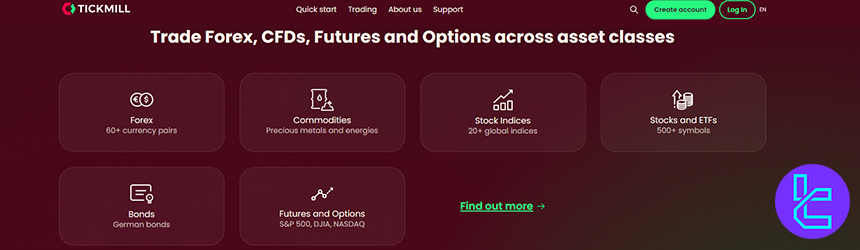
The broker supports trading through MetaTrader 4, MetaTrader 5, WebTrader, and proprietary mobile applications, enabling both discretionary and algorithmic strategies via Expert Advisors and VPS hosting services.
Operating under a No Dealing Desk execution model, Tickmill routes client orders directly to external liquidity providers, reducing internal order handling and maintaining market-based execution.
The brokerage reports an average monthly trading volume exceeding $129 billion across its international client base, with services available in more than 180 jurisdictions.
Tickmill is regulated by several financial authorities including FCA, CySEC, FSA, LFSA, and FSCA.
Investor protection mechanisms such as the Financial Services Compensation Scheme (FSCS) and the Investor Compensation Fund (ICF) are available under specific regulatory entities.
The broker offers Classic and Raw account types after completing the Tickmill registration process with a minimum deposit of $100 and supports account base currencies including USD, EUR, GBP, ZAR, PLN, and CHF.
Maximum leverage may reach up to 1:1000 depending on jurisdiction. Additional infrastructure such as Social Trading and API integration allows participation in both manual and automated trading environments.
Traders can also benefit from lower trading costs by using Tickmill rebate program provided by TradingFinder IB.
Account Types | Classic, Raw |
Regulating Authorities | FCA, CySEC, FSA, LFSA, FSCA |
Minimum Deposit | $100 |
Deposit Methods | Crypto, Bank Transfer, Credit/Debit Card, Skrill, Neteller |
Withdrawal Methods | Crypto, Bank Transfer, Credit/Debit Card, Skrill, Neteller |
Maximum Leverage | Up to 1:1000 |
Trading Platforms & Apps | MetaTrader 4, MetaTrader 5, WebTrader, Mobile App |
Tickmill Pros and Cons
Here are the benefits and drawbacks traders must consider when using Tickmill services.
Pros | Cons |
Multi-jurisdictional regulation (FCA, CySEC, FSCA) | Educational content depth varies by region |
Access to MT4 and MT5 platforms | No PAMM account offering |
NDD execution with external liquidity routing | - |
Support for algorithmic trading and Social Trading | - |
InstaForex
InstaForex is a multi-asset Forex and CFD brokerage founded in 2007 and headquartered in St. Vincent and the Grenadines, providing trading access to markets such as Forex, shares, indices, commodities, and cryptocurrencies.
The company reports a global client base exceeding 7 million users, with services offered through widely used platforms including MetaTrader 4, MetaTrader 5, WebTrader, and mobile trading applications.
The broker operates under the regulatory supervision of BVI FSC, while its European entity, is authorized by the Cyprus Securities and Exchange Commission (CySEC).
Maximum leverage may reach up to 1:1000 depending on jurisdiction, with supported order sizes ranging from 0.01 to 10,000 lots.
InstaForex provides several account structures including Insta.Standard, Insta.Eurica, Cent.Standard, and Cent.Eurica, alongside Islamic (swap-free) accounts.
The brokerage supports investment services after finalizing the InstaForex registration such as the PAMM system and ForexCopy, enabling trade replication and managed account participation within its ecosystem.
Funding options include bank transfer, cryptocurrencies, credit or debit cards, and electronic payment systems such as Skrill, Neteller, and WebMoney.
Trading is available through both instant and market execution modes, with margin call and stop-out levels set at 30 percent and 10 percent respectively.
Account Types | Insta.Standard, Insta.Eurica, Cent.Standard, Cent.Eurica |
Regulating Authorities | BVI FSC, CySEC |
Minimum Deposit | $1 |
Deposit Methods | Crypto, Bank Transfer, Credit/Debit Card, Skrill, Neteller, WebMoney |
Withdrawal Methods | Crypto, Bank Transfer, Credit/Debit Card, Skrill, Neteller, WebMoney |
Maximum Leverage | Up to 1:1000 |
Trading Platforms & Apps | MetaTrader 4, MetaTrader 5, WebTrader, Mobile App |
InstaForex Pros and Cons
Traders should consider the following benefits and drawbacks before opening an account with the InstaForex broker.
Pros | Cons |
Supports MT4 and MT5 platforms | Absence of investor compensation fund |
PAMM and ForexCopy investment options | Segregated funds not publicly confirmed |
Multiple account types including Cent accounts | - |
Flexible leverage up to 1:1000 | - |
FP Markets
FP Markets (First Prudential Markets) is an Australian-origin Forex and CFD broker operating since 2005 with a multi-entity structure and oversight from several regulators, including ASIC, CySEC, FSCA, FSC, and SVG FSA.
The CySEC registration (371/18) is tied to its European presence, while leverage and client eligibility vary by jurisdiction, with retail caps commonly aligned to 1:30 under ASIC/CySEC and higher ratios available via non-EU entities.
All entities require tradersw to complete FP Markets verification to comply with AML and CFT laws.
Trading is offered through Standard and RAW accounts with a $50 minimum deposit, and pricing is structured around either spread-only conditions (Standard) or tighter spreads plus commission (RAW).
FP Markets supports MetaTrader 4, MetaTrader 5, and cTrader, covering discretionary and automated workflows via Expert Advisors and algorithmic execution.
FP Markets registration provides access to a broad instrument range that includes Forex, indices, commodities, metals, cryptocurrencies, stocks, ETFs, and other CFD categories, positioning it as a multi-asset venue rather than a single-market provider.
FP Markets deposit and withdrawal options typically include bank transfer and major e-wallet/card rails (Visa, Mastercard, Skrill, Neteller, PayPal).
For portfolio-style participation, FP Markets references copy trading and managed-account formats such as PAMM and MAM/MAMM, depending on region and entity.
Customer support is commonly presented as 24/7 through live chat, email, and phone channels.
Account Types | Standard, RAW |
Regulating Authorities | ASIC, CySEC, FSCA, FSC, SVG FSA (and related entities) |
Minimum Deposit | $50 |
Deposit Methods | Visa/Mastercard, Skrill, PayPal, Neteller, Bank Transfer |
Withdrawal Methods | Visa/Mastercard, Skrill, PayPal, Neteller, Bank Transfer |
Maximum Leverage | Up to 1:500 (varies by entity) |
Trading Platforms & Apps | MT4, MT5, cTrader |
FP Markets Pros and Cons
Traders must consider the benefits and limitations of trading with FP Markets by checking the table below.
Pros | Cons |
Multiple regulated entities (ASIC, CySEC, FSCA) | No proprietary trading platform |
Tight pricing structure via RAW + commission model | Not available in some jurisdictions (e.g., US) |
Broad market coverage including ETFs and share CFDs | - |
Platform choice: MT4, MT5, cTrader | - |
FBS
FBS is an online Forex and CFD broker active since 2009, reporting a client base of more than 27 million users and offering access to over 550 tradable instruments across Forex, indices, commodities, shares, metals, and cryptocurrencies.
Trading is available through MetaTrader 4, MetaTrader 5, and the proprietary FBS mobile app, which is positioned as a standalone trading interface with more than 90 built-in technical indicators.
The broker’s structure includes multiple entities. Tradestone Limited operates from CySEC and is linked to Investor Compensation Fund (ICF) coverage up to €20,000 for eligible clients.
A separate global branch is overseen by the Financial Services Commission of Belize, and an Australian entity is associated with ASIC.
Leverage and eligibility depend on jurisdiction that trader complete the FBS registration, ranging from more conservative limits in regulated regions to higher ratios (up to 1:3000) in offshore settings.
FBS currently centers its offering on a Standard account, with floating spreads typically starting around 0.7 pips and a commission-free pricing model for most instruments. Trading costs can be reduced by leveraging the FBS rebate program.
Order sizing is commonly available from 0.01 lots, and margin management is framed through stated 40/20 percent margin call and stop-out levels.
Deposit and withdrawal options in the FBS dashboard generally include bank transfers, payment systems, and credit or debit cards, while Islamic (swap-free) accounts and demo accounts are also referenced.
Account Types | Standard |
Regulating Authorities | CySEC, FSC (Belize), ASIC (entity-based) |
Minimum Deposit | $5 |
Deposit Methods | Bank Transfer, Payment Systems, Credit/Debit Cards |
Withdrawal Methods | Bank Transfer, Payment Systems, Credit/Debit Cards |
Maximum Leverage | Up to 1:3000 (varies by entity) |
Trading Platforms & Apps | MetaTrader 4, MetaTrader 5, FBS Mobile App |
FBS Pros and Cons
The table below provides an overview of the benefits and drawbacks of trading with the FBS broker.
Pros | Cons |
Low entry point and small trade sizing | Single account structure |
Platform choice: MT4, MT5, mobile app | No PAMM or active copy-trading offering |
Commission-free model on standard pricing | - |
Mobile app includes 90+ technical indicators | - |
Moneta Markets
Moneta Markets is a Forex and CFD broker established in 2020 with operational roots in Johannesburg, South Africa.
It provides access to more than 1,000 markets and instruments across asset classes such as Forex, indices, commodities, shares, bonds, and cryptocurrencies.
Trading is supported on MetaTrader 4, MetaTrader 5, and two proprietary interfaces, Pro Trader and App Trader, with execution models described as STP and ECN depending on account selection.
The broker’s account lineup is structured around Direct, Prime, and Ultra.
Direct is positioned as an STP option with commission-free pricing and wider floating spreads, while Prime and Ultra are presented as ECN-style accounts with spreads from 0.0 pips and per-lot commissions.
The minimum deposit starts at $50 for Direct and Prime, with Ultra shown as a higher-threshold account. Leverage is stated up to 1:1000, and minimum order size is commonly listed at 0.01 lot.
All users are required to complete Moneta Markets verification to access withdrawals. Risk controls are framed through margin call and stop-out levels of 80 percent and 50 percent.
In terms of oversight, Moneta Markets references FSCA regulation and registration in the Saint Lucia Registry of International Business Companies (2023-00068).
The broker also highlights operational features in the Moneta Markets dashboard such as segregated funds and negative balance protection, alongside investment functions including copy trading and PAMM.
Moneta Markets deposit and withdrawal methods commonly include wire transfer, Visa/MasterCard, FasaPay, SticPay, and JCB, while country eligibility is restricted in several jurisdictions, including the United States.
Account Types | Direct, Prime, Ultra |
Regulating Authorities | FSCA (and related registrations) |
Minimum Deposit | $50 |
Deposit Methods | Wire Transfer, Visa/MasterCard, FasaPay, SticPay, JCB |
Withdrawal Methods | Wire Transfer, Visa/MasterCard, FasaPay, SticPay, JCB |
Maximum Leverage | Up to 1:1000 |
Trading Platforms & Apps | Pro Trader, MetaTrader 4, MetaTrader 5, App Trader |
Moneta Markets Pros and Cons
Check the table below to learn about the benefits and limitations of trading with the Moneta Markets broker before opening an account.
Pros | Cons |
1,000+ instruments across multiple markets | Limited top-tier regulatory coverage |
Platform mix: MT4, MT5, Pro Trader, App Trader | Newer brand (founded 2020) |
Account structure supports STP and ECN pricing | Not available to US residents |
Copy trading and PAMM investment options | - |
Exness
Exness is a multi-jurisdiction Forex and CFD broker launched in 2008 by Petr Valov and Igor Lychagov and operated by EXNESS Group with a workforce of more than 2,100 people across nearly 100 countries.
The broker reports monthly trading volumes above $4 trillion and runs a global retail market maker model that also references liquidity solutions for its client base.
Its corporate footprint spans multiple regulated entities, including FCA, CySEC, FSCA and regional licenses such as CMA in Kenya, FSC BVI, FSA in Seychelles, and CBSC in Curaçao and Sint Maarten.
Client safeguards commonly cited across entities include segregated funds and negative balance protection; while compensation frameworks depend on jurisdiction, such as FSCS coverage up to £85,000 in the UK or ICF coverage up to €20,000 in Cyprus.
Exness supports Standard, Standard Cent, Pro, Raw Spread, and Zero accounts, with minimum deposits starting at $10 for entry-level options and higher thresholds for Pro-style pricing. Tradersw can open these accounts in the Exness dashboard.
Trading costs after completing Exness registration are typically split between spreads and commissions, with spreads referenced from 0.0 to 0.8 pips and commissions ranging from $0.2 to $3.5 or a per-lot schedule on Zero.
Platform access includes MT4, MT5, Exness Terminal (web), and Exness Trade (mobile), alongside Social Trading and algorithmic trading via VPS.
Exness deposit and withdrawal methods commonly include Neteller, Skrill, Perfect Money, Sticpay, and bank cards.
Account Types | Standard, Standard Cent, Pro, Raw Spread, Zero |
Regulating Authorities | FCA, CySEC, FSCA, CMA, FSA, FSC BVI, CBSC |
Minimum Deposit | $10 |
Deposit Methods | Neteller, Skrill, Perfect Money, Sticpay, Bank Cards |
Withdrawal Methods | Neteller, Skrill, Perfect Money, Sticpay, Bank Cards |
Maximum Leverage | Up to 1:2000 (entity-based; account conditions apply) |
Trading Platforms & Apps | Exness Trade, Exness Terminal, MT4, MT5 |
Exness Pros and Cons
The following table contains the benefits and drawbacks of trading with the Exness broker.
Pros | Cons |
Regulation by FCA, CySEC, FSCA, CMA across multiple jurisdictions | Educational content less extensive compared to competitors |
Platform support for MetaTrader 4 (MT4) and MetaTrader 5 (MT5) | Some trading instruments unavailable on Standard Cent accounts |
Access to Social Trading and algorithmic trading via VPS | Service restrictions in countries such as Canada or Australia |
Risk controls including segregated funds and negative balance protection | Pricing model differs between Raw Spread and Zero accounts |
Deriv
Deriv is a multi-asset brokerage operating under Regent Markets Group, originally established in 1999 and rebranded from Binary.com in 2020.
The platform facilitates leveraged trading through derivative instruments such as Options, Multipliers, and Contracts for Difference (CFDs) across Forex, stocks, indices, commodities, cryptocurrencies, and ETFs.
Trading is supported via MetaTrader 5 (MT5), cTrader, and the proprietary Deriv X interface, which integrates TradingView charting tools after finalizing the Deriv registration process.
The broker operates under oversight of regulatory authorities including MFSA, FSA, BVI and VFSC.
Investor protection mechanisms such as segregated client funds, negative balance protection, and Financial Commission coverage up to €20,000 are implemented depending on jurisdiction.
Deriv dashboard provides Standard, Financial, and Swap-Free accounts with a minimum deposit requirement starting from $5. Floating spreads are quoted from 0.24 pips with zero trading commissions on selected instruments.
Maximum leverage after completing the Deriv verification can reach 1:1000 depending on the regulatory entity. Additional features include copy trading via cTrader, MT5 Signals integration, and access to Derived Indices for synthetic market exposure.
Account Types | Standard, Financial, Swap-Free |
Regulating Authorities | MFSA, Labuan FSA, BVI FSC, VFSC |
Minimum Deposit | $5 |
Deposit Methods | Credit/Debit Cards, Online Banking, E-Wallets, Crypto, Deriv P2P |
Withdrawal Methods | Credit/Debit Cards, Online Banking, E-Wallets, Crypto |
Maximum Leverage | Up to 1:1000 |
Trading Platforms & Apps | MT5, cTrader, Deriv X |
Deriv Pros and Cons
Here is an overview of the benefits and drawbacks of Deriv broker.
Pros | Cons |
Platform integration with MetaTrader 5 (MT5) and cTrader | Limited availability of PAMM or MAM account structures |
Regulation by MFSA, Labuan FSA, VFSC, and BVI FSC | Absence of Tier-1 regulators such as FCA or ASIC |
Access to Derived Indices and Options trading | Interface complexity on Deriv X for new users |
Risk controls including segregated funds and negative balance protection | Telephone support not consistently available |
Global Prime
Global Prime is an Australia-founded forex and CFD broker created by Jeremy Kinstlinger in 2010. Its structure combines a Tier-1 regulatory footprint through ASIC with an offshore arm under VFSC, which is typically used to serve international clients.
The brokerage operates through entities such as FMGP Trading Group Pty Ltd and Gleneagle Securities Pty Ltd, with protections that can differ by jurisdiction, including segregated accounts and negative balance protection.
The product list spans 150+ tradable instruments across Forex, indices, commodities, crypto, bonds, and US share CFDs.
Pricing is split between Standard and Raw accounts: Standard is commission-free with spreads from about 0.9 pips, while Raw targets tighter pricing with spreads from 0.0 pips and a $3.5 commission per side (or $7 per round lot on selected markets).
Execution is positioned around low-latency routing (reported from 10ms) and typical order types such as market, limit, stop loss, and take profit. Traders can lower trading costs in this broker by using Global Prime rebate services.
Global Prime supports MetaTrader 4 (MT4) as the core trading platform, with additional tools like Autochartist signals and optional social trading via ZuluTrade.
Funding is handled through a broad mix of rails after finalizing Global Prime registration, including bank wire, cards, PayPal, Skrill, Neteller, Perfect Money, FasaPay, AstroPay, and crypto, while the broker states no internal deposit or withdrawal fees (third-party charges may still apply).
Promotions can include TradingView Premium membership and an FT newspaper subscription.
Account Types | Standard, Raw |
Regulating Authorities | ASIC, VFSC |
Minimum Deposit | No Minimum Requirement |
Deposit Methods | Credit/Debit Cards, PayPal, Skrill, Neteller, FasaPay, Crypto, Bank Wire |
Withdrawal Methods | Credit/Debit Cards, PayPal, Skrill, Neteller, AstroPay, Crypto, Bank Wire |
Maximum Leverage | Up to 1:500 |
Trading Platforms & Apps | MetaTrader 4 (MT4) |
Global Prime Pros and Cons
Traders must know the benefits and drawbacks of using Global Prime services before opening an account with this broker.
Pros | Cons |
Regulation by ASIC and VFSC across different jurisdictions | Limited platform support beyond MetaTrader 4 (MT4) |
Segregated funds held with HSBC and National Australia Bank (NAB) | No Islamic (swap-free) account structure |
Access to Autochartist signals and ZuluTrade social trading | Investor protection differs under VFSC entity |
Raw pricing model with spreads from 0.0 pips | Service restrictions in certain regions such as the United States |
What is EUR/USD Trading Pair in Forex?
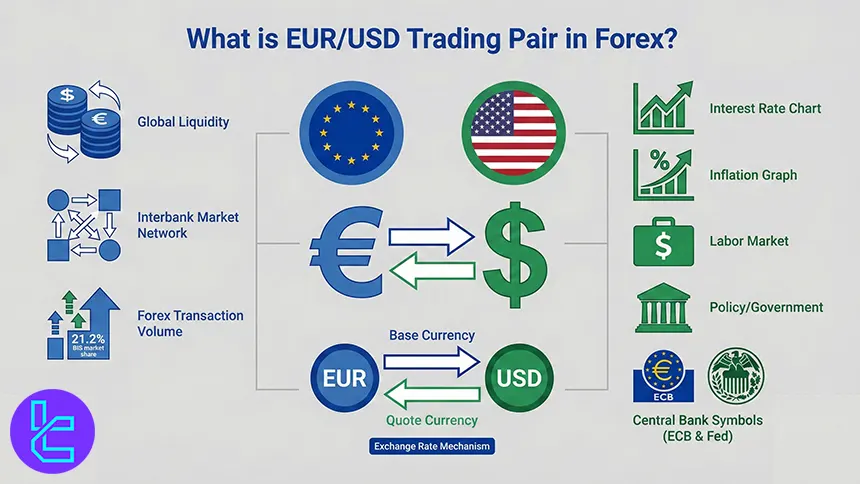
The EUR/USD currency pair represents the exchange rate between the euro and the US dollar and remains the most actively traded instrument in the global foreign exchange market.
Introduced after the launch of the euro in 1999, the pair replaced legacy European currencies such as the Deutsche Mark and French Franc, gradually becoming a central benchmark for liquidity and capital flow across international financial systems.
According to data published by the Bank for International Settlements (BIS), EUR/USD accounts for approximately 21.2% of total daily forex transactions, exceeding the trading volume of pairs such as USD/JPY and USD/GBP.
In quotation terms, the euro functions as the base currency, while the US dollar is the quote currency, meaning that the exchange rate reflects how many US dollars are required to purchase one euro.
Price movements in EUR/USD are primarily influenced by macro economic dynamics within the Eurozone and the United States.
Monetary policy divergence between the European Central Bank (ECB) and the Federal Reserve (Fed), particularly in relation to interest rate adjustments, plays a significant role in shaping capital allocation and investor sentiment.
Additional factors such as inflation trends, labor market data, fiscal policy announcements, and geopolitical developments, including trade disputes or elections in major economies like Germany or France can contribute to fluctuations in EUR/USD valuation.
What Are the Pros and Cons of Trading EUR/USD?
EUR/USD remains the most liquid currency pair in the global forex market, offering consistently tight spreads, deep institutional liquidity, and round-the-clock availability throughout the 24/5 trading week.
Its strong correlation with macroeconomic data from the Eurozone and the United States allows traders to interpret price movements through monetary policy signals from the ECB and the Federal Reserve (Fed), particularly during the London and New York sessions.
Despite these structural advantages, EUR/USD trading is closely tied to economic releases such as inflation reports, employment statistics, and interest rate decisions, which may trigger rapid volatility.
The pair’s sensitivity to central bank forward guidance, geopolitical developments, and cross-border capital flows can lead to temporary price distortions, false breakouts, or low-volatility phases outside peak liquidity windows.
Pros | Cons |
Continuous 24/5 access across London and New York trading sessions | Increased competition from institutional market participants |
Availability of macroeconomic data from Eurozone and US economies | Reduced volatility outside London–New York overlap |
Compatibility with technical analysis due to structured price behavior | Potential for false breakouts around major economic news releases |
Deep liquidity and tight spreads due to global participation in EUR/USD | Strong reaction to ECB and Federal Reserve interest rate decisions |
What are the Trading Costs of EUR/USD in Forex Brokers?
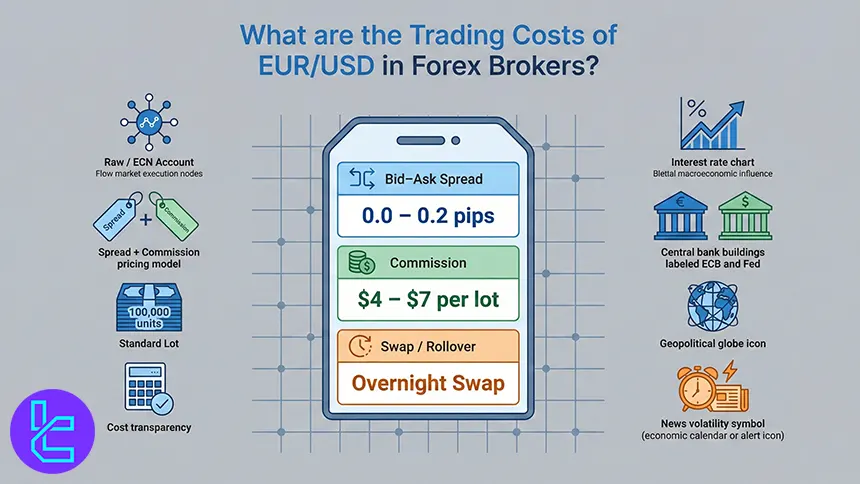
Transaction expenses associated with EUR/USD trading are typically determined by a combination of bid–ask spreads and broker commissions, with pricing structures varying across Standard and Raw/ECN account types.
On Raw or ECN accounts, spreads can narrow to approximately 0.0-0.2 pips under normal liquidity conditions, although these are usually accompanied by round-turn commissions ranging between $4 and $7 per standard lot (100,000 units).
In contrast, spread-only accounts eliminate commission charges but tend to apply wider pricing bands, often in the range of 0.8 to 1.2+ pips.
From a cost-efficiency standpoint, Raw or ECN environments are frequently evaluated based on their combined spread-plus-commission model.
For instance, a 0.1 pip spread combined with a $6 commission per lot may yield an effective transaction cost near $7, which can be more transparent than variable spread-only alternatives during stable market conditions.
Overnight financing, commonly referred to as swap or rollover, introduces an additional variable tied to the interest rate differential between the European Central Bank (ECB) and the Federal Reserve (Fed).
Depending on positioning, holding short EUR/USD exposure may occasionally generate a modest positive carry, while long positions may incur swap-related charges.
It is also important to note that EUR/USD spreads and commissions are subject to fluctuation during high-impact macroeconomic releases or geopolitical developments, potentially resulting in temporary spread widening.
EUR/USD Trading Time
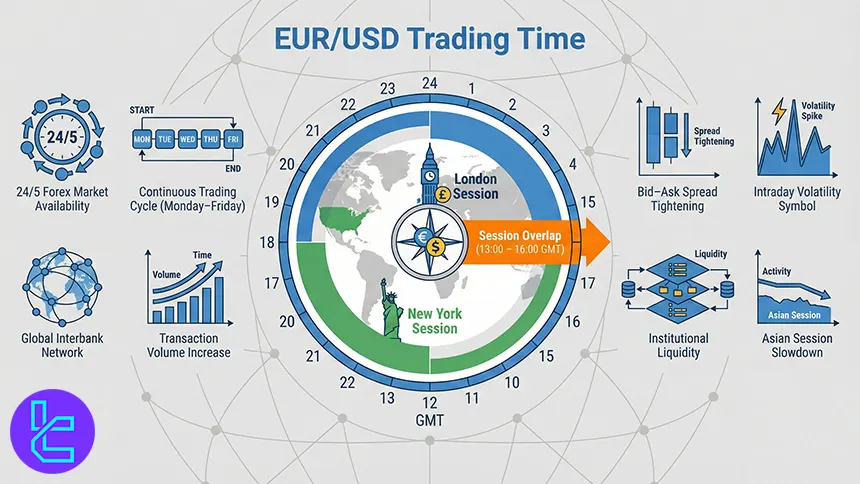
The EUR/USD pair is traded within the global forex market’s continuous weekly cycle, which operates 24 hours per day from Monday through Friday.
Although price quotes are available throughout this period, actual trading conditions such as liquidity levels, volatility, and bid–ask spread stability tend to fluctuate depending on the activity of major financial centers.
Market participation and transaction volume typically increase when the London and New York sessions overlap, creating more favorable execution conditions for EUR/USD traders.
This time window often reflects deeper institutional liquidity and improved market efficiency across the interbank network.
Key characteristics of EUR/USD Forex trading hours include:
- The forex market remains open 24 hours a day, five days a week (Monday to Friday)
- Highest trading activity occurs between 13:00 and 16:00 GMT
- This period reflects the overlap of London and New York sessions
- Bid–ask spreads are generally tighter during peak institutional participation
- Intraday volatility tends to increase due to higher transaction volume
- Asian session trading may result in slower price movement and reduced momentum
During the London-New York overlap, enhanced order flow can improve execution quality, particularly for short-term trading models such as day trading or scalping strategies.
In contrast, off-peak hours may introduce lower volatility, potentially affecting trade timing and intraday opportunity identification in EUR/USD.
What is the Maximum Leverage for Trading EURUSD Pair?
Leverage levels available for trading the EUR/USD currency pair are not fixed and largely depend on both the broker’s regulatory environment and the jurisdiction in which the trading account is registered.
Due to the pair’s deep liquidity in the global Forex market, many trading platforms are able to provide relatively flexible margin requirements; however, regulatory frameworks impose strict boundaries in certain regions.
In major financial jurisdictions such as the European Union, the United Kingdom, and Australia, retail traders are typically limited to a maximum leverage ratio of 1:30 when trading EUR/USD.
This restriction is mandated by oversight bodies including the European Securities and Markets Authority (ESMA), the Financial Conduct Authority (FCA), and the Australian Securities and Investments Commission (ASIC), with the primary objective of reducing the probability of disproportionate capital losses.
Key leverage conditions across regulatory environments include:
- Retail leverage capped at 1:30 under ESMA, FCA, and ASIC frameworks
- Professional client classification may allow leverage up to 1:500
- Offshore-regulated brokers may offer leverage between 1:500 and 1:1000
- Common offshore jurisdictions include Vanuatu, Seychelles, and Mauritius
- Higher leverage increases both exposure and downside risk
- Margin-based trading requires disciplined position sizing
While offshore brokers operating in regions such as St. Vincent and the Grenadines may provide significantly higher leverage for EUR/USD, this flexibility is typically accompanied by reduced regulatory protection.
How to Choose the Best Broker for Trading EUR/USD
Selecting a Forex broker for trading the EUR/USD pair requires more than checking the advertised minimum pricing.
Since execution quality, regulatory status, and trading infrastructure directly influence effective trading costs, evaluating brokers based on operational transparency and platform performance is essential for maintaining consistent order execution in the Forex market.
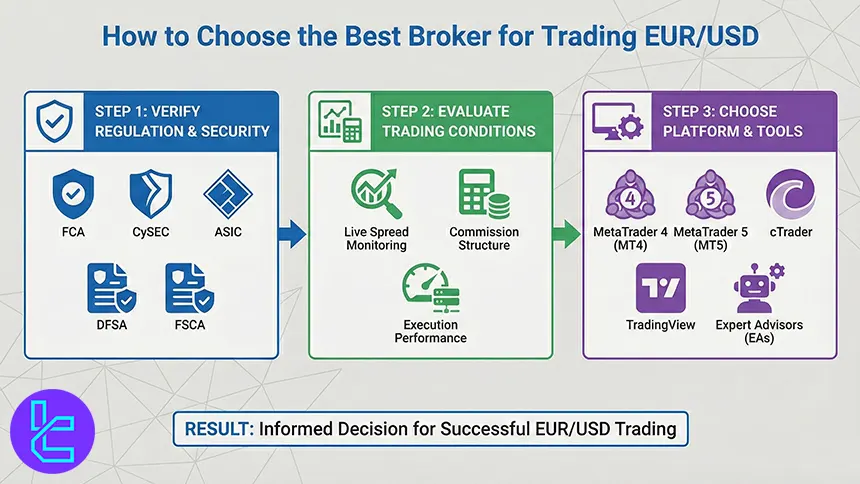
- Live Spread Monitoring: Advertised spreads (e.g., 0.0 pips) may differ from real-time averages; reviewing actual EUR/USD spreads during active sessions provides a more accurate estimate of transaction costs;
- Regulatory Oversight: Brokers supervised by authorities such as FCA, CySEC, ASIC, DFSA, or FSCA are typically required to follow stricter compliance standards regarding client fund segregation and trade execution practices;
- Commission Structure: Zero-spread or Raw accounts often include per-lot commissions; assessing the combined cost of spread plus commission helps determine the true cost-efficiency of EUR/USD trading;
- Execution Performance: Fast order execution supported by modern server infrastructure is particularly relevant for scalping, news trading, and algorithmic trading strategies using Expert Advisors (EAs);
- Trading Platform Availability: Access to platforms such as MetaTrader 4 (MT4), MetaTrader 5 (MT5), cTrader, or TradingView enables advanced charting, automated trading, and improved liquidity routing for EUR/USD positions.
What Are the Non-Trading Fees in EUR/USD Forex Brokers?
In EUR/USD Forex trading, non-trading fees represent operational expenses that are not directly related to executing buy or sell positions in the market.
These costs typically arise from account usage conditions, funding mechanisms, or currency mismatches rather than from spreads or commissions, yet they can still impact the long-term efficiency of trading activities.
For example, inactivity fees may be applied when a trading account remains unused for a specific duration, often between three to twelve months, with some brokers charging around $10 per month after the dormancy threshold is reached.
Withdrawal fees are another potential expense, as although many Forex brokers process payouts at no cost certain platforms may impose fixed charges, particularly for international bank transfers or wire payments.
Currency conversion fees can also occur when funds are deposited or withdrawn in a currency that differs from the account’s base denomination, such as funding a USD trading account with EUR.
In some cases, brokers may introduce account maintenance fees to support platform infrastructure or compliance procedures, although this is relatively uncommon among top-tier providers.
Additionally, deposit fees may apply when using specific payment methods or regional banking gateways, even though most mainstream funding options remain commission-free.
Regulatory Authorities that Supervise EUR/USD Trading in Forex Brokers
EUR/USD trading is conducted through Forex brokers that operate under the supervision of both national and international financial regulators.
Given the decentralized structure of the global foreign exchange market, oversight is applied at the jurisdictional level, where regulatory authorities enforce compliance standards related to client fund protection.
Among top-tier supervisory bodies, organizations such as the Financial Conduct Authority (FCA) in the United Kingdom, the Australian Securities and Investments Commission (ASIC), and the Swiss Financial Market Supervisory Authority (FINMA) are responsible for maintaining strict operational and capital adequacy.
Within the European Union, regulatory alignment is guided by ESMA, with enforcement delegated to national agencies including BaFin in Germany and AMF in France.
Other recognized regional regulators include CySEC in Cyprus, CONSOB in Italy, CNMV in Spain, the Central Bank of Ireland, and international entities such as the Financial Services Authority (FSA) in Japan, and the Financial Sector Conduct Authority (FSCA).
Offshore jurisdictions such as FSC Belize, FSA Seychelles, and the BVI Financial Services Commission also license Forex brokers, typically under less restrictive frameworks.
Across these environments, mandated protections often include segregated client accounts, negative balance protection, and regulatory capital thresholds designed to ensure fair pricing and operational resilience.
Best Strategies for EUR/USD Trading
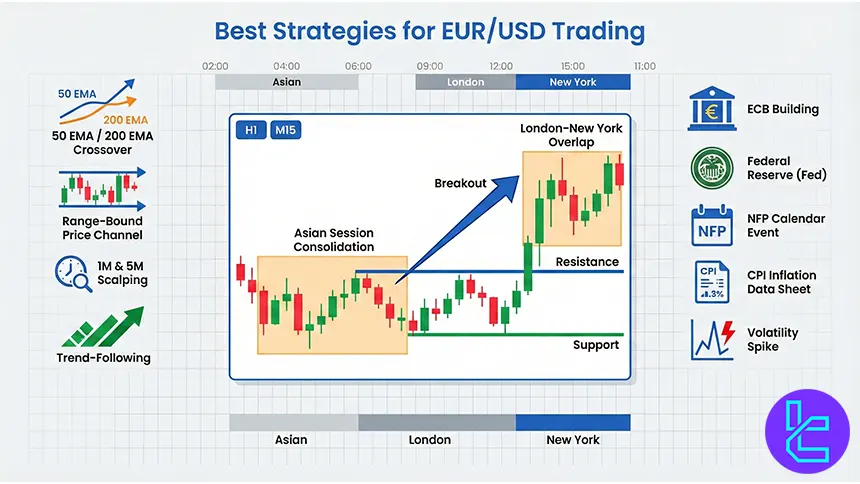
Trading strategies applied to the EUR/USD pair often focus on capitalizing on its deep liquidity profile and relatively narrow spreads, especially during periods of heightened market participation such as the London–New York session overlap.
Many systematic approaches integrate multi-timeframe technical analysis, commonly using H1 and M15 charts, while simultaneously accounting for macroeconomic signals influenced by institutions like the European Central Bank (ECB) and the Federal Reserve (Fed).
In practice, traders frequently combine technical frameworks with session-based volatility patterns to identify high-probability setups.
Monitoring consolidation ranges formed during the Asian session and assessing how price behaves around established support and resistance zones can provide context for breakout or mean-reversion opportunities.
In addition, key economic releases such as Non-Farm Payrolls (NFP) and Consumer Price Index (CPI) data often introduce short-term volatility that may influence directional bias.
Common EUR/USD trading approaches include:
- London-New York session breakout strategies that focus on price movements beyond the Asian session range once European liquidity enters the market;
- Trend-following models using indicators such as the 50 EMA and 200 EMA on 1-hour or 4-hour charts to assess prevailing momentum;
- Range-based trading methods that rely on horizontal support and resistance levels during low-volatility market phases;
- Fundamental-driven setups built around ECB or Fed interest rate announcements and inflation-related releases;
- Short-term price action or scalping techniques applied on 1-minute or 5-minute timeframes in low-spread trading environments.
What is the Best Trading Account for EUR/USD Trading?
Choosing a suitable trading account for EUR/USD in typically involves evaluating execution speed, pricing transparency, and access to institutional-grade liquidity.
As the most actively traded currency pair in the Forex market, EUR/USD benefits from accounts that provide raw or near-raw spreads, often ranging between 0.0 and 0.2 pips under ECN or DMA-style conditions.
These environments are commonly preferred by traders deploying short-term strategies or algorithmic models that depend on low latency and minimal transaction costs.
In addition, trading accounts that integrate with platforms such as MetaTrader 4, MetaTrader 5, or TradingView offer enhanced flexibility for applying technical tools like Moving Averages, price action models, and automated Expert Advisors (EAs).
Regulatory oversight, margin requirements, and order execution models also play a role in determining the suitability of an account for EUR/USD exposure across different market conditions.
Full Comparison of EUR/USD Symbol to Other Popular Instruments in Forex
The table below helps you compare the trading conditions of EUR/USD to other famous trading pairs.
Parameter | EUR/USD | GBP/USD | USD/JPY | USD/CAD |
Market Type | Major Currency Pair | Major Currency Pair | Major Currency Pair | Major Currency Pair |
Base Currency | Euro (EUR) | British Pound (GBP) | US Dollar (USD) | US Dollar (USD) |
Quote Currency | US Dollar (USD) | US Dollar (USD) | Japanese Yen (JPY) | Canadian Dollar (CAD) |
Average Daily Volatility | Medium | High | Medium | Medium |
Liquidity Level | Very High | High | Very High | High |
Typical Spread (Raw) | 0.0 - 0.2 pips | 0.2 - 0.4 pips | 0.1 - 0.3 pips | 0.2 - 0.5 pips |
Correlation with USD Index | Strong Inverse | Moderate Inverse | Moderate Direct | Moderate Direct |
Influencing Central Banks | ECB / Federal Reserve (Fed) | Bank of England / Fed | Bank of Japan / Fed | Bank of Canada / Fed |
Best Trading Sessions | London / New York Overlap | London / New York | Tokyo / New York | New York |
Conclusion
Based on our review of the best EURUSD brokers, eToro, Exness, Deriv, FP Markets, FBS, and Moneta Markets are the best available options.
Now traders must consider regulatory authority, minimum deposits, leverage limits, and account types to find the best broker that are suitable for their needs.
To understand the criteria and key factors behind our broker selection, please refer to TradingFinder Forex methodology page.