





Forex brokers offer leveraged trading for various assets, including currency pairs, stocks, commodities, cryptocurrencies, indices, etc. based on financial authoritie’s rules and regulations in the traders region.
Top regulatory authorities such as ASIC, FCA, SEC, CIRO, and CySEC impose lower limits (up to 1:30 or 1:50) while offshore regulatory often allow higher amounts (up to 1:unlimited).
The list below helps you choose the best Forex broker that offers high leverage.
 | AVATRADE | |||
 | Exness | |||
 | TradersTrust | |||
| 4 |  | HFM | ||
| 5 |  | FxGLORY | ||
| 6 |  | instaforex | ||
| 7 |  | FBS | ||
| 8 |  | deriv | ||
| 9 |  | WINDSORBROKERS | ||
| 10 |  | NORD FX |
High Leverage Broker’s Trustpilot Rating Comparison
To ensure funds safety in Forex brokers with high leverage, traders must first check user reviews and trust ratings in well-known websites. Here are the Trustpilot ratings of the best brokers with high leverage.
Broker Name | Trustpilot Rating | Number of Reviews |
+12000 | ||
Exness | +27000 | |
Traders Trust | +500 | |
NordFX | +72 | |
+2900 | ||
FBS | +8000 | |
+71000 | ||
FXGlory | +60 | |
Windsor | +100 | |
InstaForex | +400 |
Maximum Leverage in Forex Brokers
Having access to high leverage allows traders to gain higher exposure while putting less money into each trade. However, this could also make the trades close faster in volatile markets conditions since there isn’t enough margin.
Broker Name | Leverage |
1:Unlimited | |
1:3000 | |
ForexMart | 1:3000 |
BDSwiss | 1:2000 |
XM | 1:1000 |
Fibo Group | 1:1000 |
Tickmill | 1:1000 |
AvaTrade | 1:400 |
Non-Trading Fees in High Leverage Forex Brokers
Deposit, withdrawal, currency conversion, and inactivity fees are some of the most important non-trading costs of using high leverage brokers. The table below outlines these fees for some of the best brokers that offer high leverage.
Broker Name | Deposit Fee | Withdrawal Fee | Inactivity Fee |
LMFX | $0 | $0 | $0 |
NPBFX | $0 | $0 | $0 |
Trader’s Way | $0 | $0 | $0 |
$0 | $3 | $0 | |
$0 | 3% to 9% | $0 | |
Axiory | $0 | $10 | $5 |
$0 | 0.5% to 3.5% | $10 | |
FXPrimus | $0 | $0 | $10 |
easyMarkets | $0 | $0 | $25 |
MTrading | $0 | $0 | $50 |
Minimum Spreads in High Leverage Brokers
Spreads and commissions are the main costs of using the high leverage brokers. The table below provides a comparison of the minimum spreads in these brokers.
Broker Name | Spreads |
0.0 Pips | |
HFM | 0.0 Pips |
0.0 Pips | |
IC Markets | 0.0 Pips |
Forex.com | 0.0 Pips |
Eightcap | 0.0 Pips |
FxPro | 0.0 Pips |
AMarkets | 0.0 Pips |
Fusion Markets | 0.0 Pips |
IG | 0.6 Pips |
Top 8 Brokers that Offer High Leverage
Brokers offer trading leverage based on the rules and regulations set by the official monetary authority of the region. This could vary from 1:30 in EU and Britain to up to 1:3000 in offshore regulators.
In the following paragraph, you can learn about trading fess, maximum leverage, payment methods, customer support quality, and minimum deposit requirements in the top brokers with highest leverage.
Exness
Exness is a multi-regulated forex and CFD broker founded in 2008 by Petr Valov and Igor Lychagov.
The company has grown into one of the largest retail brokers in the market, reporting monthly trading volumes above $4 trillion and serving clients through several licensed entities worldwide.
Exness operates under the supervision of authorities such as FCA, CySEC, FSCA, FSA, FSC, CBCS, and CMA, while also offering segregated funds, Negative Balance Protection, and investor compensation schemes in selected regions.
The broker supports a broad range of instruments, including Forex, stocks, indices, commodities, andcryptocurrencies.
Traders can access these markets through MT4, MT5, Exness Terminal, and the Exness Trade mobile app. This broker also provides investment features such as copy trading, algorithmic trading, and VPS hosting for active users in the Exness dashboard.
Account options include Standard, Standard Cent, Pro, Zero, and Raw Spread accounts.
Trading costs remain relatively competitive, with spreads starting from 0.0 pips and commissions ranging from $0.2 to $3.5 depending on the account type. Traders can lower costs by joining the Exness rebate program.
The minimum deposit starts at $10 after completing the Exness registration, while leverage can reach 1:2000 or even unlimited for eligible users.
Exness also supports multiple funding methods, including bank cards, Neteller, Skrill, SticPay, USDT, BTC, and Binance Pay, with no inactivity, deposit, or withdrawal fees.
Account Types | Standard, Standard Cent, Pro, Zero, Raw Spread |
Regulating Authorities | FSA, CySEC, FCA, FSCA, CBCS, FSC, CMA |
Minimum Deposit | From $10 |
Deposit Methods | Neteller, Skrill, Perfect Money, SticPay, Bank Cards, Bank Transfer, USDT, BTC, Binance Pay |
Withdrawal Methods | Neteller, Skrill, Perfect Money, SticPay, Bank Cards, Bank Transfer, USDT, BTC, Binance Pay |
Maximum Leverage | Up to Unlimited |
Trading Platforms & Apps | Exness Trade, Exness Terminal, MT4, MT5, WebTerminal, Social Trading App |
Exness Pros and Cons
The table below outlines the benefits and limitations of trading with the Exness broker.
Pros | Cons |
Regulated by FCA, CySEC, FSCA, FSA, FSC, CBCS, and CMA | Restricted in countries such as Canada, Australia, and Iran |
Spreads from 0.0 pips and commissions from $0.2 | Educational content is less extensive than some competitors |
Supports MT4, MT5, Exness Terminal, and mobile trading | - |
Minimum deposit starts from $10 | - |
AvaTrade
AvaTrade is a multi-asset broker with regulatory licenses from authorities including CBI, CySEC, ASIC, FSCA, FSA, ADGM, BVI FSC, ISA, and MiFID.
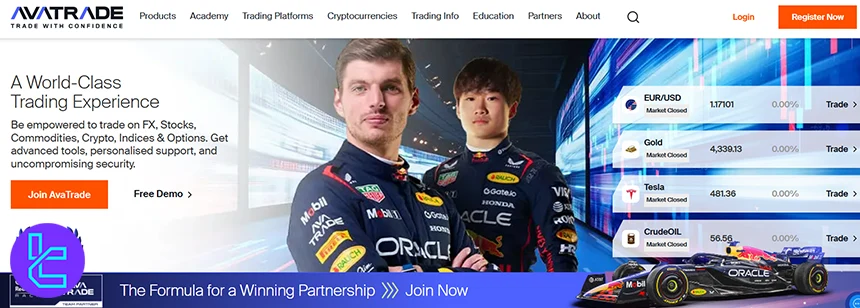
The broker operates across multiple jurisdictions and offers segregated funds, Negative Balance Protection, and investor compensation coverage for eligible European clients.
AvaTrade supports traders in more than 150 countries, although access is restricted in regions such as the United States, Belgium, Iran, Cuba, and Syria.
AvaTrade registration provides access to Forex, stocks, indices, commodities, cryptocurrencies, bonds, and options through MT4, MT5, WebTrader, AvaOptions, and mobile trading apps.
Account choices include Retail, Professional, Islamic, and Demo accounts, allowing different trader profiles to access tailored trading conditions.
This broker requires a minimum deposit of $100. Various AvaTrade deposit and withdrawal methods are available, including credit cards, debit cards, bank wire transfers, Skrill, Neteller, WebMoney, and PayPal.
Maximum leverage can reach 1:400 depending on the jurisdiction, while margin call and stop out levels are set at 25% and 10%.
Trading costs are primarily spread-based, with no commission charged on most products. AvaTrade also does not apply deposit or withdrawal fees, although inactivity fees may appear after extended periods without trading activity.
Additional features include copy trading through AvaSocial and DupliTrade, Islamic accounts, educational resources, and 24/5 multilingual customer support and are available on the AvaTrade dashboard.
Account Types | Retail, Professional, Islamic, Demo |
Regulating Authorities | ASIC, CySEC, CBI, FSA, FSCA, MiFID, ADGM, BVI FSC, ISA |
Minimum Deposit | $100 |
Deposit Methods | Credit/Debit Cards, Bank Wire Transfer, Skrill, Neteller, WebMoney, PayPal |
Withdrawal Methods | Credit/Debit Cards, Bank Wire Transfer, Skrill, Neteller, WebMoney, PayPal |
Maximum Leverage | Up to 1:400 |
Trading Platforms & Apps | MT4, MT5, WebTrader, AvaOptions, Mobile App |
AvaTrade Pros and Cons
Checking the table below allows you to understand the benefits and drawbacks of trading with the AvaTrade broker.
Pros | Cons |
Regulated by ASIC, CySEC, CBI, FSCA, FSA, and other major authorities | Inactivity fee applies after prolonged periods without trading |
Supports MT4, MT5, WebTrader, AvaOptions, and mobile trading | Restricted in countries such as the United States and Belgium |
Offers copy trading through AvaSocial and DupliTrade | No PAMM account support |
No deposit or withdrawal fees charged by the broker | - |
FBS
FBS is a multi-asset broker that has operated since 2009 and serves a broad international client base through separate entities in Belize, Cyprus, and Australia.
Its regulatory structure includes oversight from CySEC and ASIC for regional branches, while the global arm operates under FSC Belize.
Across these entities, the broker provides segregated funds and Negative Balance Protection, with leverage conditions varying by jurisdiction from 1:500 to as high as 1:3000 for eligible international clients.
The broker gives access to more than 550 CFD instruments across Forex, shares, indices, commodities, metals, and cryptocurrencies.
Trading is available through MetaTrader 4, MetaTrader 5, and the proprietary FBS mobile application, which includes more than 90 technical indicators and supports account management, market access, and trade execution from a single interface.
FBS registration allows you to access Standard account, with a minimum deposit starting from $5 and order size from 0.01 lot.
Spreads are floating and begin at 0.7 pips, while no additional trading commission is charged under standard conditions. Traders can lower trading costs by leveraging FBS rebates.
The broker also supports Islamic accounts and demo accounts, but it does not currently provide PAMM or copy trading services.
On the operational side of the FBS dashboard, deposits and withdrawals are supported through cards, bank transfers, e-wallets, and local payment systems, depending on region.
FBS also offers educational materials, market analysis, VPS access for eligible users, and 24/7 multilingual customer support.
Account Types | Standard |
Regulating Authorities | FSC Belize, CySEC, ASIC |
Minimum Deposit | From $5 |
Deposit Methods | Bank Transfer, Credit/Debit Cards, Skrill, Neteller, Sticpay, Perfect Money, PIX, Local Payment Systems |
Withdrawal Methods | Bank Transfer, Credit/Debit Cards, Skrill, Neteller, Sticpay, PIX, Local Bank Transfers |
Maximum Leverage | Up to 1:3000 |
Trading Platforms & Apps | MT4, MT5, FBS Mobile App |
FBS Pros and Cons
The table below provides a detailed look at the benefits and drawbacks of the FBS broker.
Pros | Cons |
Regulated by CySEC, ASIC, and FSC Belize | Only one live account type is available |
Minimum deposit starts from $5 | No PAMM, MAM, or copy trading services |
Supports MT4, MT5, and a proprietary mobile app with 90+ indicators | Restricted in regions such as the US, UK, EU, Israel, and Iran |
Provides access to 550+ instruments across Forex, stocks, indices, commodities, and crypto | - |
HFM
HFM, also known as Hot Forex Markets, has operated since 2010 and supports more than 2.5 million live accounts across over 27 languages.
The broker is regulated by several authorities, including the FCA in the UK, CySEC in Europe, DFSA in the UAE, FSCA in South Africa, and FSA in Seychelles.
This regulatory structure allows HFM to serve traders across multiple regions while offering different leverage limits and investor protection rules depending on the branch.
The broker provides access to Forex, metals, commodities, indices, stocks, ETFs, bonds, energies, and cryptocurrencies through MT4, MT5, and its own mobile app after completing the HFM registration.
Trading conditions vary by account type, with Cent, Zero, Pro, and Premium accounts available. Forex spreads start from 0.0 pips on the Zero account, while commission-free trading is offered on most other account types.
Trading costs can be lowered by using the TradingFinder HFM rebate program.
HFM supports deposits and withdrawals through bank wires, cards, e-wallets, and cryptocurrencies. It also offers swap-free accounts, copy trading, PAMM accounts, VPS services, Autochartist integration, SMS market alerts, and several trading calculators. The minimum deposit starts from $0, while leverage can reach 1:2000 for international clients.
Platform variety remains limited compared to some competitors, and certain regions, including the United States, are restricted.
Account Types | Cent, Zero, Pro, Premium |
Regulating Authorities | FCA, CySEC, DFSA, FSCA, FSA Seychelles |
Minimum Deposit | From $0 |
Deposit Methods | Bank Wire, Credit/Debit Cards, Skrill, Neteller, Perfect Money, Crypto |
Withdrawal Methods | Bank Wire, Credit/Debit Cards, Skrill, Neteller, Perfect Money, Crypto, WebMoney |
Maximum Leverage | Up to 1:2000 |
Trading Platforms & Apps | MT4, MT5, HFM Mobile App |
HFM Pros and Cons
Traders must understand the benefits and drawbacks of using the HFM services before opening an account with this broker.
Pros | Cons |
Regulated by FCA, CySEC, DFSA, FSCA, and FSA Seychelles | Not available in countries such as the United States, France, Belgium, and Iran |
Offers spreads from 0.0 pips and commission-free Forex trading on most accounts | Inactivity fees apply after six months without trading |
Supports copy trading, PAMM accounts, VPS, and Autochartist | - |
Provides access to more than 1,000 instruments across Forex, stocks, ETFs, crypto, and commodities | - |
InstaForex
InstaForex is a multi-asset broker founded in 2007, with operations centered around Forex, stocks, indices, commodities, cryptocurrencies, and futures.
The company states that it serves more than 7 million clients worldwide and maintains a broad international presence through representative offices and regional entities.
Its trading environment is built around MetaTrader 4, MetaTrader 5, WebTrader, and mobile applications, giving traders access to both manual and automated execution tools.
The broker offers four main account formats: Insta.Standard, Insta.Eurica, Cent.Standard, and Cent.Eurica.
These structures are designed for different deposit sizes and trading styles, with entry requirements starting from just $1 and minimum order sizes from 0.01 lot.
Maximum leverage can reach 1:1000, while trading conditions include both market and instant execution after completing the InstaForex registration and creating an account.
Islamic accounts, demo accounts, copy trading through ForexCopy, and PAMM account services are also available.
InstaForex supports payments through bank transfers, cards, e-wallets, and cryptocurrencies, including Bitcoin, Litecoin, and Tether.
The broker’s asset coverage is relatively broad, with more than 100 Forex instruments, stock CFDs, index CFDs, commodity CFDs, and crypto CFDs.
On the cost side, spreads can start from zero on selected account types, while inactivity fees apply after three months without account activity.
Account Types | Insta.Standard, Insta.Eurica, Cent.Standard, Cent.Eurica |
Regulating Authorities | BVI FSC, CySEC (EU Branch) |
Minimum Deposit | From $1 |
Deposit Methods | Bank Transfer, Credit/Debit Cards, Skrill, Neteller, WebMoney, Crypto |
Withdrawal Methods | Bank Transfer, Credit/Debit Cards, Skrill, Neteller, WebMoney, Crypto |
Maximum Leverage | Up to 1:1000 |
Trading Platforms & Apps | MT4, MT5, WebTrader, Mobile App |
InstaForex Pros and Cons
Traders must check the table below to become familiar with the pros and cons of InstaForex before opening an account.
Pros | Cons |
Minimum deposit starts from $1 | Not regulated by major Tier-1 authorities such as FCA or ASIC |
Supports MT4, MT5, WebTrader, and mobile trading | No segregated funds or negative balance protection under the BVI entity |
Offers PAMM accounts, ForexCopy, Islamic accounts, and demo accounts | Inactivity fee applies after three months without trading activity |
Provides access to Forex, stocks, commodities, indices, crypto, and futures | - |
FXGlory
FxGlory is a Saint Lucia-based broker that focuses on high-leverage Forex trading and low entry requirements.
The company supports trading in currencies, metals, and oil through four FXGlory account types: Standard, Premium, VIP, and CIP. Minimum deposits start from just $1, while leverage can reach 1:3000 depending on the account type.
The FXGlory trading platforms include both MetaTrader 4 and MetaTrader 5, along with a WebTrader platform.
Core trading features include hedging, one-click trading, Expert Advisors, swap-free accounts, VPS services, calculators, and an economic calendar are available in the FXGlory dashboard.
Order execution is available through both market execution and instant execution models.
FxGlory operates without oversight from major regulators such as Financial Conduct Authority or Cyprus Securities and Exchange Commission.
It is registered in Saint Lucia, but registration alone does not provide the same level of investor protection as regulated jurisdictions. The broker does not offer segregated funds, negative balance protection, or compensation schemes.
Account conditions vary significantly. Standard accounts start with spreads from 2 pips, while CIP accounts offer spreads from 0.1 pips with lower leverage and higher capital requirements.
FxGlory supports deposits through bank transfer, cards, PayPal, Skrill, Neteller, WebMoney, Zelle, and cryptocurrency.
Although the broker offers commission-free trading, flexible lot sizes from 0.01, Islamic accounts, and 24/7 support, it has a limited instrument list, no copy trading or PAMM services, and relatively weak trust scores across review platforms.
Account Types | Standard, Premium, VIP, CIP |
Regulating Authorities | None |
Minimum Deposit | From $1 |
Deposit Methods | Wire Transfer, Credit/Debit Cards, PayPal, Skrill, Neteller, WebMoney, Sticpay, Perfect Money, Crypto, Zelle |
Withdrawal Methods | Wire Transfer, Credit/Debit Cards, PayPal, Skrill, Neteller, WebMoney, Sticpay, Perfect Money, Crypto, Zelle |
Maximum Leverage | Up to 1:3000 |
Trading Platforms & Apps | MT4, MT5, WebTrader |
FXGlory Pros and Cons
The table below contains important benefits and limitations of trading with the FXGlory broker.
Pros | Cons |
Minimum deposit starts from $1 | No regulation from FCA, ASIC, CySEC, or other major authorities |
Supports MT4, MT5, and WebTrader platforms | No segregated funds or negative balance protection |
Offers leverage up to 1:3000 | Limited number of tradable instruments |
Provides swap-free accounts and 24/7 support | No copy trading, PAMM, or social trading features |
NordFX
NordFX has been active since 2008 and reports more than 1.7 million accounts across 190 countries. The broker offers MT4 Pro, MT4 Zero, MT5 Pro, and MT5 Zero accounts with spreads starting from 0.0 pips and leverage reaching 1:1000.
Trading is available on Forex pairs, cryptocurrencies, metals, energies, indices, and stocks, while minimum deposits start from $10 after completing the NordFX registration.
The broker relies on MetaTrader 4 and MetaTrader 5 as its primary platforms, giving traders access to Expert Advisors, automated trading, advanced charting, VPS hosting, and MQL5 copy trading tools.
Additional services include PAMM accounts, Islamic accounts, demo accounts, and copy trading solutions for users seeking passive investment options in the NordFX dashboard.
NordFX deposit and withdrawal methods include bank transfers, cards, e-wallets, and cryptocurrencies, including USDT on TRC20, ERC20, and BEP20 networks.
Most transactions are processed quickly, and the broker does not generally apply internal deposit fees, although third-party costs may vary depending on the payment provider.
Despite offering competitive spreads, multilingual support, and flexible leverage, NordFX operates without oversight from a major Tier-1 regulator.
The broker is registered in Saint Lucia and also maintains entities in Seychelles and Mauritius.
This regulatory structure may be a concern for traders who prioritize investor compensation schemes and stronger legal protection.
Account Types | MT4 Pro, MT4 Zero, MT5 Pro, MT5 Zero |
Regulating Authorities | FSA Seychelles, FSC Mauritius, Saint Lucia Registration |
Minimum Deposit | From $10 |
Deposit Methods | Bank Wire, Credit/Debit Cards, Skrill, Neteller, Perfect Money, Crypto |
Withdrawal Methods | Bank Wire, Credit/Debit Cards, Skrill, Neteller, Perfect Money, Crypto, Internal Transfer |
Maximum Leverage | Up to 1:1000 |
Trading Platforms & Apps | MT4, MT5 |
NordFX Pros and Cons
The table below offers deeper insights on the advantages and disadvantages of the NordFX broker.
Pros | Cons |
Offers spreads from 0.0 pips with leverage up to 1:1000 | Not regulated by major Tier-1 authorities such as FCA, ASIC, or CySEC |
Supports MT4, MT5, Expert Advisors, VPS, and MQL5 copy trading | Restricted in countries such as the United States, Canada, and EU member states |
Provides PAMM accounts, copy trading, Islamic accounts, and demo accounts | Educational and research content is more limited than many competitors |
Minimum deposit starts from $10 | - |
Deriv
Deriv is a multi-asset broker that evolved from Binary.com after its 2020 rebrand. The company has been active since 1999 and reports more than 2.5 million registered users, over 187 million monthly trades, and trading volumes exceeding $650 billion per month.
Its infrastructure spans multiple global offices, including locations in Malta, Dubai, Singapore, Cyprus, and Hong Kong.
The broker operates through several regulated entities, including oversight from the MFSA, LFSA, VFSC, and BVI Financial Services Commission.
Depending on the jurisdiction, leverage ranges from 1:30 to 1:1000, while client safeguards include segregated funds, Negative Balance Protection, and compensation coverage through the Financial Commission or Investor Compensation Fund.
Deriv supports trading in Forex, stocks, commodities, indices, ETFs, cryptocurrencies, and proprietary Derived Indices.
Traders can use MetaTrader 5, cTrader, and Deriv X, with spreads starting from 0.24 pips and no direct commissions after the Deriv registration process.
The broker offers Standard, Financial, and Swap-Free accounts with a minimum deposit of $5. Copy trading is available through cTrader, while payment options include bank cards, e-wallets, crypto, online banking, and Deriv P2P. Deriv verification is required for all traders.
Despite its broad market access and low-cost structure, the platform can feel complex for beginners and does not provide PAMM or MAM services in the Deriv dashboard.
Account Types | Standard, Financial, Swap-Free |
Regulating Authorities | MFSA, Labuan FSA, VFSC, BVI FSC |
Minimum Deposit | From $5 |
Deposit Methods | Credit/Debit Cards, Online Banking, E-Wallets, Mobile Payments, Crypto, Voucher, Deriv P2P |
Withdrawal Methods | Credit/Debit Cards, Online Banking, E-Wallets, Mobile Payments, Crypto, Voucher, Deriv P2P |
Maximum Leverage | Up to 1:1000 |
Trading Platforms & Apps | MT5, cTrader, Deriv X |
Deriv Pros and Cons
The table below offers an outline on the Deriv pros and cons.
Pros | Cons |
Minimum deposit starts from $5 | No PAMM or MAM account services |
Supports MT5, cTrader, and Deriv X platforms | - |
Provides access to Forex, stocks, indices, commodities, crypto, ETFs, and Derived Indices | - |
Offers copy trading through cTrader | - |
What is Leverage in Forex?
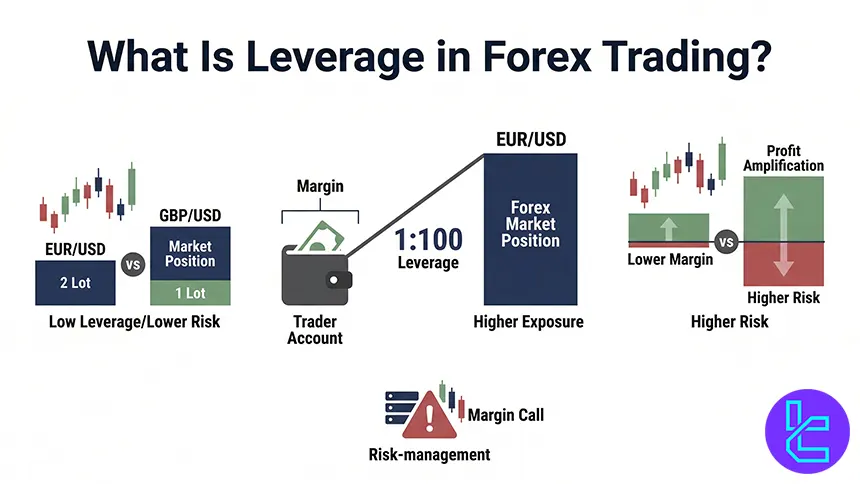
Leverage in Forex trading allows traders to open positions that are larger than the actual balance available in their account.
It works as a form of borrowed capital provided by the broker, increasing market exposure without requiring the full trade value upfront.
The amount that must be deposited to maintain a leveraged trade is called margin.
Margin is usually expressed as a percentage of the total position size. For example, a 1% margin requirement is equivalent to 1:100 leverage, meaning a trader can control a $100,000 position with $1,000 in available funds.
Leverage ratios vary widely across brokers and regulators. Lower ratios such as 1:10 or 1:30 are commonly used in more tightly regulated regions, while offshore brokers may offer leverage up to 1:500 or higher.
Although higher leverage reduces the amount of margin needed to enter a trade, it also increases exposure to market volatility.
Because both profits and losses are amplified, leverage plays a major role in risk management.
If market movements go against an open position, the account may approach a margin call or stop-out level. For this reason, the selected leverage ratio should match the trader’s strategy, account size, and tolerance for risk.
Pros and Cons of Trading with Leverage
The table below outline the most important benefits and drawbacks of trading with leverage.
Pros | Cons |
Allows traders to control larger Forex, CFD, stock, or commodity positions with a smaller initial deposit | Amplifies losses in the same way it amplifies profits |
Improves capital efficiency by reducing the amount of margin needed to enter trades | Increases the risk of margin calls and forced liquidation |
Makes it possible to diversify across multiple markets without allocating full capital to each position | High leverage can lead to rapid account drawdowns during volatile market conditions |
Can increase returns when price movements align with the trader’s analysis | Overnight positions may generate swap fees or financing charges |
Useful for short-term strategies such as scalping, intraday trading, and swing trading | Excessive leverage often encourages overtrading and oversized positions |
Enables traders to keep more cash available for risk management or other investments | Emotional trading decisions become more common when position sizes are too large |
How Does the Leverage Work in Forex?
Leverage works by allowing traders to commit only a portion of a trade’s full value, while the broker provides the remaining capital.
The required deposit is known as margin, and the relationship between the total position size and the margin amount is called the leverage ratio.
In Forex trading, leverage can significantly increase market exposure without requiring a large initial balance.
For example, a standard lot on GBP/USD is equal to 100,000 units of the base currency. If GBP/USD is trading at 1.2860, the total value of the position would be $128,600.
Without leverage, the trader would need to provide the full amount to enter the position. With a 10% margin requirement, however, only $12,860 would be needed to control the same trade.
If the price later rises by 20 pips to 1.2880, the profit would still be approximately $200, even though the trader committed far less capital upfront.
This is why leverage is widely used in Forex, CFDs, commodities, and stock index trading. While it can improve capital efficiency, it also increases exposure to losses if the market moves in the opposite direction.
Leverage Limits in Different Regions
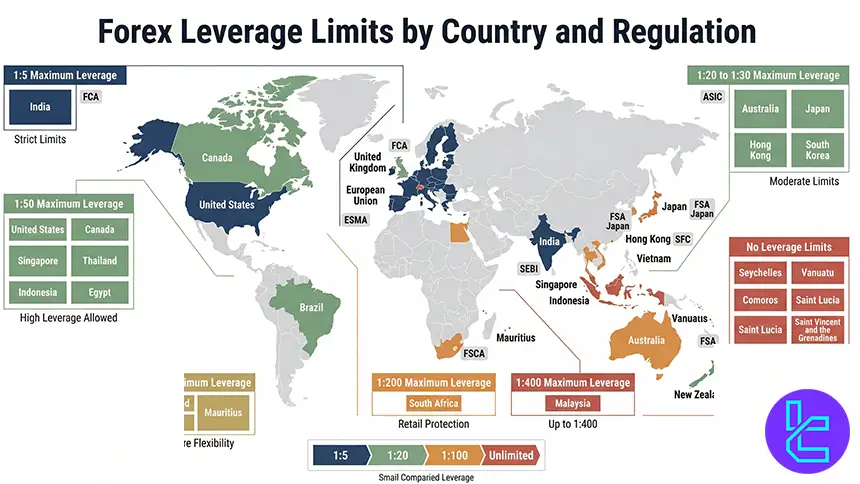
The maximum amount of leverage a broker is allowed to offer differs from one regulatory body to another. Traders in the UK, US, Australia, EEA, and Japan generally have access to lower leverage due to local restriction.
Countries with 1:5 Maximum Leverage
India has one of the most restrictive retail leverage frameworks. Under SEBI rules, leverage on major Forex pairs is generally capped at 1:5, while leverage on major indices is also limited to 1:5.
Countries with 1:20 to 1:30 Maximum Leverage
Several highly regulated jurisdictions apply conservative leverage limits for retail traders.
Australia, the European Union, the United Kingdom, New Zealand, South Korea, Japan, Hong Kong, and Vietnam generally restrict leverage on major Forex pairs to between 1:20 and 1:30.
These rules are commonly enforced by regulators such as ASIC, ESMA, FCA, FMA, FSA Japan, and SFC.
Countries with 1:50 Maximum Leverage
A number of jurisdictions allow slightly higher leverage while still maintaining tighter retail protections. Brazil, Canada, Egypt, Indonesia, Singapore, Thailand, and the United States generally cap leverage on major Forex pairs at 1:50.
These markets usually maintain lower limits on non-major Forex pairs, gold, and major indices.
Countries with 1:100 Maximum Leverage
Israel, Mauritius, and Switzerland allow leverage of up to 1:100 on major Forex pairs for retail traders. In these markets, leverage for non-major Forex pairs, gold, and stock indices is usually lower, often ranging from 1:40 to 1:50.
Countries with 1:200 Maximum Leverage
South Africa stands out among regulated markets by allowing leverage of up to 1:200 under FSCA supervision. However, non-major Forex pairs, gold, and indices are typically restricted to lower levels around 1:50.
Countries with 1:400 Maximum Leverage
Malaysia, through the Labuan FSA framework, permits leverage of up to 1:400 on major Forex pairs.
This makes Labuan-regulated brokers more flexible than many European or Asia-Pacific regulators, although leverage on gold, indices, and non-major Forex pairs remains lower.
Countries with No Leverage Limits
Some offshore jurisdictions do not impose formal leverage caps for retail Forex trading.
Countries such as Seychelles, Vanuatu, Comoros, Saint Lucia, and Saint Vincent and the Grenadines allow brokers to offer very high leverage, including 1:500, 1:1000, or even higher. These jurisdictions are commonly used by offshore brokers targeting international clients.
How to choose the Best Broker with High Leverage
Choosing a high-leverage broker involves more than comparing the maximum ratio offered. A leverage level of 1:500 or 1:1000 may look attractive, but the broker’s regulation, trading costs, and risk controls are often more important than the headline figure.
Traders should compare brokers based on execution quality, account protection measures, and the flexibility of leverage settings. A broker with lower spreads, fast execution, and strong safeguards may be more suitable than one that only offers very high leverage.
- Verify whether the broker is regulated by authorities such as FCA, ASIC, FMA, or CySEC
- Check if Negative Balance Protection is available to limit losses beyond account equity
- Compare spreads, commissions, swap fees, and other trading costs on major Forex pairs
- Review whether the broker offers ECN or STP execution for faster order fills
- Analyze margin requirements and whether leverage decreases automatically as position size grows
- Research user feedback on platforms such as Trustpilot and Forex Peace Army
- Confirm the broker’s withdrawal process, payment methods, and overall reputation for reliability
- Test the trading platform, mobile app, and risk management tools before using high leverage
What Are the Best Trading Strategies for High Leverage Trading?
High-leverage trading is usually more suitable for strategies that target small price movements and shorter holding periods.
Because leverage amplifies both profit and loss, traders often prefer approaches that allow quick entries, tight stop-loss placement, and fast position management rather than long-term holding.
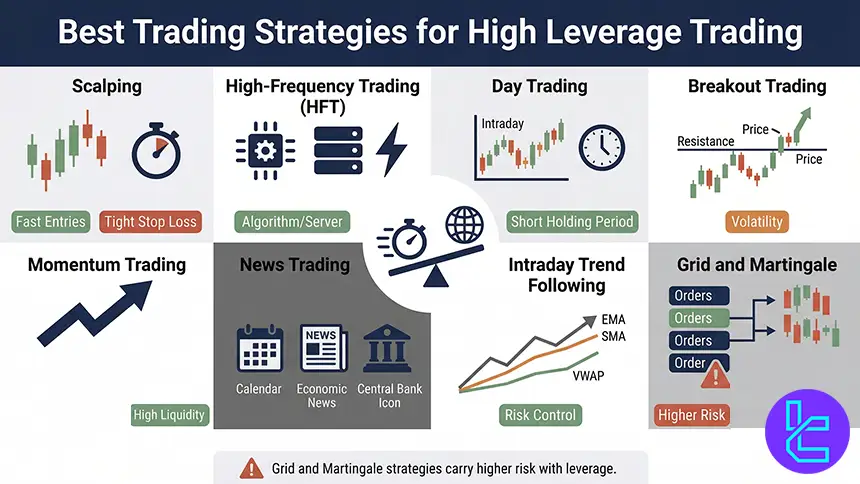
Most high-leverage strategies are built around liquidity, volatility, and precise execution. They are commonly used in Forex, gold, stock indices, and highly liquid CFDs where spreads are low and orders can be filled quickly.
- Scalping Strategy: Focuses on capturing very small price movements over seconds or minutes, often using tight stop-losses and high trade frequency;
- High-Frequency Trading (HFT): Uses algorithmic systems to execute a large number of trades within very short periods, usually in highly liquid markets;
- Day Trading: Involves opening and closing positions within the same trading day to avoid overnight swap fees and reduce exposure to unexpected news;
- Breakout Trading: Targets sharp price movements after support, resistance, or consolidation zones are broken;
- Momentum Trading: Follows strong short-term trends driven by news, volatility, or large trading volume;
- News Trading: Takes advantage of fast market reactions during events such as Non-Farm Payrolls, CPI releases, or central bank announcements;
- Intraday Trend Following: Uses EMA, SMA, VWAP, or price action to trade in the direction of the dominant trend during the same session;
- Grid and Martingale Strategies: Sometimes used with high leverage, but they carry much higher risk because losing positions can accumulate quickly.
How Do I Choose the Right Leverage?
The appropriate leverage level depends on several factors, including trading experience, strategy type, account size, and market volatility.
Lower leverage is generally more suitable for traders who are still learning how margin, stop-outs, and position sizing work, while experienced traders may use higher leverage in specific short-term setups.
There is no single leverage ratio that fits every trader or every market. Scalping on major Forex pairs may involve leverage above 1:100, while swing trading or position trading is often managed with lower ratios.
As volatility increases, reducing leverage can help protect account equity and lower the risk of margin calls.
- Beginner traders often use leverage between 1:5 and 1:20
- Intermediate traders may use leverage around 1:30 to 1:50
- Scalpers and short-term traders sometimes use leverage from1:100 to 1:500
- High leverage is generally more common in Forex, gold, and index trading than in stocks or ETFs
- Larger account sizes usually require lower leverage to control risk more effectively
- More volatile assets often require lower leverage ratios
- Stop-loss placement becomes more important as leverage increases
- Risk per trade is often limited to 1% or 2% of account equity
- Demo accounts can be useful for testing leverage before trading with real funds;
- Using the maximum available leverage is usually considered higher risk, especially for inexperienced traders.
How to Start Trading in High Leverage Brokers
Getting started with a high-leverage broker requires more than selecting the highest leverage ratio available.
Regulation, spreads, execution quality, platform stability, and risk controls should all be reviewed before opening an account.
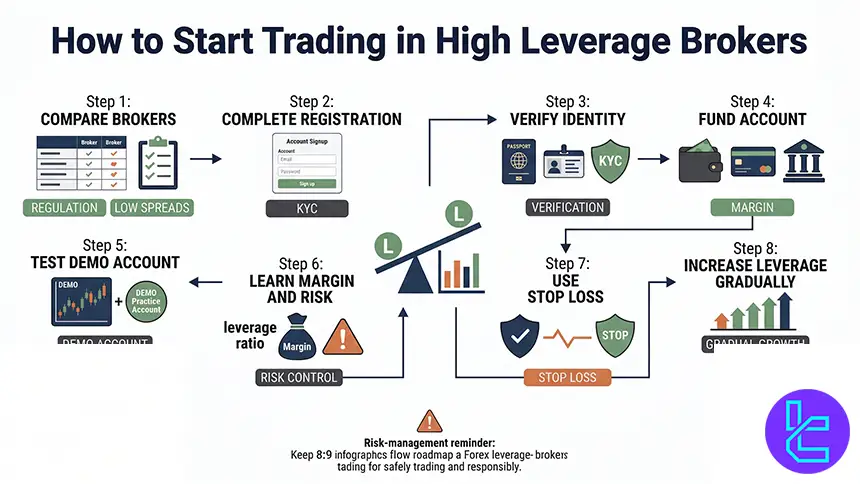
- Compare brokers based on leverage limits, regulation, spreads, commissions, and supported platforms;
- Complete the account registration process and submit KYC documents for verification;
- Deposit an amount that matches your risk tolerance and trading plan;
- Test the broker through a demo account before trading with real funds;
- Learn how margin, leverage, stop-out levels, and Negative Balance Protection work;
- Start with smaller position sizes when moving to a live account;
- Use stop-loss orders and predefined risk limits on every trade;
- Increase leverage gradually only after gaining more experience and consistency.
Leveraged Trading Comparison in Different Markets
Knowing the impact and maximum leverage of different assets and markets is key to success in financial markets. The table below provides detailed information on this subject for traders who wish to trade various instruments with high leverage.
Comparison Criteria | High-Leverage Forex | Crypto CFDs | Indices CFDs | Gold Trading |
Typical Maximum Leverage | 1:100 - 1:3000 | 1:2 - 1:500 | 1:20 - 1:500 | 1:20 - 1:1000 |
Average Daily Volatility | Medium to High | Very High | Medium | Medium to High |
Liquidity Level | Very High | High | High | Very High |
Trading Hours | 24/5 | 24/7 | Depends on Exchange Hours | 24/5 |
Margin Requirement | Very Low | Low to Medium | Medium | Low |
Spread Size | Very Low on Major Pairs | Medium to High | Low | Low |
Slippage Risk | Low on Major Pairs | High During Volatility | Medium | Medium |
Risk of Sudden Price Gaps | Moderate | Very High | High | High |
Suitable Leverage for Beginners | 1:10 - 1:30 | 1:2 - 1:5 | 1:5 - 1:20 | 1:10 - 1:20 |
Suitable Leverage for Experienced Traders | 1:100 - 1:500+ | 1:10 - 1:100 | 1:20 - 1:100 | 1:50 - 1:200 |
Best Trading Styles | Scalping, Day Trading, Swing Trading | Momentum Trading, Breakout Trading | Breakout Trading, Trend Following | Trend Trading, News Trading |
Most Commonly Traded Instruments | EUR/USD, GBP/USD, USD/JPY | Bitcoin, Ethereum, Solana | US30, NASDAQ 100, S&P 500 | XAU/USD, Silver |
Conclusion
Based on the data we gathered from various Forex brokers that offer high leverage, Exness, AvaTrade, NordFX, FBS, and deriv provide the most optimal trading conditions for all traders.
Now you must compare regulations, asset variety, minimum deposit requirements, costumer support quality, and payment methods to choose the best high leverage broker based on your needs.
All the brokers have been evaluated based on the factors mentioned in the TradingFinder Forex methodology.