





Metal trading has long been a core segment of the Forex and CFD market, with instruments such as gold (XAU/USD), silver (XAG/USD), platinum, and palladium attracting both short-term traders and long-term investors. Precious metals are widely used as inflation hedges, safe-haven assets during geopolitical uncertainty, and high-liquidity trading instruments during volatile macroeconomic cycles.
In this guide, we evaluate the best metal trading Forex brokers based on regulatory strength, pricing structure, number of available metal instruments, margin requirements, trading platforms, and overall trust metrics
 | FXGT | |||
 | MONETA MARKETS | |||
 | octa | |||
| 4 |  | fpmarkets | ||
| 5 |  | PUPRIME | ||
| 6 |  | LiteFinance | ||
| 7 |  | VT Markets | ||
| 8 |  | IFC MARKETS |
Metal Trading Brokers Ranked by Trustpilot Ratings
When selecting a broker for gold, silver, or other metal CFDs, regulation and pricing are critical, but real user feedback provides additional insight into operational reliability. Trustpilot ratings reflect client experiences related to withdrawal speed, spread stability during volatility, customer support responsiveness, and platform performance under high trading volume.
Trustpilot reviews often highlight real-world factors such as order rejections, swap discrepancies, or funding delays that may not appear in official broker specifications.
Broker Name | Trustpilot Rating | Number of Reviews |
FP Markets | 10,018 | |
Moneta Markets | 475 | |
FXGT | 1,498 | |
2,401 | ||
LiteFinance | 557 | |
OctaFX | 9,100 | |
557 | ||
PU Prime | 402 |
Minimum Spreads Offered by Metal Trading Forex Brokers
Spread cost is one of the most critical factors in metal trading, especially for gold (XAU/USD) scalpers and short-term silver traders. Unlike major Forex pairs, metal spreads can widen significantly during high-impact economic events such as U.S. CPI releases, FOMC decisions, or geopolitical shocks. Even small differences in minimum spread can materially impact net profitability over time.
Most brokers offer metals through either standard (spread-only) accounts or ECN-style accounts with raw spreads plus commission.
Broker Name | Min. Spread |
0 Pips | |
0 Pips | |
FP Markets | 0 Pips |
AETOSCG | 0 Pips |
FXCC | 0 Pips |
FXGiants | 0 Pips |
FXCM | 0.2 Pips |
OctaFX | 0.6 Pips |
Non-Trading Fees in Metal Trading Forex Brokers
When evaluating metal trading brokers, most traders focus on spreads and commissions. However, non-trading fees can significantly affect overall account profitability, especially for swing traders or long-term gold investors holding positions for extended periods.
Broker Name | Deposit Fee | Withdrawal Fee | Inactivity Fee |
$0 | $0 | $0 | |
SticPay (2.5% + $0.30), M-Pesa Kenya (0% + 100 KES), M-Pesa Tanzania (0% + 2000 TZS), and Africa Mobile Money (4.5%) | SticPay (2.5% + $0.30), M-Pesa Kenya (0% + 100 KES), M-Pesa Tanzania (0% + 2000 TZS), and Africa Mobile Money (4.5%) | $10 Monthly | |
VT Markets | $0 | $0 | $0 |
IFC Markets | $0 | $0 | $0 |
FXPrimus | $0 | $0 | Not specified |
Degiro | $0 | $0 | $0 |
CapitalXtend | $2.5 on Visa and Mastercard | $0 | €5 Monthly |
FinPros | $0 | $0 | $20 / €22 / £15 Monthly |
Platform Availability Among Metal Trading Brokers
Platform selection plays a decisive role in metal trading performance, particularly for gold (XAU/USD) and silver (XAG/USD), which often react sharply to macroeconomic news and geopolitical developments. Execution speed, charting precision, order types, and mobile accessibility directly influence trading efficiency in volatile metal markets.
Most leading metal trading brokers support widely recognized platforms such as MetaTrader 4 (MT4) and MetaTrader 5 (MT5). MT4 remains popular among gold scalpers due to its lightweight structure and broad Expert Advisor compatibility.
Broker Name | Trading Platforms |
MetaTrader 4, MetaTrader 5, proprietary OctaTrader, and Copy trading app | |
MT4, MT5, cTrader | |
PU Prime | MT4, MT5, PU Prime app |
LiteFinance | MT4, MT5, cTrader, Mobile App |
StarTrader | Proprietary Mobile App, MT4, MT5 |
RaiseFX | MetaTrader 5 |
FXNovus | WebTrader, Proprietary Mobile App |
IronFX | MetaTrader 4 |
Top 6 Forex Brokers with Metal Trading
Below are six Forex brokers that provide competitive trading conditions for precious metals such as gold (XAU/USD), silver (XAG/USD), platinum, and palladium. These brokers were selected based on regulatory strength, spread competitiveness, leverage flexibility, platform stability, and execution quality during high-volatility macro events.
FXGT
FXGT is a multi-asset Forex and CFD broker established in 2019, operating under several regulatory authorities including CySEC (for institutional clients), FSCA (South Africa), VFSC (Vanuatu), and FSA (Seychelles). This multi-jurisdiction framework allows the broker to provide segregated client funds and negative balance protection across its entities.
The broker offers five main account types: Mini, Standard+, Pro, ECN Zero, and Optimus. Minimum deposit requirements start from just $5, making FXGT accessible to beginners and low-capital traders. Leverage can reach up to 1:5000 under certain entities, while other branches apply lower limits depending on regulatory jurisdiction.
Spreads start from 0.0 pips on the ECN Zero account, with commissions from $3 per side on Forex and up to $5 for metals. Other account types operate commission-free with competitive spread structures and are available to choose after FXGT registration. The broker supports MetaTrader 4 and MetaTrader 5 platforms, enabling algorithmic trading, one-click execution, and integrated copy trading functionality.
FXGT provides access to more than 185 tradable instruments across Forex, precious metals, indices, energies, stocks, cryptocurrencies, and synthetic products. Deposit and withdrawal methods include VISA, Mastercard, Neteller, Bitwallet, Sticpay, Apple Pay, Google Pay, and local bank transfers.
Overall, the broker stands out for its ultra-low entry barrier, FXGT rebate, high leverage flexibility, and multi-asset coverage, though its relatively recent establishment and moderate symbol range compared to larger global brokers may be considerations.
Account Types | Mini, Standard+, Pro, ECN Zero, Optimus |
Regulating Authorities | CySEC, FSCA, VFSC, FSA |
Minimum Deposit | From $5 |
Deposit Methods | VISA, Mastercard, Bitwallet, Sticpay, Instant Local Bank Transfer, Neteller, Apple Pay, Google Pay |
Withdrawal Methods | VISA, Mastercard, Bitwallet, Sticpay, Neteller, Apple Pay, Google Pay |
Maximum Leverage | Up to 1:5000 (entity dependent) |
Trading Platforms & Apps | MetaTrader 4, MetaTrader 5 |
FXGT Pros and Cons
FXGT delivers tight spreads, operates under multiple regulatory jurisdictions, and supports advanced trading platforms, though regional restrictions and the absence of a proprietary platform may influence trader decisions.
Pros | Cons |
Very low minimum deposit ($5) | Relatively new broker (est. 2019) |
Leverage up to 1:5000 | Limited number of tradable symbols compared to major brokers |
Multiple regulatory licenses | Does not accept US clients |
Spreads from 0.0 pips on ECN Zero | No traditional PAMM/managed accounts |
MT4 & MT5 platform support | Limited advanced educational resources |
Copy trading available | - |
Moneta Markets
Moneta Markets is a multi-asset Forex and CFD broker founded in 2020 and headquartered in Johannesburg, South Africa. The broker operates under regulatory oversight from the FSCA and is also registered in Saint Lucia, positioning itself as a globally accessible trading platform.

The company offers three primary account types: Direct, Prime, and Ultra. The minimum deposit starts at $50, while leverage reaches up to 1:1000. After Moneta Markets verification, traders can choose between STP and ECN execution models depending on the selected account. Spreads begin from 1.2 pips on the Direct account and from 0.0 pips on Prime and Ultra accounts, with commissions as low as $1 per lot per side.
Moneta Markets provides access to more than 1,000 tradable instruments, including Forex pairs, stock CFDs, indices, commodities, bonds, ETFs, and cryptocurrencies. Platforms include MetaTrader 4, MetaTrader 5, Pro Trader with TradingView integration, and the App Trader mobile platform.
The broker supports copy trading through Moneta CopyTrader and also offers PAMM accounts for passive investors. Islamic swap-free accounts and demo accounts are also available in Moneta Markets dashboard.
Moneta Markets deposits and withdrawals are processed through bank transfer, Visa/MasterCard, FasaPay, SticPay, JCB, and cryptocurrencies such as USDT (TRC20), BTC, ETH, and USDC. The broker does not charge deposit or inactivity fees, and most withdrawals are processed within 24 hours.
While Moneta Markets offers competitive pricing and diverse instruments, it lacks Tier-1 regulation such as FCA or ASIC oversight, which may be a consideration for some traders.
Account Types | Direct, Prime, Ultra |
Regulating Authorities | FSCA, FSRA |
Minimum Deposit | $50 |
Deposit Methods | Wire Transfer, Visa/MasterCard, FasaPay, SticPay, JCB, Cryptocurrency (USDT, BTC, ETH, USDC) |
Withdrawal Methods | Wire Transfer, Visa/MasterCard, FasaPay, SticPay, JCB, Cryptocurrency |
Maximum Leverage | Up to 1:1000 |
Trading Platforms & Apps | MetaTrader 4, MetaTrader 5, Pro Trader (TradingView integration), App Trader |
Moneta Markets Pros and Cons
Moneta Markets combines competitive pricing, broad regulatory oversight, and established trading platforms; however, geographic limitations and no in-house platform could affect overall preference.
Pros | Cons |
Spreads from 0.0 pips (ECN accounts) | No Tier-1 regulatory license (FCA/ASIC) |
Low minimum deposit ($50) | Restricted in several countries (US, Canada, UK, etc.) |
1,000+ tradable instruments | Relatively new brand (since 2020) |
MT4, MT5, Pro Trader & App Trader | Mixed feedback regarding withdrawals |
Copy trading and PAMM accounts available | Limited top-tier investor protection schemes |
No deposit or inactivity fees | - |
OctaFX
OctaFX is a global Forex and CFD broker established in 2011, serving millions of traders across more than 180 countries. The company operates under multiple regulatory entities, including FSCA, MISA, and CySEC (for its EU branch), providing varying levels of oversight depending on jurisdiction.
The broker offers three main account types: MT4, MT5, and the proprietary OctaTrader account. The minimum deposit at OctaFX dashboard starts at $25, making it accessible for beginner traders. All accounts feature commission-free trading, with floating spreads starting from 0.6 pips and average EUR/USD spreads around 0.7 pips. Leverage reaches up to 1:1000 under non-EU entities.
OctaFX follows a market execution model and provides swap-free conditions across all account types, making it suitable for Islamic traders. The broker supports copy trading through its OctaFX Copy trading platform, allowing investors to replicate the strategies of Master Traders. However, PAMM accounts are not available.
Traders can access 277 instruments, including Forex pairs, indices, commodities, metals, cryptocurrencies, and stock CFDs. Platforms include MetaTrader 4, MetaTrader 5, OctaTrader (with TradingView integration), and the Octa Copy mobile app.
OctaFX deposits and withdrawals are processed via bank cards, e-wallets such as Skrill and Neteller, and cryptocurrencies including BTC, ETH, LTC, DOGE, and USDT (ERC20/TRC20). OctaFX does not charge deposit, withdrawal, swap, or inactivity fees.
While OctaFX offers competitive pricing and modern proprietary tools, its regulatory coverage remains limited compared to Tier-1 brokers.
Account Types | MT4, MT5, OctaTrader |
Regulating Authorities | FSCA, MISA (CySEC for EU entity) |
Minimum Deposit | $25 |
Deposit Methods | Bank Cards (MasterCard), Skrill, Neteller, Bank Transfer, Cryptocurrency (BTC, ETH, LTC, DOGE, USDT ERC20/TRC20) |
Withdrawal Methods | Skrill, Neteller, Cryptocurrency (BTC, ETH, LTC, DOGE, USDT ERC20/TRC20) |
Maximum Leverage | Up to 1:1000 (Entity dependent) |
Trading Platforms & Apps | MetaTrader 4, MetaTrader 5, OctaTrader (Proprietary), Octa Copy App |
OctaFX Pros and Cons
OctaFX provides efficient spreads alongside multi-jurisdiction regulation and professional trading software, yet regional constraints and reliance on third-party platforms may be considerations.
Pros | Cons |
Low minimum deposit ($25) | Limited Tier-1 regulation coverage |
Commission-free trading | Not available in US, UK, Switzerland, etc. |
Spreads from 0.6 pips | Smaller asset range compared to large multi-asset brokers |
Swap-free on all accounts | Bank card withdrawals not supported |
Copy trading available | No PAMM accounts |
24/7 customer support | - |
FP Markets
FP Markets is an Australian-founded Forex and CFD broker established in 2005, operating under multiple regulatory authorities including ASIC, CySEC, FSCA, FSC, and FSA. The broker combines Tier-1 oversight from ASIC and CySEC with additional international entities, providing segregated client funds and negative balance protection.

Through FP Markets registration, the company offers two primary account types: Standard and RAW. Both accounts require a minimum deposit of $50. The Standard account features spreads from 1.0 pips with no commission, while the RAW account offers spreads from 0.0 pips with a $3 commission per lot. Professional clients may access leverage up to 1:500 depending on jurisdiction.
FP Markets supports MetaTrader 4, MetaTrader 5, and cTrader, making it suitable for manual traders, algorithmic strategies, and ECN-focused users. The broker provides copy trading, PAMM, MAMM, FP Markets rebate and algorithmic trading options, catering to both active traders and passive investors.
Traders can access over 10,000 instruments across Forex, stocks, indices, commodities, metals, ETFs, and cryptocurrencies. FP Markets deposits and withdrawals are available via Visa, Mastercard, Skrill, Neteller, PayPal, and bank transfers, with no internal deposit or withdrawal fees.
With tight spreads, strong platform diversity, and institutional-style pricing, FP Markets appeals to experienced traders. However, it does not accept US clients and lacks a proprietary trading platform.
Account Types | Standard, RAW |
Regulating Authorities | ASIC, CySEC, FSCA, FSC, FSA |
Minimum Deposit | $50 |
Deposit Methods | Visa, Mastercard, Skrill, Neteller, PayPal, Bank Transfer |
Withdrawal Methods | Visa, Mastercard, Skrill, Neteller, PayPal, Bank Transfer |
Maximum Leverage | Up to 1:500 (entity dependent) |
Trading Platforms & Apps | MetaTrader 4, MetaTrader 5, cTrader |
FP Markets Pros and Cons
FP Markets maintains competitive spreads and strong regulatory presence across jurisdictions, supported by advanced platforms, although the lack of a proprietary system may impact some traders.
Pros | Cons |
Regulated by ASIC and CySEC (Tier-1) | Not available to US clients |
Spreads from 0.0 pips (RAW account) | No proprietary trading platform |
$50 minimum deposit | Some entities offer lower investor protection |
10,000+ tradable instruments | Withdrawal times vary by method |
MT4, MT5, and cTrader support | - |
Copy trading, PAMM & MAMM available | - |
PU Prime
PU Prime is a multi-asset Forex and CFD broker established in 2016, offering access to more than 800 tradable instruments across six asset classes.

The company operates under multiple regulatory entities, including ASIC in Australia, FSCA in South Africa, FSC Mauritius, and offshore regulators such as Seychelles FSA and Mwali FSC. Client funds are held in segregated accounts, and negative balance protection is provided.
PU Prime dashboard offers four main account types: Standard, Prime, ECN, and Cent. The minimum deposit starts from $20 on the Cent account, making it accessible to low-capital traders. Spreads begin from 0.0 pips on Prime and ECN accounts, with commissions starting from $1 per side per lot. Maximum leverage reaches up to 1:1000 under certain entities.
PU Prime supports MetaTrader 4, MetaTrader 5, WebTrader, and its proprietary PU Prime mobile app. The app integrates copy trading and social trading features, allowing users to follow and replicate professional traders. Islamic (swap-free) accounts and demo accounts are available.
PU Prime deposit and withdrawal methods include credit cards, e-wallets, cryptocurrencies, local and international bank transfers, AliPay, and UnionPay. Most deposit and withdrawal options are commission-free, but they may differ based on your PU Prime verification region.
While PU Prime offers competitive leverage and diverse bonuses, its mixed trust scores and offshore regulatory structure require careful due diligence.
Account Types | Standard, Prime, ECN, Cent |
Regulating Authorities | ASIC, FSCA, FSC Mauritius, Seychelles FSA, Mwali FSC |
Minimum Deposit | From $20 |
Deposit Methods | Credit Card, E-wallets, Cryptocurrencies, Local Bank Transfer, International Bank Transfer, AliPay, UnionPay |
Withdrawal Methods | Credit Card, E-wallets, Cryptocurrencies, Local & International Bank Transfer, UnionPay |
Maximum Leverage | Up to 1:1000 (entity dependent) |
Trading Platforms & Apps | MetaTrader 4, MetaTrader 5, WebTrader, PU Prime Mobile App |
PU Prime Pros and Cons
PU Prime offers attractive spread conditions, diversified regulatory authorization, and robust trading technology, while regional access limits and no native platform may shape broker selection.
Pros | Cons |
Low minimum deposit ($20) | Mixed Trustpilot and ForexPeaceArmy reviews |
Leverage up to 1:1000 | Offshore regulatory exposure |
Spreads from 0.0 pips (Prime & ECN) | Not available in several countries (US, UAE, etc.) |
800+ tradable instruments | High minimum deposit on ECN ($10,000) |
MT4, MT5, WebTrader & mobile app | Bonus terms may include conditions |
Copy and social trading features | - |
LiteFinance
LiteFinance is an international Forex and CFD broker established in 2005, serving over 3 million clients worldwide. The company operates under the Mauritius FSC for its global entity, while its European branch is regulated in Cyprus, offering different leverage conditions depending on jurisdiction.
The broker provides access to Forex, commodities, indices, and stock CFDs, with trading available through MT4, MT5, cTrader, and a proprietary mobile application. LiteFinance dashboard supports both CLASSIC and ECN account types, with a minimum deposit starting from $50 and leverage reaching up to 1:1000 under offshore regulation.
Spreads on the Classic account begin from 1.8 points with no commission, while the ECN account offers spreads from 0.0 points with commissions starting from $0.25 per lot depending on the instrument. LiteFinance Copy trading and PAMM services are available, allowing investors to replicate strategies from experienced traders.
LiteFinance deposit and withdrawal offers multiple options, including bank cards, wire transfers, STICPAY, Perfect Money, Volet, and cryptocurrencies such as USDT (TRC-20 and ERC-20). Most funding methods carry 0% commission, although certain local payment systems may apply additional fees.
The broker provides 24/5 customer support via email, live chat, Skype, and Telegram. While it offers competitive spreads, high leverage, and ECN technology, regulatory coverage remains primarily offshore for global clients.
Overall, LiteFinance positions itself as a cost-competitive broker with flexible account structures and copy trading capabilities suitable for both retail traders and strategy followers.
Account Types | CLASSIC, ECN (Swap-free versions available) |
Regulating Authorities | FSC (Mauritius), CySEC (EU entity) |
Minimum Deposit | $50 |
Deposit Methods | Credit/Debit Cards, Bank Wire, STICPAY, Perfect Money, Africa Mobile Money, Volet, Crypto (USDT, BTC, etc.) |
Withdrawal Methods | Credit/Debit Cards, Bank Wire, STICPAY, Perfect Money, Africa Mobile Money, Volet, Crypto |
Maximum Leverage | Up to 1:1000 (1:30 for EU clients) |
Trading Platforms & Apps | MetaTrader 4, MetaTrader 5, cTrader, LiteFinance Mobile App |
LiteFinance Pros and Cons
LiteFinance stands out with cost-efficient spreads and cross-border regulatory coverage, complemented by established platforms, though certain regional restrictions may apply.
Pros | Cons |
Established since 2005 | Offshore regulation for global clients |
ECN account with spreads from 0.0 | Limited account type variety (2 main types) |
Leverage up to 1:1000 | No 24/7 customer support |
Copy trading and PAMM available | Inactivity fee after 3 months |
Multiple platforms (MT4, MT5, cTrader) | Limited Tier-1 regulatory protection globally |
Wide deposit/withdrawal options | Some payment methods include fees |
What Criteria Were Used to Select the Best Metals Trading Brokers?
Selecting the best metals trading brokers requires more than comparing spreads on gold or silver. Since traders entrust capital to these platforms, a structured and transparent evaluation framework is essential.
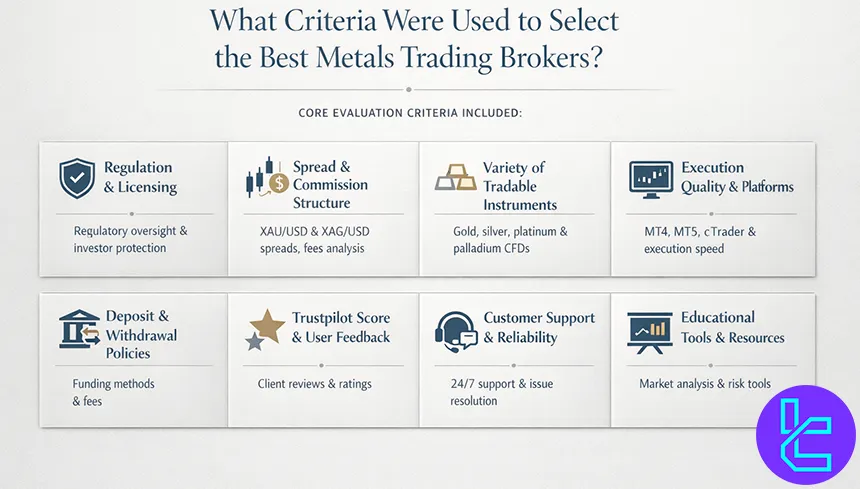
The selection process was based on a comprehensive multi-metric methodology designed to measure regulatory safety, pricing competitiveness, execution quality, and overall trading infrastructure.
A total of 19 evaluation metrics were applied to ensure objectivity and consistency. While all metrics contribute to the final ranking, several factors carried particular importance for metals traders.
Core Evaluation Criteria Included:
- Regulation and Licensing: Verification of oversight by recognized financial authorities, fund segregation policies, and investor protection mechanisms;
- Spread and Commission Structure: Detailed comparison of XAU/USD and XAG/USD spreads, ECN commissions, swap rates, and non-trading fees;
- Variety of Tradable Instruments: Availability of gold, silver, platinum, palladium, and related CFD contracts or ETFs;
- Execution Quality and Platforms: Support for MT4, MT5, cTrader, mobile apps, execution speed, and liquidity depth during high-volatility sessions;
- Deposit and Withdrawal Policies: Transparency in funding methods, processing times, and associated fees;
- Trustpilot Score and User Feedback: Analysis of client reviews related to withdrawals, slippage, and platform stability;
- Customer Support and Operational Reliability: Responsiveness, dispute handling, and overall service consistency;
- Educational Tools and Market Resources: Availability of metal-focused analysis, calculators, and risk management materials.
By combining regulatory validation, cost transparency, platform performance, and verified user feedback, this framework ensures that selected brokers provide not only access to precious metals markets but also structural reliability and long-term trading sustainability.
Why Are Metals Popular Among Traders and Investors?
Precious metals have long served as a store of value, portfolio hedge, and speculative instrument across global financial markets. In the Forex environment, metals such as gold and silver are typically traded as CFDs against major currencies, allowing traders to gain exposure without physical ownership.
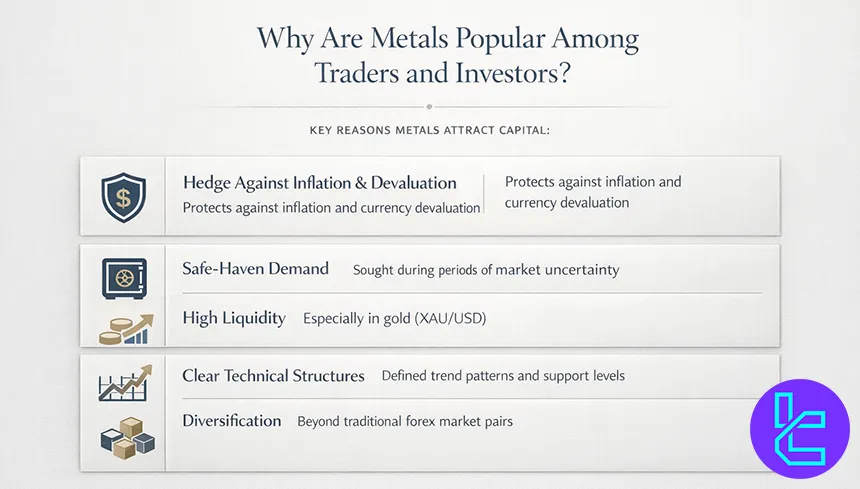
Their popularity stems from a combination of macroeconomic sensitivity and structural liquidity. Metals often react strongly to inflation expectations, central bank policy, geopolitical instability, and currency fluctuations, making them attractive for both short-term traders and long-term investors.
Key reasons metals attract capital:
- Hedge against inflation and currency devaluation
- Safe-haven demand during market uncertainty
- High liquidity, especially in gold (xau/usd)
- Clear technical structures and trend behavior
- Diversification beyond forex market Pairs
Gold, in particular, maintains deep institutional participation and strong correlation with U.S. real yields and dollar strength. Silver adds higher volatility, while platinum and palladium respond more to industrial demand cycles.
For traders seeking macro-driven volatility combined with tight spreads and high liquidity, metals represent a core asset class within multi-asset Forex portfolios.
What Are the Pros and Cons of Metals Trading in Forex?
Trading metals through Forex brokers offers flexibility and leverage, but it also introduces specific risks. Below is a structured comparison designed to help traders evaluate suitability.
Pros | Cons |
Access via CFDs without physical storage | High volatility during news releases |
High liquidity in major pairs like XAU/USD | Swap fees for overnight positions |
Ability to short sell easily | Sensitivity to U.S. dollar movements |
Strong reaction to macroeconomic events | Wider spreads during low-liquidity hours |
Portfolio diversification benefits | Leverage amplifies losses as well as gains |
Metals trading can be efficient for active traders who understand macro fundamentals and technical structure. However, risk management becomes critical due to price spikes during geopolitical or economic announcements.
What Financial Instruments Represent Metals in Forex?
Metals are primarily offered through derivative instruments rather than physical contracts. The table below outlines the main formats available through Forex brokers.
Instrument Type | Description |
Spot Metal CFDs | Most common format (e.g., XAU/USD, XAG/USD) |
Futures CFDs | Contracts reflecting exchange-listed futures pricing |
Metal vs Currency Pairs | Gold or silver quoted against USD, EUR, etc. |
Metal Indices | Basket exposure (less common) |
ETFs (via CFDs) | Gold-backed ETFs like GLD (broker dependent) |
The most liquid format remains spot gold (XAU/USD), quoted against the U.S. dollar. These contracts allow flexible position sizing, leverage, and both long and short exposure.
Some brokers also provide access to metal futures pricing, which reflects standardized contracts traded on exchanges like COMEX, but offered via CFD structure.
What Precious Metals Can Be Traded at Forex Brokers?
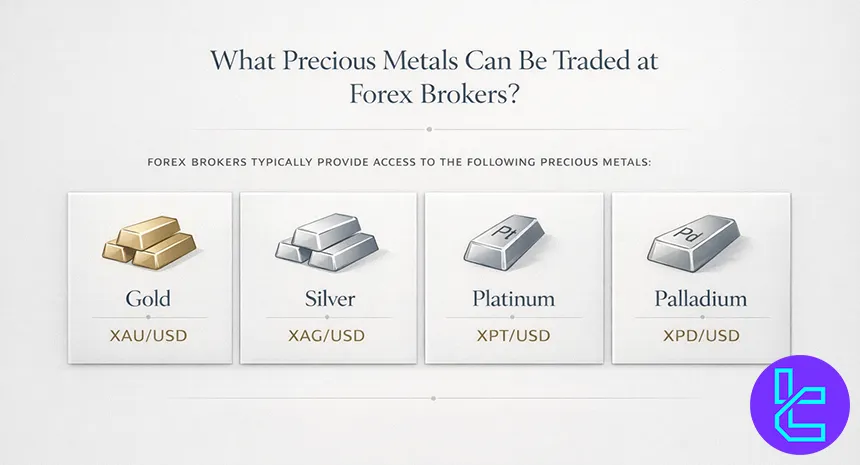
Forex brokers typically provide access to the following precious metals:
- Gold (XAU/USD)
- Silver (XAG/USD)
- Platinum (XPT/USD)
- Palladium (XPD/USD)
Gold dominates trading volume due to its role as a global reserve asset and macro hedge. Silver follows with higher percentage volatility and mixed industrial demand influence.
Platinum and palladium are more sensitive to automotive and industrial sectors, particularly catalytic converter demand. As a result, their price movements often diverge from gold during industrial cycle shifts.
Some brokers also offer cross-metal pairs such as XAU/EUR or gold quoted against alternative currencies, providing additional correlation strategies. Availability varies by broker, so checking instrument lists before account funding remains essential.
Commission and Spread Breakdown for Metals Trading
Cost structure has a direct impact on net profitability in metals trading, especially for scalpers and high-frequency strategies. Forex brokers typically price metals under two primary account models, each designed for a different trading style.
Spread-Based Accounts
In spread-only accounts, the trading cost is embedded entirely within the bid-ask difference. This structure is simpler and more predictable for beginners.
- Floating spreads (e.g., gold from 15–30 points depending on liquidity)
- No separate trading commission
- Easier cost calculation
- Suitable for swing traders and lower-frequency strategies
This model reduces complexity but may result in slightly wider spreads during volatile sessions.
Raw Spread and Commission Accounts
Raw or ECN-style accounts separate spreads from commissions. Traders access tighter pricing directly from liquidity providers while paying a fixed commission per lot.
- Near-zero spreads during active sessions
- Commission charged per lot traded
- Lower effective cost for high-volume traders
- Preferred by scalpers and algorithmic systems
For metals like XAU/USD, this structure often becomes more cost-efficient during London and New York sessions when liquidity peaks.
When Do Metals Show High Volatility? Best Time to Trade Metals
Metal volatility typically increases during overlapping major market sessions and macroeconomic releases. The highest activity generally occurs during:
- London Session (08:00-16:00 GMT)
- London-New York Overlap
- S. Economic Data Releases (CPI, NFP, FOMC)
Gold volatility often spikes during U.S. inflation announcements and Federal Reserve rate decisions. Geopolitical tensions, banking instability, or unexpected macro shocks can trigger safe-haven demand surges at any time.
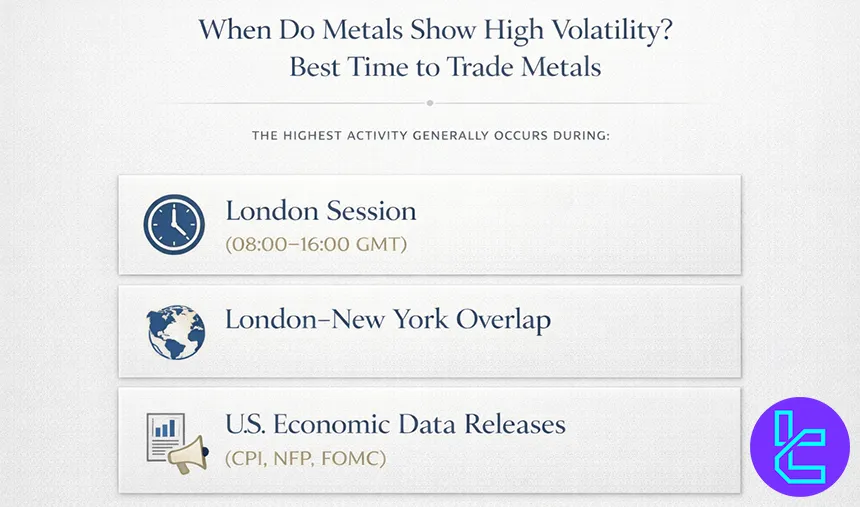
Asian session volatility is usually lower, though China-related economic data can impact industrial metals. For most intraday traders, the London–New York overlap provides the tightest spreads and strongest price momentum.
What Factors Affect Precious Metals Prices?
Precious metals respond to a blend of macroeconomic and market-specific drivers:
- S. Dollar Strength (inverse correlation in many cases)
- Real Interest Rates and Bond Yields
- Inflation Expectations
- Central Bank Gold Purchases
- Geopolitical Risk
- Industrial Demand (especially for silver and platinum)
- ETF Inflows and Institutional Positioning
Gold prices often move inversely to U.S. real yields. When real rates decline, gold tends to strengthen. Silver and platinum add industrial sensitivity, reacting to manufacturing data and global growth cycles.
Understanding these drivers allows traders to align technical setups with macro context, improving probability in metals trading strategies.
What Is the Maximum Leverage on Precious Metals?
Leverage on metals varies significantly depending on broker regulation and jurisdiction. The table below summarizes common leverage ranges.
Regulatory Tier | Typical Max Leverage on Gold |
Tier-1 (FCA, CySEC, ASIC) | 1:20 |
Offshore Entities | 1:200 to 1:1000 |
Professional Accounts | Higher (subject to qualification) |
Under European regulations, retail traders are typically limited to 1:20 leverage on gold. Offshore brokers may offer substantially higher ratios. While high leverage increases capital efficiency, it also amplifies volatility risk. A 1% gold move at 1:500 leverage can significantly impact account equity.
Risk management and position sizing become more important than leverage itself in sustainable metals trading.
Effective Strategies for Trading Precious Metals
Precious metals trading requires a structured and disciplined approach due to its strong connection with macroeconomic drivers such as inflation expectations, central bank policy, bond yields, and U.S. dollar strength.
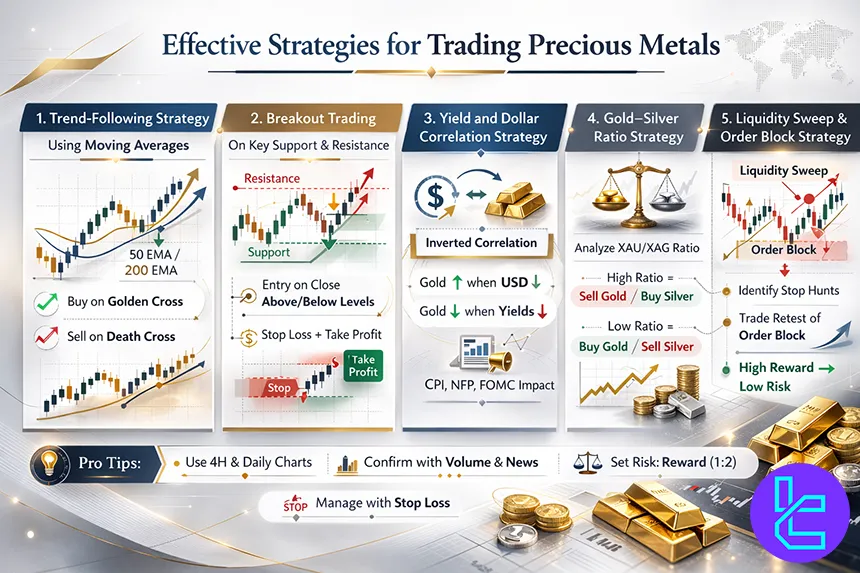
Unlike many traditional Forex pairs, metals like gold and silver frequently experience sharp volatility expansions during economic data releases and geopolitical developments.
Because metals combine technical structure with macro sensitivity, traders must align strategy selection with market conditions, volatility environment, and personal risk tolerance.
Beginners often perform better with rule-based systems that follow established trends, while advanced participants integrate yield analysis, liquidity concepts, and intermarket correlations to refine entries and exits.
Trend-Following Strategy Using Moving Averages
This strategy identifies directional bias using indicators such as the 50 EMA and 200 EMA. Traders look for long setups when price remains above both averages and short setups when below.
It performs best in sustained macro-driven trends, particularly when real yields decline or inflation expectations rise. Stop placement is typically based on recent swing highs or lows.
Breakout Trading on Key Support and Resistance
Breakout traders monitor consolidation ranges and enter positions once price closes beyond major resistance or support levels. Gold often generates strong breakouts during CPI releases, FOMC meetings, or London-New York session overlap.
Volume expansion and volatility confirmation improve reliability, while false breakouts remain the primary risk.
Yield and Dollar Correlation Strategy
Gold frequently moves inversely to U.S. real yields and often reacts to shifts in the U.S. dollar index. Traders monitor Treasury yields and DXY behavior to anticipate directional bias. Declining real yields and a weakening dollar typically strengthen bullish gold setups.
Gold-Silver Ratio Strategy
This strategy focuses on relative performance between gold and silver. When the gold–silver ratio becomes historically elevated, traders may anticipate silver outperformance. It is commonly used in swing trading and medium-term macro positioning.
Liquidity Sweep and Order Block Strategy
This advanced price-action method identifies liquidity clusters, stop hunts, and institutional order blocks. Traders wait for price to sweep liquidity zones before entering in the direction of anticipated institutional flow.
It requires strong chart-reading skills and is frequently applied during high-volume sessions for optimized risk-to-reward ratios.
Detailed Comparison of Gold, Silver, and Other Metals in Forex Trading
Precious and industrial metals traded via Forex brokers are typically offered as CFDs linked to spot or futures pricing. While Gold (XAU/USD) remains the primary safe-haven metal with deep liquidity and macro sensitivity, Silver (XAG/USD) exhibits higher volatility due to its dual monetary and industrial role.
Parameter | Gold (XAU/USD) | Silver (XAG/USD) | Platinum (XPT/USD) | Palladium (XPD/USD) |
Market Role | Primary safe-haven asset | Monetary + industrial hybrid | Industrial precious metal | Industrial catalytic metal |
Liquidity Depth | Very high | High | Medium | Medium to low |
Typical Spread (CFDs) | Tightest among metals | Slightly wider than Gold | Moderate | Wider due to lower liquidity |
Volatility Level | Medium–High (macro driven) | High (industrial demand sensitive) | High | Very high |
Main Price Drivers | USD strength, real yields, inflation, central bank demand | Industrial demand, USD strength, economic cycles | Automotive demand, supply deficits, mining output | Auto catalyst demand, supply concentration risk |
Correlation with USD | Strong inverse correlation | Inverse correlation | Moderate inverse correlation | Moderate inverse correlation |
Safe-Haven Status | Strong | Partial | Limited | None |
Industrial Sensitivity | Low | High | Very high | Extremely high |
Leverage (Retail, Tier-1 Reg.) | Often up to 1:20 | Often 1:10–1:20 | Often 1:10 | Often 1:10 |
Gap Risk Exposure | Moderate (weekend gaps) | Moderate–High | High | High |
Metals vs Stocks and Forex: Key Differences
Metals trading occupies a unique position between macro-driven currency markets and corporate performance-driven equities.
While Forex focuses on relative value between currencies and operates with the deepest global liquidity, stocks are tied to company earnings and sector cycles. Metals, particularly Gold and Silver, react strongly to inflation expectations, real yields, geopolitical risk, and USD strength.
Parameter | Metals (Gold, Silver, etc.) | Stocks (Equities) | Forex (Currency Pairs) |
Core Nature | Hard asset (precious/industrial) | Ownership in companies | Relative value between currencies |
Market Structure | OTC spot (CFDs), Futures (COMEX), ETFs | Centralized stock exchanges (NYSE, NASDAQ) | Decentralized interbank OTC market |
Trading Hours | Nearly 24/5 (futures-based pricing) | Exchange-specific sessions | 24/5 global market |
Main Price Drivers | USD strength, inflation, real yields, supply-demand | Earnings, sector growth, macro data | Interest rate differentials, central bank policy |
Volatility Profile | Medium–High | Moderate (earnings spikes) | Low–Medium in majors |
Liquidity Depth | High in Gold, moderate in others | High in large-cap stocks | Extremely deep in major pairs |
Safe-Haven Status | Strong (especially Gold) | No | Limited (USD, CHF, JPY) |
Leverage (Retail, Tier-1 Reg.) | Often 1:10–1:20 | Often 1:5 or lower | Up to 1:30 (majors under ESMA) |
Gap Risk Exposure | Moderate (weekend gaps) | High (earnings & news gaps) | Moderate (weekend gaps possible) |
Correlation Behavior | Often inverse to equities in crises | Correlated with economic cycles | Strong cross-currency correlations |
Conclusion
Metal trading remains one of the most strategically important segments of the Forex and CFD industry, combining macroeconomic sensitivity, institutional liquidity, and portfolio diversification potential.
Gold (XAU/USD) continues to dominate global trading volumes due to its safe-haven status and strong inverse relationship with real yields and U.S. dollar strength, while silver, platinum, and palladium introduce higher volatility driven by industrial demand cycles.
Selecting the right broker therefore requires careful evaluation of regulatory coverage, spread structure, leverage limits, execution quality, and non-trading fees.
For a comprehensive overview of the standards used in selecting these brokers, visit the TradingFinder Forex methodology page.