






Penny stock brokers offer trading services for low-cap shares typically traded under $5 via OTC markets. These stocks have huge risk to reward ratio and are perfect for experienced traders.
Penny stock trading charges differ from 1 broker to another; some charge a fixed fee for each trade, usually between $4.95 and $6.95, while others calculate costs based on the number of shares traded, commonly around $0.005 to $0.01 per share.
 | LYNX | |||
 | Interactive Brokers | |||
 | CAPTRADER | |||
| 4 |  | IG | ||
| 5 |  | moomoo | ||
| 6 |  | SAXO | ||
| 7 |  | xtb | ||
| 8 |  | SPREAD EX |
Trustpilot Score Comparison of Penny Stock Brokers
Traders must choose a reliable broker to trade penny stocks. One of the best ways to confirm a broker’s validity is checking it’s Trustpilot scores and user reviews. Here are the best penny stock brokers bases on Trustpilot ratings.
Broker Name | Trustpilot Rating | Number of Reviews |
CapTrader | 4.9/5 ⭐ | +700 |
Spreadex | 4.5/5 ⭐ | +100 |
4.2/5 ⭐ | +400 | |
IG | 3.8/5 ⭐ | +9000 |
3.7/5 ⭐ | +2000 | |
3.5/5 ⭐ | +5000 | |
Saxo | 3.5/5 ⭐ | +8000 |
Moomoo | 2.3/5 ⭐ | +200 |
Minimum Trading Spreads in Penny Stock Brokers
Choosing a broker with low spreads allow traders to benefit from lower overall trading costs and higher profit margin when trading penny stocks.
Broker Name | Minimum Spread |
Interactive Brokers | 0.1 Pips |
TradeStation | 0.1 Pips |
Trading 212 | 0.2 Pips |
0.5 Pips | |
Fidelity | 0.5 Pips |
Robinhood | 0.6 Pips |
0.6 Pips | |
Flatex | 1.0 Pips |
Non-Trading Costs of Penny Stock Brokers
When choosing a penny stock broker, traders must also consider deposit, withdrawal, and inactivity fees in addition to standard commissions to ensure they can manage their costs effectively.
Broker Name | Deposit Fee | Withdrawal Fee | Inactivity Fee |
Fidelity | $0 | $0 | $0 |
$0 | $0 | $18 | |
XTB | $0 | Free withdrawals for payouts over $50 | €10 |
MEXEM | $0 | 1 Free withdrawal per month | $0 |
LYNX | $0 | 1 Free withdrawal per month | €5 |
Webull | $0 | Up to $25 | $0 |
SogoTrade | $0 | Up to $50 | $12 |
TradeZero | From $0 to $15 | Up to $50 | $0 |
Available Platforms in Penny Stock Brokers
Having access to a wide variety of platform is a key consideration when choosing the top broker for trading penny stocks. Here are the best options.
Broker Name | Trading Platforms |
IG | MT4, L2 Dealer, ProRealTime, TradingView, Mobile App, WebTrader |
Trader Workstation, CapTrader App, TradingView | |
TradingView, Mobile App, WebTrader | |
E*Trade | E*TRADE Web, Power E*TRADE, Power E*TRADE Pro |
Merill | Merrill Edge Self-Directed, Merrill Guided Investing, Merrill Edge MarketPro |
Trading 212 | WebTrader, Mobile app |
MEXEM | WebTrader, MEXEM Lite, Mobile TWS, Watch TWS |
Trading 212 | WebTrader, Mobile app |
Moomoo | WebTrader, Mobile app |
Top 8 Brokers for Trading Penny Stocks
Trading Penny stocks is a high risk/high reward investment that allows traders to gain massive profits by finding top performing companies and invest in the early stages of their development.
The following sections offers deeper insight on trading conditions, commissions, trading platforms, and customer support quality to help you choose the best available option.
LYNX
LYNX is a Netherlands-based online broker founded in 2006 and headquartered in Utrecht, offering access to more than 150 markets across 30+ countries.
The broker focuses on active traders through its proprietary platforms, including LYNX+, the Mobile Trading App, and Trader Workstation (TWS).
Its product range covers Forex, shares, options, futures, ETFs, commodities, and CFDs, making it more relevant for experienced investors than for beginners.
From a regulatory perspective, LYNX operates through multiple European branches and is supervised by authorities such as AFM, DNB, BaFin, CNB, and FSMA.
Across its supported regions, the broker provides segregated funds, negative balance protection, and investor compensation coverage that generally reaches €20,000 through Dutch BCS or IBIE ICS frameworks.
Client eligibility is mainly limited to EEA markets, while leverage is capped at 1:30 under the European regulatory model.
On the cost side, LYNX states that share trading commissions start from 3 EUR, while Forex symbols can be traded with zero commission.
However, spreads, execution metrics, and several account-condition details are not disclosed in a fully standardized way.
Completing LYNX registration allows you choose between Individual, Joint, and Corporate accounts. A demo account is also available.
Overall, LYNX stands out for market access, platform depth, and regulatory structure, although its 3,000 EUR minimum deposit and professional-style environment may reduce its appeal for entry-level traders.
Account Types | Individual, Joint, Corporate |
Regulating Authorities | AFM, DNB, BaFin, CNB, FSMA |
Minimum Deposit | 3,000 EUR |
Deposit Methods | Bank Transfer via Interactive Brokers |
Withdrawal Methods | Bank Transfer via Interactive Brokers |
Maximum Leverage | 1:30 |
Trading Platforms & Apps | LYNX+, Mobile Trading App, Trader Workstation (TWS) |
LYNX Pros and Cons
The table below allows you to weigh the benefits and limitations of trading with the LYNX broker.
Pros | Cons |
Access to 150+ global markets and exchanges | High minimum deposit of 3,000 EUR |
Regulated by top-tier authorities such as BaFin and AFM | No Islamic account option |
Supports advanced platforms like LYNX+, Mobile App, and TWS | No copy trading, PAMM, or social trading features |
Offers commission-free Forex trading and fractional shares | - |
IG
IG is a London-based broker founded in 1974 that provides access to more than 17,000 instruments across Forex, indices, shares, commodities, cryptocurrencies, bonds, ETFs, options, and IPO-related products.
The company operates in over 17 countries and serves more than 381,000 clients globally. IG is also part of the FTSE 250 index, reflecting its long-standing presence in the financial services industry.
The broker is regulated by several major authorities, including the FCA in the United Kingdom, ASIC in Australia, MAS in Singapore, DFSA in Dubai, FSCA in South Africa, and JFSA in Japan.
Depending on the region, clients may receive investor compensation coverage, segregated funds, and negative balance protection. UK clients can access FSCS protection up to £85,000, while European clients may be covered up to €20,000.
IG registration offers a single CFD account with no minimum deposit requirement and leverage that can reach 1:200 for eligible regions outside stricter jurisdictions.
Traders can use multiple platforms such as MT4, TradingView, ProRealTime, L2 Dealer, and IG’s proprietary web and mobile platforms after finalizing their IG verification. Pricing is generally competitive, with Forex spreads starting from 0.6 pips and no commission on most asset classes except shares.
The broker also provides trading signals, algorithmic trading tools, educational content through IG Academy, and access to extended-hours trading for US shares and 24-hour index markets.
Account Types | CFD |
Regulating Authorities | FCA, ASIC, MAS, DFSA, FSCA, JFSA, AMF, FMA |
Minimum Deposit | No Minimum Deposit |
Deposit Methods | Bank Transfer, Credit Cards, Debit Cards |
Withdrawal Methods | Bank Transfer, Credit Cards, Debit Cards |
Maximum Leverage | 1:200 |
Trading Platforms & Apps | MT4, TradingView, ProRealTime, L2 Dealer, Proprietary Platform, Mobile App |
IG Pros and Cons
Traders can understand the benefits and drawbacks of using IG Markets services by checking the table below.
Pros | Cons |
Access to 17,000+ tradable instruments | Limited cryptocurrency offering |
Regulated by multiple top-tier authorities | No Islamic account option |
Supports MT4, TradingView, ProRealTime, and proprietary platforms | Customer support is not available 24/7 |
No minimum deposit requirement | - |
Interactive Brokers
Interactive Brokers is a global multi-asset broker founded in 1977 and headquartered in Greenwich, Connecticut. The firm operates across 34 countries, supports trading in 27 currencies, and serves more than 2.9 million client accounts.
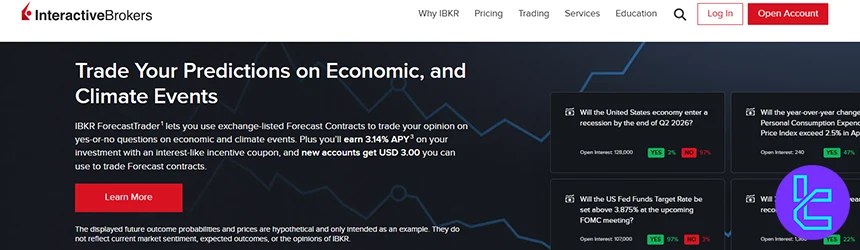
Its market coverage is one of its strongest attributes, with access to over 150 markets, 100+ Forex pairs, 90+ stock exchanges, and a wide range of asset classes including stocks, ETFs, options, futures, bonds, mutual funds, hedge funds, and US spot gold.
From a regulatory standpoint, Interactive Brokers is supervised by several high-tier authorities, including the SEC, FINRA, FCA, CBI, ASIC, MAS, SFC, and JSDA, depending on the operating entity.
Client protections vary by jurisdiction, with examples including SIPC coverage up to $500,000 in the United States, FSCS coverage up to £85,000 in the UK, and investor protection schemes in Canada and the EU.
Segregated funds are available across major entities, while negative balance protection mainly applies to retail leveraged accounts in selected regions.
The broker offers six account structures after finalizing the Interactive Brokers registration process, including Individual, Joint, Trust, Retirement, Institutional, and Non-Professional Advisor accounts.
Its platform ecosystem includes Trader Workstation (TWS), IBKR Mobile, Client Portal, and IBKR APIs, making it especially suitable for active traders and professional investors.
Funding is limited to bank-related methods such as bank transfers and checks, while pricing remains competitive with spreads from 0.1 pips and commissions from $0 depending on the instrument.
Overall, Interactive Brokers stands out for institutional-grade market access, strong regulatory depth, and advanced trading infrastructure rather than beginner-focused simplicity.
Account Types | Individual, Joint, Trust, Retirement, Institutional, Non-Professional Advisor |
Regulating Authorities | SEC, FINRA, NYSE, FCA, CBI, ASIC, MAS, SFC, JSDA |
Minimum Deposit | $1 |
Deposit Methods | Bank Transfer, Check |
Withdrawal Methods | Bank Transfer, Check |
Maximum Leverage | 1:1000 |
Trading Platforms & Apps | Trader Workstation (TWS), IBKR Mobile, Client Portal, IBKR APIs |
Interactive Brokers Pros and Cons
The table below helps traders to understand the pros and cons of trading with Interactive Brokers.
Pros | Cons |
Access to 150+ markets and 90+ global stock exchanges | Limited deposit and withdrawal methods |
Strong regulation across multiple Tier-1 jurisdictions | No Islamic account or PAMM account |
Advanced platforms including TWS, IBKR Mobile, and APIs | Customer support quality can vary by region |
Competitive pricing with spreads from 0.1 pips and commissions from $0 | No copy trading or social trading features |
Moomoo
Moomoo is a multi-market brokerage platform that originated in Silicon Valley and has expanded into Singapore, Australia, Japan, Canada, and Malaysia.

The broker reports more than 23 million users, trading volume above $500 billion, and a long list of industry recognitions exceeding 100 awards.
Its regulatory coverage spans authorities such as the SEC, FINRA, MAS, ASIC, CIRO, SC Malaysia, and JFSA, depending on the operating entity.
In the U.S., eligible accounts are protected through SIPC up to $500,000, while Canadian and Japanese entities apply their own investor protection frameworks.
The broker offers two core account structures, Cash and Margin, with a minimum deposit starting from $1.
Trading is available through Moomoo’s proprietary ecosystem, including mobile, desktop, and web platforms, all built around synchronized watchlists, live market data, advanced charting, TradingView integration, and paper trading functionality.
Asset coverage includes stocks, ETFs, options, futures market, and Forex, with particular strength in U.S. equities and access to selected Asian markets.
Moomoo’s pricing model is centered on low-cost execution, with $0 commission on U.S. stocks, ETFs, and many options products, although some index option and funding-related charges still apply.
Funding methods vary by region and include DDA, ACH, bank transfer, wire transfer, Wise, and BigPay. The broker also provides copy trading, welcome bonuses, referral promotions, and 24/7 support after finalizing Moomoo registration.
Overall, Moomoo is structured more for self-directed traders who want app-based market access, research tools, and cross-border investing rather than traditional long-term portfolio services.
Account Types | Cash, Margin |
Regulating Authorities | SEC, FINRA, MAS, ASIC, CIRO, SC Malaysia, JFSA |
Minimum Deposit | $1 |
Deposit Methods | DDA, ACH, Bank Transfer, Wire Transfer, Wise, BigPay |
Withdrawal Methods | DDA, ACH, Bank Transfer, Wire Transfer, Wise, BigPay |
Maximum Leverage | 1:2 |
Trading Platforms & Apps | Proprietary Mobile App, Desktop Platform, Web Platform |
Moomoo Pros and Cons
Check the table below to learn about the advantages and disadvantages of trading with the Moomoo broker.
Pros | Cons |
$0 commission on stocks, ETFs, and many options trades | No Islamic account option |
Supports copy trading and paper trading | Limited leverage up to 1:2 |
Access to U.S., Hong Kong, and Asian markets | No mutual funds or PAMM accounts |
Proprietary platform includes TradingView charts and advanced tools | - |
Saxo
Saxo Bank is a Denmark-based investment bank founded in 1992 that provides access to more than 71,000 financial instruments across Forex, stocks, ETFs, bonds, commodities, options, futures, indices, and cryptocurrencies.

The broker serves clients in over 180 countries and manages more than €100 billion in client assets.
With offices in 15 countries and partnerships with over 200 financial institutions, Saxo Bank is positioned as a multi-asset broker for both active traders and long-term investors.
The company is regulated by several Tier-1 authorities, including the Danish FSA, FCA, ASIC, MAS, FINMA, SFC, and JFSA.
Client protection measures include segregated funds, negative balance protection, and compensation schemes that vary by jurisdiction, such as up to £85,000 in the UK and CHF 100,000 in Switzerland.
Saxo Bank also maintains strong capital reserves and operates as a licensed bank, which adds another layer of financial stability.
This broker offers four main account tiers after completing the Saxo Bank registration process: Classic, Platinum, VIP, and Pro. There is no minimum deposit for the Classic account, while higher-tier accounts require significantly larger balances.
Trading is available through SaxoInvestor, SaxoTraderGO, and SaxoTraderPRO, with spreads starting from 0.4 pips on Professional accounts.
The broker also supports stock lending, interest on unused cash balances, free trading signals, educational content, and market research tools.
However, its pricing model and platform structure may be more suitable for experienced traders than complete beginners.
Account Types | Classic, Platinum, VIP, Pro |
Regulating Authorities | FSA, FCA, ASIC, MAS, FINMA, SFC, JFSA |
Minimum Deposit | $0 |
Deposit Methods | Bank Wire |
Withdrawal Methods | Bank Wire |
Maximum Leverage | 1:66 |
Trading Platforms & Apps | SaxoInvestor, SaxoTraderGO, SaxoTraderPRO |
Saxo Bank Pros and Cons
The table below outlines the benefits and drawbacks of trading with the Saxo Bank broker.
Pros | Cons |
Access to 71,000+ tradable instruments | Limited cryptocurrency offering |
Regulated by multiple Tier-1 authorities | No Islamic account option |
No minimum deposit for Classic account | - |
Advanced platforms with research and trading signals | - |
XTB
Founded in 2002 as X-Trade Brokers, XTB has expanded into more than 13 countries and serves over one million clients worldwide.
The broker has been listed on the Warsaw Stock Exchange since 2016 and reports client assets exceeding €7.2 billion, reflecting its large international presence.
XTB provides access to more than 36,000 tradable instruments across Forex, stocks, ETFs, commodities, indices, and cryptocurrencies.
Traders can use the proprietary xStation 5 platform or MetaTrader 4, both available on desktop, web, and mobile.
Features such as integrated market news, heat maps, economic calendars, sentiment tools, and customizable watchlists are included in the trading environment.
The broker is regulated by authorities including the Financial Conduct Authority, Cyprus Securities and Exchange Commission, Dubai Financial Services Authority, FSC, and KNF.
After going through the XTB registration, traders can access Standard and Islamic accounts, leverage of up to 1:500, floating spreads from 0.5 pips, and commission-free stock and ETF investing up to €100,000 per month.
XTB supports deposits through bank transfers, cards, Skrill, and Neteller, while withdrawals are mainly processed via bank transfer. Educational materials, demo accounts, multilingual 24/5 customer support, and detailed market analysis are also available.
However, the broker does not provide MT5, copy trading, PAMM accounts, or social trading services, and inactivity fees may apply after long periods without account activity.
Account Types | Standard, Islamic |
Regulating Authorities | FCA, CySEC, FSC, KNF, DFSA |
Minimum Deposit | $0 |
Deposit Methods | Visa, MasterCard, Bank Transfer, Skrill, Neteller |
Withdrawal Methods | Bank Transfer |
Maximum Leverage | 1:500 |
Trading Platforms & Apps | xStation 5, MT4, Mobile App |
XTB Pros and Cons
Here are important benefits and drawbacks of the XTB broker that traders must consider before opening an account.
Pros | Cons |
Listed on the Warsaw Stock Exchange with strong financial transparency | No MT5 trading platform |
Offers over 36,000 tradable instruments across global markets | Does not support copy trading, PAMM, or social trading |
Commission-free stock and ETF investing up to €100,000 monthly volume | Charges inactivity fees on dormant accounts |
Proprietary xStation 5 platform includes heat maps, sentiment tools, and integrated news | Restricted in several countries including the USA, Turkey, and Australia |
CapTrader
CapTrader is a Germany-based broker focused on multi-asset trading across more than 150 global markets.
The company provides access to over 1.2 million instruments, including Forex, CFDs, stocks, ETFs, options, futures, bonds, investment funds, warrants, and crypto-related products.
Its services are available in 34 countries, although regions such as Iran, Syria, Lebanon, and North Korea are restricted.
The broker operates under the supervision of the Federal Financial Supervisory Authority, with additional protection through entities regulated by the Financial Conduct Authority and the Central Bank of Ireland.
Segregated client funds, negative balance protection, and compensation schemes such as FSCS and ICCS are part of its risk management framework.
CapTrader supports several account formats, including Individual, Joint, Family Depot, Company, Managed, Cash, and Margin accounts.
The minimum deposit is relatively high at $2,000 to begin trading after CapTrader registration, while leverage is capped at 1:20. Trading costs are generally competitive, with spreads from 0.0 pips and commissions starting at €2 depending on the asset class.
Clients can trade through platforms such as TradingView, Trader Workstation, AgenaTrader, the Client Portal, and mobile apps. The broker also offers demo accounts, managed accounts, webinars, live seminars, and market analysis content.
However, it does not provide Islamic accounts, copy trading, or support for popular third-party platforms like MetaTrader 4, MetaTrader 5, or cTrader.
Account Types | Individual, Joint, Family Depot, Company, Managed, Cash, Margin |
Regulating Authorities | BaFin, FCA, CBI |
Minimum Deposit | $2,000 |
Deposit Methods | Bank Transfer, SEPA, Wire Transfer |
Withdrawal Methods | Bank Transfer, SEPA, ACH, Wire Transfer |
Maximum Leverage | 1:20 |
Trading Platforms & Apps | TradingView, Trader Workstation (TWS), AgenaTrader, Client Portal, Mobile App |
CapTrader Pros and Cons
The following table helps you compare the benefits and drawbacks of CapTrader before creating an account with this broker.
Pros | Cons |
Access to over 1.2 million tradable instruments | High minimum deposit requirement |
Regulated by BaFin, FCA, and CBI | No Islamic account option |
Supports advanced platforms like TradingView and TWS | No MetaTrader 4, MetaTrader 5, or cTrader |
Competitive spreads from 0.0 pips and low commissions | - |
Spreadex
Spreadex is a UK-based broker founded in 1999 that combines financial spread betting and CFD trading within a single platform environment.
Regulated by the Financial Conduct Authority, the firm operates primarily for UK clients and provides access to more than 3,000 instruments across Forex, indices, shares, ETFs, bonds, commodities, and selected cryptocurrencies for professional clients.
Client protections include segregated funds, negative balance protection, and FSCS coverage up to £85,000 after finalizing the Spreadex registration process.
The broker offers a single live account rather than multiple tiered structures, which keeps pricing and access relatively straightforward.
Trading is available through the proprietary Spreadex platform and TradingView, with support for web, iPhone, iPad, and Android interfaces.
Order features include market execution, trailing stops, force-open settings, and guaranteed stops, while margin requirements vary by asset class. Retail leverage is capped at 1:30 on major Forex pairs.
Spreadex supports deposits and withdrawals through bank transfers, debit cards, credit cards, Apple Pay, Google Pay, direct debit, and cheques.
Spreads on major currency pairs start from 0.60 pips, while share CFDs typically carry a 0.1% commission with a £10 minimum. The broker does not charge inactivity or deposit fees in standard conditions, though overnight funding applies to rolling positions.
Overall, Spreadex is more relevant for self-directed traders interested in spread betting, UK-focused market access, and simple account structure than for users seeking demo trading, MetaTrader integration, or copy trading tools.
Account Types | Live |
Regulating Authorities | FCA |
Minimum Deposit | No Minimum Deposit |
Deposit Methods | Credit/Debit Cards, Bank Transfer, Cheque, Apple Pay, Google Pay, Direct Debit |
Withdrawal Methods | Credit/Debit Cards, Bank Transfer, Cheque, Apple Pay, Google Pay, Direct Debit |
Maximum Leverage | 1:30 |
Trading Platforms & Apps | Proprietary Platform, TradingView, Mobile App |
Spreadex Pros and Cons
Traders must consider the following pros and cons before opening an account with the Spreadex broker.
Pros | Cons |
Supports TradingView integration and proprietary mobile apps | No MetaTrader platform support |
Offers spread betting, CFDs, and options trading | Educational resources are limited for complete beginners |
No inactivity fees or minimum deposit requirement | Customer support is not available 24/7 |
Regulated by the FCA with FSCS protection up to £85,000 | - |
What is Penny Stock Trading?
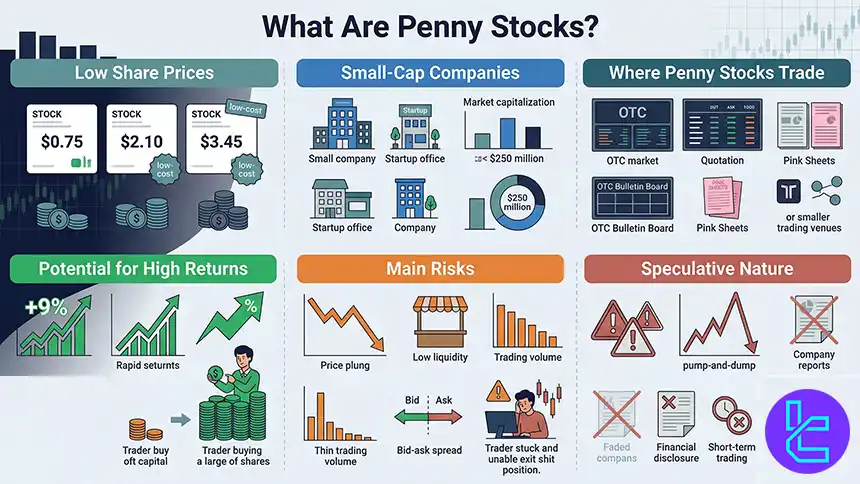
Penny stocks refer to low-priced shares, typically trading below $5 per share, that are usually associated with small-cap companies.
These securities are commonly listed on over-the-counter (OTC) markets rather than major exchanges such as the NYSE or NASDAQ. Common trading venues include the OTC Bulletin Board and Pink Sheets.
Because of their low share prices, penny stocks can attract traders looking for short-term price movements and high percentage returns.
A relatively small capital outlay may allow investors to purchase a large number of shares, which can amplify gains if prices rise. However, this same characteristic also increases downside risk.
Most penny stock issuers have limited market capitalization, often below $250 million, and may provide less public financial information than larger listed firms.
Liquidity can also be weak, which may make it difficult to enter or exit positions efficiently during volatile conditions.
Another concern is the higher exposure to speculative behavior and market manipulation, including “pump and dump” schemes. For this reason, penny stocks are generally viewed as short-term speculative instruments rather than long-term investment vehicles.
What Are the Pros and Cons of Penny Stock Trading?
Penny stocks can offer significant upside potential because even small price movements may generate large percentage returns.
They are often used in short-term trading strategies, including momentum trading, sentiment analysis, and algorithmic models focused on high-volume market activity.
At the same time, penny stocks are associated with limited liquidity, weak transparency, and higher exposure to manipulation.
Low trading volume, unreliable financial reporting, and “pump and dump” activity can make these securities more speculative than traditional large-cap stocks.
Here are the main benefits and drawbacks of trading penny stocks.
Pros | Cons |
Potential for high percentage returns | Low liquidity can create sharp and unpredictable price moves |
Suitable for high-volume and short-term trading strategies | Limited financial disclosure from some issuers |
Large number of tradable penny stocks across global markets | Higher risk of “pump and dump” schemes |
Can be combined with sentiment analysis and algorithmic trading | Requires more capital to trade effectively at scale |
Small share prices allow traders to buy large quantities of stock | Some companies may lack audited financial statements |
What Are Penny Stock Trading Costs in Brokers?
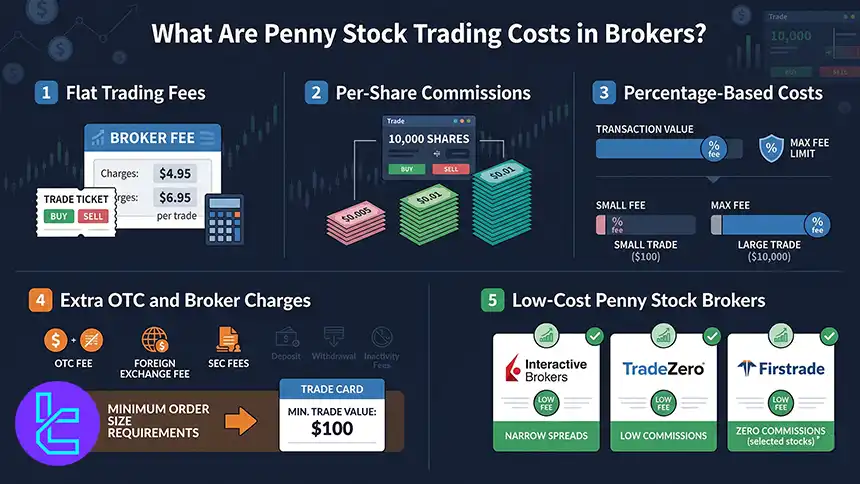
Broker costs for penny stock trading vary depending on the pricing model used by the platform.
Some brokers apply a flat fee per trade, often ranging from $4.95 to $6.95, while others use a per-share commission structure, typically between $0.005 and $0.01 per share.
Certain platforms also calculate fees as a percentage of the total trade value, sometimes with a capped maximum charge.
For traders dealing with large share volumes, commission structure becomes especially important.
Because penny stocks often trade below $5, and sometimes below $1, buying thousands of shares can generate higher overall costs than expected.
In some cases, a trade involving 100,000 shares may appear inexpensive due to the low share price, but transaction fees can still materially reduce returns.
Many Forex brokers charge separate OTC fees on top of their standard commissions, and some may require a minimum order size, such as $100 per trade.
Platforms such as Interactive Brokers, TradeZero, and Firstrade offer relatively lower penny stock trading fees.
How to Analyze Penny Stocks
Evaluating penny stocks requires more than focusing on low share prices.
Because these companies often operate with limited liquidity, smaller market capitalizations, and reduced disclosure standards, traders usually need to combine both fundamental and technical analysis before entering a position.
A common starting point is reviewing liquidity and average trading volume. Stocks with stronger daily volume are generally easier to buy and sell without major price slippage.
It is also important to examine company filings, revenue growth, debt levels, cash reserves, and overall balance sheet strength to understand whether the business can continue operating without immediate financing needs.
Key factors often used when analyzing penny stocks include:
- Review financial statements such as the balance sheet, income statement, and cash flow report
- Monitor dilution risk, including new share issuance that may reduce the value of existing shares
- Study the company’s management team, business model, and long-term viability
- Watch for catalysts such as product launches, partnerships, mergers, or regulatory approvals
- Use technical tools like Relative Strength Index (RSI) and Moving Average Convergence Divergence (MACD) to identify momentum and trend changes
- Filter potential trades with stock screeners such as MarketBeat
Is Penny Stock Trading Safe?
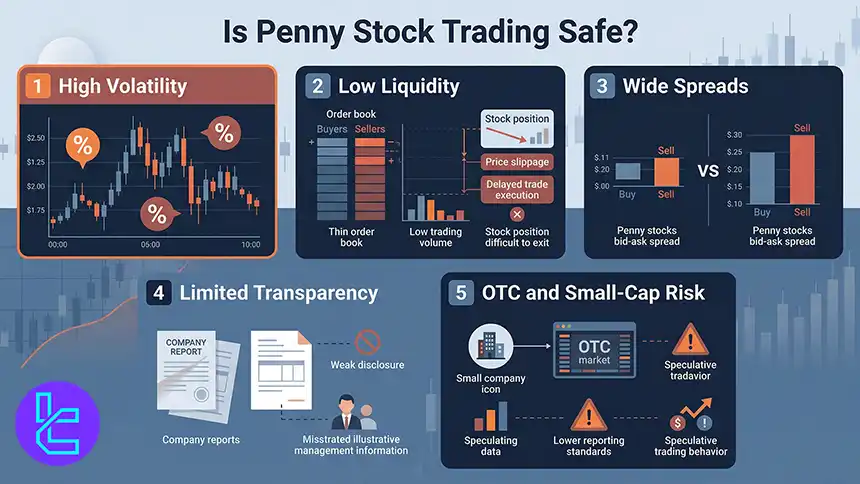
Penny stocks are generally considered high-risk securities because they combine low liquidity, limited transparency, and sharp price volatility.
Even when traded through a regulated broker, these stocks can experience large price swings within a single session, sometimes gaining or losing substantial value in a matter of hours.
One of the main concerns is trading volume. Many penny stocks have relatively few buyers and sellers, which can make it difficult to exit a position without affecting the market price.
Thin trading conditions may also increase bid-ask spreads and create more slippage during execution. Another factor is the lower reporting standards often associated with small-cap and OTC-listed companies.
In some cases, investors may have limited access to audited financial statements, management information, or long-term business data.
How to Choose the Best Broker for Trading Penny Stocks
Choosing a broker for penny stock trading is often more complex than selecting a standard stock broker.
Since penny stocks usually involve low liquidity, wider spreads, and rapid price changes, the quality of execution and trading tools can directly affect trading results.
Cost structure is another major factor. Traders who deal with large share volumes may find that flat fees, per-share commissions, or OTC-related charges have a meaningful impact on profitability over time.
Broker regulation, platform stability, and access to real-time data are also important, especially for traders using short-term or momentum-based strategies.
- Compare commission models, including flat fees, per-share pricing, and commission-free structures
- Check whether the broker supports OTC market trading in addition to major exchanges
- Prioritize brokers with fast execution to reduce slippage in volatile conditions
- Look for advanced tools such as Level 2 quotes, stock scanners, and real-time charting
- Review whether the platform offers direct market access and customizable order types
- Verify that the broker is supervised by regulators such as the SEC, FINRA, or the Financial Conduct Authority
Penny Stock Trading Tax
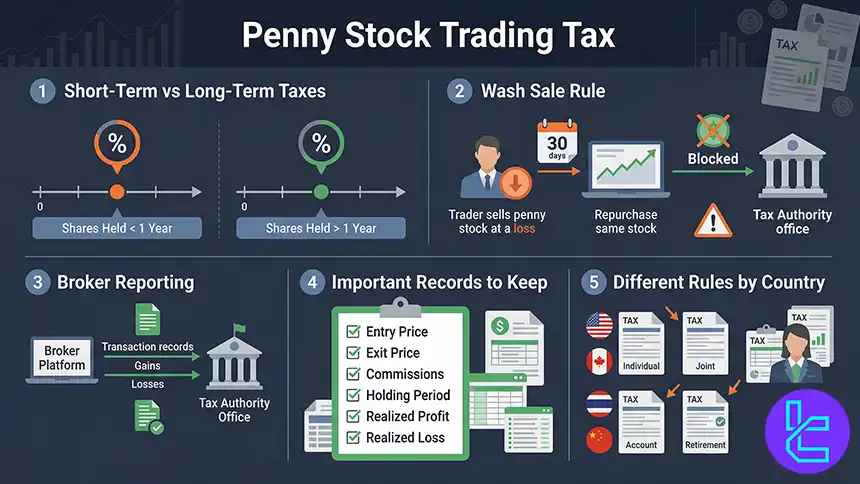
Tax treatment for penny stock trading depends on the investor’s country of residence, holding period, and the type of account used.
In many jurisdictions, profits from shares held for less than one year are taxed as short-term capital gains, which are often subject to higher rates than long-term gains.
Another important factor is the wash sale rule. In some tax systems, selling a penny stock at a loss and repurchasing the same security within 30 days may prevent the investor from claiming that loss for tax purposes.
This rule is particularly relevant for active traders who frequently enter and exit positions in volatile small-cap stocks.
Most brokers report trading activity, gains, and losses to tax authorities, meaning investors are usually expected to keep accurate records of their transactions.
This includes entry and exit prices, holding periods, commissions, and any realized losses.
Because tax rules can vary significantly between countries and account structures, many traders choose to consult a tax advisor or accountant before trading penny stocks regularly.
How to Begin Trading Penny Stocks
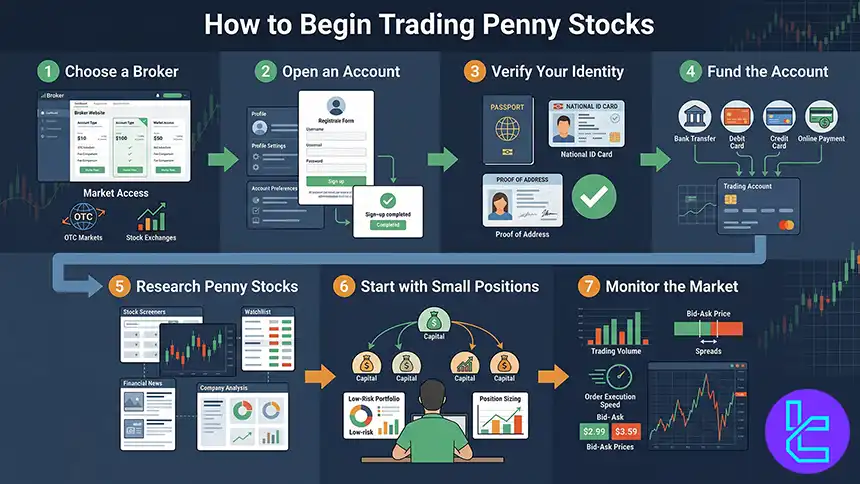
Getting started with penny stock trading usually begins with selecting a broker that supports OTC markets, low-cost execution, and real-time market data.
A typical onboarding process includes:
- Visit the broker’s official website and review its account types, fees, and market access
- Open a trading account by completing the registration form and selecting the appropriate account settings
- Complete identity verification by submitting documents such as a passport, national ID, or proof of address
- Fund the account through bank transfer, debit card, or other supported payment methods
- Research penny stocks using screeners, charting tools, and news feeds before placing a trade
- Start with smaller position sizes to understand how low-liquidity stocks behave in live market conditions
- Monitor spreads, order execution, and trading volume closely, since penny stocks can move sharply in a short period of time
Many traders also use demo platforms, watchlists, and technical indicators before trading real capital, especially when dealing with highly volatile OTC securities.
Best OTC Markets to Trade Penny Stocks
Most penny stocks trade through markets operated by the OTC Markets Group rather than on major exchanges. These markets are divided into different tiers based on company disclosure standards, financial reporting quality, liquidity, and investor risk.
The highest level is OTCQX, which is generally reserved for companies that meet stricter reporting requirements and maintain stronger transparency.
Businesses listed in this tier are often considered more established compared to other OTC issuers.
Below that is OTCQB, sometimes referred to as the venture market. It is commonly used by early-stage or growth-focused companies that still provide ongoing disclosures but may not yet qualify for higher-tier listing standards.
The more speculative segment is the Pink Open Market, also known as Pink Sheets. Companies in this category can vary widely in quality, ranging from firms with audited statements to issuers with very limited public information.
Comparison of Penny Stock Trading with Other Instruments
Like any other trading asset, penny stocks have their own benefits and drawbacks. Traders can check the table below and compare this asset to other types of instruments and tradable markets.
Comparison Criteria | Penny Stocks | Forex | Crypto | Precious Metals |
Market Type | Shares of small-cap companies, usually traded on OTC markets | Global currency market | Digital assets and blockchain-based currencies | Gold, silver, platinum, and palladium |
Volatility | Very high | Moderate to high | Very high | Moderate |
Liquidity | Low | Very high | High for major cryptocurrencies | High |
Trading Hours | Depends on OTC market or exchange schedule | 24/5 | 24/7 | 24/5 |
Minimum Capital Needed | Low | Low to moderate | Very low | Moderate |
Typical Trading Costs | OTC fees, spreads, and per-share commissions | Spreads and sometimes commissions | Exchange fees, spreads, and network fees | Spreads and sometimes swap fees |
Main Risk Factor | Low liquidity and pump-and-dump schemes | Economic news volatility | Extreme volatility and regulatory uncertainty | Sensitivity to interest rates and the US dollar |
Conclusion
Based on the current penny stock market conditions, LYNX, IG, Saxo, CapTrader, and Interactive brokers offer the best trading conditions to speculative traders worldwide.
Now, traders must weigh the pros and cons of trading with each broker by comparing trading costs, available stocks, deposit and withdrawal methods, charting tools, trading apps and more, to choose the best option based on their needs.
To understand the criteria and key factors behind our broker selection, please refer to TradingFinder Forex methodology page.