






Stock indices such as the S&P 500, FTSE 100, and DAX 40 allow traders to speculate on the collective performance of leading companies within a market. With 24/5 availability and deep liquidity, indices trading via CFDs, ETFs, futures, and options offers diversified exposure and flexible strategies.
We evaluated regulated index brokers using Trustpilot ratings, regulatory status, platform quality, trading fees, and market access. The best indices trading platforms combine competitive spreads, multi-asset support, advanced charting tools, and secure fund protection to ensure efficient speculation and long-term portfolio diversification.
 | pepperstone | |||
 | AVATRADE | |||
 | eightcap | |||
| 4 |  | D Prime | ||
| 5 |  | ONE ROYAL | ||
| 6 |  | easyMarkets | ||
| 7 |  | BlackBull | ||
| 8 |  | FxPro | ||
| 9 |  | fpmarkets | ||
| 10 |  | GO MARKETS |
Indices Brokers Rated by Trustpilot
Trustpilot ratings provide insight into trader satisfaction, platform stability, and customer support quality. Several leading indices brokers maintain strong scores around 4.5/5, supported by thousands of verified reviews, reflecting consistent execution standards and transparent fee structures.
Mid-tier providers typically score between 4.0 and 4.3, indicating reliable service with competitive spreads and solid platform performance. Lower-rated brokers often face concerns related to withdrawal processes, support responsiveness, or overall trading experience, making reputation monitoring essential before opening an account.
Broker Name | Trustpilot Rating | Number of Reviews |
AvaTrade | 11,936 | |
FP Markets | 10,012 | |
3,139 | ||
OneRoyal | 4.5/5 ⭐ | 407 |
GO Markets | 700 | |
3,227 | ||
Eightcap | 3,493 | |
1,767 | ||
FxPro | 824 | |
D Prime | 451 |
Index Trading Brokers’ Minimum Spreads
Minimum spreads play a critical role in index trading costs, especially for scalpers and short-term traders. Several top-tier brokers advertise raw spreads from 0.0 pips on major indices, typically via ECN or Razor-style accounts with commission-based pricing structures.
Other providers apply slightly wider minimum spreads, starting around 0.4 to 0.6 pips, depending on liquidity and market conditions. Evaluating spread consistency, execution speed, and overall fee transparency remains essential when selecting a competitive indices trading platform.
Broker Name | Min. Spread |
0.0 Pips | |
FP Markets | 0.0 Pips |
OneRoyal | 0.0 Pips |
CMC Markets | 0.0 Pips |
0.0 Pips | |
FOREX.com | 0.0 Pips |
0.0 Pips | |
Pepperstone | 0.0 Pips |
Saxo | 0.4 Pips |
XM Group | 0.6 Pips |
Indices Platforms Non-Trading Fees
Non-trading fees directly affect long-term profitability in index trading. Many leading platforms offer $0 deposit and withdrawal fees, along with no inactivity charges, making them cost-efficient for both active and occasional traders managing diversified index portfolios.
However, some brokers apply withdrawal fees up to $25 or monthly inactivity fees ranging from $10 to $18. Certain providers may also charge deposit fees up to 1%.
Broker Name | Deposit Fee | Withdrawal Fee | Inactivity Fee |
$0 | $0 | $0 | |
Exness | $0 | $0 | $0 |
easyMarkets | $0 | $0 | $0 |
BlackBull Markets | $0 | $5 | $0 |
$0 | Up to $25 | $0 | |
GO Markets | $0 | $0 | $0 |
Eightcap | $0 | $0 | $10/Month |
eToro | $0 | $5 | $10/Month |
FOREX.com | $0 | $0 | $15/Month |
IG | Up to 1% | $0 | $18/Month |
Index Brokers’ Trading Platforms
Leading index brokers provide access to industry-standard platforms such as MetaTrader 4 and MetaTrader 5, often combined with cTrader or TradingView integration. These platforms support advanced charting, algorithmic trading, custom indicators, and multi-device compatibility for efficient index market execution.
Several brokers also develop proprietary platforms with enhanced order management, Level 2 pricing, copy trading, and mobile optimization. Platform diversity ensures traders can access global indices, implement automated strategies, and monitor positions in real time across desktop, web, and mobile environments.
Broker Name | Trading Platforms |
MT4, MT5, cTrader | |
CMC Markets | MT4, WebTrader |
BlackBull Markets | MT4, MT5, TradingView, cTrader, BlackBull CopyTrader, BlackBull Invest |
Fusion Markets | MT4, MT5, TradingView, cTrader |
IG | MT4, TradingView, L2 Dealer, ProRealTime, Proprietary Platform |
MT4, MT5, Mobile App, WebTrader | |
Eightcap | MT4, MT5, TradingView |
FOREX.com | MT5, TradingView, Proprietary Platform |
easyMarkets | MT4, MT5, TradingView, Proprietary platform |
IC Markets | MT4, MT5, cTrader, IC Markets Mobile |
Top 8 Indices Trading Brokers
The top 8 indices trading brokers combine multi-jurisdiction regulation, competitive spreads from 0.0 pips on raw accounts, and leverage structures ranging from 1:30 under Tier-1 entities to 1:500 or higher offshore. Most provide MT4, MT5, cTrader, or TradingView access with segregated client funds and negative balance protection.
These brokers support diversified CFD access to global benchmarks such as US500, NAS100, DAX, and FTSE, alongside forex, commodities, and shares. Minimum deposits range from $0 to $100, while platform stacks include algorithmic trading, copy trading, PAMM solutions, and advanced risk controls like margin call and stop out mechanisms.
GO Markets
GO Markets is a regulated CFD broker founded in 2006 and headquartered in Melbourne, Australia. The company operates under ASIC and CySEC licenses, alongside offshore entities regulated by FSC and FSA. It maintains segregated client funds and negative balance protection across its regulated branches.

The broker offers two primary account types, Standard and GO Plus+, in addition to a PAMM solution, all available after completing the GO Markets registration process. The GO Plus+ account features spreads from 0.0 pips with a $5 commission per round lot, while the Standard account provides spreads from 0.8 pips with zero commission.
Clients can trade via MetaTrader 4, MetaTrader 5, and cTrader, plus browser-based WebTrader access. All platforms support Expert Advisors, scalping strategies, and instant execution. Margin call and stop out levels are set at 80 percent and 50 percent.
Maximum leverage reaches 1:500 under offshore entities and 1:30 under ASIC and CySEC regulation. The minimum deposit starts from 100 EUR, with trade sizes from 0.01 lot. Markets include Forex, shares, indices, commodities, crypto, ETFs, and treasuries.
Funding options include credit and debit cards, bank transfers, Skrill, Neteller, and PayPal, generally with zero internal deposit and withdrawal fees. A $50,000 demo account is available with real-time spreads and no expiry for strategy testing.
The GO Markets rebate program offers cashbacks of up to 15% on forex pairs for traders registering via the TradingFinder IB.
Account Types | Standard, GO Plus+ |
Regulating Authorities | CySEC, FSC, ASIC, FSA |
Minimum Deposit | €100 |
Deposit Methods | Credit/Debit Cards, Bank Transfers, E-wallets |
Withdrawal Methods | Credit/Debit Cards, Bank Transfers, E-wallets |
Maximum Leverage | 1:500 |
Trading Platforms & Apps | MT4, MT5, cTrader |
GO Markets Pros and Cons
GO Markets combines strong regulatory coverage, flexible leverage structures, and multi-asset access. Below is a concise overview of the broker’s key advantages and potential drawbacks.
Pros | Cons |
Regulated by ASIC and CySEC | Higher minimum deposit than some competitors |
Spreads from 0.0 pips on GO Plus+ | No bonus or promotional programs |
Wide range of CFDs across asset classes | Offshore leverage may increase risk exposure |
Supports MT4, MT5, cTrader and PAMM | Country restrictions, including the US |
Pepperstone
Pepperstone is a global forex and CFD broker founded in 2010 in Melbourne, Australia. The company reports an average daily trading volume of $9.2B across more than 400,000 clients. It supports 10 base currencies, including AUD, USD, GBP, EUR, and JPY.
Pepperstone operates under multiple regulators, including ASIC, FCA, CySEC, DFSA, CMA, and BaFin, plus an offshore SCB entity for broader eligibility. Client money is held in segregated bank accounts, and the broker states it does not use client funds for hedging.
Completing the Pepperstone registration process provides access to two core accounts, Standard and Razor. Razor targets active traders with spreads from 0.0 pips and a commission model, while Standard embeds costs into the spread for simpler pricing. Order size is typically available from 0.01 to 100 lots.
Pepperstone provides a broad platform stack, including MT4, MT5, cTrader, TradingView, and proprietary web and mobile apps. This lineup supports Expert Advisors, scalping, and hedging, while keeping access consistent across desktop, browser, and mobile devices.
Leverage can reach up to 1:500 depending on the entity and jurisdiction, while stricter regions may apply lower caps. Market access spans Forex, indices, commodities, shares, crypto, and ETFs, supporting multi-asset diversification from a single trading ecosystem. The Pepperstone rebate program offers 12.857% commission cashbacks on the Razor account.
Account Types | Standard, Razor |
Regulating Authorities | ASIC, SCB, FCA, DFSA, CMA, BaFin, CySEC |
Minimum Deposit | $1 |
Deposit Methods | Apple Pay, Google Pay, Visa, Mastercard, Bank transfer, PayPal, Neteller, Skrill, Union Pay, USDT, ZotaPay |
Withdrawal Methods | Apple Pay, Google Pay, Visa, Mastercard, Bank transfer, PayPal, Neteller, Skrill, Union Pay, USDT, ZotaPay |
Maximum Leverage | 1:30 |
Trading Platforms & Apps | Proprietary Platform, cTrader, Trading View, MetaTrader 4&5 |
Pepperstone Pros and Cons
Pepperstone delivers strong platform coverage and multi-asset depth, but account conditions can vary by region and entity. The pros and cons below highlight what traders typically value most, alongside the practical limitations to consider before opening an account.
Pros | Cons |
Top-tier regulatory coverage across several jurisdictions | No PAMM account offering |
Broad platform choice including MT4, MT5, cTrader, and TradingView | Leverage and features vary by entity and region |
Spreads from 0.0 pips on Razor account pricing | Limited bonus and promotional availability |
Wide multi-asset CFD catalogue including indices and ETFs | Some countries are restricted for onboarding |
AvaTrade
AvaTrade is a multi-jurisdiction broker backed by 9 regulatory licenses, including CBI, ASIC, FSCA, CySEC, ISA, and ADGM, with MiFID II alignment in Europe. The broker uses segregated client accounts and applies negative balance protection across its regulated entities.

Trading conditions include a margin call at 25% and a stop out at 10%, supporting tighter risk controls on leveraged positions. The broker requires a $100 minimum deposit and supports various AvaTrade deposit and withdrawal methods, including cards, bank wire, Skrill, Neteller, WebMoney, and PayPal.
AvaTrade dashboard offers Retail, Professional, Islamic, and Demo accounts, covering different trader profiles and compliance needs. The platform suite includes MT4, MT5, WebTrader, a mobile app, and AvaOptions for options-focused execution and structured risk setups.
Market coverage spans Forex, indices, commodities, metals, stocks, and crypto, with pricing typically structured through spreads rather than trading commissions. Leverage limits vary by jurisdiction, with some entities offering higher caps than EU and other stricter regulatory regions.
AvaTrade services include copy trading through DupliTrade and AvaSocial, plus a referral program for partnership-driven rewards. Customer support runs 24/5 via live chat, email, and phone, with multilingual coverage designed for cross-region onboarding and account servicing.
Account Types | Retail, Professional, Islamic, Demo |
Regulating Authorities | ASIC, CySEC, CBI, FSA, FSCA, MiFID, ADGM, PFSA, ISA |
Minimum Deposit | $100 |
Deposit Methods | Credit/Debit Cards, E-Wallets, Bank Wire Transfer, PayPal |
Withdrawal Methods | Credit/Debit Cards, E-Wallets, Bank Wire Transfer, PayPal |
Maximum Leverage | 1:400 |
Trading Platforms & Apps | MetaTrader 4, MetaTrader 5, Mobile App, WebTrader |
AvaTrade Pros and Cons
AvaTrade combines broad regulation, platform variety, and copy trading tools, while its inactivity charges and jurisdiction-based limits can matter for long-term holders. The following pros and cons summarize what traders typically evaluate before proceeding with the AvaTrade registration process.
Pros | Cons |
Wide regulatory coverage across multiple jurisdictions | Inactivity fee after 2 months on low-balance accounts |
Multiple platforms including MT4, MT5, WebTrader, and AvaOptions | Higher fees for long-term inactivity via annual administration charge |
Copy trading via DupliTrade and AvaSocial | Leverage and features vary by entity and region |
Clear risk controls with 25% margin call and 10% stop out | Restricted availability in certain countries, including the US |
D Prime
Doo Prime, legally operating as D Prime Limited, launched on December 1, 2014 and is headquartered in Hong Kong. The broker reports over 400,000 active clients, 37,000 introducing brokers, and around 1,000 employees, positioning it as a large multi-asset CFD provider.

Regulation is primarily offshore, with VFSC in Vanuatu and FSC in Mauritius, both tier 3 frameworks. Segregated funds are listed under the Vanuatu entity, while negative balance protection is shown under the Mauritius entity, so protections can differ depending on onboarding jurisdiction.
D Prime dashboard provides access to various accounts, including Cent, STP, and ECN, with leverage up to 1:1000. Cent is positioned for low-barrier entry, while STP and ECN typically start from a $100 deposit and support order sizes from 0.01 up to 100 lots, with demo access limited to STP and ECN.
Trading is available via MT4, MT5, and a proprietary terminal, with additional options such as TradingView integration and FIX API for advanced execution setups, all available after completing D Prime verification. The broker offers market execution, VPS support, and tools like Trading Central and an economic calendar for analysis workflows.
Doo Prime lists 10,000+ tradable instruments across Forex, indices, commodities, metals, crypto, futures, and securities. It also offers multiple social and allocation features, including PAMM, MAM, FOLLOWME, and copy trading, alongside 24/7 support via live chat, tickets, email, and phone.
Account Types | Cent, STP, ECN |
Regulating Authorities | VFSC, FSC |
Minimum Deposit | $0 |
Deposit Methods | Local bank Transfers, E-wallets, International Wire Transfers, Credit/Debit Card |
Withdrawal Methods | Local bank Transfers, E-wallets, International Wire Transfers, Credit/Debit Card |
Maximum Leverage | 1:1000 |
Trading Platforms & Apps | MetaTrader 4, MetaTrader 5, Doo Prime InTrade |
D Prime Pros and Cons
D Prime balances very high leverage, broad instrument coverage, and social trading features, while its offshore regulation profile and entity-based protections require careful review. The pros and cons below summarize the main trade-offs traders should consider before completing the Doo Prime registration process.
Pros | Cons |
Leverage up to 1:1000 across account structures | No tier 1 regulator listed for these entities |
10,000 plus instruments across multiple markets | Client protections differ by entity and jurisdiction |
Supports MT4 MT5 and proprietary platform options | Demo access limited to STP and ECN |
PAMM MAM FOLLOWME and copy trading availability | Some regions face onboarding restrictions |
OneRoyal
OneRoyal is a CFD and forex broker founded in 2006 under the Royal Group, with regional offices across hubs such as Sydney, Beirut, Limassol, Lagos, Cairo, and Florida. It offers access to Forex, indices, metals, oil, shares, ETFs, and cryptocurrencies through a multi-entity structure.

Regulation is split across ASIC in Australia for Royal Financial Trading Pty Ltd, plus offshore registrations with VFSC and SVGFSA. Segregated funds and negative balance protection apply under the ASIC entity, while protections and eligibility can differ for global onboarding under offshore entities.
After the OneRoyal registration, comes account selection including Classic, ECN, VIP, ECN Elite, Cent, and Demo, targeting different budgets and trading styles. Minimum deposits range from $10 on Cent to $10,000 on VIP and ECN Elite, with ECN-style pricing offering raw spreads from 0.0 and commission-based execution.
Platform access covers MT4, MT5, and the MT4 Accelerator, which adds enhanced tools for one-click execution, automation, and workflow efficiency. Trading features include VPS hosting, copy trading integration, and a PAMM account designed for allocation-based investing.
Leverage can reach up to 1:1000 depending on jurisdiction, while certain regions apply tighter caps. OneRoyal also supports multiple funding rails, including cards, bank wire, Skrill, Neteller, and cryptocurrency, and it maintains 24/5 client support via live chat and messaging channels.
Account Types | Classic, ECN, VIP, ECN Elite, Cent, Demo |
Regulating Authorities | ASIC, FSA, VFSC |
Minimum Deposit | $10 |
Deposit Methods | Visa, Mastercard, Bank Wire Transfer, Skrill, Neteller, Cryptocurrencies |
Withdrawal Methods | Visa, Mastercard, Bank Wire Transfer, Skrill, Neteller, Cryptocurrencies |
Maximum Leverage | 1:1000 |
Trading Platforms & Apps | MT4, MT5, MT4 Accelerator |
OneRoyal Pros and Cons
OneRoyal combines flexible account tiers, MetaTrader tooling, and broad CFD market coverage, while its investor protections vary by entity and some regions remain restricted. The pros and cons below summarize the broker’s main strengths and potential trade-offs before account opening.
Pros | Cons |
Wide account range from Cent to ECN Elite | High minimum deposit for VIP and ECN Elite tiers |
MT4 MT5 plus MT4 Accelerator tools | Investor protections vary by entity and jurisdiction |
Competitive pricing options including raw spreads | Not available for clients in certain regions, including the US and parts of the EU |
PAMM and copy trading availability | Asset coverage can be narrower than some multi-asset competitors |
FxPro
FxPro is a global forex and CFD broker founded in 2006, reporting over 7.8M client accounts and access to 2,100+ instruments. The broker highlights execution latency under 12 milliseconds and has collected 125+ international awards tied to platform depth and trading infrastructure.

Regulation spans FCA in the UK and CySEC in Europe, alongside FSCA in South Africa and SCB in the Bahamas for international onboarding. Client safeguards include segregated funds and negative balance protection across entities, with compensation coverage reaching up to £85,000 under FSCS and up to €20,000 under ICF.
FxPro dashboard offers Standard, Raw+, and Elite accounts designed for different pricing preferences. Standard is spread-only, while Raw+ and Elite can start from 0.0 pips with commission-based costs. Minimum order size is 0.01 lot, and leverage can reach up to 1:500 depending on jurisdiction and classification.
Platform availability includes MT4, MT5, cTrader, WebTrader, and a dedicated mobile app. Traders can run Expert Advisors, apply scalping and hedging strategies, and access multi-asset markets, including forex, indices, metals, energy, shares, crypto, and futures from a single account ecosystem, after completing the FxPro registration process.
Funding supports cards, bank wire, broker-to-broker transfer, and e-wallets such as Skrill, Neteller, and PayPal, with a typical minimum deposit of $100. Support operates 24/5 via live chat, email, phone, and an FAQ hub, while certain countries remain restricted for onboarding, not able to complete the FxPro verification process.
Account Types | Standard, Pro, Raw+, Elite |
Regulating Authorities | FCA, FSCA, CySEC, SCB |
Minimum Deposit | $100 |
Deposit Methods | Visa, Mastercard, Bank Wire Transfer, Broker to Broker Transfer, Skrill, Neteller, PayPal |
Withdrawal Methods | Visa, Mastercard, Bank Wire Transfer, Broker to Broker Transfer, Skrill, Neteller, PayPal |
Maximum Leverage | 1:500 |
Trading Platforms & Apps | MT4, MT5, cTrader, Web Trader, Mobile App |
FxPro Pros and Cons
FxPro delivers strong regulation, fast execution, and a multi-platform environment, while its inactivity fees and regional restrictions can impact some traders. The pros and cons below summarize the key trade-offs.
Pros | Cons |
Tier 1 regulation via FCA and CySEC | Inactivity fees after extended dormancy |
2,100 plus instruments across major CFD markets | Not available in some countries, including the US and Canada |
Multiple platforms, including MT4, MT5, and cTrader | Bonus availability is limited and can be time-bound |
Fast execution with multi-device access | Higher deposit requirements for certain account tiers |
easyMarkets
easyMarkets is a Cyprus-based broker led by CEO Nikos Antoniades, offering commission-free trading with a $25 minimum deposit. The brand earned “Best Forex/CFD Broker” at the TradingView Awards 2023 and “Leading Broker of the Year” at Forex Expo Dubai 2024, reflecting strong platform positioning.
The broker operates under multiple regulators, including ASIC and CySEC, plus FSCA, FSA Seychelles, and FSC BVI for wider onboarding. Client safeguards include segregated funds and negative balance protection across listed entities, while investor compensation can apply under ICF up to €20,000 in the EU structure.
easyMarkets supports MT4, MT5, TradingView, and a proprietary Web and App platform designed for simplified execution. Its signature tools include dealCancellation, Freeze Rate, and free Guaranteed Stop Loss on the proprietary interface, offering added control during volatility and fast-moving market conditions.
Leverage can reach up to 1:2000 under certain entities, while tighter caps apply under EU and Australia rules. Tradable instruments include the forex market, indices, metals, commodities, crypto, and stocks, with both fixed and variable spread models depending on the chosen platform and account environment.
Funding starts at $25 via cards, bank wire, Skrill, Neteller, and fast bank transfers, with 24/5 support through live chat, email, phone, and messaging apps. The broker runs referral and first-deposit promotions in some regions, while geo-restrictions apply in specific jurisdictions.
Account Types | easyMarkets Web/App and TradingView, MT4, MT5 |
Regulating Authorities | CySEC, ASIC, FSA, FSC, FSCA |
Minimum Deposit | $25 |
Deposit Methods | VISA, MasterCard, Maestro, Bank Wire, Skrill, Neteller, Fast Bank Transfers |
Withdrawal Methods | VISA, MasterCard, Maestro, Bank Wire, Skrill, Neteller, Fast Bank Transfers |
Maximum Leverage | 1:2000 |
Trading Platforms & Apps | MT4, MT5, TradingView, Proprietary platform |
easyMarkets Pros and Cons
easyMarkets blends multi-license oversight, low entry cost, and unique risk-control features, while its asset range and region-based limitations can matter for some traders. The pros and cons below summarize the key advantages and trade-offs, traders should consider before completing the easyMarkets registration process.
Pros | Cons |
Commission-free trading with $25 minimum deposit | Asset coverage can be narrower than multi-venue competitors |
Multiple regulators including ASIC and CySEC | No dedicated copy trading or PAMM offering |
Proprietary tools like dealCancellation and Freeze Rate | Not available in certain regions due to geo-restrictions |
High leverage availability up to 1:2000 under select entities | Support operates 24/5 rather than 24/7 |
BlackBull Markets
BlackBull Markets is a New Zealand based broker founded in 2014 under Black Bull Group Limited. The brand lists 7 major awards and provides access to 6 asset classes with 26,000+ instruments, spanning FX, indices, commodities, metals, shares, and crypto.
The broker operates under New Zealand FMA oversight for local clients and an additional entity regulated by the Seychelles FSA for international onboarding. BlackBull states segregated client accounts and negative balance protection across its listed branches, with FSCL dispute membership 5623 referenced for the New Zealand structure.
BlackBull Markets registration provides access to various account options, including ECN Standard, ECN Prime, and ECN Institutional, designed for different trading volumes. Pricing can start from 0.0 pips, while commissions vary by tier, and order size typically begins at 0.01 lots with leverage up to 1:500 depending on eligibility.
Platform coverage includes MT4, MT5, TradingView, and cTrader, plus BlackBull CopyTrader and BlackBull Invest for stock investing workflows, all available after completing the BlackBull Markets verification process. Execution supports market, limit, stop, and trailing stop orders, with margin call and stop out levels shown as 75% and 50%.
BlackBull supports a broad set of funding rails such as cards, bank wire, Apple Pay, Google Pay, crypto, Neteller, Skrill, SEPA, and FasaPay, with $0 minimum deposit for most accounts. Withdrawals commonly apply a flat $5 processing fee, while support is available 24/7 via live chat, phone, email, and WhatsApp.
Account Types | ECN Standard, ECN Prime, ECN Institutional |
Regulating Authorities | FSA, FMA |
Minimum Deposit | $0 |
Deposit Methods | Visa, MasterCard, Apple Pay, Google Pay, Bank Wire, Crypto, Neteller, Skrill, SEPA, FasaPay |
Withdrawal Methods | Visa, MasterCard, Apple Pay, Google Pay, Bank Wire, Crypto, Neteller, Skrill, SEPA, FasaPay |
Maximum Leverage | 1:500 |
Trading Platforms & Apps | MT4, MT5, TradingView, cTrader, BlackBull CopyTrader, BlackBull Invest |
BlackBull Markets Pros and Cons
BlackBull Markets combines deep instrument coverage, strong platform variety, and ECN account flexibility, while its regional availability and withdrawal charge can influence total cost planning. The pros and cons below summarize the key strengths and limitations that are going to be listed.
Pros | Cons |
26,000+ instruments across 6 asset classes | Limited availability in some regions, including EU and UK |
ECN account lineup with spreads as low as 0.0 pips | Flat $5 withdrawal processing fee |
MT4, MT5, cTrader, TradingView, plus copy and invest tools | Product range and setup can feel complex for beginners |
24/7 support with multiple contact channels | Regulatory protections differ by entity and jurisdiction |
Important Factors in Selecting the Best Indices Brokers and Platforms
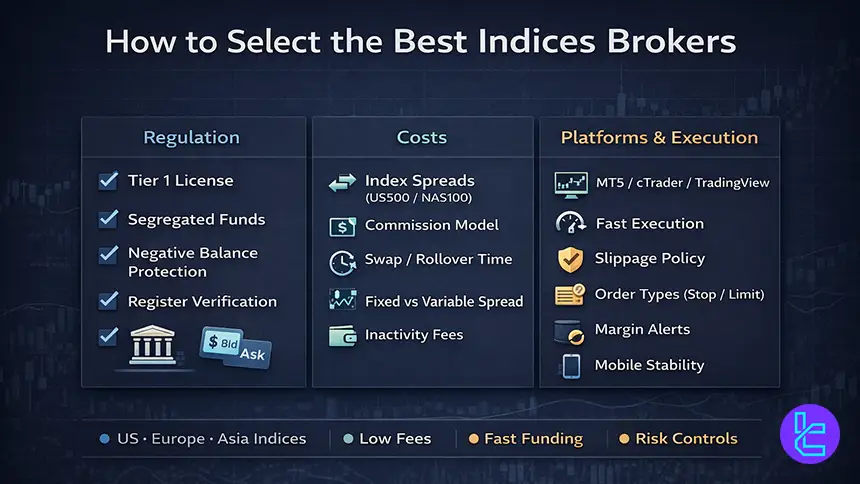
Choosing an indices broker starts with regulation, because indices themselves are not regulated products, but brokers are. Tier 1 regulators such as FCA and CySEC typically enforce segregated client funds, negative balance protection, and stricter marketing rules. This legal framework reduces counterparty risk and improves dispute handling.
Cost structure decides whether an index strategy remains viable. Compare spreads on flagship contracts like US500 or NAS100, plus commissions on raw accounts, overnight swap on CFDs, and non-trading fees like inactivity. Also check whether spreads are fixed or variable, because volatility around CPI or NFP can widen pricing dramatically.
Platform and execution quality matter most for fast index moves. Look for MT5, cTrader, or TradingView integration, stable server uptime, and clear margin call rules. Ensure your broker supports the order types you need, including stop, limit, trailing stop, and guaranteed stop loss where available, plus reliable mobile execution.
- Tier 1 regulation and license verification on the regulator register before funding any account
- Clear index catalogue covering US, Europe, and Asia benchmarks with transparent contract specs
- Competitive spreads plus commission model clarity for Standard vs Raw or ECN pricing
- Overnight swap disclosure for index CFDs and the exact time rollover is applied
- Fast execution with published policies for slippage, requotes, and liquidity protection
- Strong risk tools such as negative balance protection, stop orders, and margin alerts
- Multiple platforms across desktop, web, and mobile for redundancy during outages
- Funding and withdrawal rails that match your region with low fees and fast processing
What Are Indices?
A stock index represents the combined value of a basket of shares, grouped by region, sector, or market capitalization. Instead of tracking one company, an index reflects broader market behavior. Examples include S&P 500, Dow Jones Industrial Average, Nikkei 225, and FTSE 100, each built from a defined constituent list.
Most major indices use market capitalization weighting, so the largest companies influence price action more than smaller components. A smaller set, such as the Dow, uses price weighting, where higher priced stocks move the index more. Weighting methodology affects volatility, concentration risk, and how news about one mega cap can shift the index.
Traders cannot buy an index directly as a physical asset. They gain exposure via derivatives like CFDs, futures, options, or via instruments like ETFs and index funds. For active trading, index CFDs are popular outside the US because they allow long and short positioning, leverage, and intraday trading without owning underlying shares.
Indices Trading Advantages and Disadvantages
Indices trading offers broad exposure and diversification because one position reflects dozens or hundreds of companies. Major indices also tend to be highly liquid, making execution smoother and spreads tighter in normal conditions. For many traders, indices provide cleaner technical behavior than single stocks because idiosyncratic company risk is reduced.
The downside is that indices can show lower upside compared to picking a single breakout stock, especially during stock specific catalysts. Index volatility can still spike during macro shocks, central bank surprises, or geopolitical events, widening spreads and triggering margin calls. Leverage amplifies these swings, so risk management becomes non-negotiable.
Advantages | Disadvantages |
Lower single stock risk through diversification | Macro shocks can still cause sharp drawdowns |
Deep liquidity on major benchmarks | Liquidity can thin during extreme volatility |
Often smoother trends and clear levels | Less company specific edge vs stock picking |
24/5 availability via CFDs at many brokers | Contract terms differ by broker and entity |
Good for hedging and tactical rotation | Leverage can magnify losses quickly |
What Are the Various Types of Instruments for Index Trading
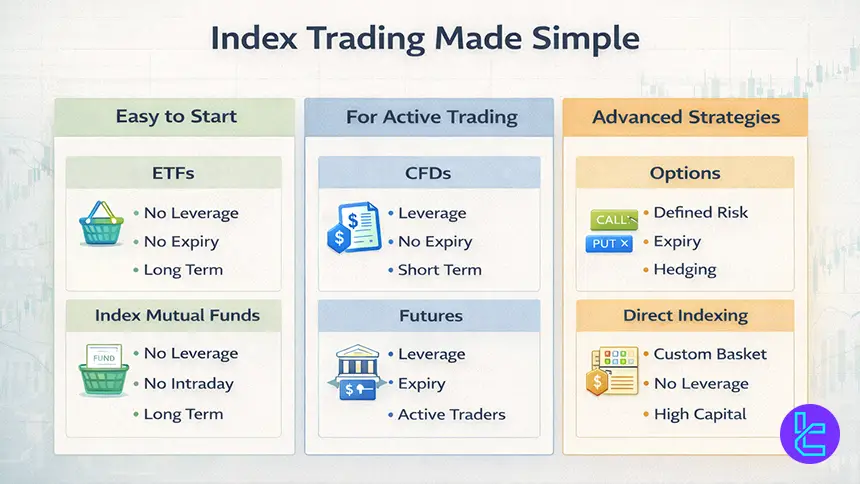
Index exposure comes in multiple wrappers, and each changes cost, leverage, and risk. Contract for Differences (CFDs) dominate retail index trading in EMEA because they mirror price movement and allow both long and short positions with margin. Futures dominate institutional participation because they are exchange traded and transparent, but require higher competence and capital.
ETFs track an index and trade like stocks, offering diversified exposure without embedded leverage unless margin is used. They are common for long term allocation and can be combined with options for hedging. Index mutual funds provide similar tracking for long horizons, though they do not trade intraday like ETFs.
Options provide the right, not the obligation, to buy or sell exposure at a set strike within a time window. They can cap risk to premium paid but are sensitive to implied volatility, time decay, and event risk. Direct indexing replicates an index by buying constituents, enabling customization and tax management, but requires larger capital and operational complexity.
- CFDs: Leveraged long and short speculation, popular outside the US retail environment
- Futures: Exchange traded index exposure with high liquidity and standardized contract specs
- Options: Defined risk structures, hedges, and event strategies using calls and puts
- ETFs: Buy and hold allocation with intraday pricing and broad index coverage
- Index mutual funds: Longer horizon tracking with simpler structure than active trading
- Direct indexing: Customized baskets and tax planning, usually requiring larger capital
Note: Instrument choice changes fees, leverage, and how rollover or expiry is handled. Broker availability also differs, so confirm the exact product list before opening an account.
Associated Costs with Indices Trading Brokers
Index trading costs start with spread, the difference between bid and ask. Some brokers advertise raw spreads from 0.0 on top indices, but may charge commission per lot or per contract. Others bundle costs into a wider spread with no explicit commission, which can suit beginners who want simpler accounting. Key costs for indices trading:
- Spread cost on core contracts like US500 and NAS100, evaluated in normal and volatile hours
- Commission structure for raw or ECN accounts, including round turn pricing visibility
- Swap or overnight financing rules and the rollover timestamp used by the broker server
- Slippage and execution quality, because poor fills act like a hidden cost on fast indices
- Deposit and withdrawal fees, including third party or intermediary bank charges
- Inactivity and account maintenance fees that compound during periods without trading
- Currency conversion fees when base currency differs from the instrument settlement
- Data or platform add-ons, such as premium tools that may require volume thresholds
What Are the Best Trading Platforms for Indices
MT4 remains widely used for indices CFDs due to familiarity, stable performance, and broad broker support. It offers charting, order management, and automation via Expert Advisors, but has fewer native timeframes and market depth features than newer platforms. Many brokers still optimize index symbols and contract specs around MT4 workflows.
MetaTrader 5 expands toolsets with more timeframes, more order types, and improved strategy testing infrastructure. For indices traders, MT5 is often better for multi asset coverage, advanced pending orders, and broader symbol organization. Many brokers also pair MT5 with faster bridging to liquidity, improving execution quality during high volatility sessions.
cTrader targets active traders with transparent pricing displays, quick order entry, and algorithmic options through cAlgo style workflows. TradingView adds web-based charting, social trading ideas, and a flexible layout, often paired with broker execution via integration.
Proprietary platforms can add unique tools like guaranteed stop loss, price freeze, or trade cancellation, but should be evaluated for stability.
Do News Events Impact Index Prices
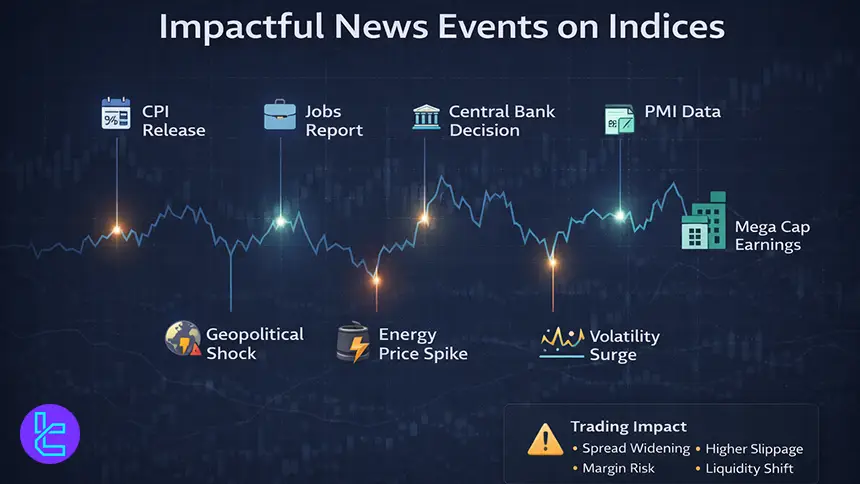
Index prices react quickly to macro news because an index aggregates company earnings expectations and discount rates. CPI, employment data, PMI releases, and central bank decisions can shift rate expectations and move indices in seconds. This sensitivity is amplified in benchmarks with heavy exposure to growth stocks, where valuation depends more on future cashflows.
Corporate earnings also matter, especially when mega cap constituents carry large weights. A single earnings surprise from a top weighted component can move a market cap weighted index noticeably.
Geopolitical headlines, commodity shocks, and policy announcements can influence sector rotations, altering index performance even when the broad economy appears stable.
News impact interacts with liquidity and spreads. Around high impact releases, spreads widen and slippage increases, so news trading on indices can be risky. Traders should plan entry timing, use risk defined sizing, and avoid over leveraging during event windows.
- Macro releases like CPI, jobs, and rates shift index discount rates and move prices rapidly;
- Earnings of top weighted constituents can create outsized index swings in cap weighted benchmarks;
- Geopolitical shocks and energy moves affect sectors and can reprice indices quickly;
- Volatility spikes widen spreads, increase slippage, and raise margin call probability;
- Economic calendar helps plan around high impact windows and reduce surprise exposure;
- Session liquidity matters, with US hours often driving the biggest moves for US indices.
Available Leverage for Index Trading in Brokers
Leverage allows a trader to control a larger index position with a smaller margin deposit. For example, with 1:50 leverage, a $100 margin can control roughly $5,000 of exposure. This is why CFDs became popular for indices trading, because both long and short positions become accessible without large capital.
Regulators often cap trading leverage for retail traders, especially under tier 1 frameworks. In many regions, index CFD leverage is limited around 1:20 for retail accounts to reduce blow up risk. Offshore entities may offer 1:200, 1:500, or higher, but these levels can magnify losses quickly and create frequent margin calls.
What Strategies Are Best for Indices Trading
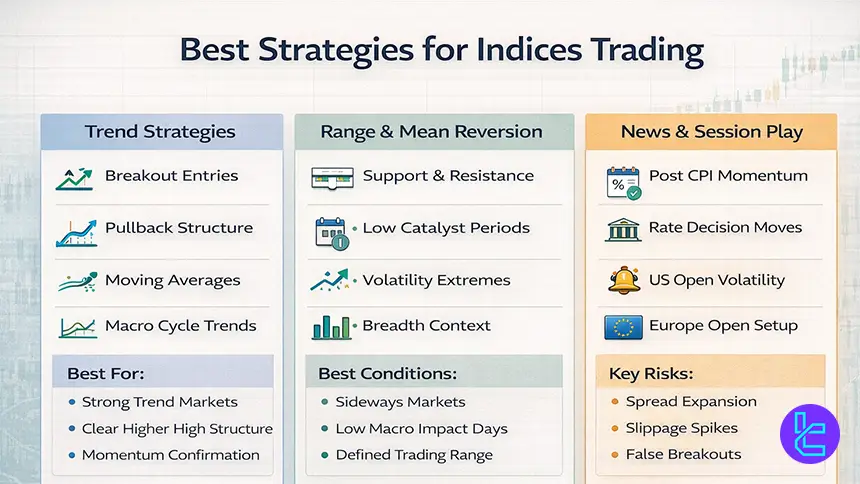
Indices respond well to structured strategies because liquidity is high and technical levels can attract large flows. Trend following works on major benchmarks during strong macro cycles, using moving averages, breakouts, and pullback entries. Range trading also appears frequently, especially when markets wait for central bank decisions, creating clear support and resistance zones.
News aware trading strategies are essential because indices reprice rapidly on CPI, jobs, and rate expectations. Many traders avoid entries minutes before high impact events or reduce size, then trade post release momentum once spreads normalize. Trading session based approaches can focus on US open volatility for US indices or European open for DAX and FTSE.
Risk management is the edge that makes index strategies durable. Define invalidation levels, use stop orders, and size positions based on volatility. Consider hedging via correlated indices or reducing exposure across multiple indices rather than stacking the same macro bet. Traders should backtest and forward test in a demo to confirm slippage and rollover behavior.
- Trend following using breakouts, pullbacks, and moving average structure on major benchmarks
- Range trading around defined support resistance during low catalyst periods and consolidation
- Post news momentum after CPI or rate decisions once spreads normalize and liquidity returns
- Session playbooks focusing on Europe open and US open for consistent volatility windows
- Mean reversion setups in stretched conditions, supported by volatility and breadth context
- Hedging and relative value by pairing indices to reduce broad market beta exposure
- Strict risk sizing based on volatility and stop distance, not on confidence in the signal
- Demo forward testing to measure real spreads, slippage, and swap impact on your strategy
Indices Trading in Comparison with Forex, Commodities, and Shares
Indices combine macro sensitivity with diversification, sitting between single stocks and currencies in behavior. They often trend during strong growth or recession phases and react sharply to interest rate shifts. Compared with forex, indices can provide clearer directional bias tied to risk on and risk off flows, while still offering high liquidity.
Parameters | Indices | Forex | Commodities | Shares |
Market Structure | Basket benchmark (many stocks), cash + derivatives | Currency pairs (relative value), spot + derivatives | Physical-linked assets, spot + futures + CFDs | Single-company equity, cash + derivatives |
Trading Hours | Near 24/5 via CFDs; exchange hours for cash/futures | 24/5 global sessions | Mostly 23/5 on futures/CFDs (exchange-dependent) | Exchange hours; limited pre/after-market (market-dependent) |
Typical Volatility | Medium–High (macro-driven, can spike on news) | Medium (can spike on central banks/data) | High (supply shocks, geopolitics, weather) | Variable; often higher single-name volatility |
Main Price Drivers | Rates, inflation, growth, earnings breadth, risk sentiment | Rate differentials, central banks, macro data, risk flows | Supply/demand, inventories, geopolitics, seasonality, USD | Earnings, guidance, valuation, sector news, M&A |
Leverage (Retail, Tier-1 Reg.) | Often capped around 1:20 on index CFDs | Often up to 1:30 on major FX pairs | Often around 1:10 (varies by commodity) | Often around 1:5 on share CFDs |
Safe-Haven Status | Not a safe haven; “risk-on/risk-off” proxy | Some pairs act as safe havens (USD/JPY/CHF) | Gold is classic safe haven; oil is not | Not a safe haven; defensive sectors may help |
Dividend / Yield | No direct dividend ownership (except ETFs/funds) | No dividends; possible carry/rollover (swap) | No dividends; roll yield/storage effects | Yes (cash dividends on shares; ETF yields) |
Correlation Profile | Correlates with global risk sentiment; cross-index correlations often high in crises | FX correlations shift by regime; majors often tied to USD cycles | Mixed; can correlate with inflation and USD (inverse) | Correlates with sector and market; higher idiosyncratic risk |
Short-Selling Access | Easy via CFDs/futures/options | Easy (sell the pair) | Easy via futures/CFDs | Easy via CFDs/options; harder in cash without margin/borrow |
Gap Risk Exposure | Moderate; higher around major news/opens | Usually lower (24/5), but gaps can occur after weekends | Moderate–High; weekend gaps and shock moves possible | High; earnings and overnight headlines can gap hard |
Conclusion and Final Words
Stock indices such as US500, NAS100, FTSE 100, and DAX 40 remain core benchmarks for traders who want diversified exposure without relying on single stock risk. The strongest indices brokers combine Tier 1 oversight, segregated client funds, and negative balance protection, while keeping spreads competitive and execution stable during high-impact sessions.
Across the shortlist, platform depth is the key differentiator. Brokers offering MT4, MT5, cTrader, and TradingView give traders flexibility for scalping, hedging, and automation, while clear margin call and stop out mechanics support risk control on leveraged index CFDs.
TradingFinder Forex Methodology is used to assess indices brokers through a structured scoring framework that reviews regulation tier and entity scope, platform quality, trading fees and spread consistency, non-trading costs, execution reliability, market access, and reputation signals.